Textile Documents › Topic: Mill spinning
603 documents found
Sort: 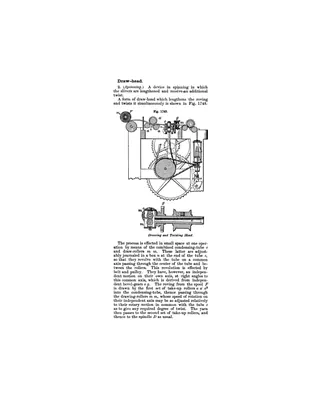
Draw Head
Article · 1 page
A short dictionary entry on the draw-head, a spinning device that lengthens slivers and adds twist. It describes a combined drawing and twisting head (Fig. 1748), in which a rotating condensing tube and draw-rollers lengthen and twist the roving in one operation. The figure shows the roving spool, take-up rollers, bevel gears and drive belt.
Textile Machinery
Engineering Weekly, July 20, 1900
Article · 1 page
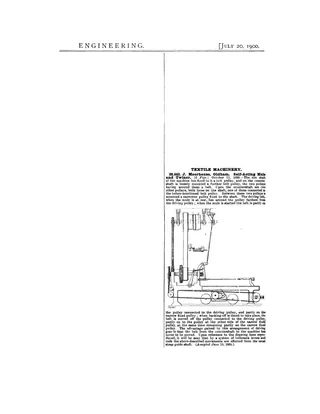
A one-page patent abstract from a July 1900 engineering periodical describing J. Moorhouse's patent no. 20,442 for a self-acting mule and twiner. It explains a belt-pulley driving arrangement on the countershaft in which the belt to the machine never has to be moved, operated by bellcrank levers and rods from the strap guide shaft. A side elevation drawing accompanies the text.
Textile Machinery
Engineering Weekly, August 31, 1900
Article · 1 page
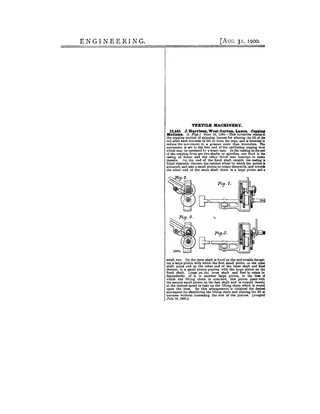
A one-page patent abstract from Engineering, 31 August 1900, describing J. Harrison's improved copping motion for spinning frames (patent no. 13,443, dated June 28, 1899, accepted July 18, 1900). It explains a gear train of fixed and loose shafts with large and small pinions and a ratchet wheel that shortens the lifting chain and reduces the lift of the rail after each traverse, without enlarging the pinions. Four mechanical drawings illustrate the gearing.
Textile Machinery
Engineering Weekly, December 7, 1900
Article · 1 page
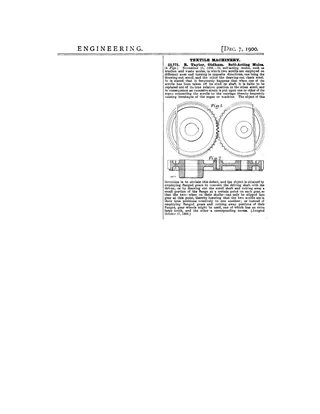
A one-page patent abstract from the journal Engineering (7 December 1900) describing R. Taylor's patent no. 22,771 of Oldham for self-acting mules. The invention uses flanged gears with a cut-away portion, or gears with an extra large tooth and matching recess, so the drawing-out scroll and check scroll can only be refitted in their correct relative positions. This prevents excessive strain and breakage of the ropes connecting the scrolls to the carriage. Two figures show the scroll wheels and a sectional elevation of the shafts and gearing.
Textile Machinery
Engineering Weekly, February 2, 1900
Article · 1 page
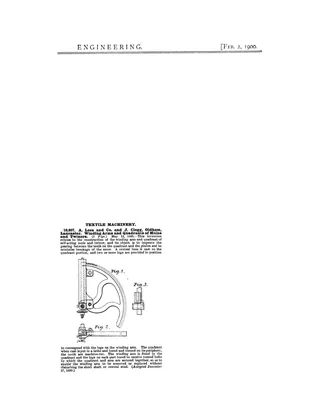
A one-page patent abstract from the journal Engineering describing British patent 10,097 (A. Lees and Co. and J. Clegg, Oldham) for an improved winding arm and toothed quadrant for self-acting mules and twiners. It explains how the quadrant is cast with a central boss and lugs, bored, turned and machine-cut, then bolted to the winding arm so the arm can be replaced without disturbing the shaft. Three engineering drawings accompany the text.
Analysis of Power Distribution in Cotton-Spinning Frame
Article · 11 pages
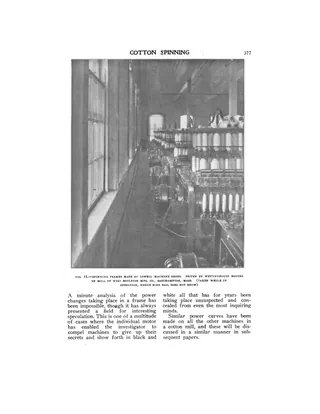
A 1909 engineering article reporting measurements of the power drawn by a single motor-driven ring spinning frame in a cotton mill, taken with a Westinghouse graphic recording wattmeter over a full working day. It explains how a ring frame works (cylinder, bands, spindles, rolls, ring rail, traveler) and interprets the power chart. The author attributes the roughly 20 percent higher load with full bobbins to air fanning at the bobbin surface rather than to bobbin weight. He attributes the small recurring peaks to yarn ballooning during the ring-rail traverse. Illustrated with photographs of the testing set and mill frames, diagrams, and power curves.
Bobbin and Fly Frame
Article · 2 pages
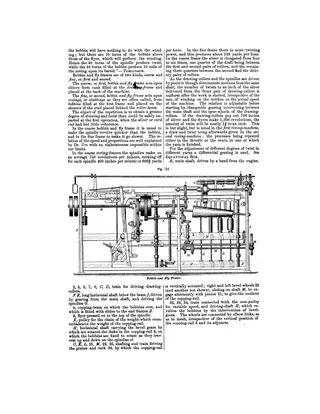
Dictionary entry from Knight's American Mechanical Dictionary describing the bobbin and fly frame, the roving machine of cotton manufacture that draws and twists sliver and winds the roving onto bobbins. It explains the flyer, spindle and bobbin motions, the cone-pulley speed compensation, the copping-rail traverse, and the difference between coarse (first) and fine (second) frames, with a quotation from Tomlinson and twist and speed figures. An engraved cross-section (Fig. 751) is keyed with lettered and numbered parts.
Combined Drafting Spinning Frame
The Melliand, September 1931
Article · 1 page
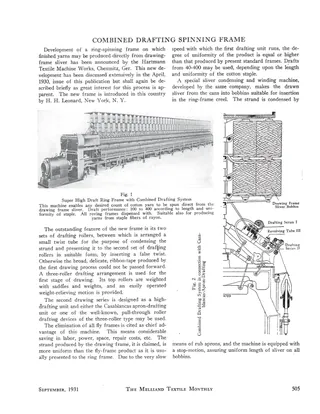
A short trade article from 1931 describing a ring-spinning frame from the Hartmann Textile Machine Works of Chemnitz, Germany, that spins finished cotton yarn directly from drawing-frame sliver without fly frames. It explains the two sets of drafting rollers with an intermediate false-twist tube, the Casablancas apron drafting option, draft ranges of 40 to 400, and a companion sliver condensing and winding machine. It includes a photograph of the machine and a diagram of the drafting system.
Cotton Spinning, Part 1
Article · 4 pages
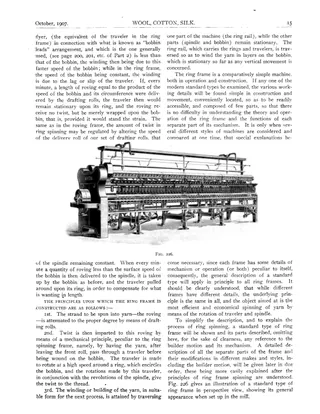
First installment of a serial on cotton spinning from Posselt's Textile Journal, October 1907. It opens with a detailed outline of the planned ring spinning chapters, then introduces the ring frame: how it compares with the mule, the principles of drafting, twisting and winding, and a part-by-part description of a standard frame using Figs. 226 and 227. The parts covered include the creel, drafting rolls, thread board, ring rail, traveler, spindle and tin cylinder.
Cotton Spinning, Part 2
Article · 4 pages
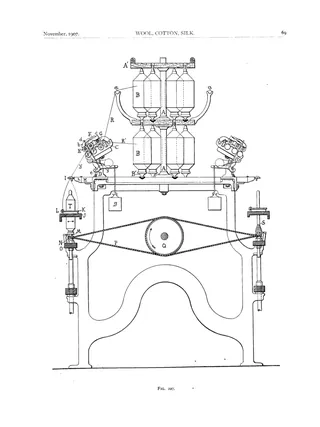
Installment of E. A. Posselt's serial on cotton spinning from Posselt's Textile Journal, November 1907, continuing the section on the ring frame. It covers how spindles, rings and travelers work together to twist and wind yarn, the difference between warp and filling bobbin builds, the tin cylinder drive, and the creel with its skewers, steps and traveler cups. Illustrated with Figs. 227-229, including a sectional drawing of the frame and a plan of a creel. The page opens with an outline of the topics planned for the full ring spinning chapter.
Cotton Spinning, Part 3
Article · 3 pages
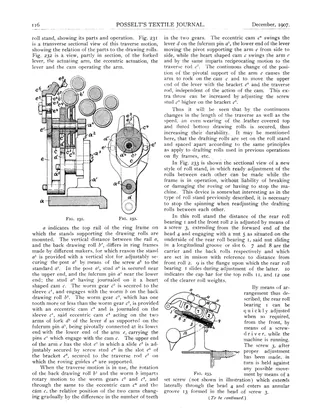
Installment of E. A. Posselt's serial on cotton spinning, from the December 1907 issue of Posselt's Textile Journal, covering the roll stands of the ring frame. It describes the parts of the drafting roll stand, top and bottom rolls, cap bars, lever weighting, the scavenger roll and the traverse guide rod. It also describes the Whitin Machine Works traverse motion and a roll stand adjustable while the frame is running. The opening page lists the contents of the whole series on ring spinning, faulty yarns and calculations.
Current Topics (Spinning Machinery)
Cassier's Magazine, 1908
Article · 2 pages
A short 1908 magazine piece praising Richard Roberts's self-acting mule spinning frame as the culmination of early cotton machinery invention. It explains how the mule draws, twists, backs off and winds yarn onto the cop as the carriage moves out and in, and describes the complex headstock mechanism. It also compares Roberts's machine with the earlier mules of Crompton and the spinning frame of Arkwright, and notes Roberts's 1832 patent and the machine's rapid adoption.
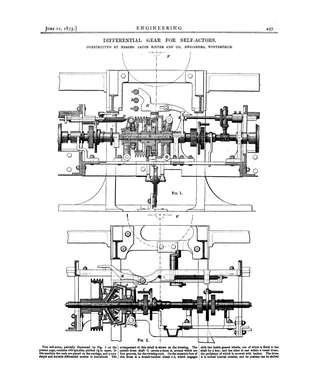
Differential Gear for Self-Actors
Engineering Weekly, June 11, 1875
Article · 2 pages
A two-page 1875 article from the journal Engineering describing differential gear mechanisms on self-acting spinning mules built by Jacob Rieter and Co. of Winterthur. It covers a 468-spindle self-actor with a differential motion on the spindle drum shaft, and a 504-spindle self-actor for fine yarns built on the Parr-Curtis system. The text explains the drums, cones, levers and catches, and gives a gear-ratio calculation, with two cross-section drawings.
Drawframe Draft
Article · 7 pages
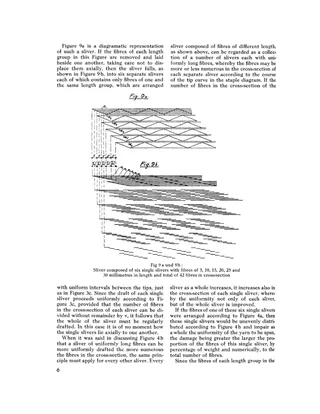
A 1929 technical article by H. Weissbach on drafting in the drawframe, the machine that draws out slivers of fibre in spinning preparation. It uses an idealised drawframe and geometric diagrams to show how the distances between fibre tips grow by the draft factor. It examines three cases: uniform fibres with evenly spaced tips, uneven tip distribution, and mixed fibre lengths. It concludes that combining several single slivers offset against one another gives a more uniform yarn, and works through calculated proportional figures for fibre counts in cross-sections.
[Electrical Carriers]
China Pictorial, 1975
Illustration · 1 page
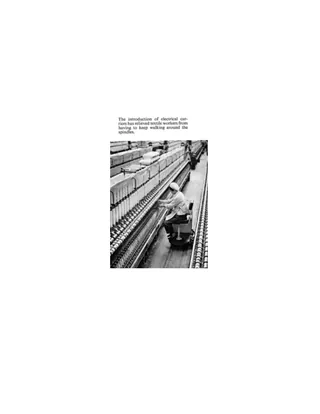
A single-page black-and-white photograph from China Pictorial, 1975, showing the interior of a Chinese spinning mill. A worker rides a small electric carrier vehicle along long frames of spindles with bobbins and roving. The caption says the electrical carriers spare textile workers from walking around the spindles.
Filer [Spin]
Article · 1 page · French
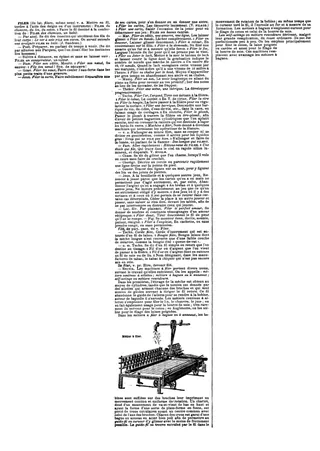
A one-page dictionary entry on the French verb "filer" from the Nouveau Larousse Illustré. It lists the verb's many senses, from spinning fibers into thread to figurative, nautical, musical, gaming and technical uses. The encyclopedic section describes three types of spinning machines: continuous flyer frames, ring frames, and self-acting mules. An engraving of a spinning machine (métier à filer) accompanies the entry.
French Worsted Drawing
Article · 1 page
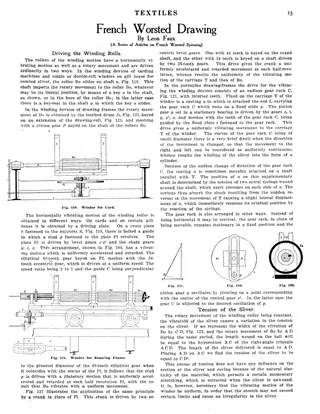
One page from a series on French worsted spinning by Leon Faux, covering how the winding rolls of carding machines, gill boxes and drawing frames are driven. It explains the horizontal vibrating motion of the winder using driving plates, elliptical and eccentric gears, cranks and gear racks, and discusses the resulting tension on the sliver. Illustrated with mechanical figures of winders and a tension diagram.
French Worsted Drawing, Part 1
Article · 1 page
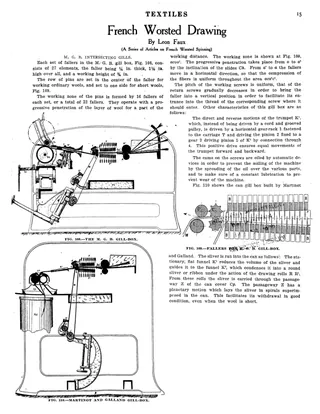
A one-page installment from a series on French worsted spinning by Leon Faux, describing the M. G. B. intersecting gill box used in worsted drawing. It covers the fallers' dimensions, pin placement, working zone, screw pitch, trumpet drive and automatic oiling, and also the Martinot and Galland can gill box that lays sliver in spirals in the can. Three technical diagrams (Figs. 108-110) illustrate the machines.
French Worsted Spinning
Article · 1 page
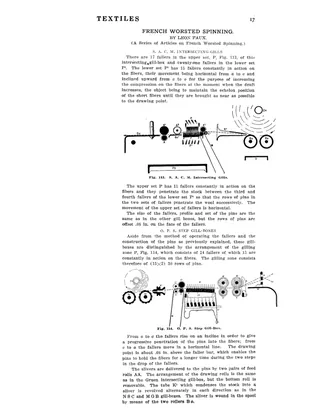
A single-page installment from Leon Faux's series on French worsted spinning, describing two types of gill-box used to prepare wool for drawing. It covers the S.A.C.M. intersecting gills, with their upper and lower sets of fallers, and the O.P.S. step gill-box, including faller counts, pin arrangement, drawing point, and sliver delivery. Two line diagrams (Figs. 113 and 114) illustrate the machinery.
Hartmann Differential Wool Spinning Mule
The Melliand, May 1931
Article · 1 page
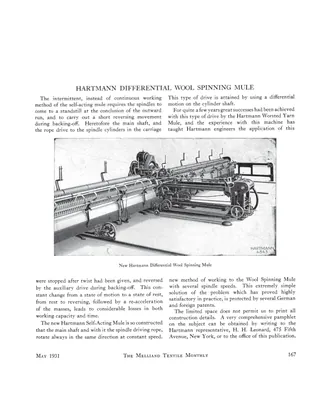
A one-page trade notice from The Melliand describing the new Hartmann Differential Wool Spinning Mule, a self-acting mule. The main shaft and spindle driving rope turn constantly in one direction at constant speed, with a differential motion on the cylinder shaft. This avoids the losses of time and capacity from stopping and reversing the spindles during backing-off. It includes a photograph of the machine, a mention of German and foreign patents, and an address for obtaining a pamphlet from the Hartmann representative in New York.
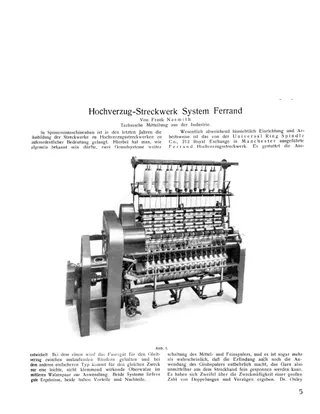
Hochverzug-Streckwerk System Ferrand [High-Draft Drafting System, Ferrand System]
Article · 2 pages · German
A short German-language technical report from 1927 on the Ferrand high-draft drafting system for spinning machinery, made by the Universal Ring Spindle Co. of Manchester. It explains how three vertically arranged roller pairs let the roving go straight into the ring frame's drafting unit, which removes the intermediate and fine roving frames. It covers claimed savings in labor, power and waste, and use with cotton, wool, asbestos and cotton-wool blends. Photographs and a line drawing illustrate the machine.
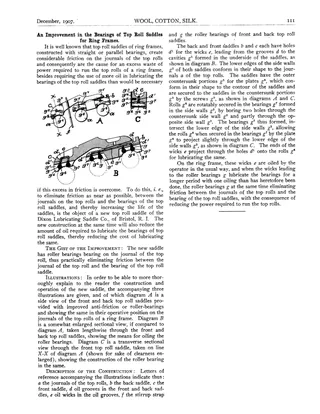
An Improvement in the Bearings of Top Roll Saddles for Ring Frames
Article · 1 page
A short 1907 trade article describing a new top roll saddle for ring spinning frames from the Dixon Lubricating Saddle Co. of Bristol, R. I. The saddle uses small roller bearings on the top roll journals to reduce friction, power consumption and oil use. The text explains three diagrams (side view, lengthwise section, transverse section) and labels the parts: journals, saddles, oil grooves, wicks, stirrup strap and roller bearings.
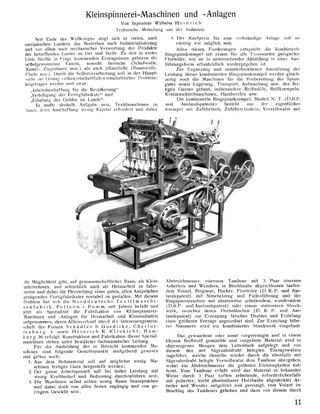
Kleinspinnerei-Maschinen und -Anlagen [Small Spinning Machines and Plants]
Article · 2 pages · German
A 1927 technical report by engineer Wilhelm Heinrich on small-scale spinning machinery and plant layouts for cottage industry, cooperatives and small enterprises. It describes the combined ring-spinning carding machine (Model N.T.) made by the Norddeutsche Textilmaschinenfabrik of Pollnow, covering its carding, web-dividing, drafting and ring-spinning stages, plus output figures, drive options and a larger version. One illustration shows the machine.
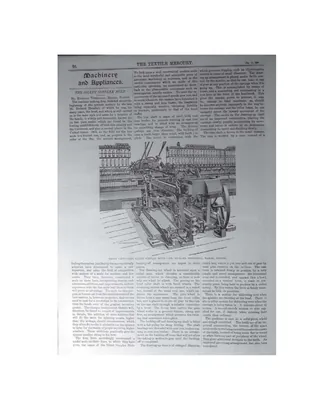
Machinery and Appliances
Textile Mercury, 1890
Article · 2 pages
Two pages from The Textile Mercury (January 1890) describing the Silent Simplex spinning mule made by Richard Threlfall of Bolton, for medium and low counts with some motions for finer counts. The article covers the frame, headstock, drawing-up and backing-off gear, cam shaft, quadrant and safety features, and includes front and back view engravings. The second page also starts a Foreign Correspondence column on wool and textile trade conditions in Antwerp, Berlin, Chemnitz, Fourmies and Lyons, with French silk import and export tables for 1881-1889.
Mule
Article · 1 page
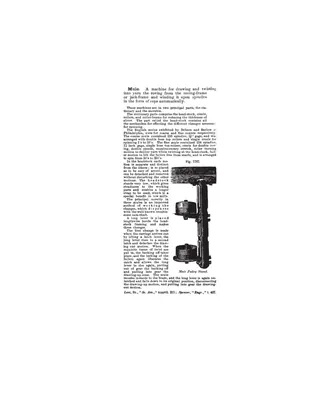
A one-page dictionary entry defining the spinning mule, a machine that draws and twists roving into yarn and winds it onto spindles as cops. It describes the stationary and movable parts and the English mules by Dobson and Barlow shown at Philadelphia, with their spindle counts, gauges and yarn counts. It also explains an improved headstock mechanism that replaces the cam-shaft with a long lever making three changes. An engraving of a mule pulley stand (Fig. 1787) accompanies the text.
A Rapid Method of Doffing or Changing Bobbins on Spinning or Doubling Frames
Article · 4 pages
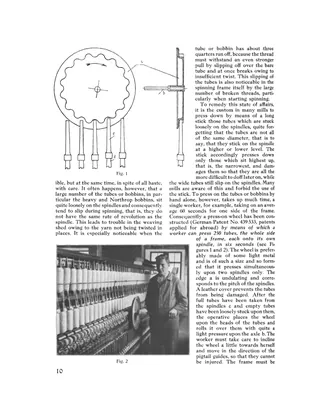
A 1929 article by engineer E. Toenniessen describing two devices for speeding up doffing (changing full bobbins or tubes) on cotton spinning and doubling frames: a press-on wheel that seats empty tubes on all spindles of a frame side in seconds, and a press-off fork carriage that lifts 20 to 25 tubes at once. It explains the problems of loose tubes slipping, the drawbacks of pressing them by stick or by hand, and the time savings found in mill trials. Two line drawings and two photographs illustrate the devices, and a recommended doffing procedure is given.
Self-Acting Woolen Mule
Engineering Weekly, January 1, 1875
Article · 3 pages
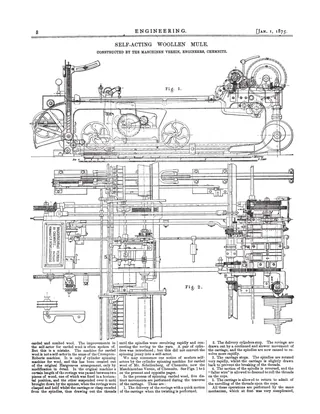
An 1875 article from Engineering describing a self-acting mule for spinning carded wool, built by the Maschinenbau Verein of Chemnitz to Mr. Schellenberg's design. It briefly places the machine against Hargreaves's jenny and the Crompton-Roberts self-actor, then lists the five movements of the carriage during spinning. It goes on to explain the mechanism: eccentrics, levers, snails, brakes and the winding motion for cops. The article closes with gear ratios, pulley sizes and speeds, and is marked to be continued. Three pages with engineering drawings (Figs. 1-5).
Self-Acting Woollen Mule
Engineering Weekly, January 29, 1875
Article · 3 pages
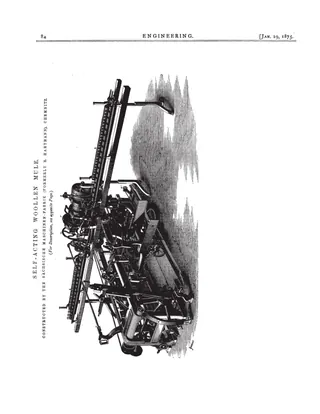
Three pages from the British journal Engineering (29 January 1875) on a self-acting woollen mule, a spinning machine built by the Sächsische Maschinen-Fabrik (formerly R. Hartmann) of Chemnitz. Two pages are full-page engraved perspective views of the machine. The text is part of Dr. H. Grothe's series 'Self-Actors'. It describes the machine's three spindle speeds, the counter, backing-off regulation, supplementary twisting and carriage return mechanisms, and gives machine dimensions and spindle counts.
Stereo view
Ephemera · 1 page
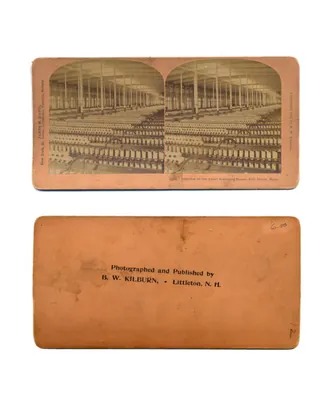
A sepia stereograph card showing the interior of a large cotton spinning room in Fall River, Massachusetts, with rows of spinning frames, bobbins, overhead shafting and tall columns. The card was photographed and published by B. W. Kilburn of Littleton, New Hampshire, and distributed by James M. Davis. It is a visual record of industrial textile spinning in a New England mill.
Textile Machinery
Engineering Weekly, January 26, 1900
Article · 1 page
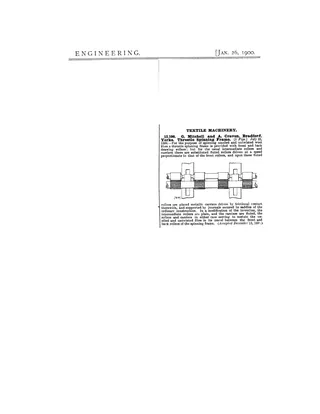
A single-page patent abstract from the 'Textile Machinery' column of the journal Engineering, January 26, 1900. It describes patent 15,100 of G. Mitchell and A. Craven of Bradford, Yorkshire, for a throstle spinning frame for unoiled, untwisted wool fibre. Fluted rollers with metallic carriers replace the usual intermediate rollers and carriers, and a variant uses plain rollers with fluted carriers. A line drawing shows the roller assembly.
Textile Machinery
Engineering Weekly, June 29, 1900
Article · 1 page
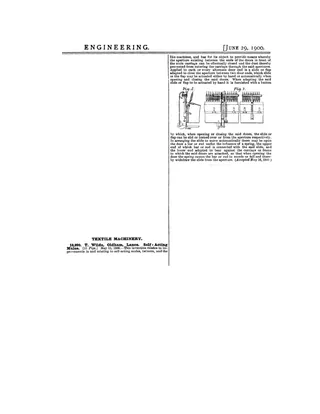
A single page from the weekly 'Engineering' (June 29, 1900) summarizing a British patent abstract for textile machinery. It describes a slide or flap, operated by hand or automatically by a spring-loaded rod, that closes the gaps between door ends in front of a self-acting mule carriage to keep dust out. Two line drawings show the door slide mechanism; the following patent entry, No. 10,099 by T. Wilde of Oldham on self-acting mules, begins at the foot of the page.
Ueber die Fehler in Lunten und Vorgarn und ihre Ermittlung [On the Faults in Slubbing and Roving and Their Detection]
Article · 2 pages · German
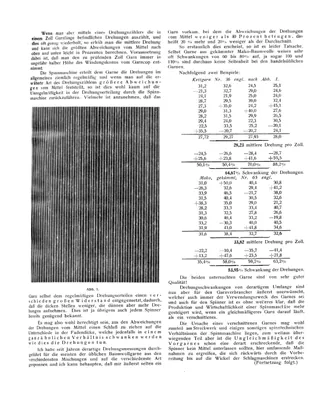
German-language article from 1927 by engineer Paul Laetsch on irregularities (thick and thin places) in cotton roving and yarn and how to detect them. It proposes counting twists per inch with a twist counter as a practical way to infer variation in yarn thickness, and gives two worked examples (a No. 36 warp yarn and a combed Mako cotton No. 65) showing twist variations of about 54 to 65 percent. The text breaks off with "to be continued"; the figure is a black-board winding of yarn used for visual inspection.
Vertical Spindle-Step
Article · 1 page
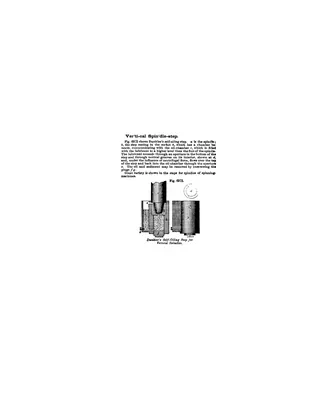
A short dictionary entry describing Dunklee's self-oiling step for vertical spindles, as used in spinning machines. It explains how oil rises through an aperture and interior grooves in the step, flows over the top under centrifugal force, and returns to the oil chamber. A single figure (Fig. 6978) shows cross-section and exterior views with lettered parts.
Woolen Spinning
Monograph · 92 pages
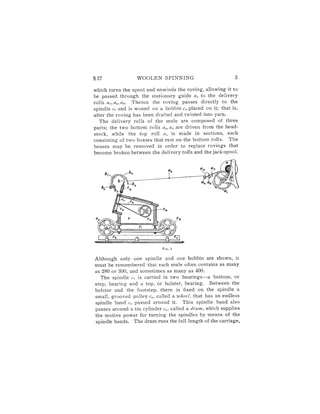
An International Correspondence Schools-style instruction paper (Section 37) on spinning woolen yarn on the self-acting mule. It begins with the history of spinning and the quality of roving, then describes the mule's headstock and carriage and each of its mechanisms in detail: delivery rolls and roving stop-motion, draft scroll and dwell motion, rim band and accelerated speed, easing-up, backing-off, drawing-in, quadrant, and builder motion. It closes with the sequence of operation, bobbin clips, spindle bands, waste, power requirements and review questions. Illustrated with many numbered mechanical line drawings.
Advertising postcard
Ephemera · 1 page
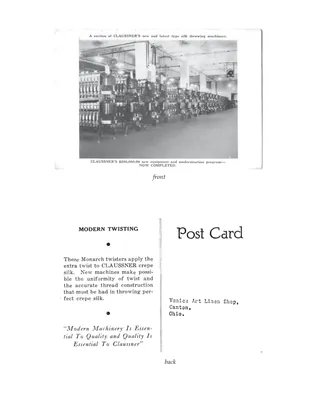
An advertising postcard from Claussner, a silk thrower, showing a section of its new silk throwing machinery. The caption announces a $250,000 equipment and modernization program and describes Monarch twisters that add the extra twist to crepe silk. The back is addressed to the Venice Art Linen Shop in Canton, Ohio.
Can-Roving Machine
Article · 1 page
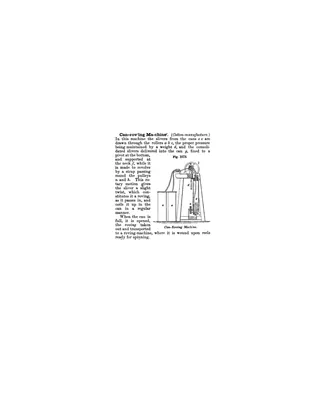
A short encyclopedia entry from Knight's American Mechanical Dictionary describing a can-roving machine used in cotton manufacture. Slivers from cans are drawn through rollers under a weighted pressure and delivered into a rotating can, where a slight twist turns them into roving. The entry includes one line drawing (Fig. 1073) with lettered parts.
Cotton Machinery
Article · 8 pages
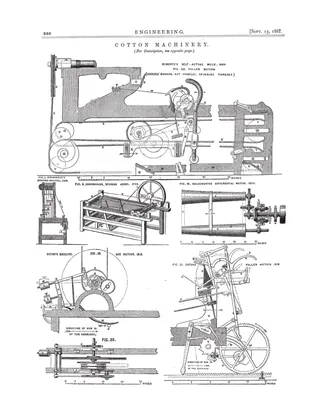
Reprint of John Platt's paper on machinery for preparing and spinning cotton, published in the journal Engineering in September 1867. It traces the development of mechanical spinning from Lewis Paul and Arkwright through Hargreaves' jenny and Crompton's mule to Roberts' self-acting mule. It also covers preparation machinery such as openers, scutchers, carding engines, drawing frames and roving frames. Half the pages are engineering plates of the machines.
Cotton Machinery Sketches
Book · 218 pages
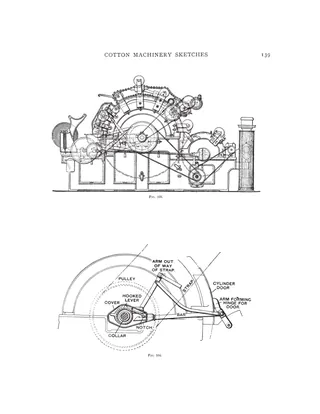
A book of line drawings and sketches of cotton spinning machinery by William Scott Taggart, issued as a companion to his book on cotton mill management. It illustrates equipment from bale breakers, mixing, scutchers, openers and carding engines through draw frames, slubbers, intermediates and rovers, to ring frames, spinning mules, winding frames and hank polishing machines. Figures include gearing plans, sections and elevations, and mill floor plans for card rooms and spinning rooms, with some maker illustrations (Dobson & Barlow, Joseph Stubbs, Platt Brothers, Howard & Bullough). The book has prefaces, notes to the second and third editions, and a list of figures; it has no weaving drafts.
Cotton Spinning
Article · 1 page
A short dictionary entry describing the Clement process for spinning cotton directly from seed cotton. It describes a combined gin and card that makes slivers from seed cotton, covering the 36-inch top-flat self-stripping card, the small gin attachment with 7-inch saws, the brush, combing plates, and the drawing and calender rollers. It cites contemporary journal references from 1879.
Cotton-Spinning Industry in Japan
Engineering Weekly, November 3, 1899
Article · 1 page
A one-page 1899 trade article reporting on the recovery of Japan's cotton-spinning industry after the 1898 depression. It covers government loans, Osaka labor competition, export of yarn to China, sources of imported raw cotton (British India, United States, China, Egypt), a new import duty, and the Union Cotton Spinners' decisions on curtailing production.
Difficulties in the Cotton-Spinning Industry in Japan
Engineering Weekly, August 19, 1898
Article · 1 page
A short 1898 newspaper article on the over-expansion and financial troubles of Japan's cotton-spinning industry. It reports 65 mills with 773,738 spindles, a surplus of unsold yarn, and competition from Chinese mills after the Shimonoseki Treaty. It also covers the Industrial Bank of Japan's inquiries into mill costs, depreciation and dividend practices, and the conditions it set for loans.
Electric Driving for Mule Spinning
Article · 9 pages
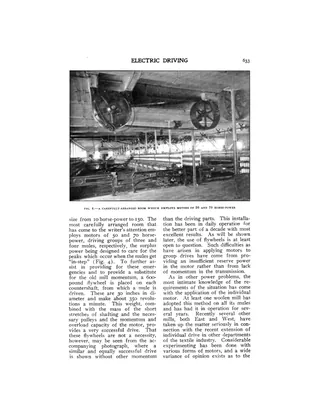
Article by Albert Walton in Cassier's Magazine (1911) on driving self-acting spinning mules with electric motors. It explains the mule's cycle (run-out, twisting, back-turns, run-in) and the sharp power peak when the spindles accelerate. It then compares group drive, individual motors with a 250-pound flywheel, and flywheel-free motors with looser speed regulation, including a side-by-side demonstration on worsted mules and power curves. Walton favors a constant-speed standard motor driving the existing countershaft.
The Fall River List of Prices for Mule Spinning
1889
Other · 20 pages
Wage price list for mule spinners in the Fall River, Massachusetts cotton mills, agreed between the Manufacturers' Board of Trade and the Mule Spinners' Association effective January 1, 1889. Most pages are tables giving piece rates for weft yarn by number of spindles (about 350 to 1000) and yarn count (18s to 50s), followed by a shorter warp table for yarns 22s to 37s. Introductory notes explain how fractional yarn numbers are rounded, the extra 5 percent for spinning weft on warp mules, and the deduction of back boys' wages from spinners' earnings. A handwritten note on one page records a 10 percent increase made Dec. 11, 1899.
Frame v. Mule Spinning in the Woollen and Worsted Industries
Article · 14 pages
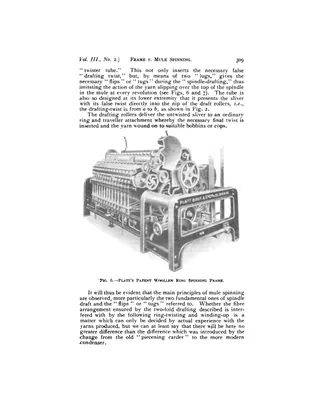
A 1912 paper by Prof. Aldred F. Barker comparing frame (ring) spinning with mule spinning of woollen yarns, with a brief note on worsted drafting. It explains the principles of woollen mule spinning (spindle draft, drafting twist, the old piecening carder versus the modern condenser) and describes Platt Bros.' patent woollen ring spinning frame with its twister tube. It gives cost, space and power comparisons and strength and elongation tests of yarns and cloths from three blends, with photomicrographs and drafting-roller diagrams, and ends with the discussion by Institute members.
French Worsted Drawing, Part 2
Article · 1 page
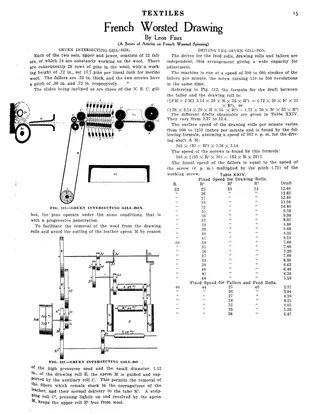
A single page from Leon Faux's series on French worsted spinning, describing the Gruen intersecting gill-box used in worsted drawing. It covers the fallers, pin rows and screw pitch for merino wool, the leather apron and drawing roll arrangement, and the independent drives. It gives formulas for draft and roll and screw speeds, with Table XXIV listing gear combinations and resulting drafts from about 3.4 to 13.4. Two schematic figures (Figs. 111 and 112) show the machine and its gearing.
Machinery and Appliances
Textile Mercury, 1890
Article · 1 page
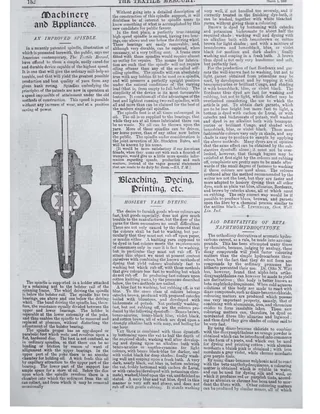
A single page from The Textile Mercury containing three short items. The first describes a newly patented high-speed spinning spindle (the Stockton Bates spindle) with two bearings, an oil chamber and a removable holder, followed by an editor's skeptical comment. The second is E. Lindenger's article on dyeing cotton hosiery yarn so that colours are fast to both washing and rubbing, combining vat blue, catechu and substantive dyes. The third reports Dr. Otto N. Witt's azo derivatives of beta-naphthohydroquinone, which form lakes with metal mordants.
Machinery and Appliances
Textile Mercury, May 3, 1890
Article · 2 pages
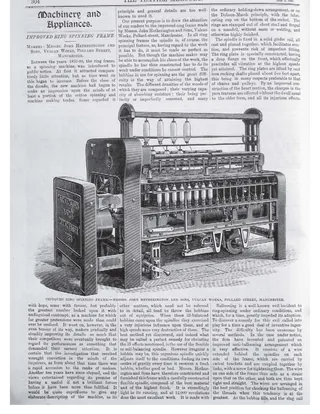
Two pages from The Textile Mercury, May 1890, describing an improved ring spinning frame by John Hetherington and Sons of Manchester. The article covers the flexible self-balancing spindle, steel rings, an anti-ballooning wire device, thread boards, front roller positions, creels and a quick doffing arrangement. The second page also has a section on bleaching and dyeing, with two new Clayton Aniline Company dyes (aurotine and Clayton Cloth Red), dyers' recipes for wool and silk, and a note on aniline dye imports into Japan.
Machinery for Treating Silk Waste, Part 2
Engineering Weekly, August 7, 1874
Article · 4 pages
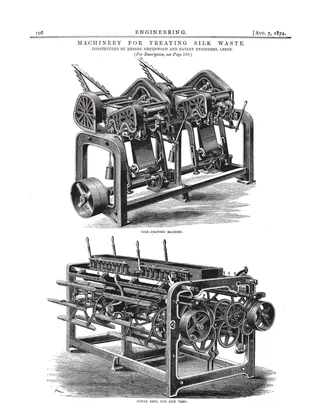
Concluding part of an 1874 Engineering article on machinery for spinning silk waste, built by Greenwood and Batley of Leeds. The text describes the later stages: drawing, roving with a screw gill and flyer, spinning, doubling or twisting, and reeling into hanks. Engraved plates show the spinning frame, screw gill roving frame, silk-drawing machine and power reel. It closes with the uses of waste-silk yarn in weft, ribbons, velvet, satin and sewing threads.
The Manufacture of Worsted Yarns (Parts I and II)
H. Beevers · c. 1960-1969
Article · 13 pages
Two-part technical article on how worsted yarn is made, written by H. Beevers of Keighley Technical College. Part I follows top sliver through the drawing sets (Open, Cone, Porcupine, New Bradford and New Continental) to final roving, with machine diagrams and tables of doublings, drafts and sliver weights. Part II covers spinning roving into yarn on flyer, cap, ring and mule frames, drafting systems including high-draft and the Ambler Super Drafter, and plying of folded yarns.
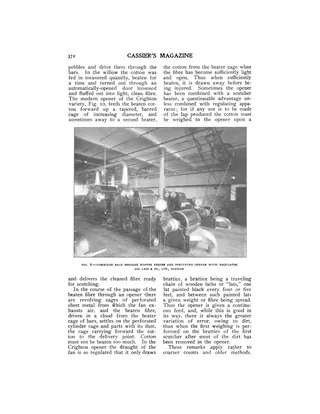
Modern Cotton Spinning Factory, Part I
Article · 21 pages
Part I of an illustrated 1909 Cassier's Magazine article on the layout and machinery of a modern Lancashire cotton spinning mill. It covers the history of spinning, cotton staple types (Sea Island, Egyptian, American, Indian), and the case for Lancashire and Oldham as the centre of the industry. Most of the article describes the blowing room: bale breakers, hopper feeders, openers, scutchers and lap machines, and feed regulators, with illustrations from Asa Lees, Dobson & Barlow, and Howard & Bullough. It ends with mill dimensions, spindle counts for fine and coarse mills, and the card room arrangement.
603 documents found