Textile Documents › Topic: Lace history and other laces
700 documents found
Sort: 
Letterhead
Ephemera · 1 page
A single-page letterhead of the National Old Lacers, an organization for people who collect, make, use and love lace. It shows the group's circular logo with a stylized bobbin or lace motif beside the organization name in script, followed by its tagline. No other text or body content is present.

Patterned glassine dust jacket
Needle and Bobbin Club, 1959
Ephemera · 1 page
A single-page scan of a patterned glassine dust jacket associated with the Needle and Bobbin Club. The page shows an embossed or patterned background with a repeating motif of stylized lace or cobweb-like radiating designs. No legible text is present.
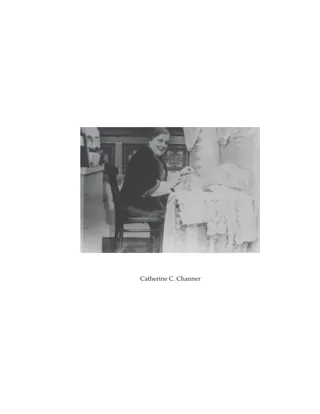
Catherine C. Channer, Lacemaker
Illustration · 1 page
A single black-and-white photograph of Catherine C. Channer, a lacemaker, shown seated at a table draped with lace while working on lace with her hands. The only printed text is her name. It serves as a portrait record of a lace maker at work.
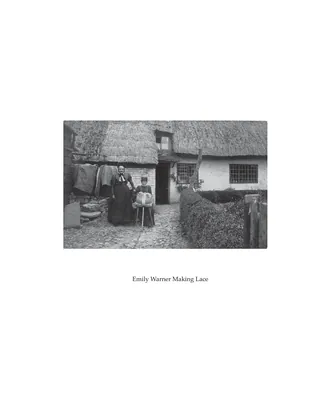
Emily Warner Making Lace
Illustration · 1 page
A single-page black-and-white photograph captioned "Emily Warner Making Lace." It shows two women in long dark dresses standing outdoors in front of a thatched cottage with a white-washed wall, leaded windows, and a cobbled yard. The only text is the caption, and the image appears to document lacemaking in a rural setting.
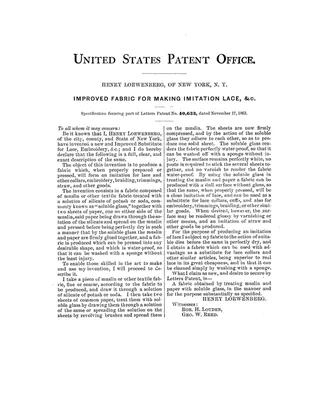
Improved Fabric for Making Imitation Lace, US Patent No. 40633
Patent · 1 page
US patent specification for a fabric intended as an inexpensive imitation of lace, embroidery, braiding and trimmings. Muslin is treated with a soluble glass (silicate of potash or soda) solution and laminated between two sheets of paper, then pressed with dies to give a lace-like pattern. The result is described as water-proof and washable with a sponge, and is proposed as a substitute for lace collars and cuffs.
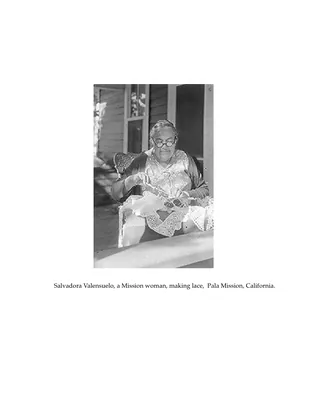
Lace Making
Illustration · 1 page
A single black-and-white photograph of an elderly woman seated on a porch, working on lace held in her lap. The caption identifies her as Salvadora Valensuelo, a Mission woman making lace at Pala Mission, California. It is useful as visual documentation of lace making by Native women at a California mission.
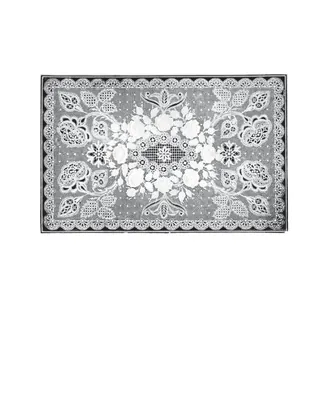
[Lace table mat or runner with rose and leaf motifs, Godey's Lady's Book, January 1842]
Godey's Lady's Book and Magazine, January 1842
Illustration · 1 page
A single-page illustration of a rectangular lace piece, probably a table runner or mat, reproduced from Godey's Lady's Book and Magazine, January 1842. It has a scalloped border, a mesh ground, roses and leaves in the center, and stylized floral and scroll motifs in the corners. The page has no readable text.
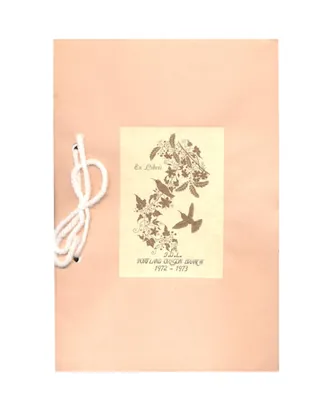
Membership brochure
Ephemera · 6 pages
Membership booklet of the Portland Oregon Branch of International Old Lacers for 1972-1973. It gives the club's by-laws (purpose, meeting schedule and place, hostess duties, dues, officers), a hostess rota for the year, and a membership roster with addresses and phone numbers for Oregon, Washington and associate members. The cover is a decorative Ex Libris I.O.L. bookplate label.
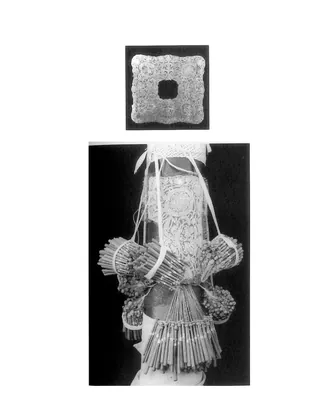
Photographs
Ephemera · 1 page
A single page bearing two black-and-white photographs of lace. The upper image shows a square lace or cutwork piece with a dark central square opening, mounted on a dark background. The lower image shows a lace-covered bodice or similar garment. No text or captions are present.
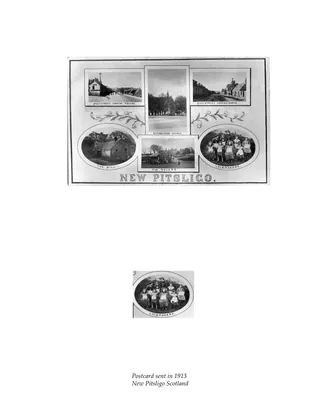
Postcard, New Pitsligo Scotland Lace Makers approx 1913
c. 1913
Ephemera · 1 page
A vintage multi-view postcard of New Pitsligo, Scotland, sent in 1913. It shows six framed photographs: High Street from the Square, the Established Church, High Street looking North, the Mill, the Square, and a group of lacemakers. The lacemakers photograph documents the local lace-making workers of the village. It contains no weaving drafts or technical instructions.
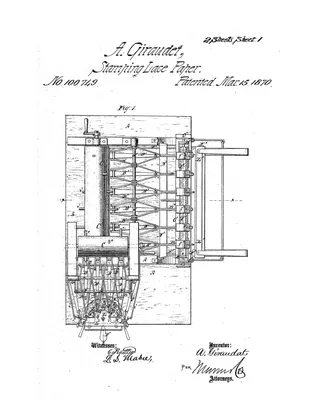
Stamping Lace Paper, US Patent No. 100749
Patent · 4 pages
US Patent No. 100,749, granted March 15, 1870, for a machine that stamps ornamental designs through lace paper (paper doilies and trimming) using hammers and dies. It describes a frame holding two machines, one for circular pieces and one for straight strips. Levers are driven by a revolving drum with arms, tensioned by adjustable springs and a treadle, and a bendable guide spring positions the hammers. The patent has two sheets of drawings (Figs. 1-5) followed by the specification and five claims.
Studio Talk (lace)
International Studio, 1919
Article · 2 pages
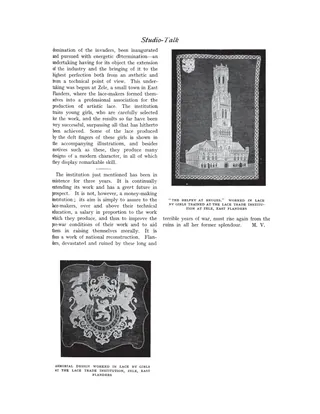
A short 1919 note from the Studio-Talk column of International Studio, datelined Ghent, on Belgian lace-making after the First World War. It describes a lace trade institution at Zele, East Flanders, founded about three years earlier under the occupation, which trains selected young girls in artistic lace and pays them wages in proportion to their output. Illustrated with lace panels of Guido Reni's Ecce Homo, the Belfry at Bruges, and an armorial design.
The Blackborne Collection of Lace
Article · 3 pages
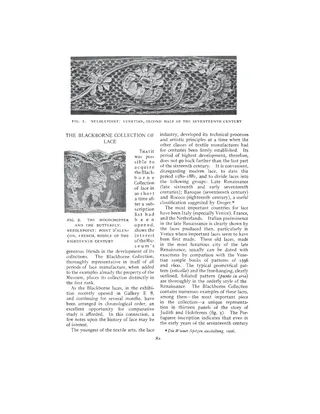
A 1909 Metropolitan Museum of Art Bulletin article announcing the museum's acquisition of the Blackborne Collection of lace and surveying the history of lace from the late sixteenth to the eighteenth century. It discusses Venetian reticella and punto in aria, Baroque and Milanese figured laces, Netherlandish, French and Flemish types, and highlights a thirteen-panel Judith and Holofernes piece. Three photographs show Venetian needlepoint, a French point d'Alençon panel, and the Judith and Holofernes panel. It closes by noting the museum's lace holdings of nearly 3,000 pieces and the countries represented.
Breton Lace
Godey's Lady's Book and Magazine, April 1890
Article · 1 page
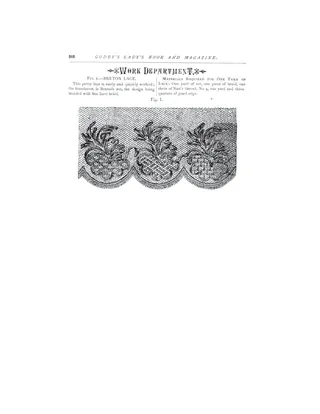
A single page from the Work Department of Godey's Lady's Book giving brief instructions for Breton lace edging. The lace is made on a Brussels net foundation with the design braided in fine lacet braid and finished with a pearl edge. A materials list for one yard is given, with one illustration of the scalloped floral edging.
Doily, US Patent No. D0081339
Patent · 2 pages
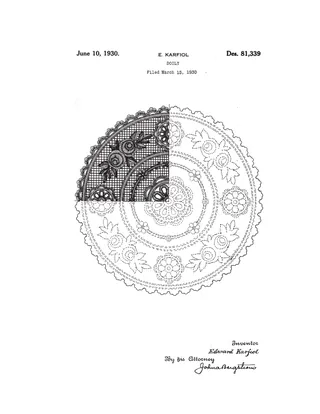
US design patent Des. 81,339 for an ornamental doily design, granted June 10, 1930 to Edward Karfiol of Brooklyn, New York. The drawing shows a round doily with a scalloped edge and an openwork design of scrolls, rosettes, flowers, and leaves in concentric bands. The text states that one quarter of the design is shown in detail and the rest repeats it, and it carries a single claim for the ornamental design.
First Words
Brian Lemin · 2010
Web Doc · 5 pages
A short web article by Brian Lemin presenting entries from the Oxford English Dictionary on the earliest recorded uses of words for lace and its tools: lace (as trimming braid and as openwork fabric), bobbin, and bone-lace. Each entry is followed by dated quotations from the 16th to 19th centuries. Lemin notes that the dictionary does not define lacemaking tool names such as bed fly, leopard, maid or candle stool.
Gold and Silver Lace, Part I
Article · 4 pages
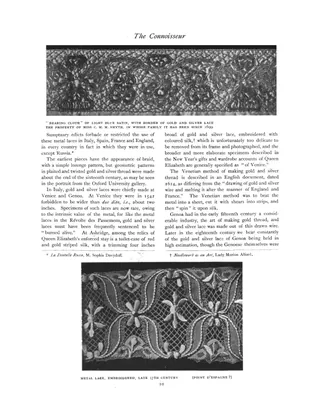
First part of an article on the history of gold and silver lace, published in The Connoisseur. It covers the fashion of 'parfilage' (unravelling gold lace for the metal), early metal-thread trimmings, sumptuary laws, and production centres in Venice, Genoa, Milan, Spain (including Point d'Espagne), Germany and Holland. Illustrations show a portrait with a gold lace ruff, a satin bearing cloth with a metal lace border, and 18th-century gold laces with réseau grounds and embroidery.

Imitation of Lace by Photography
Manufacturer and Builder, 1876
Article · 1 page
A short 1876 note from The Manufacturer and Builder describing a photographic method of imitating black lace, noticed at the last London exposition. The lace is placed in a printing frame over sensitized albumen paper and exposed for a long time, then fixed and dyed so it can be used as a negative. The result is meant to reproduce lace designs like those covering light silk parasols.
Lace-Making in the Tenements
Article · 1 page
A short periodical article describing a summer lace-making experiment at Greenwich House, a New York settlement house on the lower West Side, directed by Miss Katharine Lord. Over thirty girls and women were taught lace-making and several expert lacemakers were employed, with thread supplied and finished lace bought from the workers. It frames lace-making as home work for immigrant women, cripples and mothers, and mentions a similar program at South End House, Boston.
Modern Lace Making
Article · 1 page
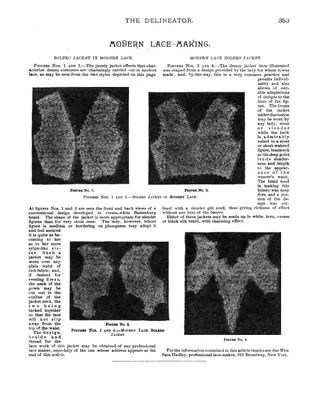
A single page from The Delineator describing two bolero jackets made in modern (Battenburg) braid lace, shown in front and back views in four figures. The text discusses how the designs suit different figures, the braids used (cream-white Battenburg, écru with gilt cord, or silk braid in white, cream or black), and how to wear the jackets over a waist or evening gown. It credits a New York professional lace-maker as the source of designs, braids and thread.
Modern Lace Making
Article · 1 page
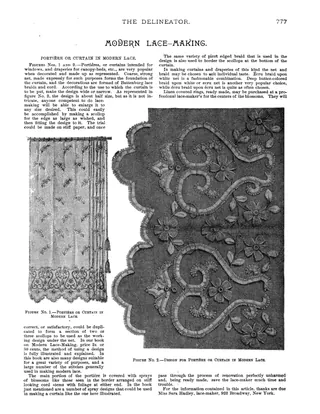
A one-page article from The Delineator on making a portière or curtain in modern (Battenberg) lace. Figure 1 shows the finished curtain and Figure 2 a half-size design. The text explains that a coarse net foundation is decorated with Battenberg braids and cord in blossom sprays, with picot-edged braid bordering the scalloped lower edge. It also suggests color combinations of braid and net, notes ready-made linen rings for blossom centers, and advertises the publisher's book on Modern Lace-Making.
Old Lace: A Handbook for Collectors
Book · 220 pages
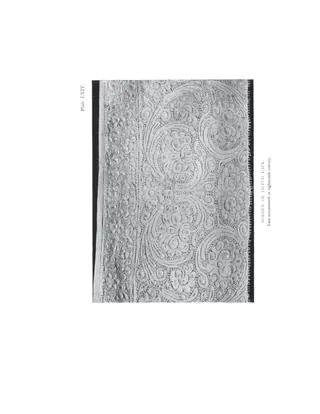
A 1908 collector's handbook on hand-made lace, covering the history, characteristics and manufacture of the main lace styles. Chapters run from lacis, cutwork (reticella) and punto in aria through Italian bobbin and needlepoint laces (Venetian, Burano, Milanese) and the Flemish, Brussels, Mechlin, Valenciennes, Dutch, Alençon, Argentan, Lille, Arras and Chantilly laces. English needlepoint, Honiton, Midland bobbin lace, Irish laces and blondes follow. The book is illustrated with many photographic plates of lace borders, lappets, collars and cravat ends, and has an index.
Punto de Aguja and Point d'Espagne. Part I
Article · 5 pages
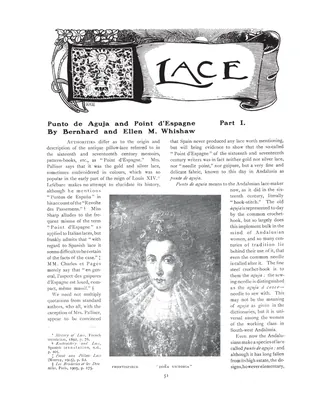
Part I of an article from The Connoisseur arguing that the 'Point d'Espagne' of sixteenth and seventeenth century writers was the fine Andalusian lace called punto de aguja (hook-stitch, worked with a crochet-like aguja on a horquilla fork), not gold lace, needle point or guipure. The authors cite Spanish edicts from 1534 to 1623, Moorish influence and pattern-books. They present evidence from two portraits of Andalusian ladies ('Doña Victoria') whose ruffs show the lace, including Arabic-letter motifs, and discuss later Philippine and Sevillian examples. Illustrated with photographs of portraits and lace details.
A Rationale for the Design of Contemporary Lace
Article · 2 pages
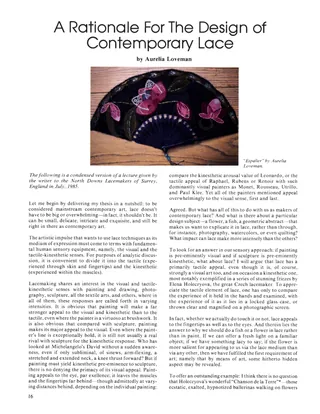
A condensed version of a 1985 lecture to the North Downs Lacemakers of Surrey, England, in which Aurelia Loveman argues that contemporary lace need not be large to count as mainstream art. She holds that lace appeals chiefly to the tactile sense, which favors small, intricate work rich in texture over the "think big" approach. She also discusses color and iridescence, especially in needle lace, using her needle lace fan "Espalier" as an example. The article ends with a short author biography and a note on the International Old Lacers.
Real Lace -- A Hint to Collectors
The Connoisseur, 1905
Article · 1 page
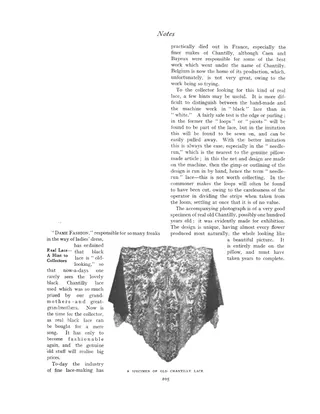
A short note from The Connoisseur advising collectors on buying real black lace, especially Chantilly. It explains how to tell hand-made pillow lace from machine imitation by examining the edge loops or picots, and warns against "needle-run" lace, in which the net and design are machine-made and the outline is added by hand. It also describes a photographed specimen of old Chantilly, possibly a century old and made for exhibition, and comments on the fashion and low prices of black lace in 1905.
Ténériffe Lace
Ephemera · 3 pages
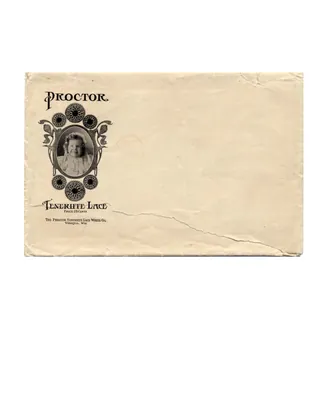
Small group of Teneriffe lace ephemera: a Paris department store card advertising a loom (metier) for making Teneriffe lace, a photograph of nine finished Teneriffe lace pieces in cream, pink and dark red thread, and the cover of a Proctor Teneriffe Lace pamphlet. The card shows a toothed circular frame and finished medallions. The pamphlet cover is from the Proctor Teneriffe Lace Wheel Co. of Viroqua, Wisconsin, priced at 25 cents.
Book on Lace--Bertozzi
Antonello · 1604
Book · 92 pages · Italian
A calligraphic writing book, apparently engraved, by the Paduan writing master Antonello Bertozzi, with additional plates signed by Sebastian Zanella. Each plate shows an Italian moral maxim or an alphabet specimen in italic script, framed by an ornamental border of lace-pattern motifs such as geometric lattices, rosettes, leaves, scrollwork and tassels. Some plates are dated 1604 and 1619. The text is in Italian and Latin and is not a lace instruction manual; the lace-like borders are of interest as pattern ornament.
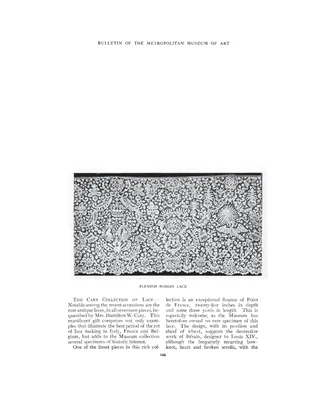
The Cary Collection of Lace
Article · 2 pages
A short 1906 museum bulletin notice describing the bequest of seventeen antique laces from Mrs. Hamilton W. Cary to the Metropolitan Museum of Art. It discusses pieces of Point de France, Flemish bobbin lace, Burano and Venetian needlepoint, Old Brussels, Point de Milan and tape lace, with notes on their designs and provenance. Two photographs show a Flemish bobbin lace flounce and a North Italian guipure panel.
A Collection of Lace Presented by Mrs, Magdalena Nuttall
Article · 2 pages
A short 1908 Metropolitan Museum of Art Bulletin notice describing the gift of Mrs. Magdalena Nuttall's lace collection of 984 pieces from about thirty-two countries. It surveys the Italian, French, Flemish, English and Irish holdings, naming types such as punto in aria, reticella, filet, buratto, Alençon and Argentan, and also mentions three lace pillows and twenty-two bobbins. It ends with a note on the donor and the display in Gallery 34.
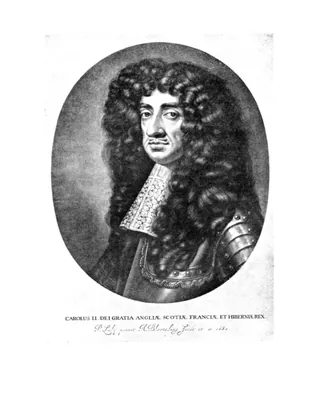
Cravats
Article · 7 pages
An article from The Connoisseur on the history of the lace cravat in the later seventeenth and early eighteenth centuries. It covers the origin of the fashion in France and its spread to England, the Steinkerque style, the costs of royal cravats, and the use of Venetian point, point de France, Mechlin and point tresse. It describes surviving examples, including cravat ends in bobbin and needle lace. Illustrated with portraits and photographs of Venetian point, bobbin lace and modern Irish needle-point cravats.
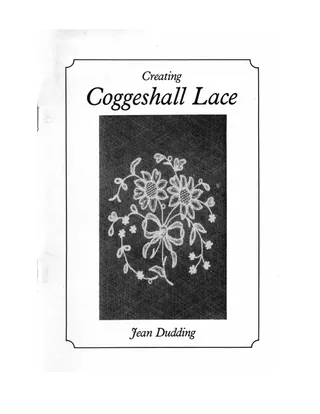
Creating Coggeshall Lace
Jean Dudding · 1979
Book · 28 pages
A beginner's manual on making Coggeshall lace, a tamboured net lace worked with a tambour hook on cotton net, published in 1979. It gives a short history of the lace in Coggeshall, Essex, lists materials and equipment, and explains how to mount the frame and net. Step-by-step instructions cover the chain stitch, zig-zag, drawback and knot stitches, finishing off, and designing and transferring patterns. It closes with diagrams of decorative filling stitches such as honeycomb, bold smuggler, spot, eyelet, check, seed pearl and birds eye, plus project suggestions, photographs of finished lace, and suppliers.
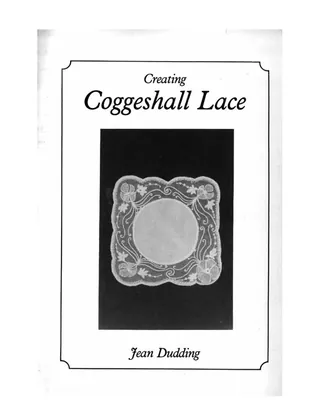
Creating Coggeshall Lace
Jean Dudding · 1988
Book · 32 pages
A beginner's manual on making Coggeshall tambour lace, a net lace worked entirely with a tambour hook in chain stitch. It covers the history of the lace in Coggeshall, Essex, from the early 19th century, then materials (cotton net, threads, hooks, frames), mounting the net, and step-by-step tambouring movements. Later sections cover zig-zag, drawback and knot stitches, design and transferring patterns to net, a series of diagrammed decorative filling stitches, and ideas for projects. Includes photographs of finished pieces and updated notes added in 1984 and for the 1988 revised edition.
Dessins nouveaux de Filet Brodé [New Designs for Filet Lace]
Article · 5 pages · French
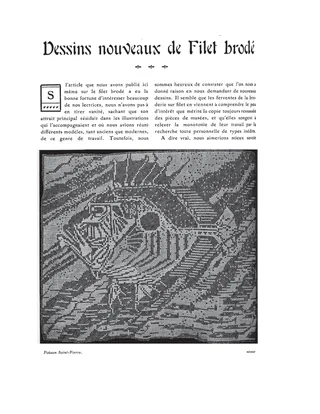
A short article from the French journal Art et Décoration (December 1909, pp. 206-210) presenting new designs for filet brodé (embroidery on netted ground) as a follow-up to an earlier article. It encourages artists to create original, stylized patterns suited to the squared grid of filet work rather than copying museum pieces. It reproduces full-page designs by Méheut (St. Peter's fish, daturas, artichokes, hollyhocks) and a figural panel by Mezzara, and announces a forthcoming study of Venetian needle lace. The article is signed Paul Mezzara.
Déclaration Contre le Luxe des Habits, Carrosses et Ornements [Declaration against Luxury in Clothes, Carriages and Ornaments]
Article · 5 pages · French
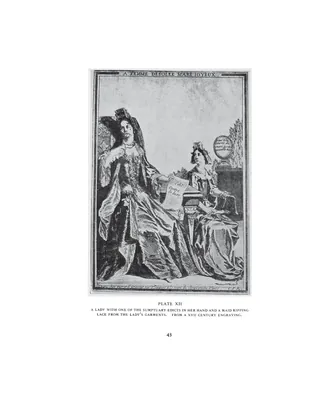
French text of the royal sumptuary declaration issued at Paris on 27 November 1660 against luxury in clothing, carriages and ornament, as reprinted in the Bulletin of the Needle and Bobbin Club. Articles ban gold and silver cloth, embroidery, and trimmings on garments and liveries, and prohibit gilding and embroidery on carriages and harness. Article V restricts the sale of foreign and French lace, passements, point de Gênes and similar thread work to a width of one inch, and bans lace-trimmed boot hose (canons). Two plates reproduce seventeenth-century satirical prints, one showing a maid ripping lace from a lady's garments.
Le Filet Brodé [Embroidered Filet]
Book · 60 pages · French
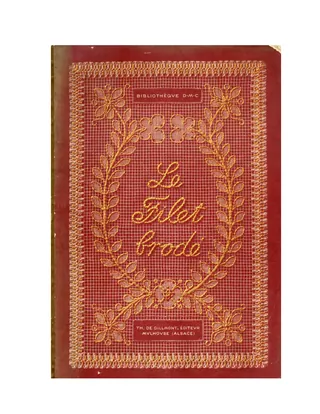
A French-language DMC Library album by Th. de Dillmont on embroidered filet (embroidery on knotted or machine-made net). It explains the tools (netting shuttle, mesh gauges), thread choices, how to make netting and square, band and frame shapes, and how to mount the net in a frame. It then covers filling and darning stitches such as point de toile, point d'esprit, point de reprise, wheels, stars, point de Venise, point coupé, background fills and languette borders. The second half has 20 plates of filet embroidery patterns and charts, followed by a DMC publications list, a product list and a thread-size table.
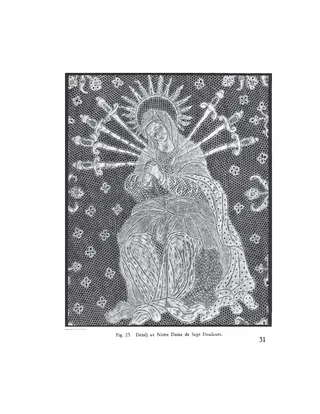
De Gamle Kniplingers Historie [The History of Old Laces]
Book · 100 pages · Norwegian
A Norwegian-language history of old lace by Irma Gram, published in Kristiania in 1921. It surveys needle and bobbin lace country by country: Italy, Sicily, Flanders and Brabant, France, England, Ireland, Spain, Denmark, Sweden, and briefly Russia, Germany and Austria. It also covers machine-made lace and ends with a guide to identifying lace as sewn, bobbined or machine-made. The text discusses materials, tools, bobbin lace stitches, grounds (réseau), fashion history and the lace industry, and is illustrated with numbered photographic figures and two plates of magnified details.
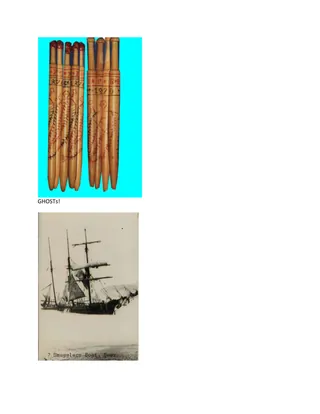
Ghosts and Smugglers of East Devon v2
Brian Lemin · 2010
Web Doc · 3 pages
A short illustrated essay by Brian Lemin (October 2010, version 2) that retells East Devon folklore about lace makers, ghosts and smugglers around Branscombe and Beer. It covers the truck system of paying lace makers in goods, frightening night walks home along Devon lanes, the 'Black Rabbit' exorcism, and the smuggling of lace by Jack Rattenbury's crew. It ends with the author explaining that he used the story to illustrate two East Devon lace bobbins he calls 'Ghosts', shown in photographs.
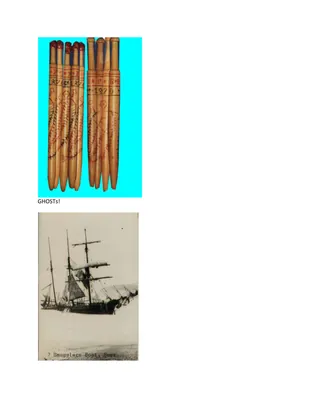
The Ghosts and Smugglers of East Devon. An Essay
Brian Lemin · 2010
Web Doc · 3 pages
A short 2010 essay by Brian Lemin that retells East Devon folk tales about lace makers in Branscombe and Beer, drawing on an old book on Devon lace. It covers payment of lace makers by the truck system, ghost stories from the dark lanes on the walk home from pay day, and the smuggling of lace by Jack Rattenbury's crew. The author ties the stories to two East Devon lace bobbins in his collection that he labels "Ghosts", shown in a photograph of decorated bobbins dated 1870.
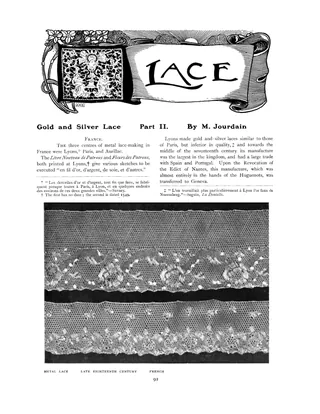
Gold and Silver Lace, Part II
Article · 5 pages
Part II of M. Jourdain's article on gold and silver (metal) lace in The Connoisseur, surveying its history in France (Lyons, Paris, Aurillac), Sicily, Switzerland, Russia and England. It draws on museum specimens, inventories, sumptuary laws, patents, and petitions, especially for English gold thread monopolies, fraud, and import prohibitions from the 13th to the 18th century. Illustrated with photographs of 18th-century French, Italian, and Russian metal lace.
Guipure d'Art
New England Fireside, July 1888
Article · 3 pages
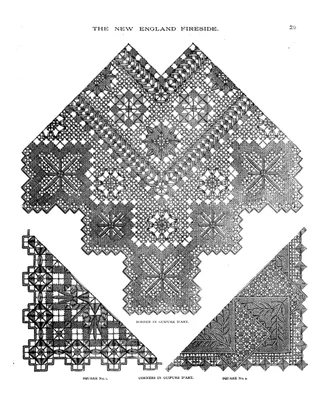
A three-page 1888 magazine article from The New England Fireside on guipure d'art, a form of lace made by darning and embroidering patterns on a netted square foundation (fillet). It lists materials, explains how to net and lace the foundation on a wire frame, and describes the principal stitches: Point d'Esprit, Point de Toile, Point de Feston, Point de Reprise, Point de Bruxelles, and wheels. Stitch diagrams and finished designs are included: a border for cushions or pillow shams, insertions, corner pieces, and two square patterns.
How to Make Irish Laces at Home
Article · 5 pages
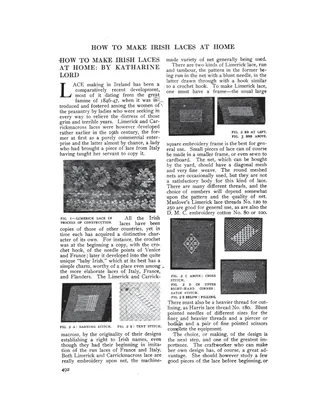
An instructional article from The Craftsman on making Limerick and Carrickmacross lace at home, both embroidered on machine-made net. It covers the history of Irish lace, materials and threads, mounting net in a frame, outlining, filling stitches (darning, tent, cross, satin and others), tambour work, and the appliqu\u00e9 and guipure methods of Carrickmacross. Illustrated with photographs of work in progress, stitch samples, a Limerick collar, and a fan mount designed by the author.
Human Figures in Lace
Article · 5 pages
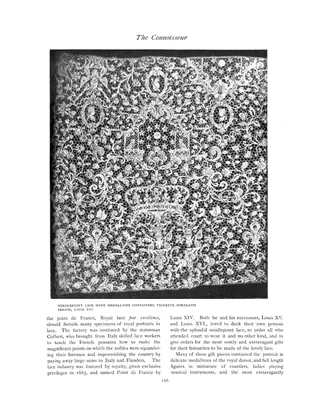
Article from The Connoisseur on the depiction of human figures in antique lace, written for collectors who want to specialise. It surveys figures in early openwork and lacis (darned netting), religious and royal portrait subjects, and figures in point de France, Alençon, Argentan, Venetian and Valenciennes laces, including the pseudo-Indian and Oriental figures of the late 17th and early 18th centuries. It also explains why figures declined in lace design and illustrates the points with plates and photographs of cravat ends, borders and medallion panels.
Ingalls' Handbook of Darned Lace Patterns
J. F. Ingalls · 1885
Book · 100 pages
A small 1885 pattern book of darned lace (darned netting) designs published by J. F. Ingalls, priced at 25 cents. The volume is almost entirely illustrations: engraved and photographic plates of motifs, borders, and edgings worked in darning stitches over a hexagonal net ground. Little or no instructional text is legible, so it serves mainly as a visual pattern source for netting and darned lace.
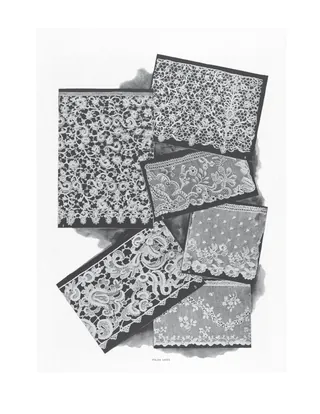
[Italian Lace]
The Book of the Fair, 1893
Illustration · 2 pages
Two plates of illustrations of Italian lace from The Book of the Fair, the account of the 1893 World's Columbian Exposition in Chicago. The first plate shows six numbered lace pieces with floral and scrolling designs in needle and bobbin-style lace. The second has three photographs: two interior views of Italian lace displays (a tall ornate stand with lace panels, and a glass-fronted cabinet with a lace-hung wall) and a piece captioned as the Queen of Italy's point d'Argentan.
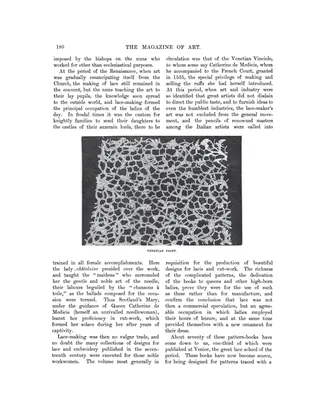
Lace
Article · 4 pages
A short illustrated article from The Magazine of Art, described as the last paper written by Mrs. Bury Palliser, sketching the early history of lace. It traces lace from convent work and open-work embroidery through cut-work, lacis, point coupé, drawn-work and reticella, and discusses Renaissance pattern books such as Vinciolo's. Illustrations show Venetian point, Reticella (Greek lace from Zante), Passement au fuseau and Point coupé from Vinciolo.
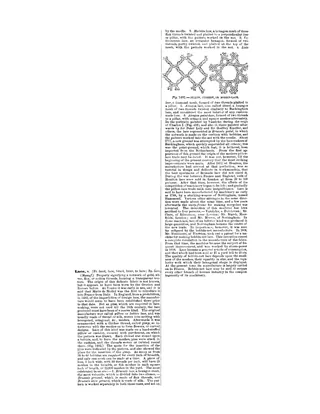
Lace
Zell's Encyclopedia, 1876
Article · 1 page
A one-page encyclopedia entry on lace, covering its definition, uncertain origins, and early history in Venice, France and England. It describes pillow or bobbin lace making on a cushion with pins and bobbins, and lists the best-known laces (Brussels, Mechlin, Valenciennes, Lisle, Alençon) by mesh type. It also traces the 18th and 19th century shift to machine production, including warp-frame lace, Heathcote's 1809 bobbin-net patent, and the Nottingham trade. A line illustration shows bobbin-lace mesh structures.
Lace Album
Frederick Fischbach · 1878
Book · 116 pages
A portfolio of twenty-six photographic plates of lace designs by Frederick Fischbach, director of the Art Industrial School in St. Gall, Switzerland, privately printed in 1878. The plates show collars, bibs, edgings, insertions, medallions and other pieces of bobbin or needle lace, photographed in white on black grounds. There is almost no text beyond the title page, and no weaving drafts. This is a scan of the Cornell University Library copy.
Lace and Lace Making
Monograph · 26 pages
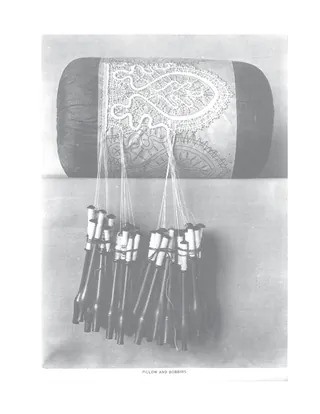
This is the May 1, 1917 issue of The Mentor (Vol. 5, No. 6, Serial No. 130), devoted to lace and lace making by Esther Singleton. It surveys the major historic laces: Venetian raised, rose and flat point, Italian pillow lace (Genoa, Milan), Point d'Alencon, Mechlin, Valenciennes, Honiton, Brussels and Chantilly. It explains the difference between needle-point lace and pillow (bobbin) lace, defines terms such as reseau, brides, picots and cordonnet, and covers lacis and reticella, the origins of lace, the lace industry in Italy, Flanders, France, England and Spain, and fashions in lace through the Napoleonic era. Illustrated with photographic plates of specimens. The issue also has an editor's notice about a membership fee increase, an Open Letter column, and Mentor Association advertising.
Lace for Your Shoes: The Impractical Vanity
Article · 8 pages
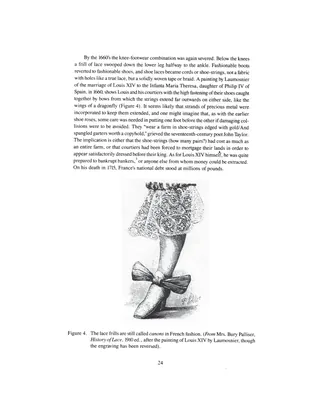
Article on the fashion for lace on footwear and at the knee and boot top in 17th-century Europe, covering shoe roses, lace-trimmed boot hose (canions), and shoe-strings, with examples from the courts of Louis XIII and Louis XIV. It then turns to the 1930s, when Nottingham machine-made Leavers net was applied to canvas and sprayed to imitate snakeskin for shoes, citing design registrations from the G.W. Price archive. Illustrated with portraits, engravings, photographs of net samples, and two Binche bobbin lace edgings; includes notes.
Lace in America
Article · 2 pages
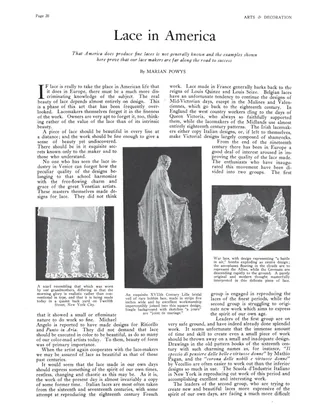
A 1919-1920 magazine article by Marian Powys arguing that lace should be judged by the quality of its design, and that American lacemaking deserves more notice. She surveys how European lace traditions keep copying older patterns, describes efforts to revive historic lace and to create new designs, and discusses Devon pillow lace (Honiton), Point d'Angleterre and early lacemakers at Ipswich, Massachusetts. The article ends with advice on choosing and wearing lace, and is illustrated with photographs of American-made pieces including a bridal veil, a war lace, and fans.
700 documents found