Textile Documents › Authors › Author: Brian Lemin
71 documents found
Sort: 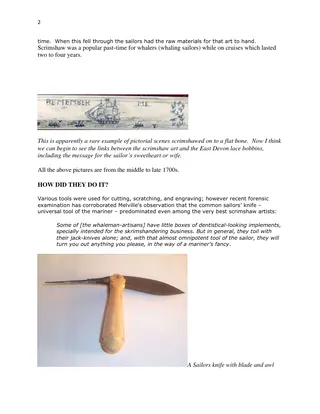
An Analysis of Maritime Decorations and Possible Decorators of Ships Depicted on East Devon Bobbins
Brian Lemin · 2010
Web Doc · 23 pages
A December 2010 study by Brian Lemin of maritime decoration on East Devon lace bobbins, arguing that ship, anchor, whale, fish and mermaid motifs link the bobbins to sailors' scrimshaw. It begins with the history and tools of scrimshaw, then presents photographs of decorated bobbins grouped by motif (anchors, fish, mermaids, a wedding toast) and by ship type (the ASP, gunship, commercial vessel, fishing boat, Vioktoria, two-ships bobbin). Each bobbin is annotated with possible identifying features such as banding, tail decoration and lettering. Lemin tentatively groups possible decorators or makers, concludes that the maritime genre is linked to scrimshaw, and invites reader input. An endnote quotes Jane Austen's Persuasion on the sloop Asp.
Anchors as Decoration on East Devon (Honiton) Bobbins
Brian Lemin · April 2020
Web Doc · 4 pages
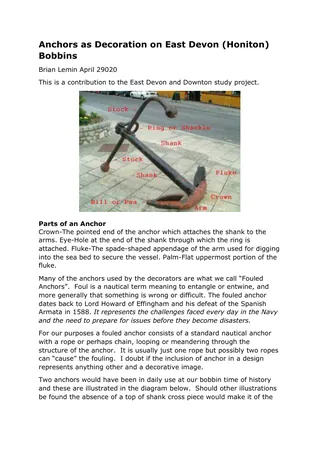
A short illustrated web document by Brian Lemin on anchor motifs used as decoration on East Devon (Honiton) lace bobbins, written as a contribution to the East Devon and Downton study project. It explains the parts of an anchor and the "fouled anchor" motif, compares two anchor types in use in the bobbin period, and shows close-up photographs of anchors painted or incised on bobbins. The author concludes that anchors mark a maritime genre of bobbin and that the area of Beer is the best source of maritime bobbins.
An Annotated Bibliography of Books That Contain Worthwhile Information on Lace Bobbins
Brian Lemin · 2022
Web Doc · 4 pages
A short annotated bibliography by Brian Lemin (February 2022) reviewing books that contain useful information on lace bobbins. Entries cover works by Bellerby, Bullock, Freeman, Hopewell, Huetson, the Springetts, Whiting and Wright, with the author's personal comments on each book's coverage, illustrations and value to collectors. He singles out Success to the Lace Pillow by Christine and David Springett as essential for any bobbin collector.
An Annotated Bibliography Relating to Lace Bobbins and Allied Topics
Web Doc · 13 pages
An annotated bibliography by Brian Lemin (July 2020) on lace bobbins, with short evaluative comments on each entry. It lists books, museum catalogues and magazine articles on English bobbins, continental bobbins (French, Spanish, Dutch, German, Danish, Norwegian), spangles and beads, and the making of bobbins by woodturning, plus a few items on lace social history. Lemin notes it is not a complete bibliography.
Antique English, Hand Carved and or Decorated, Lace Bobbins
Brian Lemin · 2011
Web Doc · 11 pages
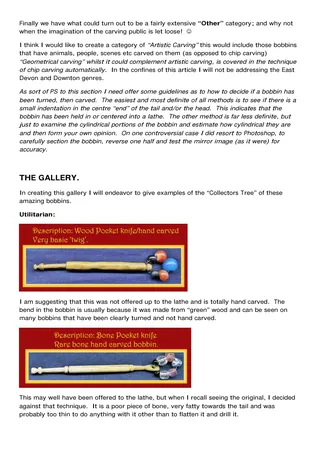
A June 2011 collector's article by Brian Lemin on antique English hand carved and chip carved lace bobbins. It gives a short history of chip carving and proposes a classification (utilitarian, turned and carved, hand carved; cylindrical or square; church window, lantern, mother and babe, artistic carving). A photographic gallery of bobbins from the Luton Museum, Fitzwilliam Museum and private collections illustrates the types, with notes on East Midland and South Bucks styles and on telling turned bobbins from fully hand carved ones.
AUCTION HARVESTING: Two unique bobbins found
Brian Lemin · 2016
Web Doc · 4 pages
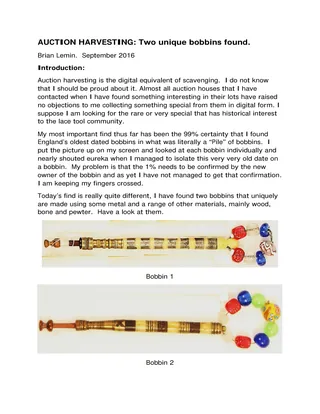
A short 2016 web article in which Brian Lemin describes two unusual lace bobbins he found in online auction listings. Both combine wood, bone, brass and pewter, and he analyzes their construction, decoration (knurling, turned rings, bitting-like cutaways, spangle beads) and resemblance to Jesse Compton bobbins. He concludes they are adapted or repaired bobbins, probably the work of a skilled turner, and is unsure whether they are modern or period adaptations.
The Batavia, re-visited
Brian Lemin · 2014
Web Doc · 5 pages
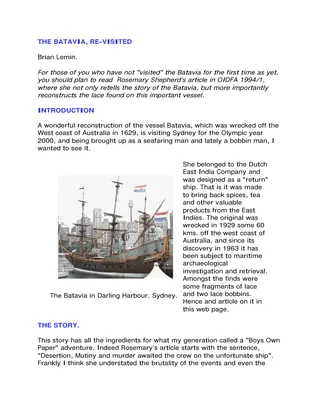
A web article by Brian Lemin on the reconstructed Dutch East India Company ship Batavia, shown in Sydney's Darling Harbour in 2000. It summarizes the 1629 wreck off Western Australia and the subsequent mutiny and massacre, then focuses on the lace fragments and lace bobbins recovered from the wreck. Lemin discusses the bobbins shown on a 90-cent stamp, questions whether they were wood or pewter, and compares their styles to Flemish and Danish bobbins rather than the Italian lace attribution in the catalogue.
Baubles Beads and Spangles on Lace Bobbins
Brian Lemin · 2010
Web Doc · 15 pages
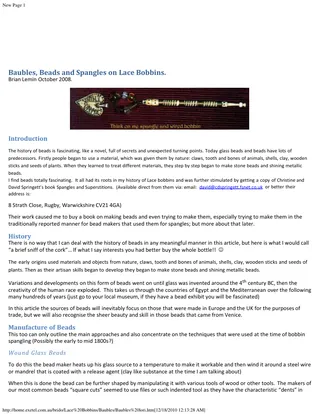
A web article by Brian Lemin (October 2008) on the beads, baubles and spangles hung from the ends of English East Midlands lace bobbins. It covers the history and manufacture of glass beads (wound, drawn, moulded, lampworked), trade beads, and the author's attempt to make beads by historical methods. It then catalogs spangle types (traditional, hinged, Steeple Claydon, birdcage, mourning, oddity) and many bead types from Wright's and the Springetts' lists, with many photographs, and closes with bead folklore and superstition.
A Bibliography of Books and Articles that Deal Substantially with the Topic of Lace Making Bobbins
Brian Lemin · 1998
Web Doc · 14 pages
An annotated bibliography by Brian Lemin (December 1998) of books and articles dealing with lace-making bobbins, plus spangles, beads and bobbin making. It is organized into sections: historical English works, continental bobbins, spangles and beads, and bobbin making (mostly woodturning magazine articles). Each entry gives a citation and the compiler's candid comments on its value; it closes with a request for additions and the author's contact details.
A Bobbin Love Story
Brian Lemin · 2014
Web Doc · 8 pages
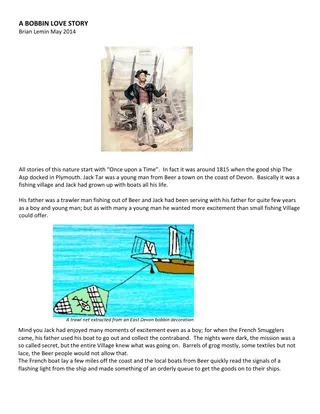
A short fictional story by Brian Lemin (May 2014) about Jack Tar, a young fisherman from Beer, Devon, who joins the Navy around 1815 and carves decorated lace bobbins for his sweetheart Polly, a Honiton lace maker. The narrative is illustrated with paintings, engravings and photographs of inscribed and carved East Devon bobbins, and with local scenes. A closing note explains that the author wrote the story as an excuse to use his bobbin pictures.
Bobbins of St Scania by Axel Hörlén
Brian Lemin · 2010
Web Doc · 8 pages
English translation of Axel Hörlén's 1969 study of lace pillows and bobbins in the southern part of Scania (Skåne), Sweden, centered on Valleberga and nearby villages. It covers the shift from the bolster pillow to the Swedish roller pillow, pillow cover materials such as linen and oilcloth, and bobbin shapes, including spangled bobbins with baskets or metal leaves that make a clatter. It compares them with Estonian bobbins from Runo and Bohemian bobbins from Vamberk. The translation is followed by notes on Czech bobbin names and a summary by editor Brian Lemin.
A Calender (sic) of Lacemakers Celebrations
Brian Lemin · 2003
Web Doc · 13 pages
A web article by Brian Lemin that walks through the year month by month, describing feast days, holidays and customs of English bobbin lacemakers. It draws mainly on Wright's Romance of the Lace Pillow and Jones and Deer's book on feasts, covering Candlemas, Shrove Tuesday, Nutting Day, Cutting Off Day, Cattern and Tanders Day, and St Thomas's Day. It also discusses candle stools, fairing bobbins, Cattern cakes and candlestick-jumping rhymes, and ends with a request for information on Continental lacemakers' festivals.
A Classification of Antique East Midland Lace Bobbins for Collectors
Brian Lemin · 2016
Web Doc · 25 pages
Brian Lemin's 2016 article proposes a system for classifying and organizing a collection of antique English East Midland lace bobbins. It covers functional types, regional types (South Bucks, Downton, Malmesbury, Waddesdon, Suffolk), and categories by decoration and construction such as bitted, pewter-inlaid, wire-beaded, mother-in-babe, tinsel and spliced bobbins. It also lists known bobbin makers, gives a classification of bobbin inscriptions based on Jenny Baker's catalogue, and explains bobbin parts and turning terms with photographs and line drawings. An appendix shows how to turn the classification into a computer folder structure.
A Collection of Inscriptions on East Devon Bobbins
Brian Lemin · 2020
Web Doc · 17 pages
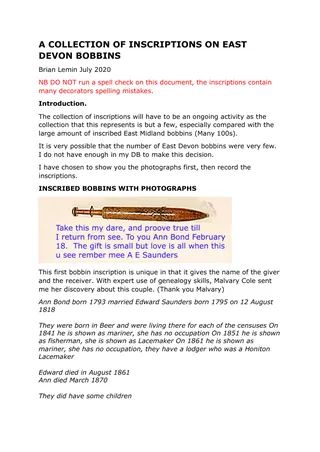
A July 2020 compilation by Brian Lemin of inscriptions found on East Devon lace bobbins, shown first as photographs and then as a numbered transcription list of 31 inscriptions with their original spellings. It includes the story of a bobbin given by Edward Saunders to Ann Bond of Beer, with genealogical notes, and a catalog of the Marks family bobbins used by Ivy Marks, one of the last lace apprentices in Honiton. These are described by date, initials, mottoes, and decorative bands such as wedges, brickwork, fish, and hearts.
A Collection of Sea Going Vessels Depicted on East Devon Bobbins. (an album)
Brian Lemin · 2020
Web Doc · 23 pages
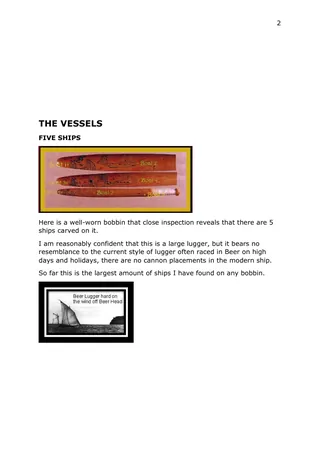
An illustrated album by Brian Lemin (July 2020) of ship and other seagoing vessel motifs carved, painted or drawn on East Devon lace bobbins. Each entry presents photographs or drawings of bobbins with their inscriptions, initials and dates (roughly 1813 to 1918), with brief comments on identifying features such as hairy hearts, fouled anchors, cannon placements, fishing nets and sails. Some entries note bobbins held at the RAMM Exeter museum that could not be shown, and the author asks readers for further information.
The Country Bobbin - Elizabeth Jones, a Unique Lace Bobbin
Brian Lemin · 2011
Web Doc · 4 pages
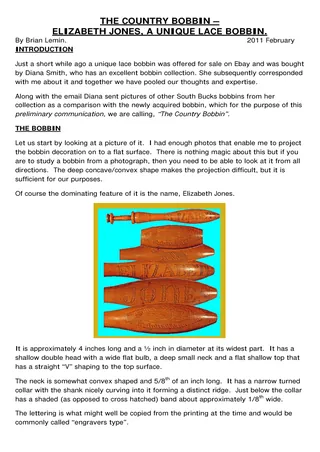
A short February 2011 web article by Brian Lemin examining a unique lace bobbin inscribed 'Elizabeth Jones', recently bought on eBay by collector Diana Smith. It describes the bobbin's size and shape, its engraver-style lettering, and the engraved fish and animal (probably a deer) below the name. It compares these features with South Bucks bobbins, East Devon fish motifs and the animals on the Fitzwilliam Museum's Shepherds bobbin, concluding the bobbin is of South Bucks type.
Cow and Calf or Jack in the Box
Brian Lemin · 2010
Web Doc · 6 pages
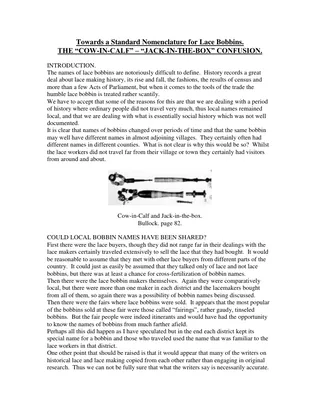
A short web article by Brian Lemin on the confusing names "cow-in-calf," "cow and calf," and "jack-in-the-box" for hollow-shanked lace bobbins that conceal a miniature bobbin. It reviews how nine published authors (Wright, Whiting, Freeman, Hopewell, Bellerby, Springett, Bullock) describe these bobbins, noting where they disagree on whether the small bobbin is loose or attached. Lemin proposes a standard nomenclature: cow in calf for the attached type, cow and calf for the loose type, and jack-in-the-box for the South Bucks "thumper." Photographs of bobbins and a reference list are included.
Cryptic Bobbins or Puzzle Bobbins
Brian Lemin · 2010
Web Doc · 11 pages
An illustrated web article on cryptic or puzzle bobbins, English lace bobbins inscribed with coded messages such as backward spellings, anagrams, and initials. It gives solved examples, mostly from the Knight, Baker and Huetson catalogue and from Wright, including a Honiton bobbin deciphered as Sotho. It then lists ten unsolved inscriptions with attempted solutions from the Arachne lace list. It ends with photographs of newly received cryptic bobbins with dotted red letters.
The Degradation of Pewter in Antique Lace Bobbins
Brian Lemin · 2003
Web Doc · 4 pages
A short web article explaining why the pewter inlay on antique bobbin lace bobbins swells, crumbles or falls off. It describes pewter as a tin-lead alloy and attributes the damage to "tin pest" or tin disease, in which tin changes form below about 13 degrees C. It also discusses the folklore that pewter-spotted "leopard" bobbins were made to ease arthritis, and offers advice on storing bobbins.
An Early effort to devise terms to describe genres of East Devon Lace Bobbin Decorations (v1)
Brian Lemin · 2019
Web Doc · 9 pages
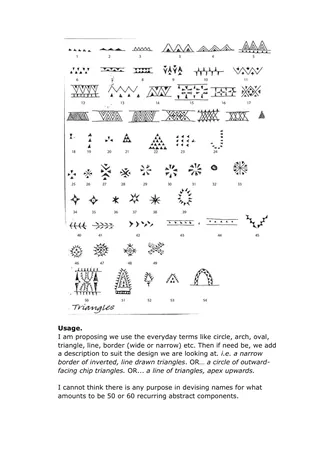
A short 2019 working paper by Brian Lemin proposing descriptive terms for classifying the decorations on East Devon (Honiton and Branscombe) lace bobbins. Building on H. J. Yallop's ten decorative categories, it covers decorating methods (chip carving filled with sealing wax, aquafortis staining), then circumferential rings, abstract patterns, foliage and flowers, living creatures, human figures, words, initials and dates, ships, nautical, naive, bricks and diamonds. Illustrated with charts of numbered hand-drawn motifs for triangles, foliage, creatures, humans and ships.
East Devon Bobbins
Brian Lemin · December 2001
Web Doc · 9 pages
A web article by Brian Lemin (December 2001, marked as not yet completed) on the lace bobbins of East Devon, England, often called Honiton bobbins. It covers the region's geography, the plain pointed bobbin form, woods used, and decoration: Aqua Fortis ("Agnes Forty") staining, Branscombe riggled rings filled with sealing wax, and incised designs such as triangles, bricks, flora, creatures, ships, initials, dates and inscriptions. It ends with a bibliography (Bellerby, Whiting, Wright, Yallop) and an appeal for information on an unidentified dated bobbin.
East Midland Spangled Bobbins
Brian Lemin · 1998
Web Doc · 15 pages
A July 1998 discussion paper by Brian Lemin speculating on why England developed the thin East Midland bobbin and why it came to be spangled. He reviews references to bone as the first lace bobbins (Palliser, Yallop, Whiting, Tornehave, Morris) and argues that English bobbins stayed thin because they were made of bone. He then weighs several explanations for spangles, including preventing rolling, thread untwisting, thread quality, and flatter English pillows. It ends with a summary, a call for further discussion, and an annotated reference list.
East Midland Spangled Bobbins some Speculations
Brian Lemin · 2010
Web Doc · 10 pages
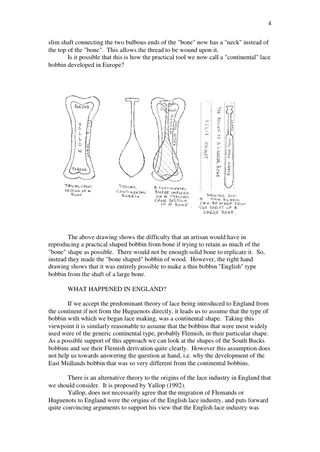
A July 1998 discussion paper by Brian Lemin speculating on why English East Midland lace bobbins are thin and spangled (beaded). He argues that early bobbins were unmodified animal bones, that English makers kept bone as a material and so had to make thin bobbins, and that spangles were added to stop bobbins rolling, to cope with thread untwisting or breaking, and to suit flatter English pillows. He draws on Palliser, Yallop, Whiting, Levey, Tornehave and Carole Morris's article on a Gloucester bone bobbin, and closes with an annotated reference list.
England's Oldest Lace Bobbin. Do We Really Know ?
Brian Lemin · 2011
Web Doc · 9 pages
A 2011 article by bobbin researcher Brian Lemin asking which is the oldest known English lace bobbin and how reliably bobbins can be dated. He surveys archaeological finds (Oxford Museum Service, a Gloucester midden, a Danish bog find dated 1550, Flemish bobbins from Eye, Suffolk) and then inscribed, dated bobbins from East Devon and Downton, including a c.1795 carved bobbin in the Fitzwilliam Museum and a 1693 Downton bobbin in the Salisbury and South Wiltshire Museum. He concludes there is no single answer, and the article includes many photographs of bobbins and a short bibliography.
England's Oldest Lace Bobbin. Do We Really Know ?
Brian Lemin · 2020
Web Doc · 11 pages
Brian Lemin's article investigates which lace bobbin can claim to be England's oldest, and the problems of dating bobbins from inscriptions and archaeological context. He reviews archaeological finds (Oxford Museum, a Gloucester midden bobbin, a Danish bog find of about 1550, and the Eye, Suffolk hoard) and then dated East Devon (Honiton) and Downton bobbins, including the Fitzwilliam Museum's carved Shepherd's Bobbin (c.1795) and a 1693 Downton bobbin. He concludes that the 1662 Budleigh Salterton bobbin in the Fairlynch Museum is the oldest dated English lace bobbin, and discusses its hand-carved neck and pole lathe turning. Illustrated with photographs of bobbins and a pole lathe diagram, with references.
Englands Oldest Dated Bobbin
Brian Lemin · 2019
Web Doc · 5 pages
A short 2019 article by Brian Lemin on a trolly lace bobbin dated 1662, found in Budleigh Salterton and held by Fairlynch Museum, which he presents as the oldest dated English bobbin. He compares it with a 1693 bobbin in the Salisbury and South Wiltshire Museum, describes its chip-carved decoration and its initials "MR", and explains why its neck is hand-carved rather than turned on a pole lathe. He also gives brief background on Devon lace history and the 1662 Parliament ban on foreign lace.
English Lace Bobbins and Their History: A Brief Overview
Brian Lemin · 2003
Web Doc · 29 pages
A short illustrated overview by Brian Lemin of English bobbin lace bobbins and their history. It describes the parts of a bobbin and the regional types (East Midlands/Bedfordshire, Honiton, South Bucks, Downton, Malmesbury, hand-carved), with Freeman's classification, inscription types, decoration, dyeing and staining, dating, and identified makers such as the Comptons, Haskins and Abbott. It closes with a conclusion and an annotated bibliography of bobbin and lace books.
First Words
Brian Lemin · 2010
Web Doc · 5 pages
A short web article by Brian Lemin presenting entries from the Oxford English Dictionary on the earliest recorded uses of words for lace and its tools: lace (as trimming braid and as openwork fabric), bobbin, and bone-lace. Each entry is followed by dated quotations from the 16th to 19th centuries. Lemin notes that the dictionary does not define lacemaking tool names such as bed fly, leopard, maid or candle stool.
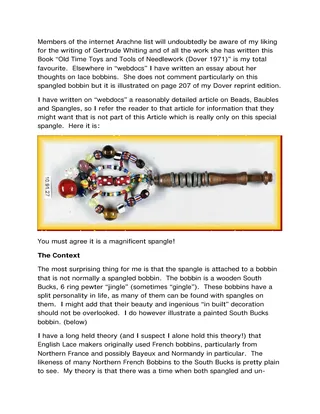
The Gertrude Whiting Spangle Illustration
Brian Lemin · 2014
Web Doc · 10 pages
A 2014 web article by Brian Lemin about a large, elaborate beaded spangle on a South Bucks pewter-ringed bobbin, illustrated in Gertrude Whiting's book Old Time Toys and Tools of Needlework and held by the Metropolitan Museum of Art (gift of Mrs. J. Boorman Johnstone, 1910). It gives a short biographical note on Whiting, compares the spangle with other types (East Midland, Steeple Claydon, mourning, birds nest), discusses how practical it would have been for lace making, and offers educated guesses at the trade beads used. Illustrated with photographs of bobbins and spangles.
Gertrude Whiting Talks About Lace Bobbins. An Essay
Brian Lemin · 2010
Web Doc · 3 pages
A short essay by Brian Lemin (December 2010) on what Gertrude Whiting wrote about lace bobbins in her book Old Time Tools and Toys of Needlework, especially the chapter "Beautiful Bobbins". It discusses her enthusiastic style, her views on the origin of bobbins and the word "sticks", and her love of spangles and beads. It also covers her descriptions of English bobbin types such as leopards, tigers, Beds fly, South Bucks and East Devon bobbins, and bobbin makers' marketing of commemorative bobbins. Lemin compares her approach with the modern classification used by Christine and David Springett.
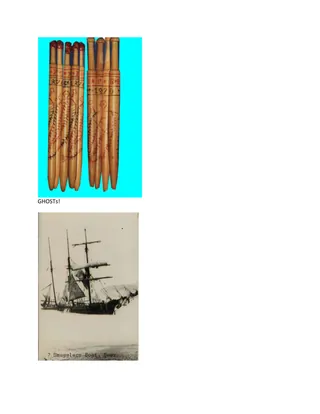
Ghosts and Smugglers of East Devon v2
Brian Lemin · 2010
Web Doc · 3 pages
A short illustrated essay by Brian Lemin (October 2010, version 2) that retells East Devon folklore about lace makers, ghosts and smugglers around Branscombe and Beer. It covers the truck system of paying lace makers in goods, frightening night walks home along Devon lanes, the 'Black Rabbit' exorcism, and the smuggling of lace by Jack Rattenbury's crew. It ends with the author explaining that he used the story to illustrate two East Devon lace bobbins he calls 'Ghosts', shown in photographs.
The Ghosts and Smugglers of East Devon. An Essay
Brian Lemin · 2010
Web Doc · 3 pages
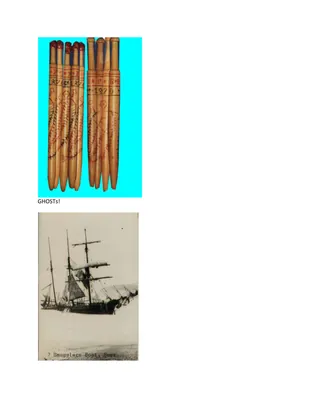
A short 2010 essay by Brian Lemin that retells East Devon folk tales about lace makers in Branscombe and Beer, drawing on an old book on Devon lace. It covers payment of lace makers by the truck system, ghost stories from the dark lanes on the walk home from pay day, and the smuggling of lace by Jack Rattenbury's crew. The author ties the stories to two East Devon lace bobbins in his collection that he labels "Ghosts", shown in a photograph of decorated bobbins dated 1870.
A Historical Analysis of Church Window Bobbins
Brian Lemin · 2010
Web Doc · 7 pages
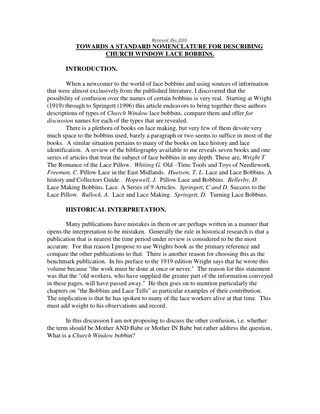
An article by Brian Lemin that compares how eight published authors, from Wright (1919) to Springett (1996), describe Church Window, Mother-in-Babe, Cow-in-Calf and Jack-in-the-Box lace bobbins. It treats Wright as the benchmark source, points out contradictions (for example Huetson's 'baby bobbin'), and proposes standard definitions: Church Window (empty slots), Mother in Babe (contains a small bobbin), Other Inserts or 'Lantern', Jack in the Box and Cow in Calf. It ends with a speculation that the inserts may originally have been candles, a call for collectors' feedback, and a reference list. Three photographs of example bobbins are included.
Historical Methods of Attaching a Spangle to a Bobbin
Brian Lemin · 2010
Web Doc · 5 pages
An informal essay by bobbin maker Brian Lemin speculating on the origin of spangles (bead-and-wire rings) on English lace bobbins and how they were attached. He discusses the difficulty of drilling spangle holes before the mid-1800s, including burning and hand/breast, pump and Archimedean drills. He describes attachment methods: staple, direct wire, bent-pin shackle, double loop, hinged spangle, and wire wound around the bobbin. He ties the spangle's introduction to the Spinning Jenny and the bobbin maker Joseph Haskins, and notes that only East Midlands makers used spangles.
Historical Steam Representations on a Honiton Lace-making Bobbins
Brian Lemin · 2019
Web Doc · 6 pages
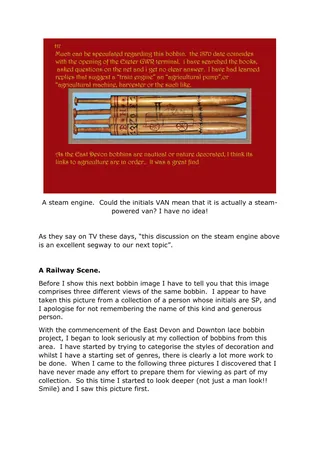
A November 2019 web article by Brian Lemin, written for the East Devon and Downton lace bobbin project, on steam-engine imagery found on decorated Honiton lace bobbins. He discusses one bobbin that may show an agricultural traction engine or steam van, with the initials VAN and the date 1870. He then reconstructs a railway scene by joining three photographs of a carved bobbin in Photoshop, showing an engine, coal tender, wagon, sleepers and smoke, and compares it with a Great Western Railway locomotive photograph of about 1874.
How Was it that Bobbins Became Interesting?
Brian Lemin · 2020
Web Doc · 5 pages
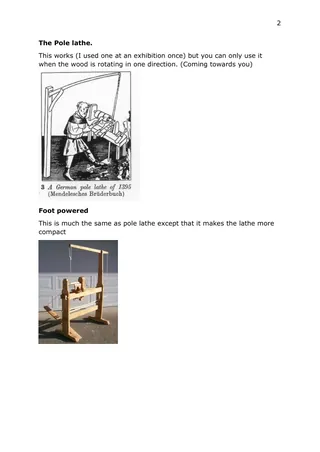
A short 2020 essay by Brian Lemin proposing that English lace bobbins became interesting to makers, collectors and writers around 1850, when the treadle lathe and better steel tools allowed finer, more varied turning. It traces the development of woodturning from the pole lathe and two-handed lathe to the treadle lathe, and relates this to the lack of early written descriptions of lace bobbins before about 1900. It argues that bobbin makers then became designers, offering spangling, varied shapes, other materials and inscribed messages. Illustrations show early lathes and an engraved plate of bobbins and pillow equipment.
In Praise of Antique Lace Bobbin Makers
Brian Lemin · 2010
Web Doc · 8 pages
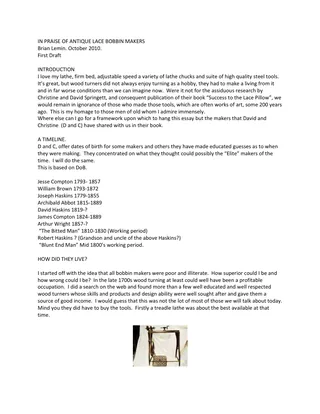
An informal 2010 essay by modern bobbin maker Brian Lemin paying tribute to the "elite" English antique lace bobbin makers identified in Christine and David Springett's book "Success to the Lace Pillow." It sketches a timeline of makers such as Jesse and James Compton, the Haskins family, William Brown, Arthur Wright, Archibald Abbott and the anonymous "Bitted Man" and "Blunt End Man," and discusses their working lives, tools, materials (wood, bone, pewter) and decorative techniques. Illustrated with photographs of framed bobbin displays and a treadle lathe.
In the Footsteps of Alan Summerley COLE
Web Doc · 20 pages
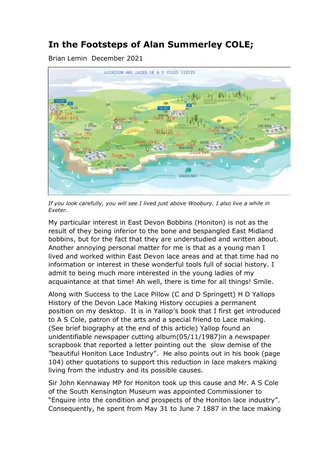
A 2021 illustrated article by lace bobbin historian Brian Lemin retracing Alan S. Cole's 1887 tour of East Devon lace-making towns and villages, made as Commissioner investigating the Honiton lace industry. For each stop (Exeter, Beer, Colyton, Branscombe, Sidmouth, Sidbury, Honiton, Ottery St Mary, Exmouth, Otterton, Woodbury) it summarizes Cole's report on dealers, worker numbers, the decline of the trade and the lack of lace schools, alongside the author's personal memories and photographs, including East Devon decorated bobbins. It ends with a preliminary biography, timeline and bibliography of Cole, and mentions Marian Powys.
The Jewess Maiden
Brian Lemin · 2010
Web Doc · 8 pages
A short essay by Brian Lemin (December 2010) on "The Jewess Maiden," a gruesome lace-makers' tell (a song sung at the lace pillow) recorded by Thomas Wright in The Romance of the Lace Pillow. He explains the blood libel and the story of Hugh of Lincoln, and links the tell to the traditional ballad "Hugh of Lincoln," with a note on Cecil Sharp's collecting. He also discusses another macabre tell, "There Was a Lady All Skin and Bone," and Shakespeare's references to pillow songs, and prints a full ballad text.
Kitty Fisher. Rhyme, Beads and Lace
Brian Lemin · 2010
Web Doc · 8 pages
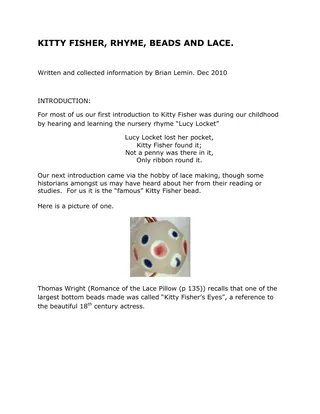
A short illustrated essay by Brian Lemin (December 2010) on Kitty Fisher, the 18th-century London courtesan, and her link to the "Kitty Fisher" glass bead used on English bobbin lace-making bobbins. It covers her biography, anecdotes from Casanova and others, the design and folklore of the bead including the evil-eye associations, and the origin of the nursery rhyme "Lucy Locket". It ends with a reproduced 1994 Daily Mail newspaper article on Kitty Fisher. It contains photographs of beads and reproductions of portraits, and no weaving drafts.
Lace Bobbin CV
Brian Lemin · 2010
Web Doc · 4 pages
A short first-person curriculum vitae by Brian Lemin describing how he became a researcher of antique English lace bobbins, starting after he bought a lathe to make them. He describes his bobbin photograph collection, two unpublished manuscripts (a dictionary of East Midland lace bobbins and a survey of East Devon lace bobbins), and lists about 35 of his articles on bobbin types, decoration, repairs, spangling, history and related lace tools.
Lace Bobbin Fashions
Brian Lemin · 2010
Web Doc · 6 pages
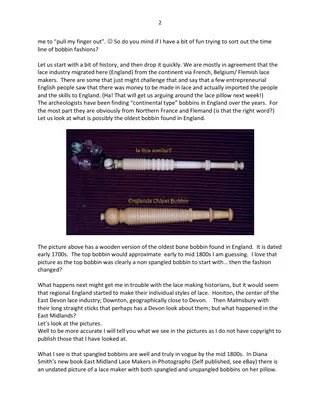
A short, informal essay by bobbin researcher Brian Lemin (Nov/Dec 2010) proposing that the spread of spangled bobbins among East Midlands lace makers in England reflected changing fashion rather than technical need. He compares antique and modern bobbin thickness, discusses continental, regional English and "transitional" bobbins with single or double heads and small bead spangles, and ties the change to the mid-1800s and the Haskins family. Photographs of wooden bobbins illustrate the argument.
Lace Bobbin Repairs
Brian Lemin · 2003
Web Doc · 4 pages
A short web article by Brian Lemin reviewing the ways antique lace bobbins were repaired by bobbin makers and lacemakers. It covers the cricket bat splice for broken necks, re-riveting of bone bitting, ceiling wax and other fixes for chipped heads, pewter inlay problems, and spangle fixings. The author notes the limited evidence for repairs and speculates that some splices were part of original construction.
Lace Bobbin Repairs
Brian Lemin · 2010
Web Doc · 2 pages
A short essay by Brian Lemin on how broken lace bobbins were repaired by bobbin makers and lacemakers. It covers the cricket bat splice for broken necks, riveting of loose bone bitting, repairs to chipped short necks (heads) with sealing wax, buttons or beads, problems with pewter inlay, and fixes for spangle fastenings. The author also discusses which splices may be original construction rather than repairs, and notes how little evidence of repair survives in collections.
The Lace Bobbins of East Devon
Brian Lemin · 2014
Web Doc · 22 pages
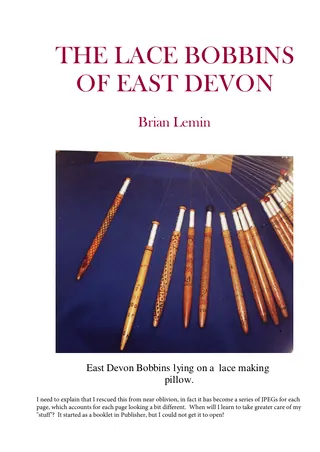
An illustrated booklet by Brian Lemin (2002) on the decorated lace bobbins used in East Devon, the Honiton lace area. It gives a brief history of Honiton lace and its trade, then describes standard and trolly bobbins, decoration methods (riggled rings, nitric acid staining, carving, painting, bone bobbins) and motifs such as ships, hearts, bricks, flowers, birds and mermaids. It discusses links to sailors' scrimshaw and ends with an appendix on the sloop Asp, which appears on bobbins, with an excerpt from Jane Austen's Persuasion. Most pages carry photographs of bobbins from museum and private collections.
Lacemakers Lamps
Brian Lemin · 2003
Web Doc · 12 pages
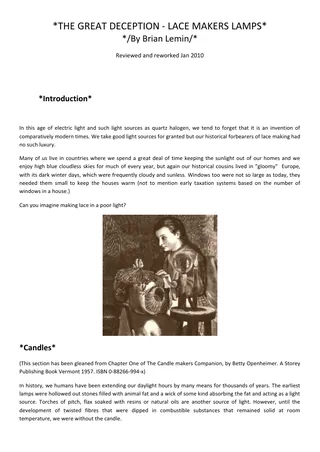
An article by Brian Lemin on the lighting used by bobbin lace makers, tracing the history of candles and rush lights and describing candle stools with water-filled magnifying flasks. It covers regional variants (English, Danish, Swiss, New England) and the custom of sharing light by rank around the stool. The author argues that the glass 'lace makers lamps' sold by antique dealers are really oil lamps rather than magnifiers, and closes with an annotated bibliography of lace and bobbin references.
A Most Unusual Lace Bobbin from a Surprising Source
Web Doc · 18 pages
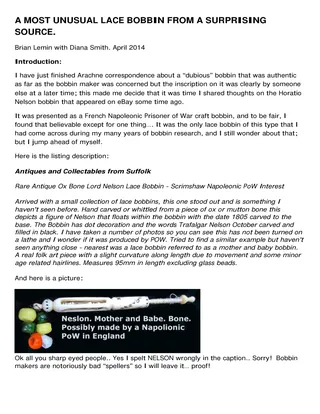
A 2014 article by Brian Lemin with Diana Smith examining a carved bone "Mother and Babe" lace bobbin, sold on eBay, whose floating figure is said to depict Admiral Nelson and which was offered as the work of a French Napoleonic prisoner of war. Lemin reviews evidence that French prisoners in British camps such as Portchester and Norman Cross made lace, bone crafts and possibly bobbins, compares decoration on bobbins, a PoW whistle and teething rings, and weighs the bobbin's origin. He concludes it is most likely a naval Napoleonic PoW carving, with a British naval or general hand-carved bobbin as alternatives. The article ends with web references and excerpts on PoW camps and machine lace.
Naive Decorations on East Devon Bobbins
Brian Lemin · 2014
Web Doc · 8 pages
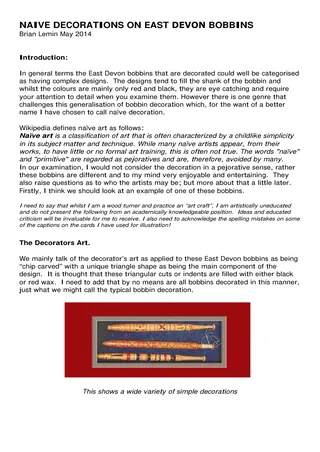
A May 2014 illustrated article by Brian Lemin on the simple, childlike ('naive') decorations found on a minority of East Devon lace bobbins, set against the usual chip-carved triangles filled with red or black wax. He speculates on who decorated them (shop decorators, young men giving bobbins on St Valentine's Day, children, sailors) without reaching a firm answer. Most of the document is a captioned gallery of photographed bobbins showing anchors, suns, fish, a cat, foliage, spirals, initials and dates, divided into 'primitive inclusions' and 'total primitive' designs.
Names and Descriptions of Shapes/Designes Found Lace Bobbins
Brian Lemin · 2011
Web Doc · 6 pages
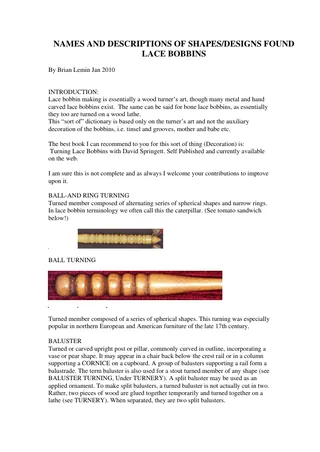
A short illustrated glossary by Brian Lemin (January 2010) naming and describing turned shapes found on lace bobbins, such as ball-and-ring (caterpillar), baluster, barley-sugar twist, reel-and-bead, sausage, sunk bead and straight taper. Each entry has photographs of bobbins or turned sections, and many definitions are borrowed from furniture-turning terminology. The final page covers lace-bobbin-only terms such as tomato sandwich, bees knees, waisted/belted, collars and bishop's crozier.
Naming Types of East Devon (Honiton) Bobbins
Brian Lemin · 2020
Web Doc · 9 pages
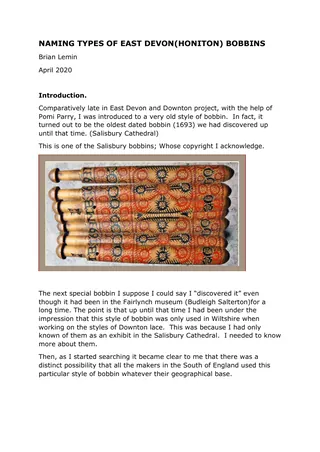
A short illustrated web article by Brian Lemin (April 2020) on how to name and classify the bobbins used by East Devon (Honiton) lacemakers. It discusses the 'trolly' bobbin, gimp bobbins, plain 'sticks', and decorated types such as the Branscombe 'wriggled' bobbins, with notes on dated examples from Salisbury Cathedral and the Fairlynch Museum. Photographs show decorated bobbins with ship, sun, Peace and railway-train motifs and inscribed examples.
71 documents found