Textile Documents › Publications › Publication: International Studio
24 documents found
Sort: 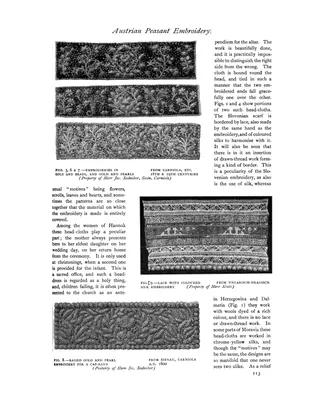
Austrian Peasant Embroidery
Article · 8 pages
An illustrated 1906 article from The International Studio by A. S. Levetus on the peasant embroidery of the Austrian Empire's provinces, including Moravia, Bohemia (Egerland), Carniola, Dalmatia, Herzegovina, Salzburg, Upper Austria and the Tyrol. It describes head-cloths, shirts, cuffs, caps, neckerchiefs, chalice covers and belts, along with their motifs, colours, stitches (cross, satin, plaited, drawn-thread, gold and pearl relief work), materials, and the customs attached to them. Twenty-one photographed figures show pieces from museum and private collections.
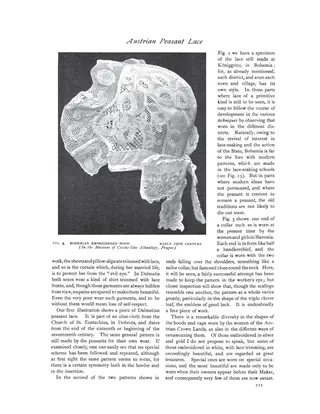
Austrian Peasant Lace
Article · 10 pages
A 1904 International Studio article by A. S. Levetus surveying the lace and whitework embroidery of peasant women in the Austrian Crown Lands (Dalmatia, Bohemia, Moravia, Wallachia, Slavonia, Tyrol, Ruthenia). It describes head-dresses, hoods, collars, churching shawls, bed curtains and sleeves, along with their motifs (heart, apple, rose, clover-leaf, cock) and their drawn-thread and cord-stitch techniques. Fifteen photographed examples, ranging from the 16th century to modern lace-school work, accompany the text.
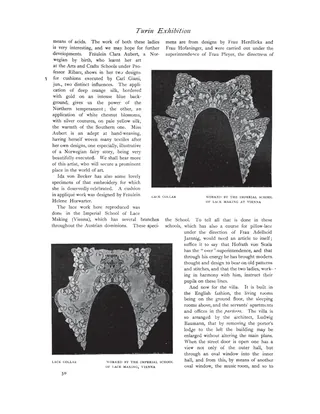
Austrian Section at the Turin Exhibition
Article · 6 pages
A 1902 International Studio article by A. S. Levetus reviewing the Austrian section at the Turin International Exhibition of decorative arts. It describes the Austrian pavilion and villa designed by Ludwig Baumann, furniture, glass, metalwork, enamel, leather and pyrogravure exhibits, and room interiors. Textile content is brief: cushions designed by Clara Aubert (who also hand-weaves), embroidery by Ida von Becker, and lace collars and a 'Sun' lace handkerchief from the Imperial School of Lace Making in Vienna and the lace school at Drosan, Bohemia.
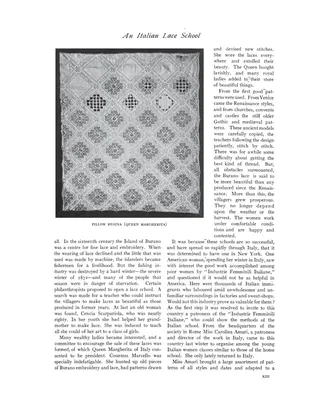
Italian Lace School in New York; Second Notice
Article · 8 pages
Article by Eva Lovett describing the Scuola d'Industrie Italiane, a lace and embroidery school for Italian immigrant girls at 28 Macdougal Street, New York, modeled on the Industrie Femminili Italiane schools in Italy. It covers the founding of the school, Carolina Amari's role, the Burano lace revival, working conditions and wages, and the stitches taught (punto reale, punto riccio, reticella, punto traforo, filet darning). It closes with a short history of the move from embroidery to reticella and pillow lace. Illustrated with photographs of reticella covers, pillows, bags and a copy of a Roman blouse.
Japanese Ornamental Basket Work
Article · 10 pages
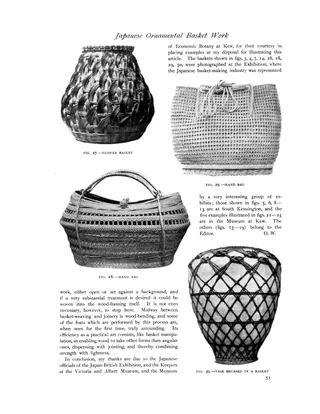
An illustrated 1911 magazine article on Japanese ornamental basketry, with a long quotation from Prof. Jiro Harada on bamboo baskets in Japan. It covers charcoal, flower, fruit, egg and lunch baskets, handbags and tobacco pouches, along with materials (bamboo, rattan, vine, willow), regional makers, and structural methods. The author compares basketry with weaving, argues for developing basket-making as an art craft in England, and links basket interlacing to Celtic and Norse ornament. Thirty figures show baskets from Japan, Burma and Formosa, including photographs of basket-weavers and sellers.
Lace and Lace Making at the Pratt Institute
Article · 4 pages
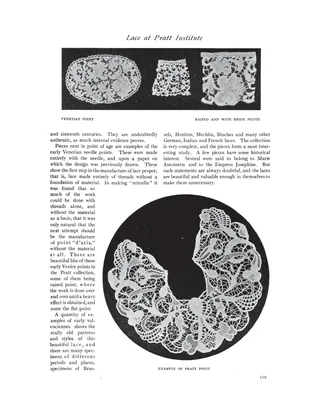
A 1907 magazine article by Eva Lovett describing the lace collection acquired by the Lace and Embroidery Section of Pratt Institute in Brooklyn and the school's teaching methods. It surveys the roughly 900 to 1,000 specimens, from early drawn work, cut work and reticella to Venetian needle points, Valenciennes, Brussels, Honiton and Mechlin. It also explains the Pratt approach of original design, conventionalized nature motifs, and learning stitches in coarse thread, leading to the heavy 'Pratt point' lace used for hangings and trimmings. Illustrated with photographs of lace specimens and student work.
Lace Collection at the Metropolitan Museum; First Notice
Article · 6 pages
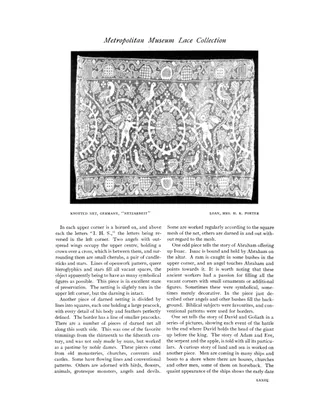
A 1906 International Studio article by Eva Lovett reviewing the newly arranged lace collection at the Metropolitan Museum of Art in New York, organized by the Viennese lace expert Frau Stephanie Kubasek. It surveys the chronological display, from Coptic openwork caps and darned netting (Netzarbeit) through drawn and cut work, Punto a Reticella and Punto in Aria needle laces, to Venetian points and early bobbin lace. Illustrated with six photographs of museum pieces, including German knotted net, Italian punto a maglia quadrata, and sixteenth-century needle point.
Lace Collection at the Metropolitan Museum; Second Notice
Article · 6 pages
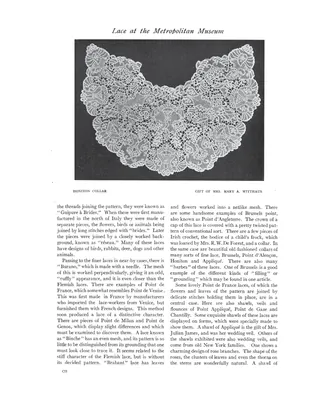
Second of two notices by Eva Lovett on the lace collection at the Metropolitan Museum of Art, New York, as displayed in 1906. It briefly traces the origin of needle and bobbin lace, then surveys the exhibited pieces: Venetian Rose Point, Flemish flounces, Brussels, Italian guipures, Point de France, Honiton, Alençon, Chantilly, Spanish and Limerick laces, plus Napoleonic pieces and curiosities. It closes with a framed demonstration of the division of labor in lace-making and a note on how the collection was acquired through gifts and loans. Illustrated with photographs of rose point, a cape, a Honiton collar, and several shawls.
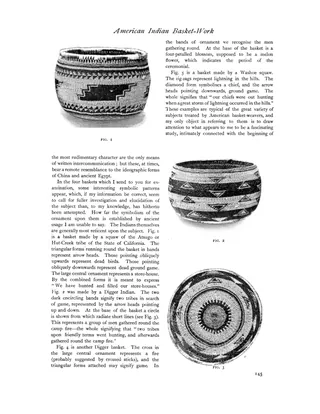
Letter to the Editor on the Subject of American Indian Basket-Work
International Studio, 1903
Article · 3 pages
A short letter to the editor of International Studio, signed "Traveller," on the symbolism in the ornament of North American Indian baskets. The writer describes five illustrated baskets, made by Atsugo (Hut-Creek), Digger and Washoe weavers, and explains what the triangles, arrow heads, zig-zags and central ornaments are said to represent, such as hunting, game, store-houses, camp fires and lightning. The letter calls for further study of the symbolism and its link to the origins of ornament and art.
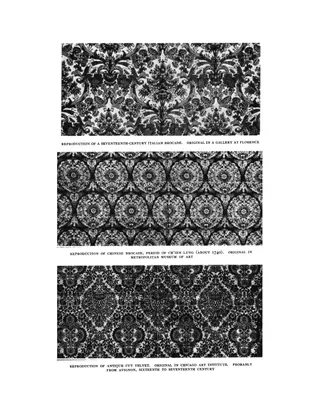
Made in America
Article · 4 pages
A 1919 International Studio article on an exhibition at the Cincinnati Museum of reproductions of historic silks woven on Jacquard looms by Cheney Brothers. It describes brocades and velvets copied from French, Italian, Chinese, Persian, Spanish and Sicilian originals, including pieces from Le Petit Trianon, the Metropolitan Museum and the Chicago Art Institute. The text stresses design history and American manufacturing achievement. Illustrations show originals alongside their reproductions.
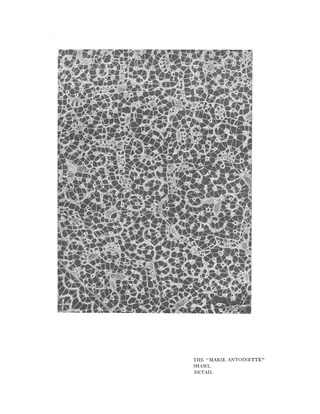
Marie Antoinette Shawl
International Studio, 1907
Article · 3 pages
A short article from International Studio describing a lace shawl traditionally called the "Marie Antoinette" shawl, in guipure antique / point de France style. It gives the provenance: made for Queen Marie Leszczynska, passed to Marie Antoinette, then through a line of French noblewomen to its owner, Vicomte de Tardy de Montravel. It also gives the triangular shape and dimensions. Two pages of photographs show the whole shawl and a detail of the pattern.
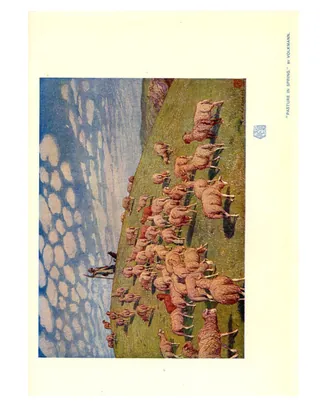
Pasture in Spring
Illustration · 1 page
A single color plate titled "Pasture in Spring" by Volkmann, reproduced from International Studio. It shows a flock of sheep grazing on a green hillside beneath a blue sky, with a shepherd at left and a stone outcrop at upper right. The page carries only a caption and has no weaving content.
Revival of Lace-Making in Hungary
Article · 6 pages
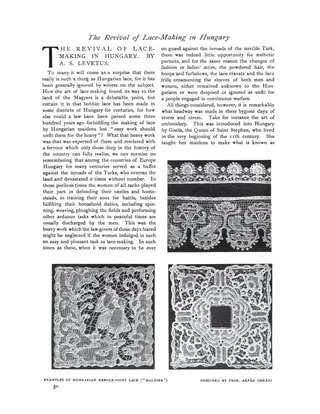
A 1911 article by A. S. Levetus on the revival of lace-making in Hungary, which began in 1906 through the efforts of Archduchess Isabella and Countess Ilona Batthyany. It covers the history of Hungarian embroidery, bobbin, drawn-thread and filet lace, and the introduction of needle-point lace (Halászer) by Prof. Arpád Dekáni. It also describes the organization of the Royal Lace Schools in Budapest, teacher training and provincial lace centers. Illustrated with halftones of needle-point and pillow lace by Dekáni, Örkény and Szendröi, and Gizella Mirkovszky, plus a soutache-embroidered cushion.
Revival of Needlework in Italy
Article · 9 pages
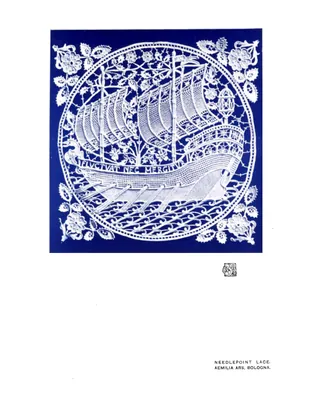
A 1914 article from International Studio by Elisa Ricci, translated by Miss C. Macfarlane, on the revival of lace-making and needlework in Italy after the mid-19th-century decline. It traces the revival of Burano point lace in Venice in 1872, the Aemilia Ars society in Bologna and its reticello lace, and the Industrie Femminili Italiane cooperative founded in Rome in 1903. Illustrated with photographs of needlepoint lace, coverlets, cushion covers and crochet from the Aemilia Ars, Beccadelli and Maraini workshops.
Some Experiments in Embroidery
International Studio, 1903
Article · 5 pages
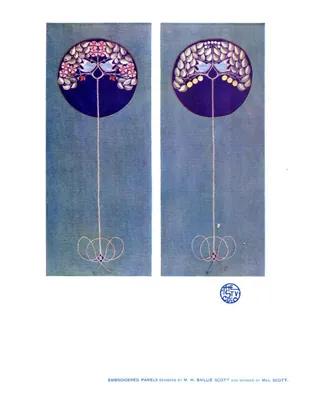
An article by architect and designer M. H. Baillie Scott on his experiments in embroidery, arguing for simple stitches, large appliqué pieces, and concentrated areas of rich materials such as silk, gold, silver and imitation jewels. He discusses dark-on-light, light-on-dark and mosaic approaches to design, braid and ribbon outlines, satin stitch, and the placement of needlework in the home (walls, overmantels, curtains, bed hangings, cushions, even garden flags). Illustrations show his designs for a portière, bedspread, cushion covers, panels and an overmantel, worked by various amateur embroiderers.
Some Modern Austrian Pillow and Point Lace
Article · 10 pages
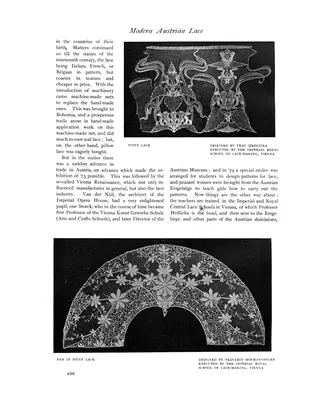
Article from The International Studio (1903) on the revival and modernization of Austrian pillow and needle (point) lace. It traces the history of lace-making in the Erzgebirge, Tyrol and Bohemia, the role of Professor Storck and the Vienna Kunst Gewerbe Schule, and the new designs by Frau Hrdlicka, Fräulein Hofmanninger and others. Technical points covered include raised contours, the construction of holes in point lace, and the joining of stems in pillow lace. Illustrated with photographs of tablecloths, fans, collars and handkerchiefs executed by the Imperial Royal School of Lace-Making, Vienna.
State Schools for Lace-Making in Austria
Article · 12 pages
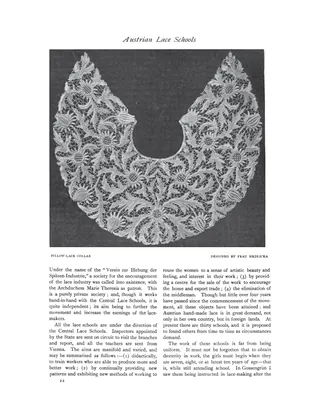
A 1904 article by A. S. Levetus describing the Austrian state-run lace schools (Fachschulen) and the Central Lace School in Vienna. It covers the social and economic need for home industries among poor rural women, the training of teachers, the elimination of middlemen, and the role of the Verein zur Hebung der Spitzen-Industrie. It also names the designers (Hofmanninger, Hrdlicka, Unger) and the regional schools such as Graslitz and Gossengrün. Illustrated with photographs of needle-point, pillow-lace and crochet collars, borders, a fan, drawn-thread work and blouse embroidery.
Studio Talk (Irish lace)
International Studio, 1921
Article · 4 pages
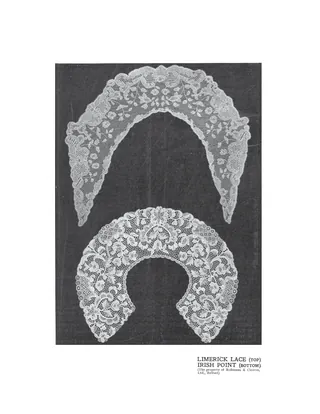
A short 1921 'Studio-Talk' report from Belfast on the Irish lace industry, prepared to accompany photographs of Limerick lace and Irish point lace from Robinson & Cleaver. It explains that Irish laces copy continental models and traces the 1846-48 famine-era convent origins of Irish point at Youghal. It also briefly covers Limerick, Carrickmacross, Rose Point (Inishmacsaint), Irish crochet and tatting, with the main centres of each, and closes on the economic and educational value of lace-making.
Studio Talk (lace)
International Studio, 1919
Article · 2 pages
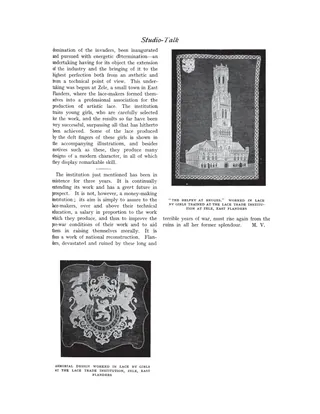
A short 1919 note from the Studio-Talk column of International Studio, datelined Ghent, on Belgian lace-making after the First World War. It describes a lace trade institution at Zele, East Flanders, founded about three years earlier under the occupation, which trains selected young girls in artistic lace and pays them wages in proportion to their output. Illustrated with lace panels of Guido Reni's Ecce Homo, the Belfry at Bruges, and an armorial design.
Textile Arts in Sweden
Article · 8 pages
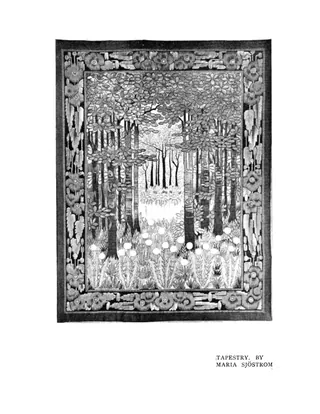
A 1906 magazine article by Axel Tallberg surveying contemporary Swedish textile arts and their roots in regional folk patterns. It describes the role of the Northern Museum in Stockholm, the main societies that promote textile home crafts (Svenska Slöjdföreningen, Handarbetets vänner, Föreningen för Svensk Hemslöjd), and commercial firms such as Nordiska Kompaniet's textile department and Gjöbel's. Illustrated with photographs of tapestries, embroidered cushions, portières, table covers and wallhangings by named Swedish designers.
Textiles at Newark
Article · 2 pages
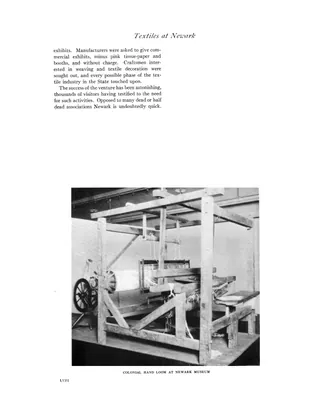
A short 1916 International Studio article describing the textile exhibition at the Newark Museum in New Jersey, organized under director John Cotton Dana. The exhibition traced textiles from fibre to yarn to cloth, showing spinning and weaving from primitive devices to modern machines, with a colonial loom, spinning wheels, colonial coverlets and homespuns. The author also covers how the museum involved club women, immigrant communities, schools, manufacturers and craftsmen. Illustrated with photographs of spinning wheels and a colonial hand loom.
Troupeau dans la Dune [Flock on the Dune]
Illustration · 1 page · French, English
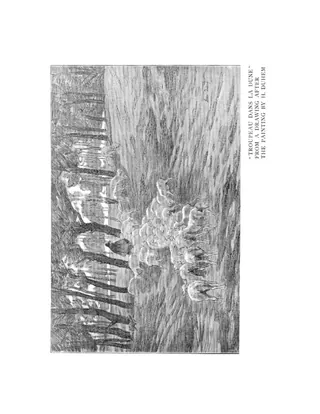
A single-page printed illustration of a flock of sheep crossing a dune landscape, with a shepherd and figures at the left. It reproduces a drawing after a painting by H. Duhem, as published in The International Studio. It has no weaving content and is of interest mainly for pastoral or sheep imagery.
Weaving in a Westchester Farm House
Article · 3 pages
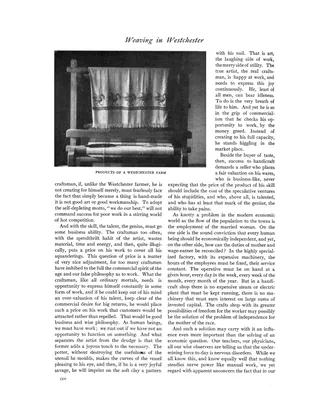
A 1906 essay on the revival of hand weaving and other handicrafts on an isolated Westchester County, New York farm, where a family wove textiles and made furniture and copper utensils in off-hours from farm work. Blatch argues for the economic and social worth of handicraft, discussing consumer demand for hand-made goods, the example of William Morris and Ruskin, the craftsman's need for skill and business sense, and craft work as a solution for married women's employment. It includes photographs titled 'Products of a Westchester Farm' and 'At the Loom'; there is no technical weaving instruction.
Youghal
International Studio, 1903
Article · 1 page
A short article on Youghal lace, an Irish needle-point lace worked stitch by stitch without a foundation. It recounts how Mother Margaret Smyth of the Presentation Convent, Co. Cork, began the industry in the famine year of 1847 by unravelling a scrap of old Italian lace to learn its construction. It also describes how the workers invented new stitches, the durability of the lace, and its value as livelihood for local women and girls.
24 documents found