Textile Documents › Topic: Knotted pile: rya and flossa
82 documents found
Sort: 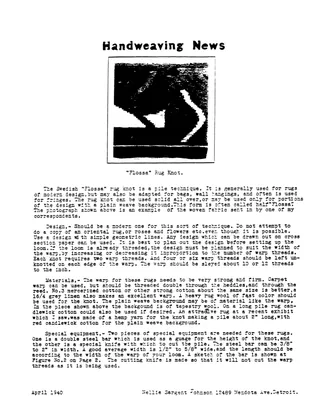
Handweaving News (April 1940): "Flossa" Rug Knot
Periodical · 3 pages · weaving drafts
An April 1940 Handweaving News article by Nellie Sargent Johnson explaining the Swedish "Flossa" pile rug knot. It covers design planning, warp and yarn choices, the gauge bar and pile knife, step-by-step knotting and edge build-up, and ways to finish the rug. It ends with a rug design grid by Elizabeth Bates and a supplier for yarns and tools.
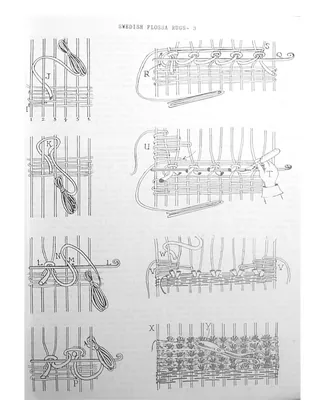
Flossa or Pile Rugs, Folio 13
Monograph · 5 pages
Folio 13 from the Osma Gallinger Tod Studio gives instructions for weaving Flossa (Scandinavian knotted pile) rugs. It compares Flossa with Rya and Half-flossa, and covers materials, planning designs on square-ruled paper, and the step-by-step knotting technique with a gauge bar. The steps include binding rows with tabby, cutting the pile, weaving wool triangles into the selvage, and clipping the surface, with substitute equipment suggested. The final page shows four Flossa rug designs, and diagrams illustrate the knotting steps.
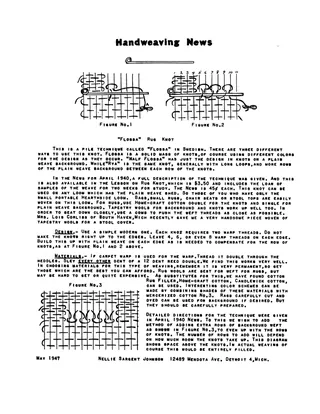
Handweaving News (May 1947): "Flossa" Rug Knot
Periodical · 3 pages · weaving drafts
A short piece from Handweaving News (May 1947) by Nellie Sargent Johnson on the Swedish "Flossa" pile rug knot, which is also used for "half flossa" and rya. It covers design, warp setup, sleying and suitable materials, with diagrams showing how to add background weft rows to even up with the knots. A second article gives details of a half flossa rug woven at the Detroit Handweaver's Guild, with a block chart and notes on the size, warp count, knot count and weft. A final page lists accessories, suppliers and references for flossa rugs and illustrates the Ghiordes (Turkish) knot.
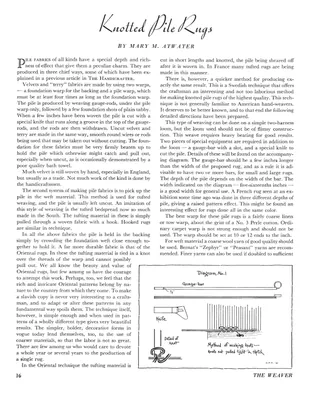
Knotted Pile Rugs
Article · 3 pages · weaving drafts
Mary M. Atwater's article from the first issue of The Weaver explains how to make knotted pile rugs using a Swedish technique on a simple two-harness loom. It briefly compares other pile methods (velvet and terry, tufted weft pile, hooked rugs) with Oriental-style knotting. It gives step-by-step directions for tying knots over pairs of warp threads with a slotted gauge-bar and pile-cutting knife, and recommends warp and weft yarns, sett, and quantities. It includes illustrations of rugs and four grid-based pattern designs with warp counts for two rug widths.
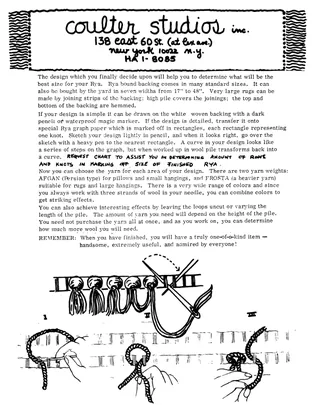
Rya
Other · 3 pages
A three-page promotional handout from Coulter Studios, New York, about rya rug making. It gives a short history of rya from Scandinavia, explains how to knot rya with the Ghiordes knot on a linen backing using a needle, and describes planning an original design with a cartoon and special rectangled graph paper. Illustrations show the knotting steps and the graphing steps.
Rya of Finland
Article · 5 pages
A short 1923 article by Eugene Van Cleef (Ohio State University) introducing the hand-knotted Finnish rya rug as a peasant craft. It covers the shift from geometric designs to symbolic center fields with foreign motifs in the 18th century, the use of ryas as wall hangings, counterpanes and bridal gifts, and the individuality of design and regional color. It stresses the value of the old dyes and colors. Two full-page photographs show an early geometric rya and a rya dated 1804 with a zigzag border.
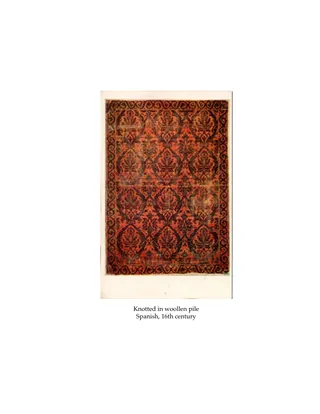
Picture postcard
Carpet, c. 1500-1599
Ephemera · 1 page
A single picture postcard showing a photograph of a carpet with a red ground and dark brown or black scrolling damask-style motifs. The motifs are arranged in rows of stylized lobed medallions with floral sprays, within a scrolling foliate border. The caption reads 'Knotted in woollen pile, Spanish, 16th century.'
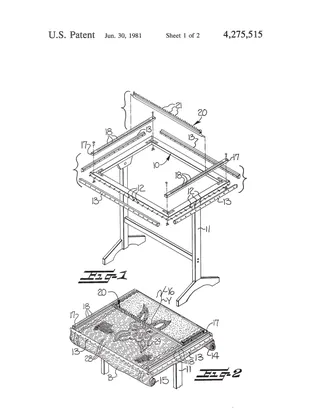
Apparatus for Making a Handcrafted Pile Rug, US Patent No. 4275515
Patent · 16 pages
US Patent 4,275,515 (Betty R. Hinson, granted 30 June 1981) for a frame-and-guide apparatus for making handcrafted pile rugs. A backing fabric is stretched on a pinned rectangular frame, and a comb-like pile forming guide set at adjustable heights holds yarn loops while each tuft is sewn and knotted into the backing with a needle, giving uniform pile spacing and height. The document includes the USPTO web printout (abstract, claims, description) and the original patent print with two sheets of drawings (Figs. 1-9).
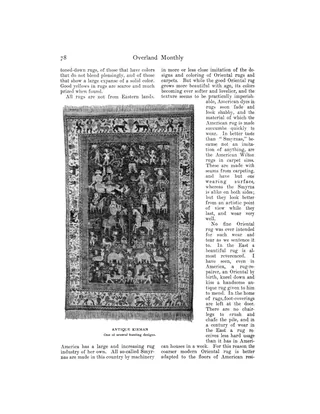
Fine Rugs
Article · 9 pages
A 1900 magazine article from Overland Monthly offering an amateur's guide to Oriental rugs at the height of the American rug-collecting craze. It surveys the main Persian, Turkish, Central Asian and Indian rug types, explains how rugs are knotted on a frame, and discusses knot counts, materials, prices, antique versus modern rugs, bleached imitations, and the meanings of designs such as the palm-leaf, prayer-rug and hunting-carpet patterns. It closes with advice on buying and a comparison with American-made Smyrna and Wilton rugs. Illustrated with halftone photographs of Kirman Shah, Serabend, Bokhara, Kasak, Shirvan, Cashmere, Kirman, Khorasan and Sinneh rugs.
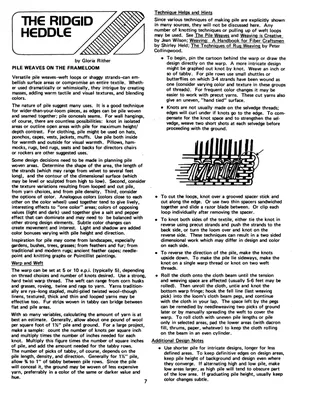
Personal Thoughts on Natural Dyeing
Article · 2 pages
Two pages from the Minnesota Weaver (November 1976), containing Gloria Rither's "The Ridgid Heddle" column on pile weaves on the frame loom, followed by Weavers' Guild "School News". The column covers design planning, warp and weft choices, yarn estimates, and techniques for cutting loops, knotting both sides, reversing pile direction, and rolling cloth with pile. The school news lists November classes, an open house exhibit, and the January interim program. Nothing in the text matches the catalogued title, Connie Magoffin's article on natural dyeing.
Turkey Carpet
Article · 1 page
A short dictionary entry describing how Turkey carpet is made, with a linen warp and weft and tufts of worsted tied in during weaving. It compares the upright hand loom of Eastern countries, where tufts are tied around pairs of warp threads, with the European Turkey-carpet loom. It covers the sequence of tuft rows and weft shots, beating down, the narrow breadths joined to form large carpets, and shearing of the pile.
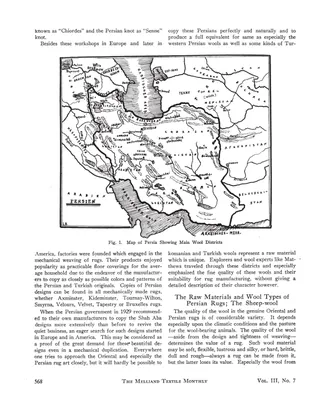
Genuine Persian Rug, Part 1
Article · 4 pages
The first part of an article on genuine Persian rugs from a 1931 trade journal. It outlines the history of Oriental rug weaving, from antiquity through the Safavid period to the spread of rugs to Europe and America and their imitation in European and American workshops and power looms. It then begins a survey of the raw materials, covering sheep wool, goat hair (Kurk) and camel hair in each Persian wool district and the effects of pasture and climate on quality. It includes a map of Persian wool districts and photographs of a bridge near Mianeh and of wool-sorters in Tabriz. The article ends with "To be continued".
Genuine Persian Rug, Part 2
Article · 5 pages
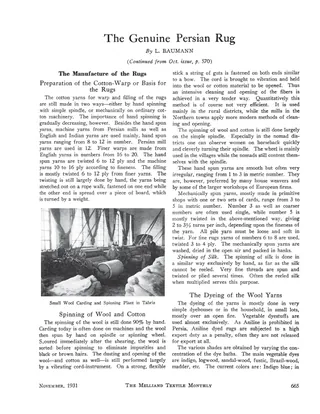
Second installment of L. Baumann's series on the Persian rug, covering how the rugs are made. It describes spinning and preparing cotton, wool and silk yarns, vegetable dyeing, the knotted-pile loom and the three knot types used in Persia, shearing and washing, and the colors, motifs and symbolism of Persian rug design. Illustrated with knot diagrams and photographs of Tabriz workshops and rug designs.
Warp & Weft, Vol. 7, No. 9 (November 1954)
November 1954
Periodical · 8 pages · weaving drafts
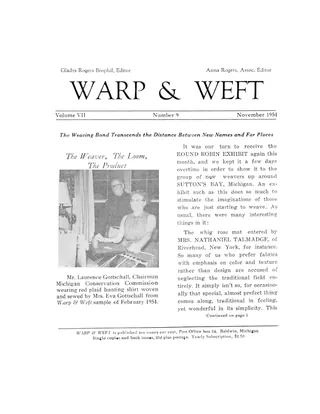
November 1954 issue of Warp & Weft, a small Michigan handweaving newsletter. It features a couturier suit fabric with a 4-shaft counterbalanced draft in burgundy and old rose Bernat yarns, including sley, spool rack and treadling notes. Other items include an article on weaving fabrics for suits and coats, a short piece on Swedish Rya and Flossa rugs, a report on a Round Robin exhibit, a review of Donald Stewart's The Setts of the Scottish Tartans, a Questions & Answers entry on combining nylon and wool, tips, a poem, and classified ads from weaving suppliers.
Carpet
Article · 10 pages
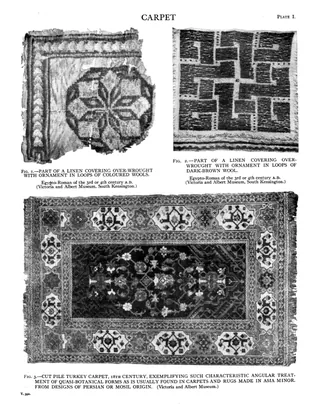
Encyclopedia Britannica (11th ed.) article on carpets covering their definition, etymology, and history from ancient Egypt, Assyria and Greece through Egypto-Roman looped textiles to later pile carpets. It describes the Oriental hand-knotted method and surveys carpet making in Persia, Turkey, India, Spain, England and France, followed by the introduction of Jacquard and steam power looms in the 19th century. Four plates illustrate Egypto-Roman loop-worked linens, Turkey, Persian, Lahore and Spanish cut pile carpets, and the Ardebil carpet; a bibliography closes the article.
Handwoven Rugs
Monograph · 33 pages · weaving drafts
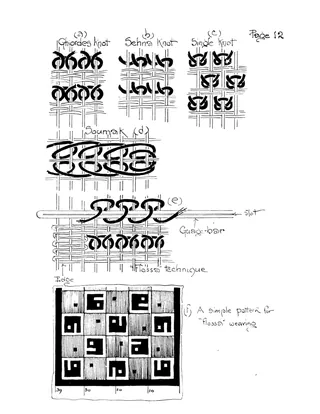
A 1948 monograph by Mary Meigs Atwater, reissued by HTH Publishers, giving concise directions for weaving rugs by hand. It covers equipment and materials, plain-weave rag and chenille rugs, Swedish twice-woven and matta techniques, picked-up tufting, knotted pile (Ghiordes, Sehna, flossa, rya), soumak, overshot, no-tabby and Indian saddle-blanket weaves, crackle, summer-and-winter, and the two-warp technique with pick-up patterns. It ends with fringe ties and closing advice. Pages are hand-lettered and illustrated with many diagrams, drafts, and pattern grids.
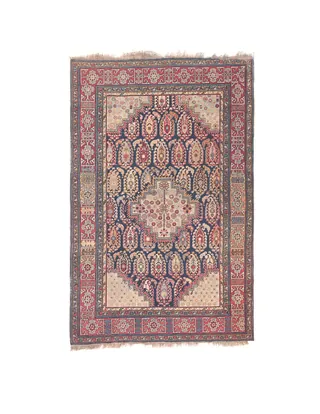
Oriental Carpets, Runners and Rugs and Some Jacquard Reproductions
Book · 507 pages
A 1910 London book on Oriental carpets, runners and rugs, with Jacquard-woven reproductions. It is built around numbered plates of knotted pieces, each captioned with size, warp and weft knots per inch and knots per square inch, followed by an analysis of each piece. The long discursive chapters (Allegory, Contemporary Arts, Carpets Runners and Rugs, Romance) range widely over mythology, Greek and Roman art, book collecting, and carpet prices and history, including the Ardabil carpet. Later sections cover Joseph Marie Jacquard and the Jacquard machine, Brussels and velvet pile carpets, and a comparison of printing and carpet weaving. Bibliographic lists and a detailed index close the volume.
The Bulletin of the Needle and Bobbin Club, Vol. 7, No. 2 (1923)
Periodical · 43 pages
Issue of the Bulletin of the Needle and Bobbin Club (Vol. 7, No. 2, 1923) with articles on lace, rugs and silk. Madame L. Paulis, translated from the French, traces the development of the drochel, the hexagonal bobbin-lace net ground of Brussels lace, with diagrams of the braiding and joining. Eugene Van Cleef writes on Finnish rya pile rugs. Other pieces cover the Cincinnati Museum lace collection (with a list by country and type), the revival of Danish Tønder lace, and extracts from Ezra Stiles's diary on eighteenth-century American silk culture. The issue ends with club and guild notes, book notes, field notes, officer lists and period advertisements.
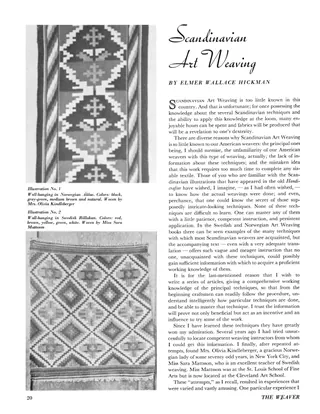
Scandinavian Art Weaving
Article · 6 pages
Introductory article by Elmer Wallace Hickman, the first in a planned series, urging American weavers to learn Scandinavian art weaving techniques. He recounts how he found Norwegian and Swedish teachers, comments on the Swedish Hemslöjd (home craft) movement, and catalogs about twelve principal techniques, including Äklae/Röllakan, Dukegång, Krabba, Flossa, Rya, Upphämpta, Flamskvävnad and Finnweave. Illustrated with photographs of wall-hangings and rugs woven by the author and his teachers, and ending with a list of Scandinavian reference books.
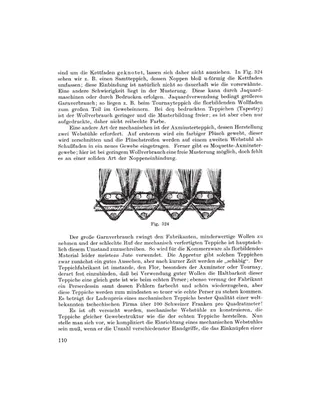
Der Echte Teppich: Praktische Anleitung zur Heimerzeugung von Teppichen in allen Knüpf- und Webetechniken [The Genuine Carpet: Practical Instructions for the Home Production of Carpets in All Knotting and Weaving Techniques]
Book · 167 pages · German · weaving drafts
A 1926 German-language handbook by Leo Arthur on making carpets at home, covering knotted pile rugs (Giordes/Smyrna and Senné/Persian knots), flat-woven kilim and sumak, combined woven and knotted rugs, metal-thread rugs, and tapestry (Gobelin) weaving. It explains warping frames, making heddles, weaving, shearing and finishing, and gives construction plans for looms and knotting frames. Later chapters cover rug washing, care and repair, commercial rug types, home dyeing with recipe tables, pattern design and stencilling, and judging rug value. It is illustrated with 355 figures and a color plate of dye samples.
Weaver, Vol. 1, No. 1 (c. 1935)
Weaver, c. 1935
Periodical · 32 pages · weaving drafts
First issue of The Weaver, a 1930s American handweaving magazine. It opens with a two-part essay by Maria Steinhoff on designing and weaving smart fabrics, covering cost, mixing yarns, color and pattern. Other articles cover knotted pile rugs (Mary M. Atwater), the sixth annual Weaving Institute at Penland, draw-loom style pick-up weaving on a four-harness loom (Nellie Sargent Johnson), rug and drape projects in coarse materials using crackle and summer and winter (W. Clyde Dunbar), and a set of ten scarf patterns with warp colors and drafts.
Double Corduroy
Article · 1 page · weaving drafts
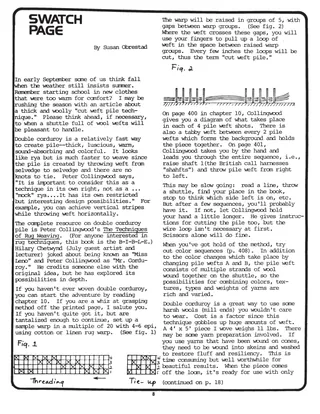
A one-page article from the Swatch Page column introducing double corduroy, a cut weft pile technique for rugs that resembles rya but is woven faster because the pile is thrown selvedge to selvedge with no knots. It directs readers to Peter Collingwood's The Techniques of Rug Weaving (chapter 10) and suggests a sample warp in multiples of 20 at 4-6 epi in cotton or linen rug warp. It also covers yarn choice, color sequences, and the heavy weft consumption. Figures show a 4-shaft threading and tie-up and a diagram of raised warp groups of 5.
Genuine Persian Rug, Part 3
Article · 5 pages
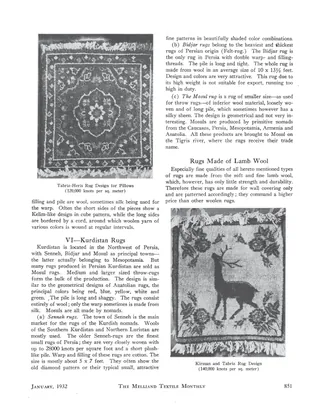
The concluding part of a three-part article from The Melliand Textile Monthly on Persian rugs. It distinguishes nomad, Persian and Turkish/Smyrna rugs, then surveys Persian rug types by region: Azerbaijan (Tabriz, Heris, Karadagh), Turkmenian, Northeast (Chorasan-Meshed), Central (Feraghan, Kashan, Isfahan, Hamadan, Sarabent, Saruk), South (Kirman, Shiras-Kashkai) and Kurdistan (Senneh, Bidjar, Mosul). For each it describes the wool, knot density per square foot, sizes, colors and designs. Illustrations include a map of Persian wool districts and two rug design photographs with knot counts.
Braiding and Hooked Rugs
U.S. Army, 1980
Monograph · 13 pages
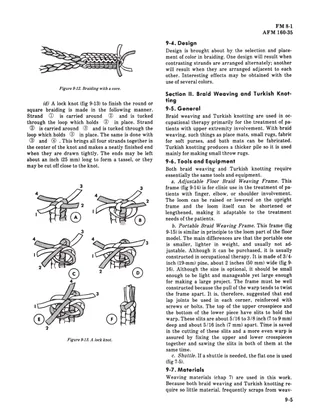
Chapter 9 of U.S. Army/Air Force manual FM 8-1 (AFM 160-35), written for occupational therapy, covering braiding, braid weaving with Turkish knotting, and rug hooking. It gives step-by-step instructions for flat braids (3 to 16 strands), round and square braids, and the lock knot. It also describes floor and portable braid weaving frames, warping and weaving methods, Turkish knot rugs, and hooked rug tools, materials, design, hooking, finishing and safety. Illustrated with numbered line figures.
As the Wheel Turns
Article · 1 page
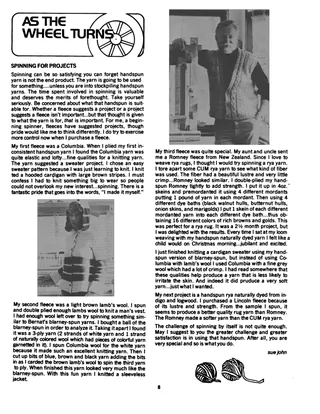
A first-person column from the Minnesota Weaver spinning series in which a beginning spinner describes choosing fleeces and spinning yarn to suit specific projects. She covers a Columbia fleece spun for a knitted cardigan, lamb's wool spun to imitate a commercial blarney-spun yarn, and a Romney fleece spun, mordanted and dyed for a rya rug. She also mentions a planned rya from Lincoln wool dyed with indigo and logwood, and urges spinners to plan what the handspun will be used for.
Dictionary of Textile Terms
Article · 1 page
A page from the 'Dictionary of Textile Terms' series in Posselt's Textile Journal, September 1917, covering entries from Kaai Finish through Kendal. Entries define fabrics, rugs, fibers, wools and finishes, many of Asian, Middle Eastern and African origin, such as Kapok, Kaffir Hemp, Kashmir Silk, Kamiko and Karadagh and Kashgar rugs. Several rug entries note the knot type used (Ghiordes or Senna).
The Magic of Good Design
Article · 3 pages
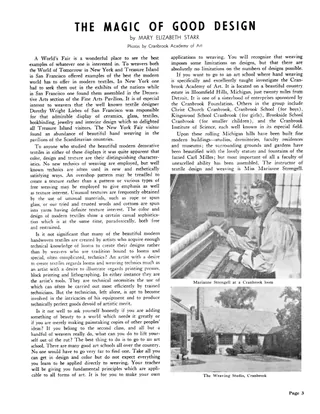
A 1940 magazine article arguing that good design, color and texture matter more in modern handwoven textiles than technical virtuosity. Drawing on the New York and San Francisco World's Fairs, it urges weavers to study design at an art school and presents Cranbrook Academy of Art, where Marianne Strengell teaches textile design and weaving. Photographs show Strengell, the Cranbrook weaving studio and grounds, and her half flossa rugs.
Questions and Answers
Article · 1 page
A question-and-answer column by Mary M. Atwater from The Weaver, July 1936. It explains how to calculate yarn quantities from yarn counts (linen cut of 300 yards, cotton and wool hank of 840 yards), with worked examples for warp yardage and advice on estimating weft and allowing for waste. Shorter answers cover applying warp dressing and where to get gauge-bars and knives for knotted pile rugs. The page also carries the concluding paragraphs of an article on a wall hanging woven in a tapestry-like technique on a rosepath threading with a binder.
Rug Techniques
Monograph · 17 pages
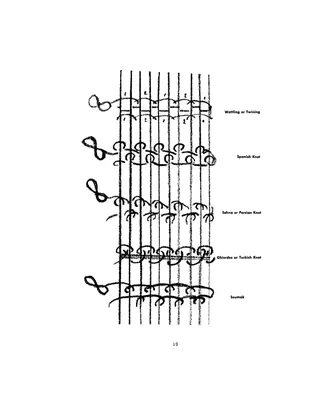
A short handweaving folder by Maria Mundal describing rug and decorative-fabric techniques, written for inexperienced weavers. It gives brief verbal instructions for wattling/twining, soumak, Sehna (Persian), Ghiordes (Turkish) and Spanish knots, rya, floss, tufting (Canadian loop), kelim, aakled, rølakan and rag rugs. One page of line drawings shows the warp-thread paths of several of the knots and stitches. Includes notes on historical origins, Scandinavian use, yarns and finishing.
Rugs and Carpets from the Orient
Book · 112 pages
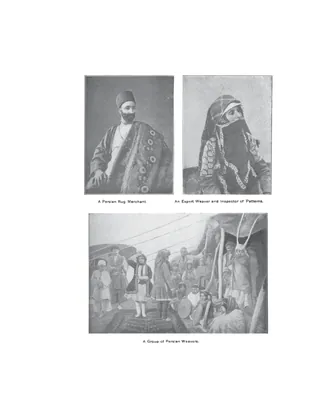
A promotional monograph on Oriental rugs and carpets issued by the H. B. Claflin Company of New York, written by Lawrence Winters for general readers. It covers the history and legends of rug weaving, looms and knotting methods, dyes, the Persian, Caucasian, Turkish and Indian rug types, buying customs in the East, and rug inscriptions. It includes glossaries of Egyptian and Chinese symbols, tables of warp, weft and knot counts by rug type, and many photographs of antique rugs, the Claflin warerooms, and views of Constantinople, including the Bosphorus, mosques and bazaars.
Warp & Weft, Vol. 5, No. 3 (March 1952)
Warp & Weft, March 1952
Periodical · 8 pages · weaving drafts
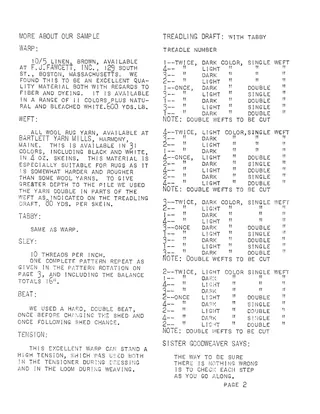
March 1952 issue of the monthly Warp & Weft, edited by Gladys Rogers Brophil. It includes a pile rug project, the Winding Path Rug, with a sample description, treadling draft, threading draft, pattern rotation and tie-up. It also has an article by Anna B. Rogers on double-face, double-weave rugs woven with rag and wool fillers, and a note on tying pile knots to enrich the rug. Other items are a report on an Anni Albers textile exhibit in Buffalo, news notes, a Questions & Answers piece on true versus plastic metallic yarns, and advertisements including a workshop at Baldwin, Michigan.
The Bulletin of the Needle and Bobbin Club, Vol. 40, Nos. 1 & 2 (1956)
Periodical · 50 pages
A double issue of the Bulletin of the Needle and Bobbin Club devoted to a single article by John F. Haskins on the Pazyrik kurgans (frozen tombs) of the Siberian Altai. It covers the excavations by Griaznov and Rudenko, the dating and the identity of the people buried there (Scythians, Massagetae, Ta Yueh-chih), and the preserved textiles of Kurgan Five. These include felt wall hangings with appliqu\u00e9s, felt saddle covers, linen and wool tapestries, Chinese silk with chain-stitch embroidery, and the pile carpet called the world's oldest. The issue has plates and line drawings, endnotes with Russian and Western references, club notes and a list of officers.
Carpets
Chambers's Encyclopedia, 1881
Article · 2 pages
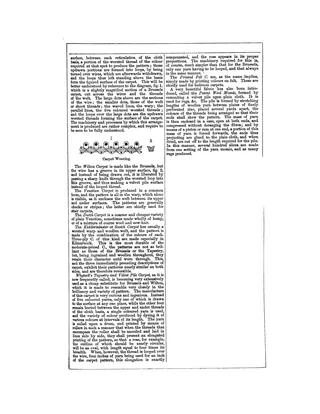
An encyclopedia article from Chambers's Encyclopedia describing the main kinds of woven and printed carpets in use in the 1880s. It covers Turkey, Axminster, Brussels, Wilton, Venetian, Dutch, Kidderminster/Scotch, Whytock's Tapestry and Velvet Pile, printed felt and Patent Wool Mosaic carpets, with notes on materials and manufacture. A diagram of magnified cross-sections shows Brussels and Wilton construction with wires, weft, warp and looped worsted.
Hand Weaving at the New York World's Fair
Article · 5 pages · weaving drafts
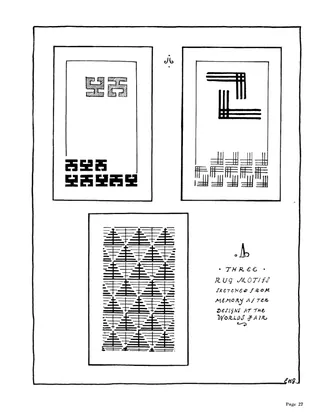
A review of hand-woven textiles seen at the 1939 New York World's Fair, concentrating on the Swedish exhibit from Elsa Gullberg's studio. It covers fringed and long-pile rugs and draperies, Rya and Flossa rugs, and samplers in Finnweave and Dukagang. Shorter sections cover Norwegian tapestry and rugs and the French and Belgian tapestry displays, including the large Floris Jespers hangings. The article includes sketches of three rug motifs and charts of designs suitable for Dukagang or other laid-in techniques. The scan ends with the start of an unrelated item on the National Conference of American Hand Weavers at Hartland, Michigan.
Handweaving News (October 1946): Weaving on the Hearthside Table Loom
Periodical · 3 pages
An October 1946 issue of Handweaving News by Nellie Sargent Johnson on projects for the small Hearthside table loom, which Sears Roebuck sold pre-threaded. She covers beating rag rugs close, covering the warp, and knotted Flossa rag rugs woven by her Wayne University students. Further projects are wool baby blankets, plaid head squares or neck scarves, and heavy curtains with Spanish weave, with a diagram of the Spanish weave method. It has no weaving drafts.
Looming Arts, Vol. 3, No. 6 (November-December 1968)
Looming Arts, November-December 1968
Periodical · 10 pages · weaving drafts
Issue of a small handweaving newsletter published by Mary Pendleton's studio in Sedona, Arizona. It gives directions for a bead leno gauze fabric on four harnesses, an eight-harness open casement fabric called "Mostly Day" with threading, tie-up and treadling instructions, and a knitting pattern for reversible "Mittens for Lovers". Other items include Katy Lee Hadley's account of weaving a rya rug from a Paul Klee design, a tip on avoiding broken selvedge threads, studio news, a 1969 summer school announcement, a poem, yarn sale offers and advertisements.
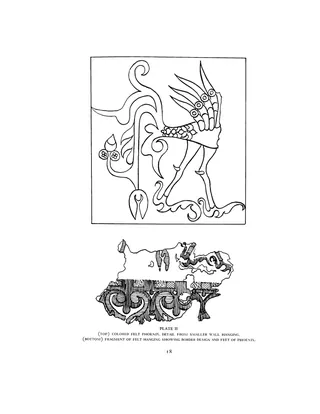
Pazyrik, the valley of the Frozen Tombs
Article · 46 pages
An article by John F. Haskins, based on a 1955 lecture to the Needle and Bobbin Club, on the Pazyryk (spelled Pazyrik) burial mounds of the Siberian Altai and their frozen contents. It covers the Griaznov and Rudenko excavations, the debate over whether the builders were Scythians or Massagetae (Ta Yüeh-chih), and the dating of the finds. The main focus is Kurgan Five and its textiles: felt wall hangings and saddle covers with appliqué, linen and wool tapestries, imported Chinese silk with chain-stitch embroidery, and a knotted-pile woolen rug with elk, griffon and horseman borders. Plates and line drawings illustrate the textiles, and endnotes cite Russian, Chinese and classical sources.
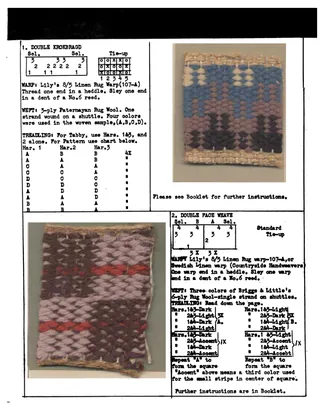
Popular Rug Techniques
Monograph · 19 pages · weaving drafts
A self-published folio booklet by Elmer Wallace Hickman describing twelve handwoven rug techniques, with a companion technique sheet and sample-sheet specifications for each. Techniques covered include Double Krokbragd, Double Face Weave, Rollakan and Aklae, a modern cotton/rayon rug, Soumak, Imitation Tapestry (clasped weft), False Flossa, Flossa, Rya, Rya with Korndrall ground, Stuffer weave and Indian Saddle Blanket weave. It gives warp and weft yarns and suppliers, sett, treadling, tie-ups, knot-tying and selvage methods, and loom modifications such as an added Stuffer warp beam.
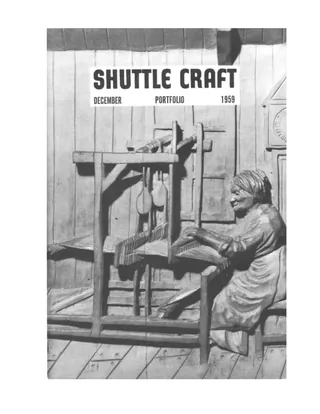
Shuttle-Craft Bulletin (December 1959)
Periodical · 37 pages · weaving drafts
December 1959 Portfolio Edition of Shuttle Craft, the monthly bulletin of the Shuttle Craft Guild (Bedford, Nova Scotia), Volume XXXVI, No. 12. It includes a Christmas wall hanging in flossa and dukagang, the Church Windows sample, and Part III of Evelyn Longard's profile draft series comparing Spot Bronson and Lace Bronson with drafts. It also has plans for the Devereaux Mansion loom, a 16-harness table loom, instructions for adding a second warp beam to LeClerc looms, and Grace Duryea's article on many ways to weave one draft. A Loom Language glossary, the 1959 index, equipment notes and advertisements are included.
Loom Music, Vol. X (1953)
Loom Music, 1953
Periodical · 89 pages · weaving drafts
Bound volume of Loom Music, Volume X (1953), a Canadian handweaving periodical edited by Mary Sandin (Edmonton) and Ethel Henderson (Winnipeg). The issues give project instructions with drafts, tie-ups and treadlings, including M's and O's linen place mats, Brooks Bouquet, rosepath, overshot contemporary treadlings, honeycomb, leno, huck, and a 12-harness upholstery. Other articles cover rya rug techniques, embroidery techniques (laid-in, Dukagong, Guatemalan, French), ecclesiastical weaving, natural fibres such as grass and raffia, stripe proportions, and weaving at the Banff School of Fine Arts. Also included are news items, book reviews, a weaving record sheet, a shed regulator, and an annual index.
A Loom-Master of Iran
Other · 9 pages
A short story, "A Loom-Master of Iran," about an orphan boy from the Persian village of Sofian who is taken in by the caravan merchant Sadak and chooses to become a weaver rather than a farmer, shepherd or merchant. In a carpet factory in Azerbaijan he is made master of the loom on which a copy of the famous Ardebil mosque carpet is woven under an American superintendent. He finishes the carpet while plague spreads through the city, and dies on it. The text is fiction and contains no weaving instruction or drafts, but it gives a romanticized picture of child weavers, knotted-pile carpet work, tools and a bazaar workshop in turn-of-the-century Persia.
Handweaving News (November 1943): "One Beam" or "Broomstick Loom" Weaving
Periodical · 3 pages
A November 1943 issue of Handweaving News in which Nellie Sargent Johnson describes new uses of "broomstick loom" (one-beam) twining. It gives instructions for making a round rug on a loop ring, with rows of rug knots, added warps and a bound edge. It also covers twining variations for belts and bags: separated warps, twisted single warps, and crossed single and double warps. Line drawings (Figures 1-8) illustrate the steps, and the issue closes with subscription notes and a remark on weaving for rehabilitation of returning soldiers.
Handweaving News (c. 1939): Importance of Texture in Handweaving Design
Periodical · 3 pages
A January 1939 article from Handweaving News by Nellie Sargent Johnson on using texture as a design element in handweaving. It reviews her earlier yearly design articles (1934-1938), then suggests texture experiments: striped samplers combining different yarns and threads, and weaving one simple abstract motif in techniques such as laid-in, embroidery weave, tufting, Spanish weave and Ghiordes knot rugs. It also explains how to enlarge designs on squared paper and argues for abstract rather than naturalistic design.
L'Art Oriental: Les Tapis [Oriental Art: Carpets]
P. Chavan, 1908
Other · 37 pages · French
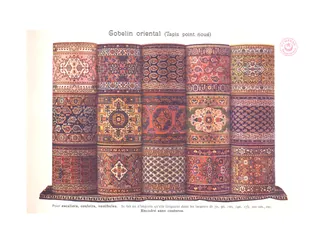
Illustrated sales catalogue (third edition) of the Geneva firm Maison P. Chavan, importer and maker of oriental carpets. It opens with a short essay on the history of the oriental carpet, then presents Turkish, Indian, Persian, antique and Caucasian rugs, kilim portières and silk rugs, with knot counts, regions of origin, colours, approximate sizes and prices. Colour plates show draped carpets, with photographs and engravings of Turkish and Greek sites and decorative objects. It closes with notes on French Jacquard moquette, repair, cleaning and storage of carpets, and a 1911 testimonial letter from a hotel.
Lily Weaving Suggestions, Vol. 2, No. 2 (1977)
Lily Weaving Suggestions, 1977
Periodical · 8 pages · weaving drafts
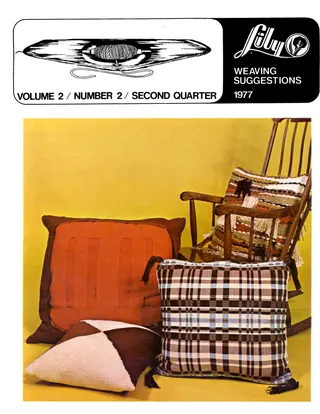
Issue of Lily Weaving Suggestions (Belding Lily Company) devoted to handwoven pillows, with four projects by different weavers. They are a diagonal-fold pillow woven as a single strip on carpet warp, a textured floor pillow built up with mixed yarns, soumak and rya, a three-layer floor pillow in pearl cotton and jute, and a Monk's Belt pillow with color-coordinated warp stripes. Each gives yarn article numbers, sett, warp and weft directions, and sewing and finishing instructions; the Monk's Belt project includes a four-shaft tie-up and treadling for sinking and rising sheds.
Warp & Weft, Vol. 5, No. 12 (December 1952)
December 1952
Periodical · 8 pages · weaving drafts
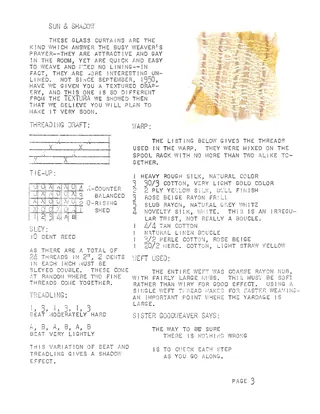
December 1952 issue of the handweaving newsletter Warp & Weft. It opens with an obituary of Ethel Mairet and excerpts from Frances Deere's letter about visiting weavers in Europe. The main pattern is "Sun & Shadow," a textured glass curtain fabric, with a threading draft, tie-up, sley, treadling, warp yarn list and weft notes, plus a page of variations on the sample. An essay on designing textured fabrics, short news items, a review of Mairet's books, a Q&A on flossa and rya rugs, and advertisements fill the rest.
Scandinavian Art Weaving
Monograph · 97 pages · weaving drafts
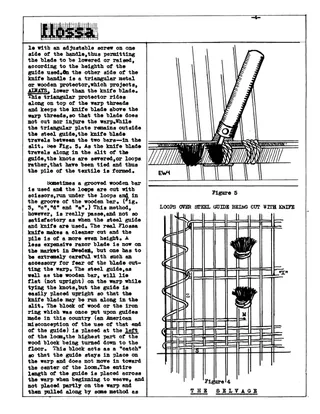
A set of instructional weaving packets by Elmer W. Hickman (Homecraft Weaving Service, Emlenton, Pennsylvania) on Scandinavian art weaving, the 'laid-in' bobbin techniques woven on a loom. It covers bobbin winding, Monk's Belt, Krokbragd, Rosengang (Rosepath) with Swedish pine tree designs, Flossa, Rya and Sniljeflossa pile weaves, Arrow and Lightning weave, Aklae, Dukagang and Krabbasnar/Half-Krabba. Each section gives warp and weft yarn recommendations, threading, sleying and treadling directions, figures of techniques and tools, and many drafts and charted designs. Sample cards, supply sources and the author's commentary ('Tabby Talk') are included.
A Weaver Traveling in Chile
Article · 4 pages
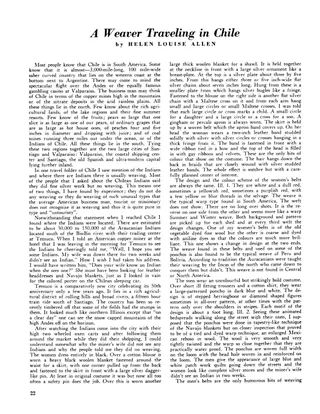
A travel account by weaver Helen Louise Allen describing her visit to Temuco, Chile, to find the weaving of the Araucanian (Mapuche) Indians. She describes women's dress and belts, men's tied-and-dyed warp ponchos, double-weave men's belts, saddle blankets, pile-knotted choapina saddle rugs and saddle bags. She also covers the warp-faced weave structures, the upright looms and how pieces are woven complete from both ends. Illustrated with eight photographs of the textiles she collected; no drafts are given.
Hemslöjden [Domestic Crafts]
Book · 65 pages · Swedish
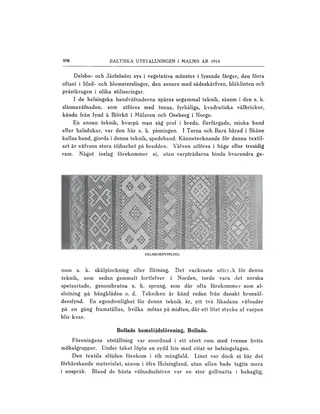
An offprint from the official report of the Baltic Exhibition in Malmö, 1914, surveying the Swedish home-crafts (hemslöjd) section. It opens with a history of the revival of Swedish handicraft from the 1860s to 1909 and the role of the Föreningen för Svensk Hemslöjd and the regional hemslöjd societies. It then goes region by region (Västerbotten, Ångermanland, Jämtland, Dalarna, Hälsingland, Gästrikland, Värmland, Småland, Öland, Halland, Skåne, Blekinge, Östergötland and others), describing the textiles, lace, embroidery, knitting, baskets and furniture each society showed. Many photographs show exhibition rooms, rya rugs, lace, and costumes. There are no weaving drafts, but techniques such as rödlakan, krabbasnår, dukagång, rosengång, opphämta and rya are described.
Loom Music, Vol. VIII (1951)
Loom Music, 1951
Periodical · 97 pages · weaving drafts
Bound volume of Loom Music for 1951 (Vol. VIII, nos. 1-10), a Canadian monthly of weaving instruction written by Mary Sandin (Edmonton) and Ethel Henderson (Winnipeg). Each issue is a themed project set with full warp, threading, sleying and treadling details, tie-ups for counterbalanced and jack looms, and yarn sources. Topics include fine and heavy linen table pieces with spaced denting and crackle, upholstery fabrics in overshot, aprons in rosepath and snowball with Italian-style treadling, Flossa and half-Flossa rugs, warp-stripe belts and bags, boucle drapery fabrics with a Swedish pattern translation, card (tablet) weaving, boucle inlay place mats, M's and O's and other towels, and bags. The volume ends with an annual index.
82 documents found