Textile Documents › Topic: Band weaving and narrow fabrics
237 documents found
Sort: 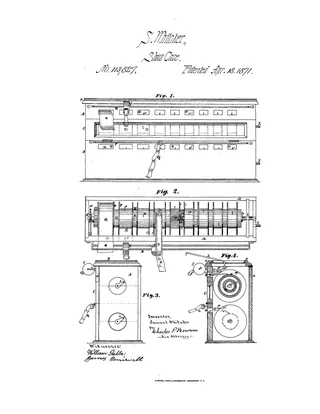
Show Case, US Patent No. 113827
Patent · 2 pages
US Patent No. 113,827, granted April 18, 1871 to Samuel Whitaker of Macon, Illinois, for a display and dispensing case for ribbons, laces and similar goods. Each spool of ribbon or lace sits on a shared crank-turned shaft with spring pressure, so any coil can be drawn out to the desired length without disturbing the others. Measuring tapes are attached to the case. The first page has patent drawings (Figs. 1-4) and the second has the specification and three claims.
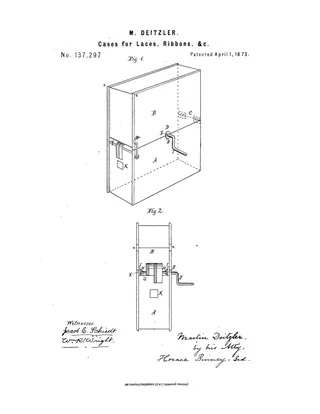
Cases for Laces, Ribbons, &c., US Patent No. 137297
Patent · 2 pages
US Patent No. 137,297, granted April 1, 1873 to Martin Deitzler of Ashland, Pennsylvania, for a hinged case that stores an original package of lace or ribbon wound on a pasteboard strip. Spring clamps and spools hold the package so the lace can be drawn out through a front opening and rewound with a key. A recess on the front holds marking-cards. The first page is the patent drawing (Figs. 1 and 2); the second is the specification and claim.
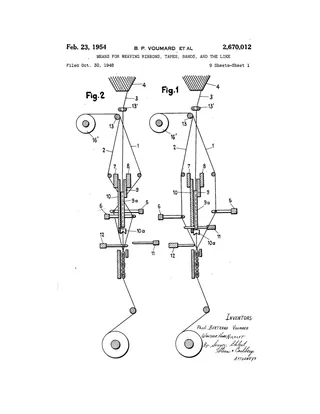
Means for Weaving Ribbons, Tapes, Bands, and the Like, US Patent No. 2670012
Patent · 13 pages
US Patent 2,670,012, granted 23 February 1954 to Bertrand Paul Voumard and Walther Henri Nicolet of La Chaux-de-Fonds, Switzerland, for a shuttleless machine that weaves several narrow bands, tapes or bandages at the same time. Weft is laid by thread guides and T-shaped inserting arms that form weft loops, and two opposed reeds, mounted on ball-guided frames and driven by cams, beat the weft up from front and rear. The document has nine sheets of drawings (Figs. 1-24) followed by the specification and eight claims.
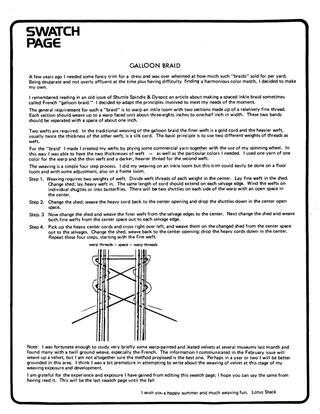
Swatch Page - Galloon Braid
Article · 1 page
A one-page Swatch Page column by Lotus Stack explaining how to weave a galloon braid, a spaced inkle-woven trim with two narrow warp-faced bands separated by a gap and joined by crossed weft cords. She describes the warping, the use of a fine and a heavy weft, and a four-step weaving sequence, illustrated by a line diagram. A closing note revises her earlier advice on weaving velvet and announces the last swatch page until fall.
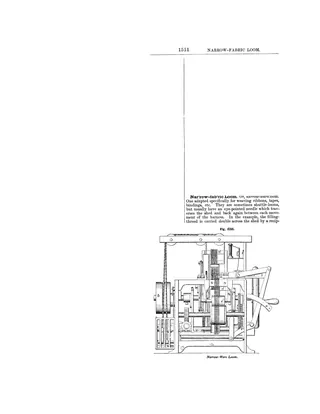
Narrow-Fabric Loom
Article · 2 pages
A short dictionary entry on the narrow-fabric (narrow-ware) loom, used for weaving ribbons, tapes and bindings. It explains that such looms usually use an eye-pointed needle to carry the weft across the shed rather than a shuttle, with the weft locked at the selvage by a shuttle and thread passing through the loop. A side-elevation figure (Fig. 8295) is described part by part: needle, bobbin, harness frames, cams, picker motion, take-up and band-wheel.
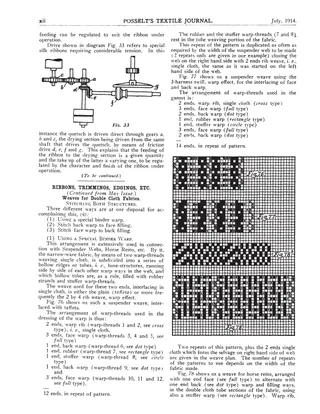
Ribbons, trimmings, edgings, etc.
Article · 2 pages · weaving drafts
Two journal pages from a continuing series on ribbons, trimmings and edgings, covering weaves for double cloth narrow fabrics. They explain stitching the two structures together with a special binder warp, as used in suspender webs and horse reins, with warp arrangements and weave plans (Figs. 76-78) using plain, 2 by 4 warp rib and 3-harness twill. The first page also ends a passage on ribbon finishing machinery drive (Fig. 33, quetsch and drying section).
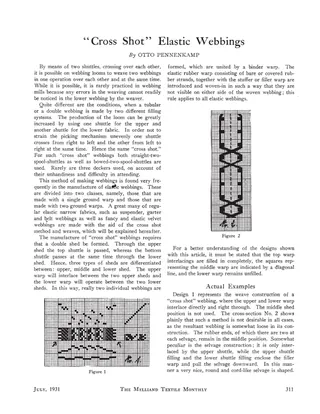
'Cross Shot' Elastic Webbings
Article · 4 pages · weaving drafts
Article from The Melliand Textile Monthly explaining the cross shot method of weaving elastic webbings, in which two shuttles cross in separate upper and lower sheds to weave two fabrics at once on a webbing loom. It describes the three-shed system, warp arrangements with binder, rubber, and stuffer ends, and selvage constructions. It works through numbered designs for single, double, and hollow webbings, with drawdowns and cross-sections, and closes with notes on two-eye heddles and harness arrangements.
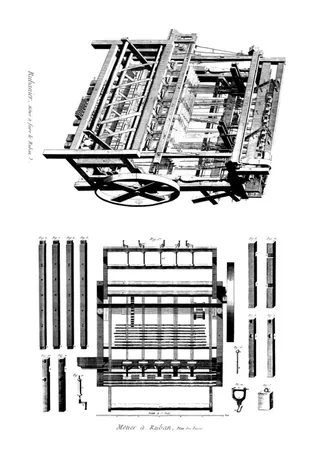
Encyclopedia: Weaving Plates, Part V - Ribbon/Ruban
Illustration · 6 pages · French
Six-page set of engraved plates on ribbon weaving (rubanier) from Diderot and d'Alembert's Encyclopédie, prepared as Part V of a weaving plates series by Philippe Demoule. The plates show the ribbon loom (métier à faire le ruban) in plan, front, tabular, side and rear elevations, and in disassembled and developed views, with numbered detail figures of heddles, shuttles, bobbins, gears, cams, pulleys, levers and treadle mechanisms. Only captions and figure numbers appear, with no explanatory text.
Handweaving News (December 1938): Further Notes on Soumak Weave
Periodical · 4 pages · weaving drafts
A December 1938 issue of Handweaving News by Nellie Sargent Johnson on warp-pattern belts woven on a simple slotted-and-holed heddle belt loom, where the warp covers the weft. It lists equipment and materials, gives four color-threading plans for simple belts, and explains a second method of planning designs on cross-section paper and weaving them with two pick-up sticks. A diagram page shows the design grids and the two sheds. The issue also carries a subscription renewal notice for 1939.
July, 1913
Article · 1 page
A single page from the July 1913 issue of Posselt's Textile Journal reporting novelties in fabric structure from abroad. It describes patented constructions for fringed braid, medallion-effect braid, multiple tubular fabrics with protective strengthening strips (belting, hose, felts), wheel tyre cord jackets, and ribbon with openwork imitation-embroidery insertion, referring to Figures 1-13. It closes with a short note on Puropol, a sulphated soap for bleaching, dyeing and finishing.
Manufacture of Narrow woven Fabrics
Article · 3 pages · weaving drafts
A continuation (March 1916) of E. A. Posselt's series on narrow woven fabrics, covering lamp wicks. It describes flat wicks built as double cloth united by a binder warp, with weave diagrams, repeats and stripe color effects, and round "hose" wicks woven as double plain tubes, including partly open (split hose) wicks and braided wicks for miners' lamps. The scan also includes two unrelated short pieces on Scotland's linen industry and on starches (farina, sago) for warp sizing.
Manufacture of Ribbons, Trimmings, Edgings, Etc.
Article · 2 pages · weaving drafts
Two-page installment from Posselt's Textile Journal (January 1916) continuing a series on ribbon, trimming and edging manufacture. It presents figs. 183-201, designs for figured ribbon centre stripes using one or two systems of extra figure warp over a plain-weave ground warp, with notes on repeats, harness counts and drawing-in drafts. It also explains an analysis of ground and figure warp interlacement on point paper, including two-color figure effects.
The Manufacture of Ribbons, Trimmings, Etc.
Article · 4 pages · weaving drafts
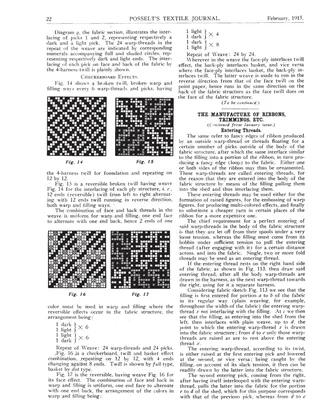
Pages 22-25 of the February 1915 issue of Posselt's Textile Journal. They include the end of an article on reversible checkerboard twill weaves, and a continuation of a series on ribbon manufacture that explains "entering threads", warp threads that float outside the fabric and are pulled in by the filling to make looped edges, figures and diamond patterns. The ribbon text is illustrated with weave plans and fabric sketches (Figs. 113-130). Two short items follow: a patented shoe-top fabric of worsted, cotton and fibre silk spots, and an air-pressure dyeing and bleaching apparatus.
Morgan Inkle Loom
Other · 10 pages
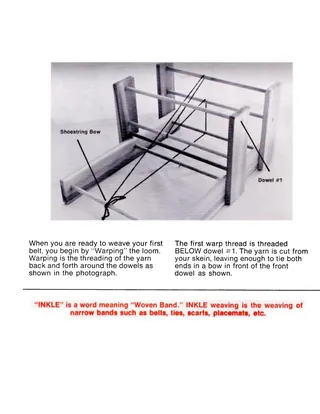
A short illustrated instruction leaflet for the Morgan Inkle Loom, explaining step by step how to warp the loom with yarn around dowels and heddles, wind a weft butterfly, form the shed, beat, advance the belt, and finish and remove the woven band. The last page is promotional, listing the loom's features, possible items (belts, scarves, purses, guitar straps) and yarn quantities needed. Photographs illustrate each step; there are no weaving drafts.
Ribbons, Trimmings, Edgings, etc
Article · 1 page · weaving drafts
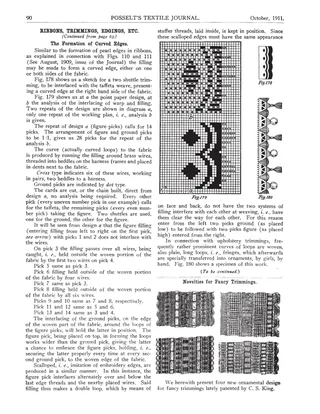
One page from Posselt's Textile Journal (October 1911), part of a continuing series on ribbons, trimmings and edgings. It explains how curved and scalloped edges are woven in two-shuttle taffeta trimmings by running the figure filling around brass wires set in heddles and dents beside the fabric. It gives a point paper design and an interlacing analysis (Figs. 178-180), with a pick-by-pick description of how the loops are held, and mentions upholstery trimmings with loops and fringes. A short note on patented fancy trimming designs by C. S. King begins at the end.
Ribbons, Trimmings, Edgings, Etc.
Article · 1 page · weaving drafts
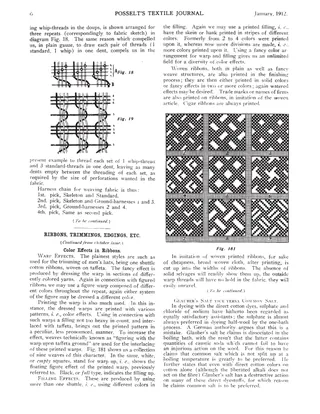
A single journal page from the January 1912 issue of Posselt's Textile Journal, continuing a series on ribbons, trimmings and edgings. It covers color effects in ribbons: warp effects (sectional colors, printed warps woven on taffeta) and filling effects (multiple shuttles, printed skeins), plus printing of finished ribbons. It also ends the preceding gauze (leno) article with a harness chain, and includes a short note on Glauber's salt versus common salt in dyeing.
Ribbons, Trimmings, Edgings, Etc.
Article · 1 page · weaving drafts
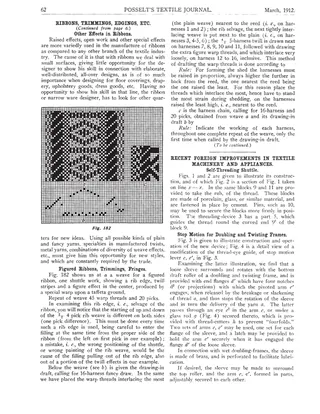
A single page from Posselt's Textile Journal (March 1912) continuing a series on ribbons, trimmings and edgings. It explains special effects in ribbon weaving and discusses a figured ribbon (Fig. 182) with a rib selvage, twill stripes and a figure on a taffeta ground. It gives the weave repeat (45 warp threads by 20 picks), the 16-harness drawing-in draft and the harness chain, with rules for drafting and for deriving the chain. The page also begins a short piece on recent foreign textile machinery, covering a self-threading shuttle and a stop motion for doubling and twisting frames.
Ribbons, Trimmings, Edgings, Etc.
Article · 1 page · weaving drafts
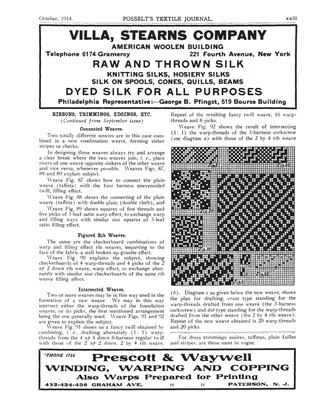
A single-page installment of a serialized article on ribbons, trimmings and edgings, continued from the September issue. It covers connected weaves, figured rib weaves and intersected weaves, with explanations of Figs. 87-92 and their weaving draft diagrams. The page includes advertisements for silk and textile-winding firms.
Two Norwegian Bands in Pickup
Article · 2 pages · weaving drafts
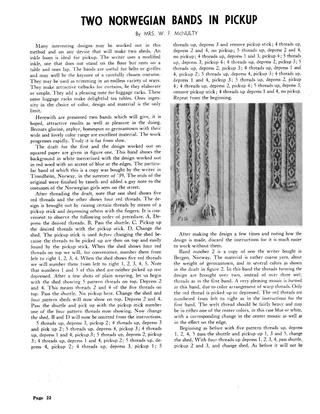
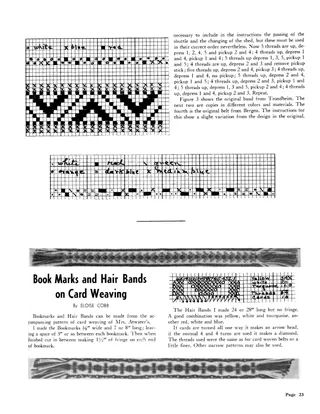
Instructions by Mrs. W. F. McNulty for weaving two Norwegian pickup bands on an inkle loom or any two-shed device. The bands are copies of originals bought in Trondheim and Bergen. Step-by-step pickup sequences are given for each band, with threading drafts and squared-paper designs in the figures. A short second item by Eloise Cobb on page 2 describes making bookmarks and hair bands from a card-weaving pattern of Mrs. Atwater's, with charts.
Weaving with the Inkle Loom
Coats & Clark, Inc., 1955
Monograph · 2 pages
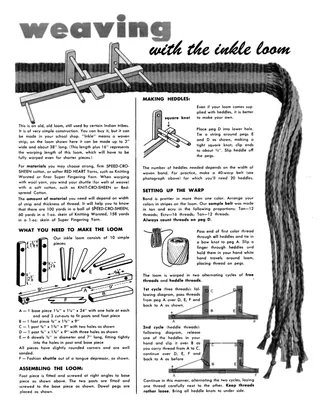
A two-page instruction leaflet from Coats & Clark's Educational Bureau on building and using a simple inkle loom. It lists the ten wooden parts with dimensions, then explains making heddles, warping in alternating free and heddle threads, changing colors, tensioning with rubber bands, and weaving up and down sheds with a shuttle. It also covers selvage control, advancing the warp, a striped belt pattern, and finishing ends with plain stitching or twisted fringe.
December, 1913
Article · 2 pages · weaving drafts
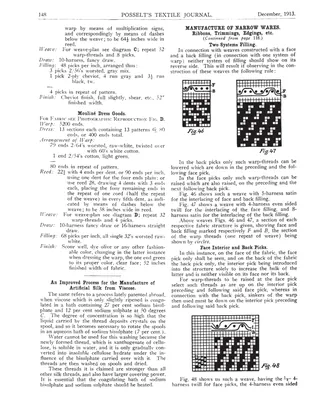
Two pages from the December 1913 issue of Posselt's Textile Journal. They close out a dress goods fabric specification (a mouliné dress goods with warp, reed, weave, filling and finish details), then give a short note on a process for making artificial silk from viscose. The rest is a continuation of a series on narrow wares (ribbons, trimmings, edgings), covering weave construction with two systems of filling (face and back picks, face/interior/back picks) and tubular and double cloth weaves, illustrated with weave plans Figs. 46-52.
Design and Construction of Narrow Woven Fabrics
Article · 8 pages · weaving drafts
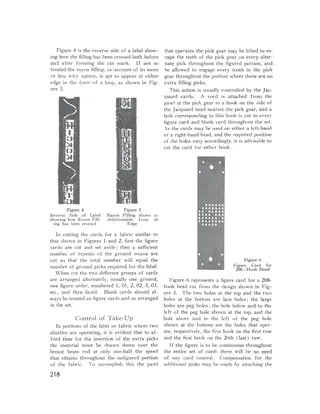
Article from The Melliand (May 1930) by Edwin J. Gibbons on designing and constructing woven name labels made on Jacquard drop-lay looms. It explains laying out designs on point paper, working out ends and picks, spacing letters, and painting figure and ground weaves. It also covers weaving face down and backwards, card cutting and arrangement, take-up control, stitching of extra filling picks, rayon and silk fillings, extra warp for figure, and a 5-harness satin rayon label. Illustrated with label photographs, a Jacquard card, and design grids.
History of Dyeing
Article · 3 pages · weaving drafts
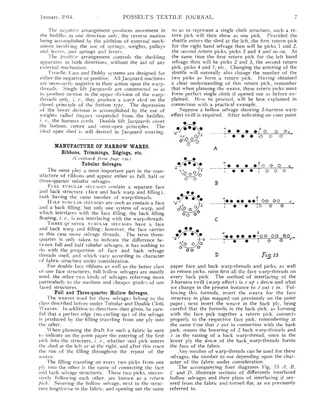
Three journal pages from Posselt's Textile Journal, January 1914, continuing a series on the manufacture of narrow wares (ribbons, trimmings, edgings). They cover full, half and three-quarter tubular (hollow) selvages, return picks, and how to plan the weave on point paper, with Figs. 53-59 showing hollow selvages in plain weave, 2x4 warp rib, 3-harness twill, 5-harness satin and 4-harness broken twill, with stuffer warp threads. Short items on flameproofing fabrics with alum and ammonium sulphate and on making absorbent surgical cotton follow. A brief passage on negative and positive shedding motions opens the first page.
Manufacture of Elastic Fabrics
Article · 3 pages · weaving drafts
Part of a serialized article by Samuel Brown on weaving narrow elastic webbing, continued from the October issue. It covers satin-face (3-leaf twill) and 4-leaf twill webs for suspenders and corset trimming, with harness and chain drafts, and heavier webs for police and fireman braces and farmers' web. Warp constructions are given as tables of thread counts, yarn sizes, reed, filling and picks per inch, with notes on rubber threads, binder and back warps, picot edges and raised cords.
Manufacture of Narrow Wares
Article · 1 page · weaving drafts
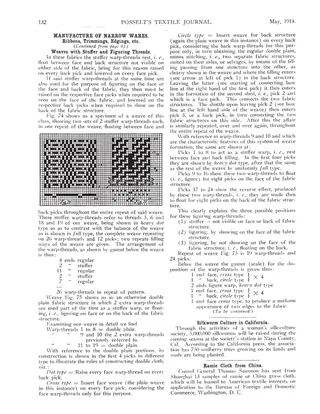
A single journal page from a continuing series on the manufacture of ribbons, trimmings and edgings, covering weaves with stuffer and figuring warp threads. It explains how stuffer warp threads float between face and back structures and how they can be raised to figure on the face or back. Fig. 74 (26 warps, 12 picks) and Fig. 75 (19 warps, 24 picks, a double plain fabric with two extra figuring warp threads) are explained with drawdowns and warp gamuts. Two short unrelated news items follow, on silkworm culture in California and ramie cloth samples from China.
Manufacture of Ribbons, Trimmings, Edging, Etc.
Article · 2 pages · weaving drafts
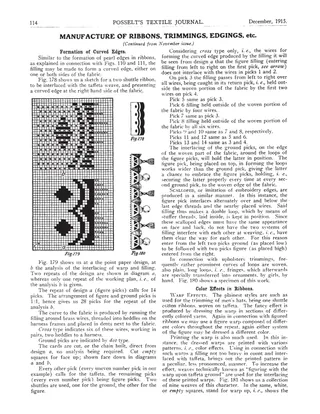
Two pages from Posselt's Textile Journal (December 1915), continuing a series on the manufacture of ribbons, trimmings and edgings. They explain how curved and scalloped edges are formed with filling around brass wires, and how color effects are produced with dyed or printed warps and fillings, printed finishing and imitation printed ribbons. They also cover raised and open-work effects, and how to prepare the drawing-in draft and harness chain for a figured ribbon with an extra figure warp on a taffeta ground, with a worked 16-harness example.
The Manufacture of Ribbons, Trimmings, Edgings, Etc.
Article · 2 pages · weaving drafts
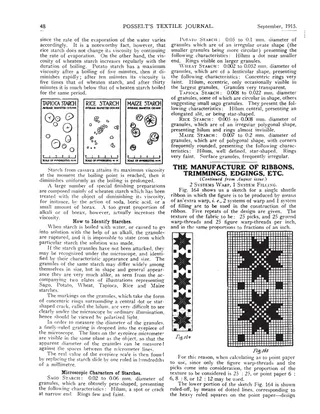
Two journal pages from Posselt's Textile Journal, September 1915, continuing a series on ribbon manufacture. It explains how to make figured single-shuttle ribbons using an extra figure warp (2 systems warp, 1 filling) and ribbons with two figure warp systems plus a ground warp (3 systems warp, 1 filling). It covers point-paper calculation, drawing-in arrangement and interlacing diagrams (Figs. 164-169), and begins a continuation on double cloth reversibles for harness and Jacquard work.
The Manufacture of Ribbons, Trimmings, Etc.
Article · 2 pages
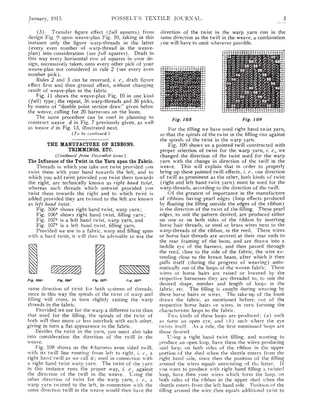
Two journal pages from the January 1915 issue of Posselt's Textile Journal, continuing a series on ribbon manufacture. The article explains how right and left hand twist in warp and filling yarns affects fabric appearance, including the relation of twist direction to twill direction in 4-harness and pointed twills. It also covers producing pearl-edge loops on ribbons with wires or horse hairs, open versus twisted loops, fancy twist effects, and the rolling of ribbons from heavy twisted threads. A short section converts German metric spun (chappe) silk counts to English counts, with worked examples.
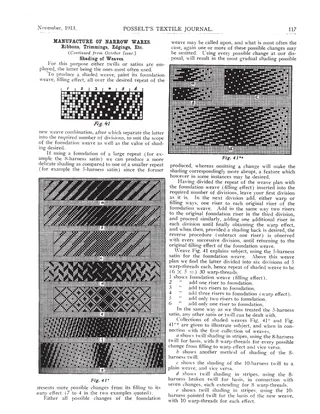
November, 1913
Article · 2 pages · weaving drafts
Two pages from the continuing series on the manufacture of narrow wares (ribbons, trimmings, edgings) in Posselt's Textile Journal, November 1913. The text explains how to build shaded weaves from twill or satin foundation weaves by adding risers in successive divisions. It then covers fabrics with two warp systems (face and back warp) and three warp systems (face, interior and back warp) with one filling, with draft figures 41 to 45 and a fabric cross-section.
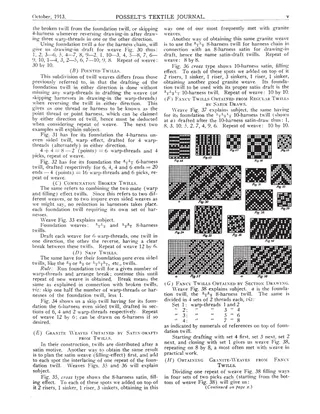
October, 1913
Article · 2 pages · weaving drafts
Two pages from the "Manufacture of Narrow Wares" series in Posselt's Textile Journal, October 1913, continuing the section on rib weaves for ribbons, trimmings and edgings. It covers strengthening rib structures with an extra binder warp or pick, basket weaves, and subdivisions of twills (broken, pointed, combination broken, skip, granite via satin drafts, and fancy twills by satin draw or section drawing). Weave drafts (Figs. 25-38) with drafting instructions and repeat sizes accompany the text. The first page also carries an advertisement for peroxide bleaching.
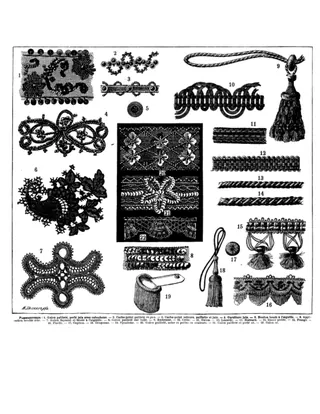
Passementerie [Lace]
Article · 2 pages · French
A two-page French encyclopedia entry on passementerie (decorative trimmings) from the Nouveau Larousse Illustré. The text defines the craft, divides it into trimmings for women's clothing, furnishings, military dress and carriages, and sketches its history from ancient Egypt and the Orient to its peak under Louis XIV. It also covers the tools and looms used, the materials (silk, cotton, wool, metallic thread, jet, beads), and the French production centers. A plate shows 22 numbered samples, including braids, galloons, fringes, cords, tassels, buttons and beaded jet trims.
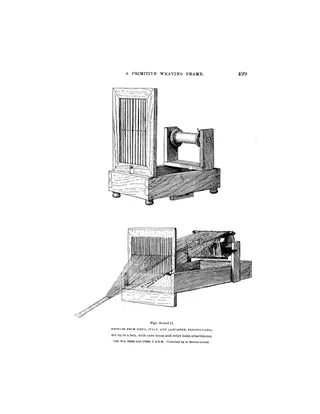
A Primitive Frame for Weaving Narrow Fabrics
Monograph · 35 pages
Otis T. Mason's 1901 Smithsonian monograph (reprinted from the Report of the U.S. National Museum) surveys the heddle frame, a hand-held or stationary device that forms the sheds when weaving narrow belts, garters and tapes. It describes specimens in the museum collection from the Chippewa, Masquakie and Pueblo/Zuni peoples, Finland, Germany, Italy, and New England and Pennsylvania. It also covers a patented hand-weaving apparatus and Pueblo battens. Each type is described with dimensions, materials, catalog numbers and method of use, and illustrated with line drawings and nine plates. It argues that the Native American frames derived from European settlers' folk craft.
Ribbon
Article · 1 page
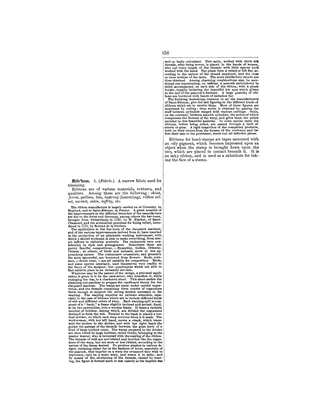
A dictionary entry on ribbon from Knight's American Mechanical Dictionary. It defines ribbon as a narrow trimming fabric and lists varieties such as satin, taffeta, velvet and lutestring. It describes the ribbon industry at Coventry and Saint-Etienne, the bar-loom, Jacquard figuring, warping, plush effects, and finishing by rolling, moire and starching. It also includes a short entry on inked ribbons for hand-stamps.
Ribbons, Trimmings, Edgings, etc
Article · 3 pages · weaving drafts
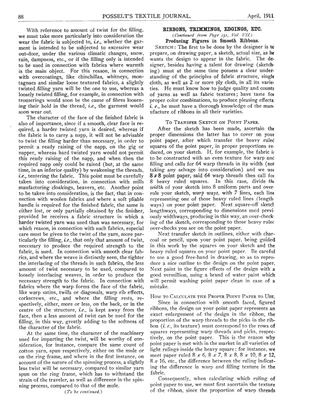
Three pages from Posselt's Textile Journal, April 1911, continuing a series on ribbons, trimmings and edgings. The section on producing figures in smooth ribbons explains how to transfer a sketch to point paper, how to choose point paper rulings (e.g. 8 x 5, 12 x 8) to match the warp-to-pick texture, and works through an extra-warp figured ribbon with a sketch, point-paper design and interlacing analysis (Figs. 164-166). The pages also include a 'Novelties from Abroad' section with loom specifications (warp, reed, filling, finish) for woolen and worsted dress goods, suiting and cloaking with weave drafts, and a short piece on silk weaving in Szechuan Province, China.
Ribbons, Trimmings, Edgings, etc
Article · 2 pages · weaving drafts
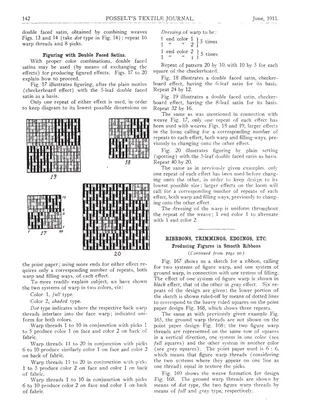
Two pages from Posselt's Textile Journal, June 1911, continuing a series on ribbons, trimmings and edgings. The first page explains how to produce figured effects with double faced satins (5-, 6- and 8-leaf satin bases in checkerboard and spot arrangements, with warp dressing and repeat sizes). It then begins a section on figures in smooth ribbons using figure warps on point paper. The second page covers figuring with a special figure pick (two systems of filling) versus figure warp, with the ground weave and chain analysis for Fig. 170. A short item on leafy cotton grades closes the scan.
Warp & Weft, Vol. 5, No. 11 (November 1952)
November 1952
Periodical · 8 pages · weaving drafts
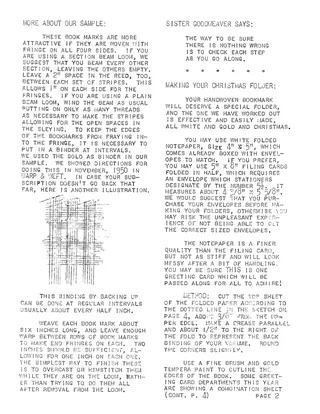
November 1952 issue of the Warp & Weft newsletter, centered on a Christmas project: a handwoven striped bookmark/greeting card woven in nylon warp with a mixed-scrap weft, plus instructions for making a gold-trimmed paper folder to present it. It also reports the winners of the Helen Bunn Competition (fiber division) at the St. Paul Gallery and School of Art with the judges' comments, and describes entries in the Round Robin traveling exhibit. Shorter items include a Q&A on weaving with spun glass thread, a Norse myth of the Valkyries weaving, Christmas greetings in 14 languages, a note on the first Christmas card, and supplier advertisements.
Weaving. -- No. XXIV: The Ribbon Loom
Article · 3 pages
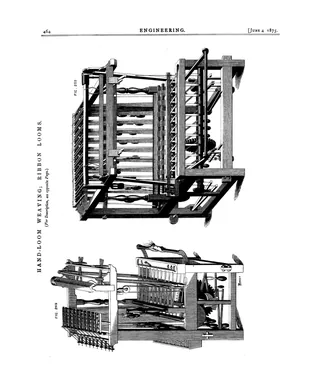
An 1875 installment (No. XXIV) of the Engineering series on weaving, dealing with the ribbon loom, also called the Dutch engine loom or swivel loom. It traces the loom's history from 16th and 17th century Dantzic and Leyden, through the bans and riots it provoked across Europe, to the Kay and Stell patents of 1745 and 1760 and the later bar loom and rack-and-wheel shuttle motion. It also describes how the swivel loom works: warp reels, weights, heddles and treadles, and the swivel shuttles driven by a peg driver or by rack and star wheels. The pages carry engraved figures (Figs. 248-256) of hand ribbon looms and their mechanisms.
Encyclopedia: Weaving Plates, Part XII - Passementerie
Illustration · 15 pages · French · weaving drafts
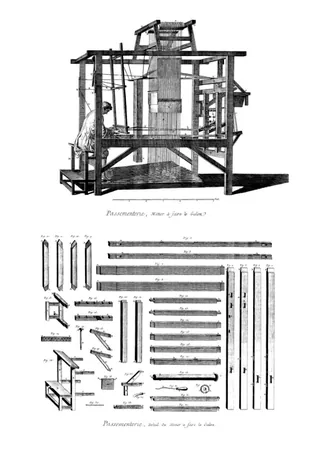
Part XII of a compiled set of weaving plates from Diderot and d'Alembert's Encyclopédie, devoted to passementerie (trimmings, braid, galloon, ribbon and fringe making). The engraved plates show workshops, galloon looms, figured-ribbon looms, fringe looms, low-warp looms, twisting (retors) equipment, and tools for making reeds (peignes) and heddles (lisses). Pages carry French plate titles and figure numbers only, with no explanatory text. Two plates show galloon pattern designs or drafts and ways of passing the pattern.
Manufacture of Narrow Wares
Article · 2 pages · weaving drafts
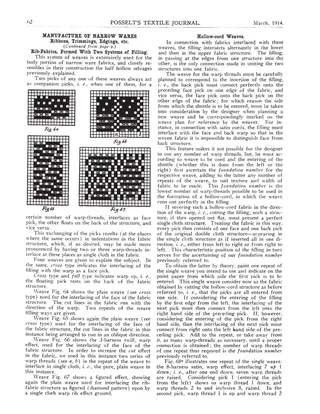
Installment of E. A. Posselt's series on the manufacture of narrow wares (ribbons, trimmings, edgings). It covers rib fabrics formed with two systems of filling (Figs. 64-67) and hollow-cord weaves, including how to find the foundation number for satin and twill hollow cords (Figs. 68-73). The scan also includes the start of an unrelated article on faults in the carbonizing of woolens.
The Manufactureof Ribbons, Trimmings, Edgings, Etc.
Article · 2 pages · weaving drafts
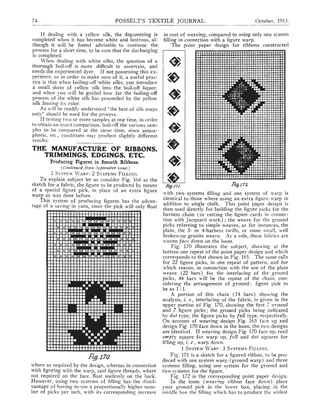
Two pages from Posselt's Textile Journal, October 1915, continuing a series on ribbon manufacture. This installment covers producing figures in smooth ribbons with one warp system and two or three filling systems, including point paper designs, shuttle box placement, pick arrangements and design paper calculation. The pages end with the start of a short article on fulling and scouring of woolens and worsteds, and the issue opens with the tail of a note on boiling-off silk.
Narrow Textile Fabrics
Article · 10 pages
A chapter from an 1872 survey of American industry describing narrow woven goods through a tour of the Philadelphia firm William H. Horstmann & Sons. It gives a brief biography of founder William H. Horstmann, a German-born silk weaver who came to Philadelphia in 1815 and introduced braiding machines and the Jacquard loom. It then walks through the departments: material and spooling rooms, power-loom and coach-lace rooms, braiding machines, tassel room, sword department, and the wholesale sales departments for trimmings, embroidery wools, flags, military, regalia and theatrical goods. Illustrations include the factory building and a chapter header of ribbons.
August, 1913
Article · 3 pages · weaving drafts
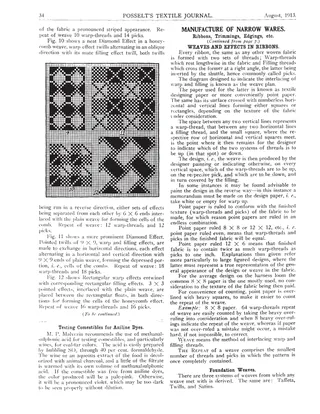
Three pages from the August 1913 issue of Posselt's Textile Journal (pp. 34-36). They continue a series on the manufacture of narrow wares, with a section on weaves and effects in ribbons. This part covers point paper, weave plans and repeats, then the foundation weaves (taffeta, twills, satins, double satins) and rib weaves, with numbered weave diagrams and drawing-in drafts for ribbon warps. The pages also include a short note on testing foods and wines for aniline dyes and a construction sheet for a woolen melton men's suiting (warp and filling arrangement, reed, finish).
Practical Weaving Suggestions, Vol. 2-71 (1971): Belts, Girdles and Sashes
Periodical · 6 pages · weaving drafts
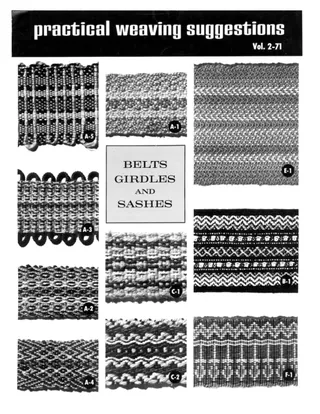
A Lily Mills pattern leaflet by Mary E. Snyder with projects for woven belts, girdles and sashes on four shafts. It opens with a short history of belts and ideas for their use, then gives warp, weft, reed, width, length, drafts, tie-ups and treadling for each project. Projects include twill and rosepath belts, a novelty texture belt, a Canadian ceinture fléchée sash and an adaptation of the Girdle of Rameses. Finishing methods such as macramé knots, braids, fringes and rings or buckles are described.
Traité de Tissage Appliqué aux Soieries et Rubans [A Treatise on Weaving applied to Silk and Ribbon]
Book · 300 pages · French · weaving drafts
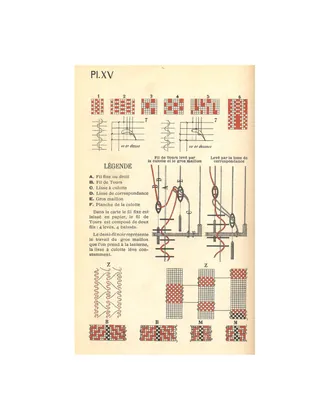
A fourth-edition French textbook on weaving silks and ribbons, by J. Seillon, a weaving teacher in Saint-Étienne. It opens with a glossary of trade terms, then covers textile materials (silk, cotton), warping, drafting and the basic weaves such as satin, twill and taffeta. The main body treats ribbon types: figured taffetas, gauze, brocaded, pile, fringe, picot, guipure and crêpe. Later sections cover Jacquard and tambour looms, dyeing arrangements, cost-price calculations, colour harmony and silk-count tables. About 20 plates of weave drawdowns (point-paper diagrams) in black and red close the volume.
The Manufacture of Ribbons, Trimmings, Edgings, Etc.
Article · 2 pages · weaving drafts
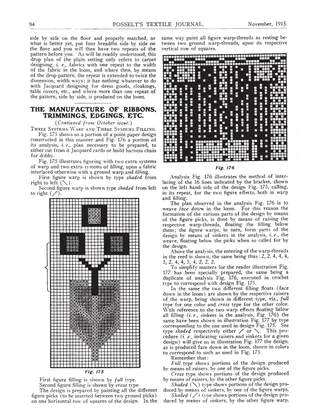
Two journal pages continuing E. A. Posselt's series on making ribbons, trimmings and edgings, from the November 1915 issue of Posselt's Textile Journal. They explain figuring with two extra systems of warp and two of filling on a taffeta ground, using a point paper design (Fig. 175), its weave analysis (Fig. 176) and a symbol-coded duplicate (Fig. 177). The text covers raisers and sinkers, weaving face down in the loom, reed entering, and the warp and filling dressing (46 ends, 36 picks). Short notes follow on a patented dove-and-olive-branch ribbon design and on two patented lace edging designs.
Ribbons, Trimmings, Edgings, etc
Article · 3 pages · weaving drafts
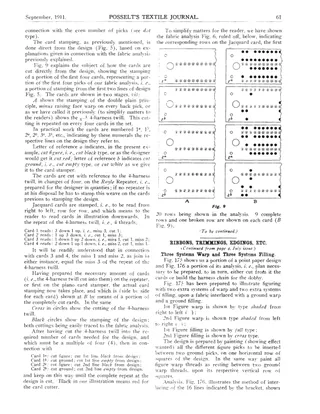
Three pages from the September 1911 issue of Posselt's Textile Journal. They continue two serial articles: one on Jacquard card stamping for a double-plain/4-harness twill fabric (Fig. 9), and the Ribbons, Trimmings, Edgings series on designs with three systems of warp and three of filling (Figs. 175-177). The ribbon article covers design preparation, analysis, reed entering, and the warp and filling gammot (dressing) for a taffeta ground with two extra figure warps and fillings, woven face down. The last page also has a short note on iron stain removal and T. Schickl's article on dyeing weighted black silk.
Narrow Woven Fabrics
Book · 239 pages · weaving drafts
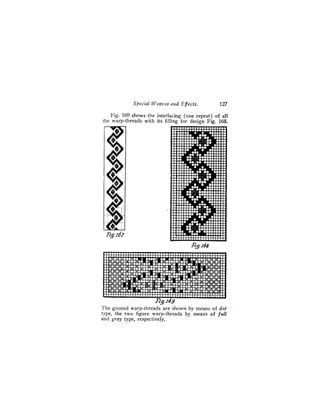
Volume 2 of Posselt's Hand Books of the Textile Industry, a technical treatise on designing and manufacturing narrow woven fabrics such as ribbons, elastic webbing, galloons, and lamp wicks. It covers yarns and yarn counts, foundation and derivative weaves, selvages, tubular and double cloth, pile, gauze/leno and open-work ribbons, figured ribbons, color effects, fringes and pearl edges. The later part describes ribbon and narrow-ware looms and their mechanisms (shuttles, lays, take-ups, let-offs), and the book ends with publisher and equipment advertisements. About 74 pages carry weave drafts and diagrams.
Advertising card and subscription reminder
Ephemera · 2 pages
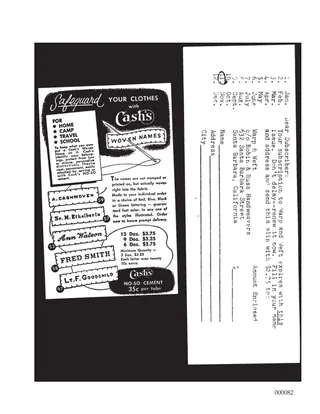
Two-page advertising card from Robin and Russ Handweavers of Santa Barbara, California, promoting Cash's woven name tapes for marking clothing, with sample styles, prices by quantity, and NO-SO cement. It includes a mail-order form and a tear-off renewal slip for subscribers of Warp and Weft ($2.75). The second page also advertises Cashsaver printed Teletags, sew-on or iron-on.
Picture postcard
Ephemera · 1 page
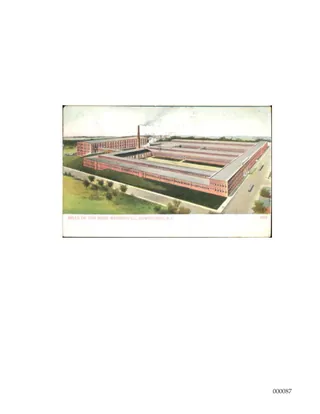
A colored picture postcard showing an elevated view of the Mills of the Hope Webbing Co. in Pawtucket, Rhode Island. The image shows a large red-brick, multi-story mill complex around a central courtyard, with a tall smokestack. The only text is a printed caption naming the mills and location, plus numbers.
Book Marks and Hair Bands on Card Weaving
Article · 1 page · weaving drafts
A short article by Eloise Cobb describing how to make bookmarks and hair bands using card (tablet) weaving, based on a pattern by Mrs. Atwater. It gives sizes, fringe and length suggestions, color combinations, and notes on turning the cards to produce arrowhead or diamond motifs. The page includes pattern charts with color keys; it opens with the end of a preceding article's pick-up instructions for Norwegian belts from Trondheim and Bergen.
237 documents found