Textile Documents › Topic: Asian and Middle Eastern textiles
469 documents found
Sort: 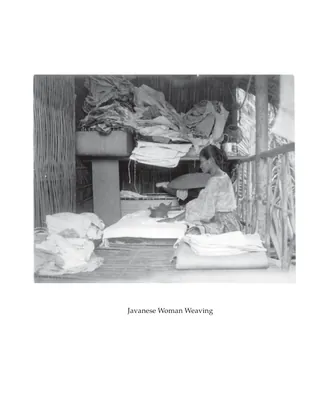
[Javanese Woman Weaving]
Illustration · 1 page
A single black-and-white photograph captioned "Javanese Woman Weaving." It shows a woman seated on a mat in an open-sided, bamboo-walled structure, working at a loom or with cloth. Stacks of folded fabric sit on a raised shelf and in baskets nearby. There are no weaving drafts or technical instructions.
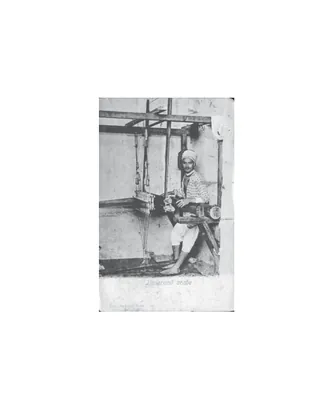
Tisserand arabe [Arab Weaver]
Ephemera · 1 page · French
A single picture postcard showing a black-and-white photograph of a seated man in a turban and checked shirt working at a traditional handloom. The loom's warp threads, heddles and beam are visible. The printed caption reads "Tisserand arabe" (Arab Weaver). The card has no other legible text.
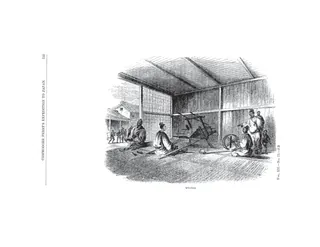
Weaving
Illustration · 1 page
A single-page wood engraving from Harper's New Monthly Magazine showing a Japanese weaving workshop with an open front and wooden-framed walls. A seated woman works a loom with a warp beam and a sword-like beater, while a second seated woman tends a large piece of equipment. The page belongs to the magazine's coverage of Commodore Perry's expedition to Japan.
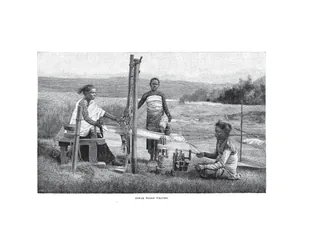
Newar Women Weaving
Illustration · 1 page
A single-page engraving titled "Newar Women Weaving," showing three Newar women weaving outdoors in a grassy field with trees and hills in the background. One woman sits at a loom made of wooden posts and cross-bars, and another stands nearby. The only text is the caption. It is useful as a 19th-century visual record of Nepalese hand weaving and loom construction.
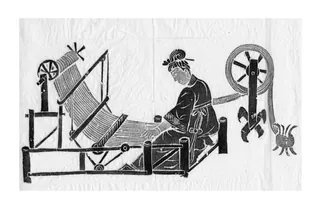
[Oriental Weaver]
Illustration · 1 page
A single woodcut-style illustration, printed on rice paper according to the catalog notes, showing a woman seated at a traditional treadle loom with a warp beam at the left. A spinning wheel stands at the right with thread running from it, and a basket of thread sits at the lower right. The page has no caption or printed text.
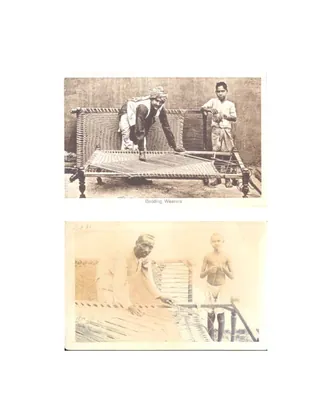
Picture postcards
Ephemera · 1 page
A single page of picture postcards titled "Bedding Weavers," showing two photographs of bedding weavers in India at work on a wooden frame loom. The top photograph shows a turbaned man bending over a large woven mat or bed-cord frame, with a young boy standing beside him. The only text is the caption.
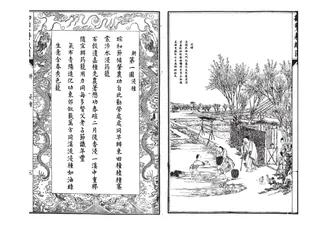
Yu zhi geng zhi tu, Vol. 2
Emperor of China Qianlong · 1700s
Book · 25 pages · Chinese
Volume 2 of an imperially commissioned Qing set of Gengzhi tu (pictures of tilling and weaving), a rice-farming series. The pages are woodblock-style engravings, each paired with Chinese poems, covering the sequence from soaking seed, ploughing, harrowing and transplanting through weeding, irrigation, harvest, threshing, winnowing, pounding, storing grain and offering thanks to the gods. One plate (page 18) shows a woman weaving at a loom under a pavilion, with a verse on weaving, and the last page carries a title strip for the weaving pictures. The text is entirely Chinese, and the volume has no weaving drafts.
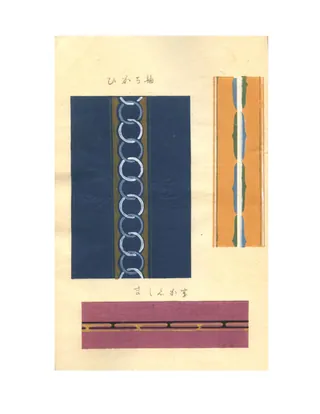
Shima shima V1.
Book · 44 pages · Japanese
A Japanese pattern book of hand-colored woodblock-style plates showing striped and patterned woven textile swatches (shima), each with brief handwritten or printed Japanese captions naming the pattern. The plates show vertical stripes, lattice, diamond, key-fret, chain-link, cloud and floral motifs in many colors. There is almost no running text and no weaving drafts; the value is as a visual sample book of Japanese stripe and pattern designs of the period.
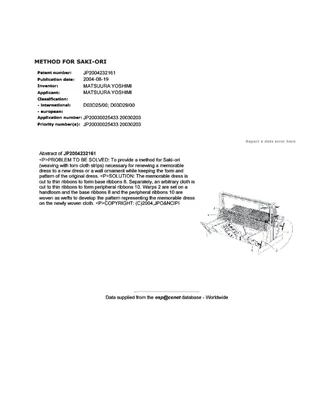
裂織の方法 [Method of Saki-Ori], JP Patent No. JP20043232161
Patent · 7 pages · Japanese
Japanese patent publication JP2004-232161 (published 19 Aug 2004) by Matsuura Yoshimi describing a saki-ori (torn-cloth weaving) method for turning a memorial garment into new cloth while keeping its shape and pattern. The garment is cut into thin ribbons that are woven as weft at positions matching the garment's outline, together with ribbons of other cloth, on a hand loom; variants add a support yarn, substitute yarn for the surrounding ribbons, or use a replica garment. The scan includes an English esp@cenet abstract page, the Japanese specification with claims and description, and seven patent figures comparing the new method with conventional saki-ori.
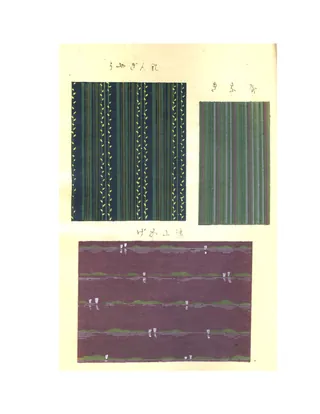
Shima shima V2.
Book · 43 pages · Japanese
A Japanese pattern book from 1904 consisting almost entirely of color-printed plates of striped, checked and figured textile swatches, with brief Japanese captions naming each pattern (such as plaids, wavy lines, bird and plant motifs). The colophon gives Kyoto printing and publication in October of Meiji 37 (1904). It is a visual design reference for Japanese kimono-type fabrics, with no weaving drafts or technical instructions.
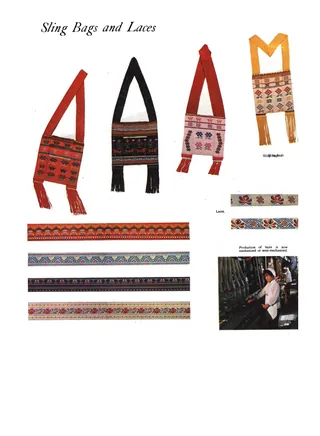
Sling Bags and Laces
China Pictorial, 1976
Article · 2 pages
A short illustrated feature from China Pictorial on sling bags and laces made for minority peoples in Yunnan, China. It describes the Tai people's long tradition of making sling bags, the Nationality Articles Manufacturing Plant in Kunming, and the shift to mechanized or semi-mechanized production in state-run factories and cooperatives. Photographs show finished bags with woven and embroidered bands, lace and braid strips, and a lace-making machine.
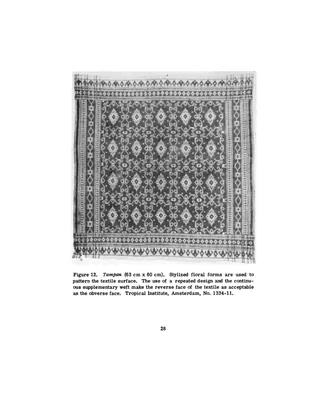
South Sumatran Ship Cloths
Article · 27 pages
An article on the ship cloths of South Sumatra, the long palepai (sesai balak) and the small square tampan. It covers their ceremonial use in marriage, birth, circumcision and funeral rites among the Paminggir and neighboring groups, and their role in marking aristocratic rank and family exchange. It also describes the technique (supplementary weft patterning on a plain weave cotton ground, with cotton, silk and metallic yarns, natural dyes, and a back tension loom) and classifies the motif groups (ships, birds, hornbills, wajang-style figures, geometric and floral designs). Twelve plates of palepai and tampan in museum and private collections are followed by notes and a bibliography.
Tibetan Applique Hangings in European Collections
Article · 16 pages
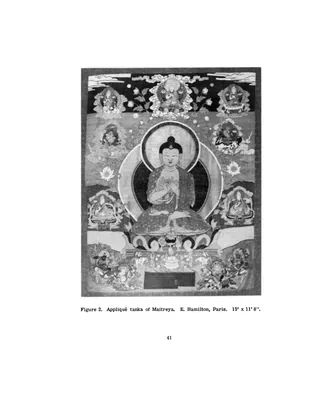
An article surveying Tibetan appliqué tankas (hangings) held in European museums and private collections, intended as a supplement to Eleanor Olson's earlier study of examples in America. It covers the use of giant appliqué banners at monastery festivals, a very large hanging in a private French collection, and tankas in Stuttgart, Leiden, Oxford, London, Liverpool and Brussels. It identifies the deities depicted, such as Maitreya, Padmasambhava, Amitayus, Vajrapani and Usnisavijaya, and notes how appliqué and embroidery were combined. Footnotes give sources, and the article is followed by ten black-and-white figures with captions and dimensions.
Tribal Arts of Northern Thailand; Costumes and Textiles
Article · 20 pages
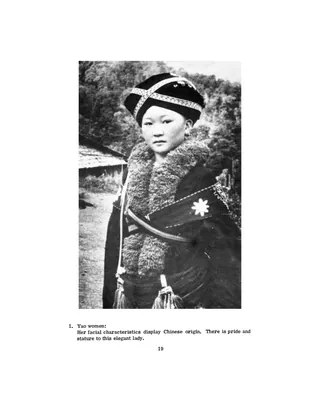
An illustrated survey of the costumes and textiles of the six major hill tribes of northern Thailand: Lisu, Meo (Hmong), Karen, Yao, Lahu and Akha. It describes women's and men's dress, embroidery, appliqué, batik on kapok cloth, seed decoration, silver jewelry, and carrying bags, with notes on each tribe's origins and status. Eleven captioned black-and-white photographs show costumes, batik work, embroidery, a Karen girl at a back-strap loom, and a Yao wedding shawl.
Demirdash and Broussa Weaving
Article · 9 pages
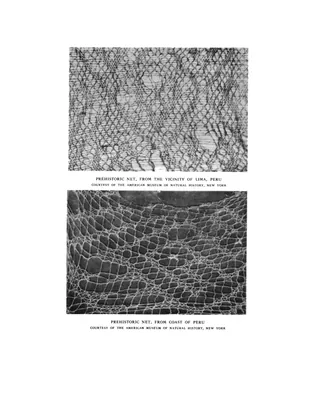
A travel narrative by Constance Sheltman of the Near East Relief describing a visit to the Greek-speaking village of Demirdash near Broussa (Bursa), Turkey, to learn about its local weaving. She describes the village, its houses and silkworm lofts, the looms, and the trousseau pieces women make, including wedding sheets with deep embroidered borders, and notes that the weaving resembles filet. Illustrations include a Broussa weaver, Broussa looms, a Coptic cap, prehistoric Peruvian nets, a lace net technique figure and Near Eastern towel borders from the Metropolitan Museum of Art.
Notes on Aborigine Textiles of Formosa Today from a Visit to the Island in 1954
Article · 28 pages
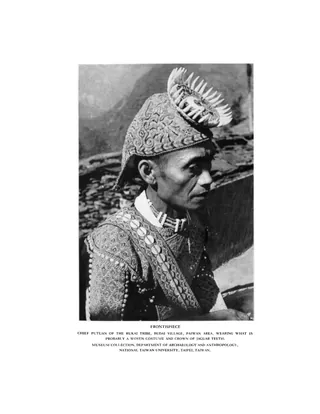
Article by Elizabeth Bayley Willis based on a 1954 visit to Taiwan (Formosa) as a handicrafts expert for the United Nations. It gives a historical sketch of the island's aboriginal peoples under Portuguese, Dutch, Chinese and Japanese rule, then describes their textiles: ramie cloth, backstrap and log-beam looms, tunics, chiefs' coats, breastplates, belts, tobacco pouches, dyes such as dye yam brown, and the southern tribes' embroidery, cross-stitch and appliqué. Illustrated with nineteen plates, including a tribal map, loom photographs and textile examples; it includes notes and a bibliography.
Notes on Cypriot Textiles
Article · 4 pages
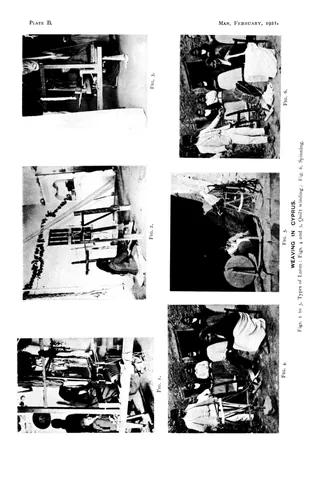
A 1921 article in Man by L. H. Dudley Buxton, based on fieldwork in Cyprus in 1913, describing traditional Cypriot textile production. It covers spinning, quill-winding and skein frames, the treatment of silk, and a detailed description of the village loom (batten, reed, four heddles, pulleys, treadles, temple, shuttle) with the additions for double-warp weaving. A plate of six photographs shows looms, quilt winding and spinning at Lapethos.
Notes on Development of Mandarin Squares: Some Newly DiscoveredMing Textiles
Article · 27 pages
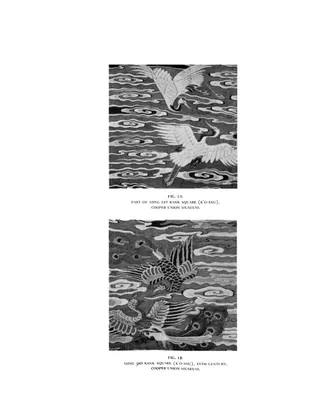
Schuyler Cammann traces the development of Chinese mandarin squares (rank badges) from their introduction under the Ming court in 1393 to the fall of the Manchu dynasty in 1912. He identifies previously unrecognized Ming squares in American museum collections, such as tapestry-woven (k'o-ssu) pieces at Cooper Union that had been labeled Japanese. He then contrasts Ming squares with early Ch'ing squares and surveys later Ch'ing changes in form, border, ornament, and technique. Ancestral portraits and Chinese encyclopedias are used as dating evidence, and the article is illustrated with 15 figures and a frontispiece.
Notes on the Early Usage of Flat Metallic Strips in Central and East Asian Textiles
Article · 12 pages
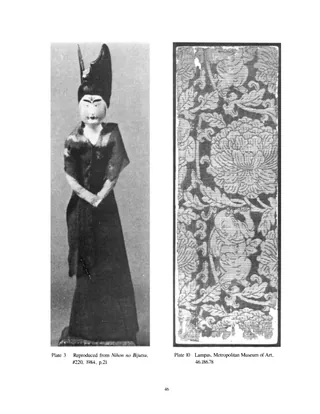
A short article on the early use of flat metallic (gold and silver foil) strips in Central and East Asian textiles, prompted by a Sung Dynasty embroidery of boys and flowering vines that came out of Tibet. It surveys earlier examples from Japan, Turfan, Khocho and Liaoning, in which the strips are tapestry-woven or couched. Lucy Maitland provides a stitch-by-stitch technical analysis of the embroidery on a silk gauze foundation, illustrated with five diagrams. Plates reproduce comparison textiles.
Unusual Pattern Loom from Bangkok
Article · 7 pages
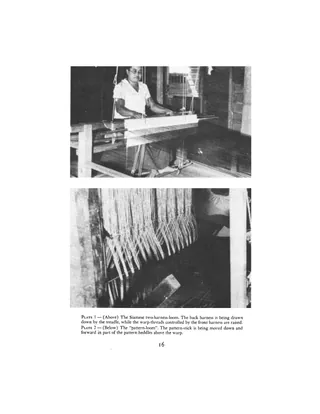
Anne Blinks reports on a survey of commercial weaving workshops in Bangkok in autumn 1957, which found eight loom types in use. She describes a traditional Siamese two-harness loom and a "pattern-loom" used in a Laotian-owned workshop, in which sticks and string heddles transfer pattern sheds to the warp and produce results like a drawloom. The text explains step by step how the pattern sticks, sword and tabby binder shots are used to weave silk and wrapped-gold fabrics, and compares the looms with types in Ling Roth's Studies in Primitive Looms. Photographs show the looms in operation and a border detail of a traditional Siamese fabric.
Weaving in Ceylon
Article · 2 pages
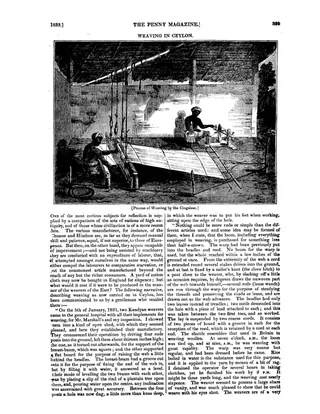
A short article from The Penny Magazine reproducing an eyewitness account of two Kandyan weavers who set up a simple pit loom at a hospital in Ceylon in January 1821. It describes the loom's construction, the sizing of the warp with rice water, the two-leaf heddles worked by toe cords, and the assistant who winds pirns on a split-bamboo swift. Engravings show the weavers at work and the shuttle. The introduction contrasts hand production in the East with machine production in England.
Art of Weaving
China Pictorial, 1976
Article · 2 pages
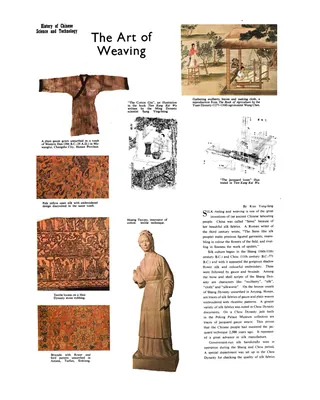
A short illustrated overview from China Pictorial's History of Chinese Science and Technology series on the development of Chinese weaving, from Shang and Chou silk culture through Han, Tang, Sung, Ming and Ching dynasties to modern mechanized mills. It covers silk reeling, jacquard gauze, brocade, early looms and shuttles, the pedal loom, and cotton innovations by the weaver Huang Tao-po. Photographs show Han tomb textiles, a Han stone-rubbing of looms, Astana brocade, and modern jacquard looms and mills. The closing section reflects the 1976 political perspective on the post-Liberation textile industry.
Chinese Women's Skirts of the Qing Dynasty
Article · 51 pages
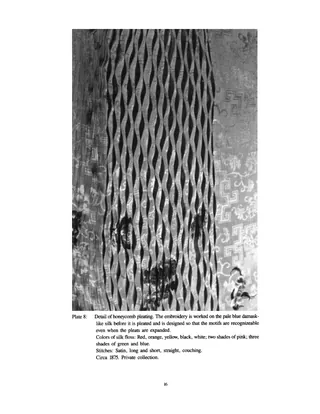
Mary V. Hays's article studies the two-piece, overlapping silk skirts worn by Chinese women during the Qing dynasty (1644-1911). It covers the history of the skirt, how to date skirts from tailoring, patterning, fabric, dyes and embroidery floss and metallic thread, the occasions and meanings of colors, and the symbolism of motifs, especially flowers. Plates with captions list colors, metallic threads and stitches for individual skirts, and tables give the Flowers of the Twelve Months with botanical and Chinese names and symbolism. The scan also includes a second article by Alan Kennedy and Lucy Maitland on flat metallic strips in Central and East Asian textiles, with a technical analysis of an embroidery on silk gauze, stitch diagrams and plates.
Some Shiraz Silks
Article · 24 pages
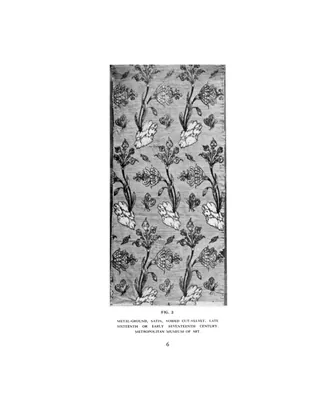
An article by Phyllis Ackerman attributing a group of Safavid silks (satins, compound cloths, a voided cut-velvet and a trimming band) to Shiraz. She argues that concealed figures and void patterns, matching those in Shiraz manuscript painting, mark them as Shiraz work. She traces the void motifs, such as a bow-legged manikin and phallic cypress, back through Mongol, Buvayhid and Sasanian silks. She reads them as Mazdean symbols kept alive by Sufis. The article includes seventeen outline sketches of void patterns, plates of the silks discussed, and footnotes citing the Survey of Persian Art and museum collections.
Weaving and Embroidery in the East
Article · 3 pages
A three-page extract from The Textile Mercury of 3 May 1890 containing a lecture-style article by Professor Lessing of Berlin on weaving and embroidery in the East. He traces Oriental textile design from medieval Persian and Arabic motifs through the 16th and 17th century floral and palmette patterns, notes the link with the European pomegranate pattern via Venice, and discusses the damage done by machine production and aniline dyes. He also covers batik printing, Oriental embroidery stitches (couched work, crochet-needle stitch, gold embroidery), and objects such as grave coverlets, door curtains, handkerchiefs, and Indian long shawls. The pages also include trade news from Oldham, Preston, Scotland, Ireland and America, short notes on the silk industry in India, and cotton, yarn, and wool market reports.
Het Weven in Nederlandsch-Indië [Weaving in the Netherlands Indies]
Monograph · 90 pages · Dutch · weaving drafts
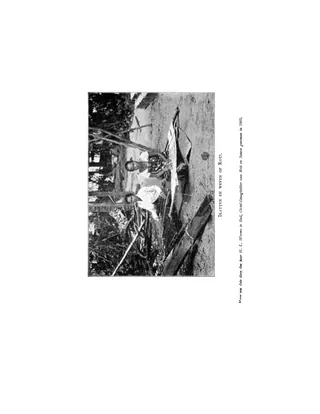
A 1903 Dutch-language monograph (Bulletin No. 28 of the Colonial Museum in Haarlem) describing hand weaving in the Dutch East Indies. It covers fibres and spinning, dyeing, warping and ikat tying (warp, weft and double ikat), the three types of loom from backstrap to pedal loom, and regional weaving centres such as Roti, Sumba, Timor, Sumatra, Borneo, Palembang, Bali and Java. A final chapter treats card (tablet) weaving of bands and borders. It includes notes, a bibliography, and about twenty plates of textiles and weaving equipment with museum provenance.
The Bulletin of the Needle and Bobbin Club, Vol. 57, Nos. 1 & 2 (1974)
Periodical · 51 pages
Double issue (Vol. 57, Nos. 1 & 2, 1974) of the Bulletin of the Needle and Bobbin Club. The main article, by Mattiebelle S. Gittinger, studies the palepai and tampan ship cloths of South Sumatra: their ceremonial use, social context, supplementary-weft technique, dyes, and motifs, with many photographs. The issue also has a report on the Victoria & Albert exhibition 'The Needle's Excellency', book reviews on needlepoint, tapestry, and printed textiles, a note on early handweaving in eastern Canada, club notes, and advertisements.
Design Techniques of Kashmir Handloom Textiles
Article · 35 pages
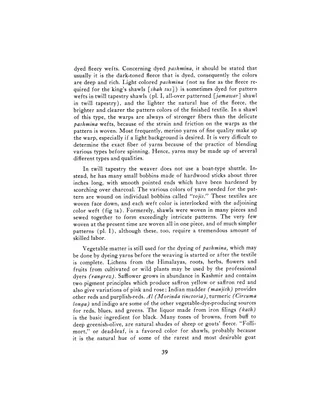
An illustrated article on the handloom textiles of Kashmir, by Rachael G. Mossman. It covers the geography, caste-bound weavers, looms, fibers (pashmina, merino, silk, cotton), dyeing, finishing, felt and embroidery, and the Persian, Chinese and Central Asian influences on design. Nine plates give technical descriptions of shawls, an embroidered panel and a sari. Fiber, yarn count, weave, pattern, stitches and finishing are recorded for each. Figure 1 reconstructs the weave techniques (evensided twill, twill tapestry, basket-weave tapestry with dovetailed wefts, double-faced twill, laid-in extra wefts, and interlocking tapestry), and a bibliography follows.
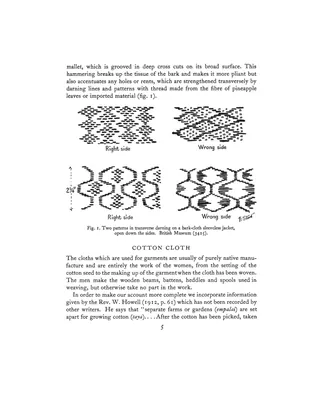
Iban or Sea Dayak Fabrics and their Patterns
Book · 205 pages
A descriptive catalogue of the Iban (Sea Dayak) textiles of Sarawak held in the Cambridge Museum of Archaeology and Ethnology. It covers Iban costume, cotton preparation, the tumpoh loom, warp-dyed (ikat-type) patterning, dyes, and weft patterning, embroidery and needle-woven tapestry badges. Specimens are described one by one by garment type (kalambi jackets, bidang petticoats, sirat loin-cloths, bedong girdles, dangdong shawls, pua blankets), with notes on thread counts, colours and named motifs. Later chapters discuss the religious meaning of the designs and possible outside influences, and give a vocabulary of Iban terms and 35 plates of line drawings of motifs (anthropomorphs, animals, birds, plants, objects).
[Indian Textiles]
Article · 2 pages
An encyclopedia excerpt surveying Indian textiles and their regional centers. It covers brocades, Kashmir shawls, cotton and silk fabrics, chintzes, tie-dyed bandana cloths, wax- and mica-printed cloths, embroideries, and pile and flat-woven rugs. It closes with an account of the decline of Indian decorative arts in the late nineteenth century and the art schools and commercial efforts that followed.
Shuttle-Craft Bulletin (September 1962)
Periodical · 4 pages
Four-page issue of the Shuttle Craft Guild Handweavers Bulletin for September 1962. It opens with an editorial on the new weaving season and upcoming Guild monographs (Contemporary Satin, a Collingwood rug monograph). The main article describes a visit to a Tibetan refugee camp where weaving is the main activity, and gives instructions for making a Tibetan Snow Jacket from heavy fulled 2-2 twill with inkle-woven bands, including two band color plans and finishing and fulling advice. The closing Weaver's Talk column covers the correspondence course and reviews or announces several books, including Estes miniature patterns, Pohja-Ompelua, and Rammevaev.
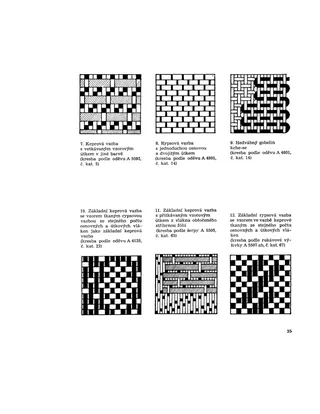
Čínské Hedvábí [Chinese Silks]
Náprstkovo muzeum, 1970
Other · 52 pages · Czech
Catalog of an exhibition of Chinese silks from the Náprstek Museum in Prague, with text in Czech and a German summary. It covers the history of silk and China's links with Europe, types of silk fabrics and embroideries, Qing dynasty court and ordinary dress and accessories, and the symbolism of motifs on Chinese silks. A numbered catalog describes garments, rank badges, skirts, tobacco pouches, hangings and pictures, giving materials, techniques, motifs, dimensions, dates and collection numbers. Further sections describe traditional silk production, with maps of the Silk Road and illustrations, plus weave-structure diagrams and embroidery stitch diagrams, and line drawings of hierarchical, Taoist, Buddhist and auspicious symbols.
The Bulletin of the Needle and Bobbin Club, Vol. 26, No. 1 (1942)
Periodical · 40 pages
Issue of the Needle and Bobbin Club's Bulletin for 1942. The main article, by Schuyler Cammann, traces the development of Chinese mandarin squares (rank badges) from the Ming period (1393) to the fall of the Manchu dynasty in 1912. It draws on museum examples, ancestral portraits and Chinese encyclopaedias, and covers k'o-ssu silk tapestry, embroidered and brocaded squares. A shorter article by Frances Little describes the Royal Manufactory at Avila, Spain (1787-1799), and its printed chintzes, with plates of floral patterns. The issue ends with Club Notes for 1942 and the list of officers.
The Bulletin of the Needle and Bobbin Club, Vol. 39, Nos. 1 & 2 (1955)
Periodical · 53 pages
Double issue (Vol. 39, Nos. 1 & 2, 1955) of the Needle and Bobbin Club Bulletin. The main articles are Elizabeth Bayley Willis's account of aboriginal textiles of Formosa (Taiwan), based on a 1954 visit, and Phyllis Ackerman's study of mediaeval silks from the Caspian provinces of Iran. Willis covers tribal history, spinning, backstrap looms, ramie cloth, brocading, tobacco pouches, breastplates, chiefs' costumes, and cross-stitch, embroidery and appliqué among the southern tribes. Ackerman uses textile designs in the Andarz Nama manuscript (1090) and surviving silk twills to trace Caspian silk production and its links to European fragments. The issue ends with book notes (Irwin's Shawls, Bird's Paracas and Nazca volume, Trudel's Swiss linen embroideries), club notes and a list of officers.
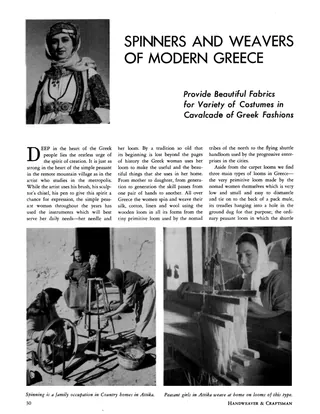
Spinners and Weavers of Modern Greece
Handweaver and Craftsman, May 1950
Article · 5 pages
An article on hand spinning and weaving in Greece around 1950, describing the three main loom types (nomad, peasant, and flying-shuttle handlooms), the fibers used (silk, cotton, linen, wool, goat hair), regional specialties, and the economic role of the home loom. The second half covers the Cavalcade of Greek Fashions shown in New York, in which handwoven Greek fabrics were made into modern and historic-style costumes, and profiles weaving firms such as Karastamati, Caloutsi and Richardson/Topoglides. Illustrated with photographs of spinners, looms and costumes.
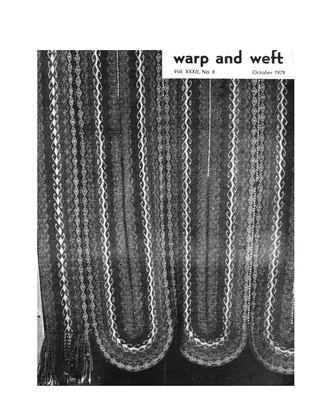
Warp & Weft, Vol. 32, No. 8 (October 1979)
October 1979
Periodical · 8 pages · weaving drafts
October 1979 issue of Warp & Weft, a monthly bulletin from Robin & Russ Handweavers of McMinnville, Oregon. Editor Russell Groff reports on a business trip to Thailand and Japan, describing silk reeling, ikat weaving, Jacquard-woven obis and the "fingernail weavers" of Kyoto, and announces a planned 1980 handweaving tour. The issue also has a 4-shaft, 6-treadle drapery fabric project ("Swedish Delight") in linen and ramie with threading, tie-up, treadling, yarn list and costs, a review of Penelope Drooker's Embroidering with the Loom, and classified ads for yarns and books.
Warp & Weft, Vol. 6, No. 10 (December 1953)
Warp & Weft, December 1953
Periodical · 8 pages · weaving drafts
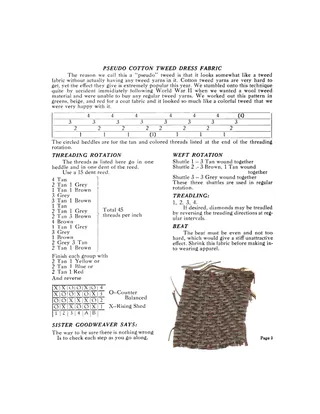
December 1953 issue of the Warp & Weft newsletter. The lead article reports on Dr. Hope Nicholson's talk about handweaving in central India: caste status of weavers, village horizontal looms, mission training schools, Niwar cotton tape, silk and Benares metallic brocades. The issue's sample is a "pseudo cotton tweed" dress fabric in 30/2 mercerized cotton, given with a four-shaft threading rotation, tie-up, weft rotation and treadling, plus notes on cotton for winter wear, yarn sources and prices, and the history and types of tweeds. It also has the Silas Says miscellany, a review of Nancy Andrews Reath's The Weaves of Hand Loom Fabrics, a Q&A on whitening yellowed silk, a poem and advertisements.
The Bulletin of the Needle and Bobbin Club, Vol. 36, Nos. 1 & 2 (1952)
Periodical · 49 pages · weaving drafts
Double issue (Vol. 36, Nos. 1 & 2, 1952) of the Bulletin of the Needle and Bobbin Club. Phyllis Ackerman's "Some Shiraz Silks" attributes a group of Safavid satins and compound cloths to Shiraz and traces hidden void-patterns and concealed motifs in Persian silks back to Sasanian and Buvayhid examples, with many photographs, outline sketches and footnotes. R. J. Charleston's "An Eighteenth Century Weaver's Pattern-Book" describes Timothy Bent's 1778-era pattern book at Blaise Castle House Museum, with reproduced drafts for huckaback, diamond, satin and calomanco patterns, samples of figured linens and analyses of the pattern units. The issue ends with book notes (including a work on the Neuchâtel printed cottons and Marian Powys's Lace and Lace-making), club notes and a list of officers.
[Ambary Hemp]
China Pictorial, 1976
Illustration · 1 page
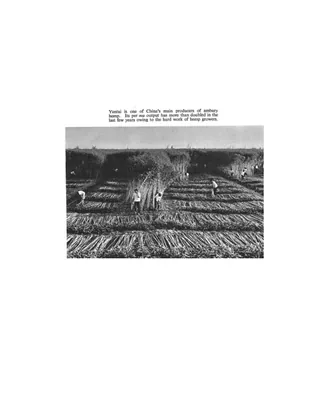
A single-page illustration from China Pictorial (1976, No. 3) showing a black-and-white photograph of a field of harvested ambary hemp. Stalks lie in rows in the foreground and bundled stalks are stacked in tall piles behind, with workers in the field. The caption says Yentai is one of China's main producers of ambary hemp and that per mu output has more than doubled in recent years.

Bamboo
Manufacturer and Builder, 1869
Article · 1 page
A very short note from The Manufacturer and Builder on the many uses of the bamboo, especially in China. It lists uses including shelter, food, boats, furniture, writing materials, clothing and punishment. It has no technical detail on processing or textile use.
Caterpillar Pest of Indigo in Behar
Article · 14 pages
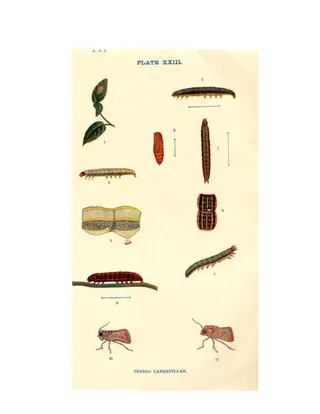
A 1906 entomological article by H. M. Lefroy, Imperial Entomologist at Pusa, on the caterpillar (Caradrina exigua) that destroys newly sown indigo in Behar. It covers the life history, damage at Surat and Pusa, the effect of east and west winds, identification, distribution and natural enemies. Remedies discussed are sowing Java-Natal indigo, using irrigated lucerne as a trap crop surrounded by a trench, and spraying. A colored plate of the insect's stages and a trench cross-section diagram are included.
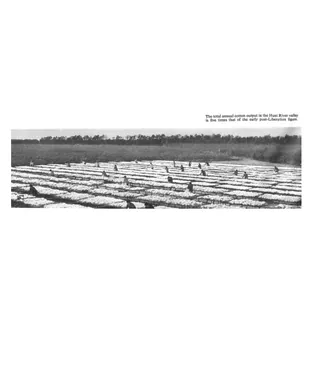
[Cotton Output]
China Pictorial, 1975
Illustration · 1 page
A single black-and-white photograph from China Pictorial, 1975, showing cotton spread out in rows across a large field with workers standing among the rows. The caption states that total annual cotton output in the Huai River valley is five times the early post-Liberation figure.
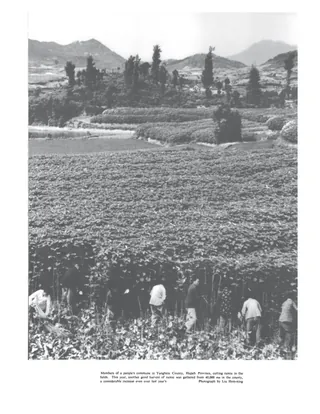
[Cutting Ramie]
China Pictorial, 1965
Article · 1 page
A single-page photo feature from China Pictorial showing members of a people's commune in Yanghsin County, Hupeh Province, cutting ramie in the fields. The caption reports a good harvest from 40,000 mu in the county, an increase over the previous year. The photograph shows workers bent over the plants in a large field with hills and terraced land behind.
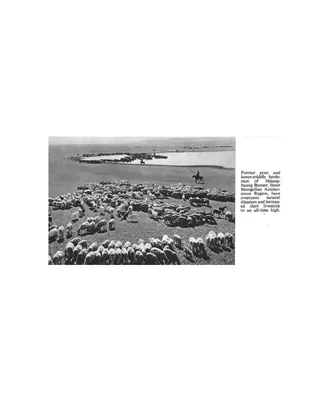
[Flock]
China Pictorial, 1976
Illustration · 1 page
A single-page black-and-white photograph from China Pictorial showing a large flock of sheep grazing on open grassland, with a herdsman on horseback and distant animal pens. The caption says herdsmen of Hsiang-huang Banner in the Inner Mongolian Autonomous Region overcame natural disasters and raised livestock numbers to a record high. It is background on sheep raising, a source of wool, and has no weaving content.
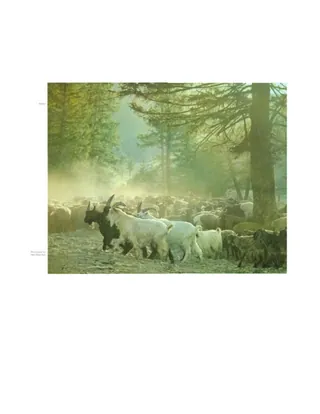
Flocks
Illustration · 1 page
A single-page photograph from China Pictorial, 1966 No. 2, titled "Flocks". It shows a large flock of goats moving through a misty conifer forest in soft morning light, with dust rising from the ground. The page carries only the title and a photographer credit, with no text on weaving or textiles.
Girl Cotton-Growers
Article · 2 pages
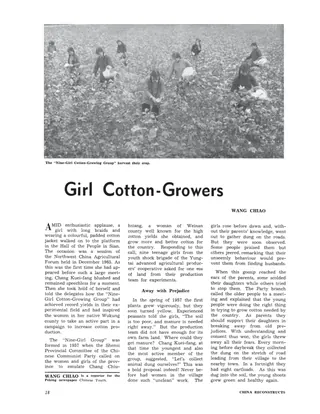
A 1966 China Reconstructs article about the "Nine-Girl Cotton-Growing Group" of Yungtai cooperative in Wukung county, Shensi province. Formed in 1957, the teenage girls ran an experimental cotton plot, overcoming social prejudice, insecticide damage and hail through manuring, transplanting and scientific experiment. The article reports their yields of over 200 jin of ginned cotton per mu and how the group inspired 1,400 girls' cotton-growing groups in the county. It contains two black-and-white photographs and no weaving content.
The Grunting Ox of Thibet
The American Penny Magazine, January 30, 1847
Article · 2 pages
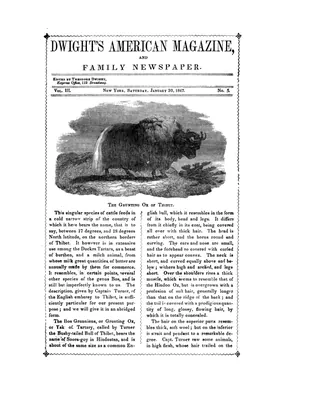
A short 1847 magazine article describing the grunting ox, or yak, of Tibet, with an engraving. It covers the animal's range, appearance, long hair, temperament, and its use by Tartar nomads for carrying loads, butter, and tents and ropes made from its hide. A second section describes the musk ox of North America as a comparable long-haired animal.
[Hemp-Producing Area]
China Pictorial, 1975
Illustration · 1 page
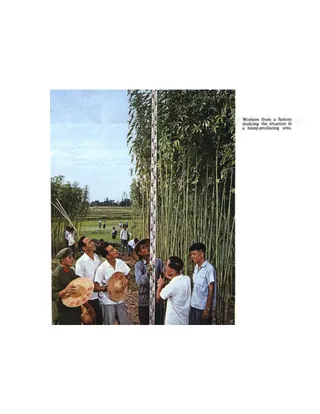
A single photograph from China Pictorial, 1975, No. 11, showing factory workers studying conditions in a hemp-producing area. Men stand in a field of tall hemp plants, one holding a measuring rod against the stalks while another points. The only text is a one-line caption.
Notes on the Use of the Hook in Indian Embroidery
Article · 13 pages
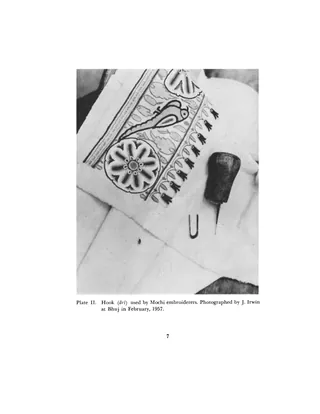
Article by John Irwin and Babette Hanish on the use of the hook (ārī) for chain-stitch embroidery in India, based on their separate field enquiries at Bhuj, Kutch, in 1957 and 1967. It covers the historical background of Gujarat and Sind chain-stitch embroidery, the Mochi caste embroiderers, how the hook is held and used, and how hookwork can be told from needlework. The earliest known published reference (1839) and a Kashmir painting of c. 1820 showing hook embroiderers are discussed, with plates, line drawings and footnotes.
Origin of the Ass, the Cat, and the Sheep in China
Science, February 5, 1892
Article · 2 pages
A short report, reprinted in Science from Nature, on a paper read by Dr. Macgowan to the China Branch of the Royal Asiatic Society in Shanghai. He argues from Chinese texts, the zodiacal cycle and the written characters that the ass, cat and sheep were not native domestic animals in China but came from abroad. The section on sheep notes that early references to lamb-skins and sheep-skins may actually mean goat skins. The article also covers Chinese cat-spirit superstitions and the discussion that followed the paper.
469 documents found