Textile Documents › Topic: Warping and dressing the loom
558 documents found
Sort: 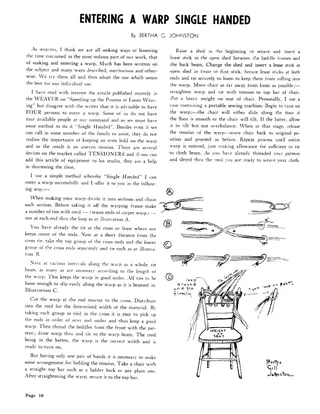
Entering a Warp Single Handed
Article · 1 page
A short 1941 article in which Bertha C. Johnston describes how one weaver can beam a warp alone. She ties the chained warp sections with cord at the ends, the cross and intervals along the length, then threads the heddles and sleys the reed before beaming. To hold tension while turning the warp beam, she ties the warp to the top bar of a weighted chair. Four line illustrations (A-D) show the ties and the chair arrangement.
Glue Method Saves Time and Warp
Article · 1 page
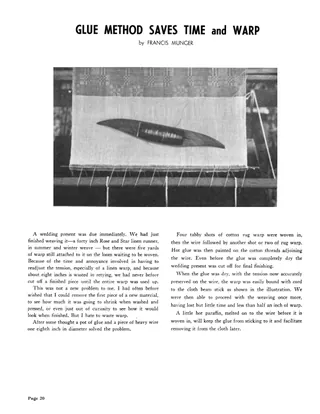
A short how-to article describing a method for cutting a finished piece off a loom without wasting warp or losing tension. The author weaves in cotton rug warp tabby shots and a thin wire, paints hot glue on the adjoining threads, then cuts the cloth off and binds the warp to the cloth beam stick with cord. The method is illustrated with one photograph of the loom, and it grew out of a linen Rose and Star runner woven in summer and winter.
Horizontal Warping Mill - 1
Master Weaver, March 1953
Article · 4 pages
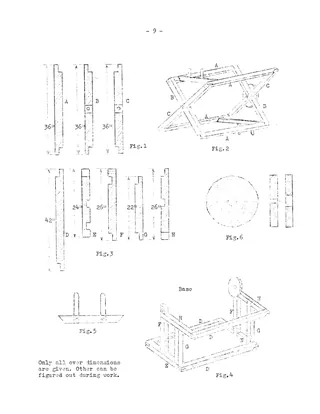
An article from Master Weaver (No. 8, March 1953) on building a horizontal warping mill that can double as a beaming drum. It explains why a horizontal reel is preferable to a vertical one, then covers materials (2x2 hardwood, about 60 running feet), construction of the rotating frame and base, and a plywood-disc brake for adjusting tension. It also describes two ways of using the reel for warping and beaming directly to the loom, with a floor-screw anchor and a "gatherer" peg block. Dimensioned drawings accompany the text, and a follow-up on an automatic feed is promised.
Horizontal Warping Mill 2 - The Heck Block
Master Weaver, May 1953
Article · 3 pages
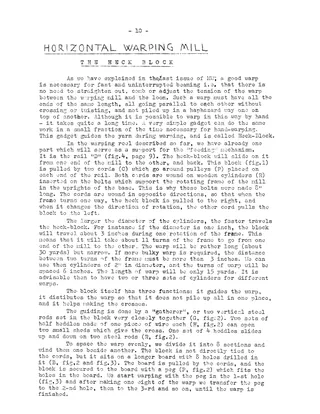
An article from Master Weaver No. 9 (May 1953) describing how to build and use a heck block, a sliding yarn guide for a horizontal warping mill. The block rides on a rail and is pulled by cords wound on wooden cylinders, so it travels along the mill as the frame turns, spacing the warp evenly and helping make the crosses. The text covers construction details (rail, perforated board, box, wire half-heddles, cylinders, pulleys), optional safety stops and a counter, and operating instructions. A page of line drawings (Figs. 1-6) illustrates the parts.
The Lease and the Lease-Rods
Master Weaver, March 1954
Article · 2 pages
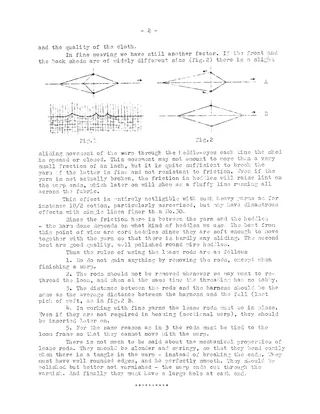
A short article from Master Weaver explaining what a lease is in a warp and what lease rods do. It argues that lease rods secure the order of the warp ends and keep the back shed even, which prevents uneven tension, wavy weft lines and lint from friction in the heddles when weaving fine yarns. It ends with five rules for using lease rods and notes on the best rod construction and on heddle types.
Questions and Answers
Article · 1 page
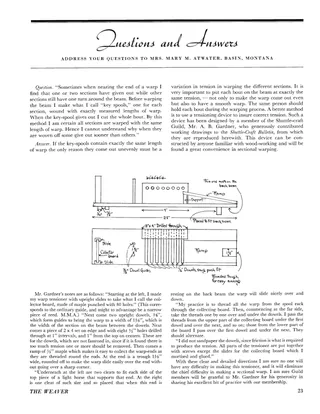
A one-page question-and-answer column by Mary M. Atwater from The Weaver, 1937. A reader asks why sections of a sectionally warped beam run out unevenly even though measured key spools were used. Atwater attributes this to uneven tension and presents a wooden warp tensioning device designed by Guild member A. B. Gardner, with a diagram and Gardner's construction and use notes.
Questions and Answers - The Lease
Article · 1 page
A one-page question-and-answer column by Mary M. Atwater explaining what the lease is in weaving: the cross in the warp that makes the tabby shed, and especially the cross made on the warping board or drum when making a warp chain. She explains why a lease matters for chained warps, why it is unnecessary in sectional warping, and argues that lease sticks at the back of the loom are not needed during weaving.
Raddles
Master Weaver, November 1954
Article · 2 pages
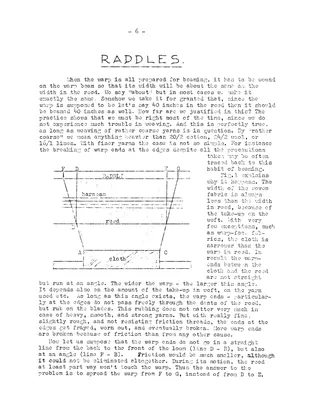
A two-page article from Master Weaver explaining why a warp should be beamed wider than its width in the reed, especially for fine yarns, to reduce friction and breakage of edge warp ends. It recommends spreading the warp with a raddle rather than a reed, describes raddle types and how to attach one to the slabstock, and gives instructions for making a simple nail raddle at home. A diagram illustrates the angle of the warp ends between reed and cloth.
Shortcuts - Beaming
Master Weaver, July 1959
Article · 3 pages
A short article from the 'Shortcuts' series in Master Weaver on beaming a warp onto the loom without a helper. It describes low-tension beaming using a continuous roll of heavy paper between layers and a weight to hold the warp. It also describes high-tension beaming using a wall-mounted pulley and sash cord, and lists suggestions for reducing friction during beaming.
Advertising brochure
Ephemera · 4 pages
A four-page advertising brochure from Terrace Yarn Shop of Portland, Oregon, promoting two instruction books on sectional warping: The Terraspool Method of Warping and Speed Warping. It describes the contents of each book, including measuring and tensioning warp, threading and apron tie-up methods, warp-saving extenders, a warp frame plan, and converting a plain warp beam to a sectional beam. Photographs and a line drawing illustrate the warping equipment and procedures.
Beaming Machine
Article · 1 page
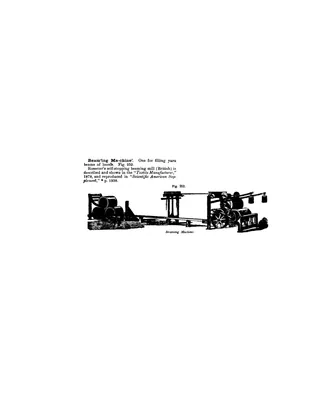
A short dictionary entry defining a beaming machine as a machine for filling the yarn beams of looms, illustrated with an engraving (Fig. 252). It notes Rosseter's self-stopping beaming mill, a British design described in the Textile Manufacturer in 1878 and reproduced in Scientific American Supplement.
Compound Sleying
Master Weaver, July 1956
Article · 2 pages
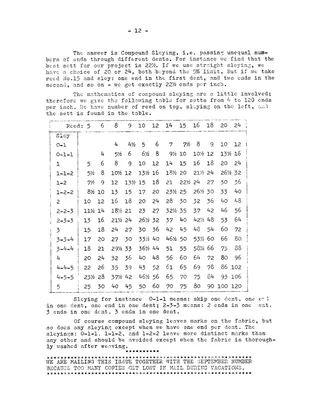
A short article on choosing and adjusting warp sett by sleying the reed with unequal numbers of ends per dent (compound sleying). It explains how much a sett can be varied from a calculated value, then gives a table of ends per inch for reeds No. 5 to 24 combined with sleying patterns such as 1-2, 1-1-2 and 0-1-1. It warns that some patterns leave more visible marks in the cloth unless it is washed.
Sectional Warping for Looms with Sectional Warp Rollers
Monograph · 7 pages · weaving drafts
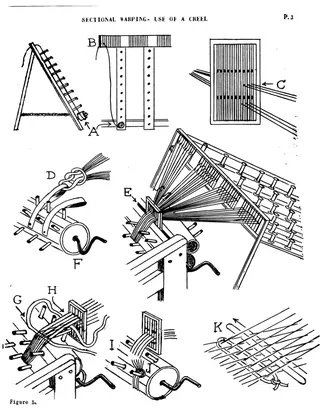
A short instructional leaflet on sectional warping for looms fitted with sectional warp rollers, written by Osma Gallinger Tod. It explains the advantages over chain warping, how to build and thread a creel, how to use a lease reed, how to wind 2-inch sections onto the roller, and how to form and transfer the cross to lease rods. It then covers threading heddles and sleying, warping stripes, plaids and borders, and adjusting lease reed dentage. Illustrated with sketches, and the last page shows a hosepath draft in a warping sequence.
Shortcuts - Deknotting
Master Weaver, November 1960
Article · 1 page
A short practical article from the "Shortcuts" column of Master Weaver on dealing with knots and broken warp ends. It advises leaving holding knots in place, tightening slipping ones, and repairing broken ends with a pinned piece of yarn tied behind the harness. After the cloth is off the loom, the knots are removed by darning in matching yarn alongside each warp end and cutting off the knot ("deknotting").
Shortcuts - Sectional Warping
Master Weaver, March-April 1959
Article · 4 pages
A short "Shortcuts" column from the Master Weaver bulletin giving practical advice on sectional warping for long warps. It covers using ready-wound tubes instead of rewinding bobbins, improving tension box rollers by covering them with felt or flannel, and getting enough tension during beaming. A closing section on the warping mill discusses how many tubes to use, double crosses in the heck-block, and the portee counter.
Shortcuts - Warping & Warping Equipment
Master Weaver, January 1959
Article · 5 pages
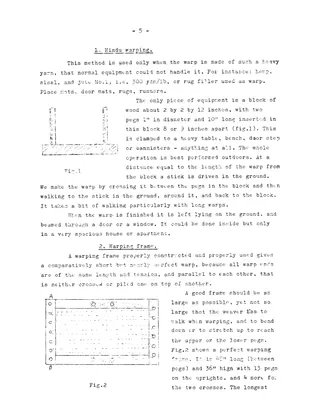
An installment of the 'Shortcuts' series from Master Weaver (1959) on warping and warping equipment. It lists five practical warping methods and describes the Hindu (straight-line) method for heavy yarns, a hardwood warping frame, and the horizontal warping reel, with notes on tension, paddles, crosses, and chaining. The article ends with the start of a section on small, widely spaced patterns using overshot with a twill ground.
Skill in Handweaving
Master Weaver, November 1953
Article · 7 pages
An article on achieving efficiency and skill in handweaving, defining skill as minimum effort for a given quality and speed. It follows the weaving process step by step: planning long warps, choosing yarns, warping with a frame, reel or mill, beaming, threading and sleying with a paper-tape check, tying-in, loom selection and features, and the mechanics of throwing the shuttle, beating, changing the shed and coordination. It also stresses the importance of a heavy, well-built production loom and gives practical speed benchmarks.
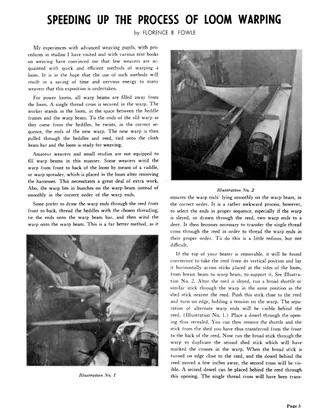
Speeding Up the Process of Loom Warping
Article · 6 pages
Florence B. Fowle describes quick, efficient methods for warping a hand loom. She covers drawing the warp through the reed first, transferring the single thread cross with dowels, securing the warp with a tassel head at the foot beam to keep even tension, and beaming with a stick and papers. She also explains how to tie a new warp to an old one with a reef knot, using step-by-step hand diagrams (Figures 1-8). Illustrated with photographs and line drawings.
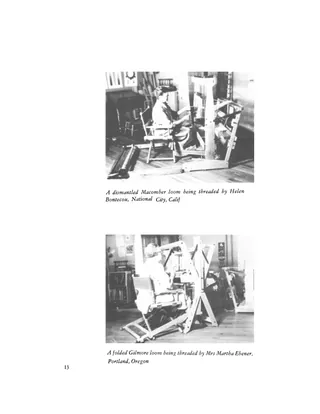
Threading is Easy
Article · 7 pages
An instructional article by Harriet Tidball on making loom threading faster and less tiring. It focuses on threading a sectionally beamed warp: dismantling the front of rigid and folding looms, seating position, taping the warp bouts to the back beam, and drawing threads through heddles in groups taken from the draft. It also covers working with an assistant and gives typical threading speeds. Photographs show Macomber and Gilmore looms set up for threading, with line drawings of heddles and a heddle rod.
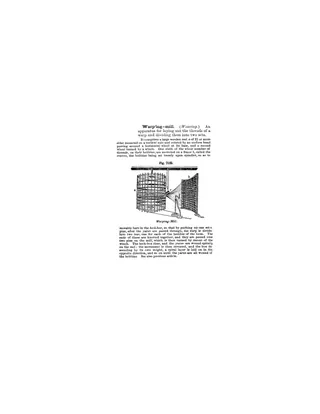
Warping Mill
Article · 1 page
A short dictionary entry from Knight's American Mechanical Dictionary describing the warping mill, a machine for laying out warp threads and dividing them into two leas. It explains the large multi-sided vertical reel, the travers frame holding bobbins, and the heck-box that guides the threads and moves up and down to wind them spirally. An engraved illustration (Fig. 7039) shows the parts.

Advertising brochure
Terrace Textures, 1953
Ephemera · 4 pages
Four-page advertising brochure for Terrace Textures, the Terrace Yarn Shop of Portland, Oregon, run by Mr. and Mrs. Curtis Payton. It presents excerpts of customer letters praising their weaving lessons and sectional-beam warping methods, and reprints Margaret Irey's article 'A New Method of Warping' from Handweaver & Craftsman (Summer 1953). The article describes the Paytons' Terraspool method and Speed Warping for sectional beams, using spools, a wire frame attachment, a pocket comb and a yardage counter, and is illustrated with photographs of the procedures.
Dressing the Loom
Monograph · 54 pages
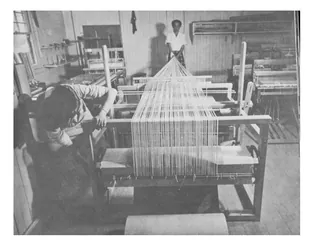
A photographic handbook by Ida Grae on direct beaming, a method of warping a loom in which the warp goes straight from the warping reel to the warp beam. It covers warp calculations, making the warp on a reel, spreading in a reed or raddle, changing the cross, beaming, heddling, sleying, tying on to the front apron, and tying new warp to old. Numbered plates (photographs) accompany the step-by-step instructions, with worked arithmetic examples for spreading plans.
Handweaving News (April 1946): Threading the Loom
Periodical · 2 pages · weaving drafts
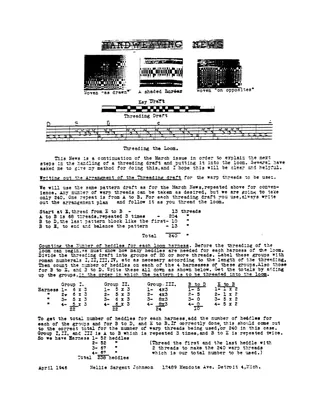
A two-page instructional issue of Handweaving News by Nellie Sargent Johnson, continuing the March issue, on how to take a threading draft and thread it into a four-harness loom. It explains writing out the threading arrangement for 240 warps, counting heddles per harness by groups, and moving heddles between harnesses. It then describes threading in looped groups to avoid mistakes, sleying the reed, and tying on to the cloth beam with even tension. Illustrated with sample photographs, a key draft, a threading draft and four figures.
How to Re-Warp and Thread the Hearthside Loom
Monograph · 2 pages
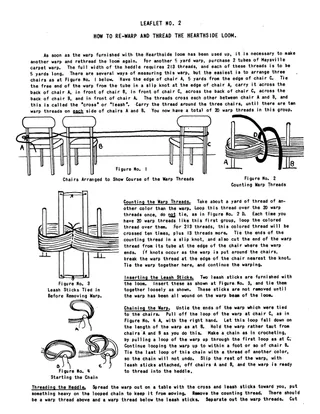
A two-page instruction leaflet (Leaflet No. 2) explaining how to make a new 5-yard, 213-thread warp of Maysville carpet warp for the Hearthside rigid-heddle loom and thread it. It covers measuring the warp around three chairs, counting and chaining, inserting leash sticks, threading the heddle, tying on to the warp and cloth beam aprons, winding the warp with two people, and beating rag weft for firm rugs. Figures show the chair layout, counting, leash sticks and chaining.
The Measurement of Warp Tension
Allan Wentink · 2005
Web Doc · 3 pages
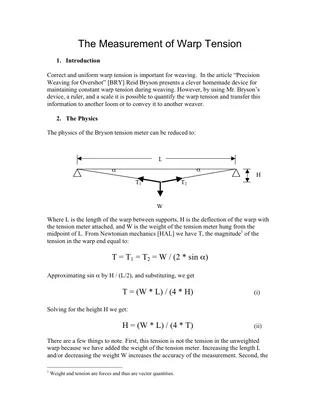
A short technical paper showing how to quantify warp tension using Reid Bryson's homemade tension meter, a ruler, and a scale. It derives a formula from the deflection of a warp end under a hanging weight (T = WL/4H) and its inverse for finding the deflection needed for a target tension. Worked examples show how a weaver can record a tension and transfer it to another loom or weaver. It notes limitations such as stretchy yarn and the added weight of the meter.
Questions and Answers
Article · 1 page
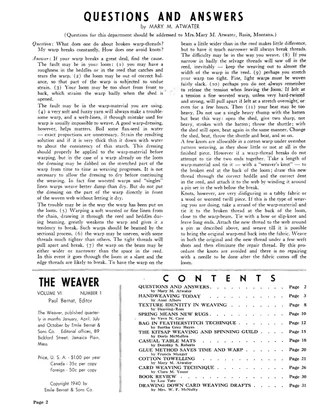
A one-page question-and-answer column by Mary M. Atwater on the causes and prevention of broken warp threads. It lists eleven possible causes in the loom, the warp material, the warping method and the weaving technique, and suggests a flax-seed dressing for weak warps and a gentle double-beat. It also explains how to replace a broken warp thread without tying knots, using a pin in the web, which matters most for tabby and wool or worsted twill fabrics.
Shortcuts, How To Weave Easier and Faster
Master Weaver, May 1958
Article · 3 pages
An opinion piece from the Master Weaver bulletin arguing that modern handweaving is needlessly slow and laborious because of poor equipment, poor instruction and outdated methods borrowed from other countries. The author cites 18th-century professional weavers' speeds (50 to 80 picks per minute, several yards per hour) to claim that weaving a yard of cloth in 30 minutes is realistic. It criticizes vertical warping reels and multi-person warping methods and introduces a forthcoming series of articles on shortcuts, starting with the loom.
Warp Beam for Triaxial Weaving, US Patent No. 3884429
Patent · 10 pages
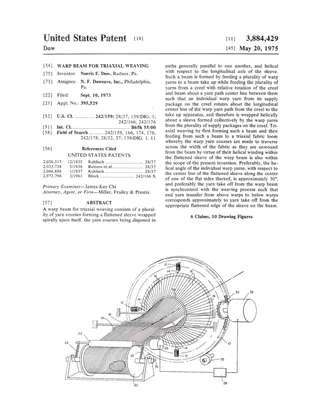
US Patent 3,884,429 (granted May 20, 1975) to Norris F. Dow describes a warp beam for triaxial weaving. Warp yarns from a rotating creel are wound helically into a flattened sleeve on a take-up beam, so the yarns migrate across the fabric width and transfer from upper to lower warp sets as the beam is unwound on a triaxial loom. The text covers the background, two beaming apparatus embodiments, the weaving method, and six claims. Four sheets of drawings show the apparatus and a stabilized triaxial fabric.
Warping Machine
Article · 1 page
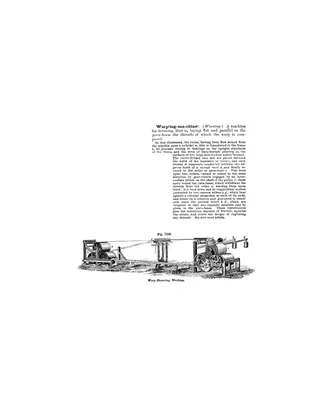
A short dictionary entry from Knight's American Mechanical Dictionary describing a warping machine used to beam a warp, laying the threads flat and parallel on the yarn-beam. It explains the illustrated machine (Fig. 7038): yarn is wound from spindles onto a cylinder, transferred to a frame, passed through two ravels (separators), and wound onto the yarn-beam, which is held under weighted pressure rollers to equalize strain and reduce thread breakage.
Beam Warpers
Monograph · 30 pages
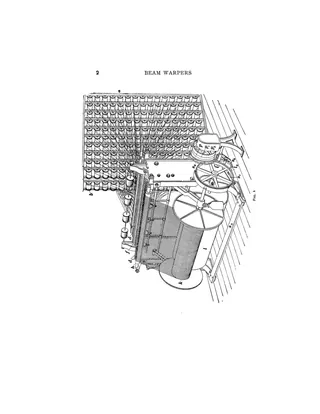
An International Correspondence Schools instruction paper on beam warpers used in preparing cotton warps after spooling. It describes the parts of the Entwistle and Draper warpers: creels, expansion combs, drop and rise rolls, stop-motions, measuring motions, slow-motion gearing, cone drive and beam doffer. It closes with speed calculations, management of warping rooms, production estimates and a table of pounds warped in 60 hours by yarn number and number of ends.
Laboratory Notes of a Dancer Loomer
Article · 4 pages
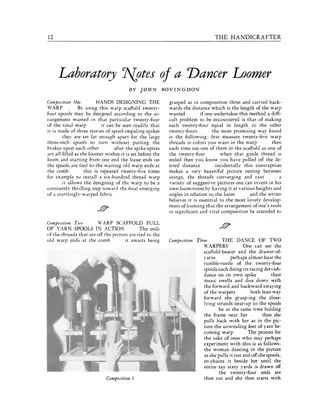
An illustrated first-person article by dancer John Bovingdon describing his experiments with handweaving as a form of movement. He explains a warp scaffold of spool-impaling spikes that holds twenty-four spools for designing and drawing off a warp, and how two people can warp rhythmically, chaining the yarn into masses to be passed through the loom comb. He also describes napping weft yarn with a wire brush on Shetland warp and a hanging piece exhibited in San Francisco. Six photographs labeled Compositions 1-6 illustrate the steps.
Machinery and Appliances
Textile Mercury, 1890
Article · 2 pages
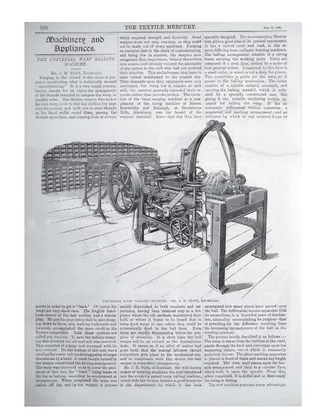
Two pages from The Textile Mercury, 17 May 1890. The first describes J. H. Stott's patent Universal Warp Balling Machine of Rochdale, with an engraving and a short history of warping from peg warping and the reel mill to beam warping. The second page covers dyeing and printing: benzophenone colouring matters, dyeing recipes for wool and cotton, patent blue and acid violet N, and tannin compounds for calico printing.
Master Weaver, No. 12 (November 1953)
Periodical · 13 pages · weaving drafts
Issue No. 12 (November 1953) of Master Weaver, a bi-monthly bulletin for handweavers published by Z-Handicrafts in Fulford, Quebec. It opens with an editor's note and an article on Cannelé, a distorted-warp weave in which short warp floats pull a pattern weft into diagonal diamond-shaped floats, with drafts, tie-ups and yarn suggestions. A long article, "Skill in Handweaving", covers efficient practice: planning, warping methods, threading, tying-in, loom selection, and the rhythm of throwing, beating and shed changing. The second part of construction directions for a double tie-up loom lists materials and describes the frames, levers, lamms, treadles and tie-up. The issue ends with an index of articles in issues 1 to 12.
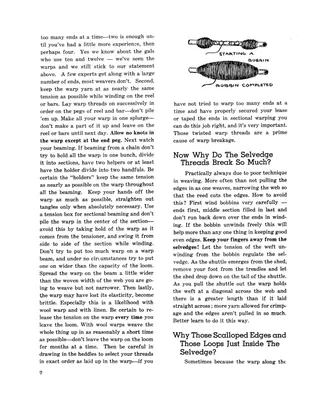
Practical Weaving Suggestions, Vol. VIII, No. 1 (c. 1958): Trouble Shooting for the Hand Weaver
Practical Weaving Suggestions, c. 1958
Periodical · 8 pages
An issue of Lily Mills' Practical Weaving Suggestions written as a question-and-answer troubleshooting guide for beginning hand weavers. It covers causes and remedies for warp breakage, selvedge problems, warp and weft skips, uneven beating, centering the warp, tying on to the front apron, and weaving speed and rhythm. It also explains how to weave a pattern "as drawn in" when no treadling draft is given. The last page advertises Lily hand weaving yarns and the Weaver's Notebook.
Shortcuts - Double Beating
Master Weaver, September 1965
Article · 1 page
A short 'Shortcuts' column from Master Weaver on when beating twice is appropriate. It argues that routine double beating wastes time and may indicate a beater too light for the job, or a weaver without a steady rhythm. It then describes legitimate cases: sticky, closely set soft wool warps, and weaves with uneven warp tension such as doup leno, warp pile weaves and pattern harness or draw loom weaving, where a second light beat clears the shed.
Speed Warping for Handweavers
Monograph · 22 pages
A 1953 handweaving manual by Dorothy and Curtis Payton describing their "Speed Warping" method, a creel-based way of warping a loom for projects of any width or length. It covers loom parts, equipment (warp frame, converted tube spools, sewing-machine winder, balance scale), calculating warp amounts, winding spools, setting up the creel, and tensioning warp onto a one-inch sectional beam. Later chapters explain cartoons and planning mixed warps, alternating-thread work charts, random arrangements, stripes and plaids, with worked examples. It is illustrated with line drawings, photographs and charts, and has no weaving drafts.
Woolen and Worsted Warp Preparation, Part 1
Monograph · 30 pages
An International Textbook Co. instruction paper (section 49, Part 1) on preparing woolen and worsted warps. It introduces the four warp preparation processes (spooling, dressing, beaming, drawing in and reeding), then covers spooling in detail: the ordinary spooler, bobbin stand and worsted creel, tension rolls, traverse motion, spool-holding device, yardage measuring motion with bell, and stop-motion. It also describes the compressing spooler with its grooved compressing roll, slow motion and stop-motion. It closes with examination questions, some with numeric answers on yardage, yarn weight and piece-rate wages.
Chain Warping: Part 2
Monograph · 49 pages
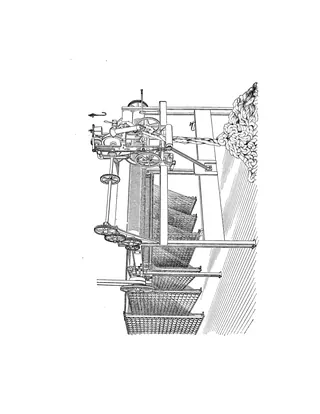
Part 2 of an International Correspondence Schools textbook on chain warping for cotton and similar mills. It describes the construction and operation of the Denn warper: creels, mechanical and electrical stop-motions, leasing harnesses (thread and pin leases), measuring rolls, the linker head, balling attachments and the measuring motion with gear calculations. It also covers chain weight calculations, Walcott warpers, Entwistle-type long-chain beaming machines, and quilling machines, ending with notes on oiling, cleaning and care of the machines. Illustrated with many mechanical line drawings.
Manual of Helpful Hints for Handweavers
Monograph · 33 pages · weaving drafts
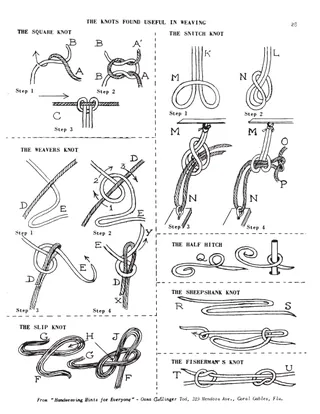
A compilation of practical hints for handweavers by Osma Gallinger Tod, made up of separate illustrated leaflet pages. Topics include weaving posture, loom placement, adjustment and tie-up, threading, making a bobbin winder and warping board, winding bobbins, piecing wefts, and achieving good selvages with threading rules for several weave structures. It also covers mending broken warps, shuttle placement, combined wefts, parallel weaving, ways to take cloth off the loom, hem and fringe finishes, joining stitches, tassels, rope, knots, drawing down drafts, and adapting reed dentage.
Multiple Warps
Master Weaver, March 1956
Article · 4 pages
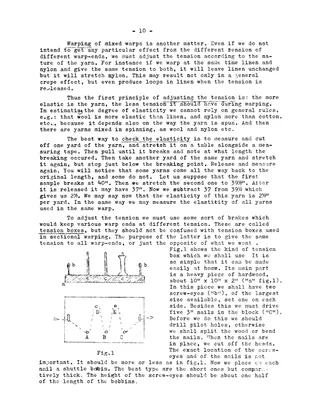
A 1956 Master Weaver article that distinguishes true multiple warps (separate warps on one or more beams, as for velvet and tissue weaves) from mixed warps of different yarns. It explains how to work out the sett for mixed yarns by averaging counts, converting to yards per pound, and how to test yarn elasticity. It also describes a homemade tension box built from a hardwood block and shuttle bobbins, and gives advice on beaming, threading and sleying mixed warps.
Questions and Answers
Article · 1 page
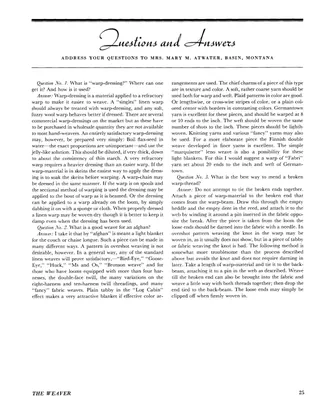
A one-page question-and-answer column by Mary M. Atwater from The Weaver. It explains what warp-dressing is and how to make a flaxseed version for linen and wool warps, suggests weaves and yarns for an afghan or light couch blanket, and describes two ways to mend a broken warp thread during weaving.
Shuttle-Craft Bulletin, Vol. XXXI, No. 4 (April 1954)
Periodical · 19 pages · weaving drafts
April 1954 issue of the Shuttle Craft Guild Handweaver's Bulletin (Portfolio Edition), edited by Harriet and Martin Tidball. It opens with an essay on the return to pattern in textile design and what it means for handweavers, then discusses warping methods and new sectional-warping equipment (Wade Speed-Warp, Blum winder and yardage counter, one-inch sectional beams, with prices and suppliers). It closes with a Polka Dots section giving four- and six-shaft drafts for dot patterns on a tabby ground, with weaving instructions, yarn details and advice on balancing the tabby. Mounted fabric samples and a Speed-Warp threading diagram are included.
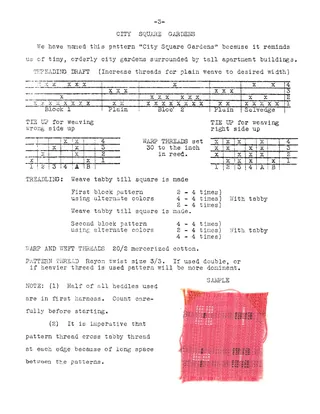
Warp & Weft, Vol. 2, No. 4 (February 1949)
February 1949
Periodical · 8 pages · weaving drafts
February 1949 issue of Warp & Weft, a monthly handweaving newsletter edited by Gladys Rogers Brophil in Chicago. It reports on weaving news (the Joliet Weavers Guild, Marjorie Burd of Sacramento), describes a faster method of warping a sectional beam loom without winding spools, and gives a draft and treadling for a small block pattern called City Square Gardens, woven on four shafts with 20/2 cotton and rayon pattern thread. Other items cover color psychology, planning symmetrical and asymmetrical plaids, a reminiscence of an 1884 magazine illustration of strip weaving, and weaving anecdotes about Lincoln and Washington. The last page announces the formation of Gladys Rogers Brophil, Inc. and a price increase.
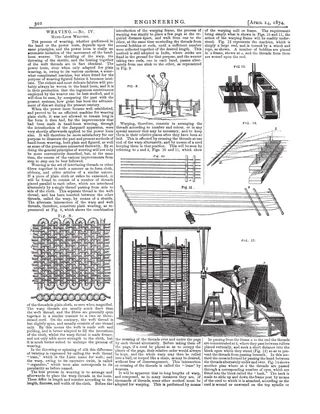
Weaving. -- No. IV: Hand-Loom Weaving
Article · 2 pages
Fourth article in a series on weaving from the periodical Engineering (1874). It explains that hand and power looms work on the same principles and describes plain weave, the difference between warp and weft yarns, and silk terms (tram and organzine). Most of it covers warping: peg warping as still done in India, the lease or cross, the warping mill with its heck, and beaming the warp with a comb. Illustrated with line figures (Figs. 8-18); no weaving drafts.
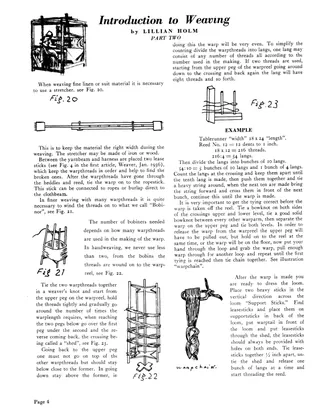
Introduction to Weaving
Article · 5 pages · weaving drafts
Part Two of Lillian Holm's instructional series on handweaving, with figures 20 to 29. It covers warping and dressing the loom: stretchers, bobbins, the warp reel, counting warp in langs, threading the reed and heddles, attaching the warp to the ropestick, and changing lease sticks. It then describes countermarch tie-ups with top, short and long lams, and the pattern-harness (harneskrustning) loom used for opphämta and damask. It closes with an introduction to reading drafts: binding construction, threading (inredning), tabby/tie-up and treadling, and the raport (repeat). The article ends 'to be continued'.
Shuttle-Craft Bulletin, Vol. XXX, No. 6 (June 1953)
Periodical · 17 pages · weaving drafts
June 1953 issue of the Shuttle Craft Guild Handweaver's Bulletin, edited by Harriet Tidball. It describes a warping system built around a 2-yard horizontal drum and a combination creel and skein holder, with step-by-step directions for sectional warping with small bouts and no pegs, beaming, and threading without a cross. It also covers nylkara, a nylon and vicara yarn from Lily Mills, and introduces the Shadow Weave with three 4- and 6-harness drafts and treadling notes. The issue ends with a progress report on the Guild's Ceylon loom fund and a review of Edward Worst's reprinted How to Weave Linens.
Tkalcovstvi [Weaving]
Article · 5 pages · Czech
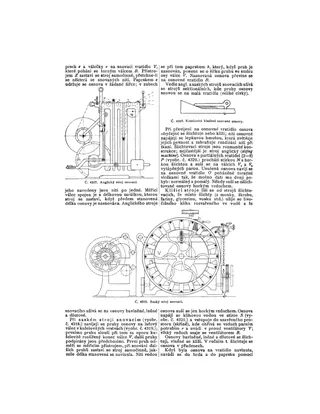
Encyclopedia article on weaving (tkalcovství) from the Czech encyclopedia Ottův slovník naučný. It surveys the history of weaving from antiquity to industrial production, then describes warp preparation: hand warping with a warping frame, bobbin rack and warping board, and English and Saxon warping machines. It also covers sizing and gluing machines and drawing the warp into the heddles and reed with hooks. It closes with statistics on the cotton, wool, linen, jute and silk weaving industries in Europe, Austria and Bohemia, and a short bibliography.
Handweaving
Cedar Lakes, 1960
Book · 79 pages · weaving drafts
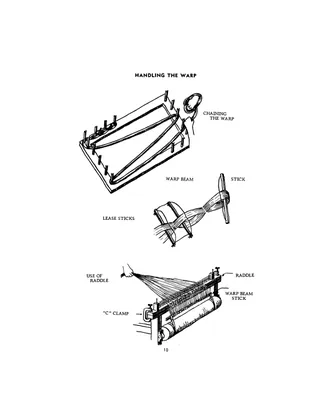
A beginner's manual for weaving on a 4-harness, 6-treadle foot treadle loom, published by the Cedar Lakes Arts and Crafts Center in West Virginia and revised in March 1960. It gives step-by-step instructions in a two-column Operation/Information format, covering the loom and its equipment, figuring yardage, making a warp on a warping board, beaming with a raddle, a reed or a sectional beam, and tying up counterbalanced and jack looms. Further chapters cover reading drafts, threading heddles, sleying, tying treadles, and weaving a 4-harness twill sample with hemstitching and finishing. Appendices give troubleshooting for broken threads and a guide to warp and weft materials and sett. Illustrated with line drawings and a few photographs.
Looming Arts, Vol. 11, No. 5
Looming Arts, c. 1982
Periodical · 8 pages · weaving drafts
Issue of Mary Pendleton's newsletter The Looming Arts (Sedona, Arizona) with weaving projects and instruction. It includes a twill-threaded stole sample combining Dante novelty yarn with smooth yarn woven as tabby, a woven candle motif for handwoven Christmas cards on linen, and a striped diamond-pattern design on multiple harnesses with its design steps. The ongoing "Learning How to Weave" series continues with Step 22, sleying the reed, covering reed specifications, cutting reeds, and sleying with a reed hook, illustrated with photos. Also has editor's notes on a sale of Craft Horizons magazines, yarn sources, weaving tips, corrections to the previous issue, subscription information, and advertisements.
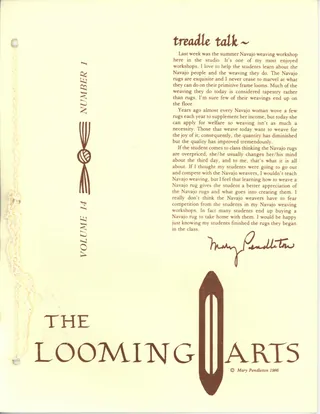
Looming Arts, Vol. 14, No. 1
Looming Arts, c. 1986
Periodical · 9 pages · weaving drafts
Issue of The Looming Arts, Mary Pendleton's handweaving newsletter from Sedona, Arizona. It includes an editorial on teaching Navajo weaving, an article on uneven sleying of the reed for place mats, drafts and directions for a tabby casement curtain fabric and a huck lace cafe curtain fabric, and the final installment of the 'Learning How To Weave' series (loom care, warping additions, left-handed paddle warping). It also covers using a stretcher (temple) to control draw-in, with photos, plus book recommendations on craft business and rigid heddle weaving and shop advertisements.
558 documents found