Textile Documents › Topic: Textile machinery (general)
1,266 documents found
Sort: 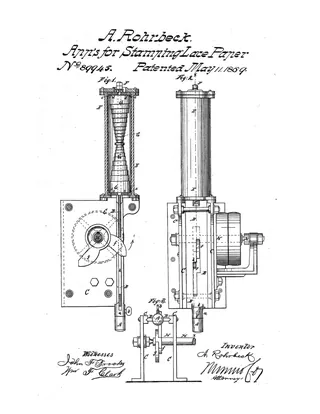
Apparatus for Stamping Lace Paper, US Patent No. 89945
Patent · 2 pages
US Patent No. 89,945, granted May 11, 1869 to Albert Rohrbeck of New York, for a machine that stamps perforated lace paper of the kind used by confectioners and cigar-makers. A spring-driven hammer, raised by a shaft with two fingers acting in a slotted plate, drops onto a steel cutting-plate and replaces hand-struck perforating tools. The document has a drawing sheet with three figures, followed by the specification and three claims.
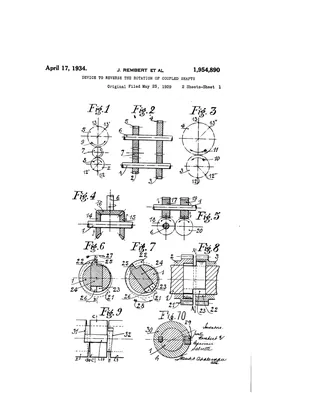
Device to Reverse the Rotation of Coupled Shafts, US Patent No. 1954890
Patent · 5 pages
US Patent No. 1,954,890, granted April 17, 1934, to Juste Rembert and Casimir Salvetti of France, assignors to Dirac. It describes a mechanical device that reverses the rotation of a main shaft without changing the rotation of a coupled countershaft. It uses two gear trains, one direct and one reversed, with a sliding key that engages spiral-grooved loose pinions. The patent has two sheets of drawings (Figs. 1-21) showing gear arrangements and key variants, followed by the specification and one claim.
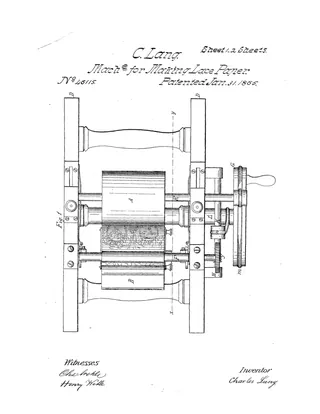
Machine for Making Lace Paper, US Patent No. 46115
Patent · 3 pages
US patent No. 46,115 granted to Charles Lang of Worcester, Massachusetts, for a machine that makes lace paper (the decorative paper used for doilies and valentines, not textile lace). Two rollers grind the raised parts off embossed paper pressed into a die. The scan has two sheets of drawings and a three-part specification with a single claim.
Modern Points of View in the Construction of Textile Machinery
Article · 6 pages
A 1929 article by consulting engineer Conr. J. Centmaier on design principles for textile machinery. It covers the construction materials (cast iron, steel, aluminium and brass alloys, metal testing methods) and argues for greater attention to static and dynamic forces, noise, and breakage. It also discusses automation, ergonomic control layouts, and electric drives such as individual spindle motors. The article is technical and engineering-oriented, with no weaving drafts.
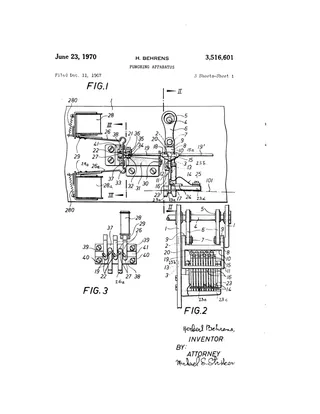
Punching Apparatus, US Patent No. 3516601
Patent · 11 pages
US Patent No. 3,516,601 for a high-speed punching apparatus, granted June 23, 1970 to Herbert Behrens, assignor to Olympia Werke AG. A reciprocating drive is coupled to selected punches by turnable coupling members with non-circular cross sections, which electromagnetic selectors rotate during the return stroke. The document has three drawing sheets (Figs. 1-6), the specification with background, summary and embodiments, and 23 claims. It is about punched record-carrier equipment and has no weaving content.
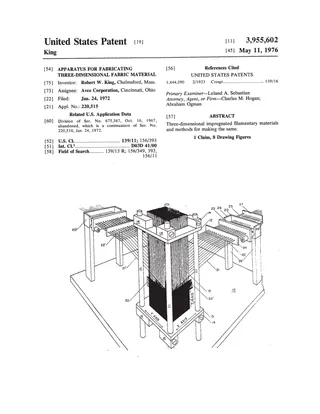
Apparatus for Fabricating Three-Dimensional Fabric, US Patent No. 3955602
Patent · 16 pages
US Patent 3,955,602 (Robert W. King, assigned to Avco Corporation, granted 11 May 1976) describes a loom-like apparatus that uses needles to weave filaments along the X and Y axes into a bundle of Z-axis filaments, producing a three-dimensional woven block. The structure is held together by inter-yarn friction, compressed, then impregnated with resin or another matrix and cured into a billet that can be machined. The document includes a web-printed copy of the patent record, the original patent drawing sheets (8 figures, including a cylindrical variant), and the typeset specification and claim.
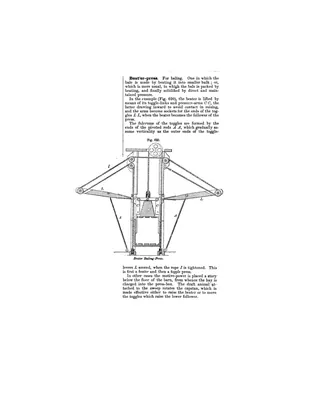
Beater-Press
Article · 1 page
A short dictionary entry defining a beater-press, a baling press in which the bale is packed by beating and then solidified by sustained pressure. It describes the example in Fig. 620, where a beater lifted by toggle-links and pressure-arms becomes the follower of the press, worked by a rope and toggle levers. It also mentions arrangements with a capstan and draft animal for hay baling. The entry concerns agricultural baling machinery, not weaving.
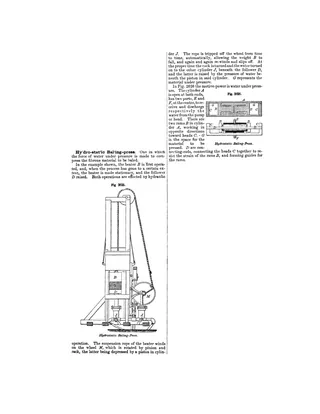
Hydrostatic Baling Press
Article · 1 page
A short dictionary entry defining a hydrostatic baling press, a machine that uses water under pressure to compress fibrous material into bales. It describes two designs: one with a hydraulically operated beater and follower raised by a cylinder, and one with two opposed rams in a double-ended cylinder. Two engraved figures (Figs. 2625 and 2626) illustrate the machines.
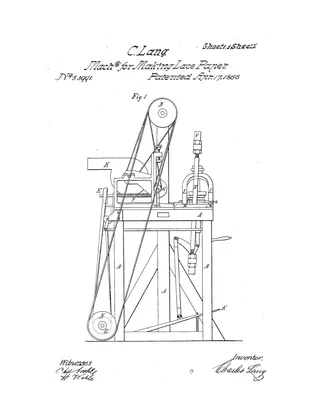
Machine for Making Lace Paper, US Patent No. 53991
Patent · 5 pages
US Patent No. 53,991, granted April 17, 1866 to Charles Lang of New York, for a machine that turns plain paper into lace-paper. A foot-operated press embosses the paper between dies. A rotating, vibrating drum covered with ground glass or emery then grinds off the raised parts, and a sucking-blower removes the dust. The scan has three sheets of patent drawings (Figs. 1-5) and a two-page specification with three claims. The specification refers back to Lang's earlier patent No. 46,115 of January 31, 1865.
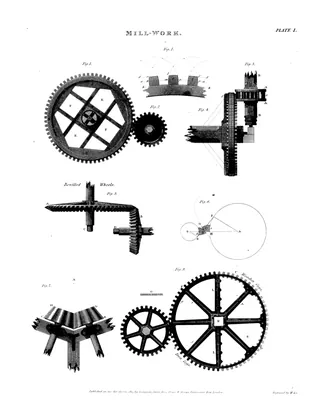
Mill-Work
Rees's Cyclopedia, 1819
Article · 13 pages
Encyclopedia article on mill-work from Rees's Cyclopedia, describing the common mechanical parts of mills: cog-wheels (spur, face, bevel/mitre wheels), pinions and trundles, wooden and cast-iron wheel construction, fixing wheels on shafts, bearings and friction rollers, shaft couplings and universal joints, and governors for regulating speed. It includes three engraved plates of gear, bearing, and shaft diagrams. The article concerns general mill machinery rather than textile processes, though it is relevant to the mechanics of textile mills.
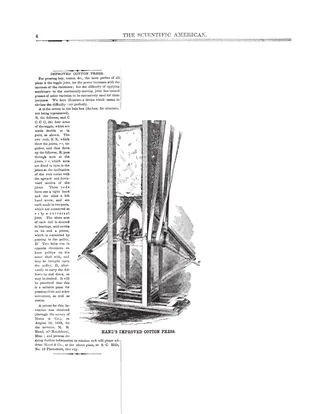
Miller's Hay, Hop and Cotton Press
Scientific American, January 1860
Article · 1 page
A short Scientific American article describing M. B. Hand's improved cotton press, patented August 16, 1859. It explains a toggle-joint press in which two oppositely threaded screw rods with universal joints, driven by gearing and belts, raise and lower the follower. It is intended for hay, cotton and cloth, and the article includes an engraving of the machine.
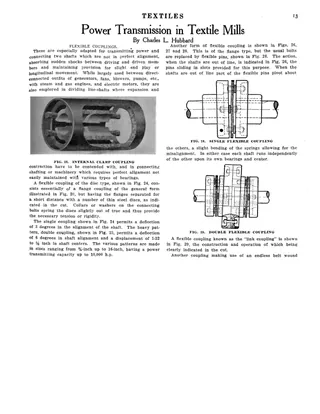
Power Transmission in Textile Mills, Part 2
Article · 2 pages
Two pages from a series on mechanical power transmission in textile mills, covering shaft couplings. The first section describes flexible couplings (disc, flange with flexible pins, link, belt, and insulated types) and their allowable shaft misalignment and size ranges. The second section covers clutch couplings (jaw and friction types) used to cut sections of line shafting in and out. Illustrated with Figs. 23-33 of couplings.
Baling Press
Article · 1 page
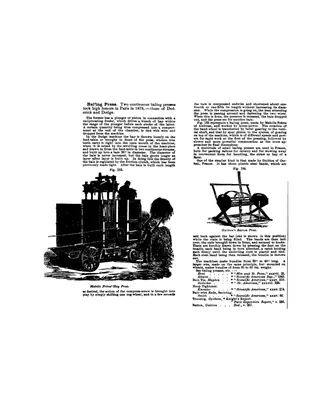
A dictionary entry on baling presses from Knight's New Mechanical Dictionary. It describes the Dederick and Dodge continuous presses honored at Paris in 1878, the horse-powered Mabille Frères hay press of Amboise, and Guitton's small ration press from Corbeil, illustrated with two engravings. It ends with a list of references to periodicals such as Scientific American.
Canvas Cutter
Article · 1 page
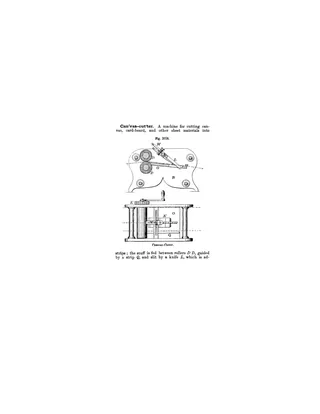
A short dictionary entry from Knight's American Mechanical Dictionary describing a canvas-cutter, a machine that slits canvas, card-board and other sheet materials into strips. Material is fed between rollers, guided by a strip, and cut by a knife. The page includes a line drawing (Fig. 1076) showing an upper elevation and a front elevation of the machine.
Card-Grinding Machine
Article · 1 page
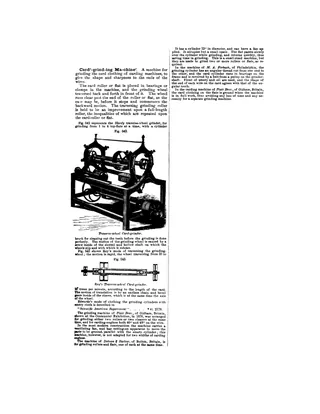
A dictionary entry describing machines used to grind the card clothing of carding machines so the wire ends are shaped and sharpened. It covers the Hardy and Roy traverse-wheel grinders (Figs. 542 and 543) and the designs of Platt Bros., Dobson & Barlow, and M. A. Forbush, with brief notes on how each works.
Cloth-Drying Machine
Article · 1 page
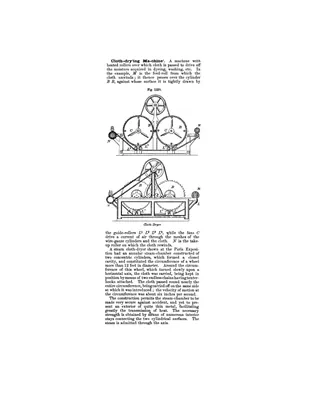
A short dictionary entry describing cloth-drying machines that use heated rollers to remove moisture from cloth after dyeing or washing. It explains one machine with a feed roll, heated wire-gauze cylinders, fans, guide rollers and a take-up roll, and a large steam-heated wheel dryer shown at the Paris Exposition that carried cloth on endless chains with tenter-hooks. Two diagrams illustrate the machines.
Cloth-Folding Machine
Article · 1 page
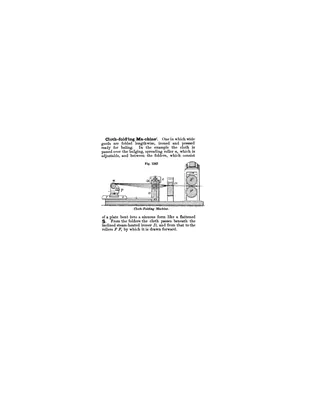
A short dictionary entry from Knight's American Mechanical Dictionary describing a cloth-folding machine that folds wide goods lengthwise, irons and presses them ready for baling. The text explains the path of the cloth over an adjustable spreading roller, through S-shaped folders, under a steam-heated inclined ironer, and out through drawing rollers. It includes one side-elevation diagram (Fig. 1343).
Cloth-Measuring Apparatus
Article · 1 page
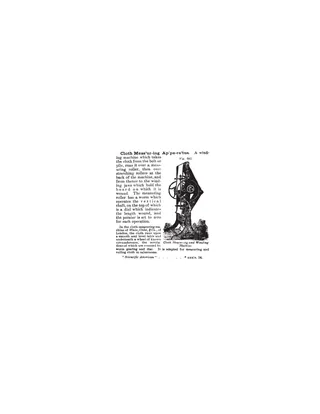
A short dictionary entry describing cloth measuring apparatus: a winding machine that draws cloth from a bolt, passes it over a measuring roller and stretching rollers, and winds it onto a board while a dial shows the length. It also notes the White, Child & Co. (London) machine, in which cloth runs under a wheel of known circumference with revolutions counted by worm gearing and dial, for use in salesrooms. Includes an engraving (Fig. 641) of the machine.
Cloth-Smoothing Machine
Article · 1 page
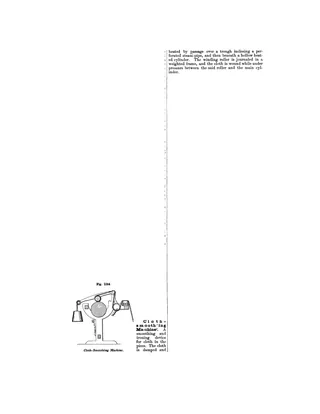
A short dictionary entry describing a cloth-smoothing machine, a device for smoothing and ironing cloth in the piece. The cloth is damped, heated by passing over a trough with a perforated steam pipe, then passes under a hollow heated cylinder and is wound under pressure on a roller in a weighted frame. Includes Fig. 1344, a side-elevation diagram of the machine.
Cloth-Varnishing Machine
Article · 1 page
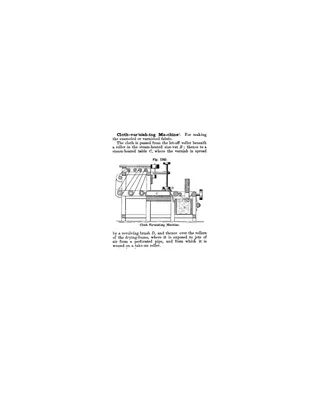
A short dictionary entry from Knight's American Mechanical Dictionary describing a machine for making enameled or varnished cloth. Cloth passes from a let-off roller through a steam-heated size-vat, over a steam-heated table where a revolving brush spreads the varnish, then over drying-frame rollers with air jets before winding on a take-up roller. Includes a side-elevation diagram (Fig. 1345).
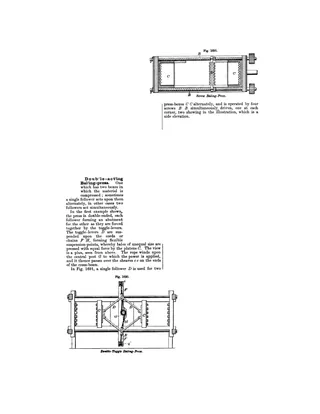
Double-Acting Baling Press
Article · 1 page
A one-page dictionary entry defining the double-acting baling press, a machine with two compression boxes worked by a single follower acting alternately or by two followers acting together. It describes two examples: a double-ended toggle-lever press with flexible cord or chain suspension that presses unequal bales with equal force, and a screw press with four corner screws. Two mechanical drawings (Figs. 1690 and 1691) illustrate the text.
Drying Machines
Article · 1 page
A short encyclopedia entry describing machines used to dry textile materials. It explains centrifugal extractors, with a perforated inner drum spinning inside an outer cylinder, and roller wringers that squeeze out moisture. It notes that remaining moisture is removed by air drying, hot chambers, or heated cylinders and steam pipes.
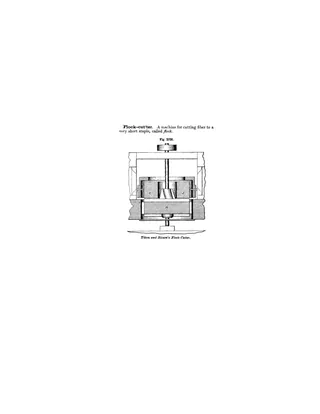
Flock Cutter
Article · 1 page
A brief dictionary entry defining a flock-cutter as a machine for cutting fiber to a very short staple, called flock. It includes an engraving (Fig. 2026) of Tilton and Ritson's Flock-Cutter in cross-section, showing the drive shaft, pulley, housing, and lower cutting block.
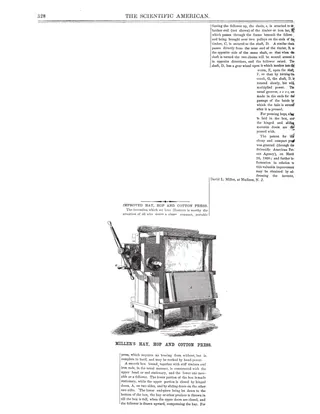
Hand's Improved Cotton Press
Scientific American, May 19, 1860
Article · 1 page
A short Scientific American item from 1860 describing David L. Miller's improved hay, hop and cotton press, with an engraving. It explains the wooden box press with a movable follower raised by chains wound on a geared shaft turned by a hand crank. It also notes use for hops and the patent granted March 20, 1860. The page also carries the end of a preceding article on a press mechanism.
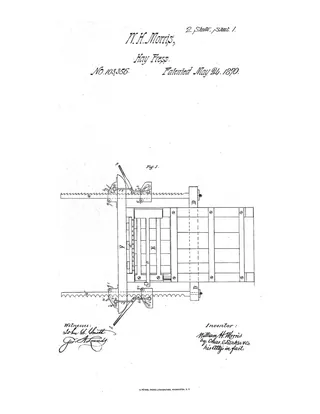
Hay Press, US Patent No. 103356
Patent · 3 pages
US Patent No. 103,356, granted May 24, 1870 to William H. Morris of Troy, Obion County, Tennessee, for an improvement in cotton, hay, and hemp presses. The press uses six upright posts and a sliding bottom beam raised by ratchet-bars and two levers, with pawls and friction rollers to reduce friction and increase leverage. The document has two sheets of patent drawings (Figs. 1 and 2) and a three-part specification with description and claim.
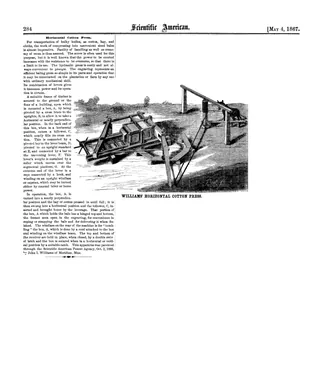
Horizontal Cotton Press
Scientific American, May 4, 1867
Article · 1 page
A short 1867 Scientific American article describing John I. Williams' horizontal baling press for cotton and hay, patented in October 1866. It explains the lever-and-follower mechanism, a tilting box, and a windlass or capstan powered by hand or horse, and notes that the press could be built on a farm or plantation. An engraving of the machine is included.
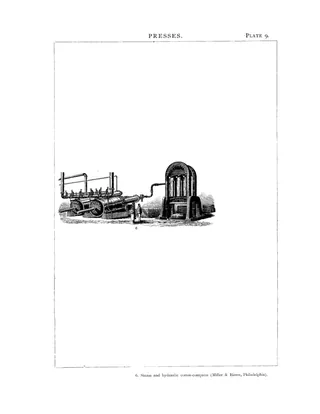
Hydraulic Cotton-Compress
Article · 2 pages
A short encyclopedia article on the hydraulic cotton-compress, a steam-powered press used to bale cotton for cheaper shipping and storage. It describes the machine's construction (three hydraulic cylinders, cross-head, platens), its high- and low-pressure steam cylinders and rams, the 3000-ton pressure and the 500-pound bale it produces, and a capacity of 100 bales per hour. A plate engraving of the Miller & Bierce press (Philadelphia) accompanies the text.
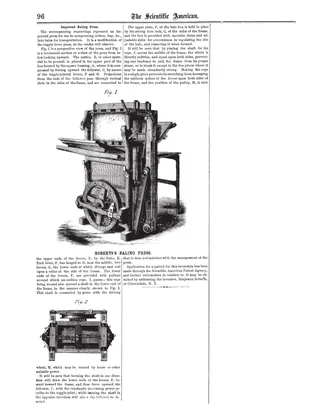
Improved Baling Press
Scientific American, August 9, 1862
Article · 1 page
A short 1862 Scientific American article describing Benjamin Roberts's improved baling press, a toggle-lever machine for compressing cotton, hay and similar material into bales for transport. It explains how an endless rope and pulleys draw the lever ends inward to force up the follower, driven by a horse-powered wheel. Two engravings show a perspective view and a view from below.
Machinery and Appliances
Textile Mercury, 1890
Article · 3 pages
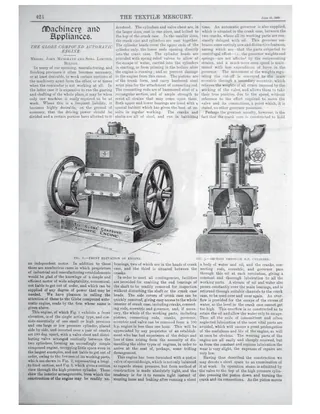
Three pages from The Textile Mercury of 21 June 1890. The main item describes the Globe Compound Automatic Engine made by John Musgrave and Sons of Bolton, covering its construction, governor, lubrication and operation, with engravings of it driving a hydro-extractor, calenders and a cotton gin. A short 'Bleaching, Dyeing, Printing, etc.' section follows with notes on heat decomposition of magnesium and calcium chlorides, hypochlorite bleaching chemistry, a wool-top dyeing machine, new dyes (Hydroleine, a red from benzidine, new blues) and a rotary-pot dyeing machine.
The Mechanics of Textile Processes, Part 1
Article · 1 page
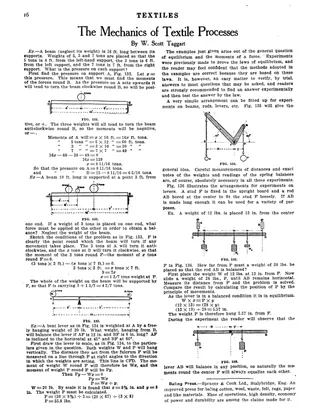
A single page from a series by W. Scott Taggart on the mechanics underlying textile machinery. It works through numerical examples of beams, moments and levers: finding the pressure on each support of a loaded beam, balancing a beam on a fulcrum, and a bent lever with hanging weights. It also describes simple experiments with spring balances and a pivoted rod to check the laws of equilibrium. The page ends with a short trade notice for a baling press for cotton, wool, waste and rags.
New Automatic Adjusting Swift
Article · 2 pages
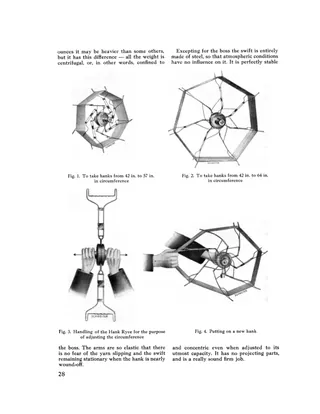
A short trade article from The Melliand describing the Schweiter Hank Ryce D.H. 545, an automatic adjusting swift for holding yarn hanks during winding. It explains the two sizes (hanks of 42 to 57 inches and 42 to 64 inches circumference), the pull-and-turn boss adjustment, and the flexible piano-wire arms. Four diagrams illustrate the swift's sizes, adjustment and loading of a hank.
Picture postcard
Ephemera · 1 page
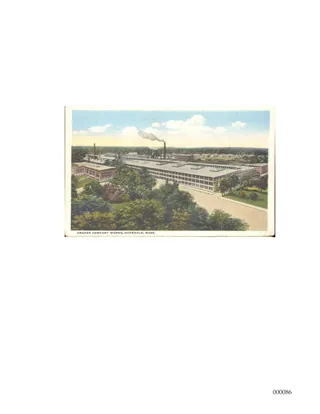
A hand-colored picture postcard showing an aerial view of the Draper Company works in Hopedale, Massachusetts. It depicts long multi-story brick and light-colored factory buildings with rows of windows. The only printed text is the caption identifying the works; the card is of interest for the history of textile machinery manufacturing.
Platt's Textile Machinery Works
Engineering Weekly, August 2, 1899
Article · 1 page
A one-page report from the journal Engineering on an excursion to Platt Brothers and Co.'s textile machinery works at Oldham, during a meeting of engineers. It gives figures on the size and workforce of the works, its history from 1821, and its departments: forge, sawmills, packing cases, foundries, steel, machine shops and spindle works. It concerns the manufacture of textile machinery, not weaving technique.
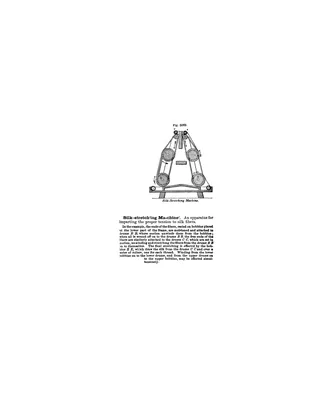
Silk Stretching Machine
Article · 1 page
A short dictionary entry on the silk-stretching machine, an apparatus that gives silk fibers the proper tension. It explains how fibers are moistened, wound from bobbins onto two sets of drums, and finally stretched onto upper bobbins over rollers. It is illustrated by Fig. 5089, a diagram of the machine.
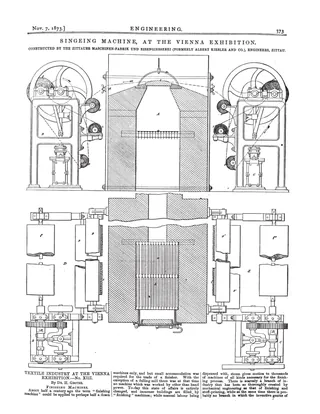
Textile Industry at the Vienna Exhibition -- No. XIII
Article · 2 pages
Installment XIII of a series by Dr. H. Grothe in the journal Engineering, reviewing the finishing machines shown at the 1873 Vienna Exhibition. It covers fulling mills, gig mills, teasel and metal cards, shearing machines and cutters, frizing machines, and singeing machines, naming exhibitors from Germany, Austria, Belgium, France and Italy. It describes in detail a plate singeing machine by the Zittauer Maschinenfabrik, with two small steam engines, illustrated by an engineering drawing with front elevation and plan.
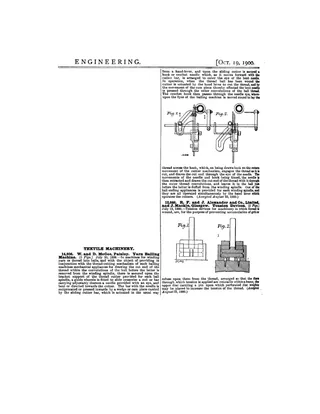
Textile Machinery
Engineering Weekly, October 19, 1900
Article · 1 page
A one-page extract from the British journal Engineering (19 October 1900) with two patent abstracts under the heading Textile Machinery. The first, by W. and D. McGee of Paisley, covers a yarn balling machine with a bent eyed needle and crochet hook that draw the cut thread end into the ball before it is doffed. The second, by E. F. and J. Alexander and Co. and J. Mackie of Glasgow, covers a thread tension device with rotatable discs and perforated weights. Line drawings illustrate both mechanisms.
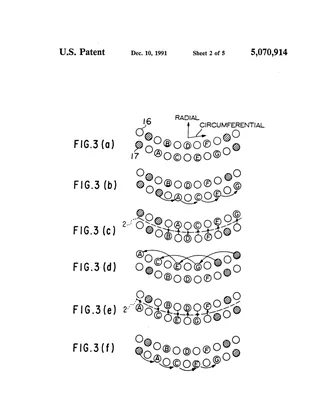
Triaxial Fabric of Interlaced Oblique Yarns, US Patent No. 5070914
Patent · 25 pages
US Patent 5,070,914 (granted 10 December 1991) describes a triaxial textile fabric for reinforcing composite materials. Oblique yarns radiate from the center and a circumferential yarn is woven spirally between them, with adjacent oblique yarns interlaced in a braiding-like action. The fabric gives isotropic elasticity and can be shaped into domes and other shells of revolution. The patent gives claims, a description of the weaving apparatus with spindle chucks, shuttles and a die, a test weaving, graphs of thermal expansion and modulus against latitude, and drawings. Certificates of correction are included.
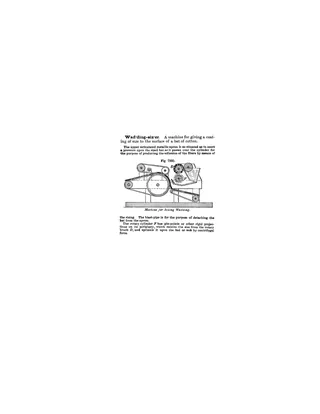
Wadding Sizer
Article · 1 page
A short dictionary entry describing the wadding sizer, a machine that applies a coating of size to the surface of a cotton bat. It explains the parts: an upper reticulated metallic apron that presses the sized bat so the fibers adhere, a blast-pipe that detaches the bat from the apron, and a pin-pointed rotary cylinder that receives size from a rotary brush and sprinkles it on the bat. A line drawing (Fig. 7000) illustrates the machine.
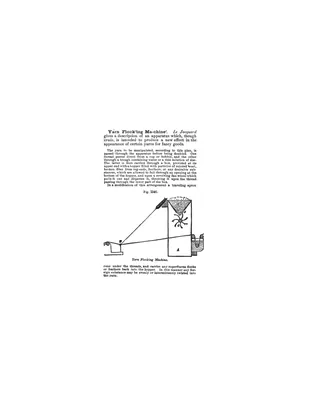
Yarn Flocking Machine
Article · 1 page
A short dictionary entry from Knight's New Mechanical Dictionary describing a crude apparatus, reported from Le Jacquard, for giving yarns a flocked effect for fancy goods. One thread is moistened with water or thin size and passed through a box where a fan-wheel scatters colored wool, rag fiber or feathers onto it before it is doubled with a plain thread. A variant uses a traveling apron to return surplus flock to the hopper. Includes one diagram (Fig. 2546).
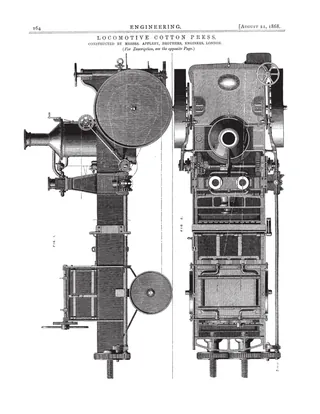
Appleby's Locomotive Cotton Press
Engineering Weekly, August 21, 1868
Article · 3 pages
A three-page article from the journal Engineering (21 August 1868) describing a portable steam-driven cotton baling press built by Appleby Brothers of London for cotton-growing districts, especially India. It explains the engine, drive and steering arrangements, and the screw and hydraulic ram pressing sequence that forms 100-ton bales in about seven minutes. It also covers the plan to drive extra presses and the benefits of compressed bales for rail transport and fire risk. The first page is a full-page pair of engineering elevation drawings.
Braid Sizing and Polishing
Article · 1 page
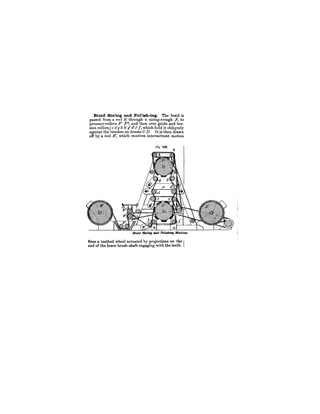
A short dictionary entry from Knight's American Mechanical Dictionary describing a machine for sizing and polishing braid. The braid runs from a reel through a sizing trough and pressure rollers, then over guide and tension rollers that hold it against brushes on rotating drums, and is taken up on a second reel with intermittent motion. Includes one cross-sectional diagram (Fig. 869) of the machine.
Cloth Press
Article · 1 page
A short dictionary entry on cloth presses, machines for pressing woolen cloth in bolt or in transit. It describes the Nussey & Leachman automatic hydraulic press of Leeds, with steam-heated platen and intermittent feed, and the Harwood & Quincy continuous press of Boston, which brushes and presses cloth coming from the shearing machine. It ends with references to further sources.
Cloth-cutting Machine
Article · 1 page
A short dictionary entry describing machines for cutting cloth into strips or garment shapes. It lists several forms: die knives on a reciprocating platen, guillotine knives, vertically reciprocating saw-knives that follow a marked line through a pile of cloth, hand saws, rotary cutters on a vertical spindle, and mandrels with rotary cutters for cutting carpet strips.
Cloth-folding Machine
Article · 1 page
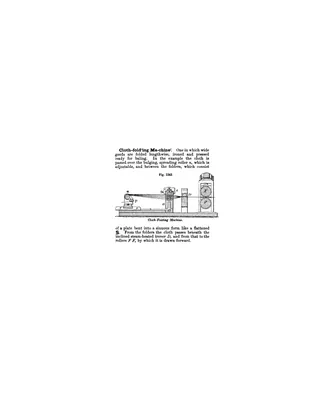
A short dictionary entry describing a cloth-folding machine that folds wide goods lengthwise, irons and presses them ready for baling. The text explains the adjustable spreading roller, the S-shaped folders, the steam-heated ironer and the draw rollers. A side-elevation diagram (Fig. 1343) accompanies it.
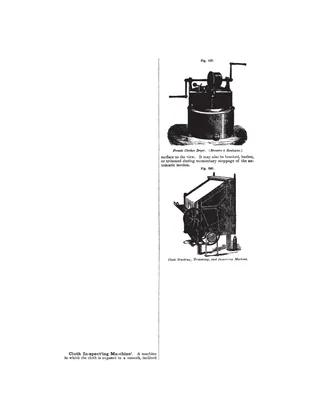
Cloth-Inspecting Machine
Article · 1 page
A single page from Knight's New Mechanical Dictionary defining the cloth-inspecting machine, in which cloth passes over a smooth, inclined surface so it can be viewed, and can be brushed, burled, or trimmed during momentary stoppage of the automatic motion. It includes an engraving of a cloth brushing, trimming, and inspecting machine (Fig. 640) and one of a French clothes dryer (Fig. 639).
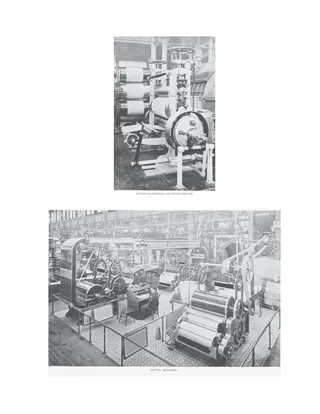
[Cotton Machinery]
The Book of the Fair, 1893
Illustration · 1 page
A single illustration page from The Book of the Fair (1893) showing two photographs of cotton machinery. The top photograph shows a cotton calendering and drying machine with large rollers, cloth cylinders, hand wheels and gears; the bottom photograph shows a row of cotton machines in a factory setting. Captions are brief, with no descriptive text.
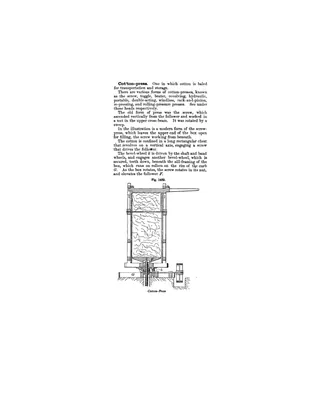
Cotton Press
Article · 1 page
A short dictionary entry on the cotton press, a machine for baling cotton for transport and storage. It lists the main types (screw, toggle, hydraulic, portable and others) and describes a modern screw press, in which a rotating box engages a screw beneath that drives the follower upward. An engraved cross-section (Fig. 1489) shows the box, follower, screw and bevel-gear drive.
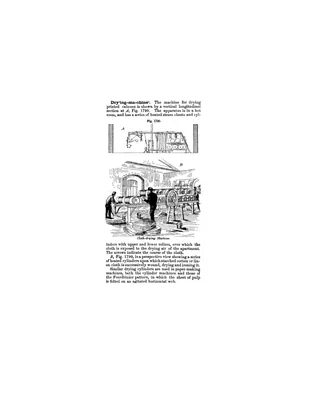
Drying Machine
Article · 1 page
A short encyclopedia entry on drying machines from Knight's American Mechanical Dictionary. It describes a calico drying machine, with steam-heated chests and cylinders in a hot room, and a second machine of heated cylinders that dry and iron starched cotton or linen cloth. It also mentions similar drying cylinders in paper-making machines. Fig. 1790 shows both machines in two engravings.
Efficient Wool Drier
Scientific American, June 18, 1898
Article · 1 page
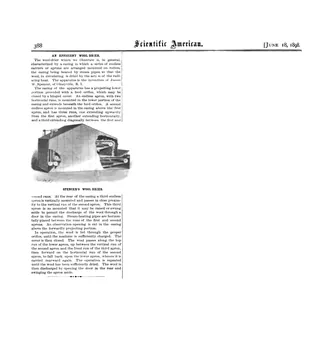
A short Scientific American article describing James W. Spencer's wool-drying machine. A steam-heated casing holds a series of endless aprons on rollers that circulate the wool repeatedly through the heat until it is dry. The text explains the construction and operation, with one perspective illustration of the machine.
Electric Driving of Cotton-Picking Machinery
Article · 16 pages
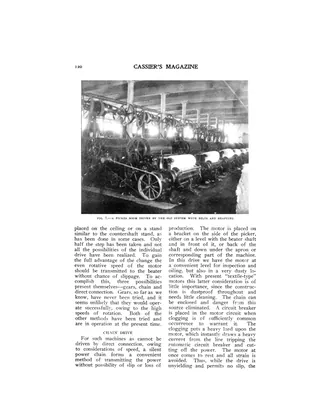
A 1910 article from Cassier's Magazine by Albert Walton on replacing belt and line-shaft drives with individual electric motors on cotton-mill picking machinery (opener, breaker, intermediate, finisher). It describes the picking process, the drawbacks of the traditional belt drive, and three motor arrangements: ceiling-mounted belt drive, silent chain drive, and direct connection to the beater shaft. It includes diagrams, photographs of picker rooms before and after conversion, and Westinghouse graphic wattmeter charts showing daily power use of a breaker, intermediate and finisher picker.
1,266 documents found