Textile Documents › Topic: Silk and sericulture
821 documents found
Sort: 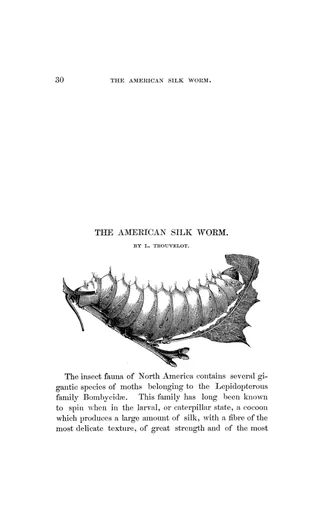
American Silk Worm, Part 1
Article · 9 pages
First part of L. Trouvelot's article on native North American silk-producing moths, published in the first issue of the American Naturalist (1867). It surveys eight or ten American species and judges which could yield usable silk, concluding that only Telea Polyphemus is practical. Trouvelot recounts his efforts since 1860 to raise the Polyphemus worm, then describes the moth's natural history: emergence from the cocoon, wing development, egg-laying, hatching and moulting. The text breaks off with 'To be continued'.
American Silk Worm, Part 2
Article · 10 pages
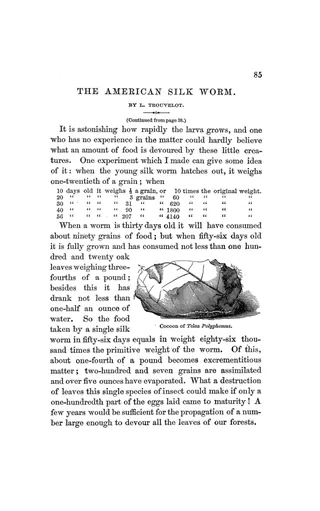
Second installment of L. Trouvelot's article on the American silk worm, Telea (Antheraea) polyphemus, from the first volume of American Naturalist. It covers larval growth and food consumption, cocoon spinning, the pupa, the silk reservoirs ("gut"), natural enemies such as birds and ichneumon parasites, and descriptions of the larva, pupa and egg. It ends with practical instructions for selecting and storing cocoons, hatching the moths, pairing, and rearing the young larvae on oak and other foliage. The article is continued in a later issue.
American Silk Worm, Part 3
Article · 7 pages
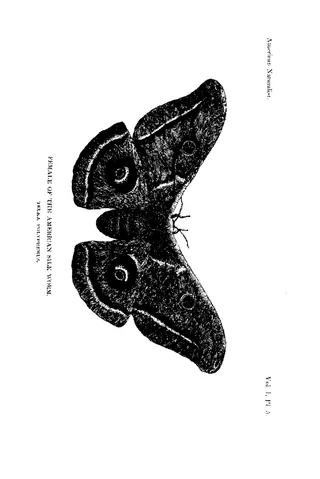
The concluding part of L. Trouvelot's article on rearing the American silk worm (Telea polyphemus) in the United States. It describes raising larvae outdoors in netted woodland and under a screened shade, with practical advice on feeding branches, moulting, water and cocoon handling. It also reports experiments on the cold tolerance of chrysalids, whether the pupa needs air (cocoons coated with starch and shellac), the impossibility of a second brood, and delaying hatching by cold storage. Two plates show the female and male moths.
The American Silk-Worm Moth: Telea Polyphemus
Article · 2 pages
A short natural-history article on the Polyphemus moth (Telea polyphemus), sometimes called the American silk-worm moth. The author describes rearing it in captivity: egg laying, caterpillar feeding and growth, cocoon spinning, emergence of the moth, and natural enemies. It ends by noting that the cocoon thread is strong and brilliant but coarser than Chinese silk, and that labor costs prevent commercial silk production in America.
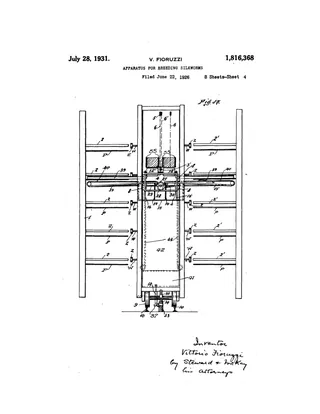
Apparatus for Breeding Silkworms, US Patent No. 1816368
Patent · 15 pages
US Patent No. 1,816,368, granted July 28, 1931 to Vittorio Fioruzzi of Piacenza, Italy, for an automated apparatus for rearing silkworms from hatching through cocoon spinning. A series of intermittently driven endless conveyor belts moves the worms along as they grow, with bridging sheets transferring them between belts. A travelling carriage feeds cut mulberry leaves, removes leaf beds, and triggers the belt movements. Spinning huts at the end of the line let the worms spin cocoons, and a rake detaches the cocoons. The document has eight sheets of drawings (Figs. 1-28), the specification, and 13 claims.
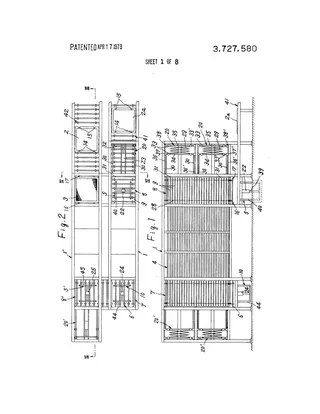
Apparatus for Rearing Silkworms, US Patent No. 3727580
Patent · 14 pages
US Patent 3,727,580 (granted 17 April 1973) describes an automated apparatus for rearing silkworms, developed by Japanese inventors and assigned to Ganze Limited and Takeda Chemical Industries. Rearing units, each a feeding tray with a net on top, move through elevator conveyors, a multi-shelf rearing frame, pushers, loaders, unloaders and a carriage that returns the nets for reuse. The text gives the background, 16 figure descriptions, a worked embodiment with two rows of frames, a prepared artificial diet recipe, a rearing example (240,000 fifth-instar silkworms yielding about 440 kg of cocoons) and 8 claims. Eight sheets of line drawings accompany it.
Artificial Feed for Domestic Silkworms, US Patent No. 3794499
Patent · 3 pages
US Patent 3,794,499 (granted Feb. 26, 1974) describes an artificial feed for domestic silkworms (Bombyx mori) that combines a conventional mulberry-leaf-powder feed with at least 30% unicellular green alga such as Chlorella or Scenedesmus. The patent covers the background on sericulture and artificial diets, example feed compositions, and a rearing-trial table (chlorella content 0-90%) showing faster growth, a shorter larval period, more uniform pupation, and heavier cocoons at 30% or more. It ends with two claims and the references cited.
Artificial Feed for Silkworms and Method of Using the Same, US Patent No. 3583871
Patent · 3 pages
US Patent 3,583,871 (granted June 8, 1971) describes an artificial feed for silkworms made from a hydrogel of maize and/or sorghum with soybean solids, which can replace mulberry leaves after the second instar. Examples compare feed compositions, cooking conditions, and particle size by larval weight and cocoon yield, and show that combining penicillin or tetracycline with a macrolide antibiotic protects larvae from flacherie. The patent ends with nine claims and a list of cited references. It was assigned to Ajinomoto Co. and Katakura Industry Co.
Artificial Feed for Wild Silkworms, US Patent No. 3792172
Patent · 2 pages
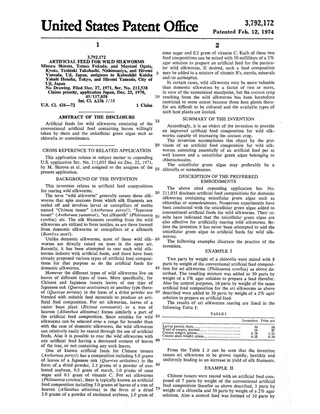
US Patent 3,792,172 (granted Feb. 12, 1974) describes an artificial feed for rearing wild silkworms indoors, such as Chinese tusser, Japanese tusser and eri silkworms. The feed adds unicellular green algae (chlorella or scenedesmus) to conventional feeds of oak, castor bean or tree-of-heaven leaf powder, soybean, sugar, starch and vitamin C. Two examples with comparison tables show shorter larval period, higher survival and cocoon yield, and heavier cocoon shells than the prior-art feed. The patent includes the claim, cited references and background on wild silk.
Attempts to Rear Silk-Worms in England
Article · 3 pages
A short Penny Magazine article surveying the history of attempts to produce silk in the British Isles. It traces sericulture from medieval Italy and France to James I's mulberry-planting campaign, the 1718 Appleton patent and company, the 1825 British, Irish and Colonial Silk Company, and experiments with lettuce leaves as feed. It concludes that high land and labour costs make commercial success in England unlikely.
Biological Investigations of the Silk Worm
Article · 3 pages
A 1930 article by W. Wagner of Krefeld, Germany, reporting incomplete biological experiments aimed at raising healthier silk worms and improving silk yield and quality. It describes treating eggs and larvae with direct induction electric current and ultra-violet light, and rearing worms outdoors, and compares disease losses, development time, cocoon size and silk color against indoor-reared controls. The author stresses that results are preliminary.
Cocoon Lodgment, US Patent No. 1347
Patent · 2 pages
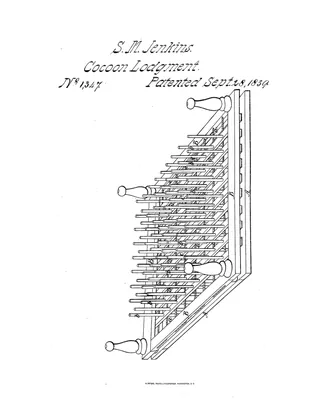
US Patent No. 1,347, granted September 28, 1839 to Solomon M. Jenkins of Easton, Maryland, for a 'cocoon lodgment', an apparatus placed over the feeding hurdles in a silkworm cocoonery so the worms can spin their cocoons in an orderly way. It consists of two wooden frames, a slatted and twine-crossed grating, and rows of descending wooden pins that serve as ladders for the worms, with an opaque covering to exclude light. The document has a drawing sheet and the specification with two claims.
Culture of the Silk-Worm
Appleton's Journal, 1869
Article · 3 pages
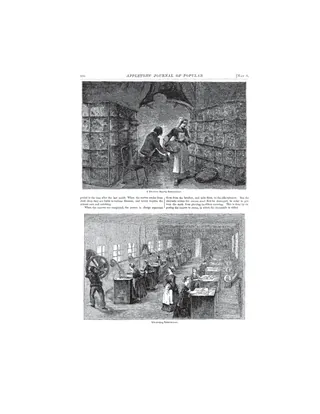
A three-page popular article from Appleton's Journal (1869) summarizing Louis Figuier's account of sericulture in "The Insect World." It covers the history of silk from China to Europe, the silkworm's anatomy and life cycle, rearing methods (rooms, feeding, moults, cocoon spinning), egg production, and the reeling of cocoons into silk thread. Two illustrations show a rearing establishment and a silk-winding establishment.
Des Vers a Soie [Silkworms]
Amans Carrier · c. 1836
Book · 30 pages · French
A printed letter (the seventh) from Amans Carrier of Rodez to M. Bonafous, director of the Royal Garden at Turin, on raising silkworms and cultivating mulberry trees in the Aveyron department of France. Carrier recounts how he began silkworm rearing in Rodez in 1819 and how his cocoon yields per ounce of eggs developed. He then describes in detail his mulberry plantation on poor calcareous, stony ground near Marcillac, covering planting methods, root studies, tree spacing and pruning. The letter closes with itemized costs, projected leaf yields and returns, and plans for a magnanerie and a steam silk-reeling mill.
"Directions for the Rearing of Silk Worms" in Mackenzie's Five Thousand Receipts in All the Useful and Domestic Arts
James Kay, Jun, & Co., 1831
Monograph · 7 pages
Excerpt of seven pages (printed pp. 350-356) from a nineteenth-century household receipt book, giving detailed directions for raising silkworms. It covers choosing and hatching eggs with a schedule of temperatures, feeding through the successive ages and moultings, and managing heat and cleanliness. It also covers gathering and sorting cocoons, saving cocoons for breeding, moth coupling and egg preservation, baking cocoons, and pruning and planting white mulberry trees. The text draws on American experience, citing Pennsylvania and Connecticut.
Eating-Inducing Compositions for Silkworms, US Patent No. 3275446
Patent · 2 pages
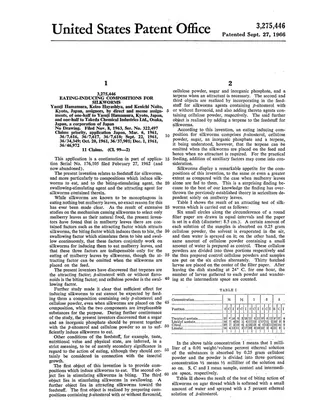
US Patent 3,275,446 (granted 27 September 1966) describes compositions that induce silkworms to eat, for use in artificial feed without mulberry leaves. It identifies three factors that make mulberry leaves acceptable: terpenes as attractant, beta-sitosterol (with or without flavonoids) as biting stimulant, and cellulose powder as swallowing stimulant. The patent also specifies sugar, inorganic phosphate and inositol, gives test tables, two formulation examples and 11 claims.
Feeding Silkworm Larvae Feed Containing Propionic Acid, US Patent No. 3295983
Patent · 2 pages
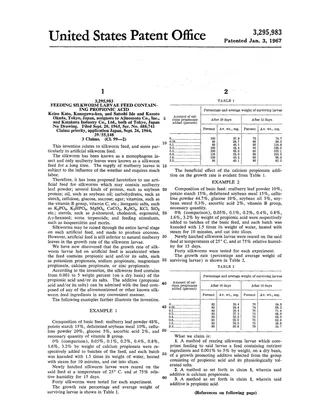
US Patent 3,295,983 (granted Jan. 3, 1967) describes a method of rearing silkworm larvae on artificial feed containing 0.001 to 5 percent propionic acid or its salts, such as calcium propionate, to speed larval growth. Two examples with mulberry-leaf-powder feeds report survival and average larval weight at 10 and 15 days in data tables. The patent lists three claims and cited references, and is assigned to Ajinomoto Co. and Katakura Industry Co. of Japan.
Feeding tent and Silk Worm Ventilation, US Patent No. 3083
Patent · 2 pages
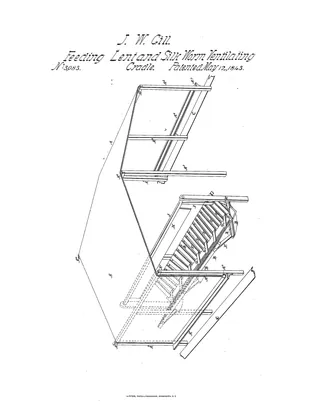
US Patent No. 3,083, granted May 12, 1843 to John W. Gill of Mount Pleasant, Ohio, for a feeding tent and ventilating cradle used in raising silkworms. The specification describes a large canvas tent with roll-up sides and rocking, rack-sided cradles fitted with troughs, slats for mulberry branches, a pendulum-driven fan, and a fender against mice. A perspective patent drawing with lettered parts accompanies the text.
Feedstuff for Silkworms Containing Aromatic Polyhydroxy-Carboxylic Acid and Method, US Patent No. 3328170
Patent · 4 pages
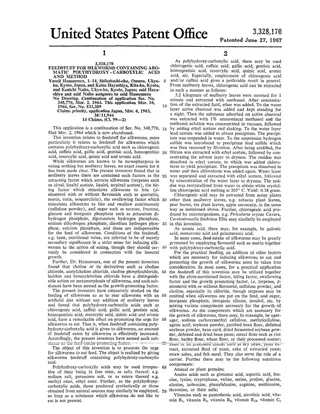
US Patent 3,328,170 (granted June 27, 1967) to Yasuji Hamamura, Keizo Hayashiya and Kenichi Naito describes an artificial feed for silkworms that contains aromatic polyhydroxy-carboxylic acids such as chlorogenic and caffeic acid as a feed-intake promoting factor. It gives the extraction of chlorogenic acid from mulberry leaves, three feeding experiments with diet compositions and results, two example formulations, and 14 claims. A certificate of correction on page 4 amends the assignment to include Takeda Chemical Industries.
Frame for Feeding Silk Worms, US Patent No. 2130
Patent · 4 pages
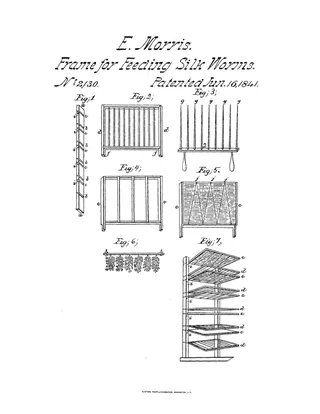
US Patent No. 2,130, granted June 16, 1841 to Edmund Morris of Burlington, New Jersey, for the "Burlington Silk Worm Frame." It describes a system of grooved uprights holding removable feeding frames and spinning roofs, a clearing fork for cleaning, and mounting ladders of dried multicaulis stems. The design is meant to ventilate the worms, cut feeding labor, and let the cocoonery keep track of cocoon age. The scan includes a drawing sheet with seven figures, the specification, and three claims.
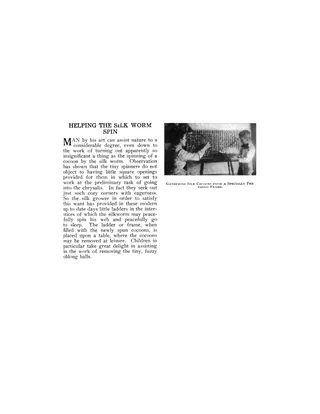
Helping the Silk Worm Spin
Technical World, September 1912
Article · 1 page
A short magazine piece from Technical World (1912) on a sericulture aid: small ladder-like frames with square openings in which silkworms spin their cocoons. The filled frame is set on a table so the cocoons can be removed at leisure, a task children enjoy. One photograph shows a person gathering cocoons from a prepared frame.
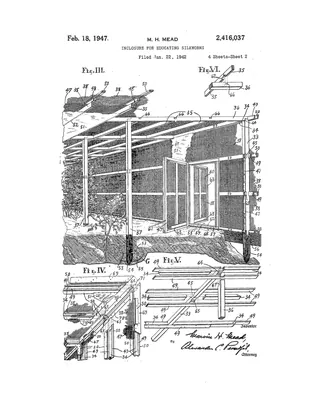
Inclosure for Educating Silkworms, US Patent No. 2416037
Patent · 7 pages
US Patent No. 2,416,037, granted 18 February 1947 to Marvin H. Mead of Savannah, Georgia, for a screened enclosure used to rear silkworms outdoors. The enclosure has a wooden frame set in concrete, an inner fine-mesh wire fabric against insects, and an outer coarse wire fabric spaced away from it against birds and animals. Four sheets of drawings (Figs. I-X) show the frame joints, doorway, and cross-sections, followed by the description, four claims, and a list of references cited.
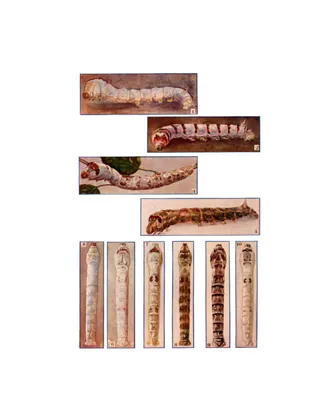
Inheritance in Silkworms: I
Monograph · 91 pages
A 1908 Stanford University monograph reporting Vernon Kellogg's breeding experiments on inheritance in the mulberry silkworm (Bombyx mori), done with Ruby Green Smith. It covers Mendelian inheritance of larval color patterns and cocoon colors, strain idiosyncrasies, double mating, fluctuating variations such as wing pattern and venation, double cocooning, sports, and fertility. A section on the economic value of the findings for silk culture and an appendix of abstracts of the author's earlier silkworm papers follow. Plates show larvae, moths and cocoons of different races.
De L'éducation de Vers a Soie [On Raising Silkworms]
Book · 98 pages · French
A French manual on raising silkworms by the method of Count Vincenzo Dandolo, written by Matthieu Bonafous and issued in a third edition in 1827 for farmers of southern France. Fifteen chapters cover silkworm biology, mulberry leaf feeding, temperature, humidity, air purification, light, space, equipment, hatching, rearing through each age, cocoon spinning, seed production, three-molt and white-cocoon varieties, and diseases. It closes with an extract of a report by M. Bosc and an explanation of four plates showing rearing apparatus and a model rearing building. It deals with sericulture rather than weaving.
De la Taille et de la Culture du Murier [On Pruning and the Cultivation of Mulberry Trees]
Book · 68 pages · French
An 1838 French treatise by Gaillard, a nurseryman at Brignais near Lyon, on pruning and cultivating mulberry trees for silkworm leaf production. It argues for pruning in March at the start of sap flow instead of summer pruning, and covers planting, yearly care of young trees, spacing, old trees, wild, Moretti, dwarf and multicaule mulberries. A closing section gives observations on rearing silkworms, including temperature, ventilation and examples of cocoon yields. It has no weaving content.
Length of Thread of the Silk-worm
Popular Science Monthly, 1873-1874
Article · 1 page
A short note from Popular Science Monthly in which Prof. Riley of St. Louis corrects an earlier calculation about the mulberry silk-worm's cocoon. He states that the thread averages little more than half a mile and seldom exceeds 1,000 yards, rather than the 11 miles previously claimed. He also gives the weight of a mile of thread as about 15½ grains.
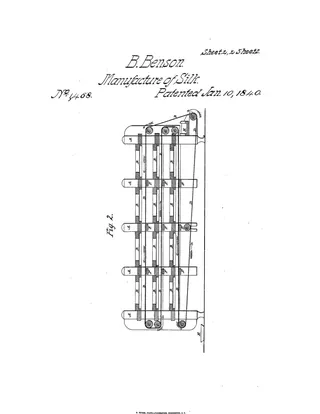
Manufacture of Silk, US Patent No. 1468
Patent · 4 pages
US Patent No. 1,468, granted January 10, 1840 to Benjamin Benson of Smyrna, Delaware, for improvements in sericulture equipment. It describes a hurdle frame for feeding silkworms fitted with an endless revolving cloth apron that carries away waste, improving on Gamaliel Gay's 1835 patent. It also describes a lodgment frame with cloth covering and paper fringe strips on which the worms spin cocoons. The scan has two drawing sheets followed by the specification and two claims.
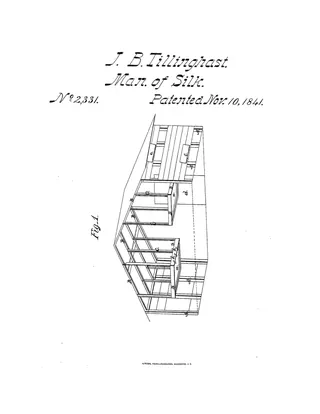
Manufacture of Silk, US Patent No. 2331
Patent · 3 pages
US Patent No. 2,331, granted November 10, 1841 to J. B. Tillinghast of Norwalk, Ohio, for a method of constructing and arranging cocooneries for silk-worms. It describes a 140-foot cocoon room with feeding frames suspended from the rafters, where worms are moved after the fourth moulting and fed and allowed to spin cocoons on whole trees or large branches. The text gives dimensions, ventilation shutters, protection against mice, and the patent claim; page 1 carries the patent drawing (Fig. 1).
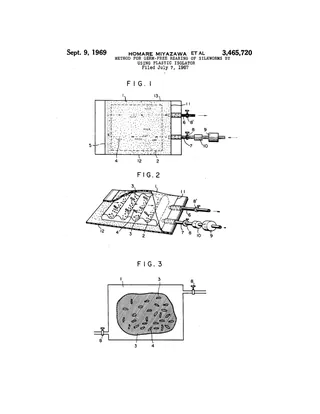
Method for Germ-Free Rearing of Silkworms by Using Plastic Isolator, US Patent No. 3465720
Patent · 5 pages
US Patent 3,465,720, granted September 9, 1969, to Homare Miyazawa, Shoichi Tarui and Masaki Kamada, assignors to Gunze Limited and Takeda Chemical Industries. It describes rearing silkworms germ-free on artificial diet in a sealed flexible plastic bag. The bag is sterilized and kept inflated with sterile air, with humidity at 60-100% and CO2 below 3%. The patent covers bag materials and sizes per larval stage, diet components and amounts, sterilization, growth and cocoon data compared with a control, and 14 claims. Three drawing figures show the isolator apparatus.
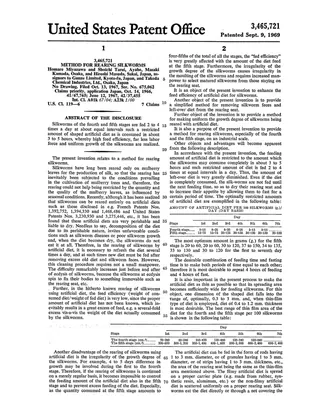
Method for Rearing Silkworms, US Patent No. 03465721.pdf
Patent · 4 pages
US Patent 3,465,721 (granted Sept. 9, 1969) to Homare Miyazawa, Shoichi Tarui, Masaki Kamada and Hiroshi Masuda, assigned to Gunze Limited and Takeda Chemical Industries, describes a method of rearing fourth- and fifth-stage silkworms on shaped artificial diet. A restricted amount of thin-film, rod, granule or strip diet is fed 2 to 4 times a day, with fasting periods between feedings, to improve feed efficiency, reduce labor and make growth uniform. It describes net and sieve arrangements for separating silkworms from feces and left-over diet, gives tables of diet amounts and feeding areas, and presents five examples with comparisons against known rearing methods, followed by seven claims.
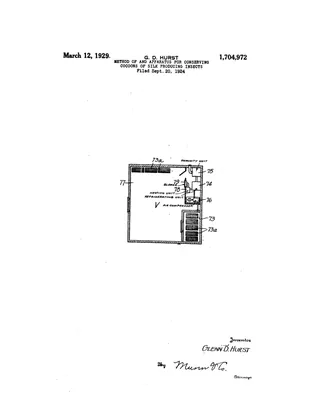
Method of and Apparatus for Conserving Cocoons of Silk Producing Insects, US Patent No. 1704972
Patent · 4 pages
US Patent 1,704,972, granted March 12, 1929 to Glenn D. Hurst of Los Angeles, describes a method and apparatus for keeping silk cocoons fresh for reeling. Instead of killing the chrysalis with heat, the cocoons are chilled with pressurized, humidity-controlled air at about 40\u00b0F and then held dormant in a storage chamber at about 45\u00b0F. This prevents the moth from emerging and breaking the filament, and preserves the silk's strength, elasticity and luster. The patent includes one drawing of the chamber, refrigeration, heating, humidity and blower units, followed by twelve claims.
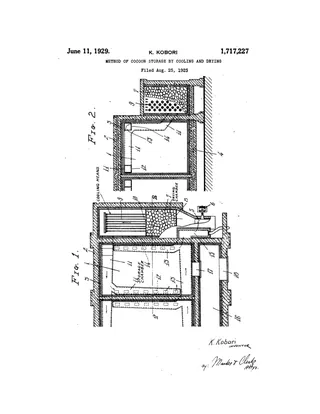
Method of Cocoon Storage by Cooling and Drying, US Patent No. 01717227.pdf
Patent · 3 pages
US Patent 1,717,227, granted June 11, 1929 to Kihachiro Kobori of Kobe, Japan (assignor to Kanegafuchi Boseki Kabushiki Kwaisha), for a method of storing raw silk cocoons. Cocoons are placed in an air-tight, insulated chamber and exposed to circulating dried air cooled to about 20-30\u00b0F, just above freezing. This kills the pupae and dries the cocoons without heat or chemicals. The patent describes the process, the drying agents (calcium chloride or heated acid clay), the apparatus, and the claim, with a drawing sheet showing two sectional views.
Method of Inducing Moult of Silkworms, US Patent No. 3230930
Patent · 3 pages
US Patent 3,230,930 (granted January 25, 1966) describes a method of inducing moulting in silkworms reared on an artificial diet, by adding choline or its derivatives (choline chloride, acetylcholine chloride, lecithin and others) at not less than 500 gamma per gram of dried diet. The text gives the background on feeding factors in mulberry leaves, a basal diet recipe, two feeding experiments with result tables, and two claims. It is a divisional application assigned to Takeda Chemical Industries and Yasuji Hamamura, with no drawings.
Method of Raising Silkworms on Artificial Feed, US Patent No. 3488196
Patent · 2 pages
US Patent 3,488,196, granted 6 January 1970 to Masazumi Niimura, Jiro Kirimura and Noboru Katsuya, describes a method of raising silkworms on an artificial feed. Larvae are fed mulberry leaf material up to the second or third instar, then a feed with 20-60% protein and no mulberry leaf. Four examples with data tables compare larval growth, cocoon weight and cocoon layer weight against mulberry-leaf-only rearing, and the patent ends with four claims and cited references.
Muriers et Vers a Soie [Mulberry Trees and Silkworms]
Book · 76 pages · French
A French treatise by Loiseleur-Deslongchamps on growing mulberry trees and raising silkworms in the climate of Paris, including methods for obtaining several silk harvests per year. The first part covers mulberry varieties, planting, and leaf yield; the second covers silkworm rearing, with the author's own experiments, losses, durations, temperatures, and the design of silkworm houses. The third part examines caterpillars other than the silkworm that produce other silks or silky matter, including Chinese wild silkworms, the great peacock moth, North American cocoons, and Bengal cocons brought back by Lamarepicquot.
Nouvelles Considérations sur les Vers a Soie [New Considerations on Silkworms]
Book · 218 pages · French
A French treatise of experimental observations on the silkworm (Bombyx mori) by Loiseleur-Deslongchamps, printed in Paris in 1839. It reports his experiments on egg hatching under cold and varying temperatures, on starving larvae, on feeding them substitutes for mulberry leaves, on moth emergence, mating, egg-laying and egg weight, and on silk thread length. It also covers varieties such as three-molt worms and pedicled cocoons, rearing in the open air, and a critical review of Chinese silk-rearing treatises as translated by Stanislas Julien. It includes tables of hatching and emergence data and one engraved plate of a silkworm on mulberry.
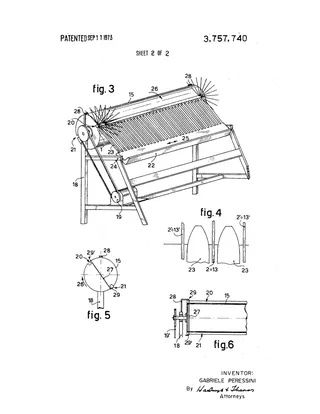
Procedure for Setting Up a Cocoonery for Silkworms as well as Removing Cocoons from the Cocoonery and Apparatus Therefor, US Patent No. 3757740
Patent · 7 pages
US Patent 3,757,740 (granted 11 Sept 1973) to Gabriele Peressini of Udine, Italy, describing an artificial silkworm cocoonery and a machine for removing the cocoons. The cocoonery consists of shafts fitted with sleeves that carry semicircular sets of flexible plastic spokes, alternated so the spokes interleave, giving a hygienic surface on which the worms spin. A rotating drum holds the cocoonery units against a pivoting comb whose teeth dislodge the cocoons into a collecting bin. The patent includes the abstract, two sheets of drawings, a description with dimensions and operating speeds, and 16 claims.
Process for Preparing Food for Silk Worms, US Patent No. 1990343
Patent · 1 page
US Patent 1,990,343, granted Feb. 5, 1935, describes a process for making artificial food for silkworms to replace mulberry leaves. The food is made from soybean that is soaked, ground, boiled and pressed into a curd, then flavored with squeezed mulberry leaf or bud juice as an appetizing agent. The patent also describes forcing mulberry twigs to bud in a hothouse so juice is available out of season. It has one claim and no drawings.
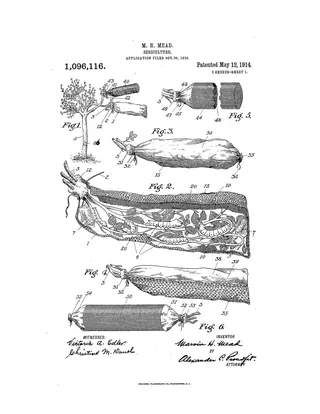
Sericulture, US Patent No. 1096116
Patent · 7 pages
US Patent No. 1,096,116, granted to Marvin H. Mead of Passaic, New Jersey, on May 12, 1914, for apparatus used in raising silkworms outdoors on living mulberry branches. The specification describes mesh pouches, cylinders and larger tree enclosures made of organdie, cotton bobinet and wire gauze, which protect the worms from parasites, birds and wasps while letting them feed on growing leaves. It also covers a reinforced mesh fabric, fastening devices, orchard arrangements and staggered hatching schedules. Two sheets of drawings (Figs. 1-14) and three claims are included.
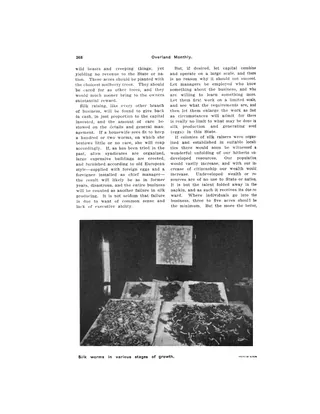
Silk Culture in California
Article · 6 pages
A 1902 Overland Monthly article by Carrie Williams arguing that California's climate and soil suit commercial silk production. She recounts early silk-raising efforts from the 1850s and 1860s, including the 1860 exhibit at the Mechanics' Fair in San Jose. She also describes her own experience in San Diego raising silkworms year-round and storing eggs in cold storage, and she discusses economics, acreage, education, and a federal silk-culture project in South Carolina. Six pages with halftone photographs of a rearing canopy and tray, silkworms, moths and cocoons, and reeling apparatus with native silk skeins.
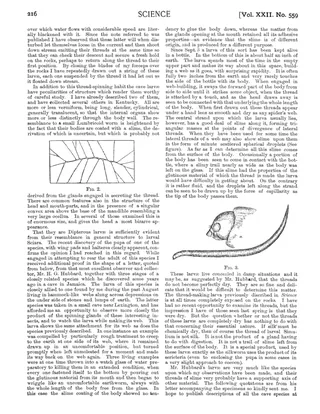
Silk Spinning Fly Larvæ
Article · 3 pages
A 1893 note from Science by H. Garman on silk-spinning fly larvae (Diptera), including cave-dwelling Mycetophilid larvae from Kentucky caves and Simulium larvae in streams. He argues that their threads count as silk in a biological sense, produced by special glands and used like the silkworm's product, even if not chemically identical to commercial silk. The article describes web-building behavior, the slime coating on the larvae, the pupa, and a letter from H. G. Hubbard on a similar Jamaican cave larva. Four line figures show larvae, a web and a pupa.
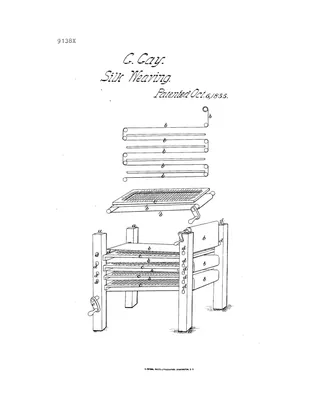
Silk Winding Machine, US Patent No. X0009138
Patent · 4 pages
US patent of October 6, 1835, granted to Jamaliel Gay of Poughkeepsie, New York. It describes a revolving apron placed under hurdles (rearing trays) for silk worms, to catch and remove the litter that falls through the cane or twine bottoms. The specification covers single-hurdle and multi-tier arrangements using rollers, a crank and an endless or wound apron. A drawing sheet with reference letters accompanies the text.
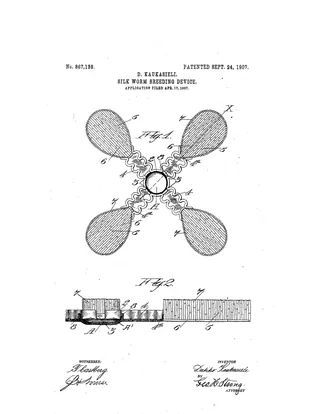
Silk Worm Breeding Device, US Patent No. 867138
Patent · 3 pages
US Patent No. 867,138, granted September 24, 1907 to Datiko Kaukasieli of West Berkeley, California, for a silkworm-breeding device. The apparatus is a molded plate-shaped hatching enclosure made from sheep and cow manure, with sinuous channels leading outward to feeding and maturing enclosures with cornstalk floors. The text explains the rationale of moving worms between zones and having them crawl over undulating surfaces to reduce mortality, and gives six claims. A drawing sheet shows a plan view and a section.
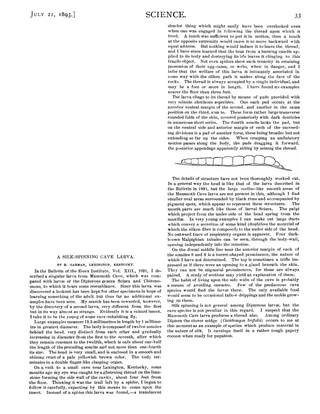
Silk-Spinning Cave Larva
Article · 1 page
A short 1893 entomological note by H. Garman describing a silk-spinning larva found on limestone cave walls near Lexington, Kentucky, probably the young of a cave-dwelling fly. It covers the larva's body structure, the pads it uses to cling to and move along its silken thread, and its likely habits and food. The author compares it with a Mammoth Cave larva he described in 1891 and with other silk-producing Diptera. It has no connection to weaving or textile practice beyond the natural silk thread.
Silkworm Culture
Article · 1 page
A short note in the Hawaiian Forester and Agriculturalist reprinting a U.S. Department of Agriculture circular (No. 488) on silkworm culture in the United States. It explains that the Department distributes free silkworm eggs and a manual to experimenters who have white mulberry or Osage orange for feed, and that it buys dried cocoons at 75 cents to $1 a pound. The editors suggest the U.S. Experiment Station at Honolulu can provide further information.
Silkworm, and its Culture in Hawaii
Article · 4 pages
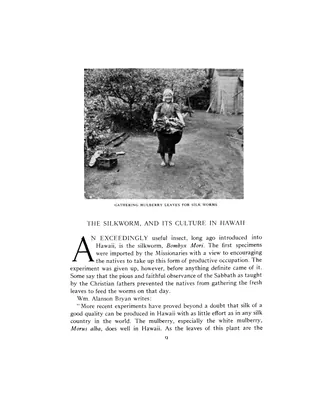
A short illustrated article on sericulture in Hawaii. It recounts how missionaries introduced the silkworm (Bombyx mori) to encourage native silk production, quotes William Alanson Bryan on the life cycle and the suitability of white mulberry, and describes the later crossing of American and Chinese worms. It ends with the decline of the industry after the 1840 drought and pest infestations. Photographs show mulberry leaf gathering, silkworms feeding, moths and eggs, and moths in a cultivator's tray.
Silkworms. Young Collector Series 2nd Ed
Book · 108 pages
A popular Victorian natural-history handbook on the silkworm (Bombyx mori) from the Young Collector Series, in six chapters. It covers the history of silk culture, the worm's form and life history, internal anatomy and dissection, rearing and management (including cocoon stifling and reeling), diseases such as flacherie, muscardine and pebrine, and wild silk-producing moths such as the Tusser, Chinese and Japanese oak silkmoths, Polyphemus, Atlas and Ailanthus moths. It is illustrated with numerous line drawings and engravings of larvae, cocoons, moths, anatomy and rearing apparatus.
Tree Coverer for Silkworm Culture, US Patent No. 1957994
Patent · 7 pages
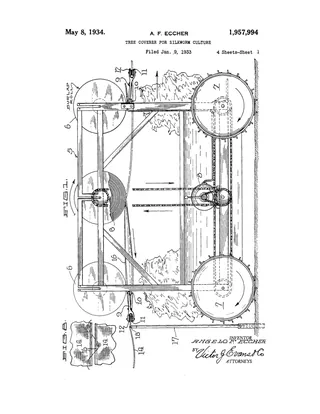
US Patent 1,957,994, granted May 8, 1934 to Angelo F. Eccher of San Francisco, for a wheeled machine that unrolls and spreads burlap covers over fields of mulberry trees used for silkworm culture. The cover protects the worms from weather and birds, and is later lowered so the worms spin their cocoons on the burlap, where they can be gathered easily. The scan has four sheets of drawings (11 figures) followed by the specification and ten claims.
Études sur la Maladie du Ver Soie [Studies on the Disease of the Silkworm]
Book · 810 pages · French
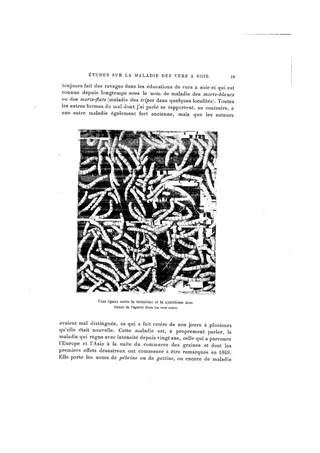
Volume IV of the Oeuvres de Pasteur (Masson), collecting Pasteur's studies on the silkworm diseases pébrine (corpuscle disease) and flacherie, carried out around Alais in the 1860s and 1870s. It covers the physical signs of disease, the history of earlier research, the nature and contagion of the corpuscles, and Pasteur's method of cellular grainage (microscopic selection of healthy moths for egg production). It also covers the hereditary and contagious character of flacherie, historical notes on sericulture, and appended official reports, letters and Senate discussions confirming the method. Illustrated with microscope plates, photographs and engravings of silkworms and rearing practice, and many tables of corpuscle counts.
Apparatus for Reeling Silk from the Cocoon, US Patent No. 399937
Patent · 6 pages
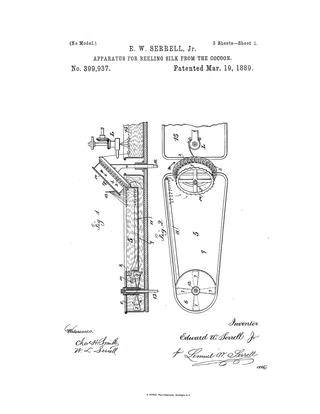
US Patent No. 399,937, granted March 19, 1889 to Edward William Serrell Jr., for a machine that automatically fills cocoon-holders (magazines) when reeling silk from the cocoon. Cocoons float in a charging basin with a circulating water current into a rotating pocketed magazine, which then ejects them one at a time into the reeling basin near the lance-bout finger. The document has three sheets of drawings (Figs. 1-8), a specification describing the locking, rotating and ejecting mechanisms, and five claims.
821 documents found