Textile Documents › Topic: Literature, poetry, and folklore
127 documents found
Sort: 
The Gentle Shepherd
Vanity Fair, March 24, 1860
Other · 2 pages
A satirical verse parody, "The Gentle Shepherd: A New Scots Pastoral," printed in Vanity Fair in March 1860. It lampoons a New York newspaper editor, called Jamie or Jeems, in mock-pastoral couplets and a Scots-dialect dialogue between Old Jamie and Young Jamie. It has nothing to do with textiles or weaving.
Helen at the Loom
Other · 3 pages
A poem by George Parsons Lathrop printed in the Atlantic Monthly, December 1873. It imagines Helen of Troy weaving a purple mantle on an upright loom, working scenes of the Trojan War into the cloth with her own sorrow and remorse. The loom serves as poetic imagery; there is no technical weaving content.
Loom of Life
Other · 3 pages
A poem by H. W. Parker published in the American Whig Review in January 1847. The speaker watches carpet-weavers at their looms, then uses the warp, woof, shuttle and finished web as extended metaphors for the soul, memory, thought and the course of a human life. It is literary verse, not technical weaving instruction.
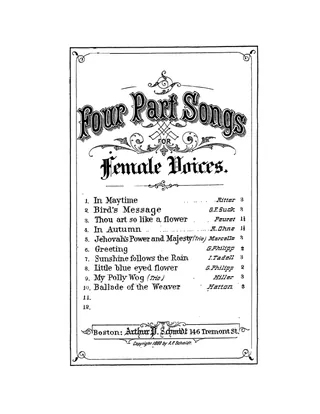
Sheet music
Arthur P. Schmidt, 1880-1882
Ephemera · 7 pages
Printed sheet music for "Ballad of the Weaver," a four-part song for female voices with piano accompaniment, arranged by H.B. Wood and published in Boston by Arthur P. Schmidt. The lyrics describe a woman who sits weaving at her cottage door year after year, waiting for a lover who does not return. The first page is a publisher's title page listing twelve songs in the Four Part Songs for Female Voices series. It contains no weaving instruction or drafts.
Sheet music
S. Brainard's Sons, 1883
Ephemera · 4 pages
Four-page piece of 1883 sheet music for the song 'I Am a Little Weaver', a melody from the German arranged for voice and piano by E.C.B. as No. 3 in the 'My First Songs' series. The lyrics are about a cheerful spinner and weaver at her wheel, with a kitten playing nearby. The sheet is published by S. Brainard's Sons of Cleveland and includes a catalog of 90 songs ('Vocal Beauties') and a list of popular songs with choruses. It has no weaving content beyond the song's subject.
Trees, Old and Young, Sprouting a Shady Boon for Simple Sheep
Illustration · 1 page
A single-page reproduction of a painting by Edward Stott, captioned with a line from Keats's Endymion, "Trees, old and young, sprouting a shady boon for simple sheep." The image shows trees against a dark ground and is a heavily thresholded, high-contrast print. The caption states that the painting was in the possession of Charles Thomas Harris, Esq. It has no weaving content.
[Weave, brothers, weave!]
Penny Illustrated Paper, May 18, 1867
Other · 1 page
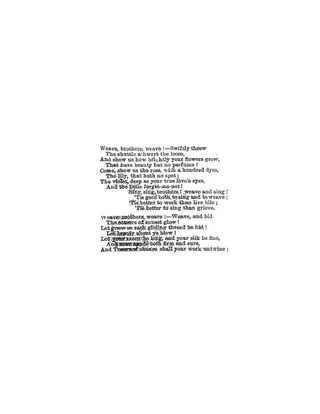
A short poem, "Weave, brothers, weave!", printed in the Penny Illustrated Paper in 1867. It addresses weavers at the loom and urges them to work and sing while producing flowers, sunset colors, and fine silk. The poem uses weaving imagery (shuttle, warp, thread, seam) and contains no technical weaving instruction.
The Weaver
Other · 2 pages
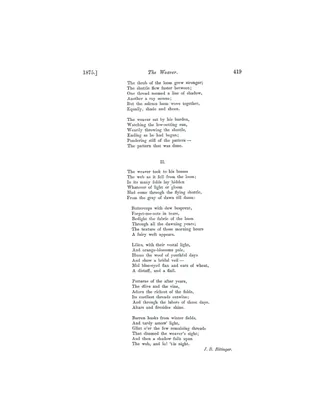
A two-page poem from the Atlantic Monthly in which a weaver at his loom throws the shuttle and ponders the pattern of the cloth. The woven web becomes an allegory of a human life, from the flowers of youth and a bridal veil, through the olive and vine of later years, to the shadow of night. It is literary verse and gives no technical weaving instruction.
Weaving
Other · 1 page
A single page from The New Republic (September 14, 1918) printing a group of short free-verse poems by Phoebe Crosby Allnutt. The poems include Morning, Kings, Paints, Nature Study, The Crazy Pine Tree, April Night, Windows, Old Thoughts, Weaving and A Visit to Hagerstown. The poem titled Weaving is a brief metaphor about a weaver at a loom given bright colors by a Master to make a design on a plain background; it is not about weaving technique.
Weaving the Web
Other · 1 page
A single-page poem, "Weaving the Web," printed in Scribner's Monthly. A young woman keeps putting off weaving her ideal web through morning, noon and evening until she is too tired and the light is gone. The loom and web serve as an allegory for a life of postponed ambitions, and the page has no technical weaving content.
Crochet
Other · 1 page
A single-page poem titled "Crochet" in which the speaker reflects on her devotion to crochet work. She compares the crochet hook to Izaak Walton's fishing hook, and compares her thread to the thread spun by Clotho, the Fate of Greek myth, and to the thread of life. She also treats a hidden knot in the worsted as a figure for concealed sorrow. It has no instructions or patterns and is of interest as literary and cultural material on women's needlework.
Hemming Cotton
Continental Monthly, March 1862
Other · 1 page
A short poem titled "Hemming Cotton," printed on one page of the Continental Monthly in March 1862. It is a Civil War-era piece that uses sewing imagery (needles, hemming, shirts) as a metaphor for the Union blockade and encirclement of the Southern cotton states. It contains no technical textile instruction.
Jan Jansen, Sheep-Herder
Article · 5 pages
A short fiction piece from New England Magazine, 1895, by Charles Howard Shinn. It tells of Jan Jansen, a Danish-educated Californian who loses his family fortune in a county-seat speculation and a bank default, and loses his sweetheart in Copenhagen. He then lives out his life as a sheep-herder and self-taught naturalist in the Sierras and Kern River country. The story has no textile or weaving content beyond the sheep-herding setting.
The Tapestry-Weavers
Other · 1 page
A two-part devotional poem by Anson G. Chester printed on a single page of Scribner's. It uses the tapestry weaver, who works on the wrong side of the web while following a pattern hung above, as a metaphor for human life lived under divine guidance. It contains no technical weaving information.
Young-Man-Leading-a-Cow and Weaving-Girl
Article · 2 pages
A short magazine article retelling the Chinese legend of the Weaving-girl (Yelr N'geu) and the Young-man-leading-a-cow (N'gow Long), as told by a Chinese informant in San Francisco's Chinatown. The two industrious lovers neglect their work, are separated in heaven by the Silver River, and meet once a year on a magpie bridge on the seventh day of the seventh month. The article explains the girls' feast day, when Chinese girls do needlework and pray to avoid the Weaving-girl's fate. It has no technical weaving content.
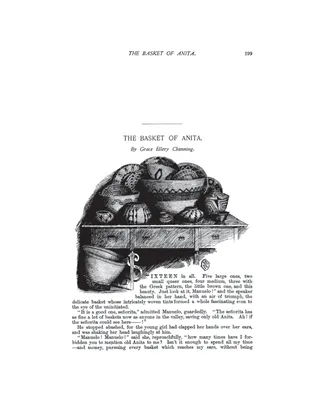
The Basket of Anita
Other · 11 pages
A short story from Scribner's Magazine set in southern California, about Elsa Loring, a convalescent Easterner who collects Indian baskets, and Manuelo, her devoted young Mexican guide. Manuelo sells his guitar to buy the legendary scarlet-feathered basket of old Anita from a passing artist, only to learn that the artist is Elsa's fiancé. The text is fiction; baskets appear as collectors' objects, with passing mention of woodpecker-feather decoration and patterned weaving but no technical instruction. Illustrations show baskets with geometric patterns.
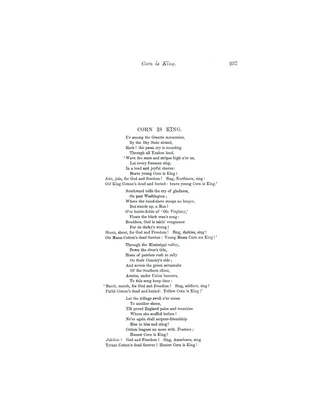
Corn is King
Continental Monthly, August 1862
Other · 1 page
A single-page patriotic poem from the Continental Monthly, August 1862, written during the American Civil War. It celebrates the supposed end of 'King Cotton' and the rise of Corn (grain) as the dominant crop of the Union, with verses on the North, the South, the Mississippi valley and England. It is not about textiles or weaving but is relevant to the cultural and political history of cotton.
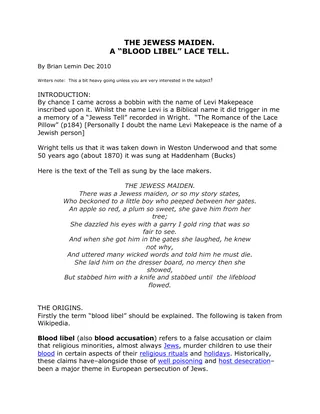
The Jewess Maiden
Brian Lemin · 2010
Web Doc · 8 pages
A short essay by Brian Lemin (December 2010) on "The Jewess Maiden," a gruesome lace-makers' tell (a song sung at the lace pillow) recorded by Thomas Wright in The Romance of the Lace Pillow. He explains the blood libel and the story of Hugh of Lincoln, and links the tell to the traditional ballad "Hugh of Lincoln," with a note on Cecil Sharp's collecting. He also discusses another macabre tell, "There Was a Lady All Skin and Bone," and Shakespeare's references to pillow songs, and prints a full ballad text.
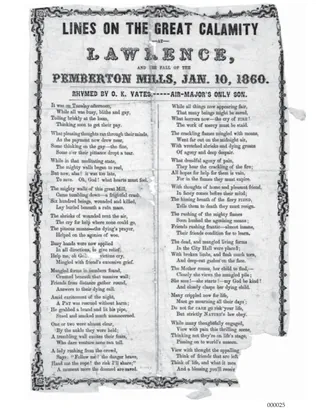
Lines on the Great Calamity at Lawrence and the Fall of the Pemberton Mills, Jan. 10, 1860
Yates, O. K., 1860
Ephemera · 1 page
A single-page printed broadside poem commemorating the collapse of the Pemberton Mill in Lawrence, Massachusetts, on January 10, 1860. Rhymed by O. K. Yates to the air "Major's Only Son," the verses describe the mill workers at their looms, the falling walls, the rescue efforts, the fire that followed, and the grief of survivors and families. It closes with a moral admonition.
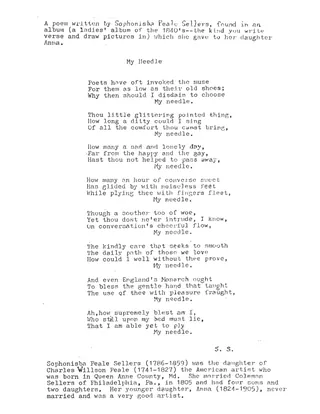
My Needle
Sophonisba Peale Sellers · c. 1840-1849
Other · 1 page
A one-page poem, "My Needle," by Sophonisba Peale Sellers, addressed to her sewing needle as a comfort in lonely hours, in conversation, and during illness. It was copied from a ladies' album of the 1840s that she gave to her daughter Anna. A brief biographical note identifies her as the daughter of the artist Charles Willson Peale and wife of Coleman Sellers of Philadelphia.
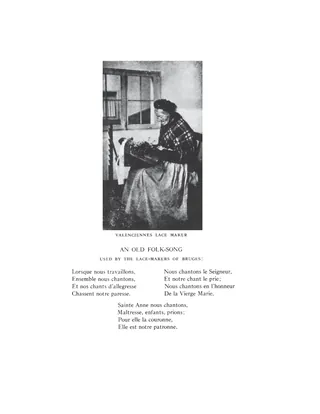
Old Folk-Song Used By the Lace-Makers of Bruges
Article · 1 page · French
A one-page item printing the text of an old French folk-song sung by the lace-makers of Bruges while they worked. The verses speak of singing together at work, praising the Lord and the Virgin Mary, and honoring Saint Anne as patroness of the lace-makers. The page is illustrated with a photograph of a Valenciennes lace maker seated at a lace pillow working bobbins.
Old Lace
New Republic, March 3, 1920
Article · 3 pages
A short personal essay from The New Republic in which the narrator describes her elderly, illiterate immigrant grandmother in a New York flat, who weaves lace on a small shuttle. The grandmother tells how two foreign strangers sheltered in her Russian village one winter taught her mother the lace pattern. The narrator concludes the men were stragglers from Napoleon's army in 1812, while the grandmother has never heard of Napoleon and cares only that the lace is unique to her region.
Pemberton Mills
Vanity Fair, January 21, 1860
Other · 1 page
A single-page poem from the magazine Vanity Fair, 1860, about the collapse of the Pemberton Mill, a textile factory in Lawrence, Massachusetts. It describes the busy looms and workers, the hidden structural decay, the sudden collapse, and the grief and anger of families, ending with a curse on the mill owners.
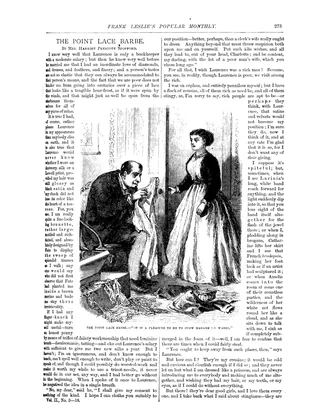
Point Lace Barbe
Other · 7 pages
A short story from Frank Leslie's Popular Monthly in which Charlotte, the wife of a poor bookkeeper, longs for a point lace barbe to go with her new black silk gown. She lets a smuggling peddler talk her into trading her clothes and household goods for the lace, then has to hide the deal from her husband. It is fiction, not a technical treatise, but it shows period attitudes toward lace, fashion and peddlers.
A Loom-Master of Iran
Other · 9 pages
A short story, "A Loom-Master of Iran," about an orphan boy from the Persian village of Sofian who is taken in by the caravan merchant Sadak and chooses to become a weaver rather than a farmer, shepherd or merchant. In a carpet factory in Azerbaijan he is made master of the loom on which a copy of the famous Ardebil mosque carpet is woven under an American superintendent. He finishes the carpet while plague spreads through the city, and dies on it. The text is fiction and contains no weaving instruction or drafts, but it gives a romanticized picture of child weavers, knotted-pile carpet work, tools and a bazaar workshop in turn-of-the-century Persia.
A Verse, Occasioned by Seeing the North-Spinning in Boton (sic)
Edes, 1769
Other · 1 page
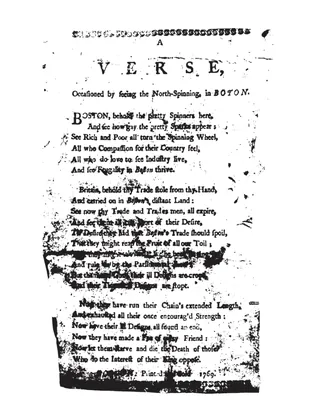
A single-page printed broadside poem from Boston, 1769, celebrating public spinning demonstrations in the city. It praises spinners and industry and frugality, and attacks British trade policy and Parliament, reflecting colonial non-importation sentiment before the Revolution. It contains no technical weaving or spinning instruction.
Song of the Shoddy
Vanity Fair, September 21, 1861
Other · 1 page
A satirical four-part poem from Vanity Fair, September 1861, protesting the poor-quality shoddy cloth uniforms supplied to Union soldiers by army contractors early in the Civil War. Three speakers (a lieutenant-colonel, a quartermaster and a tailor) testify to badly made coats, missing buttons and worthless materials, and the final stanza demands that the guilty contractor be named and shamed.
The Weavers Pocket-book, or, Weaving Spiritualized
Book · 177 pages
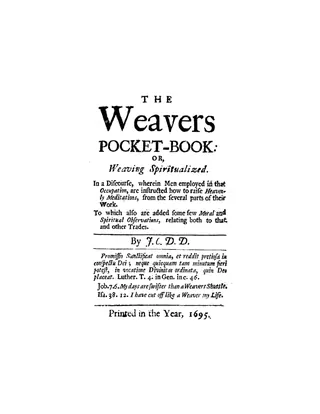
A late seventeenth-century devotional work by the English Presbyterian minister John Collinges, written for weavers. It draws spiritual meditations from each stage of the weaver's work: materials (wool, silk, hair, hemp, flax, cotton), dyeing, warp and woof, the loom, the shuttle and treddles, and the finished web. Each chapter ends with a poem. A closing section gives moral and spiritual observations on trade in general, covering thrift, laziness, trusting, credit, and the causes of trade's decay. The book is dedicated to two Norwich aldermen who were weavers. It contains no weaving drafts or technical weaving instruction.
Ciba Review (c. 1939)
c. 1939
Periodical · 40 pages
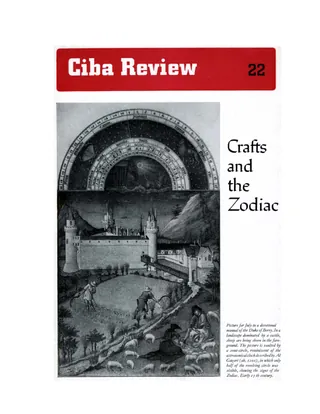
Issue 22 of the Ciba Review (Basle, June 1939) is devoted to astrology and the crafts. W. Born's three articles cover the origins and methods of astrology, the medieval calendar of seasonal labours tied to the zodiac, and the 'planet-children' tradition that assigned trades (including spinning, weaving, tailoring, embroidery and dyeing) to the influence of the planets. The issue is heavily illustrated with woodcuts, frescoes, miniatures, engravings and a tapestry. Shorter sections cover the Parcae in 1700s costume, the legend of Arachne, spinning as an allegory of virtue, and astrology in Chaucer, Bacon and Swift. Technical notes on dyeing and printing, plus Ciba dye advertisements, round it out.
The Basket-Maker
Other · 1 page
A single-page poem by Arthur J. Burdick addressed to a woman basket-maker. It praises her skill, her knowledge of where to find willows and grasses, and her use of natural colors, and likens her baskets to woven songs and visions. It is literary rather than technical and gives no instructions.
Cotton-Picking Time in the South
Article · 7 pages
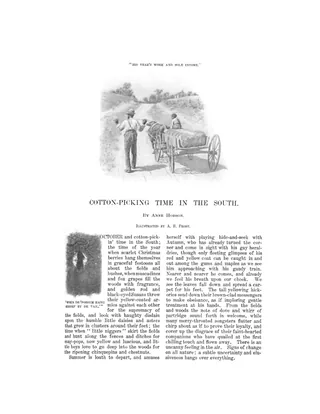
A 1902 magazine article by Anne Hobson, illustrated by A. B. Frost, describing the autumn cotton-picking season in the American South. It combines scenic description of the fall countryside with a long monologue in imitated Black dialect by a cotton picker, then describes wagons of cotton bales going to the depot and Saturday town visits by pickers. The piece is a romanticized, condescending period portrait that uses racial slurs and caricatured dialect, and it offers little technical information about cotton or textiles.
Godey's Lady's Book and Magazine, Vol. XI (July 1835)
July 1835
Periodical · 53 pages
Partial scan of Godey's Lady's Book, a Philadelphia ladies' magazine, covering the second half of Volume XI (July 1835 onward), with a volume index and the first issue's contents. It includes a hand-colored 'Philadelphia Fashions' plate, a fashion engraving of olden-time dress with an accompanying fashion article, short fiction, poetry, essays on court manners and Dutch customs, a mineralogy piece, two pieces of sheet music, and household receipts. There is no weaving content; textile interest is limited to the fashion plates and descriptions of dress.
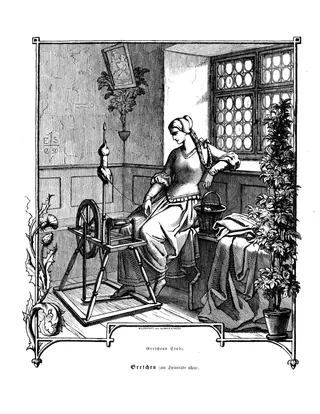
Gretchen's Stube [Gretchen's Chamber]
1850
Illustration · 1 page · German
A single wood-engraved illustration showing Gretchen, the character from Goethe's Faust, seated alone at her spinning wheel in her room. The scene includes a leaded-glass window, a basket of wool or yarn, a potted plant, and a rose-vine border. It is a visual source for the spinning wheel and domestic spinning in mid-19th-century German imagery.
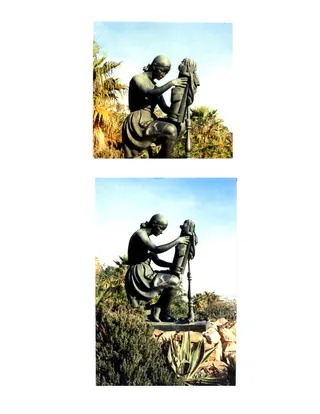
Photographs
Ephemera · 2 pages
Two pages of color photographs showing a bronze sculpture of a seated woman spinning or working at a distaff, spindle frame, or loom. The first page shows the statue in a garden with palm trees and agave plants, and the second shows it in front of a yellow multi-story building with a snack bar sign. There is no readable text.
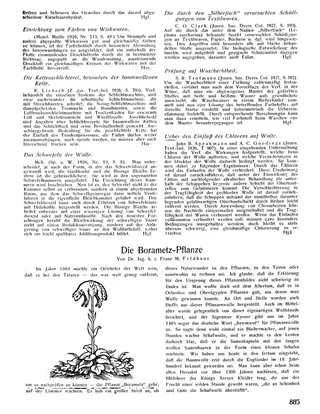
Die Borametz-Pflanze [The Borametz Plant]
Article · 1 page · German
A short German article by Franz M. Feldhaus on the legendary Borametz, the 'vegetable lamb' plant said to grow lambs, reported from Tartary in 1601. Feldhaus argues the image derives from cotton, drawn as a lamb-shaped seed capsule with white fibers, citing knowledge of plant wool since antiquity, Kyeser's 1405 word 'bawmwol', and Herodotus on Xerxes' soldiers wearing garments woven from a wild plant. The page includes an engraving of the plant and also carries the end of several unrelated textile-chemistry abstracts.
Lowell Offering, No. 1 (October 1840)
Lowell Offering, October 1840
Periodical · 16 pages
First issue (October 1840) of the Lowell Offering, a magazine of original essays, sketches, and poems written by female factory operatives in the Lowell, Massachusetts mills. Contents include the allegorical "History of a Hemlock Broom," pieces on old maids, woman's proper sphere, memory, science, autumn, Mount Auburn cemetery, and religious reflections. The closing Editorial Corner explains the publication's purpose of showcasing the talent and intelligence of mill workers and sets out rules for contributors.
Lowell Offering, No. 10-11 (December 1841)
December 1841
Periodical · 64 pages
Issue of the Lowell Offering, a periodical of prose and verse written by women mill operatives in Lowell, Massachusetts, dated December 1841. It contains allegorical sketches ("Leaves" from the port-folio of a dreamer), the serialized story "Harriet Greenough" about a farm girl who goes to work in the Newburyport mills, the fairy tale "The Princess," an account of a second visit to the Shakers, essays, and poems. It also includes three pages of hymn music and engravings of the Unitarian Church and the Appleton Street Congregationalist Church in Lowell. There is no weaving content; it is mainly useful for the literary and social history of New England mill girls.
Lowell Offering, No. 12 (December 1841)
December 1841
Periodical · 28 pages
The final issue (No. 12, December 1841) of the first volume of the Lowell Offering, a literary periodical written by women mill workers of Lowell, Massachusetts. It contains an allegory on Ambition and Contentment, patriotic and religious verse, two pieces of sheet music, short fiction (Emma and Grace), a reminiscence of an old farm-house, a sketch of Elder Isaac Townsend, and an engraving of the First Universalist Church in Lowell. It closes with an editorial concluding the volume that answers critics who say the magazine shows only the bright side of factory life, followed by the volume's index of contents, poetry and engravings.
Lowell Offering, No. 2 (May 1841)
May 1841
Periodical · 31 pages
Issue No. 2 (May 1841) of the Lowell Offering, a periodical of prose and verse written by female operatives in the Lowell, Massachusetts textile mills. It opens with a two-chapter story, "The Wedding Dress," about a factory girl who buys a silk gown and marries a wealthy old bachelor. The rest is short sketches, essays on nature and happiness, poems, translations from the French, and a closing musical score, "Song of the Weavers." There is no technical weaving content; it is useful as a primary source on mill girls' writing and life.
Lowell Offering, No. 4 (July 1841)
July 1841
Periodical · 32 pages
Issue No. 4 (July 1841) of the Lowell Offering, a periodical of writings by women mill operatives in Lowell, Massachusetts. It contains the conclusion of the story 'Clara Stanly' (Chapters III and IV), a poem on 'Old Ironsides', essays such as 'Playthings' and 'Saturday Night', and sketches including 'The Spirit of Discontent', which discusses factory life, the mill bell and long hours. The remainder is poetry, moral tales and reminiscences, including 'The Old Clock', 'The Lock of Gray Hair' and 'Familiar Sketches, No. 2: The Fig Tree'. It has no weaving content.
Lowell Offering, No. 5 (July 1841)
July 1841
Periodical · 32 pages
Issue No. 5 (July 1841) of the Lowell Offering, a periodical of writings by women mill operatives in Lowell, Massachusetts. It contains essays, serialized moral tales, poems and a shape-note hymn. Items include "Woman" on women's proper sphere and rights, the story "Prejudice Against Labor" about a factory girl facing social snobbery, essays on burial places and small talk, and engravings of St. Ann's Episcopal Church and the First Baptist Church in Lowell. It has no weaving content, but it is a primary source on the literary life and social attitudes surrounding New England mill workers.
Lowell Offering, No. 7 (September 1841)
September 1841
Periodical · 32 pages
Issue No. 7 (September 1841) of the Lowell Offering, a periodical of writings by women mill operatives in Lowell, Massachusetts. It contains essays, short fiction and verse, among them a reflection on Joan of Arc, an essay on tears, the story 'La Brainard' about a wandering madman near Lake Winnipesaukee, 'Moving into the New House', 'Familiar Sketches No. 3: The Contrast', and the allegory 'Hope and Despair'. It also has a hymn with musical notation and an engraving of the Roman Catholic church in Lowell.
Lowell Offering, No. 8 (October 1841)
October 1841
Periodical · 32 pages
Issue No. 8 (October 1841) of the Lowell Offering, a magazine of prose and verse written by women mill workers in Lowell, Massachusetts. It includes a sugar-making excursion sketch, a story about mill-girl roommates on the evening before pay-day, essays on shade trees for schoolhouses, friendship, and home, a dedication poem for the high-school house, and a song with music. The issue ends with an engraving of the Second Universalist Church in Lowell.
Lowell Offering, No. 9 (November 1841)
November 1841
Periodical · 31 pages
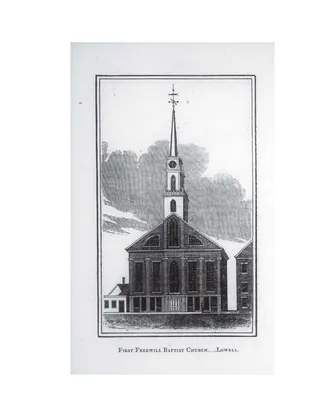
Issue No. 9 (November 1841) of the Lowell Offering, a periodical of prose and verse written by women mill workers in Lowell, Massachusetts. It contains moral tales, sketches and poems, including the narrative 'Fortune-Telling', 'Tales of Factory Life No. 2: The Orphan Sisters' about two sisters who go to work in the Lowell mills, an essay 'Aristocracy of Employment', a visit to a Shaker village, temperance pieces with a page of musical rounds, and 'The Life of a Pocket Testament'. Engravings of two Lowell churches (First Freewill Baptist and John Street Congregationalist) are included.
The Old Weavers
Article · 1 page
A short one-page piece describing the social position of hand weavers in rural communities in the days of home spinning. It portrays them as pale, solitary itinerant craftsmen carrying bags of linen thread and cloth, viewed with suspicion and superstition by villagers. The text is a literary or social sketch with no technical weaving content. It is credited to the U. S. Economist.
Cotton Mill
Other · 3 pages
A three-page protest poem, "The Cotton Mill," by Ernest Crosby, condemning child labor in cotton mills. It describes children working night shifts, injured by machinery and sickened by cotton dust, and attacks mill owners, lawmakers, and the profit-driven trade system. It is social and literary commentary, with no technical weaving content.
The Ghosts and Smugglers of East Devon. An Essay
Brian Lemin · 2010
Web Doc · 3 pages
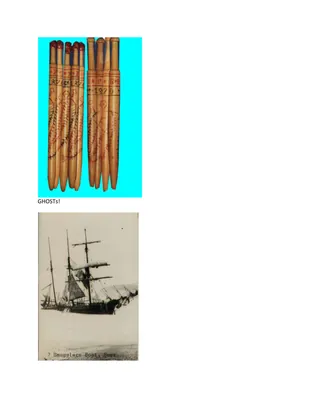
A short 2010 essay by Brian Lemin that retells East Devon folk tales about lace makers in Branscombe and Beer, drawing on an old book on Devon lace. It covers payment of lace makers by the truck system, ghost stories from the dark lanes on the walk home from pay day, and the smuggling of lace by Jack Rattenbury's crew. The author ties the stories to two East Devon lace bobbins in his collection that he labels "Ghosts", shown in a photograph of decorated bobbins dated 1870.
Kitty Fisher. Rhyme, Beads and Lace
Brian Lemin · 2010
Web Doc · 8 pages
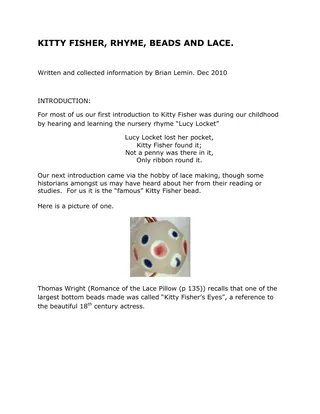
A short illustrated essay by Brian Lemin (December 2010) on Kitty Fisher, the 18th-century London courtesan, and her link to the "Kitty Fisher" glass bead used on English bobbin lace-making bobbins. It covers her biography, anecdotes from Casanova and others, the design and folklore of the bead including the evil-eye associations, and the origin of the nursery rhyme "Lucy Locket". It ends with a reproduced 1994 Daily Mail newspaper article on Kitty Fisher. It contains photographs of beads and reproductions of portraits, and no weaving drafts.
Praise of the Needle
Article · 4 pages
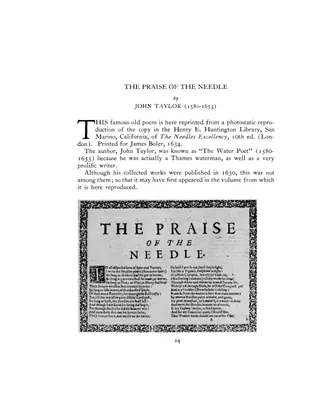
A reprint of John Taylor's early 17th-century verse 'The Praise of the Needle', reproduced from a photostat of the 1634 tenth edition of 'The Needles Excellency' (Huntington Library). The poem praises needlework as profitable, ornamental and virtuous, cites its Biblical origins, and lists stitches and sources of patterns from across Europe and beyond. It closes with sonnets honoring royal and noble needlewomen, including Katharine of Aragon, Mary I, Elizabeth I and the Countess of Pembroke. The pages show facsimile broadsides with woodcut borders alongside the text.
Weaving Myth and Magic-Cotton
Article · 1 page
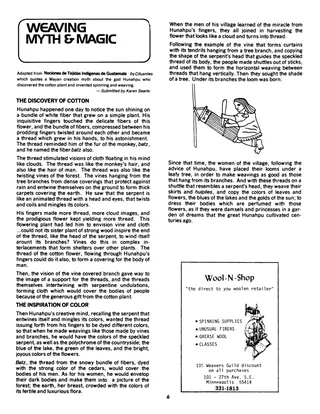
A short article adapted by Karen Searle from Cifuentes's Nociones de Tejidas Indígenas de Guatemala, retelling a Mayan creation myth in which the god Hunahpu discovers the cotton plant, invents spinning, dyeing and weaving, and inspires the first loom under a tree. It explains the origin of the backstrap loom, the shuttle and the colors of Guatemalan women's clothing such as skirts and huipiles. A line drawing of a woman at a backstrap loom accompanies the text, and a Wool-N-Shop advertisement shares the page.
127 documents found