Textile Documents › Publications › Publication: Vanity Fair
5 documents found
Sort: 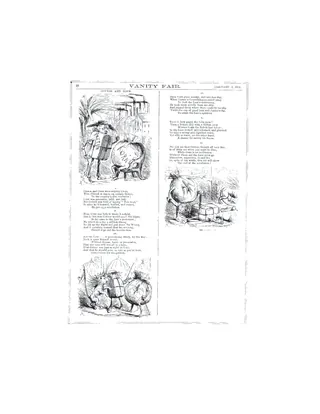
Cotton and Corn
Vanity Fair, 1862
Other · 1 page
A satirical comic poem in six stanzas from Vanity Fair, January 4, 1862, illustrated with three cartoons. It personifies Cotton (the Confederacy) and Corn (the Union) as rival kings, with the British Lion as a third party, and alludes to the Trent affair, in which Confederate commissioners were taken from a British ship. It concerns cotton as political and economic leverage during the American Civil War and has no technical textile content.
The Gentle Shepherd
Vanity Fair, March 24, 1860
Other · 2 pages
A satirical verse parody, "The Gentle Shepherd: A New Scots Pastoral," printed in Vanity Fair in March 1860. It lampoons a New York newspaper editor, called Jamie or Jeems, in mock-pastoral couplets and a Scots-dialect dialogue between Old Jamie and Young Jamie. It has nothing to do with textiles or weaving.
John Bull and His Cotton
Vanity Fair, September 21, 1861
Article · 1 page
A satirical one-page piece from Vanity Fair (1861) mocking British anxiety over cotton supplies during the American Civil War. It ridicules the London Times for proposing Chittagong as an alternative source of cotton and for suggesting that the local Kookies be set to planting it instead of fighting.
Pemberton Mills
Vanity Fair, January 21, 1860
Other · 1 page
A single-page poem from the magazine Vanity Fair, 1860, about the collapse of the Pemberton Mill, a textile factory in Lawrence, Massachusetts. It describes the busy looms and workers, the hidden structural decay, the sudden collapse, and the grief and anger of families, ending with a curse on the mill owners.
Song of the Shoddy
Vanity Fair, September 21, 1861
Other · 1 page
A satirical four-part poem from Vanity Fair, September 1861, protesting the poor-quality shoddy cloth uniforms supplied to Union soldiers by army contractors early in the Civil War. Three speakers (a lieutenant-colonel, a quartermaster and a tailor) testify to badly made coats, missing buttons and worthless materials, and the final stanza demands that the guilty contractor be named and shamed.
5 documents found