Textile Documents › Topic: Fiber identification and testing
249 documents found
Sort: 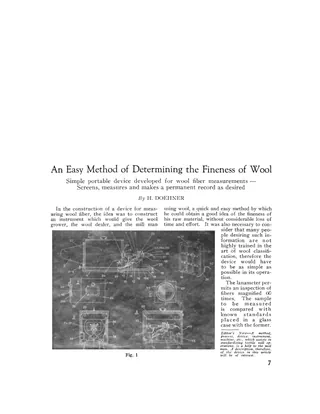
An Easy Method of Determining the Fineness of Wool
Article · 4 pages
A short article describing the lanameter, a portable device for judging the fineness of wool fibers. A microscope projects the fiber at 60x for comparison with standards, or at 500x for individual measurements on a scaled disc, and the image can also be photographed for a permanent record. The article explains the construction of the apparatus, its wooden carrying case, slides, lighting and objectives, and how wool growers, dealers and mill men can use it. Photographs show the apparatus and its components.
Fabric Analysis
Article · 2 pages
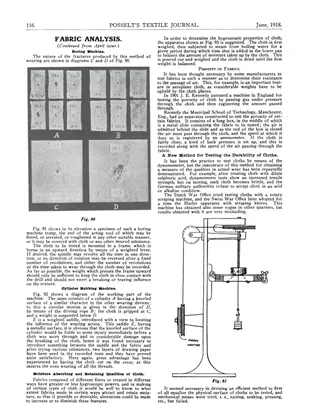
Continuation of Posselt's serialized 'Fabric Analysis' from the June 1918 issue of Posselt's Textile Journal, covering methods for testing cloth wear and durability. It describes the boring machine and cylinder rubbing machine, apparatus for measuring moisture absorption and fabric porosity, and a Manchester Municipal School of Technology method that pretreats cloth with hydrochloric acid and alcohol before scraping tests. Figures 90-93 illustrate the testing apparatus. The scan also includes short trade items on fabric gloves, sheep ranching in Wisconsin, and rice straw as a textile fibre.
Identification of Fibers
Article · 4 pages
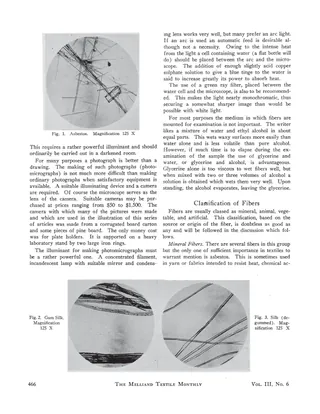
First installment of a series by H. B. Gordon on identifying textile fibers, with emphasis on microscopic appearance and supporting chemical tests. It covers microscope equipment, illumination, mounting media, and photomicrography, then begins the classification of fibers (mineral, animal, vegetable, artificial). It treats asbestos and the silks in detail: cultivated, tussah or wild, spider, and byssus silk, plus tin and organic weighting. Illustrated with nine photomicrographs and closed with references to Chamot and Matthews.
Identification of Fibers: The Hair Fibers, Part 2
Article · 3 pages
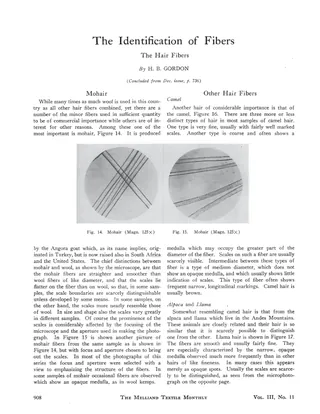
Concluding part of H. B. Gordon's series on identifying fibers by microscope, covering the minor hair fibers. It describes the microscopic appearance of mohair, camel, alpaca and llama, vicuna, cashmere, common goat, white rabbit, cow, horse and human hair, noting scale visibility, medulla and fiber fineness. Illustrated with photomicrographs (Figs. 14-25) at 100x to 125x magnification.
Microscopic Examination of Rayon
Article · 4 pages
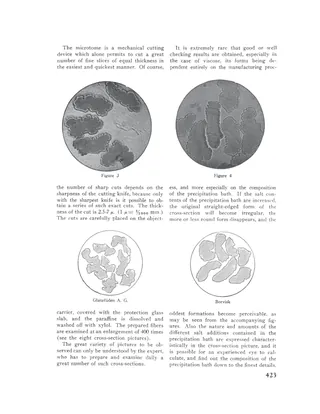
A 1930 article by G. Heink of Berlin on using the microscope to analyze rayon, as a complement to chemical testing. It covers side-view examination (fiber width, swelling value, impurities such as sulphur particles) and the preparation of paraffin-embedded cross-sections cut with a microtome. It explains how cross-section shapes reveal the rayon type and the composition of the precipitation bath, and distinguishes viscose, cuprammonium and acetate rayons. Micrographs show fibers from several manufacturers.
Structure of the Cells of Vegetable Fibers, Part 1
Article · 6 pages
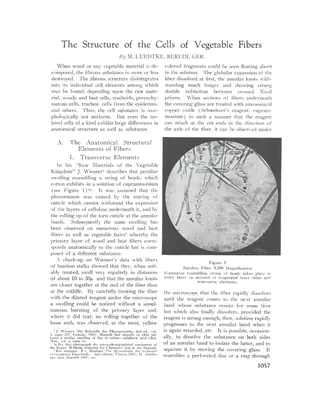
Part 1 of a technical article by M. Luedtke of Berlin on the microscopic structure of vegetable fiber cells, drawing mainly on bamboo and bleached straw fibers. It covers transverse (annular) elements that cause bead-like swelling in cuprammonium solution, the layered structure of the cell wall, spiral lamellae, fibrils, and the binding material between them. The author argues that thin membranes similar to the cuticle separate the layers and lamellae and give the fiber strength. It includes micrographs, a labeled sketch of fiber structure and extensive footnotes citing botanical literature; it ends with "To be continued".
Use of Direct Illumination in Microscopic Examination of Textiles
Article · 6 pages
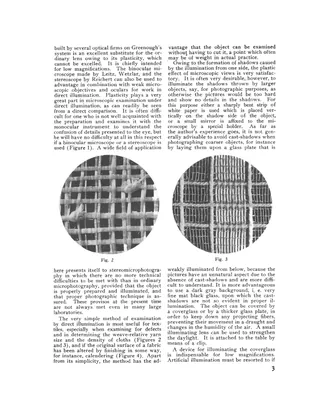
Article by Alois Herzog on using direct (reflected) illumination rather than transmitted light for microscopic examination of textiles. It surveys the available devices: simple direct observation with low-power and binocular microscopes, dark field condensers, Lieberkuhn's mirror, the vertical illuminator, and the Busch/Hauser dark field condenser. It discusses lighting, objectives for photomicrography, and the suitability of each method for checking fabric structure, finishing effects, fiber color differences and foreign matter. Eight micrographs, with a caption list giving materials and magnifications, illustrate the methods.
How to Distinguish Quickly Cotton from Linen
Article · 2 pages
A short technical article describing practical tests for telling cotton from linen in fabrics and yarns. It covers microscopic differences between the fibers, water absorption, feel and finish, yarn strength and untwisting, an oil transparency test, and dyeing and chemical tests such as Methylene Blue, fuchsin and ammonia, and copper oxide solution.
Identification of Fibers: The Hair Fibers, Part 1
Article · 3 pages
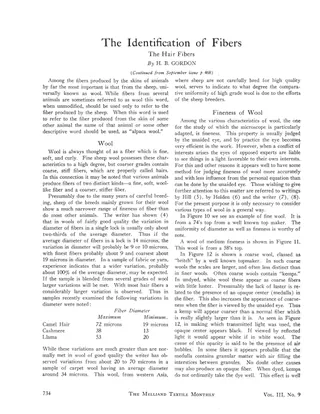
A continuation of H. B. Gordon's series on microscopic identification of textile fibers, covering the hair fibers with a focus on sheep's wool. It discusses variation in fiber diameter in wool compared with camel hair, cashmere and llama, how to judge wool fineness under the microscope, and kemps (opaque medullated fibers). It also explains the limits of identifying re-worked wool (shoddy), illustrated with 125x micrographs of fine, medium, coarse and re-worked wool. Ends with references and a note that the series continues.
The Identification of Textile Fibers
Article · 2 pages
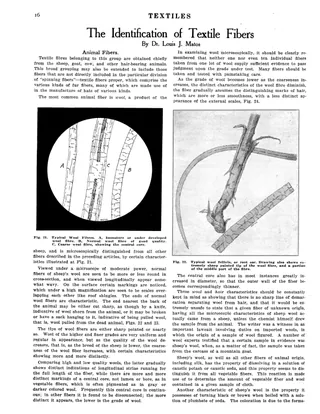
Two pages from the journal Textiles, part of a series by Dr. Louis J. Matos on identifying textile fibers by microscope and simple chemical tests. This installment covers animal fibers, mainly sheep's wool: its scale structure, fiber ends, central core, how grade relates to coarseness, and the gradual transition from wool to hair. It also gives the caustic alkali solubility test and the plumbate of soda test for the sulphur in wool. Figures 21-24 show wool fibres, a follicle, wool in the grease, and cattle hairs. The pages also carry a mill order blank description and a note on the 1916 Third International Cotton Conference.
The Identification of Textile Fibers
Article · 2 pages
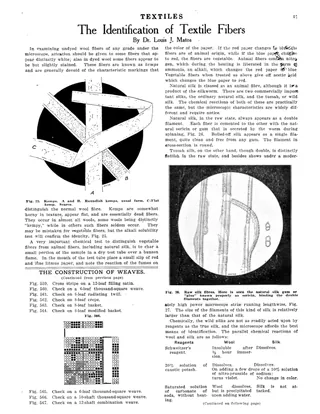
A two-page article from the trade journal Textiles on identifying textile fibers under the microscope and by simple chemical tests. It covers kemp fibers in wool, the litmus test for separating animal from vegetable fibers, and the differences between cultivated (raw and boiled-off) silk and tussah silk. A table compares wool and silk reactions to reagents, and the article ends with a note on mounting wool fibers for microscope slides. Page 2 also carries the start of an unrelated article on bearings and power transmission in textile mills.
The Identification of Textile Fibers, Part 1
Article · 2 pages
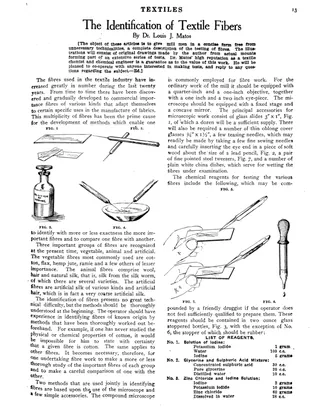
An introductory article in a series on testing textile fibres for mill workers, by textile chemist Dr. Louis J. Matos. It outlines the vegetable, animal and artificial fibre groups, the microscope and accessories needed, and gives formulas for sixteen chemical reagents. It also describes how to isolate fibres and mount them on slides, and how to apply reagents under a cover glass, with a few first identification examples such as cotton and caustic soda or copper solution tests.
Microscopy of Flax Fiber
Article · 2 pages
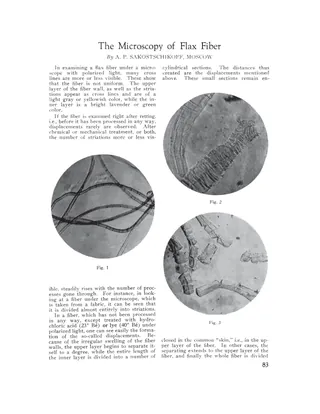
A two-page article on examining flax fiber under a microscope with polarized light. It explains how cross lines, striations and displacements appear in the fiber wall, and how chemical or mechanical processing increases them. It introduces the term 'parcels' for the small sections into which a fiber divides, and notes that the same formation was seen in hemp and Apocynum sibiricum fibers. Five micrographs illustrate the text.
New Method of Easily and Quickly Distinguishing Viscose and Cuprammonium Rayon
Article · 1 page
A short 1929 article describing a quick dye-based test for telling viscose rayon from cuprammonium rayon. It briefly notes simple identification of nitro-cellulose and cellulose-acetate rayons, and the silver nitrate test for sulphur remnants in viscose. It then gives the procedure (a gallate of iron ink and eosine dye bath, with bluish red indicating viscose and pure blue indicating cuprammonium) and the ink formula.
Newer Developments in Textile Microscopy
Article · 5 pages
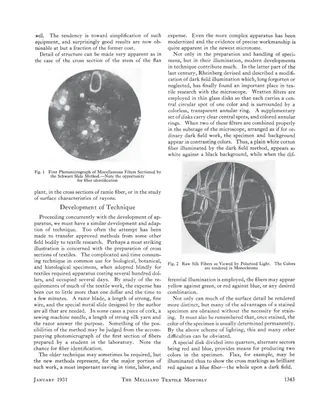
A 1931 paper by E. R. Schwarz of M. I. T. surveying new developments in textile microscopy, presented to ASTM Committee D-13 in October 1930. It covers specialized microscopes and mounting and measuring equipment, a quick low-cost method for cutting fiber cross sections (the Schwarz slide), Rheinberg colored dark-field illumination, and polarized light. It also discusses the handling and statistical treatment of data, applied mill research with pocket and stereoscopic microscopes, and prospects for x-ray, fluorescence, and photoelectric methods. Illustrated with seven photomicrographs and apparatus figures.
Structure of the Cells of Vegetable Fibers, Part 2
Article · 6 pages
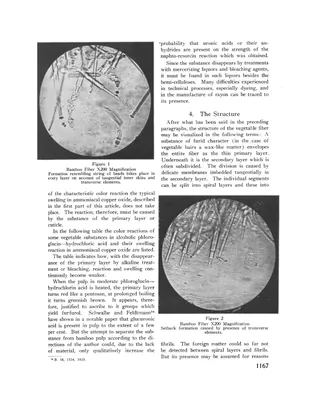
Concluding part of M. Luedtke's two-part article on the cell structure of vegetable fibers, focusing on chemical constitution. It describes extracting and separating the hemicelluloses (mannans, xylans) from cell-wall pulp with caustic soda and copper-ammonia solutions, and a proposed direct method for determining cellulose. It also covers the phloroglucin-hydrochloric acid color reaction used to identify the primary layer, with a table comparing bamboo, straw, wood, bast fibers and cotton. It closes with a summary of fiber structure (primary, secondary and tertiary lamellae, spirals, fibrils, lumen), illustrated by micrographs of bamboo and straw fibers and a labeled sketch.
Cloth Tester
Article · 1 page
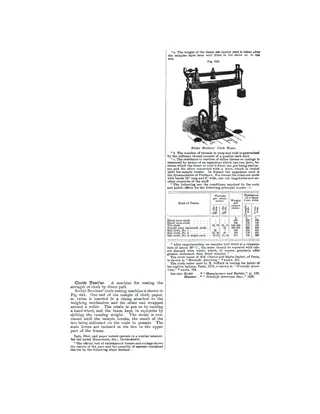
A single-page dictionary entry on cloth testers from Knight's New Mechanical Dictionary. It describes Riehlé Brothers' lever-and-weight machine that pulls a cloth, paper, or twine sample until it breaks and reads the strength in pounds. It also quotes French official testing methods (drying, thread counts, tensile resistance) with a table of requirements for hand loom cloth, tilt cloth, hammock cloth, and sail cloth, and cites other testers.
Fabric Analysis
Article · 3 pages
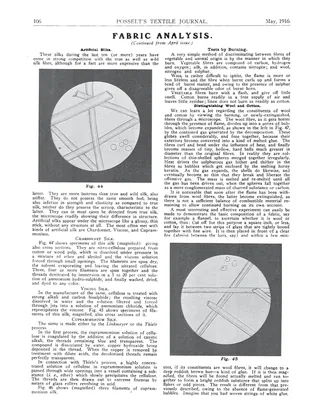
A continuation of E. A. Posselt's 'Fabric Analysis' series from the May 1916 issue of Posselt's Textile Journal. It covers identifying artificial silks (Chardonnet, viscose, cuprammonium) under the microscope and by their manufacture. It also describes burning tests to tell wool, cotton, linen, true silk and weighted silk apart, plus tearing tests for linen versus cotton. Illustrated with micrographs (Figs. 44-50). The last page carries an advertisement for a silk dyeing company and short items on artificial silk treatment and old German dyes.
Form of Destruction on Wool and Cotton Fibers
Article · 6 pages
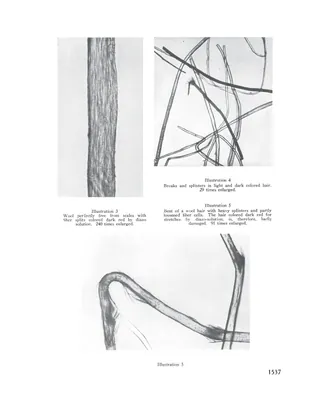
An article by J. Bartsch summarizing results from a German textile testing laboratory on how wool and cotton fibers are damaged. It describes microscopic and chemical methods, including pH measurement of acid concentration in paper-machine drying felts, and diazo and zinc-chloride-iodine staining tests. Twelve micrographs show scale damage, splits, brush ends, moth damage, and acid-parchmented and mercerized cotton fibers. It also covers acid damage to wool, hydrocellulose brittleness in cotton, and acid treatment of Swiss transparent cotton fabrics.
Identification of Textile Fibers
Article · 1 page
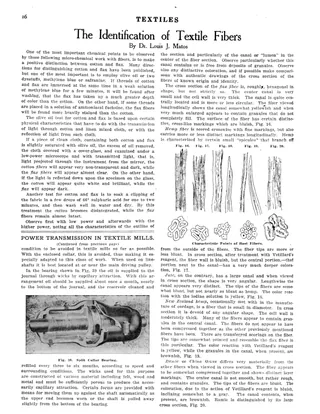
A one-page 1915 article from Textiles by Dr. Louis J. Matos on microscopic and chemical methods for identifying textile fibers. It describes dye, olive oil and sulphuric acid tests for telling cotton from flax, then the cross-section and longitudinal features of the bast fibers flax, hemp, jute, New Zealand hemp and ramie, with figures 16-20. The page also carries the continuation of an unrelated article on power transmission in textile mills.
Identification of Textile Fibers
Article · 2 pages
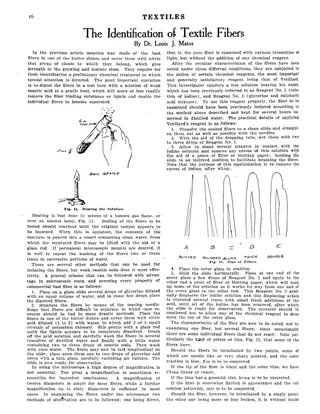
A two-page article from the journal Textiles on identifying bast fibers and cotton by microscope. It describes digesting fibers in weak caustic soda to remove lignin, mounting them on slides, and applying Vetillard's iodine and glycerine-sulphuric acid reagents. It gives tip shapes and color reactions for flax, ramie, hemp, jute and cotton, and explains how to cut and examine fiber cross sections with a razor. Illustrations show heating the solution, fiber tip profiles, a binding dish, slicing and a section lifter.
The Identification of Textile Fibers, Part 2
Article · 1 page
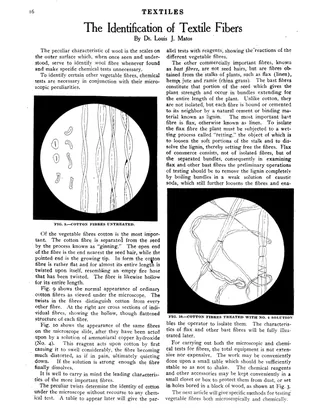
A single page from a series on identifying textile fibers by microscope and chemical tests. It describes the twisted, hollow, ribbon-like form of cotton fibers and how they swell and dissolve in ammoniacal copper hydroxide (reagent No. 4). It also introduces bast fibers (flax, hemp, jute, ramie), the role of lignin and retting, and the basic equipment for fiber testing. Two microscope figures show untreated and treated cotton.
Nap Meter
Article · 1 page
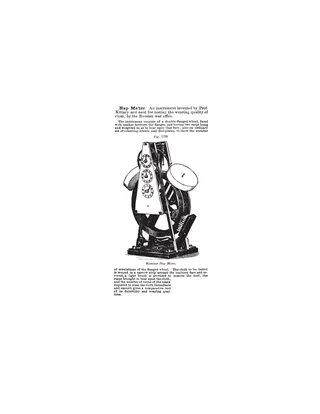
A short dictionary entry describing the Nap Meter, an instrument devised by Prof. Kittary and used by the Russian war office to test the wearing quality of cloth. A strip of cloth is wound on a leather-faced, double-flanged wheel and worn by weighted rasps, and the number of crank turns needed to wear it threadbare gives a comparative measure of durability. An engraving (Fig. 1799) shows the Russian Nap Meter with its dial counters and crank.
Silk Testing, Part 3 (Monograph 5001C)
Monograph · 58 pages
Part 3 of an International Correspondence Schools instruction paper on silk testing, covering additional tests for raw and thrown silk. It describes the serimeter test (breaking strength and evenness), the serigraph test (strength, elasticity, elongation), the gauge test for defects and cleanness, the twist test, the mirror test for evenness, and the measuring test for skein length. Each section explains the apparatus, sampling, procedure, laboratory record forms and testing-house certificates, with worked rules and examples. Examination questions are at the end.
Testing of Chemicals, Supplies in Textile Mills and Dye Works, etc., Part 2
Article · 3 pages
Part 2 of a serialized article from Posselt's Textile Journal (December 1907) on setting up a chemical testing laboratory for textile mills and dyeworks. It lists the glassware and miscellaneous apparatus needed, with quantities, and gives advice on choosing scales, handling and caring for glass vessels, and using and labelling bottles and reagent solutions. It ends by introducing the chemicals to be purchased, stressing guaranteed-purity reagents.
Testing of Textile Fibres, Yarns, and Fabrics, Part 2
Article · 2 pages
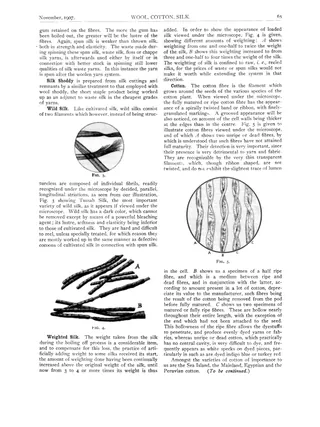
Two journal pages from the November 1907 installment of E. A. Posselt's serial on testing textile fibres, yarns and fabrics. They finish the discussion of flocks, with a method for testing a fabric for flock content, then describe silk (cultivated, spun or waste, wild/tussah, and weighted) and begin cotton. Microscope illustrations show silk and cotton fibres, including loaded silk and ripe, half-ripe and unripe cotton. The serial's outline of topics is printed on the first page.
Testing of Textile Fibres, Yarns, and Fabrics, Part 3
Article · 1 page
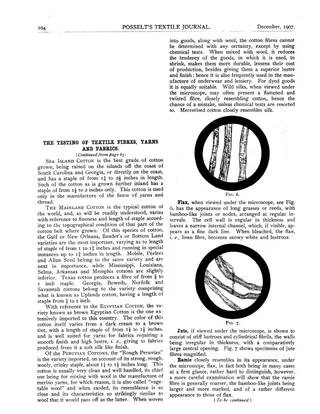
A single page from Posselt's Textile Journal (December 1907), part of a continuing series on testing textile fibres, yarns and fabrics. It describes grades of cotton (Sea Island, mainland/Upland, Egyptian, Peruvian) by staple length and use, and notes how cotton mixed with wool or wild silk is hard to tell apart without chemical tests. It also describes the microscopic appearance of flax, jute and ramie fibres, illustrated with microscope views of flax (Fig. 6) and jute (Fig. 7).
Yarn Tester
Article · 1 page
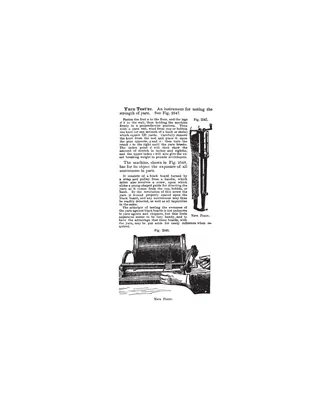
A short dictionary entry describing two 19th-century yarn testing devices. The first, a wall- and floor-mounted machine with a crank, measures the breaking weight in pounds and the stretch of a 120-yard knot of yarn. The second winds yarn onto a black board with a screw-driven guide so that unevenness and impurities can be seen. Two engraved figures (Figs. 2547 and 2548) illustrate the machines.
Yarn Tester
Article · 1 page
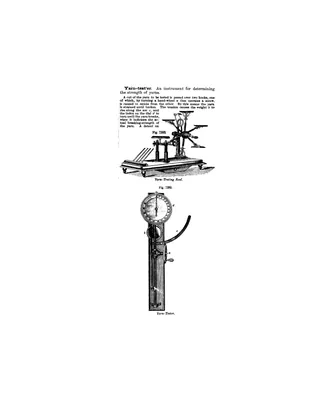
A short dictionary entry on the yarn-tester, an instrument for measuring the breaking strength of yarn. It explains how a skein of yarn is passed over two hooks and strained with a hand-wheel and screw until it breaks, while a weight rising along an arc and a dial index show the breaking load. Two engravings show a yarn-testing reel and the yarn-tester.
Fabric Analysis
Article · 1 page
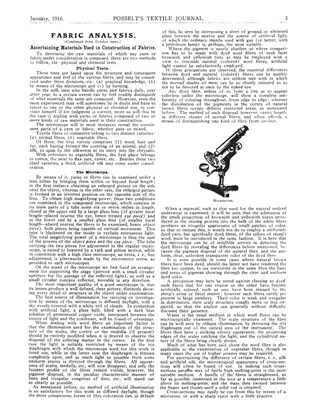
One-page installment of a serial article on fabric analysis from Posselt's Textile Journal, January 1916. It covers physical tests for identifying the raw materials in yarns and fabrics, concentrating on use of the compound microscope. It describes the microscope's parts, lighting, and how to tell dyed wool fibres from natural coloured ones. It also covers examining vegetable fibres and making cross-sections to distinguish silk from artificial silk. A line drawing of a microscope is included.
Fabric Analysis
Article · 2 pages
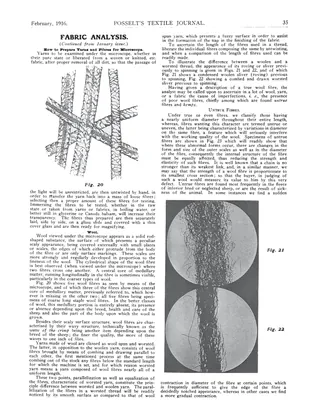
Installment of the 'Fabric Analysis' series from Posselt's Textile Journal, February 1916, on preparing yarns and fibres for microscopic examination. It describes wool fibre structure (scales, medullary core, crimp), the difference between woolen and worsted yarns, and imperfect fibres such as untrue fibres and kemps. It also covers distinguishing hair from wool and briefly describes cashmere and mohair fibres, illustrated with micrographs (Figs. 20-28).
Fabric Analysis
Article · 2 pages
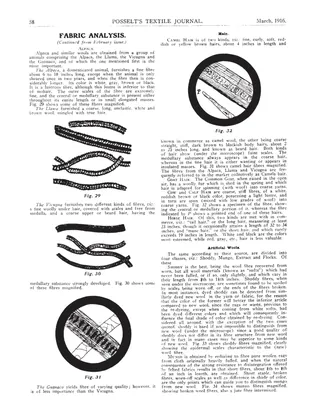
Installment of E. A. Posselt's series on fabric analysis from Posselt's Textile Journal, March 1916, covering identification of animal fibres under the microscope. It describes alpaca, llama, vicugna, guanaco, camel, goat, cow, calf and horse hair, then artificial wools (shoddy, mungo, extract and flocks) with simple tests for shoddy and for flock content. It ends with true silk and wild (tussah) silk, with microscope photographs (Figs. 29-37) of the fibres.
Fabric Analysis
Article · 2 pages
Continuation of a serial article on fabric analysis from Posselt's Textile Journal, October 1917. It covers determining size and finishing matters in cotton cloth, analysis of size compositions, and diagnosing stained, mildewed or tendered goods, with strength testing. It ends with chemical tests for cotton bleached for gun-cotton (moisture, ash, fats, acid, chlorine, hydro- and oxycellulose). A short unrelated piece on the term "shoddy" in the textile trade follows on page 2.
Fabric Analysis: Ascertaining Raw Materials Used in the Construction of Fabrics
Article · 3 pages
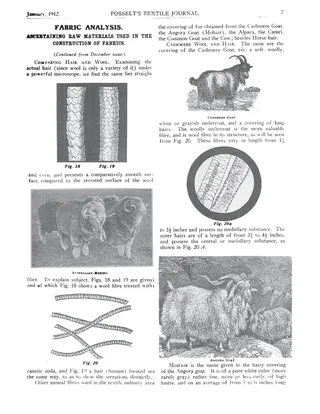
A continuation of a serial article on fabric analysis from Posselt's Textile Journal, January 1912, describing how to identify animal fibres by microscope appearance. It compares hair and wool, then covers cashmere, mohair, alpaca, llama, vicugna, guanaco, camel, goat, cow and calf, and horse hair, giving fibre lengths, colors and scale and medullary structure. Illustrated with microscope views and engravings of the animals. The scan also includes the start of a section on cotton carding.
Testing of Textile Fibres, Yarns, and Fabrics, Part 1
Article · 4 pages
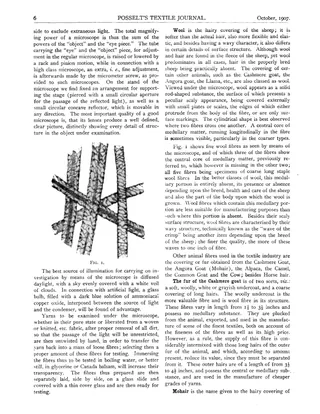
First installment of a serial article on testing textile fibres, yarns and fabrics, published in Posselt's Textile Journal, October 1907. It explains why manufacturers and buyers need to test materials, then covers yarn testing (count, twist, strength, evenness, grease and moisture) and microscopic identification of fibres. The sampled pages describe the compound microscope and how to prepare fibres for it, then wool, cashmere, mohair, alpaca, camel, goat, cow and horse hair, and the reclaimed wools shoddy, mungo, extract and flocks. One engraving shows wool fibres under the microscope.
Textile Machinery at the Paris Exposition
Engineering Weekly, May 25, 1900
Article · 2 pages
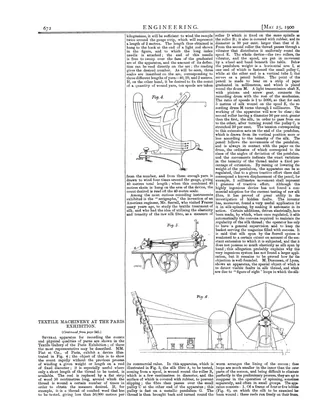
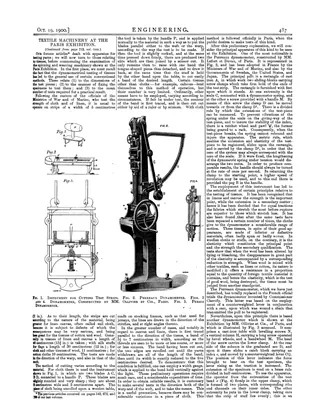
A two-page excerpt from an 1900 engineering journal describing yarn and thread testing instruments shown at the Paris Exhibition. It covers a yarn-count gauge, Serrell's 'serigraphe' for recording silk tenacity, an apparatus for detecting visible faults in silk thread, a torsion tester by Paul Gée of Lille, and the 'serimetre' tensile tester used by the Lyons Chamber of Commerce. Illustrated with Figs. 4-8; the article is continued in a later issue on fabric-testing instruments.
Textile Machinery at the Paris Exposition
Engineering Weekly, November 9, 1900
Article · 2 pages
An installment of a serial article on textile machinery at the 1900 Paris Exhibition, devoted to apparatus for the dynamometric testing of fabrics. It describes conventional test-strip sizes and cutting methods, the Perreaux, Ollivier et Cie. and Persoz testing machines, and the Alcan and Tresca experiments on friction, permeability and wear of felted versus ordinary woolen cloths. Illustrated with line drawings of the instruments.
Easy Method of the Determination of Raw and Bleached Cotton in Textiles
Article · 2 pages
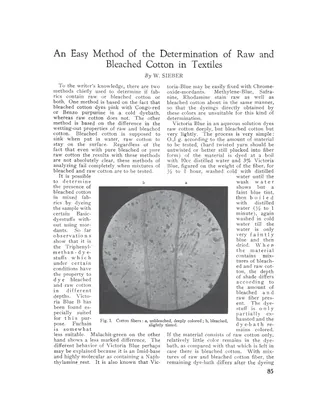
A short technical article describing a dyeing method for telling raw (unbleached) cotton from bleached cotton in textiles, including mixtures of the two. Sieber compares it with the Congo-red and wetting-out tests and recommends Victoria Blue B, a basic triphenylmethane dye applied without mordant, which dyes raw cotton deeply and bleached cotton only lightly. He gives a dyeing procedure, explains how the leftover dyebath can be compared by colorimetry to estimate the percentage of each fiber, and describes microscopic examination. Three micrographs show cotton, ramie and flax fibers, raw and bleached.
Fabric Analysis
Article · 2 pages
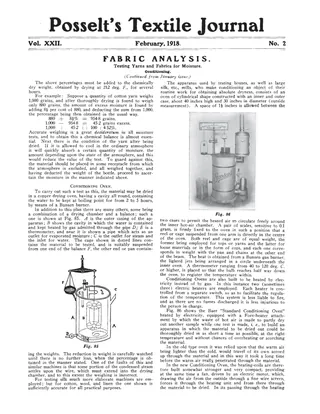
Installment of the "Fabric Analysis" series from Posselt's Textile Journal (February 1918) on testing yarns and fabrics for moisture by conditioning. It describes gas- and electrically heated conditioning ovens with balances (Fig. 85, and the Baer "Standard Conditioning Oven" in Fig. 86) and the conditioning procedure, with drying temperatures for wool, cotton and silk. Worked examples calculate dry weight, regain, invoice weight and excess moisture for scoured wool, raw cotton and cotton yarn, and short sections cover testing yarns and fabrics.
Of Fiber
Minnesota Weaver, July 1981
Article · 1 page
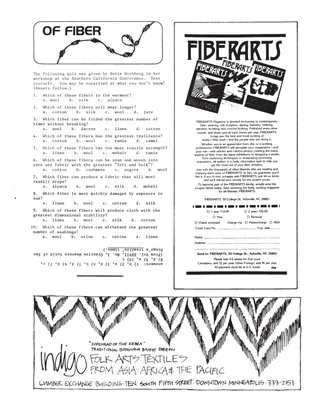
A one-page item from the Minnesota Weaver presenting a ten-question multiple-choice quiz on fiber properties (warmth, wear, resilience, tensile strength, drape, sun damage, dimensional stability, washability), with answers. The quiz was given by Bette Hochberg at a Southern California Conference workshop and was reprinted from the Creative Weavers Guild of San Diego's Threadlines. The rest of the page carries a subscription advertisement for FIBERARTS magazine and an ad for Indigo Folk Arts Textiles in Minneapolis.
Technical Basis of the Examination of Textile Materials and the Influence of Moisture Thereon
Article · 12 pages
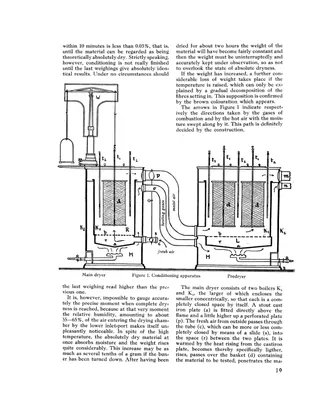
A 1929 article by Professor F. Pichler on the technical basis of testing textile yarns and fabrics, with emphasis on how atmospheric humidity and fiber moisture content affect results. It lists the instruments of a textile testing office and describes the conditioning (drying) apparatus of the Schopper type. It then covers the effect of moisture on yarn number, bundle and tube weights, yarn strength, ash content, and fat extraction. It also gives trade tolerances under the Vienna and Prague exchanges and the German cotton contract, plus a method for determining cotton in union fabrics.
Textile Tests for High School
Article · 3 pages
A 1915 article by a Chicago high school domestic art teacher on teaching textile knowledge to girls beyond sewing skills. It proposes practical classroom tests to detect adulteration and inferior quality in cotton, linen, wool, and silk, including sizing checks, the microscope, olive oil, caustic soda, sulphuric acid, and burning tests. It stresses teaching students to become informed buyers.
Vlákno [Fiber]
Ottův slovník naučný, 1897
Article · 3 pages · Czech
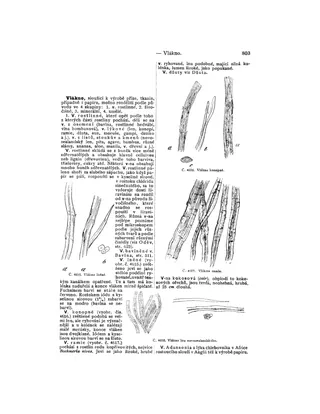
A three-page Czech encyclopedia entry on fibers from Ottův slovník naučný. It classifies textile and papermaking fibers as plant, animal, mineral and artificial, and describes how to tell them apart by burning, chemical reagents and microscope appearance. Microscope drawings show flax, hemp, ramie, New Zealand flax, wood fibers, wool and hare hair, and the entry closes with the early history of artificial silk (Chardonnet, Pauly and others).
[Comparative table of synthetic, rayon and natural fibre properties, 1953-1957]
c. 1953
Other · 7 pages
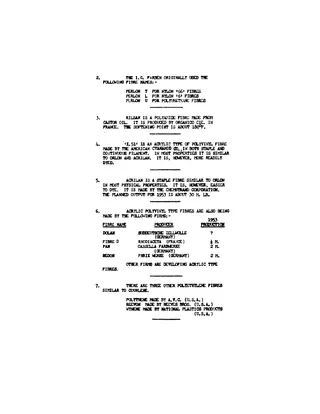
A set of comparison tables of textile fibre properties, covering synthetic fibres (nylon, polyester, acrylics, polyvinyls, polyethylene, glass), protein fibres, rayons and natural fibres (cotton, wool, flax, silk, jute). The tables give tenacity, elongation, density, moisture regain, softening point, cross section, resistance to light, acids, alkalis and abrasion, dyeability, production figures and prices (April 1957 in the U.K.), and main producers. Numbered notes list trade names, producers and production figures for nylon 6, acrylic, polyethylene, polyvinyl and protein fibres.
Fabric Analysis
Article · 2 pages
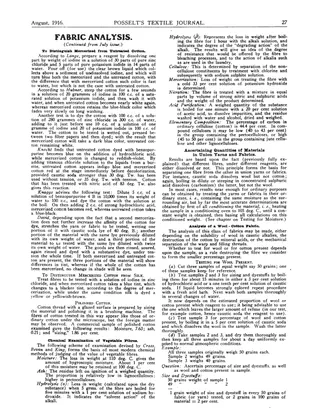
Two pages from the August 1916 issue of Posselt's Textile Journal, continuing a series on fabric analysis. The first article gives chemical tests to tell mercerized cotton from untreated cotton and from silk, a scheme for chemical examination of vegetable fibres, and worked examples of finding the percentages of wool, cotton and silk in union fabrics. The second page begins a continued article on silk throwing, covering the testing of raw silk and a winding-break grading standard.
Fabric Analysis
Article · 2 pages
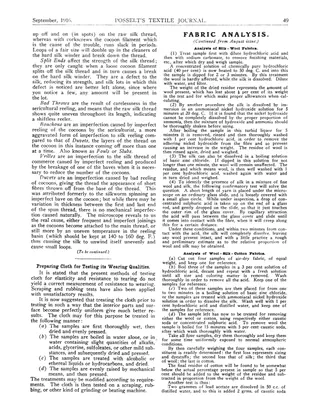
Two pages from the September 1916 issue of Posselt's Textile Journal, continuing a series on fabric analysis. They give chemical and mechanical procedures for finding the fibre content of silk-wool, wool-silk-cotton and cotton-linen fabrics, including acid, alkali and dye tests, the ink test and a worked weighing example. Shorter items cover raw silk defects (split ends, bouchons, vrilles, duvets), preparing cloth for wear testing, and silk imports at New York.
Fabric Analysis
Article · 2 pages
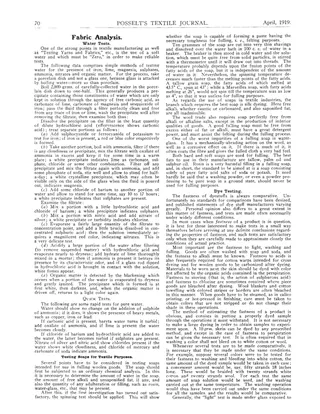
A two-page article from Posselt's Textile Journal, April 1919, on laboratory methods for testing textile materials. It covers chemical tests for water impurities (iron, lime, magnesia, sulphates, chlorides, nitrates, ammonia, organic matter), tests of soaps used for fulling wool, and dye testing: fastness to light, washing, alkali, acids, chlorine, stoving, fulling and perspiration, plus dye matching and detecting dye mixtures and adulterants. A short item at the end reports on felt and cloth made from spun glass in Italy.
Fabric Analysis: Ascertaining Raw Materials Used in the Construction of Fabrics
Article · 2 pages
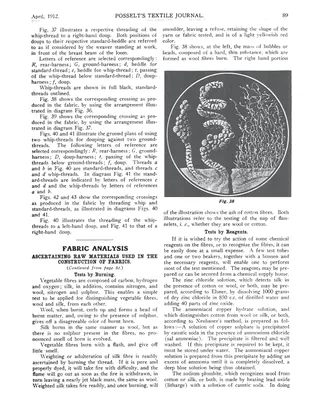
Two pages from Posselt's Textile Journal, April 1912 (pp. 89-90), containing a continuation of the series on fabric analysis. It describes burning tests to tell wool, silk and vegetable fibres apart, and chemical reagent tests (zinc chloride, ammoniacal copper hydrate, sodium plumbite, alkaline copper with glycerine), ending in a summary table of reagent reactions for cotton, wool and silk. The pages also carry the end of a note on doup/whip-thread leno threading diagrams and a fragment of a cotton carding installment covering doffer and comb settings and card waste.
Fabric Analysis; Ascertaining Raw Materials Used in the Construction of Fabrics
Article · 2 pages · weaving drafts
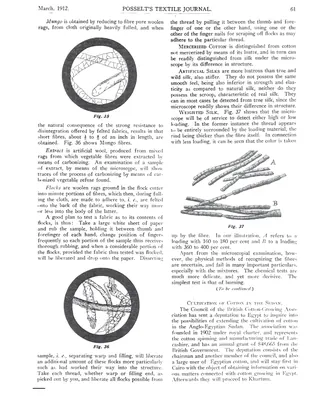
Two journal pages from Posselt's Textile Journal, March 1912, continuing a series on fabric analysis and identifying the raw materials in fabrics. It covers artificial wools (shoddy, mungo, extract and flocks), with microscope views of the fibres, and also mercerized cotton, artificial silk and weighted silk. It also covers chemical and burning tests. The first page ends an item on fancy gauze weaving, with a drawing-in draft for doup and ground harnesses.
Analysis of Yarns
Master Weaver, May 1956
Article · 4 pages
An article from the Master Weaver (1956) explaining how handweavers can identify common yarns. It reviews unreliable appearance and physical tests (luster, tensile strength, elasticity), then gives a step-by-step burning test and microscope test, with instructions for building a simple alcohol lamp and a cheap microscope setup. It identifies wool, silk, cotton, linen, hemp, jute, ramie, rayon, acetate, nylon, Orlon, metallics and fiberglass, and notes the limits of the tests for mixed or treated yarns.
249 documents found