Textile Documents › Topic: Dobby looms
243 documents found
Sort: 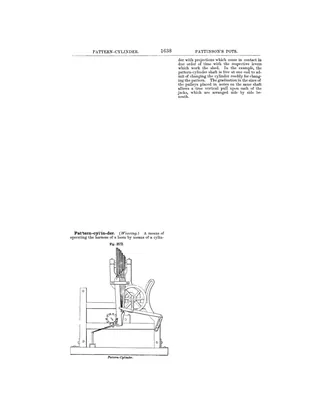
Pattern-Cylinder
Article · 1 page
A short dictionary entry on the pattern-cylinder, a loom device that operates the harness through a cylinder with projections that contact levers in sequence to work the shed. The accompanying text notes that the cylinder shaft is free at one end so the cylinder can be changed to change the pattern, and that graduated pulleys give a vertical pull on each jack. A line drawing (Fig. 3572) shows the mechanism.
Dobbies
Monograph · 37 pages · weaving drafts
An International Correspondence Schools instruction paper (Serial 495) on dobby shedding mechanisms for power looms. It describes open, close, split and compound sheds, then the construction, drive and operation of single-cylinder dobbies and their variations (positive/non-positive, single- and double-lift, single- and double-index, pawl-and-ratchet drive, right- and left-hand). It also covers the double-cylinder dobby with repeat motion, building and pegging harness chains, and timing, setting, skipping faults, and power and speed.
A New Dobby Lattice Lag
Textile Mercury, 1889
Article · 2 pages
Two pages from the Textile Mercury of 14 December 1889 (pp. 610-611). The main item describes a new dobby lattice lag from Stone and Burnett of Preston, a wooden lag with a sliding metal backing plate that holds iron headed pegs and keeps the lag from splitting. The page also covers James McMurdo's improved double lift Jacquard harness, which uses one neck band in place of two, and a short column on new dyestuffs for cotton and wool (Titan Pink, Eclipse Red 4 B, Clayton Yellow, Hebburn Fast Blue).
Dobbies and Other Head Motions
Monograph · 57 pages · weaving drafts
An International Correspondence Schools textile technology text on dobbies and other head motions, the mechanisms that raise and lower loom harnesses for weaves too complex for cam looms. It explains dobby parts (knives, jacks, hooks, fingers, chain cylinders), how chain drafts are turned into wooden, paper or punched pattern chains, and how dobbies are connected to harnesses by sheaves, straps and connectors. Later sections cover cleaning and maintenance, timing, variations such as punched-chain, Staubli and multiplier dobbies, the butterfly motion, and a heavy-duty head motion with its drive gearing. It is illustrated with many line drawings and ends with review questions.
WeaveTech Archives, August 2000
WeaveTech, August 2000
Web Doc · 162 pages
Archive of the WeaveTech email discussion list for August 2000, consisting of Topica digest issues (roughly 332 to 369) with messages from list members. Topics include AVL dobby looms and their computer interfaces, sectional beams, Macomber looms and Texsolv tie-ups, selling handwovens and studio tours, thread count, Ashenhurst's sett formula, pick glasses, rug looms, long-repeat designs, skeleton tie-ups on countermarche looms, and buying books online. Jane Eisenstein announces a web-based multi-weft double weave drafting program. Several pages near the end contain base64-encoded email attachments rather than readable text.
WeaveTech Archives, August 1999
WeaveTech, August 1999
Web Doc · 234 pages · weaving drafts
A monthly archive of the WeaveTech email discussion list for August 1999, preserved as raw messages with mail headers. Threads cover AVL looms (labeling heddle bars, selvedge reels, air compressors and air-assisted lifts, 24-shaft compu-dobby purchases, measuring on an AVL), troubleshooting a Cyrefco CompuMarche, and weaving software such as ProWeave and Fiberworks. Other discussions concern deflected double weave terminology and the final issue of Weaver's magazine, handweaver versus industrial weave nomenclature, weaving linen, hemp and wet-spun flax yarn, doup heddles, crossed warp tubes, Lycra, rolled selvedges and what makes someone a weaver. A few pages contain text-based weaving drafts or diagrams.
Posselt's Textile Journal, Vol. 3, No. 3 (September 1908)
Periodical · 52 pages · weaving drafts
September 1908 issue (Vol. 3, No. 3) of Posselt's Textile Journal, a Philadelphia monthly for the textile trades. It carries weave-design instruction, including a long article on designing and fabric structure for harness (dobby) work with twill and satin drawdowns, a Jacquard designing installment on point-paper stripe designs, and a Dictionary of Weaves page of eleven-harness weaves. Other articles cover looms (Mason, Northrop, Draper, Knowles worsted), narrow ware, spinning and winding machinery, wool yarn manufacture, knit goods, dyeing, fulling and silk ungumming. Much of the issue is advertising for machinery makers, plus a mill news column.
WeaveTech Archives, February 2000
WeaveTech, February 2000
Web Doc · 232 pages
A compiled archive of WeaveTech mailing list digests (Topica issues roughly 60 to 105) from February 1-27, 2000, preserved as raw email text with headers. Weavers discuss dust control and computers near looms, AVL looms (auto advance, compu-dobby, sectional beams), shuttles and yarn tension, yarn twist and floating selvedges, temples and draw-in, advancing twills, finishing silk, bleaching wool and dye runs, copyright, and a computer virus warning. Several pages contain encoded binary attachment data rather than readable text.
Composing and Combining Weaves
Baldwin's Textile Designer, September 1888
Article · 1 page · weaving drafts
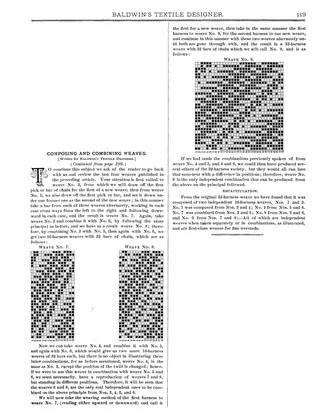
A single-page installment from Baldwin's Textile Designer (continued from page 106) on building complex weaves by combining simpler ones. It explains how to take picks (bars of chain) alternately from weaves No. 3 and 5, and No. 3 and 6, to produce 16-harness weaves No. 7 and No. 8 with 32 bars of chain. It then combines the harnesses of Nos. 7 and 8 to make the 32-harness weave No. 9, and closes with a recapitulation of how all the weaves derive from one another. Three drawdown grids illustrate Nos. 7, 8 and 9, which the author recommends for fine worsteds.
Dictionary of Weaves
Article · 1 page · weaving drafts
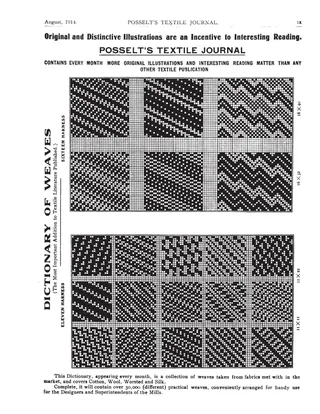
A single page from Posselt's Textile Journal (August 1914) presenting an installment and advertisement for the serialized Dictionary of Weaves. It shows two blocks of weave drawdowns, one for sixteen harness (16 x 40 and 16 x 32) and one for eleven harness (11 x 22 and 11 x 11). The text says the dictionary draws weaves from market fabrics in cotton, wool, worsted and silk, and will eventually hold over 30,000 practical weaves for mill designers and superintendents.
Punching Machine for Cards or Paper Bands to be Used for the Control of Jacquards, Dobbies and the Like, US Patent No. 3944134
Patent · 12 pages
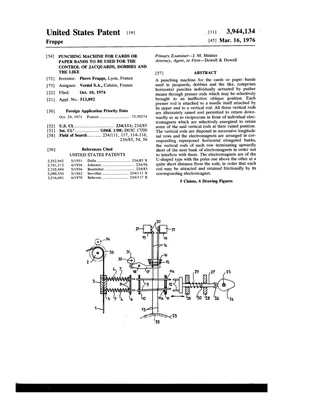
US Patent 3,944,134 (granted March 16, 1976) to Pierre Frappe of Lyon, assigned to Verdol S.A., describes a machine for punching the cards or paper bands that control jacquards and dobbies. Horizontal punches are driven through presser rods selected by vertical retaining rods, which are held in place by banks of U-shaped electromagnets receiving signals from a photo-electric reader or other source. The scan includes a 2001 USPTO web printout of the full text, the printed patent with claims, and four sheets of drawings (Figs. 1-6).
Silk Loom
The Melliand, March 1931
Article · 1 page
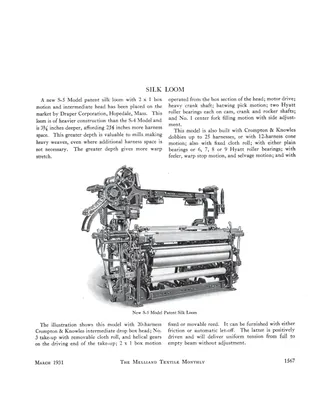
A short trade notice from The Melliand announcing the Draper Corporation's new S-5 Model patent silk loom with 2 x 1 box motion and intermediate head. It compares the loom with the S-4 Model, noting its heavier construction, greater depth and harness space, and lists options such as Crompton & Knowles dobbies up to 25 harnesses, roller bearings, let-off types and stop motions. An illustration shows the loom in side perspective.
A Study in Weave Formation
Article · 3 pages · weaving drafts
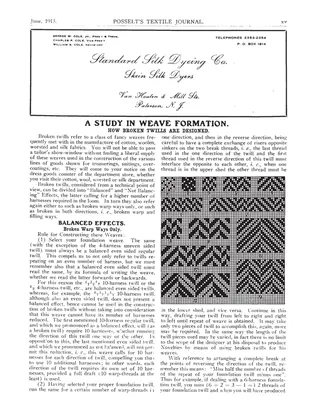
Part of a series from Posselt's Textile Journal (June 1915) explaining how broken twill weaves are designed for dobby looms. It sets out rules for choosing a balanced even-sided foundation twill, reversing its direction with a clean break, and the break-thread rule (skip half the repeat minus one). It then describes Figs. 1 to 22, covering broken warp ways only and broken warp and filling ways (check effects), with harness requirements and draft arrangements. The pages are interleaved with trade advertisements and a short item on industrial alcohol use in Russia.
Large 63 deg. Diagonals
Article · 2 pages · weaving drafts
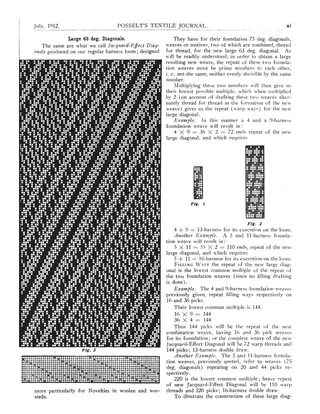
Short article from Posselt's Textile Journal explaining how to build large 63-degree "Jacquard-Effect" diagonals on an ordinary harness loom by combining two 75-degree steep-twill foundation weaves thread for thread. It gives the rules for the warp and filling repeats and the harness count, with worked examples (4 and 9 harness giving 72 ends by 144 picks on 13 harnesses; 5 and 11 harness giving 110 by 220 on 16 harnesses), illustrated by three drawdowns and a draft. The second page carries a short piece on stains on dyed cotton goods and trade advertisements.
Leno Attachments
Monograph · 38 pages · weaving drafts
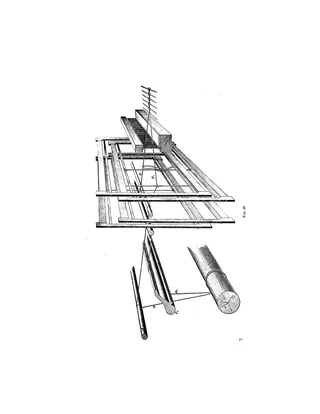
An International Correspondence Schools instruction paper (Serial 496) on the mechanical leno (gauze) attachments used on dobby looms. It explains the doup and standard harnesses, bottom and top doups, drawing in, reeding, and the slackener or easer for single-lift (close-shed) dobbies. It then covers double-lift (open-shed) dobbies with the jumper and yoke, harness-chain pegging plans, and the fixing and setting of these motions. It ends by comparing American and European drawing-in methods. Illustrated with numbered figures of harness and mechanism drawings and four chain drafts.
Automatic Dobby Dress Goods Loom
Other · 4 pages
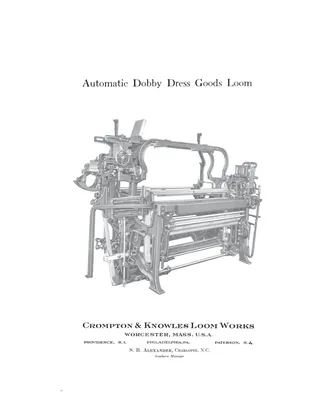
A four-page sales brochure from Crompton & Knowles Loom Works for its automatic 4 x 1 box dobby dress goods loom, intended mainly for cotton dress fabrics. It gives general specifications (frame, dobby harness motion, box motion, magazine, drive, picking, lay, stop motions, let-off, take-up) and optional changes. It also includes a floor plan with dimensions and a list of the loom types and accessory machinery the company builds. The last page shows views of the company's factory complexes.
Designing
Textile Mercury, 1890
Article · 2 pages · weaving drafts
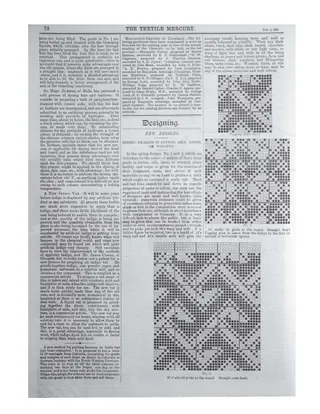
Two pages from the Textile Mercury of 1 February 1890 with a 'Designing' column for power-loom cloth makers. It gives pegging plans for spring dress goods in cotton, silk, linen or worsted, a design for woollen mantle cloth combining ribbed and twill sections with setts and colourings, and a figured dress fabric with semicircle motifs. Drawdown and pegging-plan grids are included. The first page also carries unrelated trade news items.
Designing
Textile Mercury, 1891
Article · 2 pages · weaving drafts
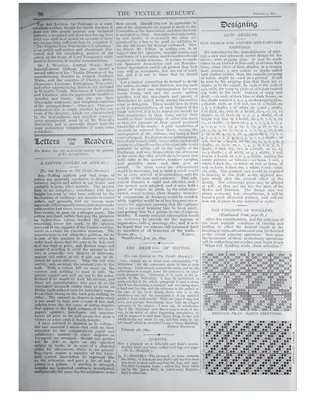
Two pages from The Textile Mercury of 7 February 1891 (pp. 98-99) containing the 'Designing' column. It gives a new 21-shaft design for fancy Oxford and Harvard shirtings, with pegging plans and a detailed warp colour and draft sequence (80 ends per inch of 24's twist, 64 picks of 16's weft). It continues a series on the finishing of woollens, covering weaving, scouring and milling, and ends with a note on novelty double cloths (Designs 11 and 12) combining a 2/2 twill worsted with a plain woollen stripe or check. Short trade notices and letters to the editor about cotton disputes, cotton drawing and loom queries are also on the pages.
Designing
Textile Mercury, 1892
Article · 1 page · weaving drafts
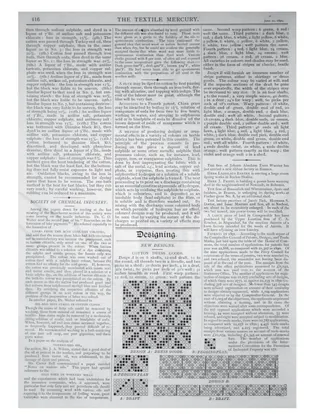
A single page from The Textile Mercury (11 June 1892, p. 416) with a "Designing" column giving two new cotton dress goods designs. Design A is a 6-shaft, 12-end draft and Design B a 4-shaft stripe weave. Each comes with a draft and pegging plan, reed and sett details, yarn counts, picks per inch, and warp and weft colour patterns. The rest of the page carries trade notes on dyeing aniline black on cotton, Society of Chemical Industry papers on lakes, oil and iron stains, Turkey-red oil and mill oils, bleaching, discharge printing, and news of new textile factories and 1891 patent statistics.
Fancy Loom Making
Article · 7 pages
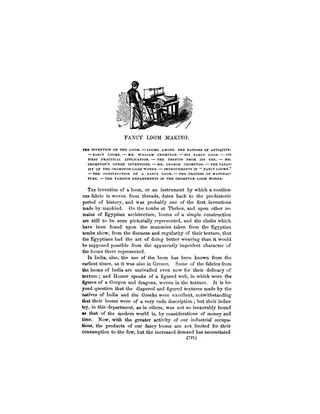
A 19th-century trade article on the history and manufacture of fancy looms, centered on William and George Crompton and the Crompton Loom Works in Worcester, Massachusetts. It opens with a brief history of the loom, then covers Crompton's patented fancy loom, its first use at the Middlesex Mills in Lawrence, and later patents and improvements. It also describes the foundry and machine shops where the looms were built, and explains how the harness mechanism, pattern chain and drop-shuttle boxes distinguish a fancy loom from a plain cam loom.
Leno Weaves
Monograph · 66 pages · weaving drafts
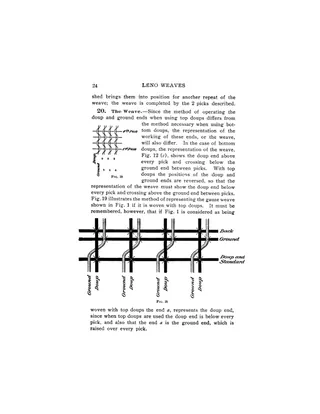
An International Correspondence Schools instruction paper (Serial 512) on leno, or gauze, weaves as woven on dobby looms. It covers plain gauze with bottom and top doups on close-shed and open-shed looms, including the standard, doup, ground and back harnesses, the slackener, jumper and yoke, and how to write harness and chain drafts. The second half treats fancy gauze: combinations of right- and left-hand doups, multiple picks before douping, multiple doup or ground ends, several sets of doups, combinations with plain weaves, effects without extra mechanisms, and dissecting leno cloth. It is illustrated with many mechanism drawings, weave diagrams and chain and drawing-in drafts.
Leno Weaving and Design, Part 1
Article · 6 pages · weaving drafts
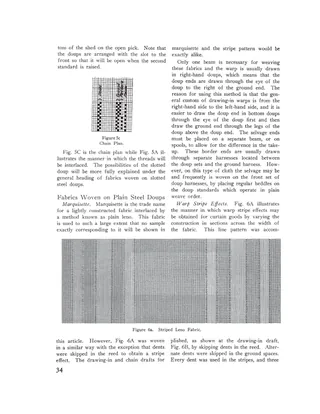
First part of a serial article on leno (gauze) weaving from The Melliand, explaining how warp threads cross one another and how steel doups are used to produce the crossing. It describes the plain steel doup and the slotted (super) doup, with a marquisette loom attachment, a dobby head with jumper motion, and drawing-in and chain drafts. Examples include marquisette, warp stripe, checked and filling-border leno, and a leno and figured rib curtain fabric. The article ends 'To be continued'.
Leno Weaving and Design, Part 3
Article · 6 pages · weaving drafts
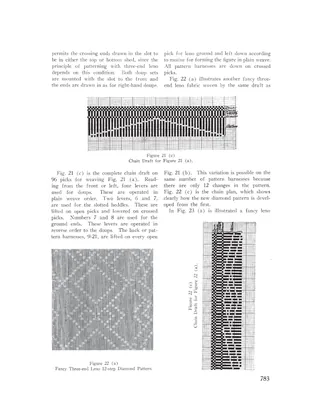
Third installment of a series on leno weaving, covering design of figured three-end leno fabrics woven with slotted steel doups on dobby looms. It explains the open and crossed shed positions of the slotted doup and describes several sample fabrics (diamond, all-over, scroll and quadri-symmetrical patterns) with drawing-in drafts and chain drafts. The final pages give practical loom settings for leno, including harness and doup standard heights, leasing, slackener setting, selvages, and reeds.
Die Mechanische Weberei [Mechanical Weaving]
Book · 354 pages · German · weaving drafts
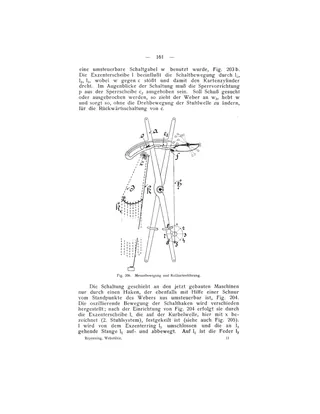
A German textbook on power-loom weaving by H. Repenning, a teacher at the higher textile school in Aachen, written for technical schools and self-study. It covers loom frames and drives (including electric motors), warp and cloth beam regulators and brakes, and shedding motions (tappets, dobbies, Jacquard and Verdol machines). It also covers weft insertion: picking and shuttle motions, shuttle box changes, automatic bobbin changing, brocade, gripper and rod looms, ribbon looms and cut-selvedge devices. It includes 398 figures, mostly mechanical line drawings, plus a few weave-related drafts and card-punching examples, and ends with sections on loom speed, power consumption and accident prevention.
Point Weaving on Multi-Harness Loom
Article · 3 pages · weaving drafts
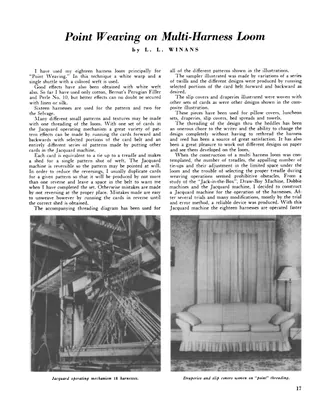
L. L. Winans describes weaving "point" patterns on an 18-harness loom (16 pattern harnesses plus 2 selvage) operated by a Jacquard-type card mechanism he built himself. Using one threading, a white warp and a colored weft, he varies twill-based patterns by running punched cards forward and backward. The article explains how the cards are punched and used, shows a card-cutting diagram, and has photographs of the mechanism, draperies, slip covers and twill samples. Blueprints of an improved machine for up to 26 harnesses were offered by the author.
Recent Improvements in Textile Machinery Relating to Weaving
Book · 222 pages
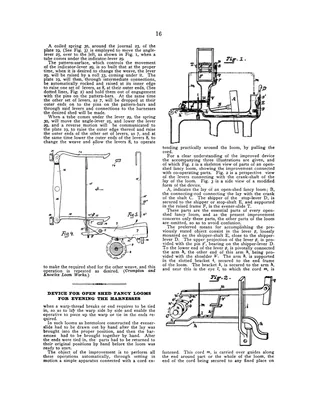
A late-19th-century technical treatise by E. A. Posselt describing patented improvements in power-loom machinery. It covers shedding mechanisms (dobbies, harness motions), drop-box and shuttle-box motions, let-off and take-up, pickers, shuttles, temples, reeds, heddles, Jacquard attachments, spooling and winding machines, lappet motions, and yarn-counting devices. Each entry explains a mechanism with line drawings and lettered parts, often credited to Crompton & Knowles, Draper, Mason or individual inventors. It also includes a table of contents and period advertisements for textile machinery and suppliers.
Spider Weaves
Article · 2 pages · weaving drafts
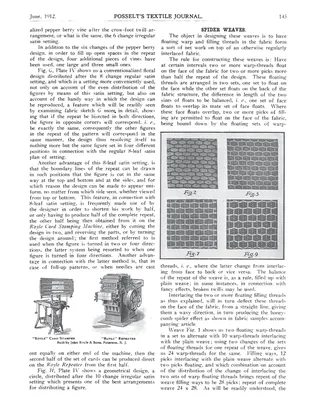
A two-page excerpt from Posselt's Textile Journal (June 1912) explaining spider weaves, which use floating warp and filling threads to form a net-like honeycomb or hexagon effect over a plain-weave ground. It gives construction rules and describes weaves Figs. 1, 3, 4, 6 and 8 with repeat sizes (e.g. 24 x 28, 28 x 32), their fabric sketches, and a 9-harness dobby drawing-in draft. The scan also opens with the end of a piece on distributing figures in satin settings with the Royle card stamper and repeater, and closes with the start of a section on faults in cotton fabrics (reedy cloth, floats).
Tappet and Dobby Looms: Their Mechanism and Management
Book · 234 pages · weaving drafts
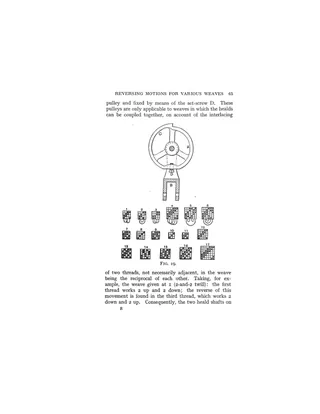
A 1912 technical manual on the construction, setting, timing and management of tappet and dobby power looms, written by a teacher of weaving at Huddersfield-area technical institutes. Nine chapters cover loom classification and driving, the going part and timing, tappet and dobby shedding, picking, shuttle-box and wefting-plan mechanisms, let-off, take-up and auxiliary motions such as stop-motions, temples and selvage formation. It is illustrated with many line drawings and includes faults and remedies drawn from the author's experience, plus a small number of weave and selvage drafts.
Der Webmeister für mechanische Weberei, III Teil: Die Schaft- und Jacquardmaschinen [The Weaving Master for Mechanical Weaving, Part III: The Dobby and Jacquard Machines]
Book · 112 pages · German · weaving drafts
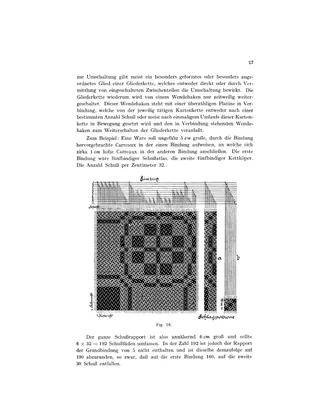
Part III of Franz Kraus's textbook for weaving-mill foremen (second revised and enlarged edition, 1926), covering dobby (shaft) machines and Jacquard machines for power looms. It describes machine components, setting-up, single-lift and double-lift dobby and Jacquard systems (Dickinson, Burnley, Hattersley & Smith, Devoge, Verdol and others), card lacing and punching, and chain-change devices. The Jacquard sections cover cord board calculation, straight-through and point (Spitz) harness tie-ups in German and English systems, mixed tie-ups, lifting cards (Aushebekarte), and troubleshooting. About 100 text figures are mostly mechanical line drawings, with a few weave and pattern diagrams.
Woolen and Worsted Fancy Looms
Monograph · 104 pages · weaving drafts
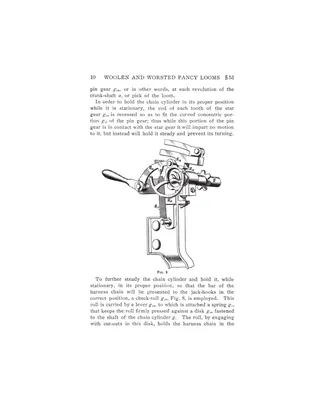
An International Correspondence Schools–style instruction text (two parts, Serials 487A and 487B) on woolen and worsted fancy looms. Part 1 covers the Knowles fancy loom: head-motion, harness chains, box motion and box chains, picking, take-up, brake and selvage motions. Part 2 covers the Crompton fancy loom, including its shedding, chain cylinder, box motion, protector, filling stop-motion, let-off and selvage mechanisms. The text is mechanical, with many line drawings of loom parts and gearing, plus a few pattern and filling drafts.
Assuring Weaving Mill Profits in a Tight Market: Improved Looms Alone Give a Fancy Mill 8% Margin
Article · 4 pages
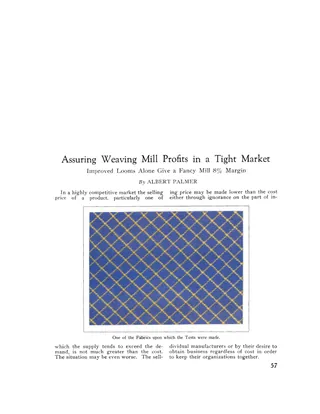
A 1929 article from The Melliand arguing that new automatic looms can protect profit margins for weaving mills in a depressed, price-competitive market. It compares the Crompton & Knowles Cotton King automatic dobby loom with the older automatic dobby dress goods loom on a cotton and rayon dress fabric, using four months of mill data. Tables give production, seconds, waste, weaver operations, looms per weaver and cost per yard, and conclude with an 8% total cost saving and a 21% return on the investment.
Figured Cotton Zephyrs
Article · 2 pages · weaving drafts
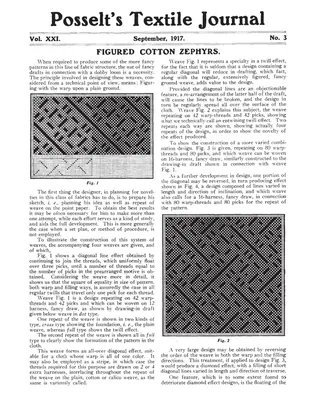
Two pages from Posselt's Textile Journal, September 1917, mainly an article on designing figured cotton zephyr fabrics: figuring with the warp on a plain ground, woven on dobby looms with fancy draws. Four weaves are explained (42- and 80-thread repeats, 12- and 16-harness drafts), including diagonal and entwining twill effects, diamond reversals, and the use of a 400 jacquard machine for sample production. The scan also includes the continuation of H. Barlow's article on terry pile fabrics, covering temples and loom measurements of cloth width versus reed width.
Terry Pile Fabric
Article · 2 pages
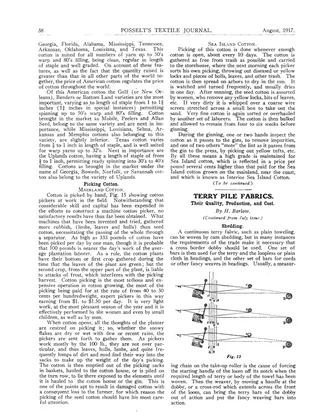
Two pages from Posselt's Textile Journal, August 1917, carrying the continuation of H. Barlow's series on terry pile fabrics. This installment covers shedding for terry weaving: cam versus cross-border dobby shedding, negative versus positive shedding, harness setting for a 3-pick terry (Fig. 13), and shed timing. The pages also include the end of an article on American cotton varieties and picking, a note on Mexican export duty on wool and hair, and a continuation of the silk throwing series describing the Atwood combination organzine spinning, doubling and twisting frame.
WeaveTech Archives, October 1998
WeaveTech, October 1998
Web Doc · 143 pages · weaving drafts
Archive of the WeaveTech mailing list digests for October 1998 (Volume 1, roughly issues 1 to 43), compiled from the Majordomo file weavetech.9810. The messages are e-mail discussions among handweavers about computer-assisted and dobby looms (AVL, Louet Megado, LeClerc), networked and advancing twills, sectional warping, dummy warps, yardage and revolution counters, and laptops for loom control. Other threads cover whether fiber art on the edge counts as art, music and weaving, variegated yarns, pebble weave, and many member self-introductions. Two pages contain simple text-based drafts, including a pebble weave scrap pattern.
Designing
Textile Mercury, 1892
Article · 2 pages · weaving drafts
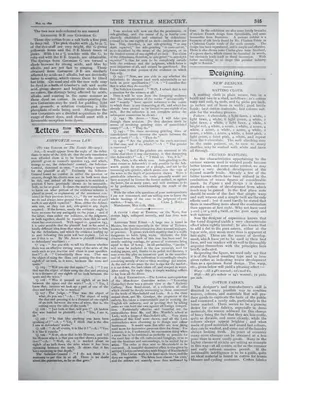
Two pages from The Textile Mercury of 14 May 1892 containing the weekly 'Designing' column plus unrelated items. The column gives a matting cloth specification with a colored stripe pattern, figured worsted mantling woven with warp and weft weaves and an 8-end diagonal, cotton blouse and dress fabrics on 8 shafts with pegging plans, and a 17-shaft gingham diagonal with warp and weft colour-repeat calculations. The first page also carries a note on new Geranine direct dyes, a patent-dispute letter about card-clothing side grinding, and short news items on fibres and a silk exhibition.
The Mechanism of Weaving
Book · 317 pages · weaving drafts
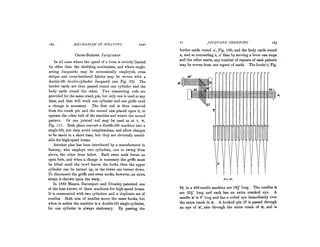
A comprehensive technical treatise by T. W. Fox on the mechanics of power-loom weaving, in its fifth edition (1922, first published 1894). It covers healds, shedding by tappets, dobbies and Jacquards, figuring harnesses, card-cutting and lacing, lappet shedding, picking, multiple box motions, swivel and gauze weaving, reeds, brakes, let-off and take-up motions, temples, and the layout of weaving sheds. The text is heavily illustrated with mechanical line diagrams; weaving drafts and tie-ups appear on only a few pages.
Recent Improvements in Textile Machinery Relating to Weaving, Part 2
Book · 182 pages
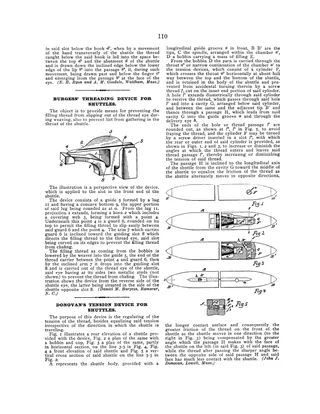
Part 2 of E. A. Posselt's survey of weaving machinery, published in Philadelphia in 1901 as a supplement to Part I, covering devices that appeared after the first volume. It describes and illustrates, mostly from patents, shedding mechanisms (dobbies, Knowles and Crompton harness motions, leno and selvage motions), shuttle changers and boxes, Northrop automatic loom parts, narrow ware looms, let-off and take-up, stop motions, picking, shuttles, temples, Jacquard and card-cutting machinery, reed tools, winding, quilling, warping and slashing machines, and thread cutters. The text is technical mechanical description keyed to line drawings, aimed at mill managers, designers and students. It contains no weaving drafts.
Some Introductory Notes Concerning Jacquard Technology
Garth Fletcher · 2002
Web Doc · 13 pages
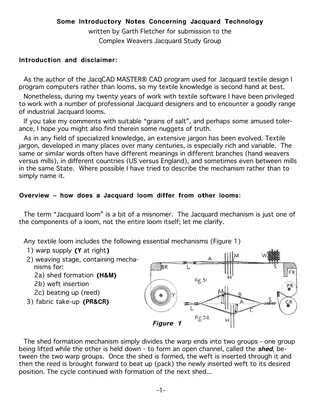
An introductory essay by Garth Fletcher, written for the Complex Weavers Jacquard Study Group, explaining how Jacquard shedding differs from dobby, drawloom and shaft (harness) looms. It describes the griffe, hook and sensing-pin mechanism, the move from pasteboard cards to endless paper and electronic control, and hook counts and head sizes. It also covers harness cords and pattern repeats, choosing hook counts so weaves repeat cleanly across seams, hooks used for weft selection and other functions, and the TC-1 and TIS/SAMT hand-loom Jacquards. It closes with trends in Jacquard design and production, illustration sources and a reading list.
WeaveTech Archives, July 1999
WeaveTech, July 1999
Web Doc · 302 pages
A compiled archive of the WeaveTech mailing list e-mail digest for July 1999, with message headers and replies from list members. Topics include the AVL bobbin-winding guide, drawloom makers (Glimakra, Myrehed, Oxaback), buying a used Macomber loom, AVL auto advance and pick-per-inch calculations, compu-dobby looms, tied weaves, double weave lace, and 16-shaft tie-ups. Other threads cover guild master-weaver ratings programs and their exclusion of computers, care labeling in the US, an online weaving journal, genetic algorithms, and weaving in the movies. One draft appears on a single page.
Textile Mercury, Vol. 3, No. 75 (September 27, 1890)
September 27, 1890
Periodical · 18 pages · weaving drafts
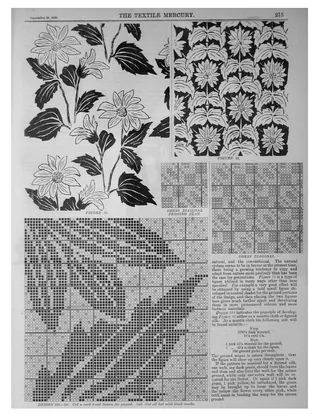
Issue No. 75 (27 September 1890) of The Textile Mercury, a Manchester weekly trade journal covering spinning, weaving, dyeing, machinery and textile markets. It includes editorials on the uniform weaving list, piece-goods measurement, Calais lace trade labour disputes, Indian factory laws and the Nijni Novgorod fair. Technical items include a new artificial indigo process, a designing column with figured-cloth designs and a dress diagonal pegging plan, and an illustrated description of Samuel Walker's Patent Positive Dobby. It also has notes on Indian textile fibres, silk in Bengal, Turkish carpet manufacture, foreign correspondence, market reports, patents and company news.
WeaveTech Archives, February 1999
WeaveTech, February 1999
Web Doc · 127 pages
Archive of the WeaveTech email discussion list for February 1999, reproduced as raw messages with full mail headers. Topics include co-op galleries and selling work, shrinkage of rayon yarn, computer-driven dobby and J-Comp looms, fly shuttles and beaters, the Macomber sliding shuttle, huck lace, lace weave color effects, whiter silk, African strip weaving, dimity, and mommy measurement of fine yarns. It also includes list administration notices, a notice of a death in the dyeing community, the Vav conference, and rules for the Third Annual Non-Holiday Serviette (Napkin) Exchange. Only one page has a weaving draft, in text form.
WeaveTech Archives, January 2001
WeaveTech, January 2001
Web Doc · 317 pages
A compilation of the WeaveTech email discussion list for January 2001, made up of Topica digests (issues 565 to about 630) with about 50 threads listed in the page overview. Topics include AVL warping wheels and their assembly, sectional warping, AVL dobby looms, air assist, ratchet brakes, dobby bars and threading with a dobby, block and unit weaves, warping drums, weaving with handspun, natural dyes and dyeing skeins, travel and textiles, and book recommendations such as Luther Hooper's Hand-Loom Weaving. Two pages (193-194) give threading and treadling notation in text form for diversified plain weave. Much of the text is email headers, quoted replies and list administration.
WeaveTech Archives, July 2000
WeaveTech, July 2000
Web Doc · 234 pages
Compilation of WeaveTech mailing list digest emails from July 2000 (issues roughly 283 to 331), archived as raw email text with headers. Discussion centers on the Convergence 2000 conference in Cincinnati: evaluations, costs, food events, fashion shows, HGA management, teacher compensation, and using college campuses as venues. Other threads cover AVL looms and warping wheel, CompuDobby maintenance, a warp beam problem with advice from Peter Collingwood, cashmere yarn sources and yarn count conversions, a damaged double-weave coverlet, left-handed weavers, and equipment for sale. Several pages are base64-encoded attachment data rather than readable text.
WeaveTech Archives, November 1999
WeaveTech, November 1999
Web Doc · 244 pages
Monthly archive of the WeaveTech email discussion list for November 1999, reproduced as raw messages with mail headers. Threads include sewing and warping with chenille yarn, static electricity in silk warps, long-eyed heddles, and a long debate over whether power looms and dobby or computerized looms count as handloom weaving. Other topics are warp tension on AVL looms, Ashenhurst's formula, warping and tie-up methods, combining ground and pattern shafts, a textile bibliography, the TSA 2000 symposium call, and an article on CAD designer salaries. There are also announcements and book notices, including Tejido Huave and Double Two-Tie Unit Weave.
Dictionary of Weaves
Article · 1 page · weaving drafts
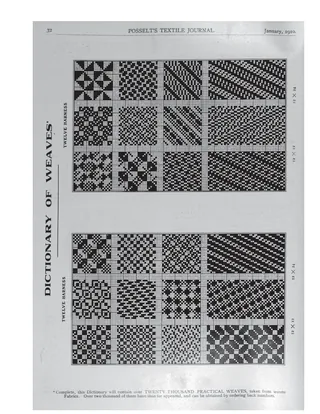
A single page from the serialized 'Dictionary of Weaves' in Posselt's Textile Journal, January 1910 (page 32). It presents twelve-harness weave drawdowns in grid form, in blocks marked 12 x 24 and 12 x 12. A footnote says the finished dictionary will hold over twenty thousand practical weaves taken from woven fabrics, with over two thousand already published in earlier issues.
Dictionary of Weaves
Article · 1 page · weaving drafts
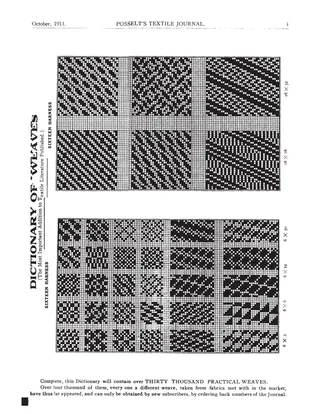
A single page from the October 1911 issue of Posselt's Textile Journal, presenting a sample of the serialized "Dictionary of Weaves." It shows large grids of black-and-white weave drawdowns labeled by size (16 x 32 and 16 x 16 for sixteen harness; 6 x 30, 6 x 24, 6 x 6 and 6 x 3 for six harness). The accompanying text says the finished dictionary will contain over thirty thousand practical weaves, with over four thousand already published and available through back numbers.
Dictionary of Weaves, Part 3
Article · 3 pages · weaving drafts
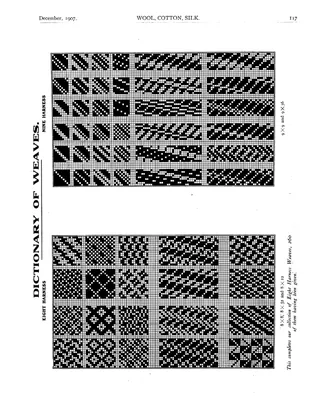
Three pages of plates from the serialized Dictionary of Weaves in Posselt's Textile Journal, December 1907. They consist almost entirely of drawdown grids for eight-harness and nine-harness weaves, with minimal text. The eight-harness series is stated to be complete at 260 weaves, and the nine-harness series is completed here with 138 weaves.
Dictionary of Weaves, Part 4
Article · 2 pages · weaving drafts
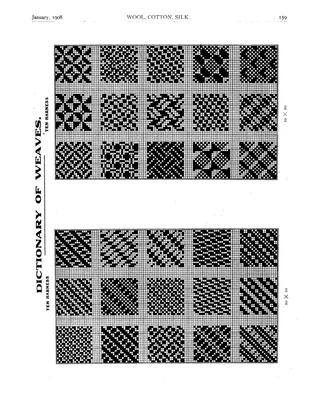
Two pages from the Dictionary of Weaves series in Posselt's Textile Journal, January 1908, consisting almost entirely of drawdown grids for ten-harness weaves. Each page shows a 5-by-2 array of 10 x 10 repeat patterns, printed sideways on the page, with no explanatory text beyond the headings.
Dictionary of Weaves, Part 5
Article · 2 pages · weaving drafts
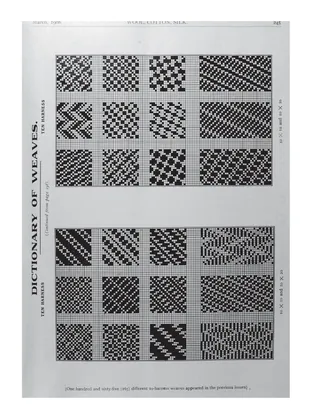
Two pages of Posselt's serial Dictionary of Weaves, continuing the ten-harness section. Each page is filled with grids of black-and-white drawdowns of ten-harness weaves, captioned '10 x 10 and 10 x 20'. There is almost no text beyond headings and a note that 165 different ten-harness weaves appeared in earlier issues.
A Study in Weave Formation
Article · 2 pages · weaving drafts
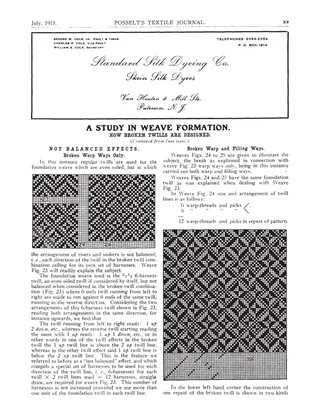
Two journal pages from a continuing series in Posselt's Textile Journal (July 1915) on how broken twills are designed. They cover unbalanced broken twills, where each twill direction needs its own set of harnesses, and breaks carried out both warp and filling ways. Worked examples (Figs. 23-29) use 6-, 8-, 10- and 12-harness foundation twills, with repeat sizes, drafting sequences and drawing-in drafts for up to 20 harnesses. The pages also carry advertisements from textile suppliers.
243 documents found