Textile Documents › Topic: Calculations: yarn counts, sett, costs
532 documents found
Sort: 
Modern Count of Yarn
Master Weaver, May 1955
Article · 3 pages
A 1955 article from the Master Weaver newsletter that criticizes the confusing yarn-count systems used for cotton, linen, wool, silk and rayon in English-speaking countries. It lists old English yarn measures from the early 19th century and argues for the metric yarn number (meters per gram), with conversion factors and formulas between English counts and metric numbers. It also explains how to find an unknown yarn's metric number by weighing a one-meter sample and how to write plied yarns.
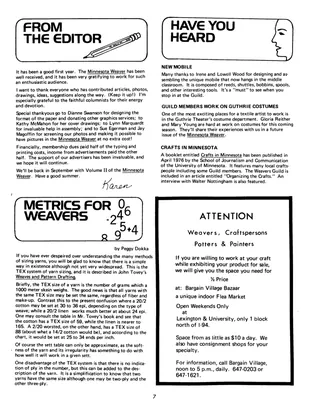
The TEX System of yarn sizing
Article · 1 page
A short article, "Metrics for Weavers" by Peggy Dokka, explaining the TEX system of yarn sizing, in which a yarn's size is the weight in grams of a 1000 meter skein. It argues that yarns of equal TEX can be set at the same sett regardless of fiber, citing the table in John Tovey's Weaves and Pattern Drafting with examples for cotton, linen and worsted. The page also carries the editor's end-of-year note, a "Have You Heard" column of guild news, and an advertisement for a flea market.
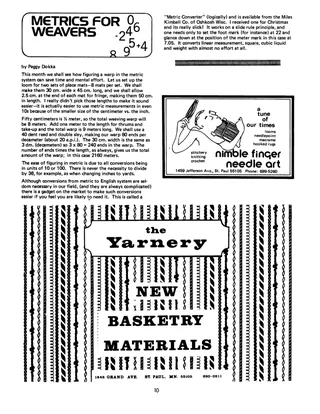
Figuring a Metric Warp
Article · 1 page
A one-page column from the Minnesota Weaver on figuring a warp in metric units. It works through an example of two sets of place mats (8 mats per set) with a 9 meter warp, a 40 dent reed double sleyed, and 240 ends, and argues that metric units in tens make warp calculation easier than inches and yards. It also mentions a slide-rule style "Metric Converter" sold by mail order. The page includes advertisements for two St. Paul needlework shops.
Handweaving News (December 1940): Handweaving as a Business
Periodical · 3 pages
A December 1940 article by Nellie Sargent Johnson offering practical advice to weavers who want to sell their work. It covers the difference between amateur and professional weavers, the need for originality, choosing a specialty such as handwoven bags, costing and pricing, equipping a workroom, buying materials, valuing time, and selling outright versus on consignment. It includes pricing examples and a simple formula of materials plus labor plus about 50% overhead.
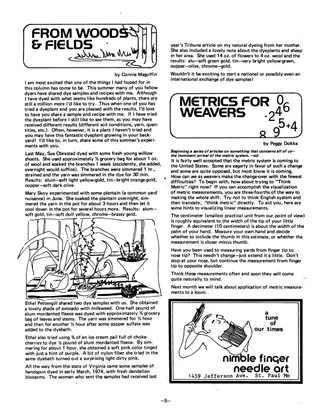
Intro to Metric System
Article · 1 page
A one-page scan from Minnesota Weaver (October 1975) containing the first installment of Peggy Dokka's series "Metrics for Weavers." It advises weavers to "think metric" directly and offers body-based aids for visualizing centimeters, decimeters and meters, with application to the loom promised for the next issue. The same page also carries Connie Magoffin's natural dyeing column "From Woods & Fields" with reader-submitted dye recipes.
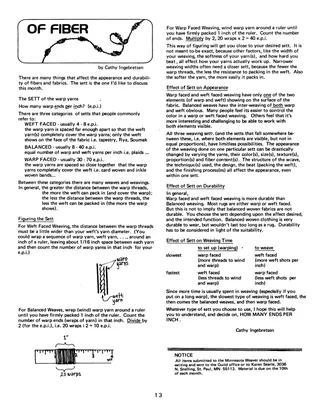
Of Fiber - The Sett
Article · 1 page
A one-page column from the Minnesota Weaver explaining sett, the number of warp ends per inch. It defines weft-faced, balanced, and warp-faced setts with typical e.p.i. ranges, and describes a ruler-wrap method for estimating sett. It also discusses how sett affects appearance, durability, and setup and weaving time.
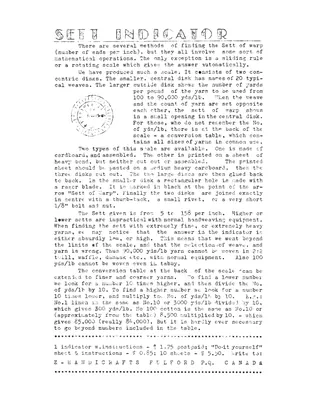
Sett Indicator
Master Weaver, July 1958
Article · 1 page
A short 1958 notice from Master Weaver describing a two-disk rotating scale that gives the sett of warp (ends per inch) without calculation. The central disk lists 20 typical weaves and the outer disk lists yarn counts in yards per pound, from 100 to 90,000. The article explains how to assemble the printed version, the range of setts it covers (5 to 158 per inch), and how to extend the yarn conversion table. It ends with prices and an ordering address in Fulford, Quebec.
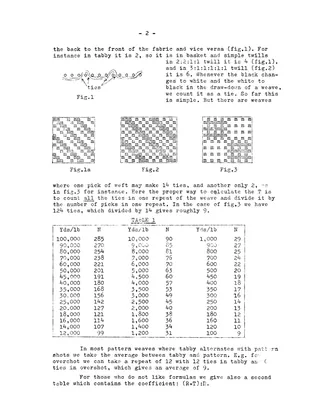
Sett of Warp for a Perfect Fabric, How to Figure it Out?
Master Weaver, July 1956
Article · 3 pages · weaving drafts
An article from the Master Weaver newsletter (Fulford, Quebec) explaining how to calculate warp sett for any weave rather than relying on simple tabby and twill graphs. It gives a "diameter number" formula (N = .9 x square root of yds/lb) and a sett formula S = N x R / (R + T), where T is the number of ties per pick. It explains how to count ties from a drawdown and includes two tables: diameter numbers by yards per pound, and coefficients for many weave types. Worked examples for linen towels in tabby and wool in 2:2 twill are included.
Straight-Line Textile Calculations. Part 5
Article · 2 pages
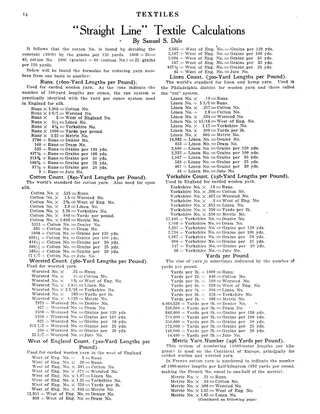
Two pages from Textiles, vol. 15 (pp. 14-15). The first is part of Samuel S. Dale's series on yarn number calculations, giving conversion formulas between yarn counting systems (runs, cotton, worsted, West of England, linen, Yorkshire, yards per pound, metric), with denier, dram, grains and jute equivalents. The second page carries an unrelated installment of W. Scott Taggart's 'The Mechanics of Textile Processes', covering levers, centers of gravity, moments, and mechanical advantage and velocity ratio, with worked examples.
Ashenhurst's Cloth Structure Tables
Book · 13 pages
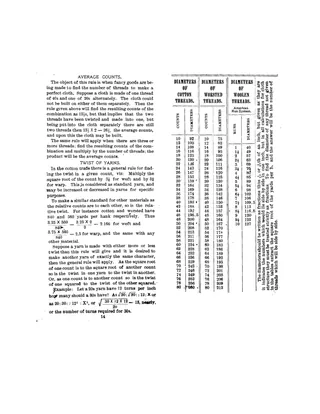
A booklet of cloth structure tables compiled by Thomas R. Ashenhurst, giving the minimum, optimum and maximum ends per inch for plain cloth in many combinations of warp and weft counts. Separate tables cover worsted, cotton or spun silk, and woolen yarns, and several mixed combinations. The text includes a preface and rules for changing pattern (twill and satin), finding picks per inch, changing cloth weight or yarn count, and calculating folded-yarn counts, average counts and yarn twist. A table of thread diameters for cotton, worsted and woolen yarns is also included.
Fabric Analysis
Article · 2 pages
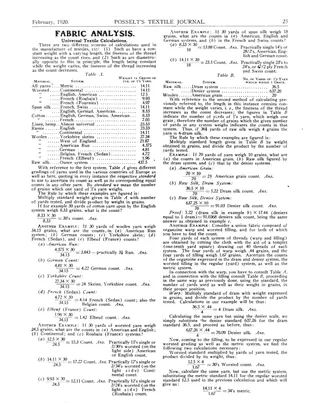
Two-page article from Posselt's Textile Journal, February 1920, explaining how to calculate yarn counts from cloth samples. It gives tables of standard weights and lengths for worsted, cotton, silk, linen, ramie and woolen yarn systems, with worked examples for each. It also covers converting cotton yard counts to metric counts and converting denier counts of artificial silk to cotton or spun silk counts. The pages end with a short news item on a drop in wool consumption and a note on a dye bath for a blue-black shade.
How to Sell
Master Weaver, July 1954
Article · 4 pages
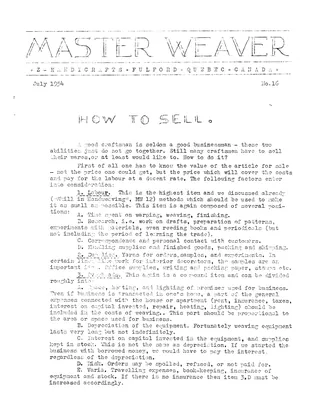
An article from the Master Weaver newsletter (Fulford, Quebec) on how handweavers should price and sell their work. It breaks down labour, supplies, overheads and tax with a worked wholesale price example, then gives rules of thumb for dealing with shops, department stores, consignment, individual customers, collection and tags. A short terminology note at the end discusses the term "harness-frame" versus "heddle-frame".
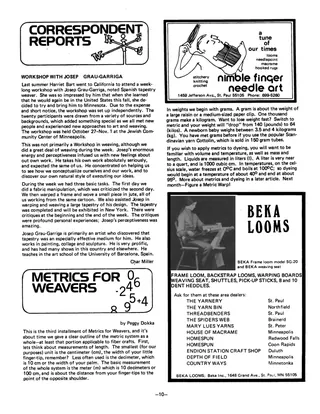
Measurements of length, weight, volume and temperature
Article · 1 page
A single page from Minnesota Weaver carrying Peggy Dokka's third installment of "Metrics for Weavers," which outlines the metric units of length, weight, volume and temperature that apply to fiber crafts, with everyday comparisons and a note on dyeing temperatures. The page also holds Char Miller's report on a Minneapolis workshop with Spanish tapestry artist Josep Grau-Garriga, and a BEKA Looms advertisement listing Minnesota dealers.
Problems in Teaching - The Yarn and the Sett of Warp
Master Weaver, March 1953
Article · 4 pages
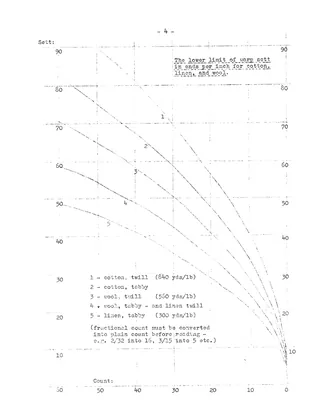
A teaching-oriented article from Master Weaver (Fulford, Quebec) on how to choose warp yarn and sett. It explains why yarn count does not give a fixed thickness, why sett formulas are unreliable, and how to find the lower and upper sett limits for warp-face, 50:50 and weft-face fabrics. It gives a simple rule, S = k√C, with coefficients for cotton, wool and linen, and a graph of the lower limit of sett by yarn count. It recommends that students make and keep sample swatches on small frame looms.
Questions and Answers
Article · 1 page
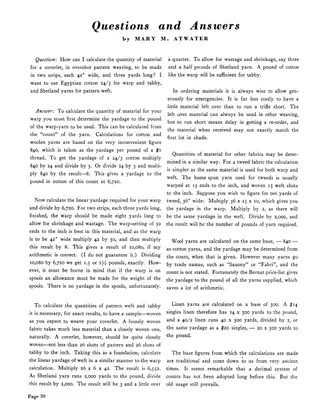
A one-page Questions and Answers column by Mary M. Atwater on calculating yarn quantities for weaving. It works through an overshot coverlet in two strips, figuring warp yardage from the cotton count (24/3 at 6,720 yards per pound) and weft weights for Shetland pattern yarn and cotton tabby. It also gives a tweed example and the base yardage figures for cotton, wool (840) and linen (300).
Straight Line Textile Calculations, Part 1
Article · 1 page
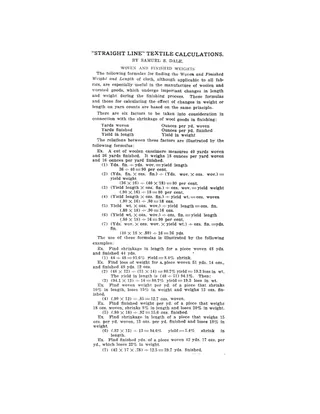
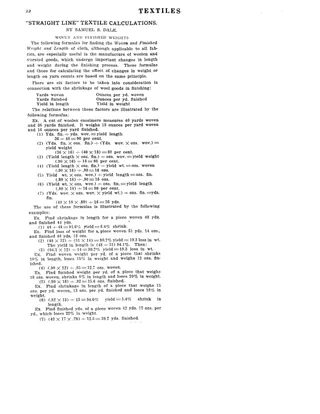
A one-page article by Samuel S. Dale on 'straight line' calculations for woven and finished weights and lengths of cloth, aimed especially at woolen and worsted goods that shrink during finishing. It sets out six related factors (yards and ounces per yard woven and finished, yield in length and in weight) and seven formulas linking them, with a worked cassimere example and further worked problems for shrinkage, weight loss, and finished yardage.
Straight Line Textile Calculations, Part 2
Article · 1 page
A one-page article from the journal Textiles, part of Samuel S. Dale's "Straight Line" textile calculations series, dealing with woven and finished weights and lengths of cloth. It sets out seven formulas relating yards woven and finished, ounces per yard woven and finished, and yield in length and weight, with a worked example of a woolen cassimere cut. Further worked examples cover shrinkage in length, loss of weight, and finding woven or finished weights and yardage. The formulas are aimed especially at woolen and worsted goods that change in length and weight during finishing.
Straight-Line Textile Calculations. Part 4
Article · 1 page
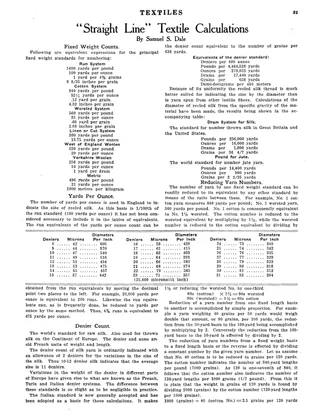
A one-page installment of Samuel S. Dale's series on "straight line" textile calculations. It lists equivalent expressions for the fixed-weight yarn numbering systems (run, cotton, worsted, linen, woolen, metric), and explains yards per ounce, the denier count and dram system for silk, and the jute pound system. It also shows how to convert yarn numbers between systems and includes a table of reeled silk diameters by denier, in microns and diameters per inch.
The Arithmetic of Weaving
Lily Mills, c. 1975
Monograph · 8 pages
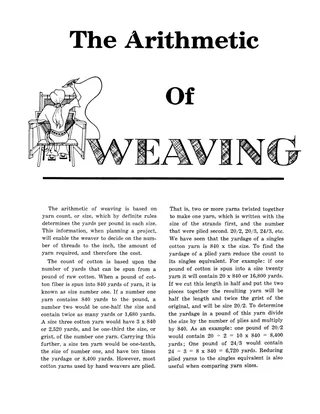
A Lily Mills booklet explaining how to calculate yarn requirements for hand weaving. It covers yarn count systems for cotton, wool, linen, silk and rayon, yardage per pound, plied yarn notation, and worked examples for figuring warp ends, shrinkage allowance, and yarn to order for yardage and place mats and napkins, including an overshot estimate. The second half is a table of yarn count and Lily's Weaving Chart, listing Lily yarns with yards per pound and tube, colors, reed settings, and suggested uses, plus novelty yarns.
Leaves from a Weaver's Notebook
Article · 3 pages
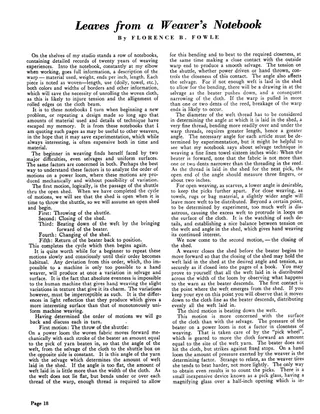
A 1939 article from The Weaver in which Florence B. Fowle draws on her weaving notebooks to advise beginners. She explains the cycle of loom motions (throwing the shuttle, closing the shed, beating, changing the shed, returning the beater) and how each affects selvages and cloth surface. She then works through a yarn-calculation example for a linen luncheon set, covering warp length, shrinkage allowance, warp yardage and filler estimation. A reference table of yarns lists suggested uses, ends per inch and yards per pound.
Metrics for Loom and Warp
Article · 1 page
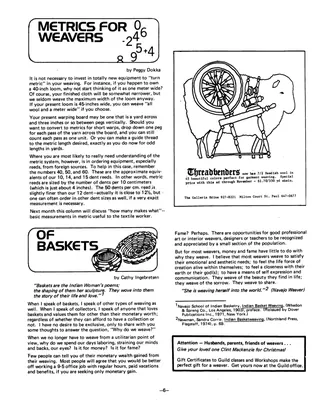
A single page from the Minnesota Weaver (November 1975) with a short column on converting to metric measurements in weaving. It suggests treating a 40-inch loom as one meter wide, adapting a warping board to metric lengths, and ordering metric reeds sized in dents per 10 cm, with rough equivalents to US dent sizes. The page also carries a short essay, 'Of Baskets' by Cathy Ingebretsen, on why people weave, plus guild and shop advertisements.
Sett of Warp for Heavy Yarns
Master Weaver, January 1955
Article · 2 pages
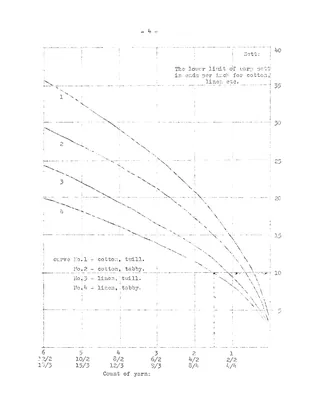
A short article from Master Weaver giving guidance on choosing warp sett (ends per inch) for heavy yarns, supplementing an earlier table for medium counts. It explains how to adjust sett for different weave families such as tabby-based, twill, pattern weaves, warp-face, weft-face and double fabrics, and how to read the accompanying graph with a worked example in No. 1½ linen. A line graph on page 2 plots the lower limit of sett against yarn count for cotton and linen in tabby and twill.
Designing
Textile Mercury, May 28, 1892
Article · 2 pages · weaving drafts
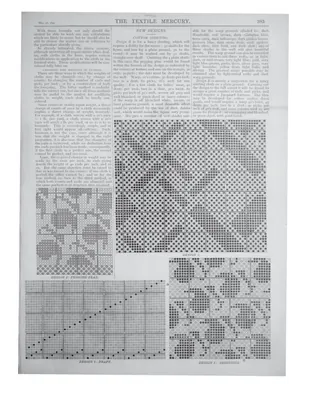
Two pages from The Textile Mercury of 28 May 1892: part XIII of the series "The Analysis of Pattern," on the weights of cloths, plus a "New Designs" section on cotton shirting. The analysis article gives worked examples of calculating yarn weights for fancy fabrics with two materials and for true crammed stripes, a general formula relating counts, width, length, and ends or picks per inch, and the ways of changing cloth weight. The shirting section describes two dobby/Jacquard shirting designs with pegging plan, draft, warp and weft particulars, and suggested weft colours. The first page also opens with dye recipes for various fibres and a short editorial on dyers and rubber proofers.
Designing and Fabric Structure
Article · 2 pages · weaving drafts
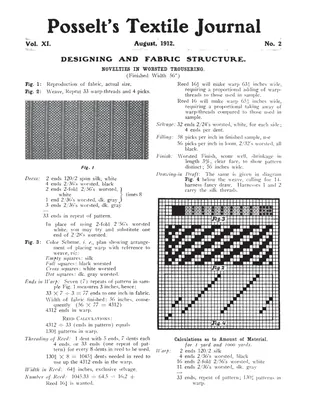
A two-page article from Posselt's Textile Journal (August 1912) that works through the design and costing of a worsted trouserings fabric with spun silk stripes. It gives the warp dress, 33-end repeat, weave and drawing-in diagrams for a 14-harness fancy draw, reed calculations, selvage, filling and finishing details. It then calculates yarn quantities per yard and per 1000 yards, and ends with a method for finding warp length when several yarn counts are mixed, taken from Posselt's Textile Calculations.
Forethought in Figuring
Article · 4 pages · weaving drafts
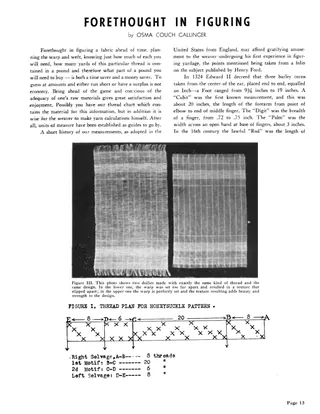
An article from The Weaver (1940) on planning a warp before weaving. It gives a short history of English units of measure and explains how to calculate yards per pound for cotton, wool and linen yarns, and how to work out warp quantity, weft quantity and material cost per yard. It then shows how to build a threading plan for a Honeysuckle pattern, balancing pattern repeats and selvage threads symmetrically, with illustrations of selvage direction.
Master Weaver, No. 28 (July 1956)
Periodical · 13 pages · weaving drafts
Issue No. 28 (July 1956) of Master Weaver, a bi-monthly bulletin for handweavers from Z-Handicrafts in Fulford, Quebec. It gives a formula and tables for working out warp sett from yarn yards per pound and the number of interlacement ties in the weave. It describes double diagonal (DD) twills on 4, 6 and 8 frames, with drafts, treadlings and two practical projects for upholstery and curtains. A drafting lesson explains how to analyze a fabric sample, and an article on compound sleying includes a table of setts for common reed numbers.
Practical Weaving Suggestions, Vol. XXIV (1953): The Arithmetic of Weaving
Periodical · 12 pages · weaving drafts
A reprinted 1953 issue of Lily Mills' Practical Weaving Suggestions (Vol. XXIV, first published 1940). It explains yarn count systems for cotton, wool, linen, silk and rayon, with a worked example of figuring warp and weft yardage and cost for place mats and napkins, plus a table of yarn counts. It also has short helpful hints (pin cushion, paper bobbins, mending broken warp threads, weaving with doubled threads), an article on lace weave (Bronson type) with drafts, tie-ups and treadling, and Lily's weaving chart listing thread sizes, yardage, colors, tabby setting and uses, ending with a Lily yarn advertisement.
Questions and Answers
Article · 1 page
A question-and-answer column by Mary M. Atwater from The Weaver, July 1936. It explains how to calculate yarn quantities from yarn counts (linen cut of 300 yards, cotton and wool hank of 840 yards), with worked examples for warp yardage and advice on estimating weft and allowing for waste. Shorter answers cover applying warp dressing and where to get gauge-bars and knives for knotted pile rugs. The page also carries the concluding paragraphs of an article on a wall hanging woven in a tapestry-like technique on a rosepath threading with a binder.
Straight-Line Textile Calculations. Part 3
Article · 1 page
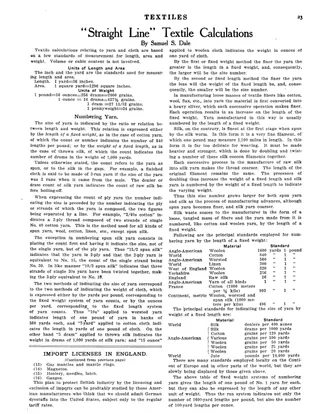
An article from the trade journal Textiles that explains the basic units of length, area and weight used in textile calculations and the systems for numbering yarn. It contrasts fixed-weight systems (cotton, worsted, woolen, linen, with yards per pound) with fixed-length systems (silk deniers and drams, jute). It covers ply notation, including the exception for spun silk, and has tables of the principal yarn-count standards. The page ends with an unrelated item on English import licenses.
A Treatise on Textile Calculations and the Structure of Fabrics
Book · 240 pages · weaving drafts
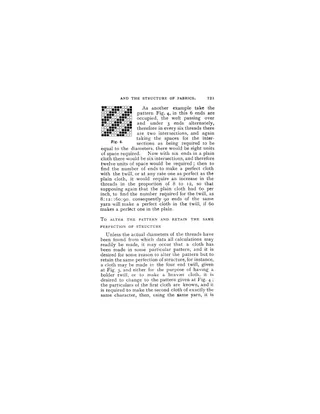
Fifth edition of Ashenhurst's treatise on the arithmetic of textile manufacture and the relationship between yarn size and cloth structure. The first part covers yarn counts in the cotton, worsted, silk, linen and woollen systems, doubling and mixing yarns, twist, sett systems, and calculating the weight and cost of warp, weft and finished fabric, including striped and checked patterns. The second part treats the structure of fabrics: thread diameters, balance of plain and twilled cloths, adjusting ends and picks per inch when changing pattern, counts or weight, with tables of yarn diameters. Appendices on cloth structure add further worked examples and some small twill drawdowns. Advertisements and a design paper price list appear at the front and back.
Yarn
Article · 1 page
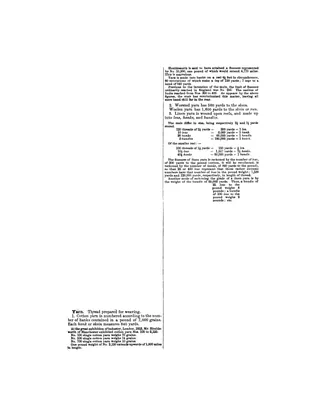
A one-page dictionary entry on yarn that explains how yarn is measured and numbered. It covers the cotton count system (840-yard hanks per pound), with examples from the 1853 London exhibition, and gives the lengths of worsted and woolen skeins. It also gives the reel sizes and the lea, hank, bundle and bunch units for linen yarn, with the lea-based numbering system.
Designing
Textile Mercury, 1892
Article · 2 pages · weaving drafts
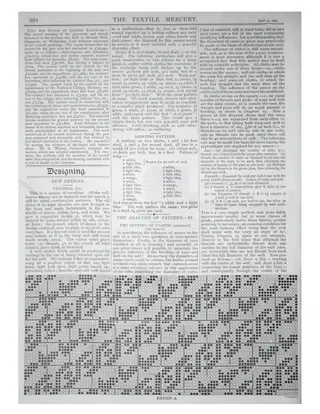
Two pages from The Textile Mercury, April 30, 1892, combining a 'Designing' column with part XI of the series 'The Analysis of Pattern'. The design column gives two new designs for vestings (Design A with a 7-shaft satin ground, Design B on 6 shafts with an 18-end draft and pegging plan) with colour and sett details for a plaid, plus a four-shaft matting shirting pattern. The analysis section, on the setting of cloths, explains how weave affects warp and weft bending and gives rules and worked examples for calculating ends per inch, including twills, plain weave and a French cashmere.
Master Weaver, No. 8 (March 1953)
Periodical · 15 pages · weaving drafts
March 1953 issue (No. 8) of Master Weaver, a bi-monthly bulletin for handweavers published by Z-Handicrafts in Fulford, Quebec. It covers teaching weavers to choose warp yarn and sett (with a graph of minimum sett by yarn count), double-face fabrics woven on one warp with two wefts on twill threadings and tie-ups, and a short note on the terms lash, leash and lease. It also gives construction instructions for a horizontal warping mill that can double as a beaming drum, and a worked example of planning a patterned chenille rug.
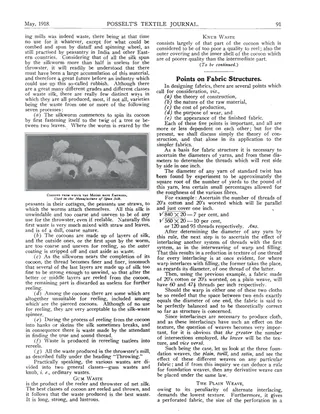
Points on Fabric Structure
Article · 2 pages
Two pages from the May 1918 issue of Posselt's Textile Journal. The main item is an installment of "Points on Fabric Structures," which explains how to calculate the theoretical thread density of a fabric from yarn diameter and the number of interlacings. It compares plain, twill and satin weaves for strength and texture, with worked examples for 20's cotton and worsted. The scan also includes the end of a piece on silk waste and the start of a dyestuff-situation article with a table of dyestuff consumption by silk manufacturers.
Practical Weaving Suggestions, Vol. XX (1952): So You Want to Sell Your Weaving?
Periodical · 8 pages
An issue of Lily Mills' bulletin Practical Weaving Suggestions in which Toni Ford advises handweavers who want to sell their work. It covers choice of looms and warping equipment, the skill needed before selling, quality materials, what to make, how to calculate selling cost and markups, and where to sell. It ends with lists of weavers' bulletins, directories, suppliers and books on craft selling and business.
Calculations in Yarns and Fabrics
Fred Bradbury · 1906
Book · 311 pages · weaving drafts
A 1906 textbook of arithmetic and formulas for the textile trades, written by the head of textile industries at the Belfast Municipal Technical Institute. It covers yarn counting systems (cotton, worsted, woollen, linen lea, silk, jute), resultant and average counts, twist yarns, blending and yarn costing, reed and heald sett systems, warp and weft quantities, and the weight and cost of woven fabrics. Later chapters treat fabric analysis and reproduction, conditioning and moisture allowances, and the theory of fabric construction (thread diameters, balance of structure, angle of curvature, compression). Worked examples and exercises with answers close each chapter, and a few threading and draft diagrams illustrate the heald calculations.
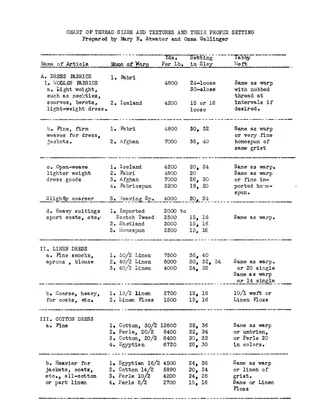
Chart of Thread Sizes and Textures and Their Proper Setting
Monograph · 10 pages
A tabular chart giving recommended warp yarns, yardage per pound, sley (reed) settings, tabby weft and suitable pattern wefts and threadings for hand-woven articles. It covers dress fabrics (wool, linen, cotton), belts, handbags, bed coverings, blankets, upholstery, draperies, rugs and table linens. Facing pages list the recommended weave structures for each use, and a closing note explains how to read the chart and why settings vary with yarn twist.
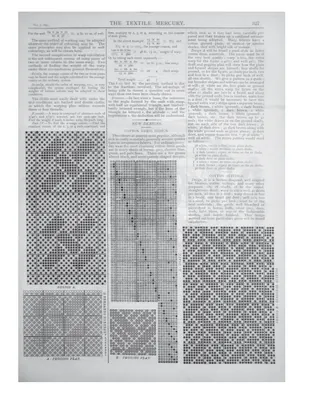
Designing
Textile Mercury, May 7, 1892
Article · 2 pages · weaving drafts
Two pages from The Textile Mercury, 7 May 1892, containing part XII of the series "The Analysis of Pattern", on calculating the weights of cloth. It gives worked rules for the weight of warp and weft, of each colour in a striped warp, and of warps mixing yarn counts via average counts. A "New Designs" section describes a cotton dress design (Design A) and a broken-diagonal cotton suiting (Design B), with drafts and pegging plans for dobby looms. The first page also carries the end of an item on Massachusetts versus Southern US cotton mill competition, hours and wages.
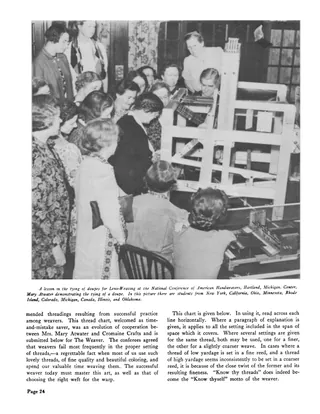
Know Thy Threads
Article · 6 pages
Article by Osma Couch Gallinger describing the National Conference of American Handweavers held at Waldenwoods, Hartland, Michigan, run by Cromaine Crafts and supervised by Mary M. Atwater. It covers the conference's aims for shop, school and home weavers, and highlights teaching "weaving as drawn in" and thread analysis. Most of the article is a chart by Atwater and Gallinger giving warp yarns, yards per pound, sley settings, tabby and pattern wefts, and recommended threadings for dress fabrics, accessories, bed coverings, upholstery, drapery, rugs and table linens.
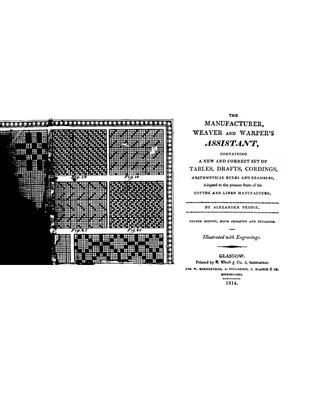
The Manufacturer, Weaver, and Warper's Assistant
Book · 145 pages · weaving drafts
A fourth-edition (1814) Glasgow handbook by Alexander Peddie for cotton and linen manufacturers, weavers and warpers. Most of the book is numbered tables for heddle (camb) weights, yarn quantities per web, warp lengths, starch quantities, eveners for beaming, reed and camb settings, weaving prices in Perth, and list prices of cotton twist yarn. Arithmetical rules with worked examples explain calculating warps and reeds. The final section gives about 44 numbered drafts and cordings (tie-ups and treadling) for cord, spot, nett, flushing, gauze, crape and velveteen cloths, plus pressure harness.
Textile Mathematics, Part 2
Book · 64 pages
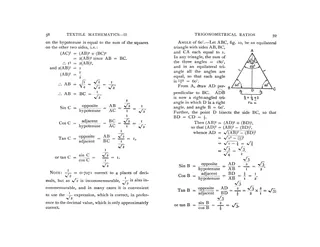
A 1921 textbook of mathematics for textile students, Part II of a two-part work by Thomas Woodhouse and Alexander Brand. It covers ratio, proportion and variation, averages, percentages, loss and regain (moisture conditioning), mixtures and costs, indices and logarithms, trigonometrical ratios, and yarn counts for cotton, linen, jute, woollen and worsted systems. Worked examples use mill problems such as pulley speeds, dressing mixtures, yarn blends and twist contraction. The book ends with exercises with answers, a section of useful data (gear formulae, weights and measures, mensuration rules) and logarithm and trigonometric tables.
Yarn Counts and Calculations
Book · 124 pages
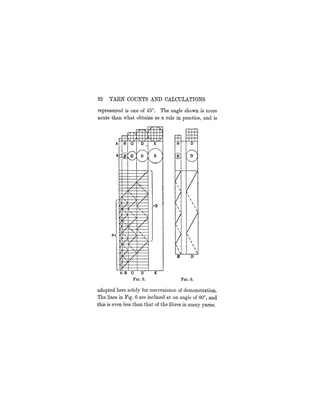
A 1921 technical manual on yarn counts and the arithmetic of yarn calculation, written by a Dundee Technical College textile instructor. It explains twenty-two systems of counting raw silk, spun silk, artificial silk, cotton, woollen, worsted, linen, hemp and jute yarns, and shows how to convert counts between fixed-weight and fixed-length systems, with conversion tables. Later chapters cover the resulting count of multiple-ply and twisted yarns with and without shrinkage, the pricing of twisted yarns and fibre mixtures, turns per inch, and the angle of twist, mostly through worked formulas and examples. It includes an index and has no weaving drafts.
Master Weaver, No. 21 (May 1955)
Periodical · 14 pages · weaving drafts
Issue No. 21 (May 1955) of Master Weaver, a bulletin for handweavers published by Z-Handicrafts in Fulford, Quebec. It contains an essay arguing for the metric yarn count (meters per gram), with conversion formulas for cotton, linen, wool and silk, and an article on silk covering history, properties, reeling and throwing, and a table of silk counts. A practical guide to weaving fine silk follows, covering winding, warping, beaming, threading, reed choice, loom adjustment, weaving problems and boiling off the gum. The issue ends with a lesson on short drafts and profiles for unit weaves (Summer and Winter, Bronson lace, huck lace) and an advertisement for individual weaving lessons.
Warps and Wefts
Article · 3 pages · weaving drafts
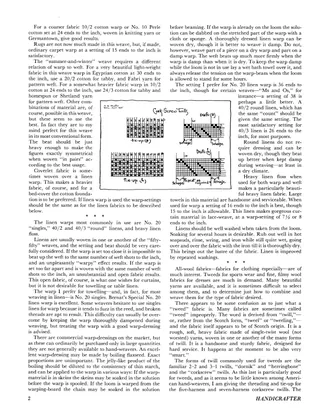
Mary Meigs Atwater discusses how to plan fabric texture through choice of warp and weft yarns, warp setting in the reed, and beat. She classifies fabrics as weft-face, warp-face, or balanced "fifty-fifty", then gives rule-of-thumb settings for coverlet (overshot) and summer-and-winter weaves in cotton, for linen warps, and for all-wool fabrics. She includes threading and tie-up drafts for five- and seven-harness corkscrew twills for tweeds, plus advice on warp dressing, dampening, tension, and finishing.
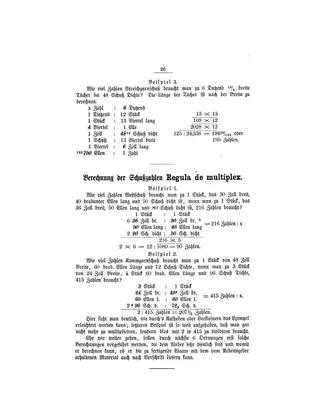
Die Deutsche Webschule: Die Theorie, Technik und Praxis. Volume 1 (text) [The German Weaving School: The Theory, Technique and Practice. Volume 1 (text)]
Book · 323 pages · German · weaving drafts
A German-language handbook of weaving theory, technique and practice for manufacturers and weavers, second edition, from the weaving school at Hohenstein near Chemnitz. The first part covers cloth calculation in detail (warp and weft counts, thread density, reed and pattern repeats, colour stripes, uneven density) and then warping, beaming, drawing-in, sizing, weft preparation and loom construction (frame, warp beam, batten, shuttles, heddles, shedding mechanisms). Later sections treat binding structures (plain weave, twills, satins, compound and figured weaves), treadle tie-ups, the Jacquard machine and harness tie-ups, and special fabrics such as rib, hollow cloth, velvet, plush, chenille and quilted bedcovers. It is illustrated with lithographed plates, and the preface says it contains 964 weave structures and patterns.
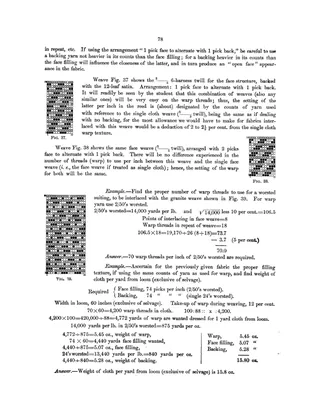
Textile Calculations
Book · 171 pages · weaving drafts
A textile mill reference by E. A. Posselt that teaches the calculations used in yarn, warp, filling and cloth manufacture. It covers yarn counts in the cotton, woolen (run and cut), worsted and silk systems, ply and mixed yarns, reed, warp and filling calculations, and the cost of materials for sample fabrics such as cassimere, worsted suiting, beaver overcoating and ingrain carpet. Later sections cover choosing the proper cloth texture for different weaves (twills, satins, ribs, backed cloths, double cloth), analysis of fibres and fabrics with microscope illustrations, cotton spinning tables, speed, belting and power, and a primer on arithmetic for textile work. Advertisements for textile machinery makers appear at the front and back.

Beer
Article · 1 page
A very short dictionary-style entry from the first edition of the Encyclopedia Britannica defining 'beer' as a weaver's term. It describes a beer as nineteen warp ends running together the full length of the cloth. The entry gives only this definition, with no drafts or further explanation.
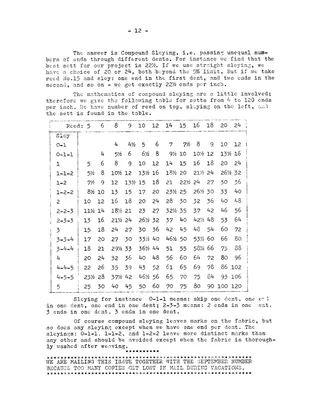
Compound Sleying
Master Weaver, July 1956
Article · 2 pages
A short article on choosing and adjusting warp sett by sleying the reed with unequal numbers of ends per dent (compound sleying). It explains how much a sett can be varied from a calculated value, then gives a table of ends per inch for reeds No. 5 to 24 combined with sleying patterns such as 1-2, 1-1-2 and 0-1-1. It warns that some patterns leave more visible marks in the cloth unless it is washed.
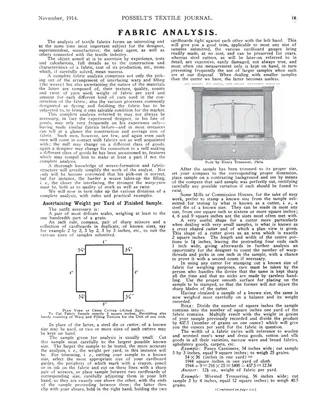
Fabric Analysis
Article · 1 page
A single-page installment of E. A. Posselt's series on fabric analysis, introducing what a complete analysis of a textile involves: weave, materials, texture, yarn counts and twist, weight per yard, and dyeing and finishing. It then explains how to find a fabric's weight per yard. The method is to trim a sample to a known size with cardboard guides, a compass or a steel cutter, including a cross-shaped cutter that gives 2 square inches, and then to weigh it on a delicate balance. Worked examples convert grains to ounces per yard. The text ends with a note that it continues on page xii.
Garments - Measurements
Article · 1 page
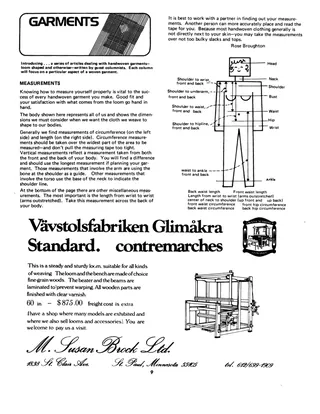
A one-page introduction to a new series on handwoven garments by guest columnists, with the first column on taking body measurements. Rose Broughton explains how to measure circumference and length for planning loom-shaped and other handwoven clothing, with a labeled diagram of a standing figure. She advises measuring over the widest part, using the longest of the front and back vertical measurements, and working with a partner.
532 documents found