Textile Documents › Topic: Soumak and weft twining
59 documents found
Sort: 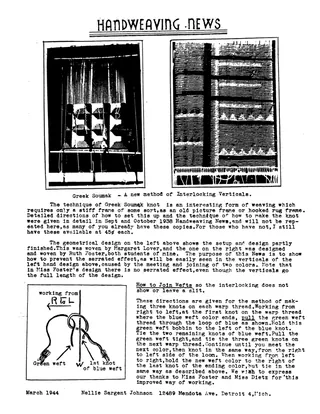
Handweaving News (March 1944): Greek Soumak -- A New Method of Interlocking Verticals
Periodical · 2 pages · weaving drafts
A two-page issue of Handweaving News (March 1944) by Nellie Sargent Johnson on the Greek soumak knot worked on a simple frame. It explains how to join wefts of different colors so that the interlocking does not leave a serrated edge or slit in vertical color boundaries, with directions for three knots per warp thread, worked right to left and left to right. Page 2 gives the chart for a student's wall hanging abstracting bare tree branches, mountains and sailboats, with color suggestions.
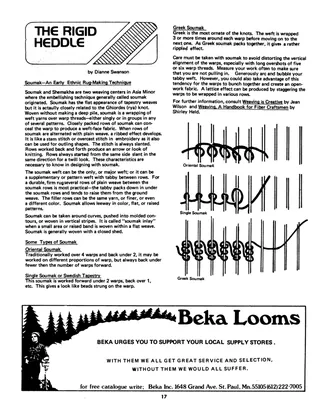
Soumak - An Early Ethnic Rug-Making Technique
Article · 1 page
A one-page article on soumak, a wrapping technique in which weft yarn is wound over warp threads to give a flat, tapestry-like or weft-face surface, often used for rugs. It explains the stitch's slant, its use as a main or supplementary weft with tabby, and describes three types: Oriental, Single (Swedish tapestry) and Greek soumak, illustrated with diagrams. It also gives tips on avoiding warp distortion and cites two weaving handbooks for further reading.
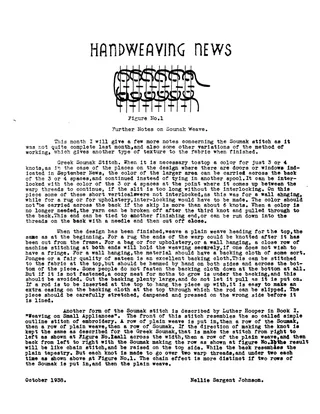
Handweaving News (October 1938): Further Notes on Soumak Weave
Periodical · 3 pages
A three-page article from Handweaving News, October 1938, continuing Nellie Sargent Johnson's instructions on the Soumak stitch. It covers finishing and backing Greek Soumak pieces, a variant after Luther Hooper with plain weave between knot rows, and a Scandinavian Soumak worked on single warp threads with the design inked on the warp. It gives yarn suggestions for rugs, bags and wall hangings, with three line figures including a bag design with color regions.
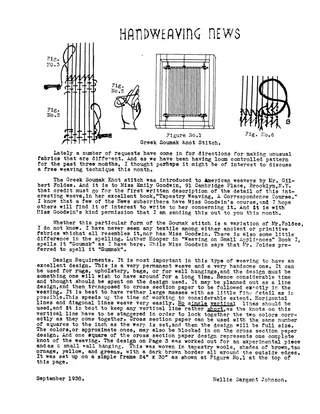
Handweaving News (September 1938): Greek Soumak Knot Stitch
Periodical · 3 pages
A three-page instruction sheet from Handweaving News (September 1938) on the Greek Soumak knot stitch, a free weaving technique worked on a simple frame. It covers design planning on cross-section paper, materials (cotton cord warp, Germantown or tapestry wool weft), making a continuous warp with pegs and dowel rods, weaving a plain-weave heading, and working the knots row by row, including interlocking colors at short verticals. Diagrams illustrate the frame, warping board, bobbin winding and knot steps, and a graph-paper design for a small wall hanging is included.
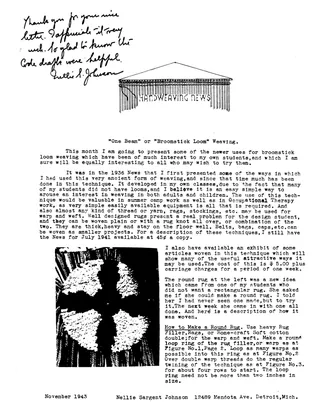
Handweaving News (November 1943): "One Beam" or "Broomstick Loom" Weaving
Periodical · 3 pages
A November 1943 issue of Handweaving News in which Nellie Sargent Johnson describes new uses of "broomstick loom" (one-beam) twining. It gives instructions for making a round rug on a loop ring, with rows of rug knots, added warps and a bound edge. It also covers twining variations for belts and bags: separated warps, twisted single warps, and crossed single and double warps. Line drawings (Figures 1-8) illustrate the steps, and the issue closes with subscription notes and a remark on weaving for rehabilitation of returning soldiers.
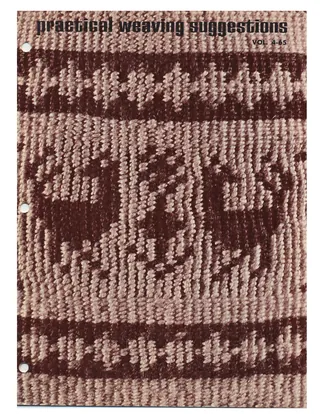
Practical Weaving Suggestions, Vol. 4-65 (1965): Twining
Periodical · 12 pages · weaving drafts
A 1965 issue of Practical Weaving Suggestions (Lily Mills) giving instructions for twined bags made on a simple upright frame loom. It covers warping, half-twist and full-twist twining, finishing, fringes and handles, and gives four bag projects (Bag for Beginners, Jute-tone Bag, Grey and Coral Bag, Bird Bag) with yarn lists, row-by-row directions and pattern graphs. It ends with a section on two crocheted handbags, a shopping bag and a white wired handbag.
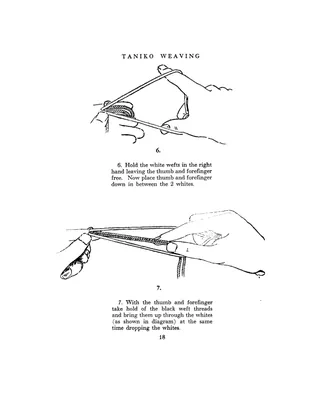
Taniko Weaving
Monograph · 45 pages · weaving drafts
A 1952 instructional handbook by S. M. Mead on taniko, the Maori technique of finger-twined weaving used for decorative borders on cloaks, kilts and belts. It gives step-by-step illustrated instructions for making a sampler: preparing warps and wefts, casting on, twisting the wefts to weave the design, and casting off, plus alternative casting-on and casting-off methods. It also provides graphed patterns with Maori names, instructions for making and lining a taniko belt with leather, and suggestions for other items such as headbands, purses and table mats.
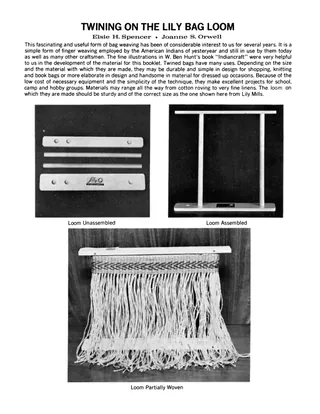
Twining on the Lily Bag Loom
Monograph · 8 pages · weaving drafts
A Lily Mills booklet on making twined bags on the Lily bag loom, a simple finger-weaving technique like that used by American Indians. It covers suitable warp and weft yarns, warping the frame with lark's head knots, making butterflies, half and full twists, color patterning, and finishing with fringes and handles. Project instructions are given for the Bag for Beginners, Jute-Tone Bag, Beige and Coral Bag, and Bird Bag, with a pattern chart for the bird motif and photographs of finished bags.
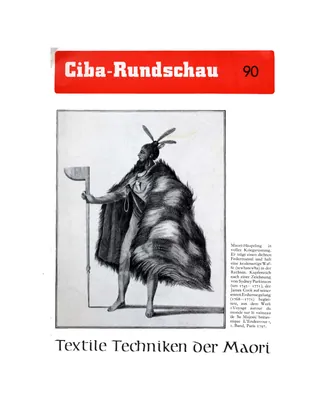
Textile Techniken der Maori [Textile Techniques of the Maori]
Ciba Review #90, April 1950
Monograph · 36 pages · German
Issue 90 (April 1950) of Ciba-Rundschau, the German-language edition, devoted to the textile techniques of the Maori of New Zealand. Dr. Walter G. Fischel covers the discovery and settlement of New Zealand, Maori culture, clothing (flax and feather cloaks, dog-hair cloaks, rain capes, belts and skirts), plaiting and twining techniques, the taniko border technique, and dyeing methods using bark and mud mordants. The text is illustrated with engravings, photographs and schematic diagrams of twining and taniko, and ends with a bibliography. The issue closes with Ciba company sections on dyes and finishing (a resin catalyst, camaieu effects on natural silk, new dyestuffs) and advertisements.
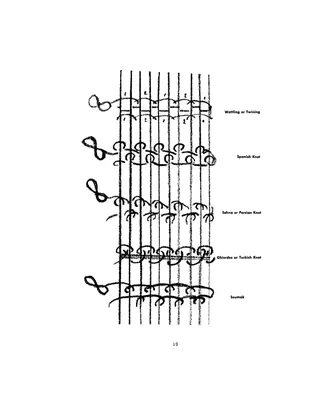
Rug Techniques
Monograph · 17 pages
A short handweaving folder by Maria Mundal describing rug and decorative-fabric techniques, written for inexperienced weavers. It gives brief verbal instructions for wattling/twining, soumak, Sehna (Persian), Ghiordes (Turkish) and Spanish knots, rya, floss, tufting (Canadian loop), kelim, aakled, rølakan and rag rugs. One page of line drawings shows the warp-thread paths of several of the knots and stitches. Includes notes on historical origins, Scandinavian use, yarns and finishing.
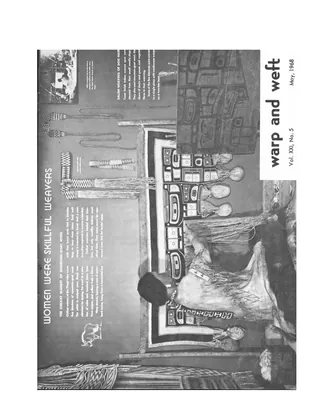
Warp & Weft, Vol. 21, No. 5 (May 1968)
May 1968
Periodical · 8 pages · weaving drafts
May 1968 issue of the monthly Warp & Weft from Robin & Russ Handweavers of McMinnville, Oregon. It features an account of Chilkat blanket weaving (mountain-goat wool, cedar-bark warp, pattern boards, dyes) drawn from a Portland Handweavers program by Mrs. Doris Kyber-Gruber, plus a short note on Coast Salish dog-hair weaving. The monthly sample is "Checkerboard," a 4-shaft upholstery fabric in ramie and English rug wool, with threading, tie-up, treadling, yarn details and costs. The issue also has an editor's letter, a notice of a Michigan weavers' conference, and classified ads and supply listings.
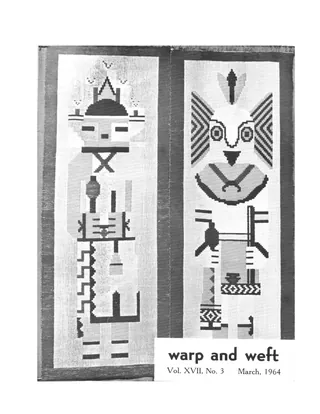
Warp & Weft, Vol. 17, No. 4 (April 1964)
April 1964
Periodical · 8 pages · weaving drafts
March 1964 issue of Warp and Weft, a monthly handweaving bulletin from Robin & Russ Handweavers of McMinnville, Oregon. It features a four-harness M's and O's draft for heavy linen place-mats, with warp, weft, reed, treadling and cost details. The issue also has an editor's column, a cover note on soumak wall hangings, reviews of Adventures in Stitches and Decorative Wall Hangings, announcements of two California handweaving conferences, and classified and display ads for yarns and looms.
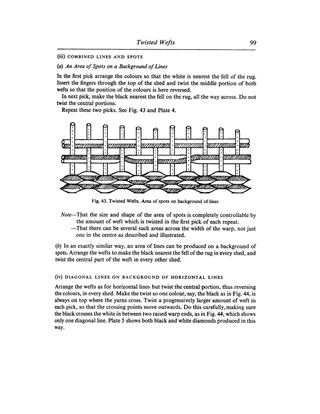
The Techniques of Rug Weaving
Book · 578 pages · weaving drafts
A comprehensive handbook on handweaving rugs by Peter Collingwood. It covers looms and equipment, yarns, and general techniques such as warping, beaming, joining wefts and finishing. Techniques for weft-face rugs include plain weave patterning, tapestry and kilim joins, soumak, weft chaining and looping, and knotted and corduroy pile. The longest sections cover multishaft weft-face weaves: twills, skip twills, shadow weave, block weaves on four to eight shafts, double-faced weaves, and pick-up versions. Later chapters treat warp-face rugs, weft twining, and rug finishes such as woven, knotted and twined edges and weft protectors. It has many weave diagrams, line figures, numbered plates, an index and a list of suppliers.
Weaver, Vol. 1, No. 3 (July 1936)
Weaver, July 1936
Periodical · 30 pages · weaving drafts
Issue of the American handweaving magazine The Weaver (Vol. 1, No. 3, July 1936) with instructional articles. Contents include knotted "Swedish" and Summak tapestry weaving on a frame, ten miniature overshot-style patterns with drafts, tablet-woven rugs, handwoven linen towels, a simplified loom tie-up for eight-harness looms, a four-harness pictorial wall hanging, a crackle-weave chair upholstery, Mexican Indian belt designs, and Mary M. Atwater's directions for simple leno ("cross") weaving with doupe harnesses. Many pages carry drafts, diagrams and photographs, and the back page has a Bernat yarns advertisement.
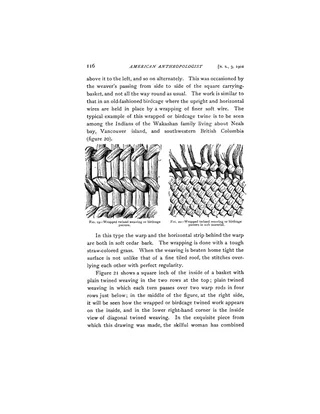
Technic of Aboriginal American Basketry
Article · 20 pages
Otis T. Mason's 1901 article classifies the technical methods of Native American basketry into woven (plicated) and coiled types. Woven types covered are checkerwork, diagonal or twilled work, wickerwork, and twined work, the last with plain, diagonal, wrapped (birdcage), lattice (tee), and three-ply varieties. Coiled types are classed by foundation: single-rod, two-rod, rod and welt, three-rod, splint (including the imbricated Klikitat style), and grass or shred. Forty numbered figures illustrate the structures, with examples from the Pomo, Hopi, Tlingit, Aleut, Nez Percé, Thompson River and other peoples. Decoration is explicitly left for a later paper.
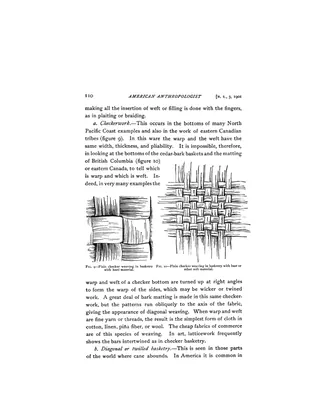
Technic of Aboriginal American Basketry
Article · 20 pages
Otis T. Mason's 1901 article classifies Native American basketry by technique. It covers woven basketry (checkerwork, diagonal or twilled, wickerwork, and several forms of twined weaving, including plain, diagonal, wrapped, lattice or tee, and three-ply) and coiled basketry (single-rod, two-rod, rod and welt, three-rod, splint, and grass or shred foundations, plus the imbricated Klikitat technique). Forty line drawings and photographic figures illustrate the structures, with examples from the Pomo, Hopi, Tlingit, Aleut, Nez Percé, Thompson River, and other peoples. Ornamentation and geographic distribution are deferred to a later paper.
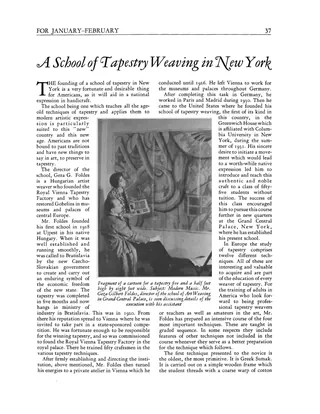
A School of Tapestry Weaving in New York
Handicrafter, January-February 1932
Article · 2 pages
Article describing the school of tapestry weaving founded in New York by Hungarian artist weaver Geza G. Foldes, first at Greenwich House in 1931 and then at the Grand Central Palace. It outlines Foldes's career in Hungary, Czechoslovakia, Vienna, Germany, Paris and Madrid, and his four-technique course taught in graded sequence: Greek Sumak, Swedish, a modified Khilim, and French. Two photographs show a tapestry cartoon and a class at work.
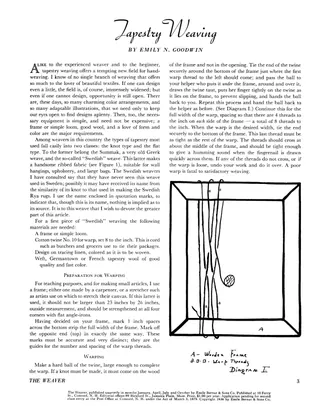
Tapestry Weaving
Article · 4 pages
An instructional article by Emily N. Goodwin introducing hand tapestry weaving on a simple frame, concentrating on the knotted "Swedish" weave. It covers materials, warping a frame with cotton twine, making knots in both directions, transferring a design onto the warp with waterproof ink, building color masses, and interlocking wefts to avoid slits. It also covers stretching and finishing, and briefly mentions the Summak knot weave; flat tapestry methods are promised for a later article.
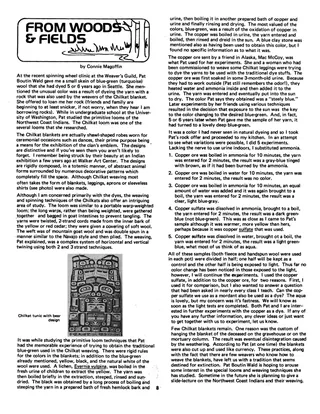
Chilkat loom and dyes
Article · 2 pages
Connie Magoffin's column describes the Chilkat blanket and its loom, a warp-weighted style loom using twining with cedar bark and mountain goat wool. It focuses on the traditional dyes: yellow from lichen, black from hemlock bark and copper, and blue-green from copper oxidized in urine. She reports five kitchen experiments with copper ore and copper sulfate in ammonia or water, and ends with a bibliography. The second page carries travel notes: a visit to a silk importer in Myrtle Creek, Oregon, and announcements of weaving tours and workshops in Norway and Sweden.
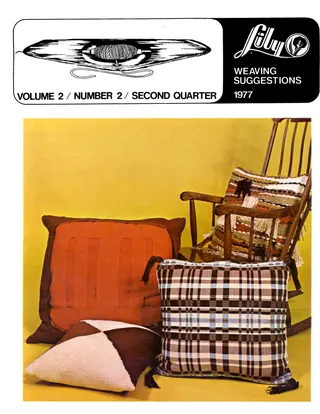
Lily Weaving Suggestions, Vol. 2, No. 2 (1977)
Lily Weaving Suggestions, 1977
Periodical · 8 pages · weaving drafts
Issue of Lily Weaving Suggestions (Belding Lily Company) devoted to handwoven pillows, with four projects by different weavers. They are a diagonal-fold pillow woven as a single strip on carpet warp, a textured floor pillow built up with mixed yarns, soumak and rya, a three-layer floor pillow in pearl cotton and jute, and a Monk's Belt pillow with color-coordinated warp stripes. Each gives yarn article numbers, sett, warp and weft directions, and sewing and finishing instructions; the Monk's Belt project includes a four-shaft tie-up and treadling for sinking and rising sheds.
Textile Fabrics of the New England Indians
Article · 10 pages
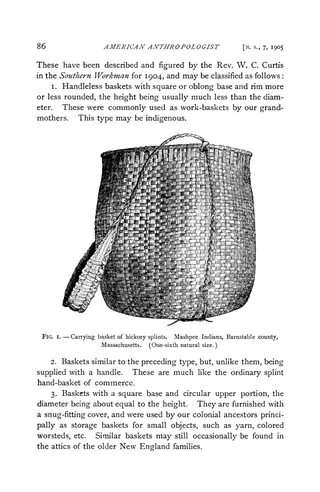
A 1905 article by Charles C. Willoughby surveying the textile arts of the New England Indians, drawing on early colonial accounts and museum specimens. It covers splint basketry (including Mashpee pack-baskets), baskets and bags of rush, maize husk and hemp, wigwam mats, twined robes, and turkey-feather mantles. It closes with a detailed description of a twined Indian-hemp wallet embroidered with moose hair (false embroidery), made by Mollocket of Maine about 1778-1785, with a technical diagram of the weave.
Expressions in Fiber: The Art of Eleanor Merrill
Other · 38 pages
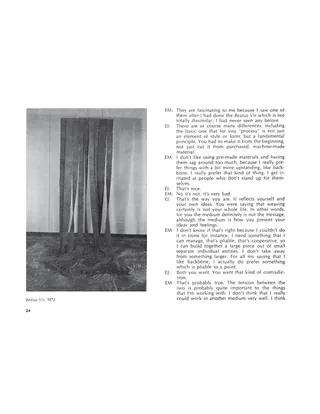
Catalogue of a 1975 exhibition of fiber art by Eleanor Merrill at the Allen Memorial Art Museum, Oberlin College. It includes a foreword on the art versus craft debate, a long interview between curator Ellen H. Johnson and the artist, a biographical chronology, and a catalogue of seven illustrated works. The interview covers her choice of wool breeds, rope, jute, sisal and manila, scavenged materials, large looms, twining, and the landscape, biblical, and family themes in her weavings. Black-and-white photographs show the works, sketchbook pages, and the artist.

Lily Weaving Suggestions, Vol. 2, No. 3 (1977)
Lily Weaving Suggestions, 1977
Periodical · 8 pages · weaving drafts
Issue of a Lily (Belding Lily Company) weaving bulletin devoted to woven floor pillows, with project instructions by weavers of the Contemporary Handweavers of Houston. It gives materials lists, threadings, tie-ups, treadlings and finishing directions for a child's floor pillow and a playroom pillow in bound weave on opposites, a two-layer double-section pillow with picked-up Greek-style loops and soumak, and a chenille floor pillow in tabby with skulato loops.
Handwoven Rugs
Monograph · 33 pages · weaving drafts
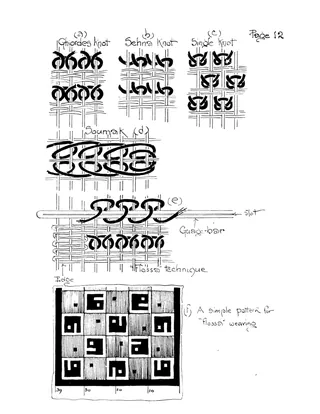
A 1948 monograph by Mary Meigs Atwater, reissued by HTH Publishers, giving concise directions for weaving rugs by hand. It covers equipment and materials, plain-weave rag and chenille rugs, Swedish twice-woven and matta techniques, picked-up tufting, knotted pile (Ghiordes, Sehna, flossa, rya), soumak, overshot, no-tabby and Indian saddle-blanket weaves, crackle, summer-and-winter, and the two-warp technique with pick-up patterns. It ends with fringe ties and closing advice. Pages are hand-lettered and illustrated with many diagrams, drafts, and pattern grids.
Minnesota Weaver, Vol. 3, No. 1 (September 1977)
Minnesota Weaver, September 1977
Periodical · 20 pages
September 1977 issue of the Weavers Guild of Minnesota's newsletter. It covers the 1977-78 guild program calendar, board meeting summaries, profiles of new officers, a Spotlight on coiled-basket maker Marilyn Herrmann, and school news. Feature articles include the first of Sue Baizerman's series "Telas de los Muertos" on ancient Peruvian textiles in the Science Museum of Minnesota, with a section on knotted weft wrapping and openwork. Also included are a Rigid Heddle column on soumak, a report on the Midwest Weavers Conference, a guilds column on a Long Island spinning group, a dye plant record sheet, a loom reed ordering advertisement, and classifieds.
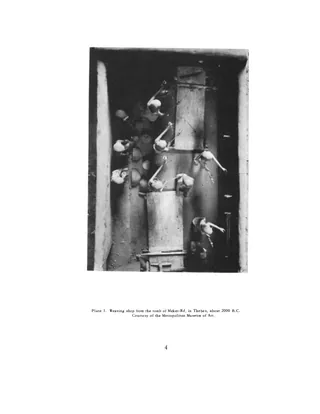
Textiles from Gordion
Article · 30 pages · weaving drafts
Article by Louisa Bellinger on the fabric fragments excavated from Phrygian grave mounds at Gordion, Turkey (8th century B.C.) by the University of Pennsylvania Museum. It first reviews the behavior of linen, hemp, cotton and wool fibers, S and Z spinning traditions, Egyptian and Greek looms, and warp preparation, then classifies the Gordion finds: bronze-studded leather, felted wool blankets, linen and hemp wrapping cloths, mohair and wool tabbys with headings from warp-weighted loom set-ups, linen tape, a pile fabric, weft-float patterns with sumak borders, and slit tapestry. Eighteen plates show Egyptian weaving scenes, excavation photos, photomicrographs, set-up charts and pattern drawings.
Hudson Collection of Basketry
Article · 8 pages
Otis T. Mason describes the Hudson collection of Pomo basketry from the Russian River region of California, acquired by the U.S. National Museum in 1899. He tabulates the plants, minerals and animal materials used, with scientific and Pomo names, and explains their preparation, colors and trade values in shell and magnetite money. He then classifies the baskets into twined and coiled types, giving Pomo names and technical descriptions of each. He closes with notes on ornamentation, including feather-work and the symbolic meaning of patterns.
Hudson Collection of Basketry
Article · 8 pages
Otis T. Mason describes the Hudson collection of Pomo basketry from the Russian River region of California, acquired by the U.S. National Museum in 1899 from Dr. J. W. Hudson. The article lists the plants, minerals, and animal materials used, with Pomo names and the parts used. It then classifies the baskets into twined and coiled weaving types, with Pomo terms for each. It closes with notes on ornamentation, feather and shell decoration, and the meanings of patterns.
Of Baskets - A Simple Wicker Basket
Article · 7 pages
A beginner's how-to article on making a round wicker basket from round reed, from the Minnesota Weaver series 'Of Baskets'. It opens with a short history of basketry and wicker, then lists tools and materials, explains how to prepare the reed, and gives six illustrated construction steps. It also covers adding weavers, shaping bowl and dish forms, variations (double weavers, twining, twill, other fibers and natural materials), two border finishes, finishing, and how to figure spoke length. A bibliography of books on American Indian basketry and a short reading list are included.
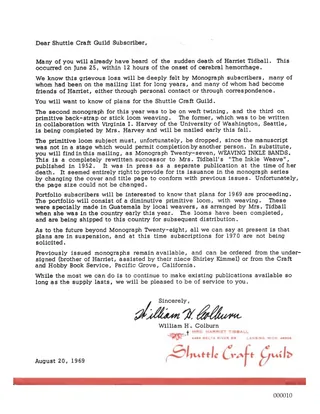
Form letter notifying membership of Harriet Tidball's death
Shuttle Craft Guild, August 20, 1969
Ephemera · 1 page
A form letter dated August 20, 1969, from William H. Colburn, brother of Harriet Tidball, informing Shuttle Craft Guild subscribers that she died suddenly on June 25 of a cerebral hemorrhage. It describes the fate of the planned monographs: the weft twining monograph will be completed by Virginia I. Harvey, the primitive loom monograph is dropped, and Monograph Twenty-seven, Weaving Inkle Bands, is issued as a rewrite of The Inkle Weave (1952). It also covers the 1969 portfolio of a small Guatemalan primitive loom, the suspension of 1970 subscriptions, and how to order back monographs.
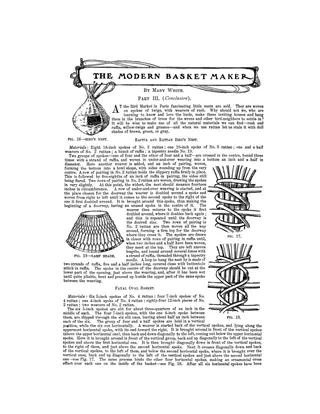
Modern Basket Maker -- III
Article · 3 pages
The concluding part of Mary White's three-part series on basketry for amateurs, published in Everybody's Magazine in 1902. It gives materials lists and step-by-step directions for a raffia-and-rattan bird's nest, an oval Fayal basket, a raffia lamp shade and a raffia rattle. It also includes recipes for dyeing rattan with vegetable dyes (fustic, logwood, indigo) and a terra-cotta stain, and explains the Indian twining stitch and spoke arrangement, with figures courtesy of Prof. Otis T. Mason.
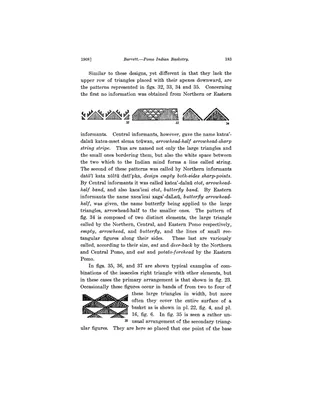
Pomo Indian Basketry
Article · 177 pages
S. A. Barrett's 1908 monograph (University of California Publications in American Archaeology and Ethnology, vol. 7 no. 3) on the basketry of the Pomo Indians of northern California. It covers materials (willow and hazel foundations, sedge root and other fibers, feathers, beads, shell), twining and coiling techniques, starting knots, border finishes, wickerwork, and basket forms. Most of the work analyzes ornamentation: design arrangement, elemental designs (triangles, rectangles, rhomboids, zigzags, diamonds, quail plumes) and combined patterns, with names recorded in the Northern, Central and Eastern Pomo dialects. It ends with lists of elemental and pattern names, a glossary of Pomo terms, many line figures and photographic plates of baskets.
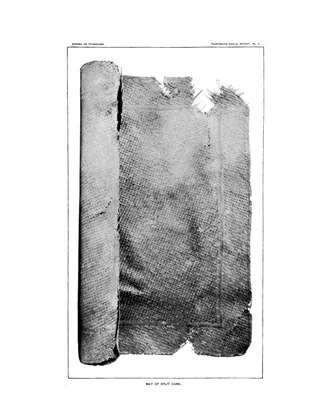
Prehistoric Textile Art of the Eastern United States
Monograph · 50 pages
William Henry Holmes's study of the textile arts of the prehistoric mound-building peoples of the eastern United States, from the Thirteenth Annual Report of the Bureau of Ethnology. It covers wattle work, basketry, matting, and pliable fabrics (cloth, nets, feather-work, embroidery), drawing on early European accounts and on archaeological remains. Surviving fabrics come from caves and shelters, charred mound deposits, contact with copper, and impressions on pottery. It is illustrated with plates and figures, including drawings that analyze twined and woven structures; it contains no weaving drafts.
Basket-Maker Caves of Northeastern Arizona
Samuel James Guernsey; Alfred Vincent Kidder · Peabody Museum of American Archaeology and Ethnology, 1921
Book · 172 pages
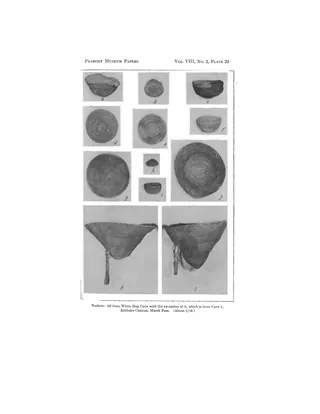
Report on the 1916-17 Peabody Museum explorations of Basket-Maker burial and storage caves near Kayenta, northeastern Arizona, including Sunflower, Goat and White Dog Caves and caves in Sayodneechee and Sagiotsosi Canyons. It describes the sites, cists, burials and mummies, then catalogs the material culture: dress and ornaments, cradles, baskets, twined-woven bags, cloth, fur-string robes, netting, cordage, atlatls, stone and wooden tools, and ceremonial objects. Many plates and diagrams show twining structures and weft patterns. It closes with conclusions on the Basket-makers' culture and their relation to the later Cliff-dwellers.
"Prehistoric Textile Art of Eastern United States" in Bureau of Ethnology, Smithsonian Institution
Monograph · 50 pages
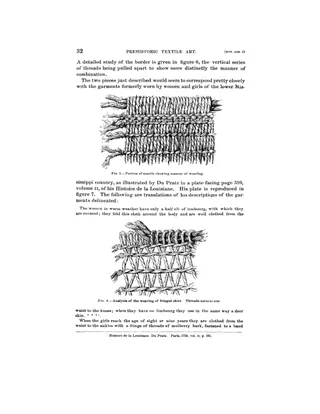
William Henry Holmes's study of prehistoric textile art in the mound region of the eastern United States, from the Thirteenth Annual Report of the Bureau of Ethnology. It surveys wattle work, basketry, matting, and pliable fabrics (cloths, nets, feather work, embroidery), drawing on early European accounts and archeological finds. Much of the evidence comes from cave and shelter burials, charred cloth from mounds, fabrics preserved by contact with copper, and fabric impressions on pottery, with discussion of twined and diagonal weaving. Nine plates and 28 figures illustrate specimens, early engravings, and restored fabric structures.
Popular Rug Techniques
Monograph · 19 pages · weaving drafts
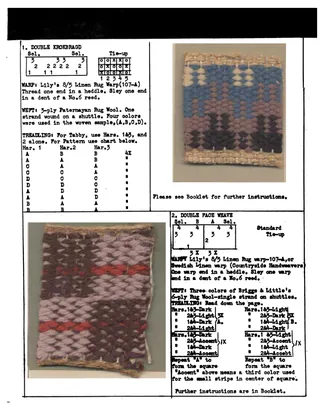
A self-published folio booklet by Elmer Wallace Hickman describing twelve handwoven rug techniques, with a companion technique sheet and sample-sheet specifications for each. Techniques covered include Double Krokbragd, Double Face Weave, Rollakan and Aklae, a modern cotton/rayon rug, Soumak, Imitation Tapestry (clasped weft), False Flossa, Flossa, Rya, Rya with Korndrall ground, Stuffer weave and Indian Saddle Blanket weave. It gives warp and weft yarns and suppliers, sett, treadling, tie-ups, knot-tying and selvage methods, and loom modifications such as an added Stuffer warp beam.
Rug Weaving Techniques: Beyond the Basics
Book · 161 pages · weaving drafts
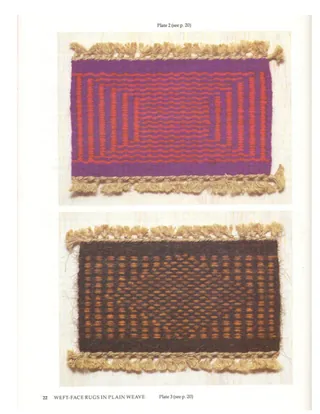
Peter Collingwood's book on handwoven rug techniques beyond basic plain weave, organized by structure. It covers weft-face rugs in plain weave (pick-and-pick stripes, crossed and clasped wefts, compensated inlay, weaving inscriptions), weft-face rugs in multishaft weaves (krokbragd, 2/2 twill, skip twills), and block weaves including three-end and four-end block drafts with pick-up and shaft-switching methods. Later chapters treat warp-face weaves, weft twining, rug finishes (braids, whipping) and workshop notes on loom features and equipment. Illustrated with many plates, diagrams and weaving drafts.
Der Echte Teppich: Praktische Anleitung zur Heimerzeugung von Teppichen in allen Knüpf- und Webetechniken [The Genuine Carpet: Practical Instructions for the Home Production of Carpets in All Knotting and Weaving Techniques]
Book · 167 pages · German · weaving drafts
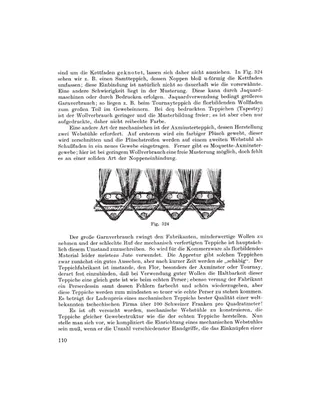
A 1926 German-language handbook by Leo Arthur on making carpets at home, covering knotted pile rugs (Giordes/Smyrna and Senné/Persian knots), flat-woven kilim and sumak, combined woven and knotted rugs, metal-thread rugs, and tapestry (Gobelin) weaving. It explains warping frames, making heddles, weaving, shearing and finishing, and gives construction plans for looms and knotting frames. Later chapters cover rug washing, care and repair, commercial rug types, home dyeing with recipe tables, pattern design and stencilling, and judging rug value. It is illustrated with 355 figures and a color plate of dye samples.
Weaver's Journal, Vol. VI, No. 4 Issue 24 (Spring 1982)
Weaver's Journal, Spring 1982
Periodical · 68 pages · weaving drafts
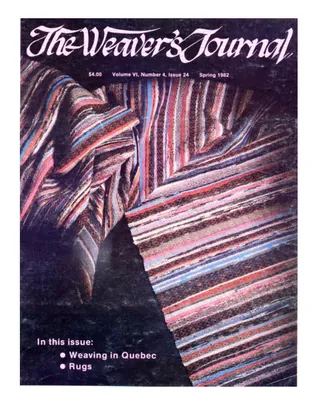
Spring 1982 issue of The Weaver's Journal (Vol. VI, No. 4, Issue 24) with a rug theme and a long feature on weaving in Quebec by Clotilde Barrett, covering traditional Quebecois techniques (catalogne, point boutonné, travail à la planche, ceinture fléchée) and contemporary garments and home textiles. Rug articles cover an all-white overshot rug, a rag-strip rug, a chenille twice-woven rug, rag rugs with overlapping weft ends, a soumak saddle blanket, a six-end block draft for rugs and a rug techniques overview. Other articles cover card weaving on four shafts, a Guatemalan brocade border, a melon basket, double woven house boots, an inkle tool kit, spice dyeing, 2-tie four-end block drafts (Summer and Winter), and Peruvian slings. The issue also has book reviews, letters, coming events and many advertisements.
Basket Making
Article · 27 pages
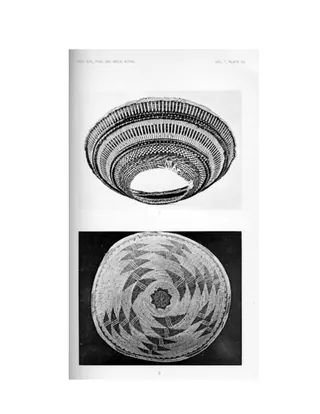
Excerpt from Goddard's ethnography of the Hupa of northern California, describing women's basket making. It covers the gathering and preparation of hazel and willow ribs, conifer and deciduous tree roots, bear-grass, maidenhair fern and giant fern, and the dyes used (alder bark, lichen, Oregon grape). It describes the twined construction of the baskets and the forms made: burden baskets, cradles, cooking baskets, storage baskets, acorn pans and women's caps. The text explains the geometric design elements and their Hupa names, with line figures and plates of baskets and materials. A short passage on dentalium shell money follows at the end.
Certain Rare West-Coast Baskets
Article · 30 pages
An 1912 ethnological article describing five rare Northwest Coast and lower Columbia River baskets in the collections of the Academy of Natural Sciences of Philadelphia. It covers a Tlingit covered rattle-lid basket, a Tlingit embroidered hat, a Tlingit berrying basket, a fine grass cup, and a basket wallet with woven masks and animal figures. The author details construction (two-strand twining, false embroidery or overlay twining, wrapped twining, tee/lattice twining, selvage and border finishes), designs and their native names, and discusses tribal attribution and the raven-tail pattern. Illustrated with plates and line drawings of designs and borders.
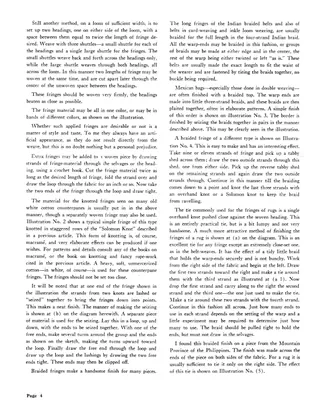
The Finish of Edges
Article · 4 pages
Mary Atwater's article on finishing the edges of woven pieces, mostly with fringes. It covers deciding whether to fringe, finishing in the loom with Spanish open-work weaving, and weaving separate applied fringes on an inkle or harness loom. It also describes knotted macramé (Solomon knot) fringes, seizing, braided fringes and tops, a braided rug-fringe tie from the Philippines, and three Maori twined finishes. Diagrams and five photographs illustrate the methods.
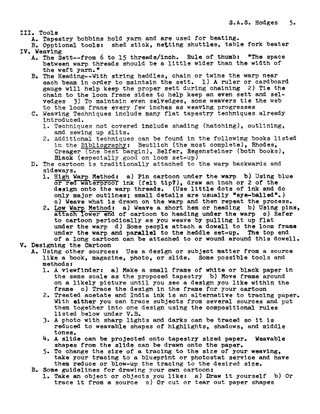
3 Approaches to Tapestry Design
Monograph · 6 pages
A six-page outline handout by Susan S. Hodges presenting three approaches to designing tapestry: designing directly on the loom with improvised frames, designing row by row using graph paper and rug-style techniques, and designing off the loom with a cartoon. It covers loom and yarn choices, warping a picture frame loom, headings, joining techniques for color areas, laid-in (brocade) methods, and composition guidelines. It ends with a bibliography of weaving books and related Shuttle, Spindle & Dyepot articles.
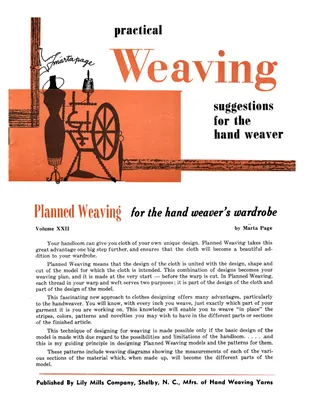
Practical Weaving Suggestions, Vol. XXII: Planned Weaving for the Handweaver's Wardrobe
Periodical · 8 pages
An issue of Lily Mills Company's "Practical Weaving Suggestions" (Volume XXII) presenting Märta Page's "Planned Weaving" approach, in which the cloth design is combined with the garment pattern before the warp is cut. It features the Fledermaus-Shortie jacket and the Pelican Bag, with material designed by Kay Geary, plus Geary's color and yarn suggestions for four versions of the jacket (travel, vacation, evening, streetwear). Yarn lists give Lily Mills articles, colors and amounts for the jacket and both bags. The issue contains no weaving drafts, only photographs and illustrations; the jacket is woven in tabby and twill treadling, with Persian rug-knot tassels and soumak stitches.
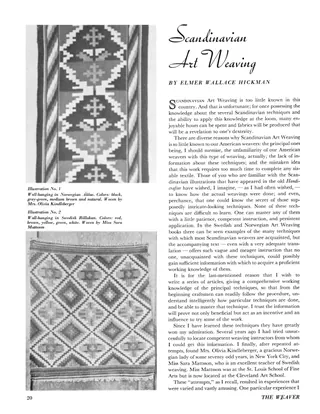
Scandinavian Art Weaving
Article · 6 pages
Introductory article by Elmer Wallace Hickman, the first in a planned series, urging American weavers to learn Scandinavian art weaving techniques. He recounts how he found Norwegian and Swedish teachers, comments on the Swedish Hemslöjd (home craft) movement, and catalogs about twelve principal techniques, including Äklae/Röllakan, Dukegång, Krabba, Flossa, Rya, Upphämpta, Flamskvävnad and Finnweave. Illustrated with photographs of wall-hangings and rugs woven by the author and his teachers, and ending with a list of Scandinavian reference books.
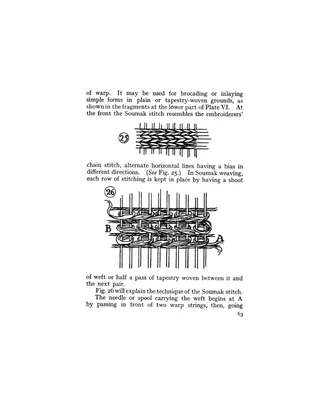
Weaving with Small Appliances, Book I: The Weaving Board
Book · 93 pages · weaving drafts
A 1922 instruction book by Luther Hooper on weaving with a simple board loom, intended for students and class teaching. It covers building and warping the loom, winding appliances, making leashes (heddles), plain tabby weaving, ornamental bands, brocading or inlay, tapestry weaving, Egyptian and Coptic mixed weaving, and Kelim, Soumak and knotted pile carpet effects. It ends with an upright tapestry table loom. It is illustrated with line figures, colored plates of woven samples, and design charts, and includes an index and publisher's advertisements.
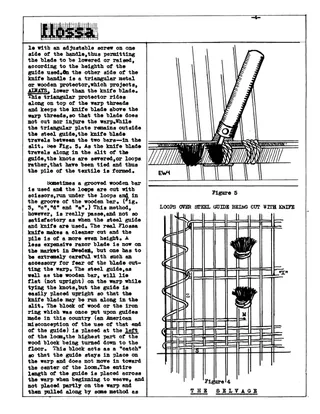
Scandinavian Art Weaving
Monograph · 97 pages · weaving drafts
A set of instructional weaving packets by Elmer W. Hickman (Homecraft Weaving Service, Emlenton, Pennsylvania) on Scandinavian art weaving, the 'laid-in' bobbin techniques woven on a loom. It covers bobbin winding, Monk's Belt, Krokbragd, Rosengang (Rosepath) with Swedish pine tree designs, Flossa, Rya and Sniljeflossa pile weaves, Arrow and Lightning weave, Aklae, Dukagang and Krabbasnar/Half-Krabba. Each section gives warp and weft yarn recommendations, threading, sleying and treadling directions, figures of techniques and tools, and many drafts and charted designs. Sample cards, supply sources and the author's commentary ('Tabby Talk') are included.
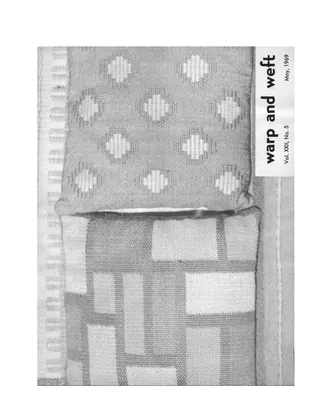
Warp & Weft, Vol. 22, No. 5 (May 1969)
Warp & Weft, May 1969
Periodical · 8 pages · weaving drafts
May 1969 issue of Warp & Weft, the monthly newsletter of Robin & Russ Handweavers in McMinnville, Oregon. It includes the editor's column about an upcoming trip to Switzerland and Northern Italy to look for silks, a cover photograph note on pillows from the St. Louis Weavers Guild display, and a long review of Peter Collingwood's The Techniques of Rug Weaving. The sample article, "Tempting, Touchable Tussah," gives a 4-shaft threading draft, tie-up, special reed sleying, treadling and weaving advice for a textured silk fabric using slubby tussah and douppioni silk. The issue closes with classified ads and marketplace ads for yarns, looms, books and equipment.
The Bulletin of the Needle and Bobbin Club, Vol. 46, Nos. 1 & 2 (1962)
Periodical · 46 pages · weaving drafts
Double issue (vol. 46, nos. 1 & 2, 1962) of the Bulletin of the Needle and Bobbin Club. The main article, by Louisa Bellinger, analyzes textile fragments excavated from Phrygian grave mounds at Gordion, Turkey: fibers (wool, goat hair/mohair, linen, hemp), spinning direction, felt, tabby weaves, loom headings, slit tapestry, weft-float patterns, sumak edges and basting. It is illustrated with many plates and charts. Marianne A. Huebner's lecture recounts the history of her antique textile collection and the Frankfurt firm through two wars, with the collection's loss and eventual recovery. The issue closes with Club Notes, an In Memoriam and a list of officers.
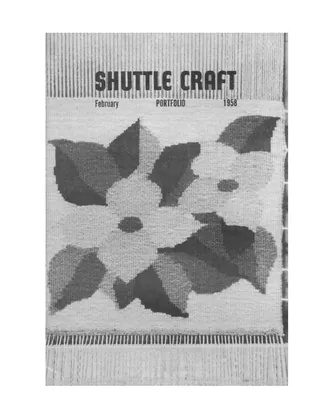
Shuttle-Craft Bulletin (February 1958)
Periodical · 39 pages · weaving drafts
February 1958 Portfolio Edition of Shuttle Craft, the monthly bulletin of the Shuttle Craft Guild, issued from Bedford, Nova Scotia by Mary E. Black and Joyce Chown. It includes a step-by-step illustrated guide to the French "Swedish Knot" technique on a frame loom, an essay on variables in weaving, Boris Veren's book column, and Harriet Tidball's article on Summer and Winter sequence weaves for color textures, with drafts, profiles and treadlings. It also contains Mary Atwater's Peruvian leno, a Loom Language column, a tapestry history, and advertisements.
59 documents found