Textile Documents › Topic: Museums, collections, and conservation
552 documents found
Sort: 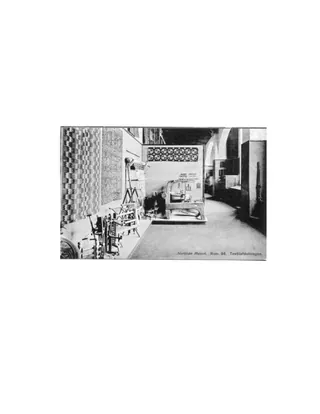
Nordiska Museet. Rum 84. Textilavdelningen. [Nordic Museum. Room 84. Textile Department.]
Ephemera · 1 page · Swedish
A single picture postcard issued by the Nordiska Museet (Nordic Museum, Stockholm) showing a historical black-and-white photograph of Room 84, the textile department. Textile samples with wavy and patterned designs are displayed hanging in the room. The only printed text is the caption identifying the museum, room and department.
[Collection of Laces]
Article · 1 page
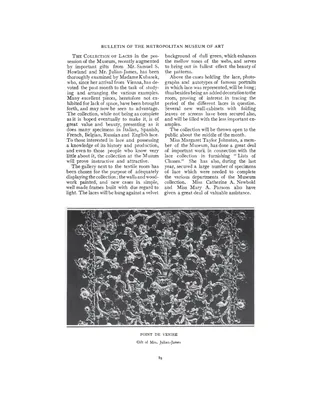
A short museum bulletin notice reporting that the Metropolitan Museum of Art's lace collection, newly enlarged by gifts from Samuel S. Howland and Julian-James, has been examined and arranged by Madame Kubasek of Vienna. It describes the new display gallery next to the textile room, with green velvet backgrounds, new cases and wall-cabinets, and photographs of portraits showing lace. It credits volunteers who helped, and includes a plate of a Point de Venise lace gift.
The Lace Room
Article · 3 pages
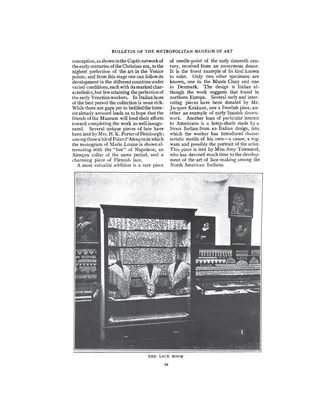
A short 1906 museum bulletin notice describing the reinstallation of the Astor and Stuart Collections of Laces in Gallery 33 of the Metropolitan Museum of Art. It names the loans and gifts added, including Point d'Alençon, a rare early sixteenth-century needle-point, Swedish and Spanish pieces, and a Sioux-made lace lamp-shade. It credits Frau Kubasek with arranging the laces and Miss Margaret Taylor Johnston with the classification. It includes one photograph of the gallery.
Notes on Textile Conservation - Storage and Display
Article · 2 pages
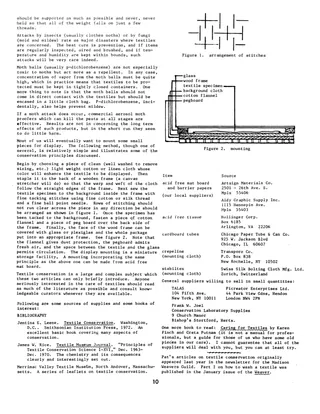
Part II of a two-part introduction to textile conservation for amateur weavers and collectors, covering storage and display. It groups environmental stresses (heat, humidity, dust, light, handling, contact with containers, insects and fungi) and gives practical precautions such as recommended temperature and humidity, avoiding UV light, rolling or padding folds, and moth control. It describes a simple method for mounting small specimens in a frame with two diagrams, and ends with a bibliography and a list of conservation suppliers.
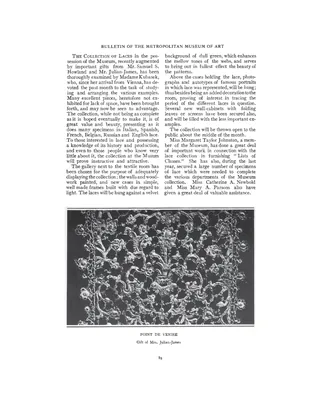
Principal Accessions
Article · 1 page
A short 1907 notice from the Bulletin of the Metropolitan Museum of Art on the museum's lace collection, enlarged by gifts from Samuel S. Howland and Julian-James. Madame Kubasek, newly arrived from Vienna, has examined and arranged the pieces, which will be shown in the gallery next to the textile room against green velvet, with photographs of portraits showing lace hung above. The notice credits several volunteers and includes a photograph of a Point de Venise lace given by Mrs. Julian-James.
February Program- Textile Preservation
Article · 1 page
Report on a February 1979 guild program in which Lotus Stack, textile coordinator at the Minneapolis Institute of Arts, spoke on textile preservation for contemporary weavers. It covers destructive factors (fiber stress, temperature and humidity, light and heat, chemical contamination), choice of warp and materials, mounting methods for rugs and tapestries, and packing, shipping and storage. The page also has a short report on a guild yarn workshop with Joy Rosner and Charlotte Haglund, plus a wool-n-shop advertisement.
Dramatic History of a Well-Known Collection
Article · 9 pages
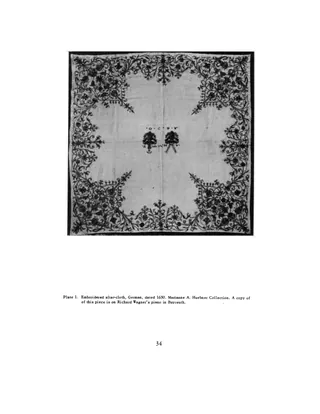
Text of a lecture given by Marianne A. Huebner to the Needle and Bobbin Club in December 1961, recounting the history of her collection of antique textiles. It begins with her aunt's Frankfurt firm R. Riesser, which served royal, church and wealthy clients and built a collection of antique textiles, including Coptic pieces from the Bock collection. It then follows the collection through two World Wars, inflation, Nazi rule, Huebner's emigration to the U.S. in 1939, and the wartime concealment of the collection in eastern Germany. Her recovery of the collection in New York in 1960 is described. The article has one plate of a German embroidered altar-cloth dated 1630.
Notes on Textile Conservation
Article · 2 pages
A practical guide for amateur conservators on deciding whether and how to wash an old textile. It covers vacuuming and brushing, a simple dye wash-fastness test, wet versus dry cleaning, the types of detergent (anionic, nonionic, cationic), supporting fragile pieces in nylon net, and the washing bath, rinsing and drying steps. The scan also includes a word-search puzzle on looms and a review of the monograph Sling Braiding of the Andes.
Notes on the Lace Collection
Article · 6 pages
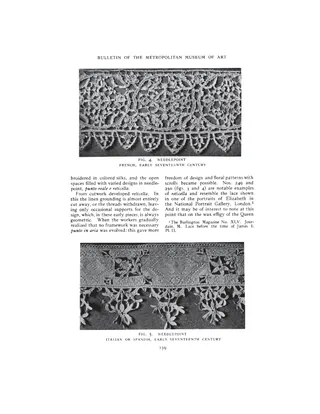
A 1900s Metropolitan Museum of Art Bulletin article surveying the museum's lace collection, its history of gifts (McCallum, Astor and others), and its notable pieces. It discusses lacis, cutwork, reticella, punto in aria, Venetian flat, rose and gros points, tape and bobbin laces, and Flemish, Binche and Alençon examples, and traces how pattern books and ruff fashions shaped lace. Seven figures illustrate selected pieces, and footnotes cite Palliser, Errera and other sources.
Notes on the Lace Collection of the Cincinnati Museum
Article · 7 pages
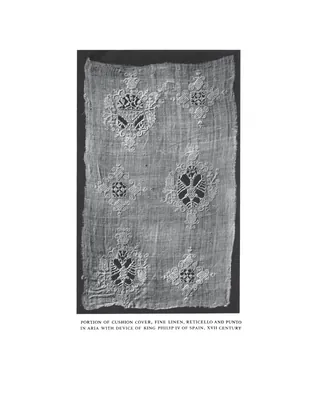
A short article from the Bulletin of the Needle and Bobbin Club describing the lace and embroidery collection of the Cincinnati Museum, acquired in 1883 through the Women's Art Museum Association. It traces the collection's origin with the French collector Mme. Fulgence and its purchase via Sir Philip Cunliffe Owen of the South Kensington Museum. It then gives a country-by-country list of the 425 pieces (Italy, France, Belgium, Holland, Spain) by type: lacis, needlepoint, bobbin, reticella and embroidery. Photographs show Italian and Spanish cushion covers with reticello, punto in aria and cutwork, and an Italian sampler.
Old Sturbridge Village
Handweaver and Craftsman, April 1950
Article · 3 pages
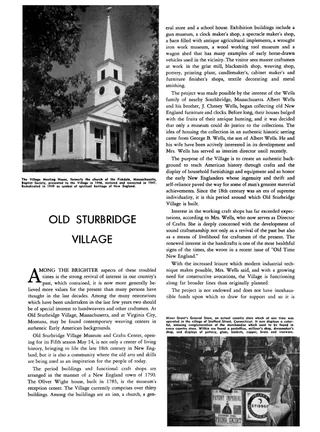
A 1950 article describing Old Sturbridge Village, a living-history museum and crafts center in Massachusetts arranged as a New England town of about 1790. It covers the Village's history and the Wells family who founded it, its craft shops (including the weaving shop), and the effort to make each shop self-supporting. The weaving section describes the two full-time weavers, the products made (luncheon sets, mats, drapery, upholstery, rugs, blankets, apparel fabrics), and a twill drapery fabric, with photographs of the weave shop, place mats and upholstery fabric.
"Ornament" and the Sources of Design in the Decorative Arts
Article · 7 pages
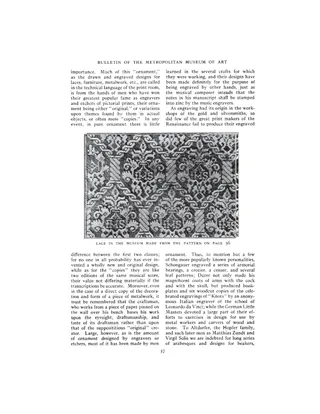
A 1918 Metropolitan Museum of Art Bulletin article arguing that craftsmen since the invention of printing have drawn their designs mainly from engraved and printed 'ornament' (pattern books and prints) rather than from existing objects. It surveys engravers and pattern-book designers from the Renaissance to the Empire style and urges museums to collect prints, drawings and book decoration. Lace appears as one example, illustrated with a 1546 Pagani pattern and lace made from it in the Museum, alongside illustrations of cups and a Cellini sketch.
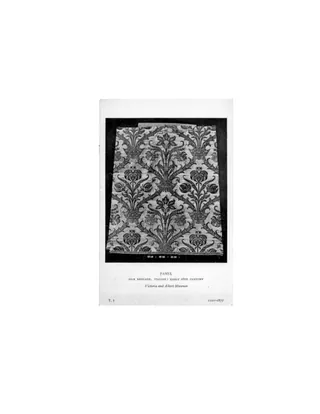
Picture postcard
Brocade, c. 1500-1525
Ephemera · 1 page
A picture postcard showing a photograph of a silk brocade panel with a repeating design of stylized flowers, foliage and tulip-like motifs in dark and light tones on a pale ground. The caption identifies it as Italian, early 16th century, in the Victoria and Albert Museum (inventory T. 8-1211-1877).
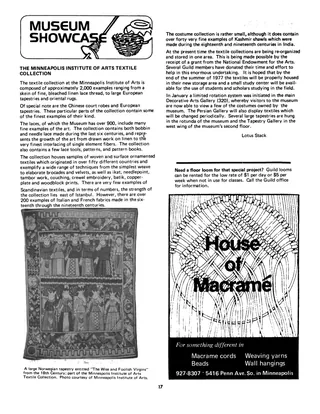
Norwegian Tapestry (photo)
Minnesota Weaver, April 1977
Article · 1 page
A one-page "Museum Showcase" piece by Lotus Stack describing the textile collection of the Minneapolis Institute of Arts. It outlines the roughly 2,000 holdings, including Chinese court robes, European tapestries, over 900 laces, Kashmir shawls and Italian and French fabrics, and reports on a grant-funded reorganization and storage project and new gallery displays. A photograph shows an 18th-century Norwegian tapestry, "The Wise and Foolish Virgins."
Supplemental Descriptive Catalog of Specimens of Lace Acquired for the South Kensington Museum Between June 1890 and June 1895
Monograph · 48 pages
A museum catalogue of lace and related needlework specimens acquired by the South Kensington Museum between June 1890 and June 1895. Entries are arranged by country (Italian, Belgian, Flemish, French, Spanish, English and Irish, Brazilian, Russian) and then alphabetically by object type, such as borders, flounces, lappets, cuffs, cloths and altar frontals. Each entry describes the technique, pattern, date, dimensions, acquisition (purchase price, gift or Bolckow Bequest) and register number. A table of reference at the end links register numbers to pages.
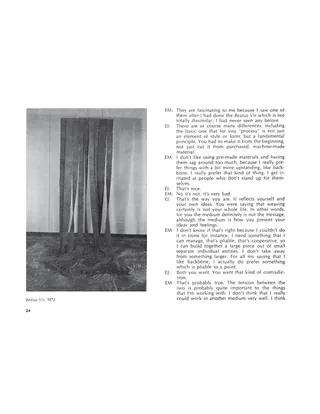
Expressions in Fiber: The Art of Eleanor Merrill
Other · 38 pages
Catalogue of a 1975 exhibition of fiber art by Eleanor Merrill at the Allen Memorial Art Museum, Oberlin College. It includes a foreword on the art versus craft debate, a long interview between curator Ellen H. Johnson and the artist, a biographical chronology, and a catalogue of seven illustrated works. The interview covers her choice of wool breeds, rope, jute, sisal and manila, scavenged materials, large looms, twining, and the landscape, biblical, and family themes in her weavings. Black-and-white photographs show the works, sketchbook pages, and the artist.
Richelieu Collection of Samples
Article · 13 pages
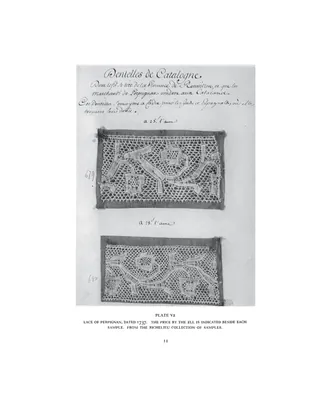
Article by Gertrude Whiting describing the Richelieu collection of textile samples (1732-1737) in the Bibliothèque Nationale, Paris, seven volumes of annotated samples of silks, cottons, linens, woolens, ribbons, gauzes and laces. It is illustrated with plates of ribbons, royal table linen of 1736, woven materials, gauzes, and Perpignan lace of 1737 with price notes. It includes a free translation of part of Richelieu's preface on the lace industry of Havre, covering prices, export to the Americas, and women's bobbin-lace wages.
Textilsammlung Iklé. Katalog [Iklé Textile Collection: Catalog]
Book · 288 pages · German
Illustrated 1908 catalog of the Iklé textile collection held by the Industrie- und Gewerbemuseum St. Gallen, written in German. It lists about 1,400 numbered items with short descriptions of origin, date, technique and materials, covering lace (needle, bobbin, filet, reticella, Venetian relief), drawn-thread and white-work, silk and linen embroideries, ecclesiastical vestments and paraments, and some Chinese silks. Much of the book consists of photographic plates of individual pieces, with a foreword and introduction at the start.
The Bulletin of the Needle and Bobbin Club, Vol. 49 (c. 1965-1966)
The Bulletin of the Needle and Bobbin Club, c. 1965-1966
Periodical · 65 pages
Golden Anniversary issue of the Bulletin of the Needle and Bobbin Club, volume 49 (1965-66), marking fifty years since the New York club was founded in 1916 to promote interest in lace and other handmade fabrics. It includes a history of the Club, portraits of past presidents, Marian Powys's reminiscence "Happy Days Remembered," and Club Notes with the list of officers. Most of the issue is a photographic catalog of textiles from members' collections (embroidery, lace, tapestry, samplers, silks, quilts, costume pieces, from Coptic to 19th century), with captions giving owner, technique, date, dimensions and provenance. A shorter section shows textiles made by members, including tapestry weaving and Honiton bobbin lace.
Looking at the Crafts
Article · 3 pages
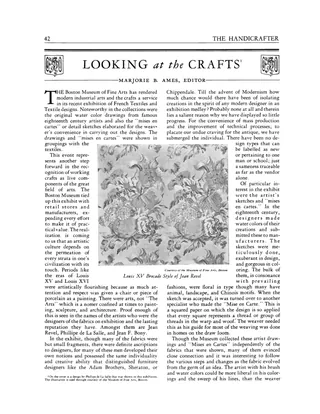
A column from The Handicrafter (January/February 1930) edited by Marjorie B. Ames. It reviews the Boston Museum of Fine Arts exhibition of French 18th-century textiles, designers' watercolors and "mises en cartes" (squared-paper weaving guides for draw looms), and describes the new Craftsmen's Guild studio shop in Boston. It also announces a new course in tapestry and Oriental rug weaving at the Master Institute of Roerich Museum, New York, taught by Mme. Verita de Bertalan. The scan ends with a page carrying the continuation of a marionette-making article and advertisements.
The Bulletin of the Needle and Bobbin Club, Vol. 58, Nos. 1 & 2 (1975)
Periodical · 65 pages
Double issue (Vol. 58, Nos. 1 & 2, 1975) of the Bulletin of the Needle and Bobbin Club. It features Robert de Micheaux's French-language account of the Musée Historique des Tissus in Lyon, covering its history, its Hôtel Villeroy home, and collections of Coptic, Persian, Italian, Spanish, English and French textiles, embroidered vestments, carpets and Lyon silks. L. P. Van der Wee writes on Tibetan appliqué tanka in European collections, with illustrations of individual hangings. The issue also has Notes from Abroad, book notes (embroidery, needlepoint patterns, Cape Breton handweaving, American coverlets), club notes, an In Memoriam, and advertisements.
The Copp Family Textiles
Book · 73 pages
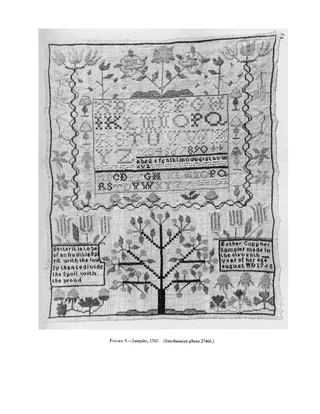
A Smithsonian Studies in History and Technology catalog (Number 7) of household textiles used by the Copp family of Stonington, Connecticut, between about 1750 and 1850 and given to the U.S. National Museum in the 1890s. It describes quilts, embroidered counterpanes, bed hangings, sheets, ticking, table linens, towels, fringes and tapes, overshot and Monk's belt coverlets, a reversible rug, and imported printed fabrics, with thread counts, fibers, twist, dimensions and dating. A closing chapter surveys eighteenth-century textile manufacture in America, and appendices cover cleaning and mounting methods for exhibition, with a bibliography. Illustrated with numerous photographs and historical engravings.
Alte Textilien [Old Textiles]
Other · 52 pages · German · weaving drafts
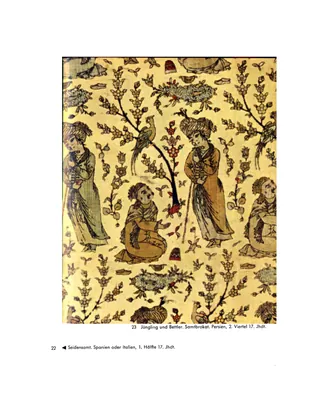
A German-language picture booklet from the Badisches Landesmuseum Karlsruhe presenting a selection of historic textiles from its collections. After a foreword and an introductory essay on weaving and tapestry technique, materials and dyes, it reproduces 32 black-and-white plates: late antique Egyptian tapestry weaves, Italian silk brocades and velvets, medieval and Renaissance embroideries, needle lace, Persian and Asian pieces, Brussels tapestry, French damask and a printed textile. Descriptive catalog entries give technique, materials, thread counts, pattern repeat sizes, origin and date for each plate, and a glossary explains terms such as Doppeldurchbruch, Kettenstich and Lasurstich.
Catalogue of the Collections in the Science Museum South Kensington
Book · 78 pages
A 1921 Board of Education catalogue of the textile machinery collections in the Science Museum, South Kensington, with descriptive and historical notes on each object. It is arranged by process: cotton preparing and spinning, wool, silk reeling and throwing, looms and shedding motions (including Jacquard and power looms), knitting, finishing, dyeing and printing, sewing machines, and rope-making. Entries give donors, dates, inventory numbers and technical explanations of how each machine worked. Three plates of photographs at the end illustrate cotton gins, spinning wheels, Hargreaves's jenny, Crompton's mule, a Jacquard apparatus and sewing machines. There is a list of donors and an index.
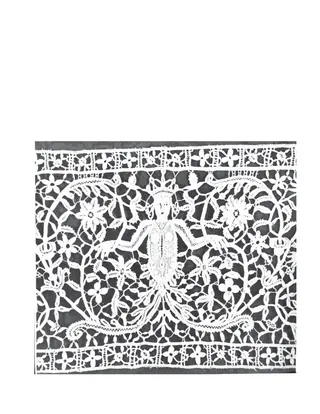
The Greenleaf Collection: Textile Arts from the 16th to the Early 19th Century
The Cooper Union Museum, c. 1964
Other · 41 pages
Exhibition catalogue of the Greenleaf Collection of textile arts, a bequest to the Cooper Union Museum, dated January 1964. It opens with a biography of collector Richard Cranch Greenleaf, then lists numbered objects with accession numbers, previous owners, dates and places: men's waistcoats, a large section of needle and bobbin laces (Punto Tagliato, Reticello, Point de Venise, Alençon, Mechlin, Binche and others), embroideries, woven silks and velvets, caps and coifs, wig stands, tassels, purses and small objects. It ends with a lace glossary and a bibliography.
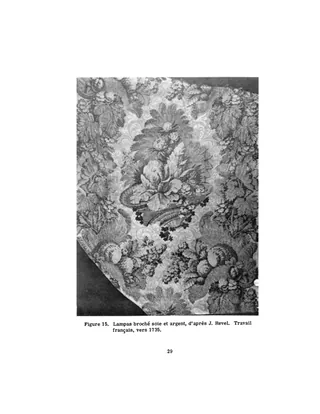
Le Musée Historique des Tissus [The Historical Museum of Textiles]
Article · 30 pages · French
A French-language article by Robert de Micheaux, honorary curator, describing the Musée Historique des Tissus of the Lyon Chamber of Commerce, founded in 1856 and housed since 1950 in the Hôtel Villeroy. It surveys the collections: Coptic, Sassanian, Byzantine, Persian and Turkish textiles and carpets, Far Eastern pieces, medieval embroideries, Spanish and Italian velvets and brocades, liturgical vestments, and Lyon silks from Philippe de Lasalle through Jacquard, Grégoire's painted velvets and 20th-century designers. Eighteen halftone figures show the building, galleries and selected textiles.
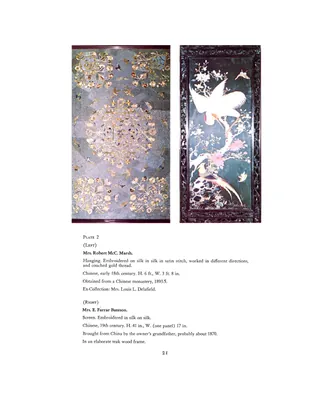
Textiles from Members' Collections
The Bulletin of the Needle and Bobbin Club, 1965-1966
Article · 36 pages
A photographic plate catalogue of 37 textiles lent from the private collections of Needle and Bobbin Club members, with a caption for each piece giving owner, technique, origin, date, dimensions, provenance, and published references. The items span Coptic tapestry roundels and early silks through embroideries, tapestries, laces, samplers, costume, a quilt, and a Jacquard double-cloth coverlet, dated from about the 6th century to 1935. Many pieces were later given to museums such as the Metropolitan, the Cooper Union, and the Victoria and Albert.
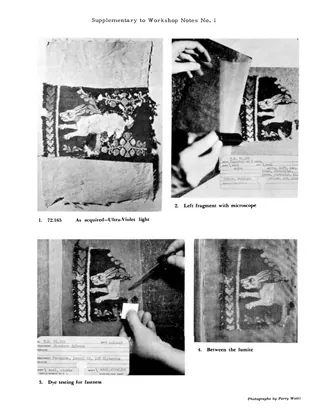
Workshop Notes
Monograph · 69 pages · weaving drafts
A collection of the Textile Museum's Workshop Notes papers (Nos. 1-11, c. 1950-1955) on conservation and technical analysis of textiles and rugs. Topics include step-by-step cleaning and mounting of wool textiles, cleaning cotton textiles with dye-fastness tests, rug repair, display and storage, and preservation of dated tiraz fabrics. Analysis papers cover early weaves and techniques in Egypt and the Near East (tapestry, rep, gauze, tabby, twill, drawloom binding), the museum's rug analysis method and charts, a late Roman tapestry from Egypt, patterned knitted stockings found in Egypt, and a proposed terminology for ancient and primitive fabrics. Illustrated with workshop photographs, analysis cards, structural diagrams and drafts-style notation.
Western Art
Book · 27 pages
A 1910 section of the Handbook of the Museum of Fine Arts, Boston, covering Western art objects in the galleries. It opens with textiles: Coptic Egyptian and Peruvian tapestries, Persian and Turkish rugs, velvets and brocades, Flemish and French tapestries, and Italian and Spanish brocades, damasks and velvets. It also has a section on lace (drawn-work, cut-work, reticella, Venetian and French point, bobbin lace) with Spanish buratto and Italian embroidery. The rest covers Saracenic ceramics and metalwork, sculpture, silver, porcelain, ironwork, manuscripts and amber, with short bibliographies.
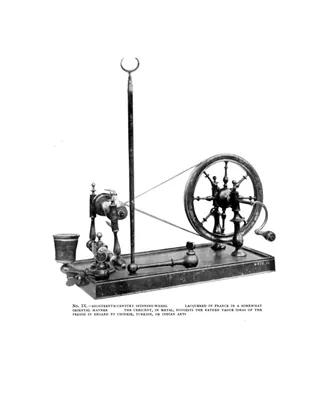
Eighteenth Century Spinning Wheel
The Connoisseur, 1916
Illustration · 1 page
A single page with a black-and-white photograph of an eighteenth-century spinning wheel, lacquered in France in a somewhat oriental style. The caption notes that the metal crescent finial reflects the period's vague ideas about Chinese, Turkish, or Indian arts. It appears to be one plate from a numbered series in The Connoisseur.
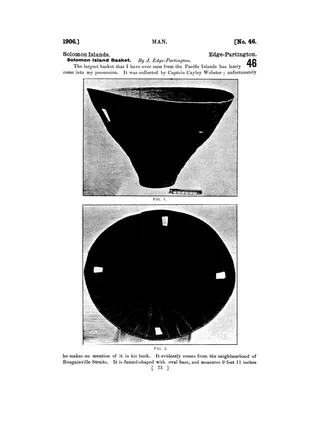
Solomon Island Basket
Article · 2 pages
A short note from the journal Man describing a very large funnel-shaped coiled basket from the Solomon Islands, probably the Bougainville Straits area. It gives the basket's dimensions and construction: single-rod coiling of reeds bound with split rattan, herring-bone ornament in vertical bands, and four handholes below the rim. The author compares it with smaller baskets in the British Museum. Two photographs illustrate the basket.
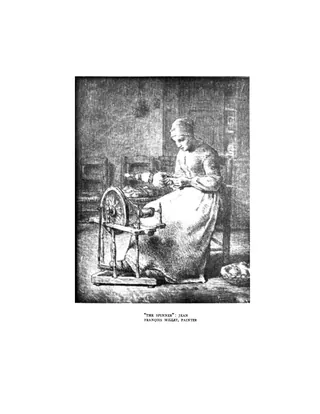
Spinner
Illustration · 1 page
A single-page halftone reproduction of Jean-François Millet's painting "The Spinner," showing a woman seated at a spinning wheel in a dim interior. A distaff holding fiber stands at the left, with a basket at lower right and a wooden chair behind her. The page carries only a short printed caption naming the work and the painter.
Study of Costume as an Aid to the Dating of Italian renaissance Paintings
Article · 24 pages
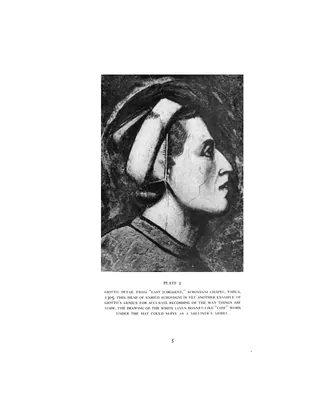
An essay by Stella Mary Pearce (Mrs. Eric Newton) arguing that the study of costume can date Italian Renaissance paintings to within about five to ten years. She maintains that fashions in clothing and hairdressing changed quickly, that no painter escaped contemporary fashion, and that no painted figure is unaffected by it, even when dressed in classical or archaic garb. Examples come from Giotto, Mantegna, Carpaccio, Raphael, Lippi, Crivelli and others, with sixteen plates of painting details and comments on how Christ, the Apostles, the Madonna, angels and saints were dressed.
A Classification of Antique East Midland Lace Bobbins for Collectors
Brian Lemin · 2016
Web Doc · 25 pages
Brian Lemin's 2016 article proposes a system for classifying and organizing a collection of antique English East Midland lace bobbins. It covers functional types, regional types (South Bucks, Downton, Malmesbury, Waddesdon, Suffolk), and categories by decoration and construction such as bitted, pewter-inlaid, wire-beaded, mother-in-babe, tinsel and spliced bobbins. It also lists known bobbin makers, gives a classification of bobbin inscriptions based on Jenny Baker's catalogue, and explains bobbin parts and turning terms with photographs and line drawings. An appendix shows how to turn the classification into a computer folder structure.
The Degradation of Pewter in Antique Lace Bobbins
Brian Lemin · 2003
Web Doc · 4 pages
A short web article explaining why the pewter inlay on antique bobbin lace bobbins swells, crumbles or falls off. It describes pewter as a tin-lead alloy and attributes the damage to "tin pest" or tin disease, in which tin changes form below about 13 degrees C. It also discusses the folklore that pewter-spotted "leopard" bobbins were made to ease arthritis, and offers advice on storing bobbins.
The Fox and the Crane Needlepoint
Article · 1 page
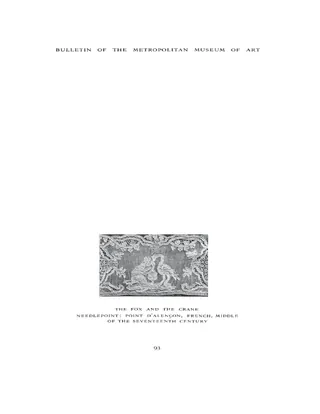
A one-page entry from the Bulletin of the Metropolitan Museum of Art showing a needlepoint lace panel of a fox and a crane, illustrating the fable. The caption identifies it as Point d'Alençon, French, mid-seventeenth century. The page consists of a photograph with a brief caption.
John Nelham's Needlework Panel
Article · 14 pages
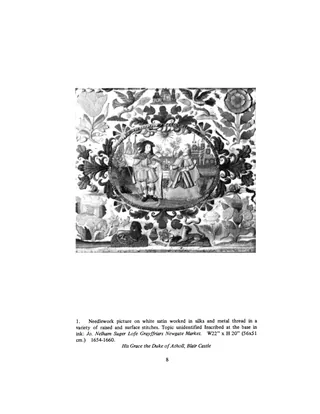
Article by Margaret Swain on a seventeenth-century English raised-work (stumpwork) picture on white satin at Blair Castle, inscribed in ink with the name and address of John Nelham, a London embroiderer and pattern drawer at the Sugar Loaf, Grayfriars, Newgate Market. She compares it with related oval-medallion panels in the V&A, Bayou Bend, St. Louis, Nottingham, the Metropolitan Museum and the Fitzwilliam, and discusses how designs were drawn out on satin from printsellers' engravings. She dates the panel to 1654-1660 and cautions against attributing all similar panels to Nelham's workshop. Nine plates, references and a table of oval dimensions are included.
Lace Collection of Mr. Arthur Blackborne: Part III-- Rose Point
Article · 9 pages
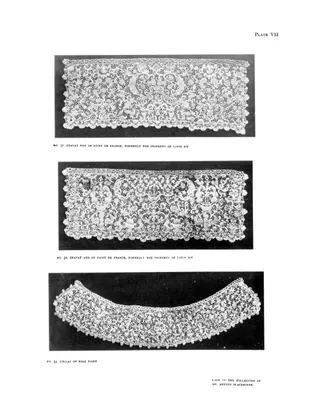
Part III of M. Jourdain's series on Arthur Blackborne's lace collection, devoted to rose point (raised Venetian needlepoint lace). The text first explains how rose point differs from later punto in aria in its conventional scroll design, raised relief, and elaborate brides (bar grounds). It then gives numbered catalogue entries (Nos. 31-47) for cravat ends once owned by Louis XIV, collars, cuffs, lappets, and borders, describing their designs, meshes, picots, and provenance. Four plates (VII-X) reproduce many of the pieces in black and white.
Milanese Bobbin Lace with Hunting Scenes
Article · 3 pages
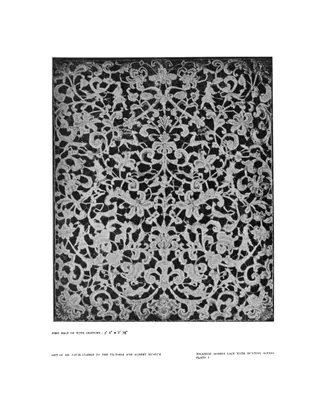
A short museum-acquisition article by P. G. Trendell on two Milanese bobbin-lace panels with hunting scenes, given to the Victoria and Albert Museum by Louis Clarke. It compares them with the Brussels bobbin-lace coverlet of 1599 and discusses the figural motifs (Cupid, huntsmen, hounds, stags, lions, double-headed eagles). It also notes the diamond-shaped plaited mesh ground introduced in the late 17th century and differences between Italian and Flemish technique. Two photographic plates illustrate the panels.
Moon and Her Children; A Tapestry from a Set of the Planets
Article · 7 pages
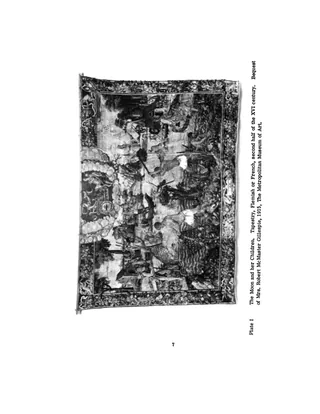
Article by Edith Appleton Standen on a sixteenth-century Flemish or French tapestry in the Metropolitan Museum, 'The Moon and Her Children' (also published as 'Month of June'), from a set of the planets. It traces the design to a 1531 woodcut series attributed to Bartel Beham and explains the planetary iconography, including the moon's chariot, water themes and shell-game scene. It compares the tapestry with a Brussels version in Munich and other sets, and discusses its style, coarse weave and likely provincial origin. Includes notes and three plates.
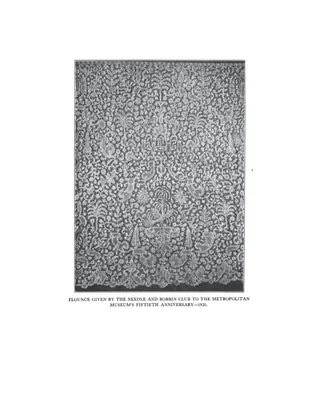
Needle and Bobbin Club Flounce at the Metropolitan Museum of Art
Article · 3 pages
Short article from the Bulletin of the Needle and Bobbin Club describing an early eighteenth-century Brussels bobbin lace flounce that the Club gave to the Metropolitan Museum of Art for its fiftieth anniversary in 1920. It gives the flounce's dimensions, the mesh types and techniques (toilé, grillé, cinq trous, brides picotées, braided relief work), and a description of its garden design with a fountain, birds, trees and flowers. It also speculates on how the lace was originally used. A halftone photograph of the flounce is included.
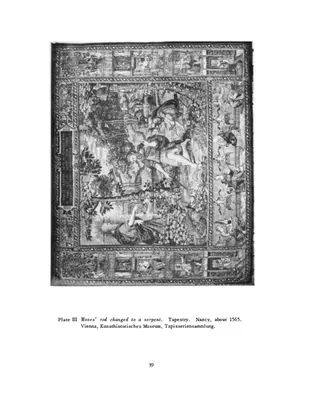
Note on the Tapestries at the Pompe Funèbre of Charles III of Lorraine
Article · 10 pages
An article on the tapestries hung in the salle d'honneur at the 1608 funeral ceremonies (Pompe Funèbre) of Charles III, Duke of Lorraine, as shown in Friedrich Brentel's engravings of about 1610. The author compares the Moses tapestries in the engravings with nine Moses tapestries from the Dukes of Lorraine now in Vienna, and cites Pierre Marot's explanation of the differences. She identifies Bernard Salomon's woodcuts in the Quadrins Historiques de la Bible (Lyons, 1553/1558) as the pattern source for Brentel's tapestry scenes. Illustrated with plates of the engravings, a Vienna tapestry, the Discours title page, and a Salomon woodcut.
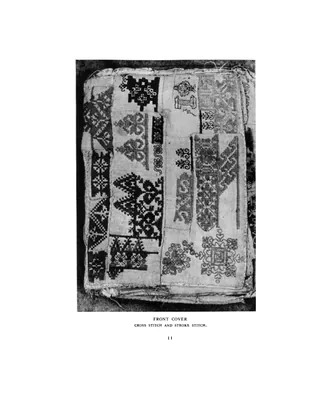
Old Sampler Book
Article · 13 pages
A short illustrated article from the Needle and Bobbin Club Bulletin presenting the twelve leaves of a small sampler book, shown in their original order. The book is thought to have come from Portugal and to have been made there or in Spain in the seventeenth century. The introduction describes the stitches, colors and materials, and each plate carries a caption listing the stitches shown, including cross stitch, stroke stitch, reticello, drawn work, matting stitch and bullion stitch.
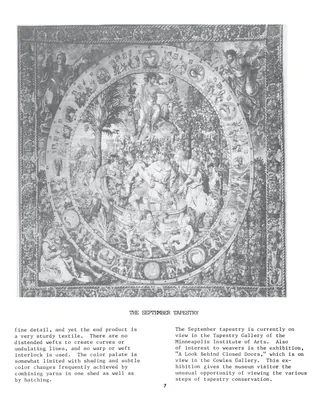
On Tapestry
Article · 2 pages
A column from the Minnesota Weaver in which Lotus Stack, associate curator of textiles at the Minneapolis Institute of Arts, begins a series on the museum's tapestry collection. It discusses the Brussels tapestry 'The Month of September' (c. 1525-1528), from a twelve-month series attributed to Van Orley, covering its iconography, its Gothic and Renaissance influences, and related editions in other museums. It also gives technical details of the weave: wool with silk highlights, 19 warp ends per inch, about 80 wefts per inch, and shading by hatching and combining yarns in one shed.
On Tapestry
Article · 2 pages
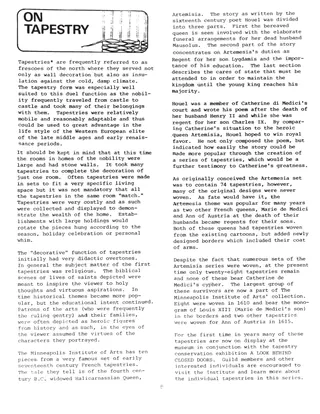
A short article from the Minnesota Weaver on the historical role of tapestries in late medieval and early Renaissance Europe, where they served as decoration, insulation, and displays of wealth. It focuses on the early seventeenth century French Artemisia series, ten pieces of which are held by the Minneapolis Institute of Arts, and explains how the story was tied to Catherine de Medici and later regent queens. A captioned photograph shows one tapestry from the series, woven in 1610 for Marie de Medici.
Pattern Sources of Scriptural Subjects in Tudor and Stuart Embroideries
Article · 56 pages
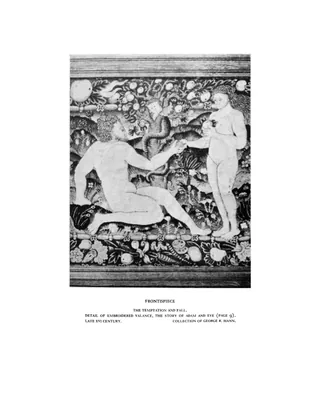
An illustrated article tracing the printed sources (woodcuts and engravings from sixteenth- and seventeenth-century Bibles and print series) used as patterns for Scriptural scenes in English Tudor and Stuart embroideries. It pairs photographs of petit-point panels, valances, needlepoint pictures and embroidered bookbindings with the woodcuts and engravings they copy, covering Adam and Eve, Tobias, Jacob, Solomon, Abraham and Hagar, Rebekah, David and Bathsheba, and Belshazzar. It ends with a list of embroidered examples of each subject in museums and private collections.
Picture postcard
Sampler, Tudor Period; London Museum, 1485-1603
Ephemera · 1 page
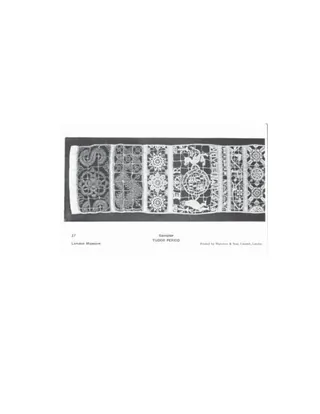
A single black-and-white picture postcard published by the London Museum showing a Tudor-period sampler. The photograph shows a long narrow strip of needlework or lace-like work arranged in vertical bands of geometric, floral and figurative motifs, including a central medallion. The printed caption gives only the museum name, the object type and period, and the printer.
Picture postcard
Ephemera · 1 page
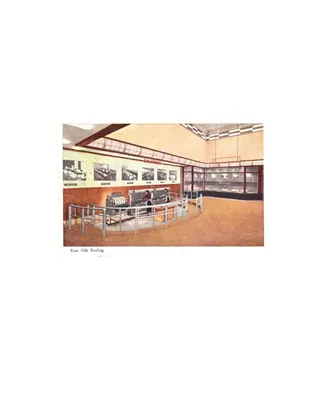
A single picture postcard captioned "Raw Silk Reeling." It shows a color photograph of a museum or exhibition gallery with a raw silk reeling machine, tended by two figures, behind a curved metal railing. Photographic panels on the wall above show textile-related imagery. The only text is the caption.
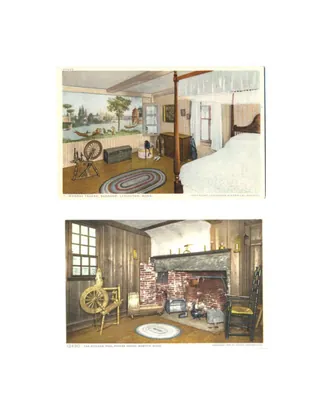
Picture postcards
Ephemera · 6 pages
A set of picture postcards, shown two per page over six scanned pages, depicting historic interiors that include spinning wheels. Locations include Munroe Tavern, Paul Revere House, the House of Seven Gables attic, Martha Washington's spinning room at Mount Vernon, Plas Newydd, Kelmscott Manor, Aberconwy, the Adelina Patti House, Dalarna in Sweden, and the Fairbanks House in Dedham. One card shows a sepia photograph of a Donegal spinner at her wheel, with a handwritten message on the card.
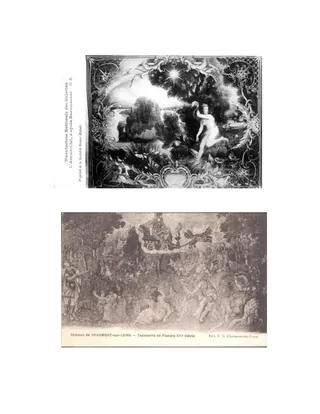
Picture postcards
Ephemera · 4 pages · French, English
A small set of picture postcards reproducing historic tapestries, scanned as four pages of paired images. Subjects include Gobelins Manufactory pieces (L'Air-en-Ciel after Beauneveu, a Louis XV hunt scene after Oudry), a 16th-century Flemish tapestry at Chaumont-sur-Loire, the Unicorn Tapestries at the Château de Verteuil, a Musée de Cluny medieval piece, and a Victoria and Albert Museum Flemish Trojan War tapestry. Captions are mostly French, with some English.
552 documents found