Textile Documents › Topic: Diaper and block weaves
92 documents found
Sort: 
Coded Weaving
Master Weaver, September 1954
Article · 2 pages · weaving drafts
A two-page article from Master Weaver explaining how to weave a coded message into cloth using any four-block draft. Each letter is encoded by a block number and a number of weft picks, with a code table in Fig. 1 and a clue border woven at the start to establish block order. The example message "MERRY XMAS" is worked out with treadling directions and a drawdown, and the article explains how to read the message back from the fabric.
Diaper
Zell's Encyclopedia, 1876
Article · 1 page
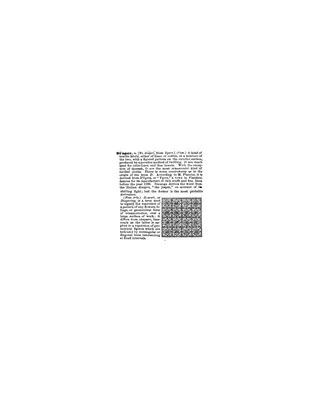
A short encyclopedia entry defining diaper as a linen or cotton textile with a figured pattern produced by a special kind of twilling, used for table linen and towels. It discusses the disputed origin of the word (Ypres in Flanders versus Italian diaspro) and also defines diaper-work in the fine arts as a repeated ornamental pattern over a surface. A small illustration shows a patterned block of rosettes in square cells.
Weaving Terminology - Clasped Wefts
Master Weaver, July 1953
Article · 1 page · weaving drafts
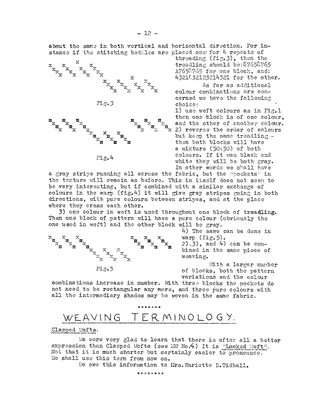
A one-page item from Master Weaver No. 10 (July 1953). It opens with the end of an article on colour combinations in block weaves that use stitching heddles. Colour can be varied in weft and warp to give gray stripes and pure-colour blocks, and the treadling is given for two blocks. The short terminology note then reports that "Locked Weft" is a better term than "Clasped Wefts", with credit to Mrs. Harriette D. Tidball.
Diaper
Article · 1 page · weaving drafts
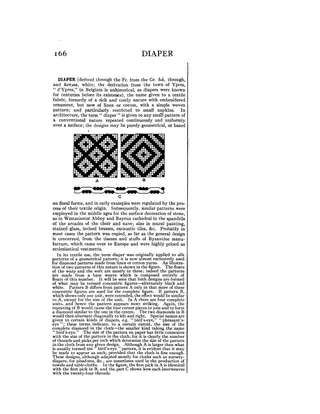
Encyclopedia Britannica (11th ed.) entry on diaper, covering the word's derivation, the fabric, and the use of diaper patterns in architecture and decoration. It then describes diaper weaving as small diamond patterns in linen or cotton built on a base weave of three-thread floats. Two diamond drawdowns (A and B) illustrate concentric black and white figures, with a strip showing the interweaving. It also covers bird's-eye and pheasant's-eye diapers and their use in nursery diapers, towels and tablecloths.
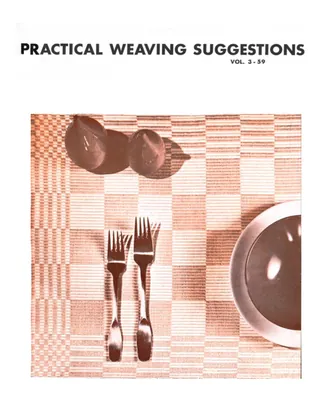
Practical Weaving Suggestions, Vol. 3-59 (1959): The Zig-Zag Weave
Periodical · 8 pages · weaving drafts
An issue of Practical Weaving Suggestions (Lily Mills) by Edna Olsen Healey introducing the Zig-Zag Weave, a four-harness Simplified Drall (Swedish) weave forming two reversible blocks, one shiny and one dull. It gives the basic draft, tie-up, treadling, reed setting, weaving and finishing advice, and full threading plans with Lily yarn specifications for four dinner place mats (aqua, crabapple and white, silver grey linen, cork linen). Further samples include a floss design and three small upholstery patterns, with drawdown grids on the last page.
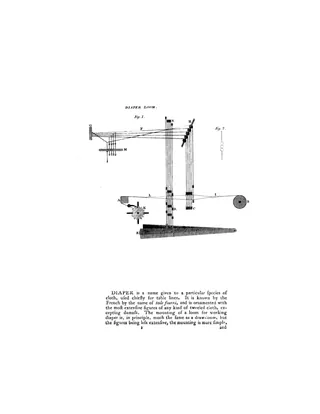
Diaper
Rees's Cyclopedia, 1819
Article · 2 pages
An encyclopedia article on diaper, a twill-based cloth used chiefly for table linen, and on the loom mounting used to weave it. It explains how diaper uses broken five-leaf twill with reversed floats to form figures, and how a back harness operated by the weaver's hand supplements the front treadle mounting. It describes the parts of the diaper loom shown in an engraved figure (breast beam, cloth beam, treadles, back harness, cords and pulleys, and the iron or copper eyes called mails).
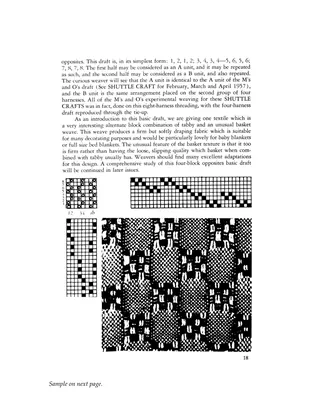
The Multiple-Harness Weaver: A Basic Draft
Article · 3 pages · weaving drafts
An article from Shuttle-Craft Bulletin's "Multiple-Harness Weaver" series introducing the idea of basic drafts for eight-harness looms. It reviews the versatility of the four-harness twill and its shed combinations, then extends the principle to eight-harness threadings. The main example is the four-block opposites threading (1,2,1,2; 3,4,3,4; 5,6,5,6; 7,8,7,8), with a draft and a woven sample of alternating tabby and basket-weave blocks, suited to blankets.
Shuttle-Craft Bulletin, Vol. XXXI, No. 2 (February 1954)
Periodical · 20 pages · weaving drafts
February 1954 issue of the Shuttle Craft Guild Handweaver's Bulletin (Portfolio Edition), devoted to the unit weaves developed by Dr William G. Bateman of Seattle. It explains the Unit system of drafting and Profile drafts, then covers the Boulevard Weave and the Bateman Blend (Atwin) Weave with threading units, tie-ups, treadling rotations and texture variations such as hollow squares and Dukagang effects. A closing section explains how to adapt the weaves for 4 and 6 harnesses, and the Tag Weave is promised for the March issue.
Weaving. -- No. XI: Diaper Weaving
Article · 2 pages · weaving drafts
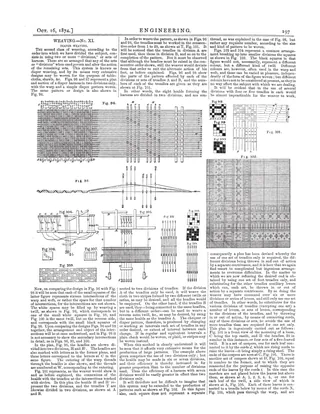
Installment No. XI of a serial on weaving in the journal Engineering, explaining diaper weaving, in which two or more divisions of harness and treadles are combined to weave large checker or diaper patterns for tablecloths and shawls. It describes a two-division harness with its threading and treadling plans, the twills that fill the pattern squares, and a mounting that controls up to twenty leaves with a single set of treadles using coupers, levers and handles. It closes with the construction of healds, leashes, lingoes and the comber board for figure weaving.
Weft-Faced Weaves - Boundweave
Article · 2 pages · weaving drafts
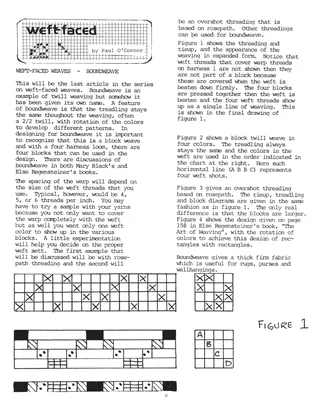
Final article in a series on weft-faced weaves, explaining boundweave as a block weave based on twill in which the treadling stays constant (often 2/2 twill) while weft colors are rotated to form patterns. On a four-harness loom it gives four blocks. It covers sett (4 to 6 threads per inch), a rosepath threading and an overshot threading based on rosepath, and a four-color block rotation chart. The figures include drafts, block diagrams and drawdowns, with a design adapted from Else Regensteiner's The Art of Weaving. Boundweave is recommended for rugs, purses and wall hangings.
Shuttle-Craft Bulletin, Vol. XXXI, No. 3 (March 1954)
Periodical · 20 pages · weaving drafts
March 1954 issue of the Shuttle Craft Guild Handweaver's Bulletin, Portfolio Edition. It continues Dr William G. Bateman's series on unit weaves with an article on the Tag weaves (5-, 7- and 9-thread extensions of the Boulevard technique), giving profile drafts, tie-ups and treadling rotations for four sample textures. It also continues The Bateman Blend with treadling directions for "hollow square" and "alternated ovals" yardages, plus an all-over texture weave on the Atwater Lace tie-up. The issue closes with reviews of Mary Meigs Atwater's Byways in Hand-Weaving and Louis Cheskin's Color-Tune Your Home, and Harriet Tidball's notes on looms.
Umbrian Weaves
Article · 4 pages
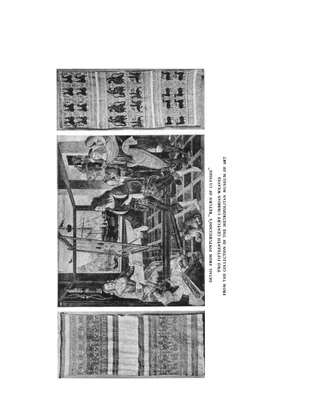
A short 1918 article by Frances Morris on Umbrian household linens (tovaglie) shown at the Needle and Bobbin Club's annual meeting. It describes the coarse cotton diaper-patterned fabrics with deep blue grotesque bands, their use as towels and altar cloths, and the motifs such as the Perugian griffin, Guelph lion and fonte maggiore. It also discusses the fifteenth-century loom shown in Pinturicchio's 'Return of Ulysses', indigo dye, the modern revival, and lists contributors and references. Illustrated with halftones of a Rocchi Collection weave, Metropolitan Museum towels and the Pinturicchio detail.
Warp & Weft, Vol. 32, No. 5 (May 1979)
May 1979
Periodical · 8 pages · weaving drafts
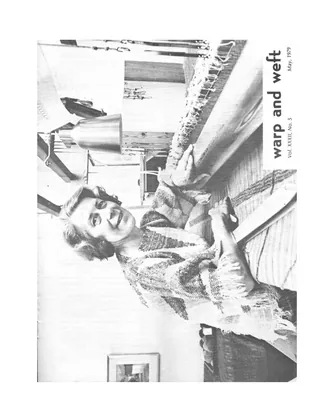
May 1979 issue of Warp & Weft, the monthly bulletin of Robin & Russ Handweavers in McMinnville, Oregon. It includes the editor's report on the Malin Selander workshops and photographs of her at her loom and in hand-woven clothing, and a project called Golden Diamonds, a warp-faced five-block diamond unit weave on 4 shafts in 20/2 Egyptian cotton. The project gives the threading, two tie-ups (4 and 8 treadles), treadling sequences, sett of 60 epi, weft choices, weaving tips and a cost breakdown. It also has a review of Peter Teal's Hand Woolcombing and Spinning, plus classified yarn and equipment ads.
Handicrafter, Vol. III, No. 6 (May-June 1932)
Handicrafter, May-June 1932
Periodical · 36 pages · weaving drafts
Issue of The Handicrafter (May/June 1932), a general craft magazine with a strong weaving component. The lead article by Agnes K. Nielsen gives warping and weaving directions for block patterns (Lasting Beauty, Four O'Clock, Queen's Patch, Sugar Loaf, Monk's Belt) on the Daga and Kircher looms. Other textile content includes card (cardboard loom) tapestry weaving for camp girls, and R. F. Heartz's analysis of a sixteenth-century Spanish overshot linen with a draft and treadling table. The issue also covers marionettes, leather tinting and a leather scrap cushion, batik, clay preparation, envelope-lining crafts, book reviews, and knitting and crochet instructions for sweaters, plus loom and supply advertisements.
Shuttle-Craft Bulletin, Vol. XXIX, No. 9 (September 1952)
Periodical · 16 pages
September 1952 issue of the Shuttle Craft Guild's monthly bulletin (Portfolio Edition, with mounted fabric samples), published in Virginia City, Montana by Harriet and Martin Tidball. It continues the classification of handloom weaves with Class IV (the unit weaves, including Summer and Winter, Bergman, Combination, Atwater/Bronson Lace and warp-pattern weaves, double twill, double weave pattern, damask) and Class V (texture contrast weaves such as spot weave, Swedish lace, huck, canvas, waffle, M's and O's). It also includes an article on spaced-warp stoles, a history of the Shuttle Craft Guild and its transfer from Mary Meigs Atwater to Harriet Tidball, and a directory of US yarn and equipment dealers for handweavers.
Handweaving Made Easy
Master Weaver, September 1954
Article · 2 pages · weaving drafts
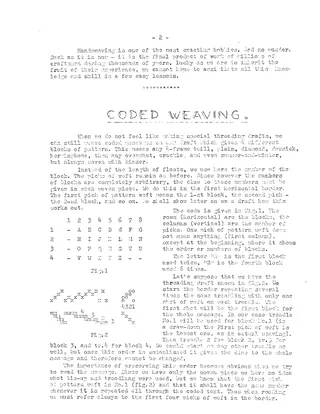
A 1954 issue of Master Weaver (Fulford, Quebec) carries an editorial arguing that handweaving is not easy and that advertising claims of 'easy' looms, yarns and lessons are misleading and discourage beginners. The second page begins a section on 'Coded Weaving', explaining how to weave coded messages into four-block drafts by using the number of picks per block to stand for letters, with a code table (Fig. 1) and a small draft (Fig. 2).
Variations of Four-Block Patterns
Master Weaver, December 1951
Article · 3 pages · weaving drafts
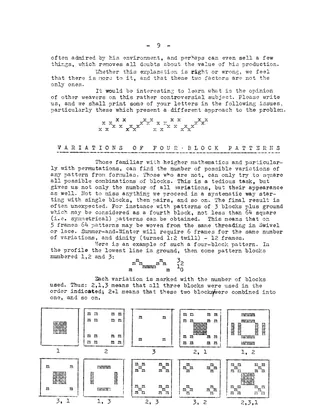
A short article from Master Weaver (Dec. 1951) on working out all the possible variations of a four-block pattern (three pattern blocks plus ground). It explains a notation for combining blocks and presents grids of small profile and drawdown diagrams showing 64 symmetrical variations woven from one threading. The final page begins a note on weaving terminology, taken from the 'Encyclopedia of Hand-Weaving', discussing the word 'harness' and its synonyms (heddle-frame, shaft, leaf, heald). The scan opens with the end of an unrelated discussion about weavers' motivations.
Chaise Longue Coverlet
Article · 2 pages · weaving drafts
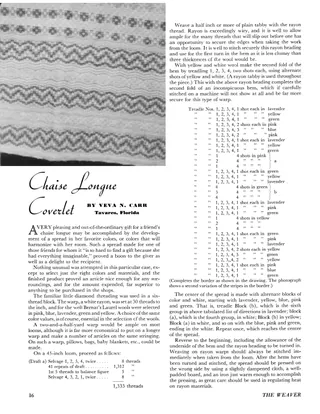
An article from The Weaver (April 1937) by Veva N. Carr of Tavares, Florida, describing a chaise longue coverlet woven as a gift. It uses a small diamond threading in six-thread blocks on a white rayon warp set at 30 ends per inch, with Bernat's Laurel wools in pink, blue, lavender, green and yellow. The text gives the warp count for a 45-inch loom, a full treadling and color sequence for the border, directions for the center blocks, and hem and finishing advice for rayon warps. A photograph of the coverlet and a full-page draft accompany it.
Dornick
Article · 1 page
A short encyclopedia entry defining dornick (also spelled dornic or dornock) as a stout linen cloth woven in a simple diaper pattern. It gives the origin of the name from Dornich, or Tournay, in the Netherlands, and notes the likely spread of manufacture to Norfolk, England, with Dutch emigrants fleeing the Duke of Alva's persecution.
Handweaving News (July 1939): Designing Two Block Patterns
Periodical · 4 pages · weaving drafts
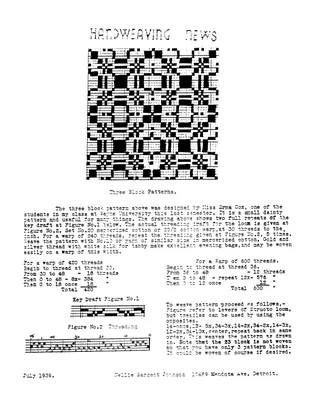
A four-page July 1939 issue of Handweaving News by Nellie Sargent Johnson presenting several four-harness threading drafts for small pieces. It gives drafts for a small three-block pattern by Erma Cox, 'Lindy's Invitation' by Ruth Lindeman, and 'The Spider's Web' by Lillian Dowley, with warp counts for different widths, sett, yarn sizes and lever or treadle weaving sequences. Photographs show a place mat border with napkin, a green fabric sample and a silk and gold thread bag, with color and picked-up motif notes.
The Hollow Square Pattern
Shuttle-Craft Bulletin, 1957
Article · 1 page · weaving drafts
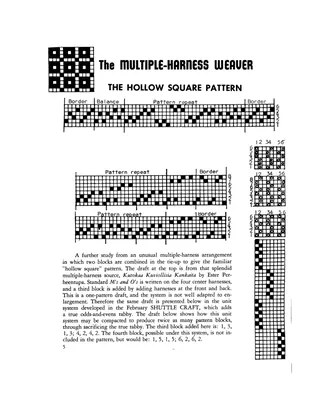
A one-page article from the Multiple-Harness Weaver column presenting a "hollow square" pattern made by combining two blocks in the tie-up. The top draft comes from Ester Perheentupa's Finnish multiple-harness book Kutokaa Kuviollisia Kankaita, with M's and O's on the four center harnesses and a third block added by front and back harnesses. The same pattern is then redrafted in the unit system described in the February Shuttle-Craft, with a compacted version that gives twice as many pattern blocks at the cost of a true tabby. Several drafts on six and eight shafts are shown with border, balance and pattern repeat labels.
How to Find the Number of Pattern Variations
Master Weaver, November 1960
Article · 1 page
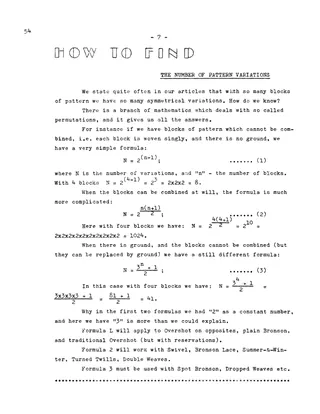
A one-page article from Master Weaver that explains how to calculate the number of symmetrical pattern variations for a given number of blocks, using three permutation formulas. The formulas cover blocks woven singly with no ground, blocks combined at will, and blocks with ground that cannot be combined, each worked through for four blocks. It then lists which weave structures each formula suits, such as overshot, Bronson, summer and winter, and double weaves.
Block Drafts from Heinrich Leisy's Pattern Book
Ute Bargmann · 2000
Manuscript · 236 pages · weaving drafts
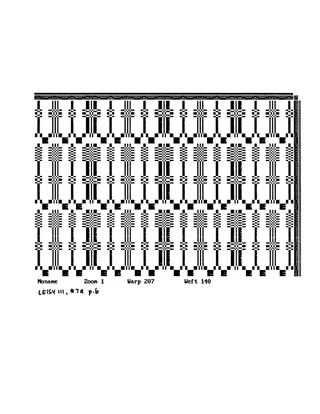
A set of computer-generated drawdowns of block patterns from Heinrich Leisy's pattern book, prepared by Ute Bargmann. Each page shows one draft as a black-and-white grid from weaving software, with a handwritten label giving the Leisy section (III, IV, V, VI), pattern number and original page. The drafts are grouped by section and include a few named patterns (Church, Altar, Chalice) and kerchief patterns, plus a note on a double weave tie-up and a straight twill.
Dictionary of Textile Terms
Article · 2 pages
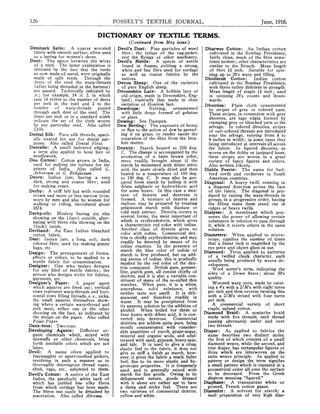
Two journal pages from the June 1916 issue of Posselt's Textile Journal, continuing E. A. Posselt's alphabetical Dictionary of Textile Terms from 'Denmark Satin' through 'Doily'. Entries define fabrics, fibers, dyes and finishing chemicals (dextrin, diastase, diazo colors), lace types, and loom and carding terms (dent, dobby, doffer, designer's paper). Some entries explain weave construction, such as diagonal, diaper, dimity and doeskin. There are no weaving drafts.
Turned Twills
Master Weaver, March 1954
Article · 3 pages · weaving drafts
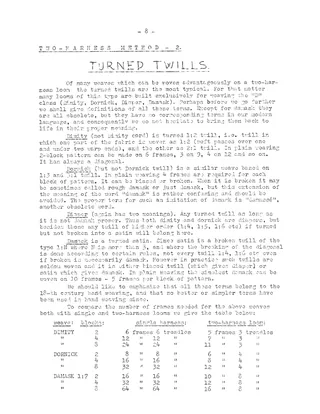
An article from Master Weaver on turned twills woven by the two-harness method, which combines a ground harness with pattern frames. It defines dimity, dornick, diaper and damask and tabulates the frames and treadles each needs on single-harness and two-harness looms. It then discusses drafting the tie-up so that pattern blocks are cut cleanly, using figures of drawdowns and a 5-block damask profile. A short section on weaving terminology (counter-marche, sinking and rising sheds) follows.
Turned Twills - The ""D"" Class: Dimity, Diaper, Dornick, Damask
Master Weaver, May 1959
Article · 4 pages · weaving drafts
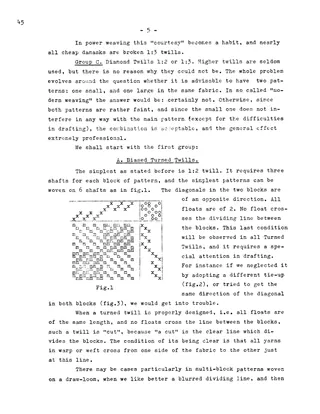
Article from Master Weaver No. 45 (May 1959) on turned twills, the "D" class: dimity, diaper, dornick and damask. It defines turned twills (blocks of vertical and horizontal floats, 1:N twills on six or more shafts), classifies them into biased, broken/satin and diamond groups, and explains the rule that no float may cross the line between blocks. Drafts show a 6-shaft example, faulty tie-ups, and a 12-treadle block-combination draft with a compound tie-up; tie-up design is deferred to the next issue. The last page begins a short "Odd Weaves" piece on unsymmetrical huckaback lace and texture weaves made from overshot, crackle and summer-and-winter.
Warp & Weft, Vol. 2, No. 9 (July 1949)
July 1949
Periodical · 8 pages · weaving drafts
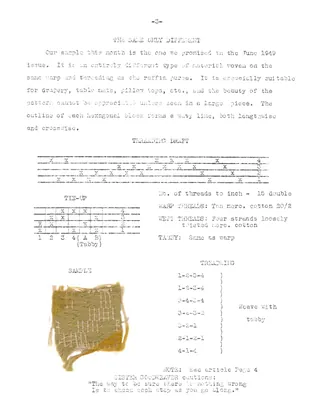
July 1949 issue of the Chicago-based handweaving newsletter Warp & Weft. It reports on the Shelburn Craft School in Vermont, summer weaving events and exhibits (Northport, Michigan; Potomac Craftsmen at the Smithsonian), and a column on machine-made 'handwoven' neckties. The monthly sample is a four-shaft hexagonal block pattern woven with tabby, with threading, tie-up and treadling given, followed by an article of hints on weaving with tabby. Also includes women-inventor trivia, a poem, short anecdotes, and advertisements for threads and summer classes.
Thomas Jackson, Weaver: 17th and 18th Century Records Portfolio
Other · 3 pages
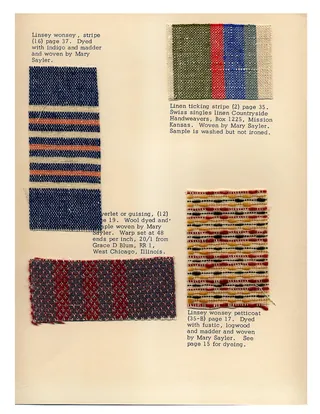
A portfolio of mounted fabric swatches accompanying Harriet Tidball's Shuttle Craft Guild Monograph Thirteen on Thomas Jackson, a 17th and 18th century weaver. Captions give the monograph page for each sample, along with the fibers, dyes, warp sett and weaver. The samples include linsey-woolsey stripes, a linen ticking stripe, a coverlet or bedcover sample, linen damask and diaper weaves, and a happing weave in fours and fives.
Rug Weaving Techniques: Beyond the Basics
Book · 161 pages · weaving drafts
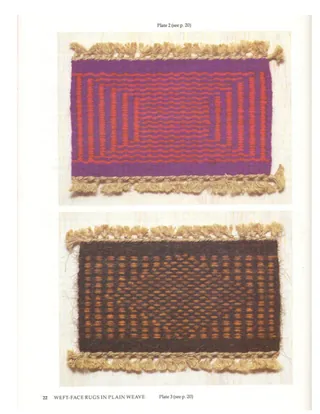
Peter Collingwood's book on handwoven rug techniques beyond basic plain weave, organized by structure. It covers weft-face rugs in plain weave (pick-and-pick stripes, crossed and clasped wefts, compensated inlay, weaving inscriptions), weft-face rugs in multishaft weaves (krokbragd, 2/2 twill, skip twills), and block weaves including three-end and four-end block drafts with pick-up and shaft-switching methods. Later chapters treat warp-face weaves, weft twining, rug finishes (braids, whipping) and workshop notes on loom features and equipment. Illustrated with many plates, diagrams and weaving drafts.
Warp & Weft, Vol. 10, No. 3 (March 1957)
March 1957
Periodical · 9 pages · weaving drafts
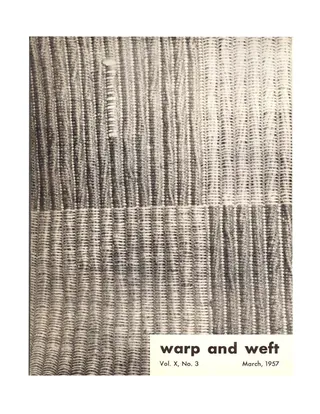
March 1957 issue of Warp and Weft, a monthly handweaving newsletter published by Robin & Russ Handweavers of Santa Barbara, California. It includes the editor's column, a profile of weaver and author Heather G. Thorpe, an exhibition calendar, and a review of the reprint of the Bronson book on weaving and dyeing. The pattern feature is a 4-harness block-pattern hall runner or stair carpet in cotton warp with jute and metallic rayon boucle weft, with threading, tie-up, treadling, a sample swatch and cost breakdowns. It ends with a short note on the term 'man-made fibers' and pages of classified and supplier advertisements for looms, yarns and equipment.
Dictionary of Weaves
Article · 2 pages · weaving drafts
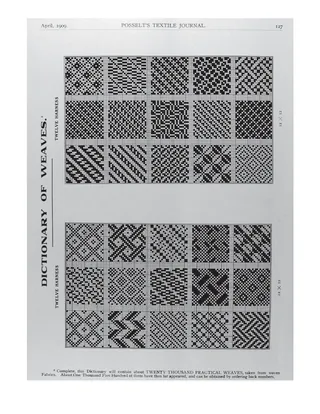
Two pages from the April 1909 issue of Posselt's Textile Journal (pp. 127-128) from the serialized 'Dictionary of Weaves'. They consist almost entirely of twelve-harness weave drawdowns, in 12 x 12 and 12 x 24 repeats, showing twill, diagonal and block patterns. A footnote says the complete dictionary will hold about 20,000 practical weaves taken from woven fabrics, with about 1,500 published so far.
Handweaving News (December 1942): Some Old "Bronson" Weaves
Periodical · 3 pages · weaving drafts
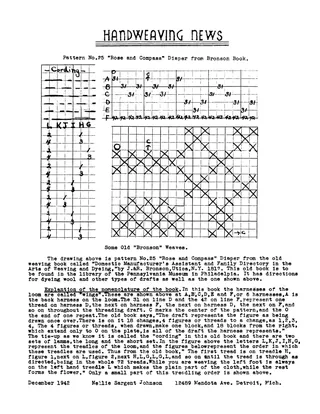
A short article by Nellie Sargent Johnson in Handweaving News (December 1942) presenting old drafts of Bronson weave. It begins with pattern No. 25 "Rose and Compass" Diaper from J. & R. Bronson's 1817 "Domestic Manufacturer's Assistant" and explains the book's nomenclature (harnesses as "wings", tie-up as "cording"). It then gives modern tie-ups, threadings and weaving directions for 4-, 5- and 6-harness Bronson weave patterns taken from old linen samples, with notes on warp and weft sizes and setts for fine linens.
Handweaving News (March 1948): Warp Pattern Rugs
Periodical · 2 pages · weaving drafts
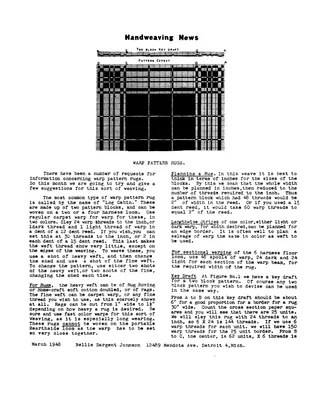
A March 1948 Handweaving News article by Nellie Sargent Johnson on weaving warp pattern rugs, chiefly the two-block "Log Cabin" type, woven on two, four or six harness looms. It covers sett, warp colors, heavy and fine weft alternation, planning block sizes in inches, a key draft, threading and tie-up, and a complete two-figure rug adapted from a Swedish draft with a treadling sequence. Two pages of drafts and figures are included.
Symmetry with Independent Blocks
Allan Wentink · 2004
Web Doc · 3 pages · weaving drafts
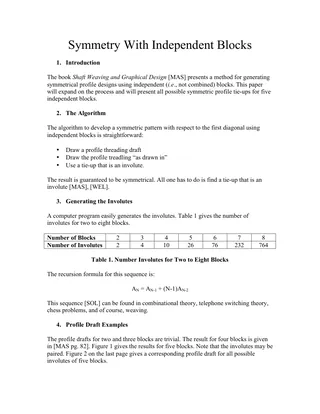
A short mathematical paper expanding on a method from Masson and Roussel's Shaft Weaving and Graphical Design for making symmetrical profile designs with independent blocks. It explains that a profile threading, a treadling "as drawn in", and an involute tie-up together give a symmetric result. It tabulates the number of involutes for two to eight blocks, with the recursion formula, and illustrates all 26 involutes for five blocks. A second figure gives the corresponding profile drafts.
Why do We Weave?
Master Weaver, December 1951
Article · 2 pages
Two pages from the first issue of Master Weaver (December 1951). The main piece, "Why Do We Weave?", considers why people take up handweaving as a hobby in a mechanised age, citing emotional attachment to the past and the satisfaction of making a whole product oneself, and invites readers to write in with their views. The pages also include the end of a note on swivel weave technique (warp and weft setting, cutting floats, uses) and a short piece on variations of four-block patterns, showing how block combinations yield 64 symmetrical patterns on 5 frames in swivel or lace.
Dictionary of Weaves
Article · 1 page · weaving drafts
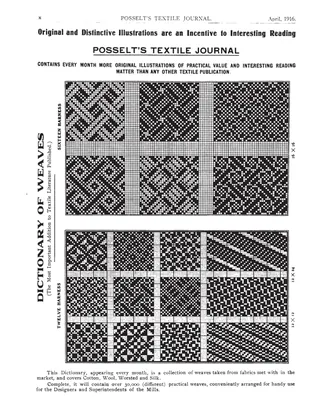
A single page from the April 1916 issue of Posselt's Textile Journal, carrying an installment of the serialized 'Dictionary of Weaves'. It shows two large drawdown grids, a sixteen-harness 16 x 16 weave and a twelve-harness weave (12 x 24 and 12 x 12), with diagonal and block structures. The text says the Dictionary appears monthly, is drawn from market fabrics in cotton, wool, worsted and silk, and is planned to total over 30,000 weaves for mill designers and superintendents.
How Many Roses in a Draft?
Master Weaver, November 1963
Article · 3 pages · weaving drafts
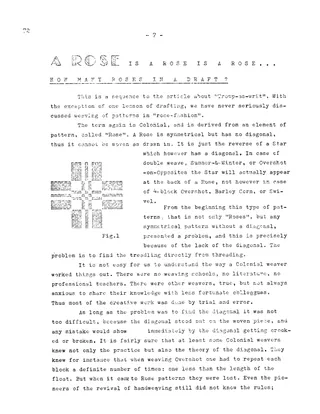
An article from Master Weaver explaining how to find treadlings for "rose-fashion" patterns, which are symmetrical patterns without a diagonal and so cannot be woven as drawn in. It gives simple rules for converting the basic (as-drawn-in) treadling into Rose 1, 2, 3 and so on by renumbering blocks and treadles. Worked examples are given for 4-block Overshot in swivel effect and for Barley Corn, with threadings, tie-ups and treadling sequences.
Musterbuch [Pattern Book]
Wilhelm Kiel · 1840
Manuscript · 33 pages · German · weaving drafts
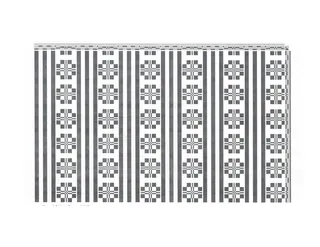
A German weaver's pattern book (Musterbuch) made for Wilhelm Kiel of Langenholzhausen and dated 26 April 1840. It consists of a decorative title page, photographs of loose damaged woven pattern samples, and many large drawdown grids of geometric patterns in black and white or gray: crosses, checks, stepped and diamond motifs, rosettes, and striped plaid-like layouts. A few pages carry notes of warp and weft thread counts or lengths. The scan is landscape and mostly image-based with almost no legible text.
Personalized Linens
Article · 6 pages · weaving drafts
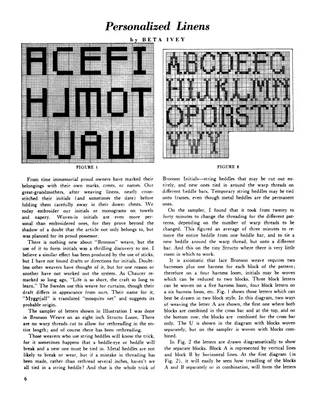
An article by Beta Ivey on weaving personal initials and monograms into linens using Bronson (lace) weave. She explains how letters are broken into two or four blocks, gives threading and treadling directions for blocks A and B on four harnesses, and describes changing string heddles to rethread for each letter. Practical notes cover a sampler woven on a Structo loom and an IB monogram towel in 40/2 linen sleyed at 30 ends per inch. Also included are proportion planning, place mat layouts, and loom suitability. Figures show letter drafts and diagrams, and there are photographs of the finished sampler and towels.
Peter Collingwood's Shaft Switching Technique, Part 2
Article · 2 pages · weaving drafts
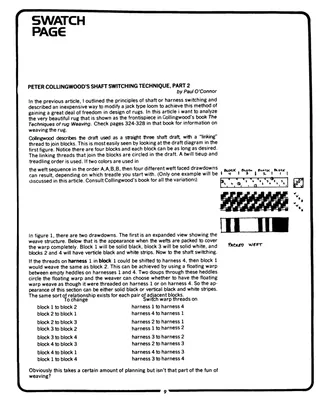
Second of two articles by Paul O'Connor explaining Peter Collingwood's shaft switching technique for weaving rugs. It analyzes the rug shown as the frontispiece of Collingwood's The Techniques of Rug Weaving, using a three-shaft threading with linking threads to join four blocks and a twill tieup. It explains how floating warp threads running through doups between empty heddles can be switched between shafts to change blocks, with a table of the switches needed. Figures include a block draft with drawdowns, a drawing of the rug and a threading draft for the switching section.
Problems in Teaching 12 - Drafting
Master Weaver, March 1956
Article · 2 pages · weaving drafts
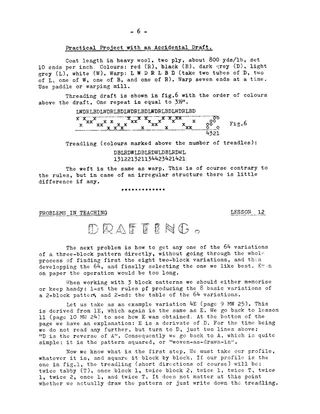
Lesson 12 of the Master Weaver series 'Problems in Teaching' on drafting block patterns. It explains how to derive one of the 64 variations of a three-block pattern directly from a profile, using the rules for two-block variations and the table of 64 variations, with a worked example (variation 4E) and treadling directions. It is preceded by a short practical project for a multicolour wool coat length, with a colour-striped warp, a four-shaft threading draft and treadling.
Shuttle-Craft Bulletin, Vol. XXX, No. 2 (February 1953)
Periodical · 3 pages
A short portfolio insert from the February 1953 Shuttle-Craft Bulletin, consisting of a cover, a page of notes, and a card mounting two fabric swatches. The notes describe a yellow open-texture linen sample (possibly Atwater or Swedish lace) and an eggplant cotton sample showing lace blocks on ten harnesses. They explain how the lace texture is reduced block by block by adding pattern harnesses until plain tabby results.
Weaving Block Patterns on the Daga and Kircher Looms
Article · 6 pages
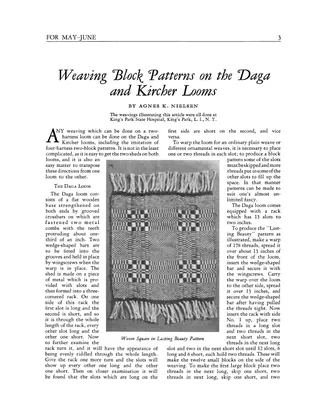
A 1932 Handicrafter article by Agnes K. Nielsen explaining how to weave two-block patterns on two small frame looms, the Daga (slotted metal rack) and the Kircher (wooden reed with pegged warp boards). It gives written warping and weaving instructions for patterns including Lasting Beauty, Four O'Clock, Pattern No. 1 and No. 2, Queen's Patch, Sugar Loaf (Window Sash) and Monk's Belt, using two shuttles in a dark and light alternation. Photographs show the finished squares and runners, which were woven at King's Park State Hospital, and the materials used are noted (carpet warp, perle cotton, novelty yarn, rayon).
Dimity
Master Weaver, July 1958
Article · 5 pages · weaving drafts
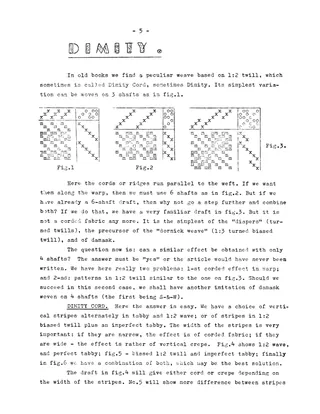
An article from Master Weaver on dimity, a weave based on 1:2 twill, and how to adapt it to 3, 4 and 6 shafts. It gives drafts for dimity cord (ridges along the weft or warp) and for two-block pattern dimity on four shafts, with notes on take-up, float length and fabric strength. It also covers the history of 3-shaft looms and twill, and includes a table runner project in single linen with threading, warp, weft and treadling instructions. A short note on weaving terminology (harness vs. shaft) closes the piece.
Peter Collingwood's Shaft Switching Technique, Part 1
Article · 2 pages · weaving drafts
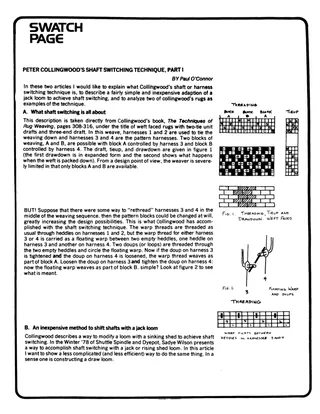
Part 1 of a two-part article by Paul O'Connor explaining Peter Collingwood's shaft (harness) switching technique for weft-faced rugs. It describes how floating warp threads held by doups between empty heddles on shafts 3 and 4 can be switched between pattern blocks A and B. It also gives a low-cost way to adapt a jack loom with a raised bridge, cup hooks and nylon seine twine doups, with practical sett and weft advice, and refers to Collingwood's Plate 98 rug as an example.
Practical Weaving Suggestions, Vol. XIV: Place Mats that Stay Placed
Periodical · 4 pages · weaving drafts
A Lily Mills Practical Weaving Suggestions bulletin by Toni Ford on heavier table mats that lie flat and stay put. It recommends mat and hem sizes and describes four mats with warp, weft and color details. These are a ribbed mat of alternating heavy and light wefts, a two-size warp mat built of squares, a Rosepath mat in novelty cotton, and a six-harness block-unit mat by Harry Burkett with a threading draft and six-treadle tie-up. It also gives tips on squared texture, warp tension and napkins, and ends with a list of recommended Lily yarns.
Warp & Weft, Vol. 36, No. 9 (November 1983)
November 1983
Periodical · 8 pages · weaving drafts
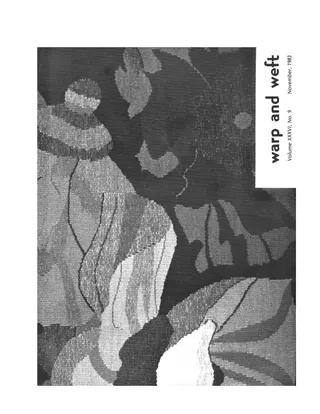
November 1983 issue of Warp & Weft, a monthly from Robin & Russ Handweavers of McMinnville, Oregon. It includes an editor's column by Russell Groff, a cover tapestry note on shading techniques (mixed-color bobbins, hatching), and a four-shaft "Carnival" fabric project with tie-up, threading, treadling, sample photo, and yarn and fabric costs. It also has a short note on scarce mohair, reviews of Clotilde Barrett's Double Two-tie Unit Weaves and Paula Simmons's The Handspinner's Guide to Selling, and pages of yarn classified ads.
Master Weaver, No. 26 (March 1956)
Periodical · 14 pages · weaving drafts
Issue No. 26 (March 1956) of Master Weaver, a bi-monthly bulletin published by Z-Handicrafts of Fulford, Quebec. It explains how to build 'accidental' drafts from random number sequences (cards, telephone directories, dice) and how to check them for long floats, and gives a coat-length project in wool. Other articles cover drafting 3-block patterns from 2-block variations (Lesson 12), multiple and mixed warps (finding average yarn count for sett, tension boxes, warping, beaming and sleying), and mock leno woven on huckaback lace. The issue also carries an ad for individual weaving lessons and an editor's note.
Weaving Four-Harness Patterns on a Two-Harness Loom
Article · 5 pages · weaving drafts
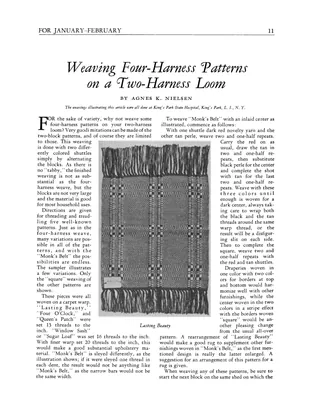
An article by Agnes K. Nielsen explaining how to imitate two-block four-harness patterns on a two-harness loom, using two colored shuttles and alternating blocks instead of tabby. It gives threading and treadling directions for five patterns: Lasting Beauty, Four O'Clock, Queen's Patch, Sugar Loaf or Window Sash, and Monk's Belt. It also covers warp setts, special sleying for Monk's Belt, an inlaid-center Monk's Belt variation, a rug layout based on Lasting Beauty, and suggestions for draperies and furnishings. Photographs of woven samples made at King's Park State Hospital illustrate the patterns.
The Weaver's Assistant
Book · 68 pages · weaving drafts
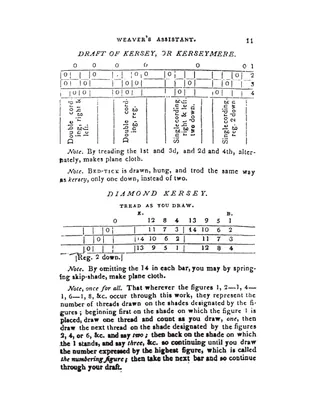
An early American weaving manual printed at Bridgeport, Connecticut, in 1818, explaining the first principles of weaving and giving upwards of eighty drafts for diapers, coverlets and other cloths. It opens with a glossary of loom terms and an explanation of drawing and cording (tie-up) methods on two to four shafts, then presents drafts for kersey, huckaback, dimity, fustian, shawls, floating-work and double carpet coverlets, and diapers on up to sixteen shades. It closes with observations on painting drafts to preview the figure, and an appendix of tables for calculating warp lengths, reeds, beers, bouts and threads, followed by contents and errata.
92 documents found