Textile Documents › Topic: Backed and compound cloths
130 documents found
Sort: 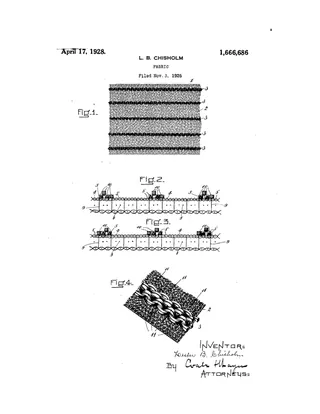
Fabric, US Patent No. 1666686
Patent · 4 pages
US Patent 1,666,686, granted 17 April 1928 to Lester B. Chisholm of Melrose, Massachusetts, assignor to Everlastix, Inc. It describes a non-slipping woven fabric in which parallel rubber strands are bound into a two-ply backing at staggered intervals, forming raised, crowded loops (bights) that give a rough, chainlike rib texture. The patent includes drawings (plan, cross-sections and a perspective view), a description of weaving tension, and five claims.
Handout
Ephemera · 1 page · weaving drafts
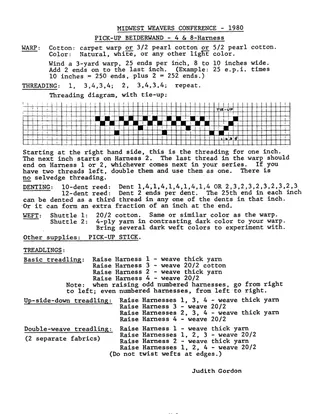
A one-page workshop handout by Judith Gordon for the 1980 Midwest Weavers Conference on pick-up Beiderwand for 4 and 8 harnesses. It gives warp specifications (cotton carpet warp or pearl cotton, 25 ends per inch), a threading with diagram and tie-up, denting for 10- and 12-dent reeds, and weft choices (20/2 cotton with a contrasting 4-ply yarn). It also lists a basic treadling, an up-side-down treadling, and a double-weave treadling, and notes that a pick-up stick is needed.
Backing in Warp
Master Weaver, September 1962
Article · 2 pages · weaving drafts
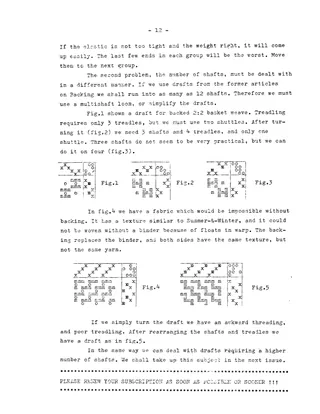
A two-page article from Master Weaver explaining how to move backing yarn from the weft to the warp by turning a draft 90 degrees, so threading becomes treadling and vice versa. This lets a backed fabric be woven with one shuttle and only four treadles. It covers practical warping problems (twisting of face and backing ends, sett, tension, threading with a weighted bunch) and the shaft count needed. Five drafts illustrate backed 2:2 basket weave and a Summer-and-Winter-like fabric.
Handbook of Weaves
Article · 5 pages · weaving drafts
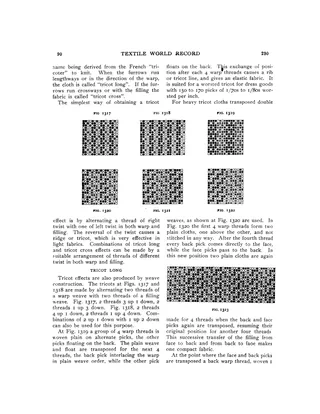
An installment of G. H. Oelsner's serialized "A Hand Book of Weaves," translated and revised by Samuel S. Dale, covering felt-cloth weaves, tricot weaves (long and cross), and cloths with an extra inner fabric. The text explains how tricot ridges are produced by alternating twills, transposed double plain weaves, and back-warp or back-filling constructions, with advice on yarn size and set. It includes drawdowns Figs. 1311-1348 and step-by-step rules for drafting outer and inner weaves.
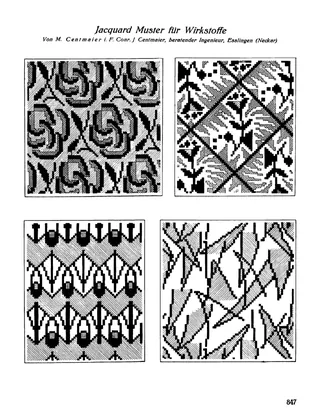
Das Verstärken oder Verdichten von Geweben und deren Untersuchung [Reinforcing or Thickening Fabrics and Their Analysis]
Article · 3 pages · German
A 1927 German-language article by Richard Hünlich on reinforcing or thickening fabrics by layering thread systems, and on how to analyze such fabrics. It describes three types: warp doubles (extra backing warp), weft doubles (extra backing weft), and double cloths, with guidance on choosing ratios of face to backing threads and on stitching the layers together invisibly. It also explains how to design the weaves on point paper and how to dissect a sample to determine the weave. The scan opens with the end of an earlier piece on ice-pattern (Eisbindung) fabrics with color-and-weave striping and check effects, and closes with a page of jacquard pattern designs.
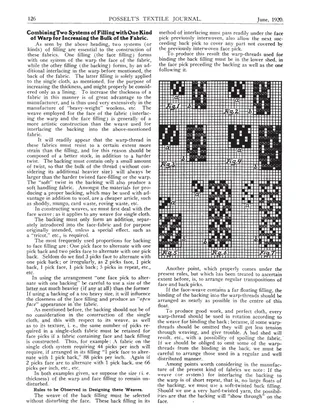
Combining Two Systems of Filling with One Kind of Warp for Increasing the Bulk of the Fabric
Article · 3 pages · weaving drafts
An instructional article from Posselt's Textile Journal (June 1920) on designing single-cloth fabrics that combine a face filling and a backing filling with one warp to add thickness, mainly for heavy woolens. It covers picking ratios (1 face:1 back, 2:1, 3:1), yarn twist and size for the backing, rules for binding the back picks, and the effect on texture and finishing. Thirteen figures show weave drawdowns for twill and satin faces with their back weaves, with repeat sizes given, and the later figures show double-cloth type structures with stitching. The scan also includes short trade news items on silk, cotton and hosiery.
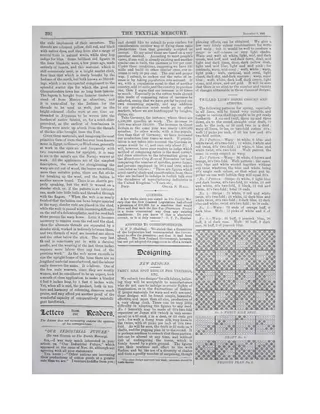
Designing
Textile Mercury, 1890
Article · 2 pages · weaving drafts
Two pages from The Textile Mercury of 6 December 1890 (pp. 392-393) with design notes for manufacturers. The first page gives a fancy silk spot design for vestings (8-shaft draft, 32-end pegging plan, yarn counts, reed and colour combinations) and six twilled linen dress check and stripe patterns on a six-end twill. The second page discusses novelty designs for woollens and worsteds, mainly warp-backed cloths, with Designs 206-208 shown on point paper and sketches of the effects. The first page also has the end of a piece on Navajo weaving, a reader's letter on cotton spindle growth, and a query and answer about New Zealand flax.
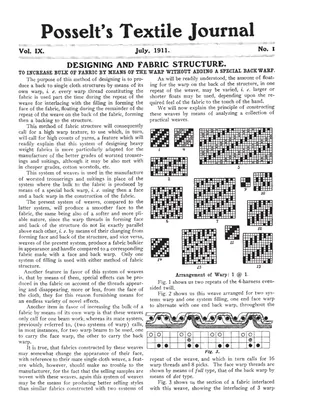
Designing and Fabric Structure
Article · 3 pages · weaving drafts
An article from Posselt's Textile Journal (July 1911) on 'false back' weaves, a way to add bulk to single-cloth fabrics using the fabric's own warp rather than a separate back warp. It explains how to build false back weaves from 4-harness twill, basket, 3/3 6-harness twill, 8-harness fancy and figured twills, and 8- and 12-harness granite weaves, in 1 @ 1 and 2 @ 1 face-to-back arrangements. Illustrated with numbered weave drafts (Figs. 1-34) and warp-section diagrams. The last page begins a continued piece on producing figures in smooth ribbons.
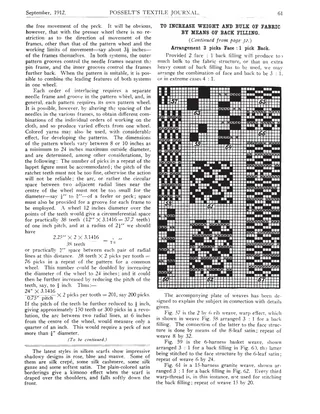
To Increase Weight and Bulk of Fabric by Means of Back Filling
Article · 1 page · weaving drafts
A single page from Posselt's Textile Journal (September 1912), continuing a series on adding weight and bulk to fabric with back filling. It covers arrangements of 3 face picks to 1 back pick, with a plate of weave diagrams (Figs. 57-67) showing a 2 by 6 rib, a 6-harness basket weave and a 15-harness granite weave, each with the back filling stitched to the face by satin interlacings. The page also carries the end of an unrelated article on lappet pattern wheels.
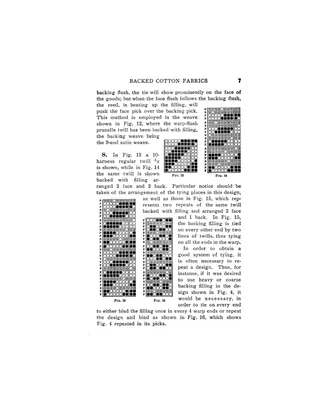
Weaves for Backed Cotton Fabrics
Monograph · 22 pages · weaving drafts
An International Correspondence Schools instruction paper on designing weaves for backed cotton fabrics, in which an extra warp or filling adds weight or warmth without showing on the face. It covers filling-backed and warp-backed cloths, including how to arrange face and back picks or ends, place the tying points, and make harness and chain drafts. The last sections treat piqués and Bedford cords, with wadding picks or ends, cutting picks and instructions for dissecting these cloths. Many design-paper figures and practice problems are included.
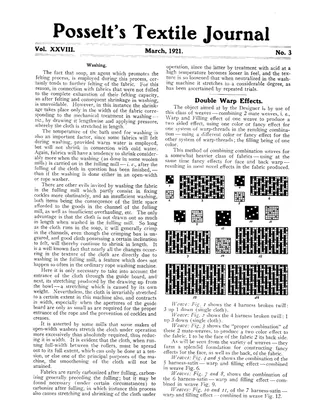
Double Warp Effects
Article · 2 pages · weaving drafts
Two-page scan from Posselt's Textile Journal, March 1921, whose main item is a short piece on double warp effects: combining two mate weaves (warp-effect and filling-effect) to make a two-sided cloth with different colors on face and back warps. Sixteen small drafts and drawdowns illustrate broken twills on 4 harnesses and 5-, 6-, 7- and 8-harness satins, plus a figured single-cloth effect on an 8x8 weave. The pages also carry filler articles on washing woolen cloth after fulling, dyeing hosiery with cotton splicing, and mordanting wool with chrome and sulphates.
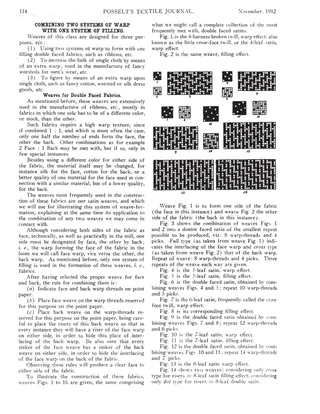
Lappet Weaving
Article · 4 pages · weaving drafts
A four-page installment from Posselt's Textile Journal (November 1912) on combining two systems of warp with one filling. It explains how to build double-faced satin fabrics and how to add an extra back warp for bulk in men's wear worsteds, with rules for placing face and back weaves on point paper. Figures 1-52 give draft examples for 1:1, 2:1 and mixed face-to-back arrangements using satins, twills, baskets and granite weaves. The last page continues the Lappet Weaving series, describing presser wheel and common wheel lappet ornaments (Figs. 6-9), including multi-frame work, open-work stripes and corded stripes.
The Manufacture of Beaver Overcoatings
Article · 2 pages · weaving drafts
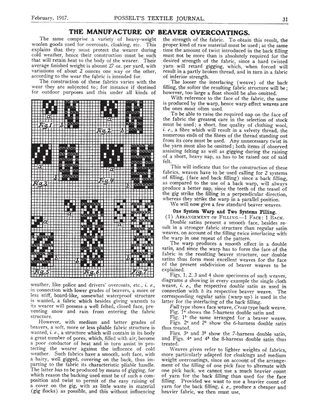
Part of a serial article from Posselt's Textile Journal (February 1917) on the construction of beaver overcoatings and cloakings, heavy woolen fabrics napped by gigging. It covers stock selection, twist and felting, and why a separate back filling is used. It gives standard beaver weaves built on 5- to 8-harness double satins, 4-harness twills and an irregular satin, with backing ratios of 1:1, 2:1 and 3:1 and a cotton warp variant. Seven drafts (Figs. 1-7) show face and back picks. Page 2 also carries a short item on cotton consumption and the start of an article on Indian turmeric as a dyestuff.
Ribbons, Trimmings,Edgings, etc
Article · 2 pages · weaving drafts
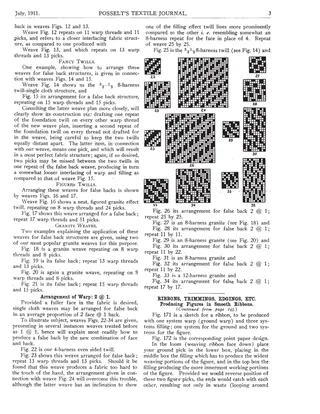
Two pages from the July 1911 issue of Posselt's Textile Journal, continuing a series on ribbons, trimmings and edgings. The first page finishes a discussion of false-back (backed) weave structures built on 4- and 8-harness twills, figured twills and granite weaves, with 1@1 and 2@1 face-to-back arrangements (Figs. 12-34). The second covers producing figures in smooth ribbons with one ground warp and several filling systems, including shuttle box arrangements, pick order and point paper designs (Figs. 171-174). It ends with the start of a continuing article on the influence of yarn twist on fabric.
Woolen and Worsted Ply Weaves
Monograph · 53 pages · weaving drafts
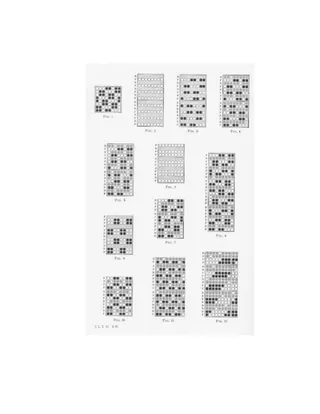
A correspondence-school instruction paper (International Correspondence Schools, Serial 511) on ply weaves for woolen and worsted cloth. It explains backed fabrics (filling-backed, warp-backed, reversibles, cut backed cloths, wadding fillings), double cloths (tying methods, wadding yarns, cut double cloths, double plain weaves) and triple cloths. It shows how to construct the weaves on design paper and how to make the drawing-in and chain drafts, with many numbered draft figures and practice examples.
Designing
Textile Mercury, 1890
Article · 2 pages · weaving drafts
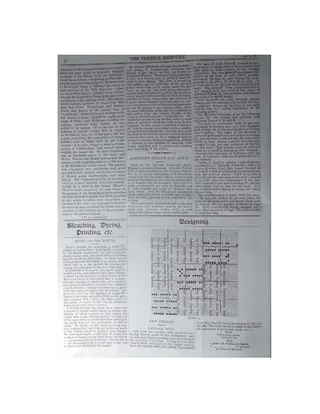
Two-page extract from The Textile Mercury containing a 'Designing' column on power-loom cloth design. It explains reversible double-weft carriage rug fabrics (Design 26, with notes on warp, weft, picks per inch and raising/finishing), a double plain alternative, and a striped worsted trousering (Design 28) with a draft and pegging plan. Page 1 also carries the end of an article on the Spitalfields silk-weaving district and notes on dyeing, including Alizarine Yellow G.G. and R. recipes for wool and cotton.
Warp & Weft, Vol. 21, No. 6 (June 1968)
June 1968
Periodical · 9 pages · weaving drafts
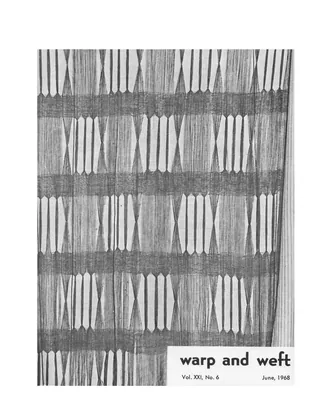
June 1968 issue of Warp & Weft, the monthly bulletin of Robin & Russ Handweavers in McMinnville, Oregon. It includes the editor's column about weaving conference trips, a critical review of Thorpe and Larsen's Elements of Weaving, a note on the cover photograph of an openwork drapery, and the monthly sample "Treasure Tones", a four-shaft backed upholstery fabric with a black 20/2 cotton warp, turquoise 10/2 cotton tabby backing and English Rug Wool pattern weft. The sample section gives threading, tie-up, treadling, warp take-up and a cost breakdown per yard. The issue also has a subscription price increase notice, the first of a photo series on worsted yarn production (carding), classified ads for yarns and equipment, and a back page of advertisements.
Our Textile Design School: Lesson 18 -- Binder Warps
Textile World Record, February 1906
Article · 11 pages · weaving drafts
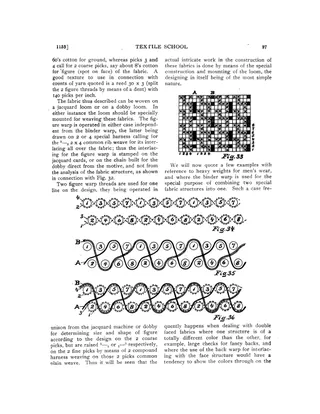
Lesson XVIII of the Textile World Record's textile design school series, on binder warps: extra warps, usually cotton, that stiffen or bind fabric structures. It covers binder warps in single cloth (silk dress goods built on 5- and 8-leaf satin and 2x4, 2x6 and 2x8 warp rib weaves, each combined with a plain binder at ratios from 2:1 to 4:1), and in cotton pique and figured dress goods. It also covers double cloth for men's wear, where binder warps join two plain or twill fabrics, and pile fabrics such as tapestry and Brussels carpets. Most pages carry weave drawdowns (Figs. 1-47) and thread-interlacing diagrams, with text on repeats, ratios, take-up and the need for separate warp beams.
To Increase Weight and Bulk of Fabric by Means of Back Filling
Article · 4 pages · weaving drafts
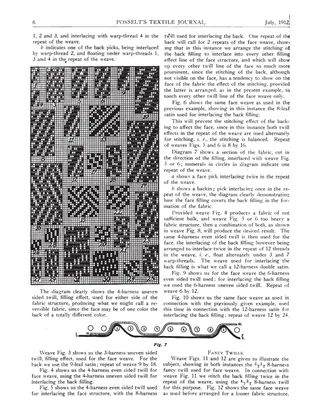
Article from Posselt's Textile Journal (July 1912) on adding weight and bulk to woolen and worsted cloth with a back filling, a second weft hitched to the back of a single-cloth structure. It sets out design rules: face-to-back pick ratios, yarn twist and count, and how to choose twill or satin weaves to bind the backing without disturbing the face. A plate of 28 weaves and several fabric cross-section diagrams illustrates face weaves and their backed versions, including fancy and figured twills, entwining twills, granite weaves and corkscrews. The start of the scan also has the end of a piece on calculating the repeat of Jacquard designs, and the last page has a short item on dyeing woolens with artificial silk effect threads.
To Increase Weight and Bulk of Fabric by Means of Back Filling
Article · 2 pages · weaving drafts
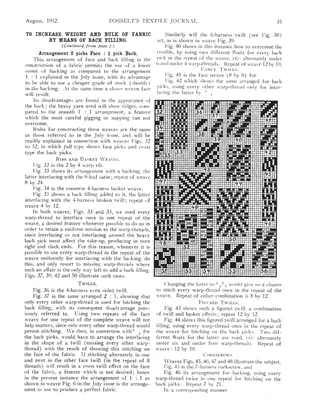
Continuation of a Posselt's Textile Journal article (August 1912) on adding back filling to fabrics to increase weight and bulk. It covers the 2 face : 1 back pick arrangement and the 2 face : 1 back : 1 face : 1 back combination, with weave diagrams (Figs. 32-56) for ribs, basket weaves, twills, fancy and figured twills, corkscrews, broken twills and granite weaves. The scan also starts an article on Jacquard terry pile fabrics, and has short notes on dyeing artificial silk and a thread polish recipe.
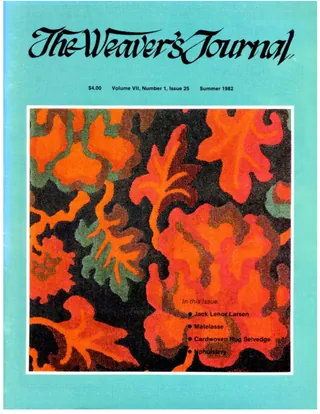
Weaver's Journal, Vol. VII, No. 1, Issue 25 (Summer 1982)
Weaver's Journal, Summer 1982
Periodical · 80 pages · weaving drafts
Summer 1982 issue of The Weaver's Journal, a quarterly for textile craftspeople. It features an interview with designer Jack Lenor Larsen, articles on interior and upholstery fabrics, and a group of pieces on matelasse and stitched double cloth, including loom-controlled quilting on four shafts and weave analysis. Other projects include a cardwoven selvedge for weft-faced rugs, a Linbogarn shirt with Bar Code 39 stripes, a braided strap from Colombia, woven felted boots, a double-woven mailbag, and backstrap weaving in Ecuador. The issue also has reader letters, book and foreign periodical reviews, product news, classified ads, and the Volume VI index.
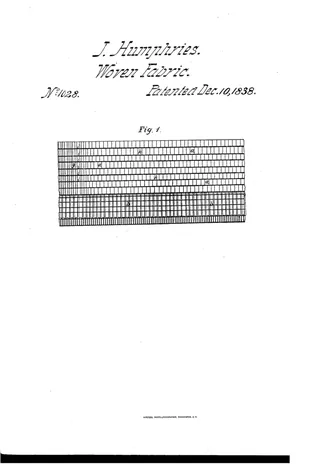
Woven Fabric
John Humphries · December 10, 1838
Patent · 2 pages · weaving drafts
US Patent No. 1,028, granted December 10, 1838 to John Humphries of New York, for an improvement in the manufacture of carpeting and rugs. The invention attaches an additional ply, rib or knit layer of weft material to the back of carpets such as Brussels, Wilton, Saxony and Imperial, secured by threads passing over and under the ply and through the carpet. A single figure shows the back of the carpet with the added ply and stitching threads.
Dictionary of Textile Terms
Article · 1 page
One page of the serialized Dictionary of Textile Terms from Posselt's Textile Journal, April 1918, continuing from the March issue. It gives short definitions of entries running from Mamudi to Mauvein. The entries cover fabrics, fibers and cottons, dyestuffs, finishing machinery and processes, and some weave terms such as Marseilles weave, mat weave and matelassé.
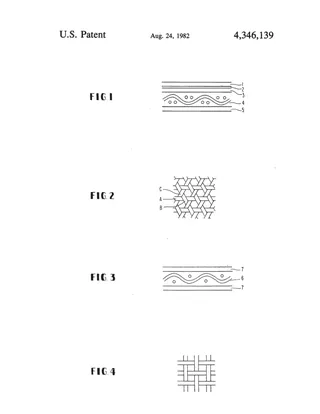
Highly Weather-Proof High Strength Tri-Axial Woven Membrane Materials, US Patent No. 4346139
Patent · 9 pages
US Patent 4,346,139, granted 24 August 1982 to Osawa, Nishimura and Toyooka of Sumitomo Electric Industries, for a weather-proof, high-strength membrane material for radomes. The membrane is a layered laminate: polyvinyl fluoride film, adhesive, sprayed urethane, a triaxially woven polyaramide (Kevlar-type) fabric with axes at 60 degrees, and a second sprayed urethane layer. The triaxial weave is claimed to resist creasing on triangular frames and to keep radio-wave permeability. The scan includes a web-database printout and the original patent pages with four figures, 13 claims and a description.
Designing
Textile Mercury, 1890
Article · 2 pages · weaving drafts
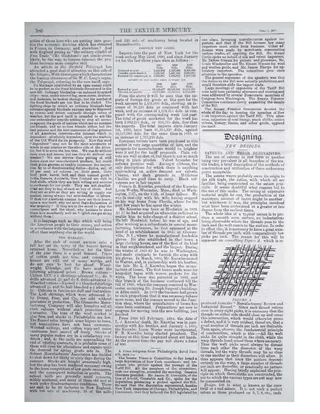
Two pages from The Textile Mercury of 7 June 1890 containing a 'Designing' column on sateens and their derivatives. It explains sateen construction principles (high ends per inch, few picks, weft lying straight) and discusses 4-, 5-, 6- and 7-end sateens with their uses in coatings, dress goods, doeskins and Venetian cloth. It also covers tying a back to a sateen face, illustrated by small drafts (Designs 108-120), and gives a linen dress design with fruit and foliage figures, with warp and weft specifications. The first page also carries unrelated trade news on the US tariff, markets and dry goods imports.
Double Weaves - Stitched Layers
Master Weaver, May 1953
Article · 3 pages · weaving drafts
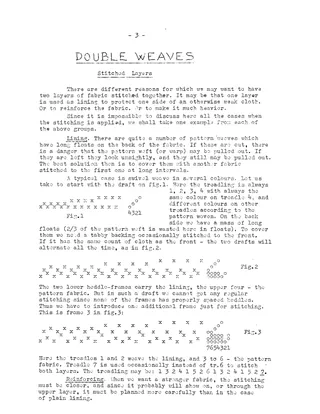
A short article from Master Weaver on stitching together the two layers of double weaves. It covers three uses: lining to cover long floats on the back of pattern weaves such as swivel weave, reinforcing an open basket weave with a tabby ground, and quilt weaves with wadding between the layers. Drafts (Figs. 1-10) and treadling sequences accompany each example. It ends with a practical project for a heavy couch cover, giving yarns, setts, quantities and reed advice.
Two Warp Double Weaves
Master Weaver, May 1961
Article · 2 pages · weaving drafts
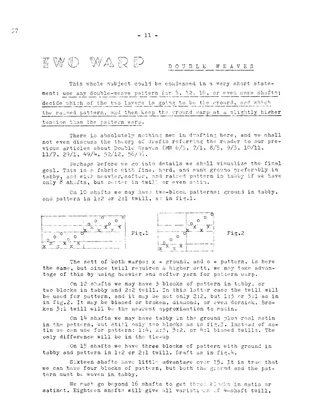
A two-page article from Master Weaver explaining how to weave double weaves with two separate warps, a tighter ground warp and a slacker pattern warp, on 8 to 21 shafts. It describes what each shaft count allows: tabby ground with tabby, twill or satin pattern, and two to four pattern blocks. Fig. 1-4 give threading drafts; tie-ups are deferred to a later article. It ends with practical advice on weft tension, shuttle handling, edges, warp tensions and sampling.
Designing
Textile Mercury, 1891
Article · 2 pages · weaving drafts
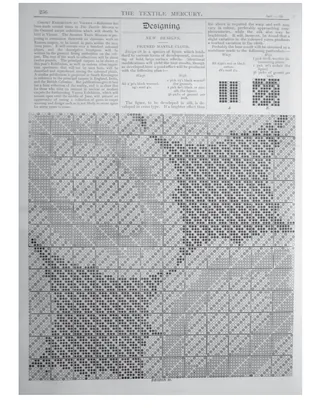
Two pages from the Textile Mercury of 11 April 1891 with the weekly 'Designing' column of new fabric designs for the trade. It gives yarn counts, reeds and picks per inch for a figured mantle cloth (Design 28), a 20-shaft dress goods draft, coloured fancies, zephyr lawns, stripes and plain muslins, with warp colour schemes and pegging plans. A short note on the Oriental carpet exhibition at Vienna precedes the column.
Designing and Fabric Structure
Article · 2 pages · weaving drafts
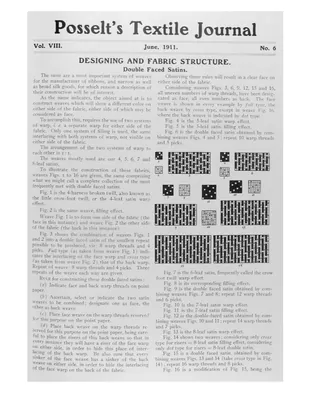
An installment of Posselt's "Designing and Fabric Structure" series on double faced satins, from Posselt's Textile Journal, June 1911. It explains how two warp systems and one filling are combined so each side of the fabric shows a different color, with a rule for constructing the weaves and Figs. 1-16 covering 4- to 8-leaf satin combinations. It then shows how to produce checkerboard and spotted figured effects by exchanging face and back colors (Figs. 17-20), with warp dressing and repeat sizes. The second page also begins a continuation on producing figures in smooth ribbons (Figs. 167-169).
Drafts and Designs, Vol. 20 (1977-1978)
Russell E. Groff · 1977-1978
Periodical · 20 pages · weaving drafts
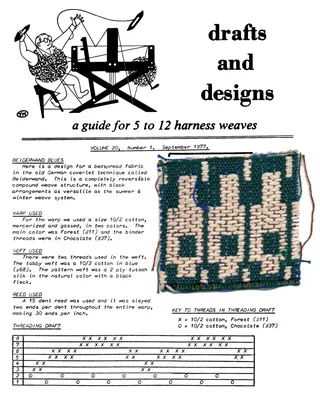
Volume 20 of the monthly periodical Drafts and Designs, covering issues 1 to 10 (September 1977 to June 1978), published by Robin & Russ Handweavers of McMinnville, Oregon. Each issue presents one fabric sample for 5 to 12 harness looms, with a threading draft, tie-up, treadling sequence, yarns and reed used, notes on weaving the fabric, and the cost of the yarns and fabric. Designs include a Beiderwand bedspread, a Bronson spot plaid, a Tag System bedspread, double weave drapery and overlay fabrics, a Welsh blanket copy, and 8-harness fabrics such as Beehive Ovens and Indian Village.
Drafts and Designs, Vol. 24 (1981-1982)
Periodical · 12 pages · weaving drafts
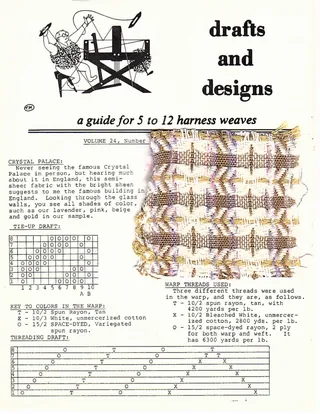
A 12-page selection of monthly issues from Volume 24 (September 1981 to June 1982) of Drafts and Designs, a newsletter of Robin & Russ Handweavers for 5 to 12 harness weaving. Each issue presents one fabric sample with its threading and tie-up drafts, treadling sequence, reed sleying, threads used, and per-yard cost. Samples include Crystal Palace (8-shaft semi-sheer rayon and cotton), Beiderwand, Daffodils in Spring (6-shaft warp-faced linen), Sculptured Sand-Dunes (Bedford cord), Marcee's Magic (8-shaft linen point twill variation), and San Diego Sun-Rise (6-shaft extended twill in cotton floss).
Die Eskimogewebe [The Eskimo Fabrics]
Article · 2 pages · German · weaving drafts
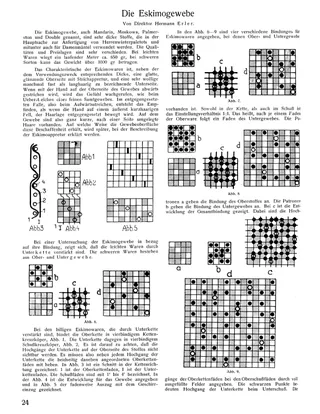
First installment of a German article by Hermann Erler on Eskimo cloths (also called Mandarin, Moskowa, Palmerston and Double), thick woolen coatings used for men's winter overcoats and some women's coats. It describes the characteristic smooth, brushed face and woolly back, then explains the weave structures: lighter qualities use a backed warp with a 4-end warp-faced and weft-faced twill, while heavy qualities use a double cloth with separate face and back weaves. Drafts and a table list four face/back/binding combinations (Abb. 6-9), and two photographs show the cloth after fulling and after finishing. The article ends with 'to be continued', with finishing to be covered later.
November, 1913
Article · 2 pages · weaving drafts
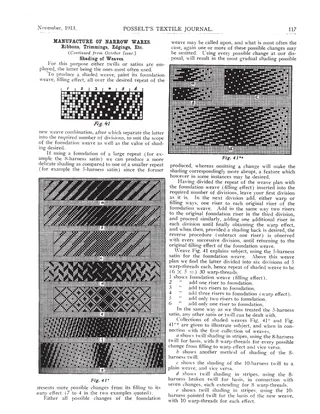
Two pages from the continuing series on the manufacture of narrow wares (ribbons, trimmings, edgings) in Posselt's Textile Journal, November 1913. The text explains how to build shaded weaves from twill or satin foundation weaves by adding risers in successive divisions. It then covers fabrics with two warp systems (face and back warp) and three warp systems (face, interior and back warp) with one filling, with draft figures 41 to 45 and a fabric cross-section.
Reversibles
Article · 2 pages · weaving drafts
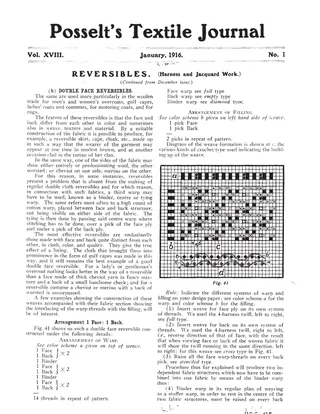
Part of a serial article from Posselt's Textile Journal (January 1916) on double face reversible fabrics for harness and Jacquard weaving. It explains how face and back plies differ in color, weave and material, and how a third binder (centre or tying) warp joins them. Worked examples (Figs. 41-43) with warp and filling arrangements, weave plans and fabric sections cover 1 face:1 back and 2 face:1 back constructions using 4- and 6-harness twills and plain weave.
Two-Warp Fabrics 2
Master Weaver, November 1960
Article · 2 pages · weaving drafts
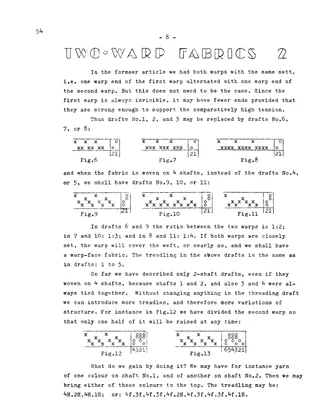
A two-page installment from Master Weaver on two-warp fabrics, continuing an earlier article. It explains how the first (hidden) warp can be set with fewer ends than the second warp, using ratios of 1:2, 1:3 and 1:4, and gives 2-shaft and 4-shaft drafts (Figs. 6-13). It then covers dividing the second warp to bring different colours to the surface, reversible tie-ups, treadling examples, and how to weave raised cords, terry (uncut) pile and cut pile with rods.
Welts, Piques, Toilet Cloth, Quiltings, Bed Spreads
Article · 4 pages · weaving drafts
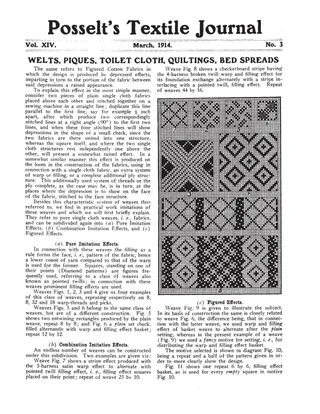
Article from Posselt's Textile Journal on welts (cords), piqués, toilet cloth, quiltings and bed spreads. It first covers imitation effects in single cloth (pointed twills, basket-weave figured effects), then explains welt construction with face and back warp and wadding picks. Includes numbered weave diagrams (Figs. 1-42), a fabric calculation for a 40-inch cotton welt (reed, take-up, yarn counts, material weights), and cross-section diagrams of welt fabrics. The scan ends with the start of a following article on skip twills.
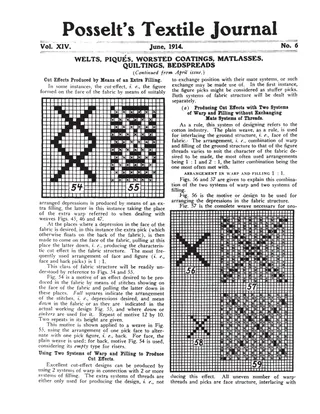
Welts, Piqués, Worsted Coatings, Matlasses, Quiltings, Bedspreads
Article · 2 pages · weaving drafts
Two pages from Posselt's Textile Journal: the continuation of a series on welts, piqués, worsted coatings, matlassés, quiltings and bedspreads, followed by the start of an article on analyzing double cloth weaves. The first part explains how cut (depressed) effects are produced with an extra filling or with two systems of warp and filling, in 1:1 and 2:1 arrangements, with motive and weave Figs. 54-59. The second part gives a worked example of separating a 27-end double cloth weave into face weave, back weave and stitching weave, illustrated by seven drawdown figures.
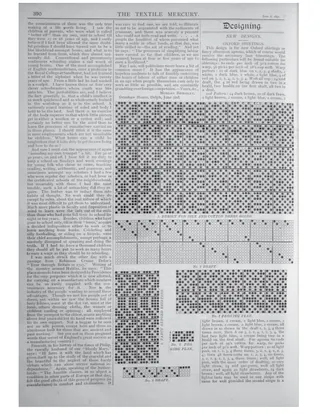
Designing
Textile Mercury, 1891
Article · 2 pages · weaving drafts
Two pages from The Textile Mercury of 6 June 1891 presenting new fabric designs with drafts and pegging plans. They cover Oxford shirtings and apron fabrics, a light silk and cotton dress goods design on 16 shafts, and wadded-pick structures for woollens and worsteds (Designs 45-48) with colour and yarn suggestions. Design 48 combines furrows with an 8-end sateen on 18 shafts, and the section closes with suggestions for dress fabrics. The first page opens with the end of an unrelated letter to the editor.
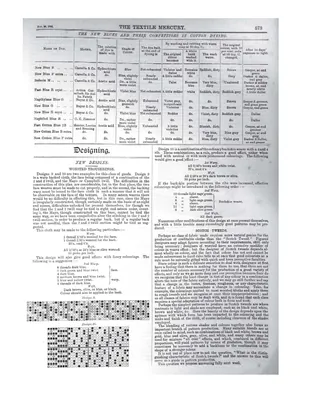
Designing - Worsted Trouserings
Textile Mercury, 1899
Article · 1 page · weaving drafts
A single page from The Textile Mercury with a 'Designing' column on worsted trouserings. It gives two designs (9 and 10) with draft grids: Design 9 is a warp-backed cloth combining 2/2 twill and the Mayo (Campbell) twill, tied on an eight-end sateen base, and Design 10 combines buckskin weave with a 4 and 4 rib. Yarn counts, reed, picks per inch and colour warp/weft suggestions are given. A short introductory section on Scotch tweeds discusses colour in pattern design. The top of the page has a table comparing blue cotton dyes (New Blue, Indazin, Naphthylene Blue and others) for fastness and shade.
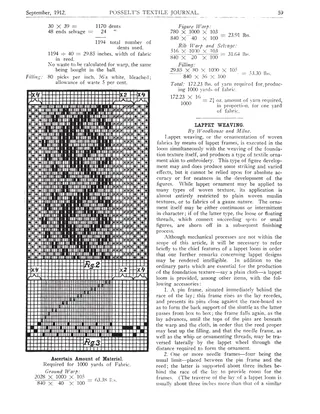
Lappet Weaving
Article · 3 pages · weaving drafts
Three pages from the September 1912 issue of Posselt's Textile Journal. The first part of an article on lappet weaving by Woodhouse and Milne explains how lappet ornament is woven with the ground cloth and describes the lappet loom's pin frame, needle frames, whip rolls and pattern wheels (common and presser types), including pattern wheel size and pick calculations. The scan opens with the end of a warp and yarn quantity calculation for a lappet fabric. It closes with a section on adding weight and bulk to fabric with back filling, with weave drafts 57-67 showing 3 face : 1 back arrangements stitched with satins on rib, basket and granite weaves.
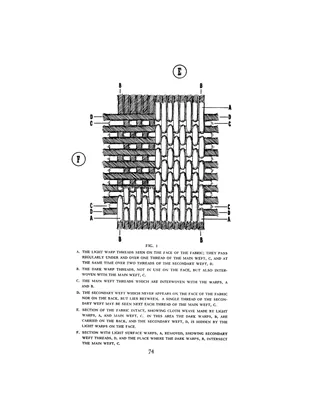
Notes on the Weaves of a Group of Silk Fabrics from the Burial Mounds of Noin-Ula Now in the Pennsylvania Museum of Art, Philadelphia
Article · 5 pages
Article by Eleanor B. Sachs, compiled from notes by Nancy Andrews Reath, on the weave structures of Han Dynasty silks from the Noin-Ula burial mounds in the Pennsylvania Museum of Art. It explains the complex warp-faced compound cloth weave, with several colored warps, a main weft and a hidden secondary weft, which is the same technique as the Lou-lan silks found by Stein. It also describes a fine fancy gauze weave. Technical analyses of two examples give materials, colors, thread counts and sizes, and a diagram (Fig. 1) shows the layered structure.
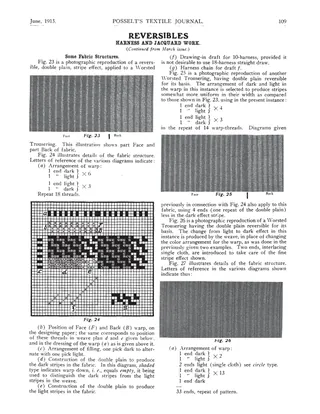
Reversibles
Article · 2 pages · weaving drafts
Installment of Posselt's series on reversible fabrics (harness and Jacquard work), published in June 1915 and continued from the March issue. It describes worsted trouserings built on the double plain reversible principle, with photographs of face and back and diagrams giving warp and filling arrangements, weave plans for dark and light stripes, a 10-harness drawing-in draft and harness chain. It also covers a reversible built with 4-harness even-sided twill for both plies. The second page ends with a short unrelated piece on unsuitable materials (starch, gelatine, glue) in finishing cotton goods.
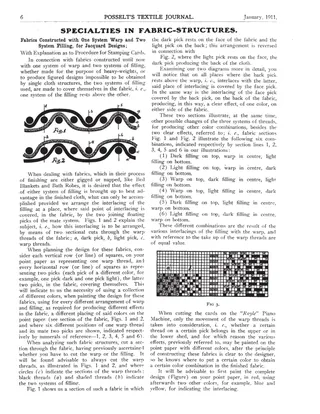
Specialties in Fabric Structures
Article · 4 pages · weaving drafts
Article from Posselt's Textile Journal, January 1911, on designing Jacquard fabrics with one warp system and two filling systems (dark and light picks) that cover each other, as used for gigged or napped goods like blankets and bath robes. It explains point-paper painting, card stamping for the Royle piano machine, and binding weaves (4-harness broken twill, uneven-sided regular twill, 5-leaf satin), with Figs. 1-8 showing sections and interlacing diagrams. The last page begins an unrelated article on making artificial silk from cellulose with an improved apparatus.
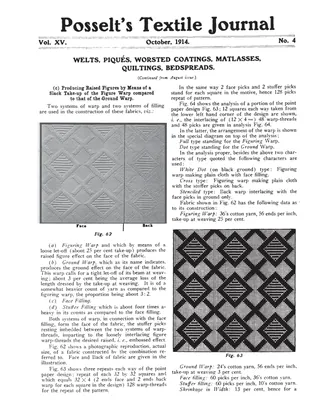
Welts, Piqués, Worsted Coatings, Matelassés, Quiltings, Bedspreads
Article · 2 pages · weaving drafts
Two pages from Posselt's Textile Journal, October 1914. The first continues an article on welts, piqués, matelassés and similar fabrics, describing raised figures produced by a slack take-up of the figure warp relative to the ground warp. It covers the two warp and two filling systems, the stuffer picks, point paper design and analysis, and construction data for a sample cotton fabric. The second page carries the end of that article, a note on a patented plush fabric design, and a section of the series on foundation weaves covering the characteristics of satin weaves and the number of harnesses needed.
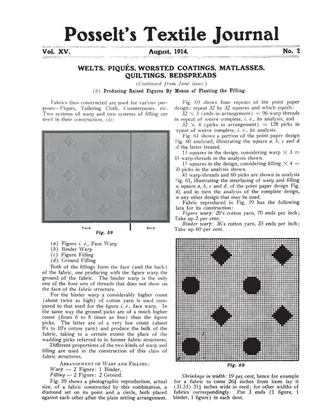
Welts, Piqués, Worsted Coatings, Matlasses, Quiltings, Bedspreads
Article · 2 pages · weaving drafts
Two pages from Posselt's Textile Journal continuing a series on welts, piqués, matelassés and related fabrics. This installment covers raised figures made by floating the filling, using a figure warp, binder warp, figure filling and ground filling. It gives the arrangement, yarn counts, sett, take-up, shrinkage and reed data for a Jacquard-woven piqué, with point-paper design and analysis figures. It ends with specifications for a worsted trousering fabric.
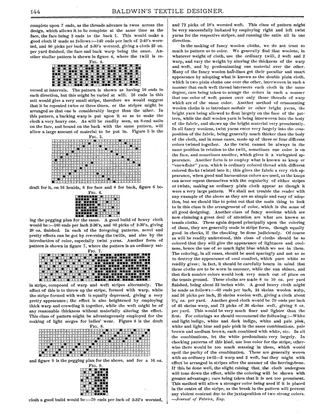
Worsteds and Woolens, Etc.
Baldwin's Textile Designer, September 1889
Article · 2 pages · weaving drafts
A two-page article from Baldwin's Textile Designer (September 1889), reprinted from the Journal of Fabrics, on designing worsted and woolen cloths for men's coatings, trouserings and suitings. It describes satin-based corkscrew or rolling twill patterns on 10, 11 and 14 ends, a backed cloth, and a heavy 16-end backed satin with draft and pegging plan, plus a satin stripe for light serges. Cloth builds are given as ends and picks per inch, yarn counts and finished weight. The last part covers fancy woolens (double plain hair-lines, mohair, twist and knop yarns) and tennis cloths, with coloring advice.
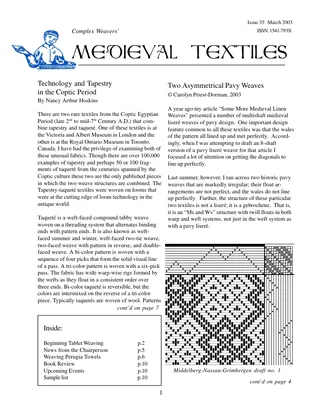
Complex Weavers Medieval Textiles Study Group Newsletter 35
Nancy M. McKenna · March 2003
Web Doc · 10 pages · weaving drafts
Issue 35 (March 2003) of the Complex Weavers Medieval Textiles Study Group newsletter. It includes Carolyn Priest-Dorman's analysis of two irregular medieval pavy weaves (gebrochene structures) from a Middelburg antependium and a linen fragment from St. Truiden, with drafts. It also has Nancy Arthur Hoskins's article on Coptic tapestry-taqueté textiles and her recreation, Cerise Moodey's introduction to cardweaving with warping instructions, and Joanne Burrows's account of weaving linen 'Perugia towels' with diamond twill ground and brocaded borders. The issue closes with a chairperson's column, a comic strip about a medieval cloth merchant, upcoming exhibitions and a review of Mazzaoui's book on the Italian cotton industry.
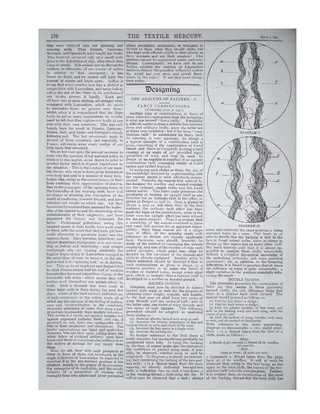
Designing
Textile Mercury, 1892
Article · 2 pages · weaving drafts
Two pages from The Textile Mercury (March 5, 1892) containing part V of the series 'The Analysis of Pattern', on fancy combination twills, backed cloths and double cloths, with advice on analysing woven fabrics and finding how backing is tied to the face. A second section, 'Cotton Dress Goods Designs', discusses fashion and colours for cotton dress goods and gives draft, pegging plan and threading details for a fancy zephyr stripe with small warp spots. The pages include draft grids for Designs 9-15 and A, plus magnified thread diagrams. The first page also opens with an editorial on the Lancashire cotton trade and labour unions.
Die Eskimogewebe [The Eskimo Fabrics]
Article · 2 pages · German · weaving drafts
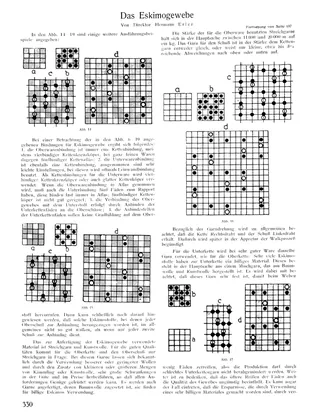
A two-page installment (pp. 330-331) of Hermann Erler's serial article on Eskimo fabrics, a double-cloth wool material with separate face and backing warps and wefts. It gives further weave examples (Abb. 14-19) and summarizes the structures used: four-end warp-faced cross twill or five-end warp satin for the face, and warp-faced twill, satin or plain weave for the backing, with backing warp ends tied to face picks. It also covers yarn materials (carded woolen yarn, shoddy, cotton blends, mohair or silk for chinchilla effects), yarn counts, twist direction, and how these affect fulling. A table lists face weave, backing weave, binding weave and thread settings for each figure.
The Textiles from Las Huelgas de Burgos
Article · 24 pages
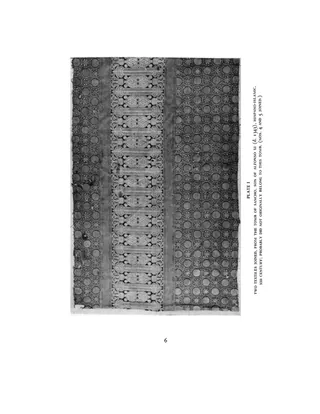
Dorothy G. Shepherd reviews Manuel Gómez-Moreno's 1946 publication on the textiles found in the royal tombs at the Cistercian convent of Las Huelgas de Burgos, adding notes from her own study there in 1949. She re-classifies the silks, twills, half-silks and tapestries using Nancy Reath's weave terminology and disagrees with Gómez-Moreno's attributions, assigning many pieces to Hispano-Islamic or Mudejar workshops rather than Christian or Regensburg ones. Fourteen plates illustrate fabrics from the tombs of Fernando de la Cerda, Leonor of Aragon, Alfonso VIII and others, and a comparison stucco panel.
130 documents found