Textile Documents › Topic: Tartans, plaids, stripes, and checks
245 documents found
Sort: 
Tartan
Article · 1 page
A short encyclopedia entry defining tartan as a checkered cloth, also called plaid, with notes on the possible French and Spanish origins of the word and the Gaelic name breacan. It notes that Highland clans each have a distinctive pattern, and cites two reference works on clan tartans.

Gingham
Zell's Encyclopedia, 1876
Article · 1 page
A short encyclopedia entry defining gingham as a cotton fabric, usually with a colored check pattern produced by weaving colored threads rather than by dyeing or printing the finished cloth. It notes the French origin of the word and mentions that several kinds are sold under different trade names, including umbrella gingham woven in a single color.
Plaid
Article · 1 page
A short encyclopedia entry defining the plaid as the woollen outer garment of Scottish Highlanders. It gives the proposed Gaelic and Latin etymology, describes how the plaid was worn and how the lower portion became the kilt (philibeg), and notes that the word came to mean any checked or tartan cloth, including shepherd's plaid.
Stripes
Master Weaver, September-October 1962
Article · 3 pages
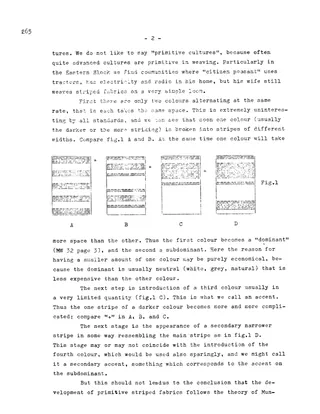
A short essay from the Master Weaver bulletin on the development and design of striped fabrics. It traces how stripes in weft and warp evolved in primitive weaving, from two alternating colours to dominant, subdominant and accent stripes, illustrated with four sample panels. It closes with six suggestions for designing stripes, including blending colour ratios, unsymmetrical stripes and changing the rhythm, and notes suitable weaves such as tabby and broken twills.
Stripes, Part 1: Introduction
Ralph E. Griswold · December 24, 2004
Web Doc · 2 pages
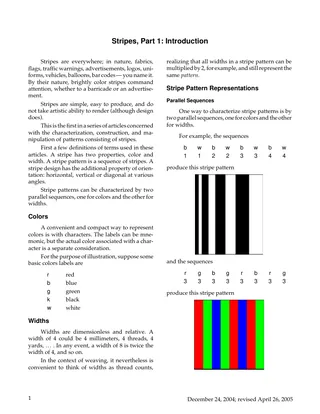
The first article in Ralph Griswold's series on stripe patterns. It defines stripes by color and width, and defines stripe patterns and stripe designs (which add orientation). It describes two representations: parallel color and width sequences, and color/width pair sequences. It also explains reducing repeated adjacent colors and the orientation of stripes at angles between 0° and 90°, with 45° corresponding to regular twills. It is a short conceptual introduction with simple illustrated examples and no weaving drafts.
Tartan
Article · 1 page
Encyclopedia article on tartan, a worsted cloth woven with colored warp and weft stripes in set sequences, and its association with Scottish Highland dress. It covers the term's etymology, early documentary references from 1471 to 1703, the post-1745 acts prohibiting Highland dress (repealed 1782), and doubts about the authenticity of clan setts. It closes with brief color descriptions of the tartans of about twenty clans and a short list of references.
Plaids
Monograph · 14 pages
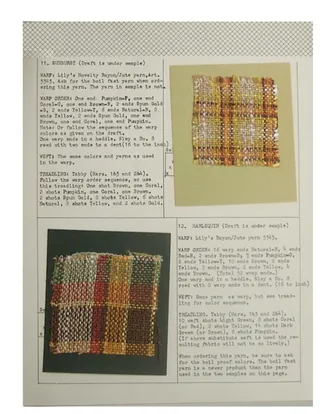
A folio of 24 plaid fabric patterns by Elmer W. Hickman, issued under the Onondaga Weavers Guild emblem, with woven swatches mounted on each page and drafts placed beneath them. Each entry gives the warp yarns, warp order, reed and sley, weft, and treadling. Most are tabby plaids; a few are twill or use other treadlings. The last page, titled Tabby Talk, explains the diffused construction in which the warp color counts are rotated to set the weft shot counts (illustrated with Thistle). It also gives helpful hints, thanks to contributing weavers, and a list of yarn suppliers.
Scotch Tartan Sets
Monograph · 16 pages
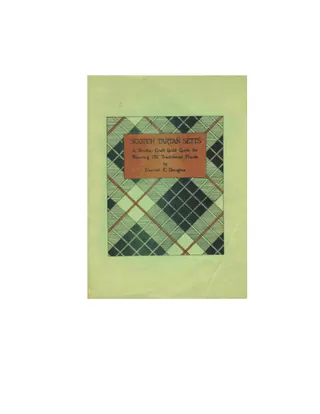
A 1949 Shuttle-Craft Guild pamphlet by Harriet C. Douglas giving thread-count color setts for 132 traditional Scottish tartans. The introduction covers the history and standardization of tartans, threading and weaving as a balanced 2-2 twill, yarn choices (Bernat Fabri wool, Lily Mills cottons), warp setting for various articles, books on tartans, and estimating yarn. The bulk is an alphabetical listing (Anderson to Wemyss) of setts, each with pattern units A, B, C, D, the number of threads per color stripe, and total ends.
Stripes: The Survival of the Fittest
Article · 5 pages
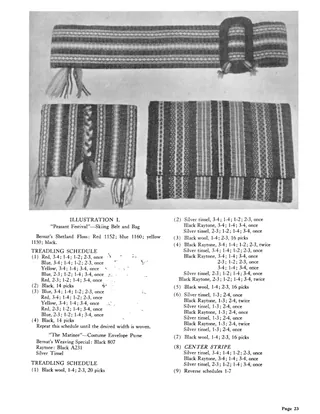
An article on designing striped handwoven fabrics, arguing that stripes succeed through a planned balance of regimentation and variety in color, width, treadling and yarn. It gives treadling schedules with yarn colors and pick counts for small items such as skiing belts, costume purses, bags, chair seats, footstool covers and end-table runners, all woven on a Rose Path threading. Named examples include "Peasant Festival," "The Bedouin," "Cleopatra," and several unillustrated tabby-stripe designs.
The Weaver's Book of Scottish Tartans Portfolio
Other · 9 pages
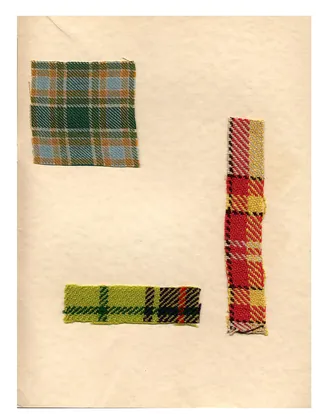
A sample portfolio accompanying Harriet Tidball's Shuttle Craft Monograph Five, The Weaver's Book of Scottish Tartans. It contains twelve mounted swatches cut from tartan yardages, with a text key describing each sample: the tartan name and number, yarn, sett in ends per inch, and weaver or mill. The notes discuss traditional, ancient (faded), hunting, pre-proscription unnamed and substitute ("bastard") colorings, and the suitability of each fabric for suits, scarves, children's jackets, kilts and dress fabric.
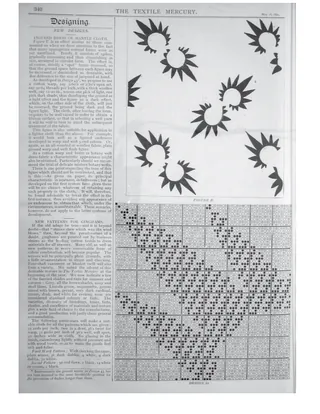
Designing
Textile Mercury, 1891
Article · 2 pages · weaving drafts
Two pages from the Textile Mercury of 16 May 1891, in its designing column. They describe a new jacquard figure for dress or mantle cloth (Figure E, Design 43), built from circular arrangements of graduated spikes, with suggested cotton warp and woollen weft constructions. The pages also give ten plain-weave and ten four-shaft twill colour-and-weave gingham stripe patterns with warp counts, sett and colour sequences, and a new all-over figured design for silk and cotton dress goods with a pegging plan, a 28-shaft straight draft and colour suggestions.
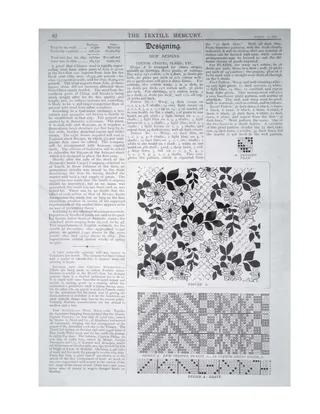
Designing
Textile Mercury, 1892
Article · 2 pages · weaving drafts
An article from The Textile Mercury of January 23, 1892, giving new design suggestions for cotton stripes, plaids and a figured dress fabric. It gives warp and weft counts, reed setts and colour sequences for two striped patterns and seven plaid patterns on six shafts, with a pegging plan and draft for Design A. It closes with a figured worsted or silk dress fabric (Design 7) with yarn and sett details, suggested substitutions of mohair and worsted, and notes on using double plain weave for solid leaf areas.
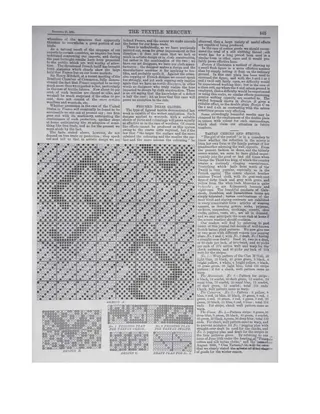
Designing
Textile Mercury, 1890
Article · 2 pages · weaving drafts
Two pages from the Textile Mercury of 27 December 1890 (pp. 444-445). The pages open with the end of a piece on the Bradford Chamber of Commerce and retaliation against French tariffs, then run short items on Piedmontese and Italian hemp cultivation, book reviews and a note on granite cloth. The textile content is a 'Designing' column arguing that British cloth lacks artistic design compared with French, followed by notes on figured dress cloths (Designs A, B, C using plain, twilled hopsack and double plain) and tartan checks and stripes. The tartan section gives thread counts for the Clan M'Neil, Macintosh, Cameron and Gunn setts, with pegging plans and a draft.
Master Weaver, No. 65 (September-October 1962)
Periodical · 14 pages · weaving drafts
Issue No. 65 (September-October 1962) of Master Weaver, a bi-monthly bulletin for handweavers published by Z-Handicrafts in Fulford, Quebec. It contains articles on the design and history of striped fabrics, a handwoven pile "fur coat" fabric combining corduroy pile, tabby lining and stitching on 8 shafts, basket weave (2:2, 3:3, 4:4) with tabby-edge threadings and weaving rhythm, and backing in warp using turned drafts. A "From the Classics" excerpt from Clinton G. Gilroy's The Art of Weaving (1844) on harmonious colouring is included, and the issue ends with a subscription and product advertisement.
Practical Weaving Suggestions, Vol. 4-61 (1961): Design Your Own Plaids
Periodical · 8 pages · weaving drafts
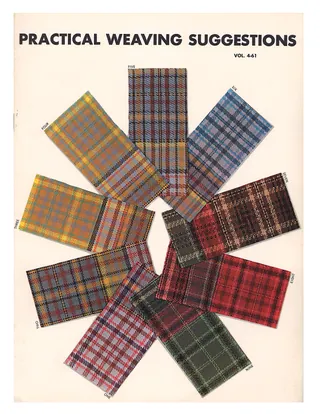
A Lily Mills Practical Weaving Suggestions booklet in which Muriel F. Barnes explains how to design a plaid, using a sample blanket woven in Lily Art. 110 weaving wool. She works out a 4-color, 86-end warp sequence, a 10-dent reed sett at 2 ends per dent, and a squared-paper design, then weaves nine color schemes with different weaves. Drafts are given for 2/2 twill, broken twill, tabby and basket, comb tabby with 1:3 twill, tabby with 2/2 twill, a small figure weave, and two crepe weaves. Color schemes are listed for each sample.
The Scottish Tartan Plaids
Article · 5 pages · weaving drafts
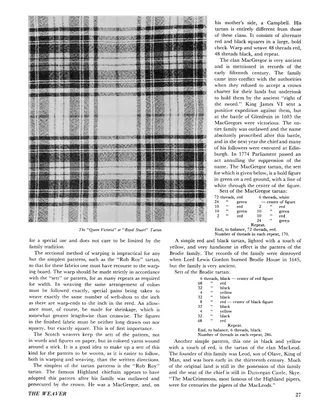
Mary Atwater introduces Scottish tartan plaids for American handweavers, covering the traditional Highland costume, the meaning of clan patterns, and practical advice on yarn, sett, warping and finishing. She gives thread-count setts for about a dozen tartans, including Rob Roy, MacGregor, Brodie, MacLeod, Macbeth, the Stewart tartans, Black Watch, Menzies, Murray of Tullibardine, Douglas, MacKay and MacQueen, with brief clan histories and colour descriptions. Suggestions are given for scarves, shirts, skirts, couch blankets and automobile robes.
Warp & Weft, Vol. 26, No. 5 (May 1973)
Warp & Weft, May 1973
Periodical · 8 pages · weaving drafts
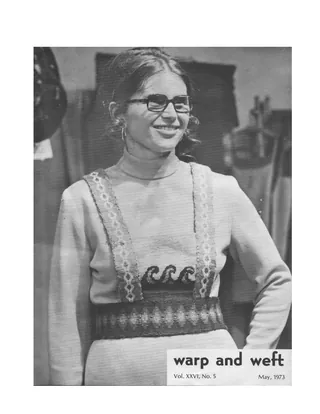
May 1973 issue of Warp & Weft, the monthly newsletter of Robin & Russ Handweavers in McMinnville, Oregon. It includes the editor's report on the new Oregon Trail Loom and on weaving conferences in Vancouver and Denver, reviews of two books titled Simple Weaving (by Marthann Alexander and Grete Kroncke), and the monthly sample, a 4-harness twill tartan called Raspberry and Pink Fizz. The sample has a tie-up for counterbalanced and jack looms, a threading draft, yarn details, a correction to the April tie-up, and a cost breakdown. The issue ends with an editorial urging weavers to experiment, classified ads for yarns and equipment, and a marketplace page.
Warp & Weft, Vol. 35, No. 1 (January 1982)
January 1982
Periodical · 8 pages · weaving drafts
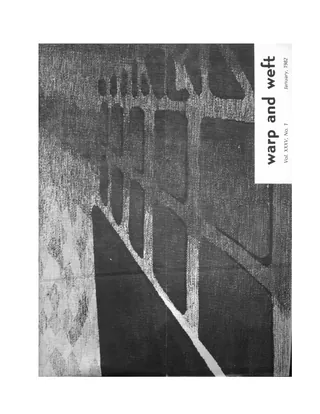
January 1982 issue of Warp and Weft, the monthly newsletter of Robin & Russ Handweavers in McMinnville, Oregon. It includes the editor's column (a New Mexico conference, an England trip and antique bobbin lace bobbins), a cover note on a tapestry by Marilyn Geller, and a full draft for the Douglas tartan with threading, tie-up, colors, sett and treadling. It also has a review of The Woolcraft Book by Constance Jackson and Judith Plowman, classified ads for yarns and equipment, and ads for a New Zealand and Australia weaving tour.
Designing
Textile Mercury, 1890
Article · 2 pages · weaving drafts
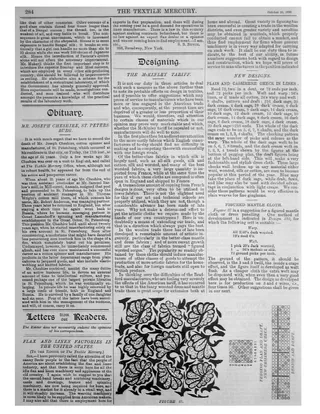
Two pages from The Textile Mercury of 25 October 1890 with a weekly Designing column. The column discusses how the McKinley Tariff affects textile design and suggests that British manufacturers move into finer figured worsted and mantle fabrics. It gives sett, colour and draft details for a plain and cassimere check in linen, a figured mantle cloth (Figure 27, Design 192), and five fancy tartan checks, including the Macduff or Fife tartan. The pages also carry an obituary of Joseph Cheshire, a St. Petersburg cotton spinner, a reader's letter on opportunities for flax and linen machinery in the United States, and the end of an item on Bengal silk.
Kentucky Weaver, Vol. 4, No. 2 (1951)
Kentucky Weaver, 1951
Periodical · 16 pages · weaving drafts
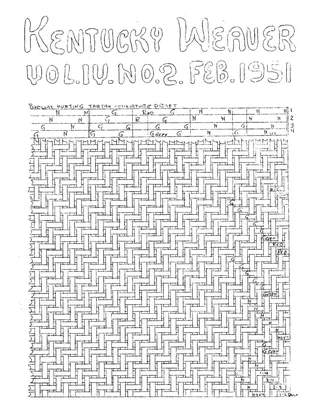
Issue of the Kentucky Weaver (February 1951, Vol. IV, No. 2) devoted to Scottish tartans woven on a 4-shaft even twill. It opens with an introduction on tartan history and current uses, with book recommendations, then gives threading drafts and sett notes for the Barclay, Clergy, Elliot, Leslie, Logan/MacLennan, MacAlpine, MacLeod, MacMillan, Macpherson (dress and grey hunting), MacQueen and Wallace tartans. Each page gives basic, typical and scaled-down thread counts, color blocks, sett and yarn suggestions (nylon, wool, mercerized cotton, linen), and notes on afghans, shirting, upholstery, scarves and bags made at the Little Loomhouse. The issue also includes clan history, tips for new young weavers, and a swatch page.
The Sett and Weaving of Tartans
Monograph · 48 pages
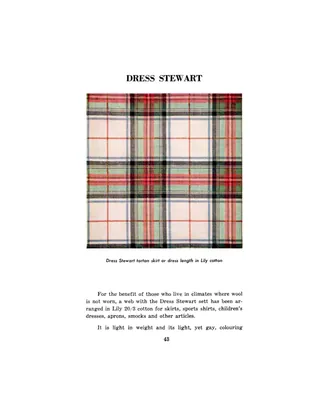
A 1959 instructional booklet by Mary E. Black, published by Lily Mills, on understanding and handweaving Scottish tartans. It explains the difference between a plaid and a tartan, the clan and district origins of setts, and the block system for threading and treadling setts on a 2/2 twill. Step-by-step projects (Menzies, Buchanan, MacLeod, Johnstone, MacPherson, Mackintosh, Dress Stewart) give materials, sleying, warp setts, block order and finished sizes for place mats, napkins, scarves, skirts and dress lengths in Lily cotton and wool yarns. Also covers beating to keep a 45-degree diagonal, selvedges, and finishing.
Warp & Weft, Vol. 14, No. 6 (June 1961)
June 1961
Periodical · 8 pages · weaving drafts
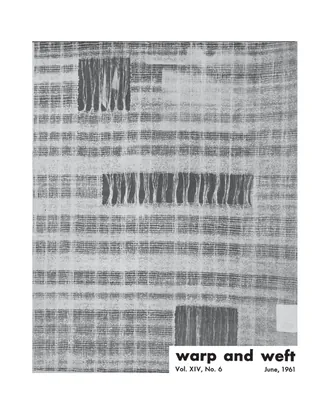
June 1961 issue of Warp and Weft, a monthly handweaving bulletin from Robin & Russ Handweavers of Santa Barbara. The main feature is a draft for an authentic Buchanan tartan in 2/32 worsted, with tie-up for counterbalanced and jack looms, an 82-thread threading, treadling sequence, reed and sett details, and notes on selvages and using a temple. It also includes the concluding article on the history of spinning, from the Saxony wheel to the English inventors and the commercial spinning steps. The issue closes with an editor's column, a sheer striped drapery fabric by Nina Burnham, a book sale, and classified and display advertisements for yarns, looms and supplies.
Warp & Weft, Vol. 18, No. 1 (January 1965)
January 1965
Periodical · 9 pages · weaving drafts
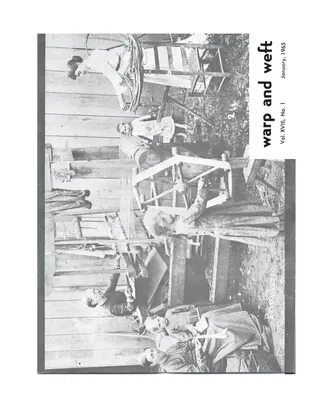
January 1965 issue of Warp and Weft, a monthly handweaving newsletter from Robin & Russ Handweavers of McMinnville, Oregon, marking the end of its first ten years. It includes an editor's note, a note on the cover photograph of a primitive Alabama cotton factory (c. 1870), and a review of Iona Plath's book Handweaving. Two projects with full drafts, yarn specifications, treadling and costs follow: a plaid of silk, loop mohair and rayon boucle for a coat fabric, and rose-pink linen and rayon place-mats with metallic weft. The issue closes with classified ads and a marketplace page for yarns, looms and books.
Warp & Weft, Vol. 23, No. 6 (June 1970)
Warp & Weft, June 1970
Periodical · 8 pages · weaving drafts
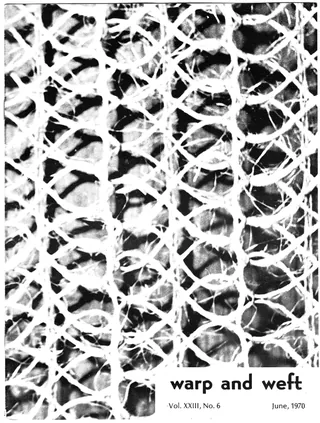
June 1970 issue of Warp & Weft, the monthly newsletter of Robin & Russ Handweavers in McMinnville, Oregon. The main feature is a complete draft and treadling sequence for the MacAlpine tartan, a 2/18 worsted twill with 72-thread repeat, plus notes on yarns, reed, selvages, tartan history and fabric cost per yard. Other items include the editor's travel plans, a description of the cover wall hanging woven of sisal, a review of Odd Nordland's book on knotless netting, a book corner of reprinted weaving titles, and classified ads for tools, yarns and books.
Warp & Weft, Vol. 3, No. 4 (February 1950)
February 1950
Periodical · 8 pages · weaving drafts
February 1950 issue of the monthly Warp & Weft, edited by Gladys Rogers Brophil in Chicago. It features an original 2-harness textured plaid sample with threading, tie-up, treadling and yarn details, plus notes on adapting the pattern and general hints on planning plaids. Other items include a letter on weaving in Mexico, a short piece on Penelope, articles on tartans, a Q&A on synthetic yarns and estimating warp left on the beam, and a new reader classified-ads page.
Warp & Weft, Vol. 31, No. 2 (February 1978)
February 1978
Periodical · 8 pages · weaving drafts
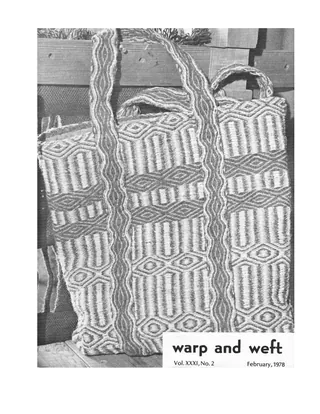
February 1978 issue of Warp and Weft, the monthly newsletter of Robin & Russ Handweavers in McMinnville, Oregon. It includes the editor's column, a review of Lucille Landis's book Twills and Twill Derivatives, and a project for the "Jacobite" tartan in 2/18 worsted, with tie-up, color key, threading draft, sett, yarn and fabric costs, and notes on traditional tartan structure. It also describes a bag on the cover woven in a bound weave with card-woven handles, and an overshot handbag project in the "Small Diamond" pattern on 10/2 linen. The last pages are classified ads and book and loom advertisements.
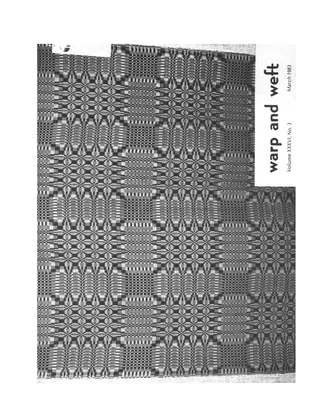
Warp & Weft, Vol. 36, No. 3 (March 1983)
March 1983
Periodical · 9 pages · weaving drafts
March 1983 issue of Warp & Weft, the monthly bulletin of Robin & Russ Handweavers, McMinnville, Oregon. It features a Colquhoun tartan sample in 2/12 worsted wool with a 4-shaft tie-up (jack and counterbalanced), threading, treadling, a 110-end color order, sett (12-dent reed sleyed double), and a yarn and fabric cost breakdown, followed by notes on tartan history and classification. Also included are an editor's letter about two weaving conferences and business conditions, a cover note on an award-winning overshot coverlet, reviews of Doramay Keasbey's Pattern Devices for Handweavers and Patricia de Menezes' Crafts from the Countryside, and classified ads for yarns.
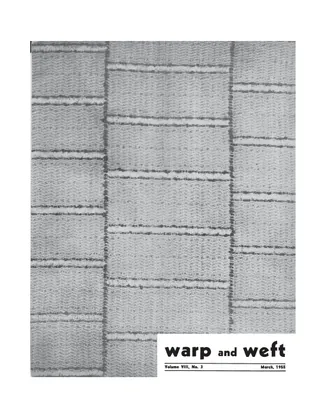
Warp & Weft, Vol. 8, No. 3 (March 1955)
March 1955
Periodical · 8 pages · weaving drafts
March 1955 issue of Warp and Weft, a monthly handweaving newsletter from Robin and Russ Handweavers of Santa Barbara, California. The monthly sample is the Princess Margaret Rose tartan, woven as a 4-shaft twill in 2/18s French spun worsted, with threading and tie-up drafts, color key, weft sequence, reed, yardage and cost figures. Other items include an editor's note, guild exhibit announcements, a profile of Chicago weaver Madge Friedman, reviews of Maja Lundback's Swedish book Vi vaver till hemmet and Berta Frey's Seven Projects in Rosepath, a questions-and-answers column on silk run measure and reeds, and supplier advertisements.
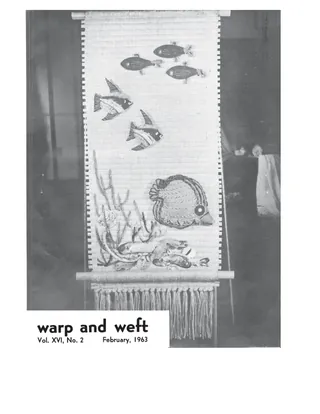
Warp & Weft, Vol. XVI, No. 2 (February 1963)
Warp & Weft, February 1963
Periodical · 9 pages · weaving drafts
February 1963 issue of the monthly Warp & Weft, edited by Russell E. Groff of Robin & Russ Handweavers, McMinnville, Oregon. It includes an editor's column on a new adult education weaving class, a review of Malin Selander's swatch book Swedish Swatches (Yellow Series), and a dresser scarf project in 20/2 ramie on a rosepath threading. The main feature is the MacQueen tartan woven as a 4-shaft straight twill in Bernat's Weaving Afghan, with threading, tie-up, thread counts, costs and notes on selvages, plus a short history of the MacQueen clan. The issue ends with classified ads for weaving books and equipment.
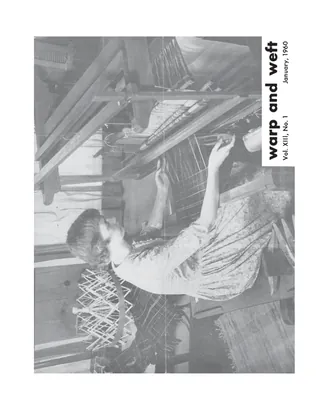
Warp & Weft, Vol. 13, No. 1 (January 1960)
January 1960
Periodical · 9 pages · weaving drafts
January 1960 issue of Warp & Weft, a monthly newsletter from Robin & Russ Handweavers of Santa Barbara, California. The main feature is the Elliot tartan, a 4-shaft straight twill in 2/18 Fabri worsted, with threading draft, tie-up, sett, treadling, a hint on using cotton selvedge threads, yardage cost and clan history. Other items include a review of Malin Selander's Swedish Hand Weaving, a profile of the Golden Gate Weavers Guild, a note on the cover photograph of weaving at Mystic Seaport Museum, classified ads and loom advertisements.
Warp & Weft, Vol. 26, No. 4 (April 1973)
Warp & Weft, April 1973
Periodical · 8 pages · weaving drafts
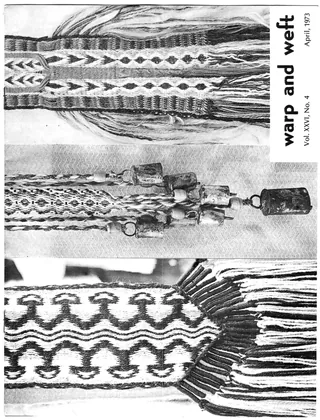
April 1973 issue of Warp & Weft, the monthly newsletter of Robin & Russ Handweavers in McMinnville, Oregon. It features a four-harness twill tartan, "The Dress Tartan Blues," combining 2/18 worsted and English tweed yarns, with tie-up, a two-repeat threading of 46 threads each, yarn details, reed and sett, and a cost breakdown of about $4.00 per yard. Also included are the editor's column, a cover note on card-weaving variations, a review of Therese de Dillmont's Complete Encyclopedia of Needlework, loom-naming contest winners (the Oregon Trail Loom), shop projects, and classified yarn ads.
Warp & Weft, Vol. 9, No. 4 (April 1956)
April 1956
Periodical · 9 pages · weaving drafts
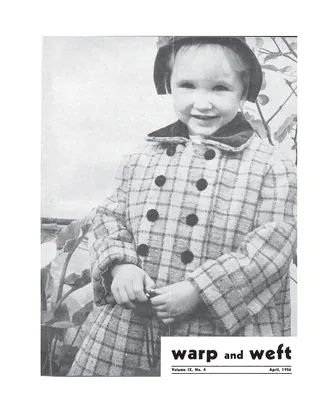
April 1956 issue of Warp and Weft, a monthly handweaving newsletter from Robin & Russ Handweavers of Santa Barbara. The featured sample is the MacDuff Hunting Tartan, woven in 30/2 worsted as a 4-harness twill, with the threading draft, tie-up, warp and weft color sequences, reed and sett, and costs. It also covers the use of Weavol warp dressing to reduce broken warp threads, answers on rising shed and Vicara fiber, reviews of two books (Rauha Arnio's Finnish "Kaunista Kangaspuissa" and Antony Hunt's "Textile Design"), a snowdrop-inlay stole, craft event news, and supplier advertisements.
Shuttle-Craft Bulletin, Vol. XXXII, No. 9 (September 1955)
Periodical · 22 pages · weaving drafts
September 1955 issue of the Shuttle Craft Guild Handweaver's Bulletin (Portfolio Edition), edited by Harriet Tidball, built around fall 1955 fashion fabrics: smooth solids, plaids, tweeds and red colorways. It explains how to ply custom fancy yarns on a homemade yo-yo spindle, and gives a shadowy four-red plaid in Bernat Fabri (sectional beaming, creel arrangement, color threading, weaving on the diagonal). It also covers lightweight Bernat Afghan dress and jacket fabrics with supplementary warp checks, Tattersall plaid history and pattern, a set of coordinated separates, and a loop mohair leno stole. The issue ends with a Bernat yarn dealer list, four book reviews, and the Threadbender newsletter; the Portfolio edition included woven swatches.
Warp & Weft, Vol. 7, No. 2 (February 1954)
February 1954
Periodical · 8 pages · weaving drafts
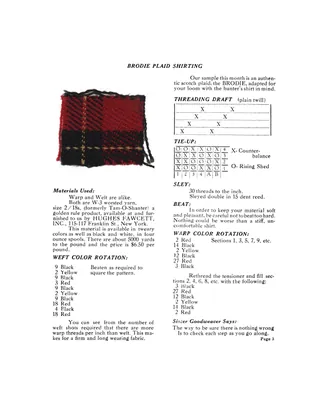
February 1954 issue of the handweaving newsletter Warp & Weft. It carries the monthly sample, a Brodie tartan plaid shirting in plain twill, with a threading draft, tie-up, sett, and warp and weft color rotations in worsted yarn. Other items are a reprinted article on tailoring a handwoven sport shirt, guild exhibit reports from Southern California and Florida, a note and poem on the tartan kilt, questions and answers on tartans, a book review of The Romance of Textiles, and advertisements.
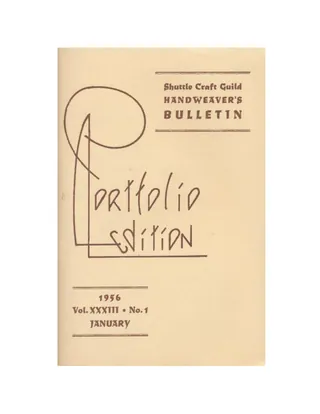
Shuttle-Craft Bulletin, Vol. XXXIII, No. 1 (January 1956)
Periodical · 23 pages · weaving drafts
January 1956 issue of the Shuttle Craft Guild Handweaver's Bulletin (Portfolio edition with woven linen samples), devoted to red and white checked linens. It gives seventeen check and plaid arrangements, from plain tabby squares, inlay dots and tartan-style plaids to Log Cabin, scrim, canvas weave, overshot squares, turned spot weave, Goose Eye and 8-harness texture checks, with drafts, tie-ups and treadling. It also covers linen yarn sizes, sett, cost per square yard, and care of red linen. Shorter pieces describe a sleying method for chained warps, discuss the terms set/sett and shot/pick, and include a Threadbender newsletter about weaving vacations.
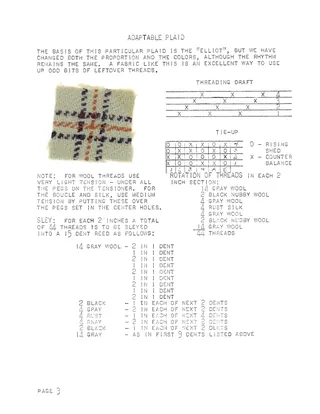
Warp & Weft, Vol. 4, No. 3 (January 1951)
January 1951
Periodical · 8 pages · weaving drafts
January 1951 issue of Warp & Weft, a small newsletter from the Norwood Loom Company, edited by Gladys Rogers Brophil. It announces the transfer of the Brophil studio in Winnetka, Illinois to Celeste Fentress, and reports on an Anni Albers exhibition and a Norwegian weaving school. The main feature is an adaptable wool plaid sample, based on the Elliot tartan, with a 4-shaft threading, tie-up, thread rotation and sleying for a 15-dent reed. Supporting articles cover buying, handling and finishing wool yarns, yarn numbering and yardage calculation, a garment yardage guide, a review of Simple Tartan Weaving by Agnes MacDonald, and short notes on tartan dyes, ramie and Hesiod.
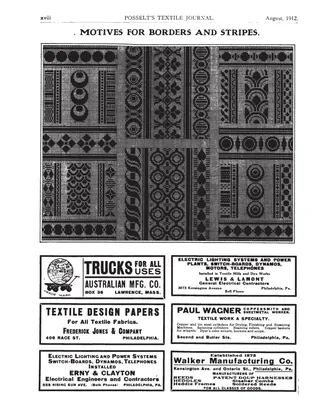
Motives for Borders and Stripes
Article · 1 page
A single page from Posselt's Textile Journal showing a sheet of decorative design motifs for borders and stripes, with repeating circles, diamonds, geometric blocks and floral-like forms in black and white. The rest of the page is taken up by advertisements from Philadelphia-area textile supply and service firms.
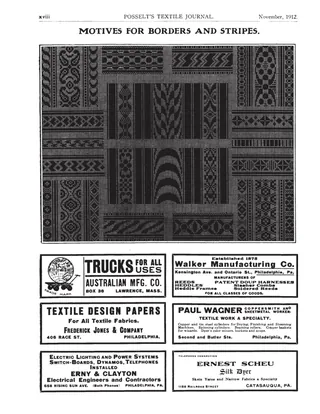
Motives for Borders and Stripes
Article · 1 page
A single journal page from Posselt's Textile Journal titled "Motives for Borders and Stripes," consisting of a large plate of decorative woven-pattern motifs with geometric and floral border and stripe designs. The rest of the page is occupied by advertisements from Philadelphia-area textile suppliers and service businesses.
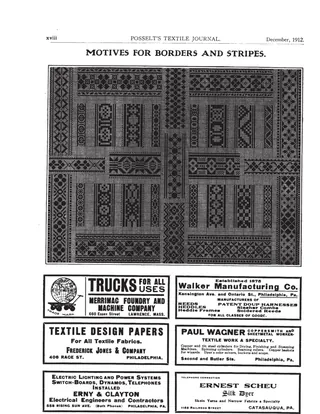
Motives for Borders and Stripes
Article · 1 page
A single page from Posselt's Textile Journal showing a large halftone plate of motives for textile borders and stripes, with geometric diamond and lattice patterns and repeating border bands. The rest of the page is taken up by advertisements from Philadelphia-area textile suppliers and machinery makers. There is no explanatory text or weaving draft.
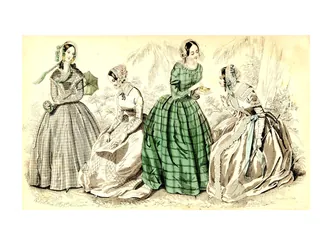
[Fashion plate of four women in plaid and check dresses, August 1843]
Godey's Lady's Book and Magazine, August 1843
Illustration · 1 page
A single mid-19th-century fashion plate from Godey's Lady's Book showing four women in plaid and check-patterned dresses in an outdoor setting among trees. The figures wear bonnets and carry accessories such as a parasol and a bouquet. The page has no legible text, so only the illustration can be described.
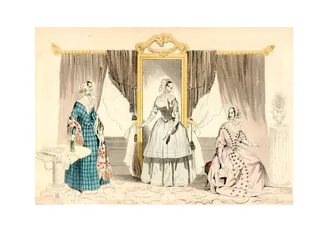
[Fashion plate of three women in a drawing room, April 1843]
Godey's Lady's Book and Magazine, April 1843
Illustration · 1 page
A single hand-colored fashion plate from Godey's Lady's Book, April 1843, showing three women in mid-19th-century dress in a drawing room. The figures wear a blue plaid dress with a patterned shawl, a grey-blue gown with a dark bodice and white lace collar, and a pink dress with dark rosette trim. The plate has no printed text and is of interest for period costume and fabric styles.
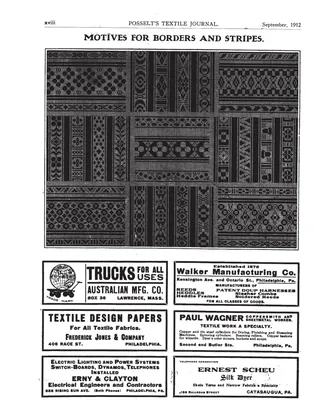
Motives for Borders and Stripes
Article · 1 page
A single journal page showing a large plate of black-and-white design motifs for textile borders and stripes, with geometric and floral repeats arranged in panels. The page carries no text discussion of the designs. The rest of the page is advertising from Philadelphia-area textile suppliers.
Dictionary of Textile Terms
Article · 2 pages
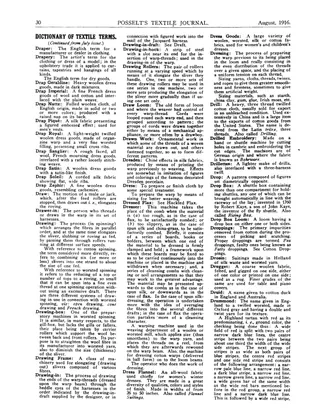
Two pages from the August 1916 issue of Posselt's Textile Journal, continuing an alphabetical dictionary of textile terms through entries from Draper to Dynamiting. Entries define fabrics (drap cloths, drill, duck, duvetyn, drugget), Highland tartans (Drummond, Dunbar, Dundas), and spinning, drawing, dressing, dyeing and finishing processes and machines. Weaving terms such as draw loom, drawing-in, drop box, dwell and Dutcher temple are also defined.
Gingham
Article · 1 page
A short encyclopedia entry defining gingham as a light to medium weight cotton or linen cloth woven from dyed or white yarns in stripes, checks or plaids. It discusses proposed origins of the name (Guingamp in Brittany, or Malay ging-gang meaning striped), notes production in Lancashire, Glasgow and the United States, and mentions printed imitations and use for dresses.
New Check Loom
Scientific American, 1847
Article · 1 page
A short 1847 Scientific American article on a new power check loom invented by Mr. Peacock, agent of Ida Mills in Troy, New York, reprinted from the Mechanics' Mirror. It traces the progress from two-shuttle to three- and four-shuttle looms, including Mr. Neal's revolving shuttle box, and describes Peacock's adjustable single pattern wheel with movable pins that can produce any gingham pattern from two to 220 picks. It stresses the importance of color arrangement and balance in gingham weaving.
Shima shima V1.
Book · 44 pages · Japanese
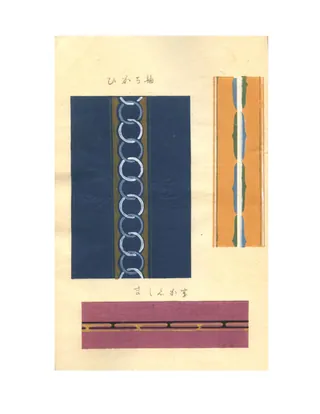
A Japanese pattern book of hand-colored woodblock-style plates showing striped and patterned woven textile swatches (shima), each with brief handwritten or printed Japanese captions naming the pattern. The plates show vertical stripes, lattice, diamond, key-fret, chain-link, cloud and floral motifs in many colors. There is almost no running text and no weaving drafts; the value is as a visual sample book of Japanese stripe and pattern designs of the period.
Adaptations of Commercial Weaves
Article · 2 pages · weaving drafts
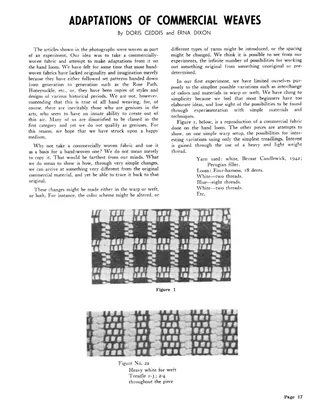
A short article describing an experiment in adapting a commercially woven checked fabric on a four-harness hand loom. The authors argue that hand weavers can create original work by making simple changes in color, yarn type, and spacing rather than copying traditional patterns. They give the warp setup (white and blue stripes, 18 dents) and weft and treadling variations for a series of sample swatches, including plain-weave stripes and twill.
Designing
Textile Mercury, 1890
Article · 2 pages · weaving drafts
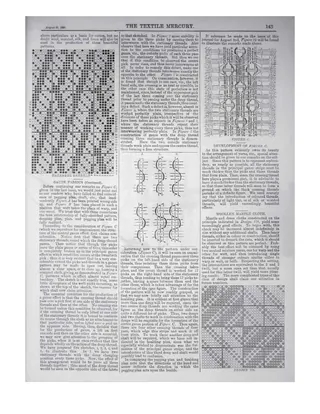
Two pages from The Textile Mercury, 30 August 1890, covering the 'Designing' column. It gives a clan tartan design (McDonnell of Glengarry) with threading, color sequence, reed and pick counts for cotton. It continues a technical series on gauze fabrics, explaining doup and stationary threads, pick grouping, healding and pegging plans, and the development of Figure C. It closes with notes on a woollen mantle cloth design (Design 176) related to 2 and 2 twill.
A Handwoven Outfit
Article · 1 page · weaving drafts
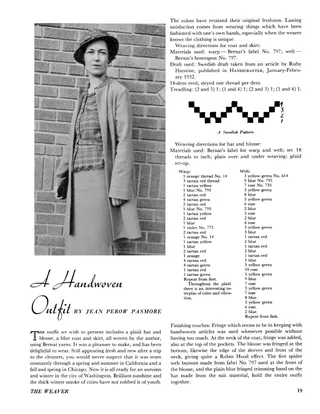
A one-page article in which Jean Perow Pasmore describes a handwoven outfit made with Bernat yarns: a plaid hat and blouse and a blue coat and skirt. It gives weaving directions for each part, including materials, reed and sley, treadling, a plaid warp color sequence, a weft color sequence, and finishing details such as fringe and spider web buttons. A Swedish draft taken from a 1932 Handicrafter article by Ruby Harstine is used for the coat and skirt fabric.
Shima shima V2.
Book · 43 pages · Japanese
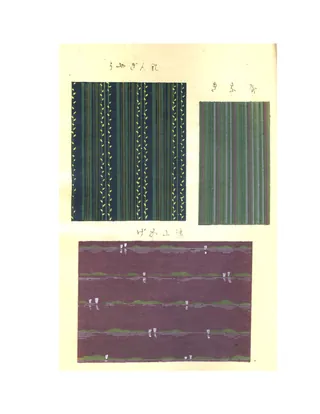
A Japanese pattern book from 1904 consisting almost entirely of color-printed plates of striped, checked and figured textile swatches, with brief Japanese captions naming each pattern (such as plaids, wavy lines, bird and plant motifs). The colophon gives Kyoto printing and publication in October of Meiji 37 (1904). It is a visual design reference for Japanese kimono-type fabrics, with no weaving drafts or technical instructions.
245 documents found