Textile Documents › Topic: Piqué, Bedford cord, and dimity
65 documents found
Sort: 
Dimity
Rees's Cyclopedia, 1819
Article · 1 page
A short encyclopedia entry defining dimity as a stout cotton cloth, originally imported from India and by then widely made in Britain, especially Lancashire. It distinguishes dimity from fustian: dimity is ornamented in the loom with stripes or figures and usually bleached white, while fustian is a plain twilled cloth usually dyed after weaving. It notes that striped dimities are cheaper because they need simpler loom mounting, and refers readers to the article Draught and Cording for mounting plans.

Dimity
Zell's Encyclopedia, 1876
Article · 1 page
A short dictionary-style encyclopedia entry defining dimity as a thick cotton cloth, usually striped or patterned in the loom. It gives the word's etymology from Greek and Latin roots meaning a double thread, and notes its uses for women's dress, bed furnishings and window curtains, and that it is rarely dyed.
Ribbons, trimmings, edgings, etc.
Article · 2 pages · weaving drafts
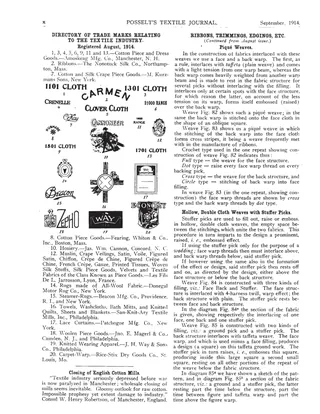
Two pages from Posselt's Textile Journal continuing a series on ribbons, trimmings and edgings. They explain piqué weaves with face and back warps, hollow double cloth weaves with stuffer picks, and the construction of three-ply and four-ply fabrics, with numbered weave diagrams (Figs. 82-86) and sectional sketches. The pages also carry a directory of textile trade marks registered in August 1914 and a section of a dictionary of technical terms covering wool-related entries.
Dimity
Master Weaver, July 1958
Article · 5 pages · weaving drafts
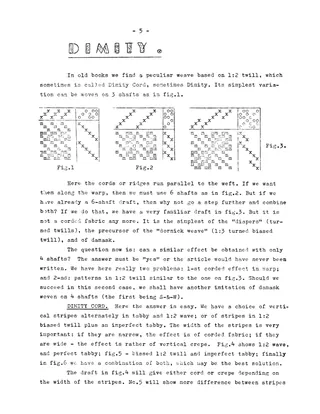
An article from Master Weaver on dimity, a weave based on 1:2 twill, and how to adapt it to 3, 4 and 6 shafts. It gives drafts for dimity cord (ridges along the weft or warp) and for two-block pattern dimity on four shafts, with notes on take-up, float length and fabric strength. It also covers the history of 3-shaft looms and twill, and includes a table runner project in single linen with threading, warp, weft and treadling instructions. A short note on weaving terminology (harness vs. shaft) closes the piece.
Master Weaver, No. 40 (July 1958)
Periodical · 14 pages · weaving drafts
Issue No. 40 (July 1958) of Master Weaver, a bi-monthly bulletin for handweavers published by Z-Handicrafts in Fulford, Quebec. It contains an editorial and the article "Shortcuts" on choosing a loom (arguing for a four-shaft counterbalanced loom with a shed regulator), and an article on dimity and dimity cord in 3-, 4- and 6-shaft 1:2 twill with drafts and a linen table runner project. It also has a note on the term "shaft", a first sampler for net weaves using rigid wefts and a net comb, and a description of a rotating sett indicator sold by the publisher. The last page is an advertisement for Canadian yarns from Charles E. Billard Ltd., Montreal.
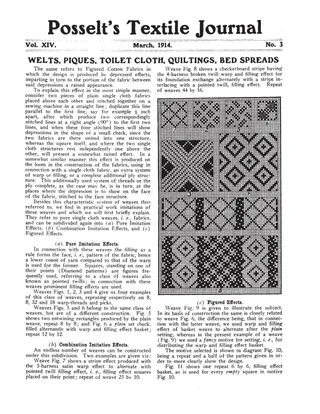
Welts, Piques, Toilet Cloth, Quiltings, Bed Spreads
Article · 4 pages · weaving drafts
Article from Posselt's Textile Journal on welts (cords), piqués, toilet cloth, quiltings and bed spreads. It first covers imitation effects in single cloth (pointed twills, basket-weave figured effects), then explains welt construction with face and back warp and wadding picks. Includes numbered weave diagrams (Figs. 1-42), a fabric calculation for a 40-inch cotton welt (reed, take-up, yarn counts, material weights), and cross-section diagrams of welt fabrics. The scan ends with the start of a following article on skip twills.
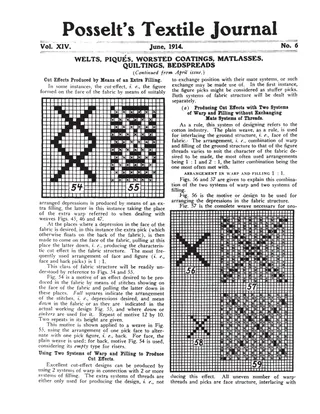
Welts, Piqués, Worsted Coatings, Matlasses, Quiltings, Bedspreads
Article · 2 pages · weaving drafts
Two pages from Posselt's Textile Journal: the continuation of a series on welts, piqués, worsted coatings, matlassés, quiltings and bedspreads, followed by the start of an article on analyzing double cloth weaves. The first part explains how cut (depressed) effects are produced with an extra filling or with two systems of warp and filling, in 1:1 and 2:1 arrangements, with motive and weave Figs. 54-59. The second part gives a worked example of separating a 27-end double cloth weave into face weave, back weave and stitching weave, illustrated by seven drawdown figures.
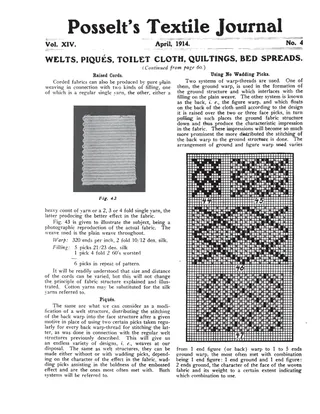
April, 1914
Article · 4 pages · weaving drafts
Four pages from the April 1914 issue of Posselt's Textile Journal (Vol. XIV, No. 4). The first part continues a series on welts, piqués, toilet cloth, quiltings and bed spreads, covering raised-cord fabrics and piqué weaves made with and without wadding picks. It gives weave and motive diagrams, warp and filling arrangements, fabric specifications, and rules for analyzing a sample to work out its weave. The final page begins an article on dressing woolen warps, covering spooling and warp calculations for a plain warp.
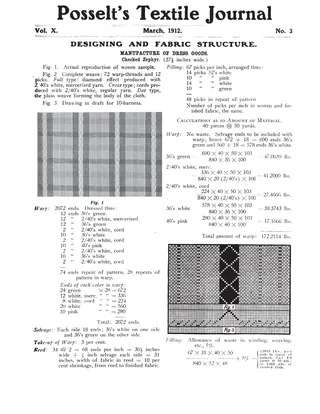
Designing and Fabric Structure
Article · 3 pages · weaving drafts
Three pages from Posselt's Textile Journal, March 1912, in the series on designing and fabric structure. The first part gives a worked example for a checked zephyr dress fabric: warp and filling colors, reed, take-up, and calculations of yarn weight for 40 pieces of 50 yards. The second part explains designing by changing the texture of the warp within the weave repeat, which gives piqué or matelassé-like embossed effects (plain weave for raised areas, a 2-2 filling rib for depressed areas), with diamond and oval spot drafts and harness requirements. The last page begins with a continuation of the series on gauze or leno weaving, covering doups, whip threads, and stripe effects.
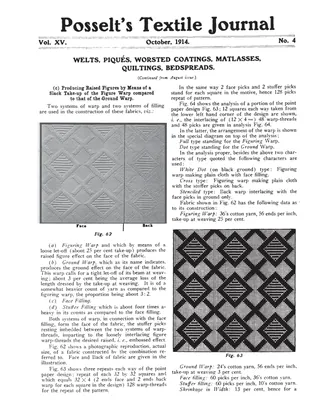
Welts, Piqués, Worsted Coatings, Matelassés, Quiltings, Bedspreads
Article · 2 pages · weaving drafts
Two pages from Posselt's Textile Journal, October 1914. The first continues an article on welts, piqués, matelassés and similar fabrics, describing raised figures produced by a slack take-up of the figure warp relative to the ground warp. It covers the two warp and two filling systems, the stuffer picks, point paper design and analysis, and construction data for a sample cotton fabric. The second page carries the end of that article, a note on a patented plush fabric design, and a section of the series on foundation weaves covering the characteristics of satin weaves and the number of harnesses needed.
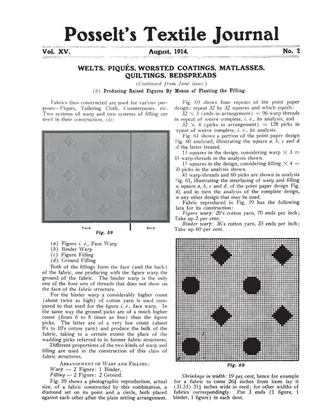
Welts, Piqués, Worsted Coatings, Matlasses, Quiltings, Bedspreads
Article · 2 pages · weaving drafts
Two pages from Posselt's Textile Journal continuing a series on welts, piqués, matelassés and related fabrics. This installment covers raised figures made by floating the filling, using a figure warp, binder warp, figure filling and ground filling. It gives the arrangement, yarn counts, sett, take-up, shrinkage and reed data for a Jacquard-woven piqué, with point-paper design and analysis figures. It ends with specifications for a worsted trousering fabric.

Dimity
Article · 1 page
A very short encyclopedia entry defining dimity. It gives the word's derivation from the Greek for "double thread" via Italian, and describes the cloth as a stout, usually white fabric woven with raised patterns, used for bed upholstery and curtains and sometimes printed in colours.
Dimity
Article · 1 page
A short encyclopedia entry defining dimity, a figured cotton fabric first made in Spain and used mainly for bed hangings. It gives the etymology of the name from Greek, notes that Massachusetts colonists made dimities and fustians by 1643, and describes the raised and depressed figure or stripe that is reversed on the two faces. It also mentions the finer dimity used for dresses.
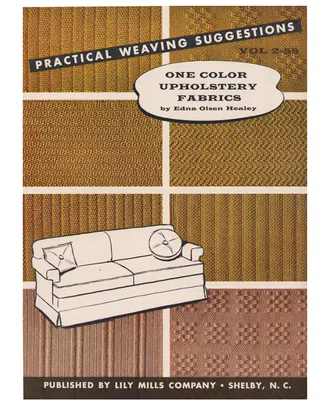
Practical Weaving Suggestions, Vol. 2-58 (1958): One Color Upholstery Fabrics
Periodical · 12 pages · weaving drafts
A 1958 issue of Lily Mills' Practical Weaving Suggestions by Edna Olsen Healey on weaving plain one-color upholstery fabrics from Lily 3 Strand mercerized soft twist cotton (Art. 714). It gives seven sample fabrics (A-1 through G-1) with photographs, threadings, tie-ups, treadlings, sett and yarn colors. The samples cover Bedford Cord stripes on 8 and 6 shafts, a four-shaft twill weftwise rib, a twill raised weft stripe, Swedish Droppdrall on 6 and 4 shafts, and a Bundendrall warp stripe. Notes on loom choice, width allowance for shrinkage, and a Lily yarn color list are included.
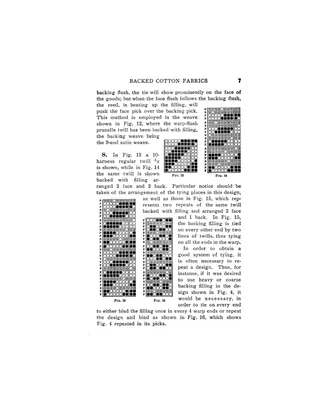
Weaves for Backed Cotton Fabrics
Monograph · 22 pages · weaving drafts
An International Correspondence Schools instruction paper on designing weaves for backed cotton fabrics, in which an extra warp or filling adds weight or warmth without showing on the face. It covers filling-backed and warp-backed cloths, including how to arrange face and back picks or ends, place the tying points, and make harness and chain drafts. The last sections treat piqués and Bedford cords, with wadding picks or ends, cutting picks and instructions for dissecting these cloths. Many design-paper figures and practice problems are included.
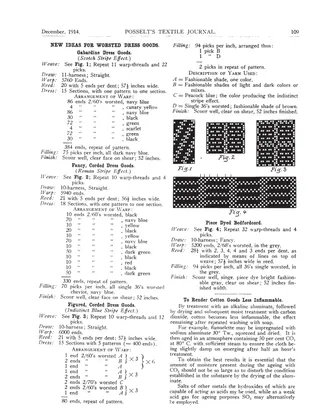
New Ideas for Worsted Dress Goods
Article · 1 page · weaving drafts
A single journal page giving cloth specifications for four worsted dress goods: a gabardine with Scotch stripe effect, a corded Roman stripe fabric, a figured corded fabric with an indistinct blue stripe, and a piece-dyed Bedford cord. Each entry lists the weave repeat, harness draw, warp ends, reed, color arrangement of the warp, filling picks and finishing, with four weave draft diagrams (Figs. 1-4). A short unrelated item follows on making cotton goods less inflammable with alkaline aluminate and carbon dioxide.
Shuttle-Craft Bulletin (December 1957)
Periodical · 44 pages · weaving drafts
The December 1957 Portfolio edition of Shuttle Craft, the monthly bulletin of the Shuttle Craft Guild, now run by Mary E. Black and Joyce Chown. Articles cover Harriet Tidball's prize-winning open-work room divider "Tracery" (Spanish eyelet, wrap stitch, Brooks bouquet), a chiné technique for Christmas tree greeting cards with warp painted on the loom, and bound weaving with humanistic figures (Grenadiers) on overshot diamond threadings in 4 and 5 shafts. Mary Black also reconstructs an old dimity counterpane weave from a coverlet clipping. Other items are a hemstitching tip, filing advice, Boris Veren's book reviews, back-bulletin and advertising pages, photographs of woven portfolio samples, and a 1957 index.
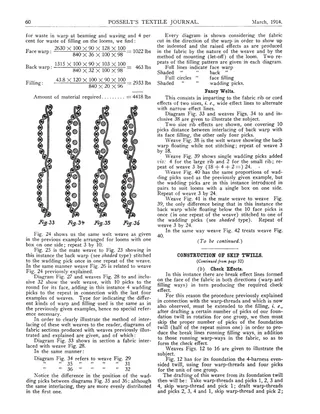
Construction of Skip Twills
Article · 2 pages · weaving drafts
Two pages from a continuing series in Posselt's Textile Journal on the construction of skip twills. The check-effects section explains how to draft skip twills from 4-, 6- and 10-harness even-sided foundation twills, skipping ends and picks to make break lines in both warp and filling directions (Figs. 12-16). Fig. 16 is worked out as a broken-effect skip twill of 78 ends, with its construction draft. The first page also ends an installment on welt weaves, with wadding picks, fancy welts and fabric-section diagrams (Figs. 24-42) and a material-quantity calculation. The second page closes with a short note on cotton spinning in Japan.
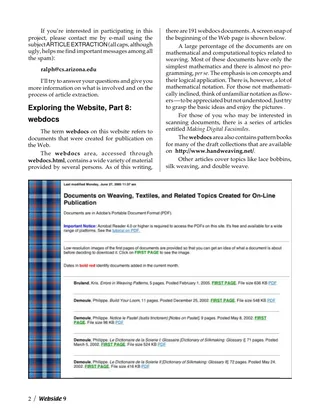
Webside, Number 9 (July 2005)
Periodical · 7 pages · weaving drafts
Issue number 9 (July 2005) of Webside, the newsletter of Ralph Griswold's weaving website. It covers recent site additions, a call for volunteers to extract individual articles from periodical PDFs, and a tour of the webdocs area of on-line publications. It also covers the Library of Congress "An American Time Capsule" ephemera collection, a Tess Parrish column on bobbin lacemaking bobbins and winding, and lace news. The Cyber Sample Page by Margaret Coe presents a piqué double weave with a draft, yarns and sett, and the issue ends with a list of available CDs.
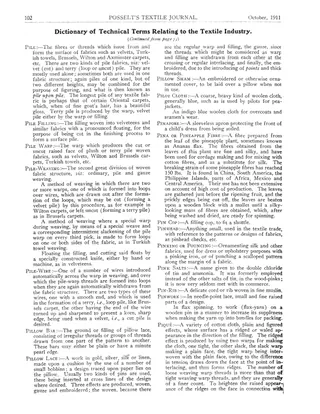
Dictionary of Technical Terms Relating to the Textile Industry
Article · 2 pages
Two pages from the October 1911 installment of E. A. Posselt's serial glossary of textile terms, covering entries from PILE through POIL DE CHEVRE. Entries define fabrics (piqué, plush, plaid, pilot cloth), fibres (pineapple, pita), lace types (pillow lace, Plauen lace, pinwork) and weaving and finishing terms (pile weaving, pile wire, plain weave, planting, plated hosiery). Definitions are brief, with longer technical explanations for pile weaving, piqué construction and plated hosiery.
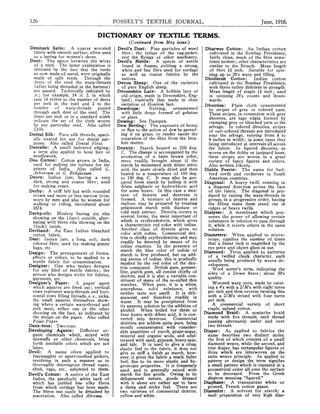
Dictionary of Textile Terms
Article · 2 pages
Two journal pages from the June 1916 issue of Posselt's Textile Journal, continuing E. A. Posselt's alphabetical Dictionary of Textile Terms from 'Denmark Satin' through 'Doily'. Entries define fabrics, fibers, dyes and finishing chemicals (dextrin, diastase, diazo colors), lace types, and loom and carding terms (dent, dobby, doffer, designer's paper). Some entries explain weave construction, such as diagonal, diaper, dimity and doeskin. There are no weaving drafts.
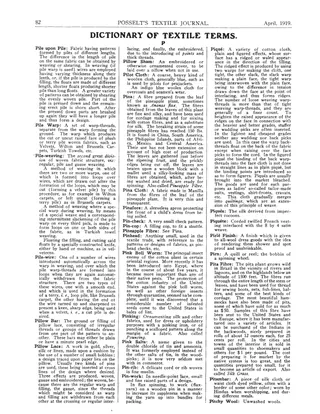
Dictionary of Textile Terms
Article · 2 pages
Two pages of the serialized 'Dictionary of Textile Terms' from Posselt's Textile Journal, April 1919, covering entries from 'Pile upon Pile' through 'Point de Gaze Lace'. Entries define fabrics, fibers, weaving and lace terms, finishes, and trade vocabulary, including pile weaving, piqué, plush, plaid, pillow lace, and needle-point laces. The entries are short and encyclopedic, with no illustrations or weaving drafts.
Drafts and Designs, Vol. 24 (1981-1982)
Periodical · 12 pages · weaving drafts
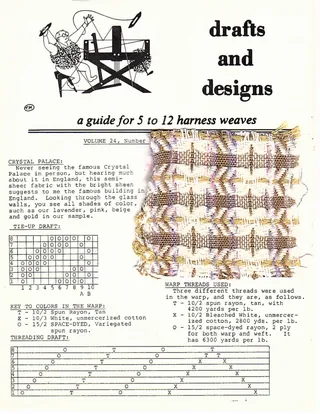
A 12-page selection of monthly issues from Volume 24 (September 1981 to June 1982) of Drafts and Designs, a newsletter of Robin & Russ Handweavers for 5 to 12 harness weaving. Each issue presents one fabric sample with its threading and tie-up drafts, treadling sequence, reed sleying, threads used, and per-yard cost. Samples include Crystal Palace (8-shaft semi-sheer rayon and cotton), Beiderwand, Daffodils in Spring (6-shaft warp-faced linen), Sculptured Sand-Dunes (Bedford cord), Marcee's Magic (8-shaft linen point twill variation), and San Diego Sun-Rise (6-shaft extended twill in cotton floss).
Turned Twills - The ""D"" Class: Dimity, Diaper, Dornick, Damask
Master Weaver, May 1959
Article · 4 pages · weaving drafts
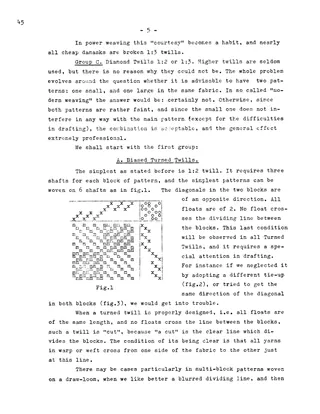
Article from Master Weaver No. 45 (May 1959) on turned twills, the "D" class: dimity, diaper, dornick and damask. It defines turned twills (blocks of vertical and horizontal floats, 1:N twills on six or more shafts), classifies them into biased, broken/satin and diamond groups, and explains the rule that no float may cross the line between blocks. Drafts show a 6-shaft example, faulty tie-ups, and a 12-treadle block-combination draft with a compound tie-up; tie-up design is deferred to the next issue. The last page begins a short "Odd Weaves" piece on unsymmetrical huckaback lace and texture weaves made from overshot, crackle and summer-and-winter.
Drafts and Designs, Vol. 16 (1973-1974)
Russell E. Groff · 1973-1974
Periodical · 20 pages · weaving drafts
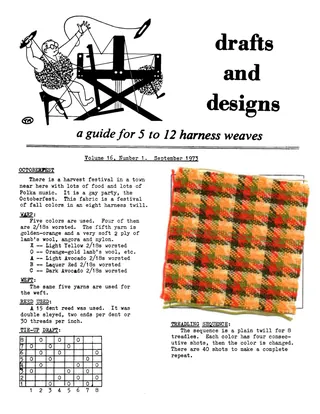
Volume 16 of the monthly newsletter Drafts and Designs, published by Robin & Russ Handweavers of McMinnville, Oregon, covering September 1973 to June 1974. Each issue presents one fabric sample for 5 to 12 harness looms, with threading and tie-up drafts, treadling sequences, yarn keys, reed and sleying details, thread and fabric costs, and weaving tips. Samples include an eight-harness twill in fall colors, a six-harness Aztec pyramid pattern in tussah silk and wool, Bedford cord, a nine-harness parquet design, a linen fabric for patio mats, and a twelve-harness alpaca fabric.
Modern Patterns in Traditional Weaves
Master Weaver, October 1952
Article · 4 pages · weaving drafts
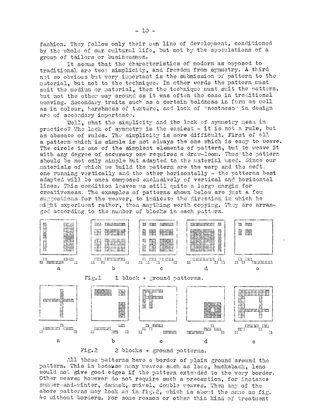
An article from Master Weaver arguing that handweavers can design modern, simple, asymmetrical block patterns within traditional unit weaves such as summer and winter, turned twill (dimity), huckaback, lace weaves and double weaves. It presents sample patterns of 1 to 9 blocks plus ground, each with a profile draft, and explains how to convert a profile into a full threading draft by calculating units per block from total ends and sett. Worked examples cover summer-and-winter napkins and a 45 by 45 inch bridge table cover in 1:2 turned twill, with tie-up and treadling notes.
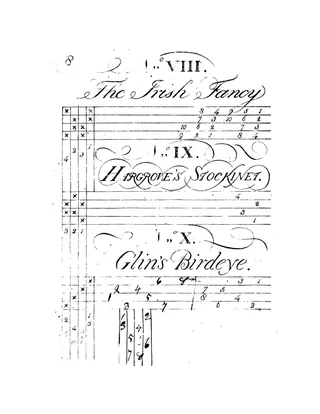
The Weavers Draft Book and Clothiers Assistant
Book · 27 pages · weaving drafts
A 1792 Baltimore weaver's draft book by John Hargrove, addressed to American weavers and cloth manufacturers. After a preface and brief instructions on reading the drafts, it presents about 52 numbered handwritten-style drafts for figured cottons and linens such as cords, dimities, fustians, velverets, satinets, thicksets, stockinets, birdseyes and diapers, with threading, tie-up and treadling. It closes with receipts for sizing cotton warps and for dyeing cotton, linen and wool in blue, green, madder red and black.
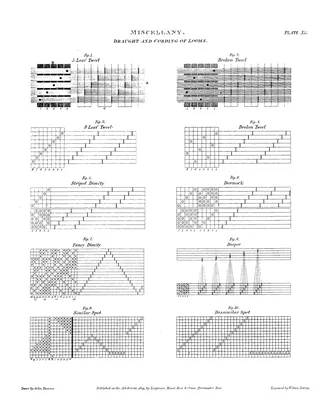
Draught and Cording
Rees's Cyclopedia, 1819
Article · 5 pages · weaving drafts
An encyclopedia article from Rees's Cyclopedia explaining draught (the order of drawing warp threads through heddles) and cording (tying leaves to treddles) for looms. It describes how plans are drawn and read, then works through ten figures: five- and eight-leaf tweel and broken tweel, striped dimity, dornock, fancy dimity, diaper mounting, and similar and dissimilar spots. The last page is Plate XII, with the draught and cording diagrams for these figures.
Loom Music, Vol. XXII (1965)
Loom Music, 1965
Periodical · 95 pages · weaving drafts
Volume XXII (1965) of Loom Music, the Canadian handweaving periodical edited by Mary Sandin (Edmonton) and Ethel Henderson (Calgary), bound as ten monthly issues and a final volume index. Issues give full drafts, tie-ups, treadlings, warp plans and sources for projects: Rosepath and Bronson lace table linens, Bedford cord and other upholstery fabrics, worsted and tweed apparel yardage, crackle coating, head bands and triangles, Indian bead weaving, Flossa rugs, red-themed items, Arctic finger-woven belts and mitts, place mats and a raffia mat. It also includes warp-setting advice, supplier lists, notes on the Guild of Canadian Weavers, an index to the 1944-1964 theory lessons, a survey of articles published, and the announcement that there will be no 1966 issue.
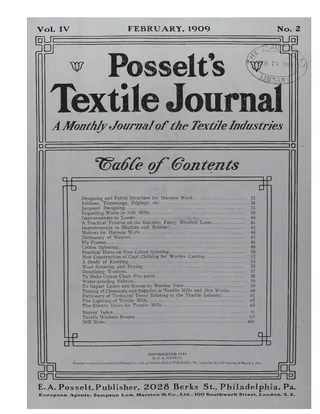
Posselt's Textile Journal, Vol. 4, No. 2 (February 1909)
Periodical · 53 pages · weaving drafts
February 1909 issue of Posselt's Textile Journal, a monthly trade periodical of the textile industries. Its weaving content includes a lesson on designing for harness work (45° regular twills and 70° steep twills, with practice questions), notes on piqué, hollow and multi-ply weaves for ribbons and trimmings, Jacquard designing for two-warp, one-filling cloths, and a collection of 22 motives for 3 to 10 harness work. The rest covers silk mill waste, loom, shuttle and bobbin improvements, the Knowles fancy worsted loom, cotton spinning and fly frames, card clothing, knitting, wool scouring, decatizing, finishing treatments, mill lighting and electric drive, a dictionary of technical terms, and many machinery advertisements.
A Cotton Fabrics Glossary
Indian Textile Journal, January 1897
Article · 1 page
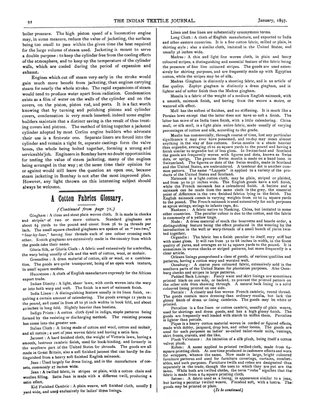
A one-page installment of an alphabetical glossary of cotton fabrics from the Indian Textile Journal, January 1897, covering entries from Gingham to Satine. Each entry gives a short description of the cloth's construction, fibre content, finish, typical width or weight, country of manufacture and uses. Entries include gingham, grenadine, jaconet, madras, muslin, nainsook, organdie, percale, pique and robes.
Dictionary of Technical Terms Relating to the Textile Industry, Part 2
Article · 1 page
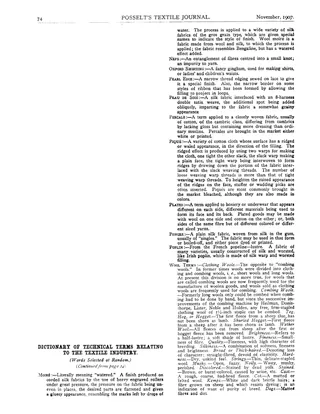
A single journal page from the serialized "Dictionary of Technical Terms Relating to the Textile Industry" (words selected at random), published in Posselt's Textile Journal, November 1907. It defines fabrics and finishes such as moiré, peau de soie, percale, piqué, ponge, poplin, neps, pearl edge, and plated hosiery. It also includes a section of wool terms covering clothing and combing wools, fleece types (hogget, wether wool), and wool qualities and faults (kemps, cots, dags).
Turned Twills
Master Weaver, March 1954
Article · 3 pages · weaving drafts
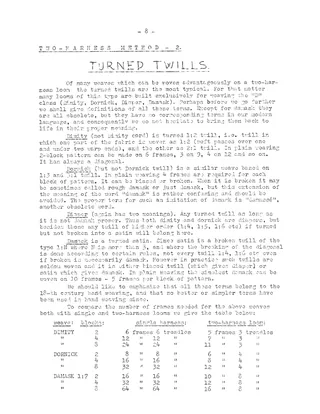
An article from Master Weaver on turned twills woven by the two-harness method, which combines a ground harness with pattern frames. It defines dimity, dornick, diaper and damask and tabulates the frames and treadles each needs on single-harness and two-harness looms. It then discusses drafting the tie-up so that pattern blocks are cut cleanly, using figures of drawdowns and a 5-block damask profile. A short section on weaving terminology (counter-marche, sinking and rising sheds) follows.
May, 1913
Article · 2 pages · weaving drafts
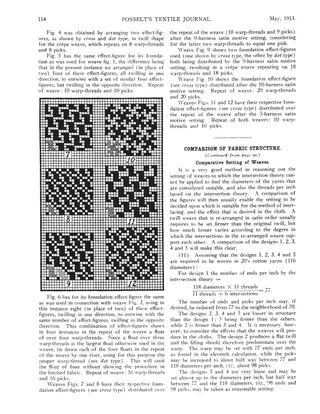
Two pages from the May 1913 issue of Posselt's Textile Journal. They finish an article on crepe weaves built from effect-figures arranged in twill and satin order, then continue the series 'Comparison of Fabric Structure', which covers setting (ends and picks per inch) for twill, honeycomb, Bedford cord, piqué and imitation gauze weaves using the diameter and intersection theory. The pages also open F. Bradbury's 'Jacquard Harness Mounting', which describes harness building and the knots used in tying harness.
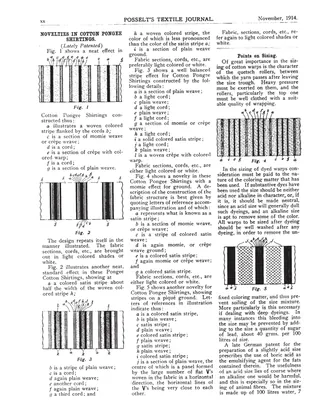
Novelties in Cotton Pongee Shirtings
Article · 2 pages
Two pages from Posselt's Textile Journal describing five patented stripe designs for cotton pongee shirtings, each explained through lettered cross-section diagrams. The designs combine satin stripes, plain weave, momie (crepe) weave, cords and a piqu\u00e9 ground. The article is followed by notes on sizing cotton warps (quetsch rollers, sizing dyed warps, acid sizes with boric acid, talc-based size recipes) and a short item on proposed cotton mills in Texas, plus advertisements for Permutit and Klauder-Weldon dyeing machines.
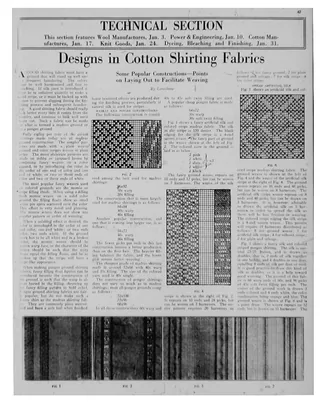
Designs in Cotton Shirting Fabrics
Textile World Journal, January 17, 1920
Article · 2 pages · weaving drafts
Two-page issue excerpt from Textile World Journal's cotton manufactures technical section. The main article, by Lanceham, covers cotton shirting fabric design, comparing madras and pongee grounds, typical thread counts and yarn sizes, and harness requirements for dobby-woven patterns with artificial silk, colored stripes, momie and Bedford cord weaves. It includes fabric swatches and weave drafts (Figs. 1-8). A second article, on the setting of drawing rolls on roving and spinning frames, follows on page 2.
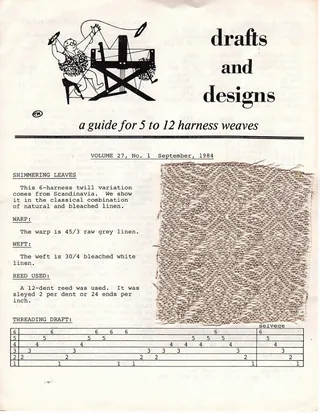
Drafts and Designs, Vol. 27 (1984-1985)
Periodical · 14 pages · weaving drafts
A selection of issues from volume 27 of Drafts and Designs, a monthly guide for 5- to 12-harness weaves published by Robin & Russ Handweavers of McMinnville, Oregon, covering September 1984 to June 1985. Each issue presents one fabric sample with threading, tie-up and treadling drafts, reed and sett, yarns used, costs per yard, and notes on weaving and finishing. Projects include a linen twill (Shimmering Leaves), a double two-tie unit weave (Diamond Ties), checks and baskets, a 5-harness textured weave, a 7-harness waved pique, a 10-harness Angels on Cloud Nine, and Navaho Diamonds. The last pages of two issues carry advertisements for used looms and workshops.
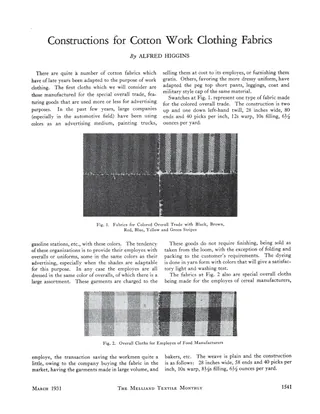
Constructions for Cotton Work Clothing Fabrics
Article · 3 pages
A 1931 trade article from The Melliand Textile Monthly describing cotton fabric constructions for work clothing, including colored overall cloths, uniform twills, Bedford cord, napped suitings, stock-dyed twills, imitation worsted trousering and a 'Frenchback' cloth with an extra warp. For each fabric it gives the weave, width, ends and picks per inch, yarn counts, weight per yard, dyeing and finishing requirements. Photographs of swatches illustrate each type.
Our Textile Design School: Lesson 18 -- Binder Warps
Textile World Record, February 1906
Article · 11 pages · weaving drafts
Lesson XVIII of the Textile World Record's textile design school series, on binder warps: extra warps, usually cotton, that stiffen or bind fabric structures. It covers binder warps in single cloth (silk dress goods built on 5- and 8-leaf satin and 2x4, 2x6 and 2x8 warp rib weaves, each combined with a plain binder at ratios from 2:1 to 4:1), and in cotton pique and figured dress goods. It also covers double cloth for men's wear, where binder warps join two plain or twill fabrics, and pile fabrics such as tapestry and Brussels carpets. Most pages carry weave drawdowns (Figs. 1-47) and thread-interlacing diagrams, with text on repeats, ratios, take-up and the need for separate warp beams.
Grammar of Textile Design
Book · 285 pages · weaving drafts
Third edition of Harry Nisbet's textbook on the structural design of woven fabrics, with 669 illustrations, mostly point-paper weave diagrams (drawdowns), drafts and shedding plans. It covers plain weaves and their modifications, twills, diamond and Grecian weaves, Bedford cords, backed fabrics, fustians (velveteen and corduroy), terry and loop pile, gauze and leno, figured leno brocade, tissue, lappet and swivel fabrics, warp ondulé, brocade, damask, Alhambra, piqué, toilet quilting, patent satin and tapestry fabrics. It also has a chapter on the decorative use of artificial silk. Related loom mechanisms such as terry motions, doup harnesses and Jacquard machines are described with line drawings, and the text explains how to prepare applied designs for card cutting.
Design in the Weaving Manufactures
Rees's Cyclopedia, 1819
Article · 3 pages · weaving drafts
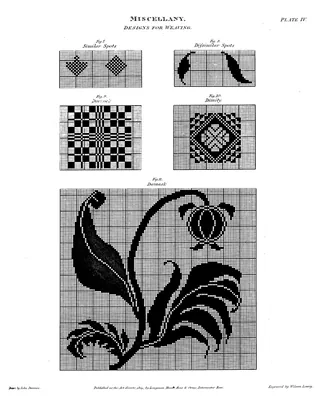
An encyclopedia article on 'design' in woven manufactures, explaining how ornamental patterns are drawn on ruled design paper and translated to the loom. It covers how squares represent warp and weft threads, how oblique and curved lines are approximated, and includes a table of angles of obliquity for 1 to 9 squares of warp and weft. A worked example calculates the size of a damask flower on cloth versus on paper. The last page is Plate IV, 'Designs for Weaving', showing grid designs for similar spots, dissimilar spots, dornock, dimity and damask.
Dictionary of Textile Terms
Article · 2 pages
Two pages of a serialized textile dictionary from Posselt's Textile Journal, May 1915, continued from the April issue. Entries run alphabetically from Basic Acetate of Lead through Big Boll. They cover fabrics (batiste, bengaline, Bedford cord, beaver), loom parts (batten, beams, basse-lisse), fibres and cotton varieties, dyes and chemicals, lace, tapestry, and mill machinery and terms.
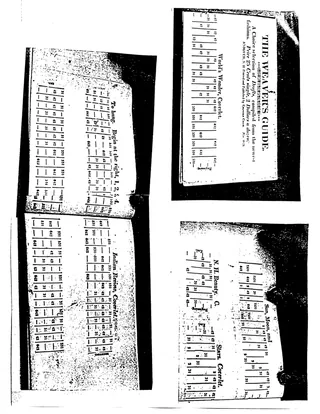
The Weaver's Guide
Book · 2 pages · weaving drafts
A two-page broadside or small pamphlet of weaving drafts titled The Weaver's Guide, advertised as a choice selection of drafts compiled from the newest fashions. It gives threading and tie-up notations for named coverlet patterns such as World's Wonder, N. H. Beauty, Stars, and Sun, Moon, and Indian Remon, and for damask and diaper patterns such as Lemon Peel Coverlet and Diamond Dimity. The imprint names Andover, N. H., with a price of 25 cents single or 2 dollars a dozen.
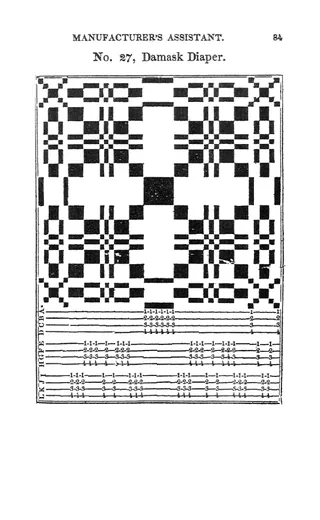
The Domestic Manufacturer's Assistant and Family Directory in the Arts of Weaving and Dyeing
Book · 217 pages · weaving drafts
A 1949 Charles T. Branford Co. reprint of the 1817 Utica handbook by J. & R. Bronson on domestic weaving and dyeing of cotton and woollen goods. It covers looms and utensils, yarn tables and calculations for plaids, checks and shirting, and the preparation of yarn (sizing, warping, beaming, drawing in), followed by about 30+ numbered weaving drafts with cording and treading directions for ticking, bird's eye, diaper, dimity, coverlets, carpet and broad cloth. The second half gives numbered dye recipes for cotton, linen and wool (blue, green, yellow, black, drab, crimson and others), notes on dyestuffs, and miscellaneous household receipts.
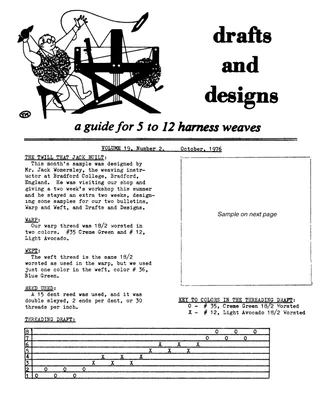
Drafts and Designs, Vol. 19 (1976-1977)
Russell E. Groff · 1976-1977
Periodical · 25 pages · weaving drafts
Volume 19 (September 1976 to June 1977) of the monthly bulletin Drafts and Designs, published by Robin and Russ Handweavers of McMinnville, Oregon, for 5 to 12 harness weaves. Each issue presents one fabric sample with warp and weft yarns, reed and sleying, threading draft, tie-up, treadling sequence, and notes on cost and weaving. Fabrics include a silk Summer and Winter, two treadlings of a worsted twill designed by Jack Womersley, a shadow weave travel blanket, a twelve-harness silk twill, Swedish lace in linen, and upholstery fabrics (a Bedford cord and a viscose/silk design).
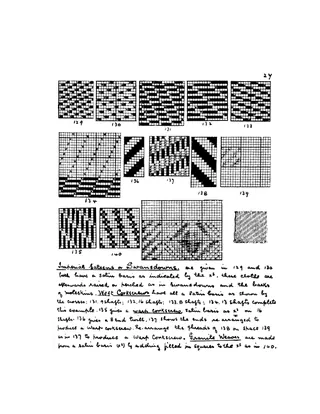
Manuscript Notes on Weaving, Book I
Book · 145 pages · weaving drafts
A facsimile of James Holmes's manuscript-style first-year course notes on cotton weaving, published by Lupton Bros. of Burnley in 1912. It combines handwritten text and hand-drawn figures covering fabric structure and loom mechanics, with numbered exercises where students complete designs, looming and peg plans. Design topics include twills, spots, honeycombs, diamonds, crepes, Bedford cords, piques, extra warp and weft figuring, and shirting stripes. The mechanical sections cover shedding, tappet construction and driving, dobbies, the plain loom, picking motions, take-up, temples and the weft fork.
Problems in Teaching 9 - Drafting
Master Weaver, July 1955
Article · 2 pages · weaving drafts
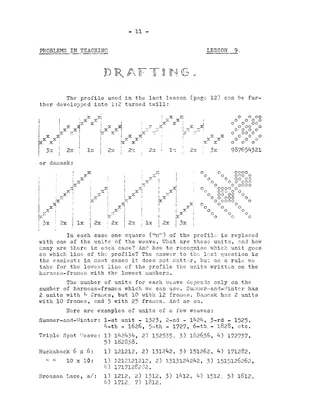
Lesson 9 in the Master Weaver series "Problems in Teaching," on converting a design profile into a threading draft. It explains how each profile square is replaced by one or more weave units, with lists of unit threadings for summer and winter, triple spot, huckaback, Bronson lace, dimity, dornick and damask. Worked examples show how to scale the number of units per square to fit a given warp width and sett, with condensed threading drafts.
Textile Design and Colour
Book · 369 pages · weaving drafts
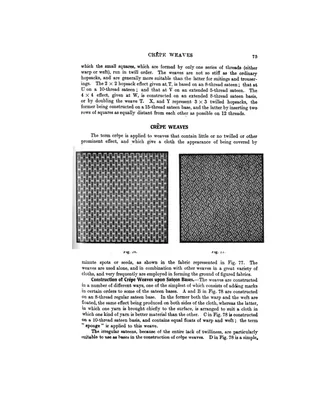
A 1921 second edition of William Watson's textbook on the design and colouring of woven fabrics made from one warp and one weft system. It covers the construction of simple and special weaves (plain, twill, sateen, diamond, crepe, huckaback, corkscrew, Bedford cord, welts and piques), stripe and check combinations, calculations, colour theory, and colour-and-weave effects. It also treats Jacquard machines and harnesses and the designing of figured fabrics, with the arrangement of repeats and figures on point paper. Illustrated with hundreds of figures and drafts, and includes a new appendix on standard yarns, weaves and fabrics and an index.
Der Webmeister für mechanische Weberei, IV Teil: Die Vorrichtungen für spezielle Gewebe [The Weaving Master for Mechanical Weaving, Part IV: The Devices for Special Fabrics]
Book · 120 pages · German · weaving drafts
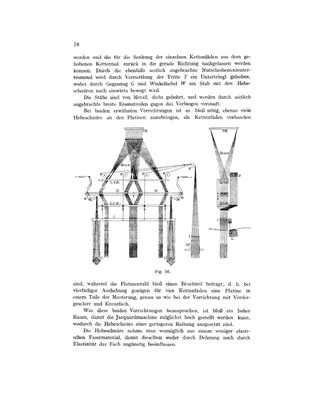
Part IV of Franz Kraus's German-language handbook for mechanical weaving foremen, covering the loom setups and attachments needed for special fabrics. It treats light and heavy cloths, double cloths, striped and checked goods, rips, piqué, matelassé, moiré, lancé and brocaded fabrics, pile fabrics (velvet, plush, chenille, loop), damask and half-damask rigs on Jacquard machines, openwork and leno (Dreher) fabrics with their drafts, selvedges, bead and feather fabrics. Illustrated with mechanical diagrams of regulators, shedding and Jacquard mechanisms, plus weave drafts for leno structures.
Études analytiques des principaux tissus [Analytic Studies of the Main Fabrics]
Book · 68 pages · French · weaving drafts
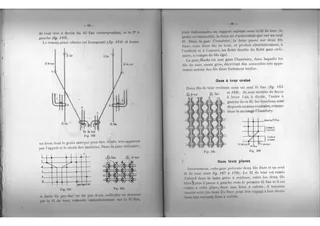
An 1898 French technical treatise by André Simon analyzing the principal woven fabrics by their interlacement of warp and weft, with 219 original figures placed in the text. It is organized in three groups: fabrics with straight threads, pile fabrics (velvets), and gauze fabrics with twisted threads. Chapters cover loom parts, drafting and threading (rentrage, empoutage), plain, twill and satin weaves, double cloth, piqué and matelassé, pleated fabrics, brocading, bead fabrics, warp and weft velvets, leno-type gauzes, and chenille. Many pages carry drawdowns, threading diagrams and mechanism drawings for hand looms, dobby and Jacquard harnesses.
65 documents found