Textile Documents › Topic: Netting and macramé
155 documents found
Sort: 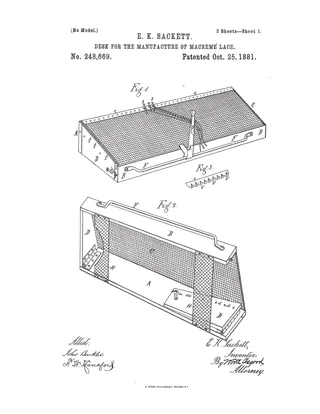
Desk for the Manufacture of Macremé Lace, US Patent No. 248669
Patent · 5 pages
US Patent No. 248,669, granted October 25, 1881 to Emanuel K. Sackett of Brooklyn, New York, for a foldable lace-desk (lace-board) used to hold threads while making macramé lace. The specification describes a flexible canvas top stretched between a back piece and front piece, hinged end pieces, thread-holding pins, and an adjustable spring-bar that lifts threads for tying Solomon's knots. It closes with five claims and is accompanied by two sheets of drawings (Figs. 1-6) showing the desk open, folded, and in variant constructions.
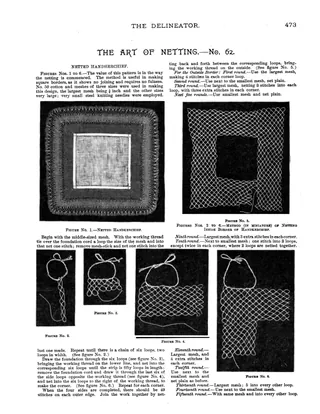
Art of Netting -- No. 62
Article · 1 page
A single page from The Delineator's series on netting (No. 62) giving instructions for a netted handkerchief with a square border and central square panel. It explains a method of starting the netting that shows no joining and needs no fulness, then lists the rounds of the outside border using three mesh sizes. Six figures show the finished handkerchief and miniature diagrams of the inside border method.
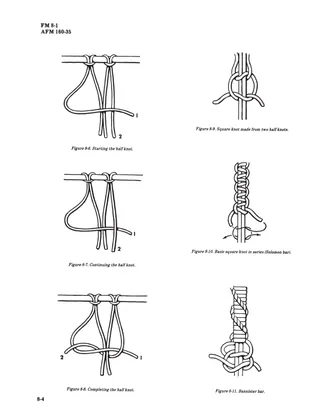
Cord Knotting or Macrame
U.S. Army, 1980
Monograph · 8 pages
Chapter 8 of a U.S. Army/Air Force manual (FM 8-1 / AFM 160-35) giving instructions in cord knotting, or macrame, as used in occupational therapy. It covers making and using a wooden knotting frame and waist hooks, suitable cords, cutting and starting cords, the half knot, square knot, Solomon and Bannister bars, half hitches and diagonal patterns, splicing, and finishing a belt. Line drawings illustrate the frame, hooks and each knot.
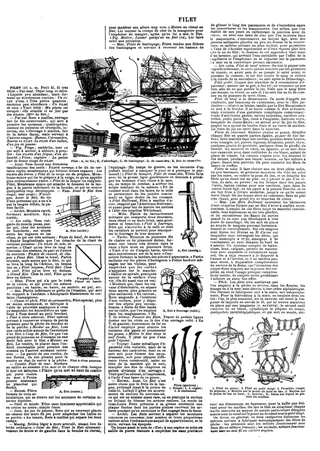
Filet [Net]
Article · 1 page · French
A page from the Nouveau Larousse Illustré (1904) containing part of the dictionary entry 'Filet', covering its many senses. The portions most relevant to textiles are the nautical entries on netting (bastingage nets, Bullivant steel torpedo nets) and the fishing entry describing hand netting with a netting shuttle (navette) and a mesh gauge stick, with knots tied on the thumb or under the little finger. It also briefly distinguishes French (two-thread) and English (single-thread) machines for making fishing nets. The rest of the page covers unrelated senses: horse bridle, architectural flashing, and culinary preparations of beef, venison and sole.
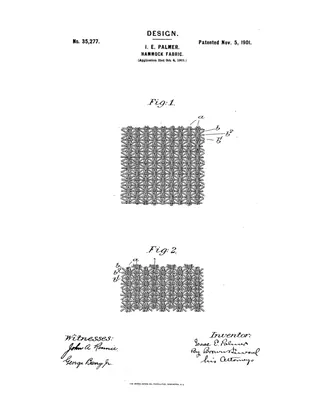
Hammock Fabric, US Patent No. D0035277
Patent · 2 pages
US design patent No. 35,277, granted November 5, 1901 to Isaac E. Palmer of Middletown, Connecticut, for a hammock fabric. The specification describes warp threads grouped in pairs that alternately separate and approach, and weft threads in groups of three whose outer members alternately approach and recede while the central member runs straight across. Two drawings show the face and reverse of the fabric; there are no weaving drafts.
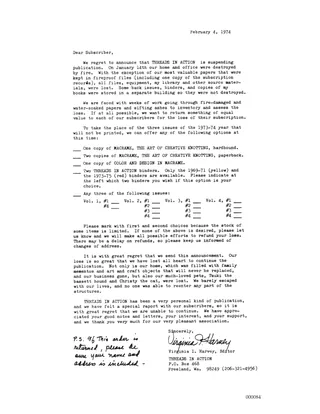
Letter to subscribers to Threads in Action announcing suspension of publication
Threads in Action, February 4, 1974
Ephemera · 1 page
A form letter dated February 4, 1974, from editor Virginia I. Harvey to subscribers of Threads in Action, announcing that the magazine is suspending publication after a fire on January 14 destroyed the Harveys' home and office. The letter lists replacement options for the three unprinted issues of the 1973-74 year: copies of her macrame books, binders, or back issues. It includes a checklist order form and a handwritten postscript about a returned order.
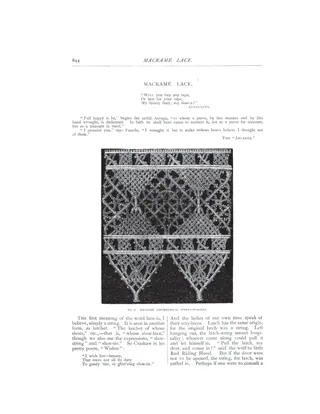
Macramé Lace
Article · 5 pages
A 1878 magazine article on macramé lace, opening with the etymology of the word 'lace' and its early use as string or band, then tracing macramé as a knotted fringe work of Arabic derivation. It notes the use of linen thread from the Barbour Flax Company and where the lace could be ordered and learned in New York, and cites 'The Queen Lace Book' as the source for the Italian patterns. It closes with a commentary on the over-use of cheap revival crafts. Six halftone illustrations show knots and Italian and American macramé panels.
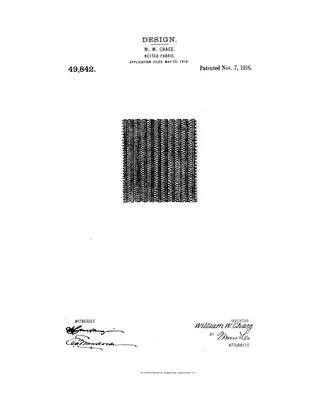
Netted Fabric, US Patent No. D0049842
Patent · 2 pages
US design patent No. 49,842 granted to William Wall Chace of Brooklyn, New York, on November 7, 1916, for an ornamental design for netted fabric. The first page carries the drawing of a fabric fragment with closely repeated diagonal mesh lines in vertical bands. The second page holds the brief specification and a single claim for the design as shown.
Netting
Monograph · 14 pages
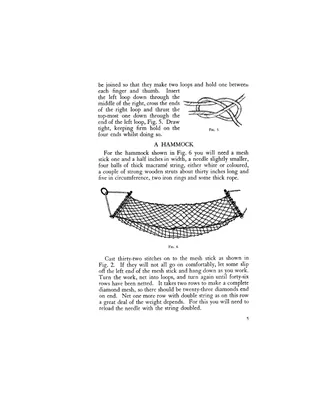
Dryad Leaflet No. 92 is an instructional booklet on hand netting with a mesh stick and needle. It covers tools, string choice, casting on, plain diamond mesh, and joining with the weaver's knot. Projects include a hammock, square- and diamond-mesh ping-pong nets, a striped string shopping bag on rings, rabbit or purse nets, and a wool scarf. Each is illustrated with numbered line drawings.
Art of Netting -- No. 59
Article · 1 page
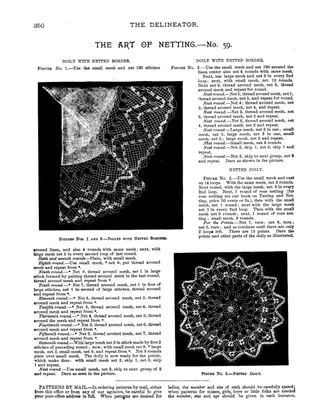
A single page from The Delineator's long-running netting series (No. 59) giving written instructions for three netted doilies. Figures 1 and 2 are doilies with netted borders worked around a linen center, and Figure 3 is a star-shaped netted doily with 15 points. Directions are given round by round using small and large meshes, with darning to finish, and one pattern refers readers to the magazine's book on tatting and netting for rose netting.
Art of Netting -- No. 61
Article · 1 page
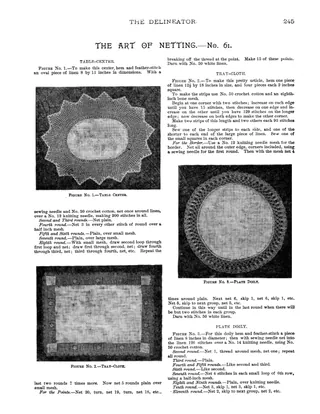
A single page from The Delineator (page 245) with instructions for three netted articles: an oval table center, a tray-cloth, and a plate doily. Each is made by netting onto hemmed linen with No. 50 crochet cotton over knitting-needle and bone meshes, with round-by-round directions and darning in white linen. Three halftone photographs show the finished pieces.
Long Black Silk Mitten -- Netting
Article · 1 page
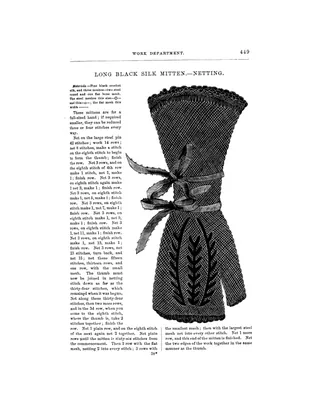
A single-page pattern from the Work Department of Godey's Lady's Book (1860) for a long black silk netted mitten. It lists the materials (fine black crochet silk, two steel meshes and one flat bone mesh) and gives row-by-row netting instructions, including shaping and joining the thumb and finishing the cuff. An engraving shows the finished mitten with a scalloped cuff, floral motif and ribbon tie at the wrist.
Macramé Lace
Woman's World, 1890
Article · 5 pages
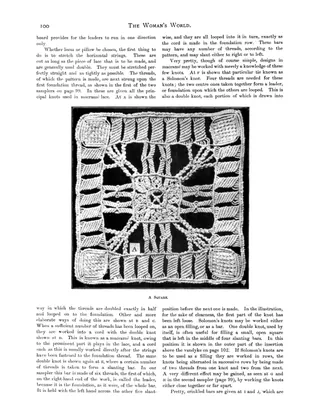
A Victorian magazine article on making macramé lace, with a short history of the craft and its supposed Arabic origin. It explains the equipment (a weighted pillow or a board loom) and the main knots shown on two knot samplers: the double macramé knot, slanting bars, Solomon's knot, crinkled bars, the raised picot knot, and picot bars. It then gives working instructions for a vandyked edging with fringe, a square panel with added corner threads, and an insertion, plus advice on cutting thread lengths. The article is signed Ellen T. Masters.
Netted Tidy
Article · 1 page
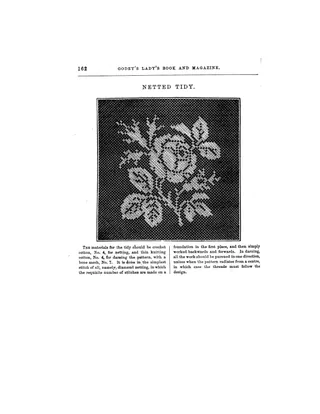
A one-page pattern from Godey's Lady's Book for a netted tidy (antimacassar-style cover). It gives materials (No. 4 crochet cotton for the netting, thin knitting cotton for darning the pattern, a No. 7 bone mesh) and explains that the ground is plain diamond netting worked back and forth, with the floral or radiating motif darned in afterward. A photographic illustration shows the finished piece with a light darned motif on a dark netted ground.
Netting Machine, US Patent No. 51744
Patent · 3 pages
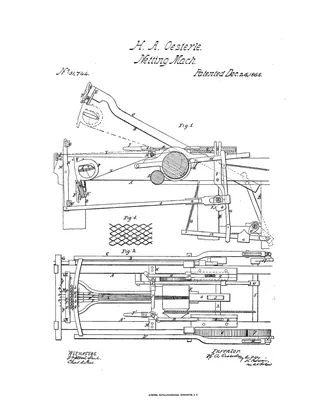
US Patent No. 51,744 granted to Herman A. Oesterle of Philadelphia for a machine that makes netted or lace fabrics, such as sashes worn by army officers. The specification describes a frame, shuttles with bobbins, spring catch-levers, a sliding guide bar for warp threads, beaters and a take-up drum, and explains how shuttle threads are looped around pairs of threads to form the net. It ends with five claims. The patent drawing shows side and plan views of the machine and a diagram of the fabric produced.
Cord Knotting
Monograph · 15 pages
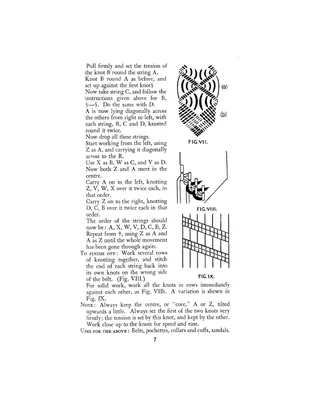
Dryad Leaflet No. 127 is a short instruction booklet on decorative cord knotting and macramé-style string work by E. Mary Macdonald of Dorset House School of Occupational Therapy. It gives step-by-step directions, with diagrams, for eight knots and plaits: buttonhole, finger knitting, four in hand, half hitch, nine or seven plait, round plait, Solomon's knot and square sennate. It ends with instructions for four knotted belts (A to D) attached to buckles, with notes on string lengths, colour arrangements and uses such as bag handles, dog leads and belts.
Looms for Weaving Fish Nets
Textile World Journal, May 26, 1917
Article · 1 page
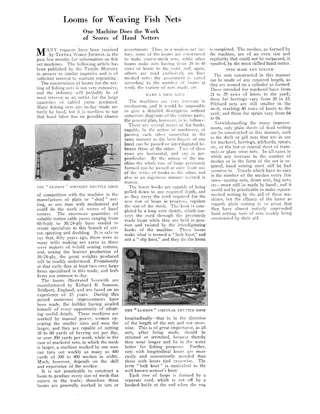
A 1917 trade article, reprinted from the Textile Mercury, describing Richard R. Samson's hand-powered net-making machines (straight and circular shuttle looms) built in Bridport, England. It explains how the machines form lock knots with interdigitating hooks and a wire shuttle, the output per day for herring and mackerel nets, and the mesh sizes for different fish. It also notes that only plain flat netting can be machine-made, while trawls and shaped nets still require hand netting.
Macramé
Book · 49 pages
A DMC Library album on macramé by Th. de Dillmont, offering an introduction and instructions on materials, the cushion and accessories, and how to form the knots. Line drawings show flat knots, picots, shell knots, bars, collecting knots and joining methods. Written directions follow for fringes, grounds, insertions and gimps (including gimps worked with macramé bobbins and a gimp with a corner). The second half is a series of photographic plates with numbered samples of knotted bands and fringes, ending with a list of DMC threads.
Net
Article · 2 pages
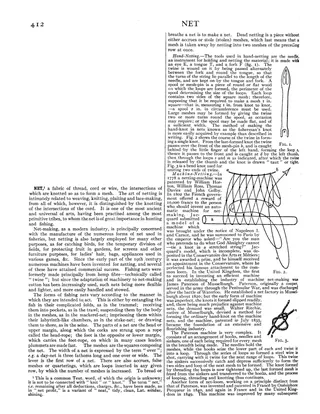
Two-page encyclopedia article defining netting as a knotted-mesh fabric and describing its uses, especially fishing nets, along with net terminology such as head, foot, mesh and accrues. It explains hand-netting with the needle and mesh-pin, the fisherman's knot and the bend knot, and traces machine netting from the 1778 patent through Jacquard, Paterson, Ritchie, Pecqueur, and Baudouin and Jouannin. It ends with a short section on wire netting and its machine manufacture.
The Net Work
Book · 60 pages
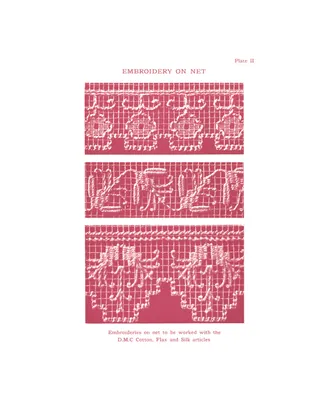
A D.M.C Library album on embroidery on net (lacis), edited by Th. de Dillmont. The text describes hand netting with needle and mesh, making squares and rectangles of straight net, mounting net on frames, and many embroidery stitches such as darning, linen, loop, buttonhole, Venetian and Russian stitch, along with fillings and grounds. It is followed by 20 plates of net embroidery patterns in red and color, a D.M.C Library publications list, and thread-size charts for D.M.C cotton, flax and silk.
Netted Collar and Doily
Article · 1 page
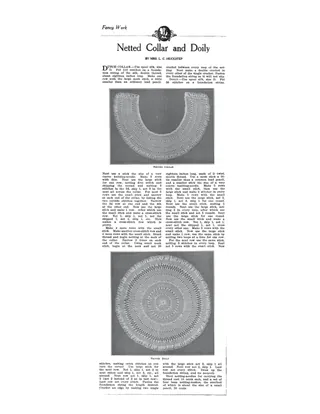
A one-page 1892 magazine article from the Fancy Work section giving netting instructions for a Dutch collar in spool silk and a round doily. It specifies stitch counts, mesh stick sizes, and row sequences including cross-stitch rows, narrowing, and a crocheted edge. It ends with prices for steel netting needles and bone mesh sticks, and is illustrated with photographs of the finished collar and doily.
Netted Feather Robes
Article · 8 pages
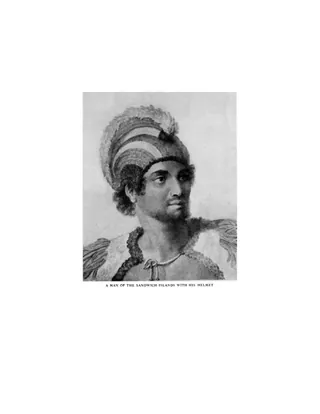
An article on the netted feather cloaks, capes and helmets of Hawaii, made by tying tufts of small feathers to a filet mesh of olona fibre. It describes how the birds were caught, the feather types and colors used, the designs, and the famous royal pieces such as Kamehameha's mamo cloak. It also covers collections in the Bishop Museum and elsewhere, and briefly mentions feather fabrics from Brazil and China. Illustrations show a Hawaiian man in a helmet, King Kaumualii's helmet and King Kamehameha in his cloak.
Anleitung zum Erlernen der Filet-Guipüre und der Knüpfarbeit [Instructions for Learning Filet Guipure and Knotted Work]
Monograph · 19 pages · German
A German instruction booklet (second enlarged edition) from the ladies' magazine "Der Bazar" teaching filet-guipure (darned and embroidered netting) and knotted work (macramé-type knotting). The filet section explains making the netted filet ground with needle and mesh stick, joining threads, increasing and decreasing for squares, borders and corners, and the filling stitches point de reprise, point de toile and point d'esprit. It then gives patterns for doilies, a table cover, curtains, collars, a blouse, borders and squares. The knotting section describes the knotting cushion, basic knots and many borders, fringes, a handkerchief case, belts and a waist pendant, with numbered illustrations throughout.
Embroidery
Godey's Lady's Book and Magazine, February 1878
Article · 1 page
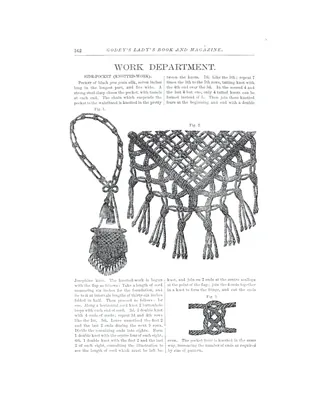
A one-page Work Department piece from Godey's Lady's Book (February 1878) giving instructions for a black silk side pocket with a knotted-work (macramé-style) flap and front. It describes the foundation cord, the row-by-row knotting with buttonhole loops, double knots and tatting knots, and the Josephine-knot chain that suspends the pocket. Illustrations show the finished pocket and chain and a knotted mesh panel with fringe.
Filets [Nets]
Article · 2 pages · French
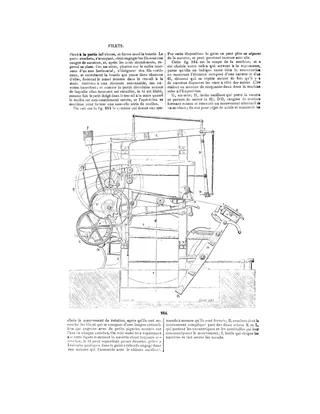
A short French encyclopedia article on nets (filets), explaining how fishing nets are made by hand with a mould and shuttle, with each mesh held by a knot. It then describes the mechanical net-making machine of the French engineer Pecqueur, shown at the 1849 Exposition and awarded a prize by the Société d'encouragement. The text explains how hooks, shuttles and eccentrics form the loops and knots, and a cross-section figure (fig. 884) has labeled parts.
Net Making
Article · 5 pages
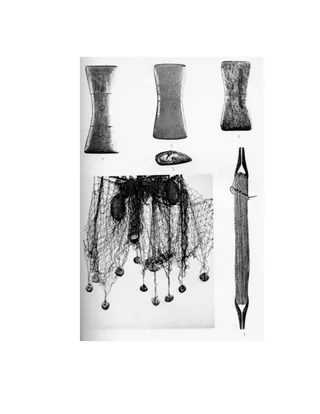
A short excerpt from Goddard's ethnography of the Hupa of northern California describing how they make nets and snares. It covers preparing twine from Iris macrosiphon leaf fibers, using a mussel-shell thumbnail to strip the fibers, and twisting the two-ply cord on the thigh. It also describes the bobbin and elk-horn mesh-sticks used in knotting nets. A plate explanation and photographs show a seine with wood floats and stone sinkers, a bobbin, a thumb shell and mesh-sticks.
The Priscilla Netting Book
Belle Robinson · 1914
Book · 52 pages
A 1914 instruction book from the Priscilla Publishing Company, edited by Belle Robinson, on hand netting and Filet Brodé (embroidered netting). It explains the equipment (mesh-sticks, netting needles, frames), square, circular, diagonal and battlemented netting, and the darning stitches used to ornament the net: Point de toile, Point de reprise, Point d'esprit, Point de feston and Point de poste. Numbered projects (Nos. 600-631) include centrepieces, doilies, scarves, cushion covers, a table cover, altar cloth lace, an alb border, collars, a yoke, edgings and insertions, each with materials and row-by-row directions. The second half has many charts of filet patterns, corner motifs and alphabets. Advertisements for other Priscilla books and the magazine appear at the front and back.
Imperial Macrame Lace Book
Barbour Brothers Limited, 1877
Book · 100 pages
An 1877 instruction book from Barbour Brothers, makers of Barbour flax linen thread, teaching macramé lace with their threads. After a promotional introduction on the Barbour Flax Spinning Company and its Philadelphia Exhibition success, it explains materials and basic knots (single, double and open chain, Solomon's knots, raised picot). It then gives written directions for 17 numbered patterns of insertions, edgings and scollops, each with a plate of the finished piece and the thread length needed. It closes with a reprinted Boston Evening Transcript article on lace making as a new industry for American women.
The Imperial Macramé Lace Book
Book · 66 pages
A late 19th-century instruction book on macramé lace published by Barbour Brothers to promote their flax macramé threads. After an introduction and notes on materials and basic knots (single, double and open chain, Solomon's knot, raised picot), it gives written instructions for 17 numbered patterns, such as insertions, edgings and fringed scollops. Each pattern is illustrated with an engraving and lists the thread lengths needed. The book ends with a reprinted newspaper piece on the Barbour Flax Spinning Company at the Philadelphia Exhibition and an advertisement for the firm's threads.
"Manufacture of Fish Nets" from Industries of Scotland
Monograph · 9 pages
A chapter from David Bremner's The Industries of Scotland (1869) on the manufacture of fishing nets. It covers hand net-making in coastal villages, the shift from hemp to cotton twine, and the story of James Paterson, inventor of the net-loom at Musselburgh around 1820. It also describes J. & W. Stuart's Musselburgh factory, the preparation and spinning of hemp, how the net machine forms knotted meshes, the types of nets made, worker wages and conditions, and the spread of net manufacture to other Scottish towns.
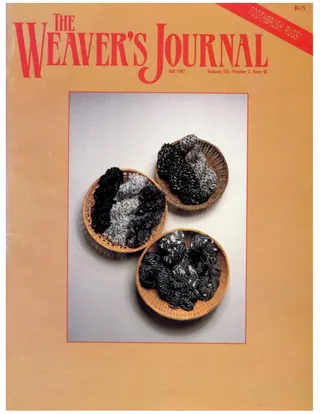
Weaver's Journal, Vol. XII, No. 2 Issue 46 (Fall 1987)
Weaver's Journal, Fall 1987
Periodical · 76 pages · weaving drafts
Fall 1987 issue of The Weaver's Journal, a quarterly for handweavers and spinners, with a cover feature on toothbrush rugs, a rag-based form of nalbinding (needle-looping). Other articles cover Scandinavian nalbinding, overshot variations (swivel, honeycomb, shadow weave, huck, brocade and petit point), a guild's history, Japanese felt artist Shinnosuke Seino, handspun yarn design, a triangular handspun shawl, Andean warp-faced fabrics, rayon twill scarves, multilayer and double weave color changes, and warp-faced krokbragd. It also includes tapestry tips, editorials and letters, book reviews, a calendar, and advertisements. The editors announce austerity measures, and the issue is marked as the final one.
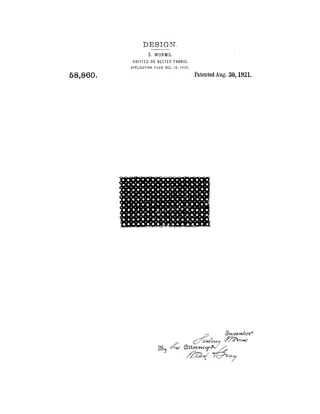
Knitted or Netted Fabric, US Patent No. D0058860
Patent · 2 pages
US design patent D58,860, granted 30 August 1921 to Sidney Worms of New Rochelle, New York, and assigned to Franklin Knitting Mills. It claims an ornamental design for a knitted or netted fabric. The single drawing shows a plan view of a fabric with small open holes in a staggered diagonal grid and a looped border. The text is a short specification with a one-line claim.
Bibliography from A Historical Review of Knotless Netting in South America
Other · 4 pages
A four-page bibliography extracted from Sandra F. Dickey's 1964 UC Berkeley master's thesis on knotless netting (looping, single-element structures) in South America. It lists about 50 works from 1883 to 1964, mostly on Andean archaeology and textiles (Peru, Paracas, Nazca, Ancon) and on ethnography of South American peoples (Chaco, Guiana, Araucanians). Works by Bird, O'Neale, Engel, Métraux and Nordenskiöld are heavily represented, along with Davidson's 1935 study of knotless netting.
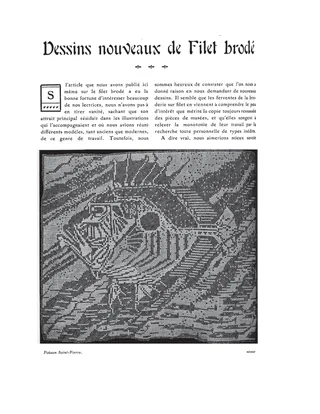
Dessins nouveaux de Filet Brodé [New Designs for Filet Lace]
Article · 5 pages · French
A short article from the French journal Art et Décoration (December 1909, pp. 206-210) presenting new designs for filet brodé (embroidery on netted ground) as a follow-up to an earlier article. It encourages artists to create original, stylized patterns suited to the squared grid of filet work rather than copying museum pieces. It reproduces full-page designs by Méheut (St. Peter's fish, daturas, artichokes, hollyhocks) and a figural panel by Mezzara, and announces a forthcoming study of Venetian needle lace. The article is signed Paul Mezzara.
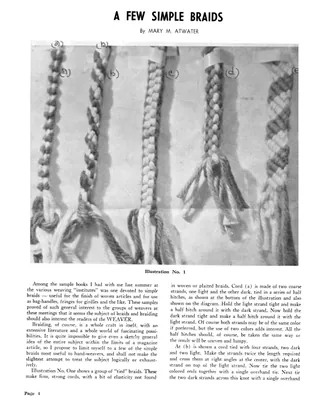
A Few Simple Braids
Article · 6 pages
Mary Atwater introduces a selection of simple braids and knotted cords that handweavers can use for finishing woven pieces, bag handles, drawcords and girdle fringes. She gives step-by-step directions for tied braids (half-hitch and crowning knot), Solomon knot cords, looped or bight braids (twin-bight, Antique Sennit), multi-strand Indian, combing and Girdle of Rameses braids, and sailors' sennits. Photographs of sample cords and hand-drawn diagrams accompany the text, and she recommends a further reference on knots and rope work.
Le Filet Brodé [Embroidered Filet]
Book · 60 pages · French
A French-language DMC Library album by Th. de Dillmont on embroidered filet (embroidery on knotted or machine-made net). It explains the tools (netting shuttle, mesh gauges), thread choices, how to make netting and square, band and frame shapes, and how to mount the net in a frame. It then covers filling and darning stitches such as point de toile, point d'esprit, point de reprise, wheels, stars, point de Venise, point coupé, background fills and languette borders. The second half has 20 plates of filet embroidery patterns and charts, followed by a DMC publications list, a product list and a thread-size table.
Guipure d'Art
New England Fireside, July 1888
Article · 3 pages
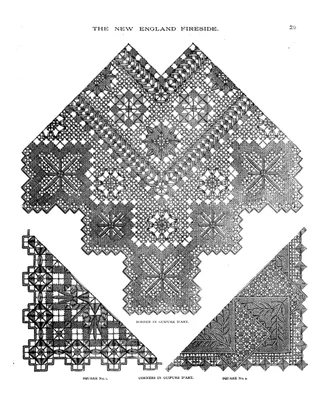
A three-page 1888 magazine article from The New England Fireside on guipure d'art, a form of lace made by darning and embroidering patterns on a netted square foundation (fillet). It lists materials, explains how to net and lace the foundation on a wire frame, and describes the principal stitches: Point d'Esprit, Point de Toile, Point de Feston, Point de Reprise, Point de Bruxelles, and wheels. Stitch diagrams and finished designs are included: a border for cushions or pillow shams, insertions, corner pieces, and two square patterns.
Ingalls' Handbook of Darned Lace Patterns
J. F. Ingalls · 1885
Book · 100 pages
A small 1885 pattern book of darned lace (darned netting) designs published by J. F. Ingalls, priced at 25 cents. The volume is almost entirely illustrations: engraved and photographic plates of motifs, borders, and edgings worked in darning stitches over a hexagonal net ground. Little or no instructional text is legible, so it serves mainly as a visual pattern source for netting and darned lace.
Käpyily-ja solmeilutyöt [Tatting and Knotting]
Book · 62 pages · Finnish
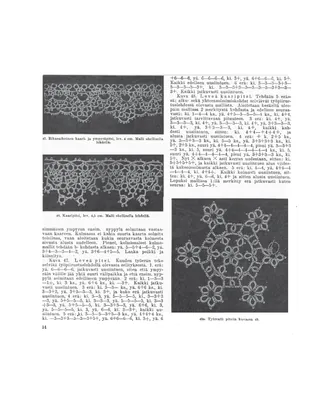
Finnish-language instruction book (Otava's handicraft series no. 6), translated from German by Ilona Jalava, on shuttle tatting (käpyily, frivolité) and knotting/macramé-style work (solmeilu). The first part explains the shuttle, hand positions, rings, arches, picots and joining, followed by many numbered lace edgings, handkerchief borders, collars, doilies and stars with written stitch counts. The second part covers knotting bases, knots (double half-hitch, Josephine knot, leaf knot, picots) and finished pieces such as borders, a belt and reins, a vest, a bag, a cap and free-form lace. It has 147 figures; the last pages reproduce reduced pattern sheets with pattern diagrams and instructions and a list of abbreviations.
Lacis By Carita
The Connoisseur, 1909
Article · 1 page
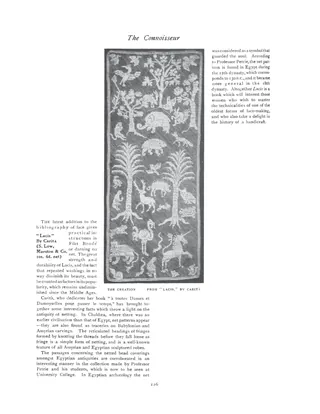
A short book notice from The Connoisseur reviewing "Lacis" by Carita, a practical guide to filet brodé (darning on net). It summarizes the book's historical remarks on the antiquity of netting in Chaldaea, Assyria and Egypt, citing Professor Petrie's collection at University College. A full-page illustration shows a lacis panel titled "The Creation" with trees and animals in registers within a netted border.
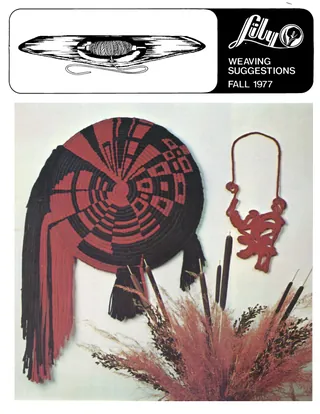
Lily Weaving Suggestions, Vol. 2, No. 4 (1977)
Lily Weaving Suggestions, 1977
Periodical · 8 pages
Fall 1977 issue of Lily Weaving Suggestions, a Belding Lily Company bulletin devoted to coiled basketry with fiber. It describes figure-of-eight coiling, recommended cords and yarns, and tools, then gives projects: a soft jewelry neckpiece and a circular convex coiled wall hanging by Joan Michaels Paque, and a knot-stitch soft pot (basket) by Ellen Jones using larks head and half-hitch knots over a Fiber Flex core. Includes diagrams of the stitches and pull-out skeins, a short bibliography of basketry books, and a photograph of coiled vessels.
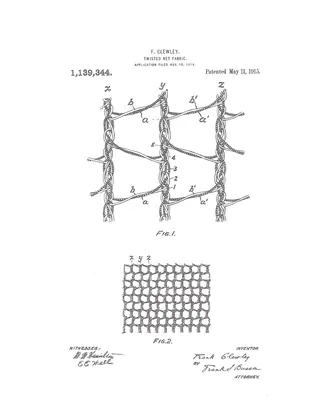
Twisted Net Fabric, US Patent No. 1139344
Patent · 2 pages
US Patent No. 1,139,344 granted to Frank Clewley of Philadelphia in 1915 for a twisted-net fabric. It describes an open-work knitted fabric made on a rib-lace machine with two guide bars, in which paired threads interloop in alternating chains so that torn or cut fabric cannot ravel far. The fabric is intended for laundry bags and dyers' bags. Two line drawings show the loop and chain construction.
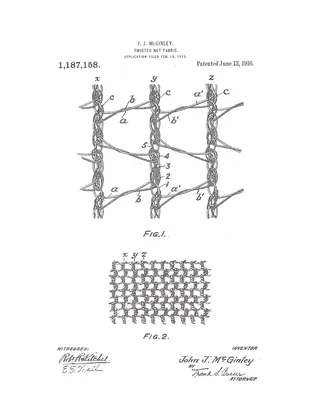
Twisted Net Fabric, US Patent No. 1187158
Patent · 4 pages
US Patent No. 1,187,158, granted June 13, 1916 to John J. McGinley of Philadelphia (assignor to Simon Friedberger), for an open-work twisted net fabric knitted on a lace machine. The fabric is intended for laundry bags and dyers' bags, where torn or cut threads must not ravel. It improves on Frank Clewley's earlier patent No. 1,139,344 by adding a binder thread to each chain, and the text describes the loop structure thread by thread. It includes two figures and three claims.
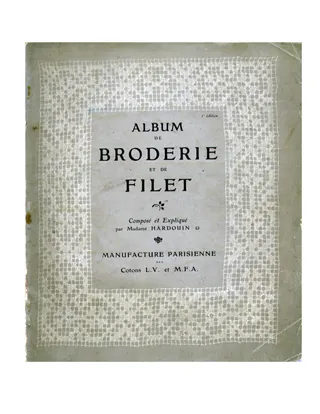
Album de Broderie et de Filet [Album of Embroidery and Filet]
Book · 50 pages · French
A French needlework album, 2nd edition, by Madame Hardouin for the Manufacture Parisienne des Cotons L.V. et M.F.A. The first part covers embroidery: transferring designs, initials, plumetis, festoon (feston, Richelieu, Colbert), English embroidery, cut-work, flat satin stitch, and eleven ornamental stitches, with advice on needles and washing. The second part covers filet (knotted net) embroidery: making the net square and band with shuttle and mesh gauge, darning (Cluny) stitch, and photographed sample squares worked on nets A to D, plus Filet Italien and Filet d'Art. Thread numbers for the company's cottons are given throughout.
Album de Filet Brodé [Album of Embroidered Filet]
Book · 52 pages · French
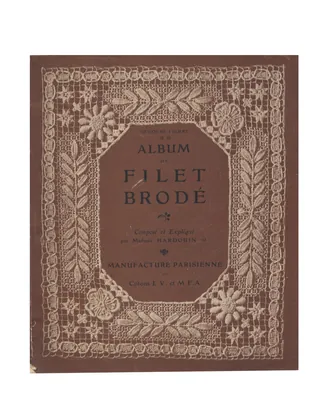
A French-language pattern album of embroidered filet (darned netting lace), published as the second volume by the Manufacture Parisienne des Cotons L.V. et M.F.A. and composed and explained by Madame Hardouin. It gives short instructions and many photographic plates of insertions (entre-deux), bands and squares in Cluny, Italian and art filet, plumetis embroidery on filet, appliqué on filet, soutache filet, and filet with Irish crochet appliqué. Captions give mesh counts and recommended L.V. linen lace thread and M.F.A. embroidery cotton numbers. The art filet section describes stitches such as point de reprise, point d'esprit, point croisé, point ondulé, the spider, stars, lozenge and leaves.
Filet-Guipure [Filet Guipure]
Th. de Dillmont, 1923
Book · 35 pages · German
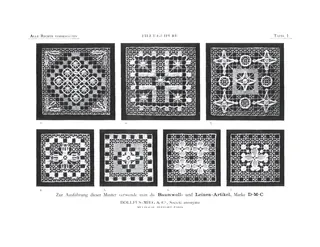
A German-language pattern album from the D.M.C Library (Th. de Dillmont, Mulhouse) on Filet-Guipure, a netted-ground embroidery that combines dense stitches with lace filling stitches. An introduction and instructions cover making the net ground, framing, thread choice and sizes, new stitches (Russian stitch, slanted loop stitch, decorated loop stitches, spiders, corner fillings, stars of loose threads, Venetian stitch), stiffening, and uses. Twenty plates (Tafel I-XX) show 68 numbered patterns of squares, ground patterns, insertions and lace edgings, followed by D.M.C product and publication lists.
The Finish of Edges
Article · 4 pages
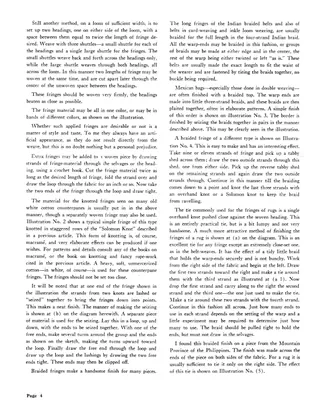
Mary Atwater's article on finishing the edges of woven pieces, mostly with fringes. It covers deciding whether to fringe, finishing in the loom with Spanish open-work weaving, and weaving separate applied fringes on an inkle or harness loom. It also describes knotted macramé (Solomon knot) fringes, seizing, braided fringes and tops, a braided rug-fringe tie from the Philippines, and three Maori twined finishes. Diagrams and five photographs illustrate the methods.
Lacis
Article · 3 pages
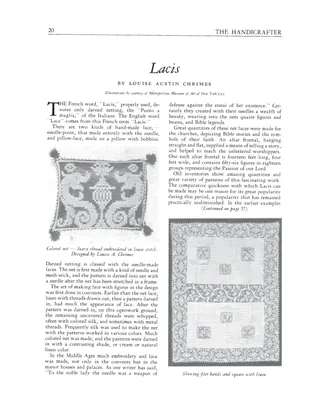
A short illustrated magazine article on lacis, the darned netting lace (punto a maglia) in which patterns are darned into a hand-knotted net stretched on a frame. It covers the origin of the term, the distinction between needle-point and pillow lace, and the medieval history of net lace made in convents and manor houses, including church altar frontals with Bible scenes. The photographs show cushions, filet panels, and samples of linen stitch, Sardinian weave, linen darning, shadow work, and embroidered net.

Twine Crochet Work
Marie Louise Kerzman · 1883
Book · 46 pages
A short 1883 instruction booklet (second, enlarged edition, Crochet Series No. 2) on crocheting with twine, compiled and edited by Marie Louise Kerzman and published by Henry Bristow of Brooklyn. It explains basic crochet stitches, abbreviations, suitable twine and needles, and gives row-by-row directions for eleven lambrequin (valance) edging designs, each illustrated, plus fringe-making instructions. It ends with a section on netting a hammock with a seine needle and mesh board.
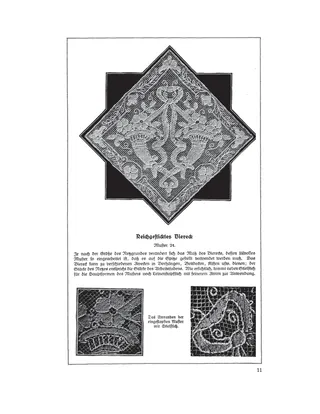
Filet Arbeiten. Vol. 2: Gipüre
Book · 46 pages · German
A German-language pattern book on filet guipure (Filetgipüre) from Beyers Handarbeitsbücher, Band 39, arranged by Marie Niedner. It opens with instructions on netting the filet ground (needle, rods, cushion or Nähschraube, increasing and decreasing) and on darning and filling stitches such as linen stitch, loop stitch, spiders, stars and leaves. The main part presents photographed projects with working notes and references to counted patterns: curtains, insertions, edgings, doilies and tablecloths, an altar-cloth lace, and coloured filet pieces such as a cushion, a bag and tablecloths. The final pages list a pattern sheet (Musterbogen) and advertise other Beyer publications.
155 documents found