Textile Documents › Topic: Crepe and granite weaves
106 documents found
Sort: 
Beitrag zur Kenntnis der Kreppbindungen [Contribution to the Knowledge of Crepe Weaves]
Article · 1 page · German
First installment of a German-language article on crepe fabrics and the crepe weave structures used to make them. It describes three ways to give a fabric a crepe character: finishing with engraved calenders, using hard-twisted yarns (S and Z twist in warp and weft, or yarns that shrink in finishing such as mercerizing), and weaving with crepe bindings whose scattered floats break up reflected light. It announces that later parts will examine how common crepe bindings are derived and how new ones can be constructed. This page contains no drafts, and the article ends with "Fortsetzung folgt".
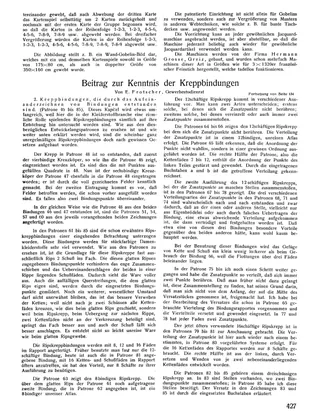
Beitrag zur Kenntnis der Kreppbindungen [Contribution to the Knowledge of Crepe Weaves]
Article · 2 pages · German · weaving drafts
Installment of E. Frotscher's article on crepe weaves (Kreppbindungen), covering crepe weaves produced by superimposing one weave on another (patterns 46 to 85). It explains how the combined weaves are built, with particular attention to rib crepe weaves (Ripskreppbindungen) used for piece-dyed women's dress fabrics. It describes 8-, 12- and 16-end repeats, the placement of added binding points on a plain 2-pick rib base, and the 3-pick rib crepe, and notes the advantages over plain rib. The second page has the drawdown grids numbered 46 to 85. The text begins with the end of an unrelated note on a patented Jacquard enlarging device for tapestry.
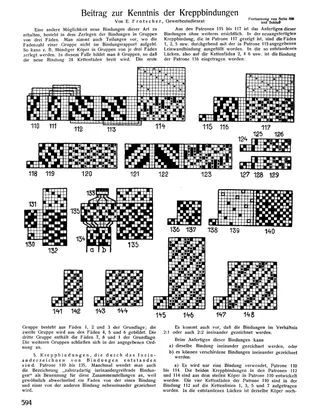
Beitrag zur Kenntnis der Kreppbindungen [Contribution to the Knowledge of Crepe Weaves]
Article · 3 pages · German · weaving drafts
The concluding part of E. Frotscher's German-language study of crepe weaves (Kreppbindungen), continuing from an earlier page 520. It explains methods for constructing crepe weaves: dividing weaves into groups of threads, interdrawing weaves in ratios such as 1:1, 2:1 and 2:2, adding or removing points on base weaves (plain, twill, satin), filling in divided pattern areas, and drawing free "wild" crepe weaves. The pages carry numbered drawdowns (about 110 to 168), with notes on shaft counts, Jacquard use and balancing float lengths. The scan ends with the start of an unrelated technical note on a patented doubling and press-board inserting machine.
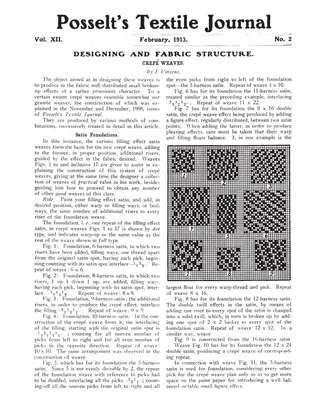
Designing and Fabric Structure
Article · 2 pages · weaving drafts
Two pages from Posselt's Textile Journal, February 1913, on textile design and fabric structure. The first is J. Vinzenz's installment on crepe weaves built from satin foundations, with rules and descriptions for weaves Figs. 1-17 (5- to 16-harness satins and double satins) and their repeats. The second page finishes the crepe weave descriptions and begins an article on warp-pile fabrics made with an extra warp, covering terry and velvet pile and the wires used to form them.
The Construction of Granites
Article · 2 pages · weaving drafts
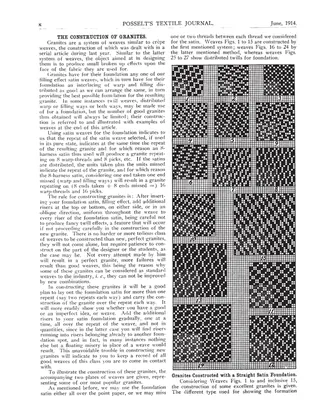
Part of a serial article by E. A. Posselt explaining how granite weaves (small broken-up effects similar to crepe weaves) are constructed from filling-effect satin foundations. It gives the rule of adding risers to each foundation satin point, advice on avoiding twill effects, and describes a plate of weaves, Figs. 1 to 15, built on 8- to 16-harness satins. The scan also includes two unrelated short pieces on finishing and sizing cotton and linen cleaning and dusting cloths and on New Jersey's woolen and worsted industry statistics for 1913.
The Construction of Granites
Article · 1 page · weaving drafts
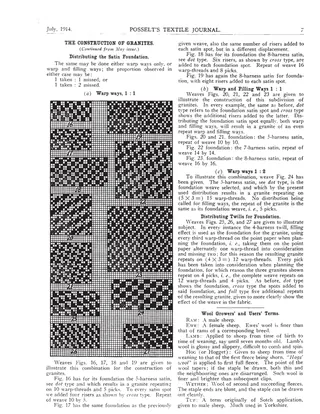
A single page from Posselt's Textile Journal, continuing a series on constructing granite weaves. It explains how to build granites by distributing a satin foundation warp-ways or warp-and-filling-ways (1:1 and 1:2 proportions) and by distributing twills as a foundation, with weave draft Figs. 16-27 showing foundation spots (dot type) and added risers (cross type). The page also includes a short glossary of wool growers' and users' terms (ram, ewe, lamb, hog, wether, tup).
Crepé Weaves
Article · 3 pages · weaving drafts
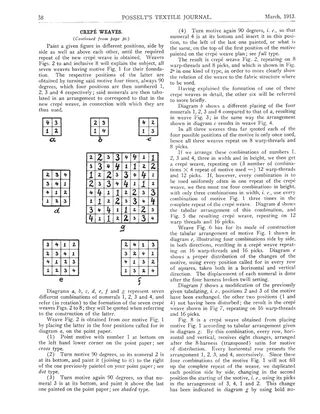
Three pages from Posselt's Textile Journal (March 1913) with the continuation of a series on crepé weaves, followed by part of a series on pile fabrics. The crepé section explains how to build crepé weaves from a motive turned through four 90-degree positions and arranged by numeral tabulations (Figs. 2-8, repeats of 8x8, 12x16 and 16x16). The pile fabrics section covers Astrakhan fabrics (ground and pile warp, wires, drawing-in on harnesses, terry and cut pile) and double plush, with weave and section diagrams. A short note on preparing fabrics for dyeing by rubbing over fixed bars ends the text.
Designing and Fabric Structure for Harness Work: Granite Weaves
Article · 2 pages · weaving drafts
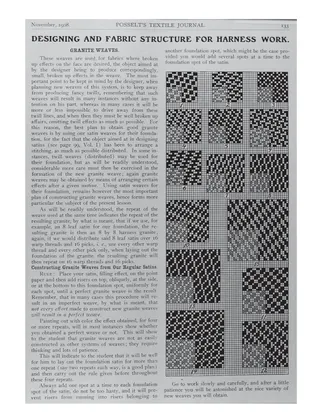
A two-page lesson from Posselt's Textile Journal (November 1908) on designing granite weaves for harness-loom work, which produce small, broken-up effects on the fabric face. It explains building granite weaves from satin foundations by adding risers to each foundation spot, and describes a plate of 15 granite weaves built on 8- to 16-harness satins, with a closing exercise. Page 2 begins a separate short piece on yarn strength, elasticity, twist and contraction by twist, criticizing old hand-testing methods.
February, 1914
Article · 2 pages · weaving drafts
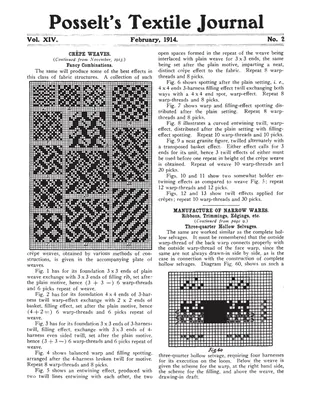
Two pages from the February 1914 issue (Vol. XIV, No. 2) of Posselt's Textile Journal. They continue a series on crêpe weaves, describing thirteen fancy-combination crêpe weaves (Figs. 1-13) built from plain weave, rib, basket and twill exchanges, with repeat sizes. They also continue the series on narrow wares manufacture, covering three-quarter and half hollow selvages with drawdowns, warp and filling schemes, and drawing-in drafts (Figs. 60-63). A short note on the Kashmir silk industry follows.
Novelty from Men's Wear
Article · 1 page · weaving drafts
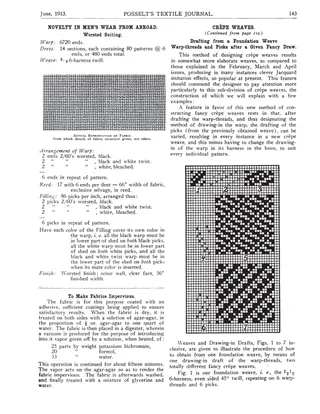
A single page from Posselt's Textile Journal with two items. The first gives the specifications for a worsted men's suiting from abroad: warp and filling arrangement, reed, picks per inch, 6-harness twill weave, and finish. It also includes a short note on making fabrics impervious. The second is an installment of a series on crêpe weaves, explaining how to derive fancy crêpe weaves from a 6-harness twill foundation weave and a fancy drawing-in draft, with numbered draft figures.
Crepe
Master Weaver, March 1955
Article · 4 pages · weaving drafts
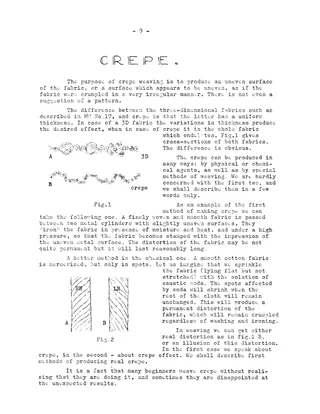
An article from Master Weaver No. 20 on weaving crepe fabrics, in which the whole cloth undulates, as distinct from 3D fabrics. It briefly covers mechanical and chemical crepe finishing, then describes weaving methods: same-direction yarn twist, alternating right- and left-hand twist yarns, differential warp tension, mixed linen and cotton warps, and tabby combined with satin or satinet. It gives a four-harness crepe draft with ten treadling variations and refers to multiharness crepe weaves from Oelsner. A short book note on Mary E. Black's Handweavers' Reference follows.
Granite-Weaves
Article · 2 pages · weaving drafts
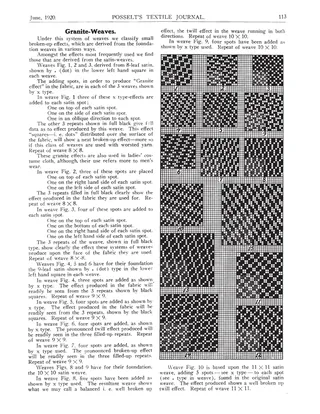
A two-page spread from Posselt's Textile Journal (June 1920) explaining granite weaves, small broken-up effects built by adding spots to the points of satin weaves. Fifteen weaves are described, based on 8- through 16-leaf satins, with a page of drawdown figures showing the foundation points and added spots. The scan also includes short pieces on loading and filling in silk fabrics (analytical tests) and on dyeing feathers.
History of Dyeing
Article · 2 pages · weaving drafts
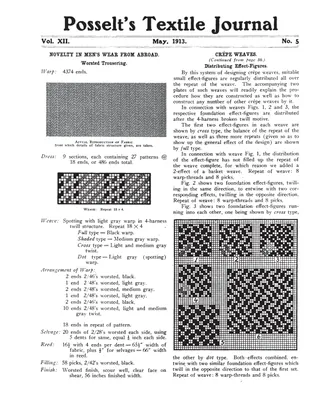
Two pages from Posselt's Textile Journal, May 1913, containing three items. One gives full construction details for a worsted trousering fabric (warp arrangement, reed, filling, finish) with a 4-harness twill spotting weave repeating on 18 x 4. The second continues a series on designing crêpe weaves by distributing small effect-figures over the repeat, using broken twill and 5-, 9- and 10-harness satin settings (Figs. 1-12). The third continues a discussion of comparative setting of weaves based on the intersection theory, with thread-count calculations for 20's cotton.
Novelty in Cotton Crepe
Article · 1 page · weaving drafts
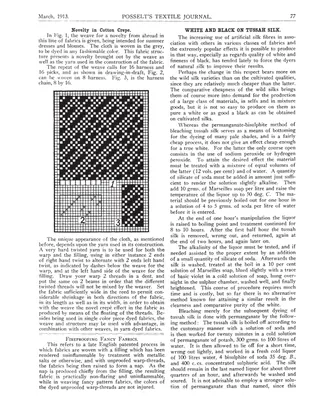
A single page from Posselt's Textile Journal describing a novelty cotton crepe weave for summer dresses and blouses, with a 16-end, 16-pick repeat that can be drawn on 8 harnesses, plus the harness chain. The fabric depends on hard-twisted yarns, alternating 2 ends of right-hand twist with 2 of left-hand twist in warp and filling, and on allowing for considerable shrinkage. The page also carries short items on fireproofing fancy fabrics with a treated filling and on bleaching and dyeing tussah silk white and black.
Novelty in Men's Wear from Abroad
Article · 2 pages · weaving drafts
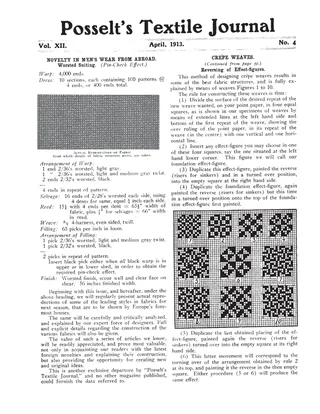
Two pages from Posselt's Textile Journal giving construction details for a pin-check worsted men's suiting from a European house: warp and filling arrangement, reed, picks per inch and finish, on a 4-harness even-sided twill. It continues a series on crepe weaves, explaining a rule for building them by reversing effect-figures on point paper, with ten weave diagrams. It ends with the start of an explanation of the double lift double cylinder Jacquard machine, with a line drawing.
November, 1913
Article · 1 page · weaving drafts
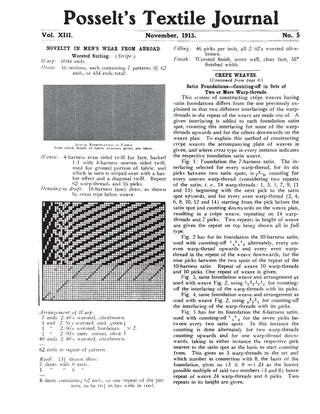
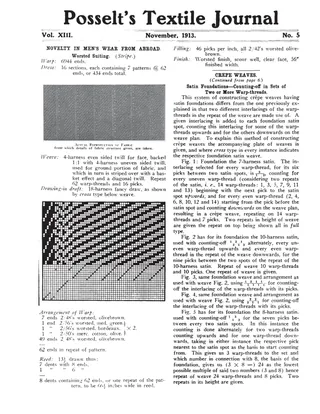
A single page from the November 1913 issue of Posselt's Textile Journal (Vol. XIII, No. 5). It gives full specifications for a novelty worsted striped men's suiting, including warp arrangement, reed, filling, finish, an 18-harness fancy draw and a weave draft. It also continues the series on crepe weaves, covering crepe weaves built on satin foundations by counting off the warp-threads in sets of two or more, with Figs. 1-5 on 7-, 10- and 8-harness satins.
November, 1913
Article · 2 pages · weaving drafts
Two pages from the November 1913 issue (Vol. XIII, No. 5) of Posselt's Textile Journal. They give the structural details of a striped worsted men's suiting, with a 4-harness twill weave, an 18-harness fancy draw, warp arrangement, reed and filling specifications. They also continue a series on crepe weaves built on satin foundations by counting off in sets of two or more warp threads (Figs. 1-7), and begin an article on drawing-in drafts, reed and heddle calculations, including a rule for finding the least number of harnesses needed.
A Study in Weave Formation; How Crêpolines are Made
Article · 2 pages · weaving drafts
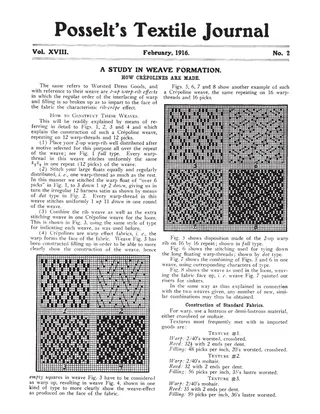
Article from Posselt's Textile Journal (February 1916) explaining how crêpoline weaves for worsted dress goods are constructed. It combines a 2-up warp-rib with an irregular 12-harness satin stitching weave on 12x12 and 16x16 repeats, illustrated by eight weave diagrams. It also gives six standard fabric textures (warp, reed, and filling specifications) and continues a series on double-face reversible fabrics, covering color combinations, fulling problems, and Scotch tweeds.
Constructing Granite Having a Satin Basis
Article · 2 pages · weaving drafts
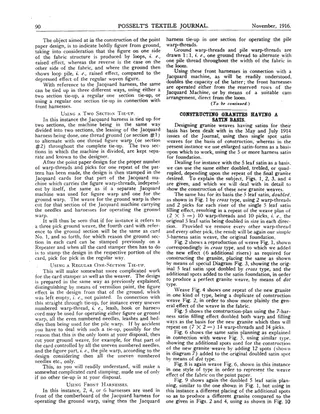
A 1916 article from Posselt's Textile Journal on designing granite weaves built on enlarged satin foundations (5- and 7-harness satins doubled or tripled), with point-paper construction diagrams (Figs. 1-17) showing how extra risers are added to the satin spots. The scan opens with the end of a piece on Jacquard tie-ups (two-section, one-section, front harnesses) for pile fabrics, and page 2 also carries a short note on a new peroxide bleaching process and the start of a series on dyeing cotton and silk with logwood.
Construction of Weaves for Novelties
Article · 1 page · weaving drafts
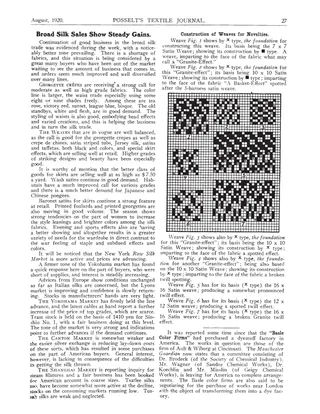
A one-page article from Posselt's Textile Journal, August 1920, describing seven weave constructions for novelty fabrics. Each is built on a satin base (7x7, 10x10, 12x12 or 16x16) to give granite, basket, spotted or broken twill effects, with a drawdown for Fig. 2. The page also carries a trade report on broad silk sales and raw silk markets, plus a short note on Basle dye firms buying a U.S. dyestuff factory.
June, 1913
Article · 3 pages · weaving drafts
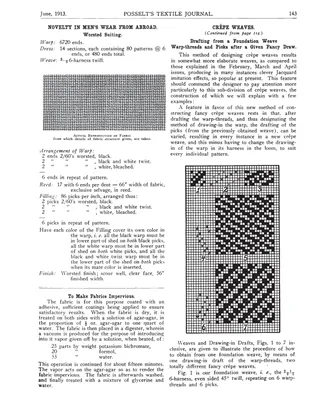
Three pages from the June 1913 issue of Posselt's Textile Journal. They include a worsted suiting specification (6-harness twill, warp and filling color arrangement, reed, picks and finishing), a short note on making fabrics impervious, and a continuation of the series on crêpe weaves. The crêpe weave installment explains how to derive fancy crêpe weaves from a foundation weave by fancy warp drawing-in drafts and filling drafting, with examples from a 6-harness twill and 8- and 10-harness granite weaves. It ends with the start of an article on new shades and dyeing for costume cloths.
Manufacturing a Fancy Stripe De Chine
Article · 5 pages · weaving drafts
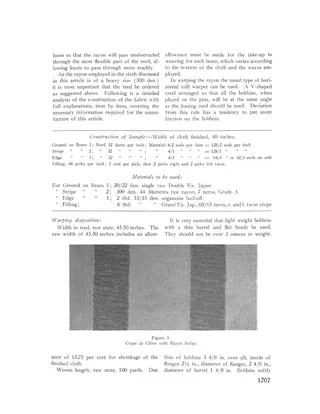
Technical article on manufacturing a fancy stripe crepe de chine in an all-silk ground with a 300 denier rayon stripe, woven on two warp beams. It covers loom setup, reed and bobbin specifications, warping, creeling and beaming, the fabric construction (reed 32 dents, 68 picks per inch), warp layout, total ends, and an eight-shaft skip draft in two harness sets. It closes with notes on weaving speed, humidity and mill cost per yard.
May, 1913
Article · 2 pages · weaving drafts
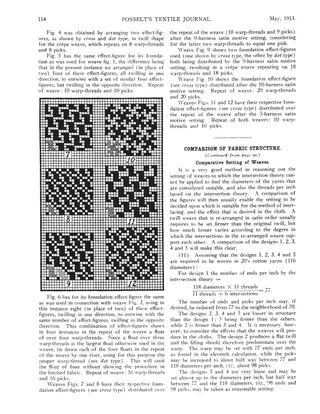
Two pages from the May 1913 issue of Posselt's Textile Journal. They finish an article on crepe weaves built from effect-figures arranged in twill and satin order, then continue the series 'Comparison of Fabric Structure', which covers setting (ends and picks per inch) for twill, honeycomb, Bedford cord, piqué and imitation gauze weaves using the diameter and intersection theory. The pages also open F. Bradbury's 'Jacquard Harness Mounting', which describes harness building and the knots used in tying harness.
July, 1913
Article · 2 pages · weaving drafts
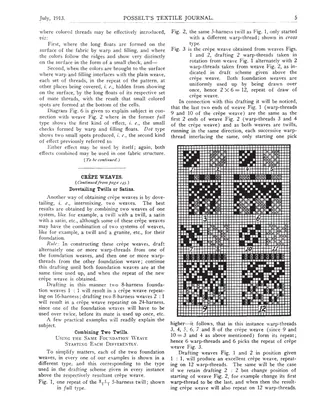
Two pages from the July 1913 issue of Posselt's Textile Journal. They continue the series on crêpe weaves, here dovetailing twills or satins, with the rule for drafting two foundation weaves in alternation and worked examples (Figs. 1-12) combining 5- and 6-harness twills and 8-harness granite weaves. The pages also include a short item on printing viscose on fabrics and a section of the series on narrow wares (ribbons, trimmings) covering doppione, spun and artificial silks.
Posselt's Textile Journal, Vol. 6, No. 4 (April 1910)
Periodical · 55 pages · weaving drafts
April 1910 issue of Posselt's Textile Journal, a US monthly for the textile trades. Technical articles cover Northrop Model E loom picking motion, granite weaves built by four changes from 3-harness twill foundations, dyeing and slashing cotton chains, cloaking and dress goods specifications with weave diagrams, cotton mixing, flax waste spinning, a silk loom stretching roller, a carpet design, calico printing and wool finishing. It also has a dictionary of technical terms (L), an eight-harness section of the Dictionary of Weaves, trade news, mill news, personal notes and many machinery and dye advertisements.
Posselt's Textile Journal, Vol. 6, No. 6 (June 1910)
Periodical · 63 pages · weaving drafts
June 1910 issue of Posselt's Textile Journal, a monthly American trade periodical. It covers hosiery dyeing, overedging and trimming, the Jacquard machine, granite weaves with weave diagrams, men's wear novelties, market reviews, cotton spinning (ring frame), yarn testing, bleaching, the Duplex carding system, and finishing of woolens, worsteds, silk and carriage cloth. It also has a monthly directory of registered trade marks, a report on the hosiery and underwear manufacturers' convention, a supplement of harness-work motives, a Dictionary of Weaves section on 8-harness weaves, and many advertisements, a buyers' index and mill news.
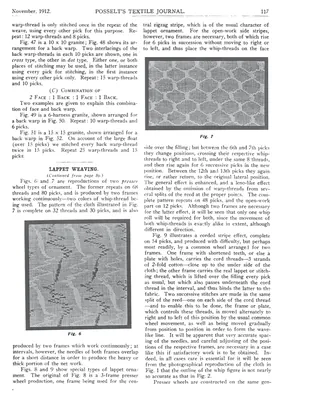
Combining Two Systems of Warp with One System of Filling
Article · 2 pages
Two journal pages from the November 1912 issue of Posselt's Textile Journal. The first finishes a discussion of combining face and back warps on granite weaves (6-harness and 10 x 10 and 15 x 15 granites, with repeats given). It then continues a series on lappet weaving, describing presser-wheel ornaments with whip threads, multi-frame effects, a corded stripe, and how presser wheels are constructed. The second page ends with an excerpt on defective shedding by Thomas Roberts, covering how troughing the shed affects cover and twill appearance.

Crape
Article · 1 page
A short encyclopedia entry defining crape, a thin crinkled fabric made from tightly twisted raw silk. It describes the weaving as a thin gauze, the gum dressing that produces the wrinkled surface, and its use in black as mourning wear. It also mentions Japanese and Chinese crapes and wool crape cloth made by roller embossing.
Faults in Crêpe Fabrics Containing Rayon
Article · 4 pages
A 1932 technical article on the causes of faults in crêpe fabrics made wholly or partly of rayon. It covers weft faults (weft bars, tram lines, lashing-in, box marking), warp faults (slack ends, streaky acetate warps), scouring faults (oil spots, residual silk gum, creasing) and finishing faults (over-tensioning, rain-spotting, slipping, blistering, shrinkage). It concludes that most faults can be avoided with proper care in manufacture. Two photographs illustrate weft bars and a crease effect after dyeing.
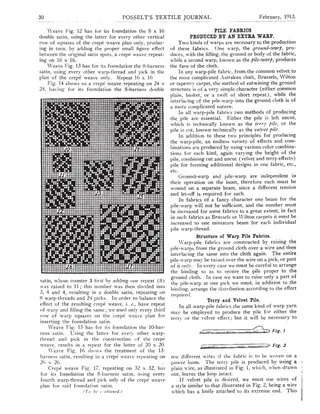
Pile Fabrics Produced by an Extra Warp
Article · 4 pages · weaving drafts
Instalment of a Posselt's Textile Journal series on warp-pile fabrics made with an extra (pile) warp. It explains ground warp versus pile warp, terry (uncut) versus velvet (cut) pile, the wires and trevette knife used on hand looms, and how loops are formed. It then gives weave plans and fabric sections for common velvet weaves, including two-pick and three-pick velvets and a 6-harness twill ground, with repeats, warp and filling ratios, and pick-by-pick lifting instructions. The first page also carries the end of a preceding article on crepe weaves built on satin foundations (Figs. 12-17).
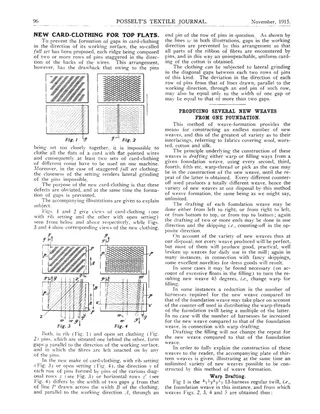
Producing Several New Weaves from One Foundation
Article · 2 pages · weaving drafts
An article from Posselt's Textile Journal (November 1915) describing a method of building many new weaves from a single foundation weave by drafting every second, third, fourth, etc. warp thread or pick until the new repeat is reached. Examples use a 13-harness regular twill (warp and filling drafting, including turning weaves 45 degrees) and a 20-harness 45 degree twill drafted in groups of two threads to give novelty dress-goods weaves. A plate of thirteen drawdowns accompanies the text. The scan also begins with a short item on new card-clothing for top flats in cotton carding.
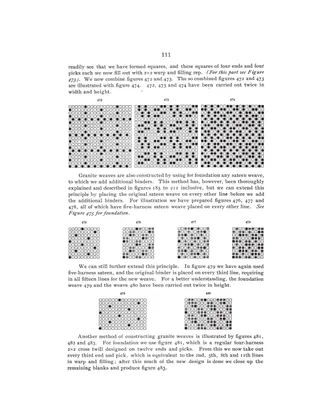
Construction of Weaves, No. 7
Monograph · 29 pages · weaving drafts
Part 7 (1901) of Charles G. Petzold's serial textbook on weave construction for textile schools, designers, overseers and loom fixers. It covers honeycomb weaves, several methods of building granite weaves (from plain and rep, sateen with added binders, cross twill with lines removed, and broken twill parts), and Mockel's weaves with four changes built on twill and sateen foundations. It closes with a section on how regular and reversed yarn twist affects light and shade in plain, sateen and twill fabrics, illustrated with photographs. Figures 451-624 are drawdown-style grids, and the issue includes advertisements for Lawrence, Mass. mill suppliers.
Crape
Article · 1 page
Encyclopedia article defining crape as a gauzy, crimped silk fabric woven from hard-spun silk yarn in the gum. It distinguishes soft Canton or Oriental crape, whose waviness comes from reverse-twisted weft that relaxes when degummed, from hard crape, whose crisp texture comes from secret finishing processes. It also covers uses such as mourning dress and nuns' veils, British production centers, and imitations like cotton Victoria crape.
Dictionary of Textile Terms
Article · 2 pages
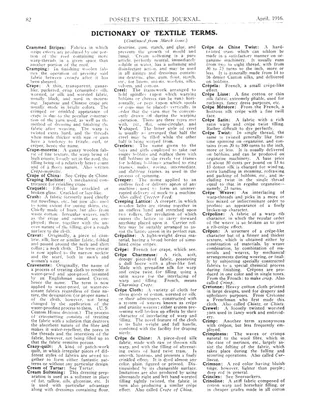
Two pages of a serialized textile dictionary from Posselt's Textile Journal, April 1916, continuing from the March issue. Entries run alphabetically from Crammed Stripes through Cut Goods and cover fabrics (crape, crêpe varieties, crash, cretonne, crinoline), yarns and twists, finishing and bleaching processes, machines, dyes and chemicals, fibres, sheep breeds, and some lace and crochet terms. Definitions are brief and technical, often noting French origins and manufacturing details.
July, 1913
Article · 5 pages · weaving drafts
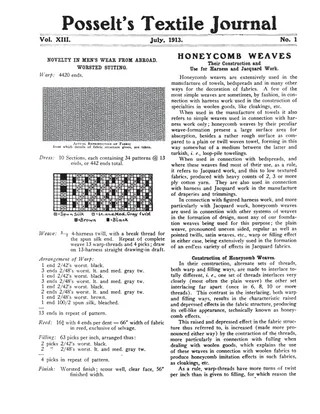
Five pages from the July 1913 issue (Vol. XIII, No. 1) of Posselt's Textile Journal. They open with a worsted men's suiting specification (warp and filling details, reed, finish) and then give the first installment of an article on honeycomb weaves, covering ordinary and Brighton honeycomb construction, harness and Jacquard use, and color effects. The issue also includes a continuation of the article on crêpe weaves, here dovetailing twills, with 5-harness twill examples. Many weave draft grids and fabric reproductions are included.
Shuttle-Craft Bulletin, Vol. XXIX, No. 12 (December 1952)
Periodical · 22 pages
December 1952 portfolio issue of the Shuttle Craft Guild's Handweaver's Bulletin, devoted to fancy twills as texture weaves. It explains how to read full-draft diagrams of fancy twills and convert them to threading, tie-up and treadling, then classifies straight twills (normal diagonal, shaded, spotted, reclining, steep, crepe twills) with long lists of treadle tie-ups for 4, 6 and 8 harnesses. It also gives directions for a double-faced fancy twill afghan on 8 harnesses, with original and revised tie-ups, notes on the sample swatches in the portfolio (including a color-fastness warning), a list of weaving suppliers, and a critique of a loom advertisement's claims about warp waste.
Satin and Other Weaves
Monograph · 22 pages · weaving drafts
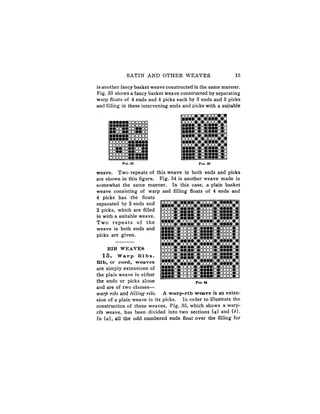
An International Correspondence Schools instruction paper (Serial 507) on the construction of satin weaves and weaves derived from them. It explains how satin bases are chosen, warp- and filling-flush satins, irregular 6-end satins, and double satins, and includes a table of satin orders for 5 to 12 ends. It then covers satin derivatives, granite weaves, basket weaves, warp and filling ribs, unequal ribs, corkscrew weaves, and honeycombs. Most pages carry small drawdown figures, and practice exercises follow two of the sections.
A Study in Weave Formation
Article · 3 pages · weaving drafts
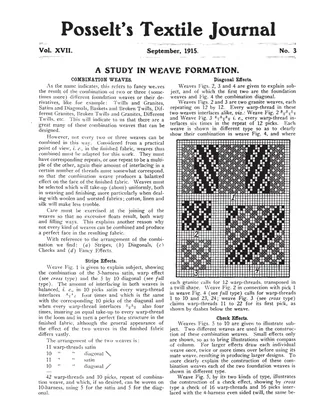
Part of a series in Posselt's Textile Journal on weave formation, dealing with combination weaves made by joining two or more foundation weaves such as satins, granites, twills, diagonals, baskets and broken twills. It explains the conditions for combining weaves (matching repeats, balanced interlacing and uniform take-up) and works through Figs. 1-15, covering stripe, diagonal, check and fancy (Jacquard-style) effects, with harness requirements and repeat sizes. The scan ends with the start of a short unrelated piece on judging the viscosity of starch pastes for sizing and finishing, with illustrations of sago, potato and wheat starch grains.
November, 1913
Article · 3 pages · weaving drafts
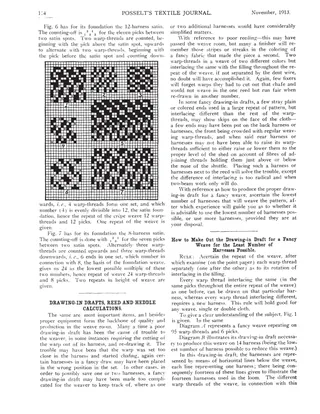
Three pages from the November 1913 issue of Posselt's Textile Journal. They finish a discussion of satin-based crêpe weaves (12- and 8-harness foundations), then explain how to make out drawing-in drafts for fancy weaves using the fewest harnesses, with reed and heddle considerations. They also cover the harness chain, calculating heddles per harness (worked example with 5700 ends and a 95-end repeat), and drafting on point paper. A short item by E. R. Darling on a para-nitraniline test distinguishing jute from hemp closes the scan.
Design and Fabric Structure
Article · 2 pages · weaving drafts
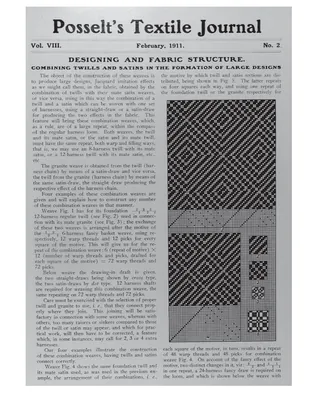
Two pages from Posselt's Textile Journal (February 1911) on designing and fabric structure, explaining how to combine twills with their mate satin (granite) weaves to make large Jacquard-imitation designs on a regular harness loom. Worked examples (Figs. 1-8) use 10- and 12-harness twills and granites arranged after basket-weave motives, with repeats of 40, 48, 72 and 84 threads and drawing-in drafts using straight and satin draws. The second page also has a short piece on Persian rug making covering regional rug types, Kerman silk rugs, and the use of silk waste.
Master Weaver, No. 20 (March 1955)
Periodical · 14 pages · weaving drafts
Issue No. 20 (March 1955) of Master Weaver, a bulletin for handweavers published by Z-Handicrafts of Fulford, Quebec. It includes an article on linen (history, fiber properties, processing), a guide to weaving patterned chenille rugs with short pieces of chenille weft, a lesson on short-draft notation for twills, spot weaves and swivel, and an article on producing crepe fabrics with twist direction, differing tensions and multiharness drafts. It also has an excerpt from Peddie's 1822 The Linen Manufacturer, a short review of Mary E. Black's Handweavers' Reference, and an advertisement for individual weaving lessons.
Posselt's Textile Journal, Vol. 7, No. 2 (August 1910)
Periodical · 59 pages · weaving drafts
August 1910 issue of Posselt's Textile Journal, a monthly trade journal of the American textile industries. It carries technical articles on the Jacquard machine, granite weaves, Brussels and Wilton carpets, carpet finishing, cotton warp sizing, napping, London shrinking, silk treatment and weighting, knitting novelties, dyeing cotton corduroys, electrical singeing, and air conditioning for mills. It also includes market reviews, a trade-mark directory, a dictionary of technical terms, mill news, and many machinery and dyestuff advertisements. Weaving drafts appear in the granite weave, novelties and dictionary-of-weaves sections.
Posselt's Textile Journal, Vol. 3, No. 5 (November 1908)
Periodical · 52 pages · weaving drafts
November 1908 issue (Vol. 3, No. 5) of Posselt's Textile Journal, a Philadelphia monthly for the textile industries. It carries technical articles on beaver overcoatings and double-satin beaver weaves, silk culture and silk defects, ribbon looms and take-up motions, granite weaves and harness-work designs, yarn testing, the Whitin gingham loom, Jacquard designing, the Knowles fancy worsted loom, cotton ring spinning, knitting machines, dyeing and finishing, and a dictionary of textile terms. It also reports on the Textile Overseers' Association of Philadelphia and includes mill news and many period machinery advertisements. Weave drafts appear on six pages, mainly beaver weaves, hollow weave for ribbons, granite weaves and figured harness motives.

Crape
Article · 1 page
A one-sentence encyclopedia entry defining crape as a commercial fabric made like gauze from raw silk that is gummed and twisted on the mill. It gives no details of weave structure, finishing, or uses.
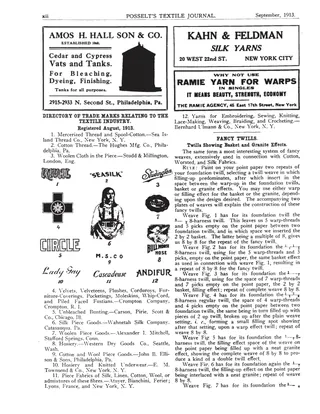
Fancy Twills
Article · 3 pages · weaving drafts
An article from Posselt's Textile Journal on fancy twills with basket and granite effects, giving a construction rule and descriptions of Weave Figs. 1 to 25. Each weave is built on an 8-, 10-, 12- or 16-harness foundation twill, with basket or granite weaves filling the empty space between twill lines, and repeats are stated. The point-paper drafts appear on the second and third pages. The scan also includes the journal's trade mark directory and advertisements.
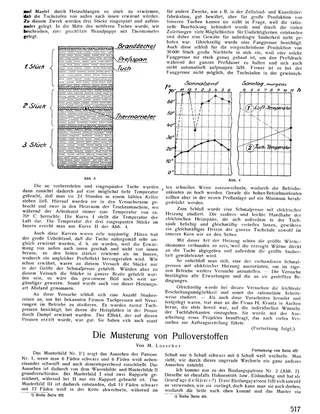
Die Musterung von Pulloverstoffen [The Patterning of Pullover Fabrics]
Article · 3 pages · German · weaving drafts
Part of a serialized German-language article from Melliand's Textilberichte on patterning pullover fabrics. Loescher describes houndstooth/ice-weave (Eisbindung) weave designs, numbered 1 to 7, several requiring 16 shafts, and explains how colour arrangement in warp and weft changes their appearance, and how designs can be turned or used for stripes. The drafts are illustrated as black-and-white pattern grids. The scan begins with the end of an unrelated article on cloth presses with electric heating and ends with the start of a section of E. Frotscher's article on crepe weaves.
Crape
Article · 1 page
A short dictionary entry defining crape as a gauzy fabric of raw silk, woven without crossing. It describes uses for shawls, mourning goods and ecclesiastical habits, explains how highly twisted silk gives crisped crape its wrinkled texture, and mentions related fabrics (aerophane, gauze). It also gives a traditional account of crape's origin at Boulogne.
Rayon Fabrics Made of Cupra-Ammonium Yarns
Article · 2 pages
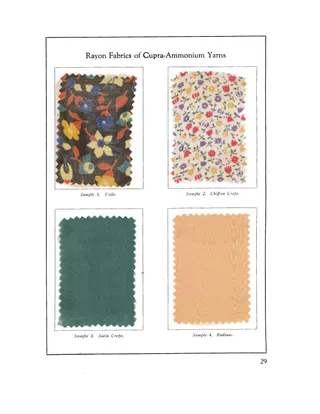
A short 1929 article from The Melliand by Otto Niemann on fine-filament cupra-ammonium rayon yarns that give fabrics with the look, drape and handle of silk. It gives construction details for four piece-dyed sample fabrics (voile, chiffon crepe, satin crepe, and a radium underwear/shirting fabric), including ends and picks per inch, yarn denier and twist. It also advises using clip rather than pin tenter frames in finishing and notes that the rayon fabrics cost less than silk. The second page shows the four swatches as magnified images.
Designing and Fabric Structure
Article · 3 pages · weaving drafts
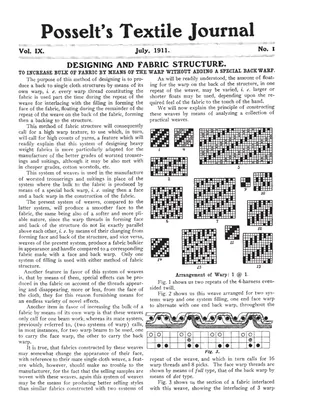
An article from Posselt's Textile Journal (July 1911) on 'false back' weaves, a way to add bulk to single-cloth fabrics using the fabric's own warp rather than a separate back warp. It explains how to build false back weaves from 4-harness twill, basket, 3/3 6-harness twill, 8-harness fancy and figured twills, and 8- and 12-harness granite weaves, in 1 @ 1 and 2 @ 1 face-to-back arrangements. Illustrated with numbered weave drafts (Figs. 1-34) and warp-section diagrams. The last page begins a continued piece on producing figures in smooth ribbons.
Jacquardkarten-Spareinrichtung für Gobelin-Bildweberei [Jacquard Card-Saving Device for Gobelin Picture Weaving]
Article · 2 pages · German
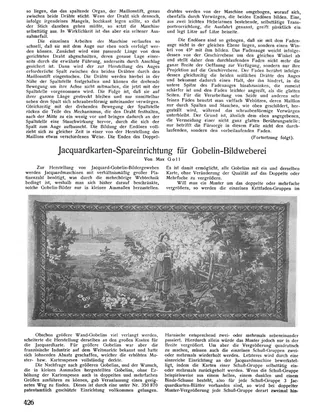
Two-page scan from Melliand's Textilberichte (1927) with Max Goll's article on a patented device (German patent no. 350 870) that saves Jacquard cards in Gobelin-style picture weaving. By repeating warp groups across the harness and automatically stepping the card set back to repeat weft groups, one card set can weave a pattern at double or multiple size, as in a wall tapestry woven at 175x80 cm and 350x160 cm. The scan also includes the continuation of E. Frotscher's article on crepe weaves, covering rib crepe (Ripskrepp) bindings built by superimposing weaves, with 8, 12 and 16-thread repeats and draft diagrams (Patronen 46-85). The page before Goll's article ends the text of an unrelated piece on wire heddles.
106 documents found