Textile Documents › Topic: Scandinavian textiles
222 documents found
Sort: 
Practical Weaving Suggestions, Vol. XXV (1953): A Visit to Scandinavian Weaving Centers
Periodical · 4 pages · weaving drafts
A four-page issue of Lily Mills' Practical Weaving Suggestions in which Colonel John S. Fishback reports on a Penland Craft Tour of weaving schools, studios and craft shops in Denmark, Finland, Sweden and Norway. He describes the long training in Scandinavian weaving schools, a graduate's detailed sample notebooks, and the cooperation between craftsmen, architects and merchants. The issue ends with a draft for a four-shaft lace and plain stripe fabric sleyed unevenly for glass curtains or place mats, with threading, sleying, treadling and tie-up instructions using Lily 20/3 cotton.
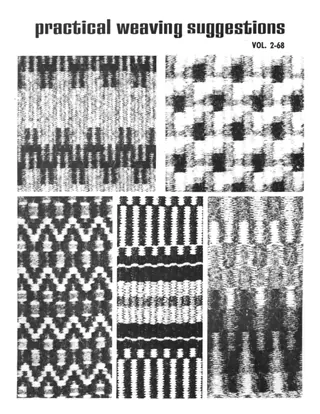
Practical Weaving Suggestions, Vol. 2-68 (1968): Cushions ... a la Scandinavian
Periodical · 6 pages · weaving drafts
An issue of Practical Weaving Suggestions by Elmer W. Hickman on weaving cushions in the Scandinavian bound weaving (bunden vavning) technique, in which weft completely covers the warp to give a tapestry-like fabric. It gives general advice on warp, sett, weft yarns, finishing and pillow forms. It then offers instructions and drafts for five cushion designs: Bargello, Scania, Aurora Borealis, Domino and Moderne. Each includes warp and weft specifications, sley, treadling and color suggestions, using Lily Mills yarns.
Shuttle-Craft Bulletin (September 1961)
Periodical · 6 pages · weaving drafts
September 1961 issue of the Shuttle Craft Guild Handweavers Bulletin, edited by Harriet Tidball. The main letter describes her summer trip to Copenhagen, Stockholm, Helsinki, Amsterdam and Switzerland, covering craft shops, department stores, yarns, looms, tapestry lessons with Eva Anttila, and the status of crafts in Scandinavia. A short article, "A Color Study from an Apron Fabric," gives a bound overshot draft with a four-color weft sequence on a red 24/2 cotton warp, with a discussion of color harmony. The issue ends with subscription and book-sales announcements.
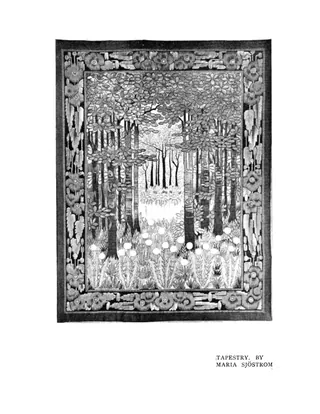
Textile Arts in Sweden
Article · 8 pages
A 1906 magazine article by Axel Tallberg surveying contemporary Swedish textile arts and their roots in regional folk patterns. It describes the role of the Northern Museum in Stockholm, the main societies that promote textile home crafts (Svenska Slöjdföreningen, Handarbetets vänner, Föreningen för Svensk Hemslöjd), and commercial firms such as Nordiska Kompaniet's textile department and Gjöbel's. Illustrated with photographs of tapestries, embroidered cushions, portières, table covers and wallhangings by named Swedish designers.
Warp & Weft, Vol. 1, No. 3 (January 1948)
January 1948
Periodical · 8 pages · weaving drafts
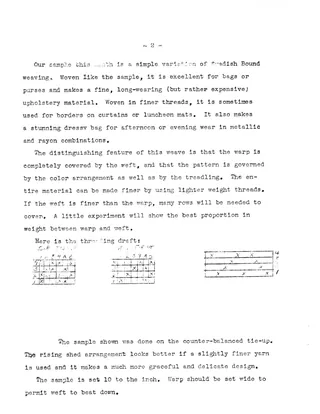
Issue 3 of a small Chicago newsletter for hand weavers, edited by Mary F. Bottlemy. It gives a sample project in a Swedish Bound-type weft-covered weave, with threading, tie-up and treadling drafts for counter-balanced and rising-shed looms, plus yarn notes. Other items are a color theory page with a color wheel, reader Q&A on sectional beam tension and straight edges, tips, poems, and announcements for Marglad looms, a Brophil Studio move, and the World Hobby Exposition in Chicago in February 1948.
Learning to Weave in Sweden
Article · 2 pages
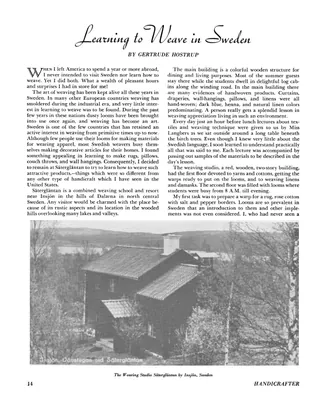
A first-person account by an American student of a summer learning to weave at Sätergläntan, a weaving school and resort near Insjön in Dalarna, Sweden. She describes daily lectures, the weaving studio, and her progression from a two-shaft rug warp through Rose Path pattern weaving, a table square threaded from a draft, double weave, napkins and furniture-covering samplers, to Dukagång (embroidery weaving) on a pillow and a finger-woven tapestry wall hanging. Also notes Swedish practice of linen warps with wool wefts and the instructor's advice on choosing colors from nature.
Scandinavian Art Weaving
Monograph · 97 pages · weaving drafts
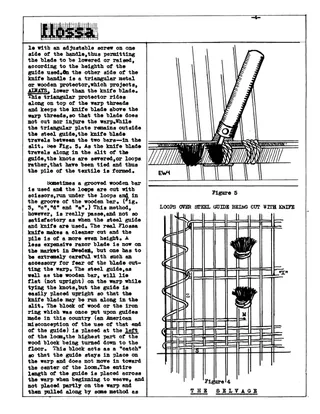
A set of instructional weaving packets by Elmer W. Hickman (Homecraft Weaving Service, Emlenton, Pennsylvania) on Scandinavian art weaving, the 'laid-in' bobbin techniques woven on a loom. It covers bobbin winding, Monk's Belt, Krokbragd, Rosengang (Rosepath) with Swedish pine tree designs, Flossa, Rya and Sniljeflossa pile weaves, Arrow and Lightning weave, Aklae, Dukagang and Krabbasnar/Half-Krabba. Each section gives warp and weft yarn recommendations, threading, sleying and treadling directions, figures of techniques and tools, and many drafts and charted designs. Sample cards, supply sources and the author's commentary ('Tabby Talk') are included.
Sätergläntan, a Dalecarlian Weaving School
Article · 9 pages
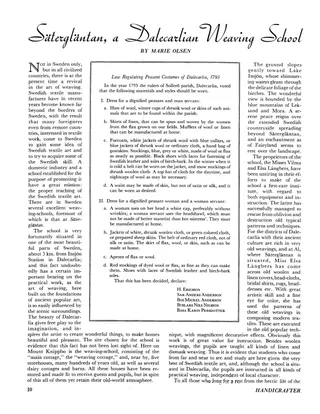
Article describing Sätergläntan, a weaving school in Dalecarlia, Sweden, run by the Misses Vilma and Elsa Långbers near Lake Insjön. It covers the school's setting, its revival of old Dalecarlian patterns and plant dyeing, and includes a 1793 Sollerö parish law regulating peasant costume materials. The article is followed by forty numbered photographs of woven samples (rose-step, geese-eye curve, monk's belt, Leksand pattern, in-woven and hand embroidery, rugs) with captions, but no threading drafts.
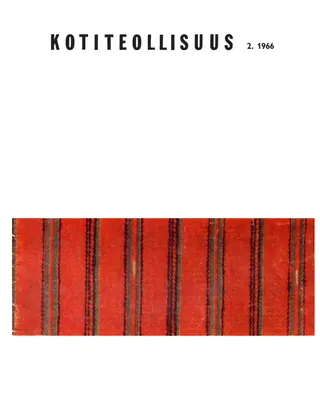
Kotiteollisuus [Rural Crafts], No. 2 (1966)
Periodical · 40 pages · Finnish · weaving drafts
Issue no. 2 of 1966 of the Finnish periodical Kotiteollisuus (Rural Crafts), published by Kotiteollisuuden keskusliitto. It mixes general craft articles (home crafts and leisure time, Finnish folk costume versus national costume, a woodcarver who makes cheese hoops, a kitchen table and bench, soapstone working methods, beehive wall construction) with weaving projects. The weaving section gives patterns with warp and weft yarns, reed sizes, threading instructions and drafts for woven stripes imitating tablet-woven band, all-linen towels, tray-holder cloths, runners and scarves. It ends with association news, a scarf competition result list, a book notice and directories of craft shops and schools.
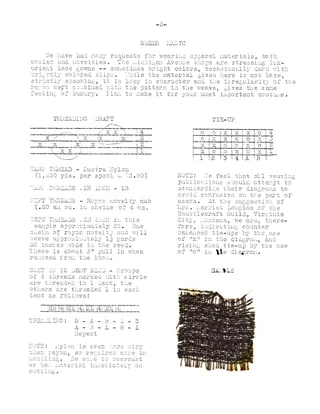
Warp & Weft, Vol. 3, No. 2 (December 1949)
December 1949
Periodical · 8 pages · weaving drafts
December 1949 issue of a monthly weaving bulletin published in Chicago by Gladys Rogers Brophil. It reports on a Minneapolis Weavers Guild round robin exhibit and gives a project with a draft for a sheer dress fabric woven with Lustra Nylon warp and rayon novelty nub weft. It also includes Russell E. Groff's report on handweaving in the Scandinavian countries, a short piece on nylon, suggestions for handwoven scarves and card table covers, short filler items, and a page of equipment and book prices for a weaver's Christmas.
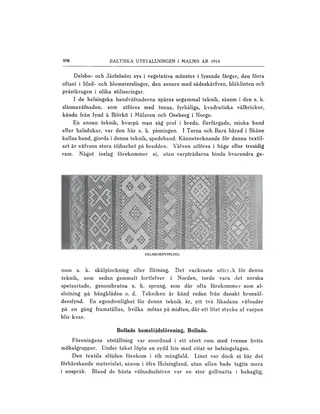
Hemslöjden [Domestic Crafts]
Book · 65 pages · Swedish
An offprint from the official report of the Baltic Exhibition in Malmö, 1914, surveying the Swedish home-crafts (hemslöjd) section. It opens with a history of the revival of Swedish handicraft from the 1860s to 1909 and the role of the Föreningen för Svensk Hemslöjd and the regional hemslöjd societies. It then goes region by region (Västerbotten, Ångermanland, Jämtland, Dalarna, Hälsingland, Gästrikland, Värmland, Småland, Öland, Halland, Skåne, Blekinge, Östergötland and others), describing the textiles, lace, embroidery, knitting, baskets and furniture each society showed. Many photographs show exhibition rooms, rya rugs, lace, and costumes. There are no weaving drafts, but techniques such as rödlakan, krabbasnår, dukagång, rosengång, opphämta and rya are described.
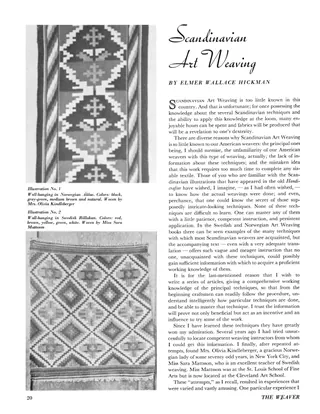
Scandinavian Art Weaving
Article · 6 pages
Introductory article by Elmer Wallace Hickman, the first in a planned series, urging American weavers to learn Scandinavian art weaving techniques. He recounts how he found Norwegian and Swedish teachers, comments on the Swedish Hemslöjd (home craft) movement, and catalogs about twelve principal techniques, including Äklae/Röllakan, Dukegång, Krabba, Flossa, Rya, Upphämpta, Flamskvävnad and Finnweave. Illustrated with photographs of wall-hangings and rugs woven by the author and his teachers, and ending with a list of Scandinavian reference books.
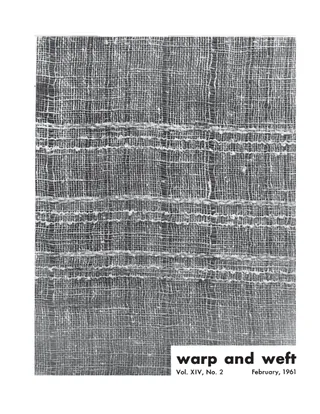
Warp & Weft, Vol. 14, No. 2 (February 1961)
February 1961
Periodical · 9 pages · weaving drafts
February 1961 issue of Warp and Weft, a monthly published by Robin & Russ Handweavers in Santa Barbara, California. It includes the editor's column on inventory and card-weaving and ramie programs, a profile of Swedish weaver Malin Selander, and a 4-shaft, 3-treadle draft for a novelty upholstery weave in cotton and viscose, with color suggestions for the weft. It also has a review of Harriet Tidball's double weave pamphlet, a report on the Selander workshop in San Jose, and classified and loom advertisements.
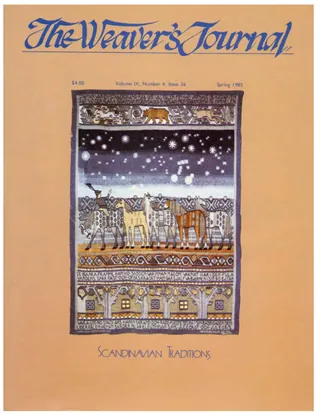
Weaver's Journal, Vol. IX, No. 4 Issue 36 (Spring 1985)
Weaver's Journal, Spring 1985
Periodical · 88 pages · weaving drafts
Spring 1985 issue of The Weaver's Journal, with a loose Scandinavian theme alongside rugs and interiors. Features include the third part of a series on textile conservation, Märta Måås-Fjetterström's tapestries, the Finnish ryijy (rya) tradition and Irma Kukkasjärvi, the Norwegian braided fringe firfletting, Swedish Vadstena picture lace, and an immigrant weaving at the American Swedish Institute. Rag rug coverage includes Log Cabin rag rugs from the Two Harbors area of Minnesota, rag rug lore, and a Finnish-American memoir of a homemade loom. Technical articles cover double-faced krokbragd on six and eight shafts, shaft-switching with weighted floating heddles on rising shed looms, designing for an interior, and three-toned blocks with long-eyed heddles, with drafts. Also contains columns on fashion trends, letters, a calendar, publication notices, classifieds and many advertisements.
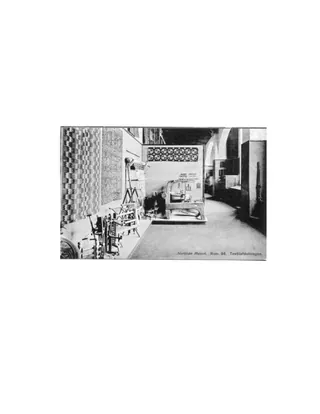
Nordiska Museet. Rum 84. Textilavdelningen. [Nordic Museum. Room 84. Textile Department.]
Ephemera · 1 page · Swedish
A single picture postcard issued by the Nordiska Museet (Nordic Museum, Stockholm) showing a historical black-and-white photograph of Room 84, the textile department. Textile samples with wavy and patterned designs are displayed hanging in the room. The only printed text is the caption identifying the museum, room and department.
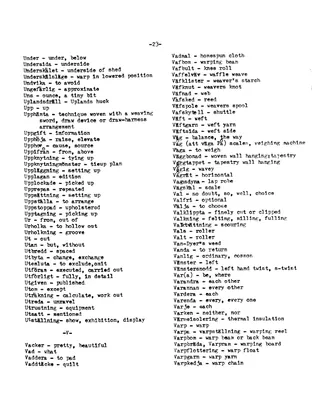
Swedish-English Weaving Glossary
Other · 27 pages
An alphabetical Swedish-to-English glossary of weaving and textile terms compiled by Marie C. Hayes. It covers loom parts, yarns and fibers, dyeing and colors, finishing, weave structures such as huck (dräll), rosepath, twill, honeycomb and damask, and inlay techniques such as rölakan and krabbasnär. It also gives general vocabulary useful for reading Swedish weaving books. Some regional pattern names (Daladräll, Bollnäsdräll, Bohusväv) are explained. The A section appears twice, once with the Swedish diacritics missing and once corrected.
Swedish-English Weaving Glossary
Other · 16 pages
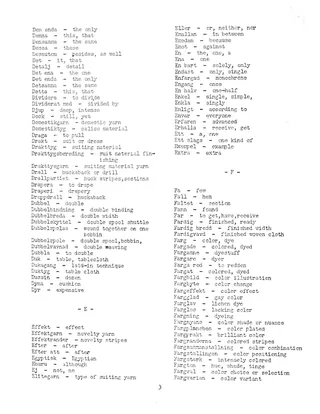
A 16-page Swedish-to-English glossary of weaving and textile terms compiled by Doris Veren and published by Craft & Hobby Book Service, Monterey, California. It lists several thousand Swedish words alphabetically (A through Y), with diacritics omitted, covering looms and loom parts, yarns, fibers, dyeing, colors, fabrics, weave types and everyday words found in Swedish weaving instructions. Conversion tables (centimeters to inches, meters to feet and yards, grams to ounces and pounds, kilograms to pounds and ounces) precede the glossary.
Tapestry Through the Ages: Khelim, Aklae and Rolakan
Article · 2 pages
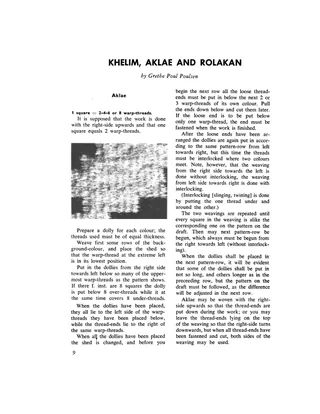
A two-page instructional article by Grethe Poul Poulsen on three related tapestry techniques: aklae, rollakan and khelim. It explains how to place and interlock dollies (butterfly bobbins) of coloured weft over a chosen number of warp threads following a squared pattern. It describes how the three techniques differ in interlocking and in how thread ends are fastened, and how to wind a dolly. The pages include a pattern block for aklae and photographs of the right and wrong sides of rollakan.
Adaptation of Dukagang to a Modern Work Bag
Article · 2 pages
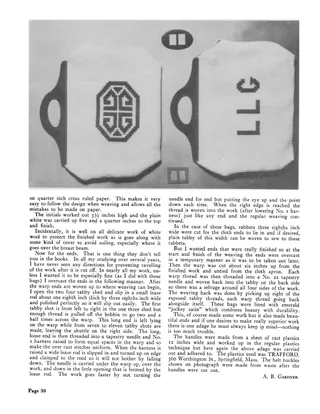
A.B. Gardner describes adapting the Scandinavian Dukagang technique, as presented by Elmer Wallace Hickman in an earlier issue of The Weaver, to make a white wool work bag with an octagonal green medallion and initials. She explains her departures from Hickman's method: weaving right side up with a bobbin bin clamped to the cloth beam, weaving in pattern ends instead of knotting them, and carrying the pattern to the selvedges. She also covers warp and yarn choices, a twill threading, overcast and woven-back finishing of the ends, and plastic handles. A photograph shows the finished handles and belt buckles.
Billedvaer
Minnesota Weaver, March 1977
Article · 1 page
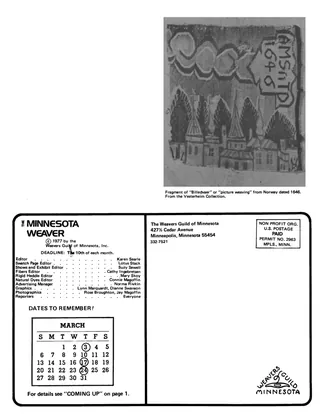
A single page from The Minnesota Weaver (March 1977) showing a photograph caption for a fragment of Norwegian "Billedvaer" (picture weaving) dated 1646, from the Vesterheim Collection. The image itself is not legible in the scan. The page also carries the newsletter masthead listing editors, a March calendar, and the Weavers Guild of Minnesota mailing panel.
Bobbins of St Scania by Axel Hörlén
Brian Lemin · 2010
Web Doc · 8 pages
English translation of Axel Hörlén's 1969 study of lace pillows and bobbins in the southern part of Scania (Skåne), Sweden, centered on Valleberga and nearby villages. It covers the shift from the bolster pillow to the Swedish roller pillow, pillow cover materials such as linen and oilcloth, and bobbin shapes, including spangled bobbins with baskets or metal leaves that make a clatter. It compares them with Estonian bobbins from Runo and Bohemian bobbins from Vamberk. The translation is followed by notes on Czech bobbin names and a summary by editor Brian Lemin.
Kniplinger [Lace]
Book · 51 pages · Danish
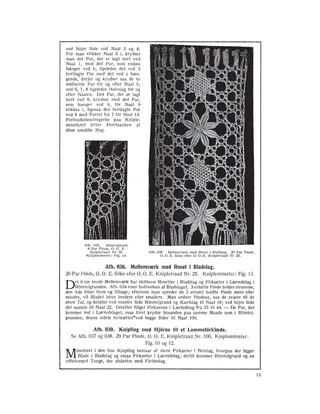
A Danish-language instruction booklet on bobbin lace (kniplinger) from Beyers Haandarbejdsbøger, Serie O.O.E., Bind 8. It covers equipment (pillows, bobbins, thread numbers, pins), the basic twist and cross movements and stitches (half stitch, whole stitch, cloth stitch, leaf stitch, plaited bars), then graded projects with thread number and bobbin-pair counts. These include narrow edgings, insertions, handkerchief laces with corners, round lamp-shade cloths and doilies, tape (Baandknipling) laces, and a Hungarian lace. Many photographs show finished lace and the starts of pieces, and the final pages are pattern plates (Blad II to V) with pricking diagrams.
Weaving in Many Languages
Article · 2 pages · weaving drafts
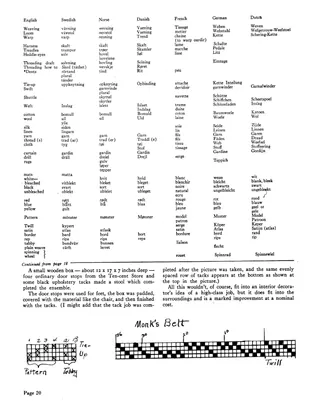
Helen Louise Allen explains how she learned to read Scandinavian weaving books and shares notes on Swedish, Norwegian and Danish grammar as it applies to draft descriptions, including plurals, passive verbs, attached articles, prepositions, and converting centimeter sett to threads per inch. She gives a sample bilingual description from Sigrid Palmgren. A comparative vocabulary table of weaving terms in English, Swedish, Norwegian, Danish, French, German and Dutch follows, covering loom parts, fibers, colors, and structures. A small Monk's Belt draft appears on the second page.
Art or Craft?
Master Weaver, March 1958
Article · 3 pages
An editorial from the Canadian periodical Master Weaver arguing that most handweavers are craftsmen rather than artists and should not be pressured to be "creative" or "modern". It contrasts craft, grounded in technique and tradition, with "arty" experimental weaving, cites Scandinavian folk-based design as a model, and says craftsmen preserve handweaving knowledge. It ends with a short "From the Classics" excerpt from the History of Brome County, about a woman who sheared, spun and wove cloth for trousers in three days.
Some Weaves for Upholstery and Curtain Fabrics
Article · 3 pages · weaving drafts
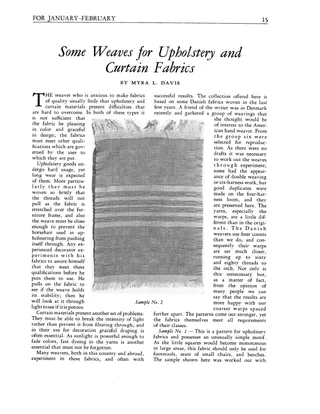
A 1930 Handicrafter article by Myra L. Davis on weaving upholstery and curtain fabrics, with six samples reproduced on four-harness looms from Danish hand-woven originals. It explains the requirements of each fabric type, such as firmness, closeness of weave, drape and fast dyes, and gives yarns, sett and treadling for each sample. Draft diagrams and photographs of the samples are included, along with a note on alternating heavy and fine warp threads to make a firm, non-porous upholstery fabric.
Sprang
Book · 25 pages · weaving drafts
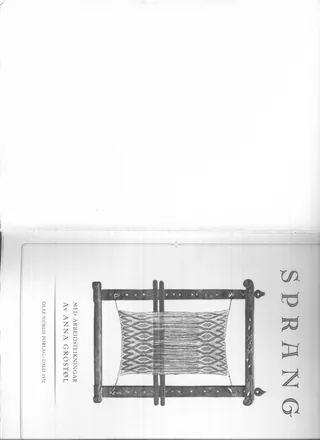
A 1932 Norwegian-language handbook on sprang (a plaited, twined warp technique) by Anna Grostøl, with instructions and working charts. It covers the history of sprang in Norway, the frame and spindles, warping, the stitch sequence for a sample, making holes, and finishing. Photographs show historic pieces from Hallingdal, Gudbrandsdalen, Nordmøre and other regions, plus bands, mittens, bags, a shawl and a cloth. The last pages hold gridded working charts for the patterns shown in the figures.
Finnish-English Weaving Glossary
Other · 14 pages
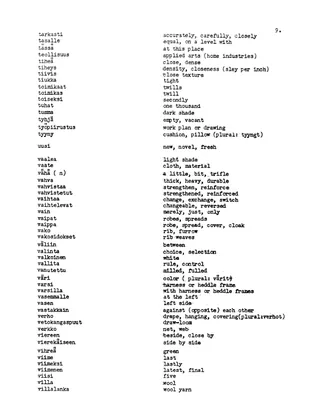
A short Finnish-English glossary of weaving terms compiled by Aina Ringler, intended to help English-speaking weavers read Finnish pattern books. Introductory sections explain reed set and sley (tiheys), conversion of Finnish reed numbers (per 10 cm) to dents per inch, how to read the warping and reeding directions in Ester Perheentupa's book Kutokaa Kuviollisia Kankaita, and a brief summary of Finnish pronunciation and grammar. The main part is an alphabetical word list covering weave structures, equipment, materials, colors and common pattern-book vocabulary.
Handweaving News (February 1939): A Two Block Pattern Derived from an Old Swedish Table Cloth
Periodical · 3 pages · weaving drafts
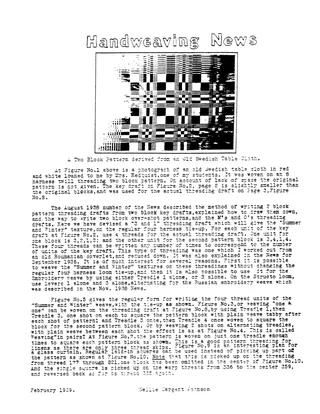
A short article from Handweaving News (February 1939) by Nellie Sargent Johnson on deriving a two-block pattern from an old Swedish red and white table cloth woven on an 8-harness twill threading. She converts the block key draft into a four-thread "3 and 1" threading that weaves Summer and Winter texture, or Russian embroidery weave, on a regular four-harness tie-up. The article gives threading units, treadle sequences (one and one, in pairs, single treadle), and a full 359-thread draft. It closes with a plan for glass curtains in mercerized cotton with picked-up squares and heavy weft accents.
Mattor
Article · 7 pages · weaving drafts
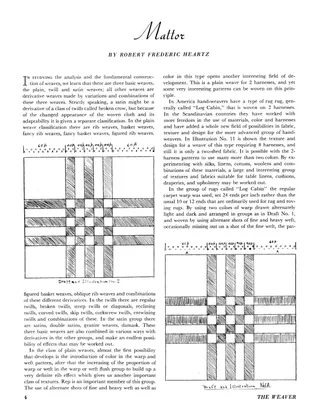
An article from The Weaver (October 1936) by Robert Frederic Heartz on "Mattor," a Scandinavian-style weave built on plain-weave sheds using alternate shots of fine and heavy weft, with pattern created by dropping a fine shot. It begins with a survey of basic weaves, then explains the technique with a warp-colored check example (Drafts 1, 1A, 1B) and treadling instructions. It presents a series of drafts (Nos. 2-17) taken from Danish, Finnish, Norwegian and Swedish sources for 4, 6, 8 and 10 harnesses, with notes on uses such as runners, rugs, upholstery, pillows and dress fabric.
An Open-Work Weave
Article · 4 pages · weaving drafts
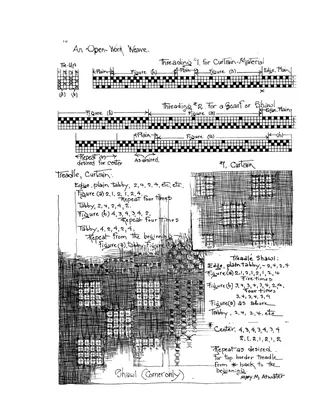
A 1928 Handicrafter article by Mary Meigs Atwater introducing an open-work (lace-work) weave of Scandinavian origin on four shafts. It gives threading and treadling drafts for a linen curtain and for a scarf or shawl, with sett, yarn choices, border arrangements, and loom tie-up transpositions for treadle and table looms. It also suggests variations such as dress fabrics, baby blankets, drapery with grouped warp threads, and six-treadle tie-ups.
Practical Weaving Suggestions, Vol. 3-59 (1959): The Zig-Zag Weave
Periodical · 8 pages · weaving drafts
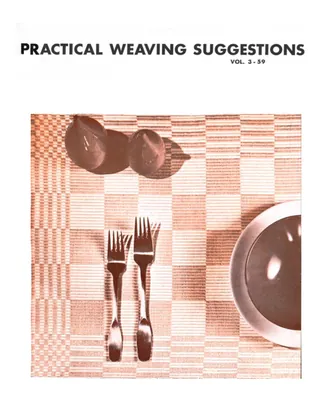
An issue of Practical Weaving Suggestions (Lily Mills) by Edna Olsen Healey introducing the Zig-Zag Weave, a four-harness Simplified Drall (Swedish) weave forming two reversible blocks, one shiny and one dull. It gives the basic draft, tie-up, treadling, reed setting, weaving and finishing advice, and full threading plans with Lily yarn specifications for four dinner place mats (aqua, crabapple and white, silver grey linen, cork linen). Further samples include a floss design and three small upholstery patterns, with drawdown grids on the last page.
Ricami Norvegesi [Norwegian Embroidery]
Book · 61 pages · Italian
Italian-language DMC Library album on Norwegian (Hardanger) embroidery, a white-on-white counted-thread cutwork with drawn-thread grounds and needle-lace fillings. It opens with an introduction and instructions on fabrics, threads and the four stages of work, illustrated with numbered stitch figures (bars, picots, punto spirito, wheels, festoons). Thirty-six plates then show finished pieces and details (place mats, runners, table covers, cushions, collars, bags, blouses, window and bed covers), each with notes on materials and DMC thread numbers. The volume ends with a list of other Biblioteca DMC titles.
Rya of Finland
Article · 5 pages
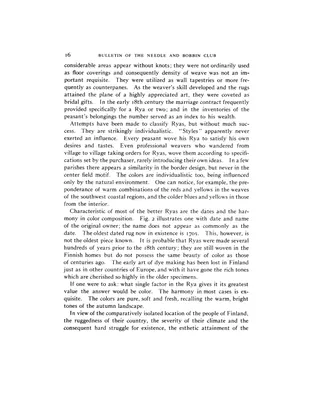
A short 1923 article by Eugene Van Cleef (Ohio State University) introducing the hand-knotted Finnish rya rug as a peasant craft. It covers the shift from geometric designs to symbolic center fields with foreign motifs in the 18th century, the use of ryas as wall hangings, counterpanes and bridal gifts, and the individuality of design and regional color. It stresses the value of the old dyes and colors. Two full-page photographs show an early geometric rya and a rya dated 1804 with a zigzag border.
Scandinavian Art Weaving, Norwegian Lynildbordvevning or Lightning Weave
Article · 8 pages · weaving drafts
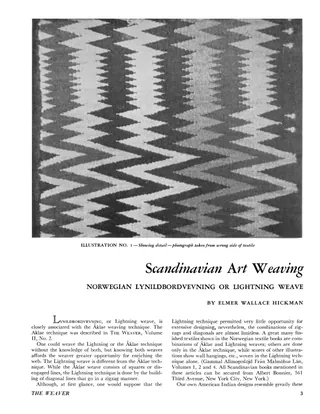
An instructional article by Elmer Wallace Hickman on Norwegian Lynildbordvevning (Lightning weave), a bobbin-woven tapestry technique that builds zigzag diagonals and is related to Åklae. It covers loom setup, yarns and warp, the sequence of interlocking and pattern sheds, and how to reverse the diagonal, add bobbins and drop bobbins. Three patterns are given (an experimental design, a nine-unit hanging and a more difficult colored design), with step diagrams and photographs taken from the wrong side of the textiles. Hickman also compares the technique to American Indian weaving and cites Scandinavian sources.
Scandinavian Art Weaving, Swedish Dukagång
Article · 9 pages · weaving drafts
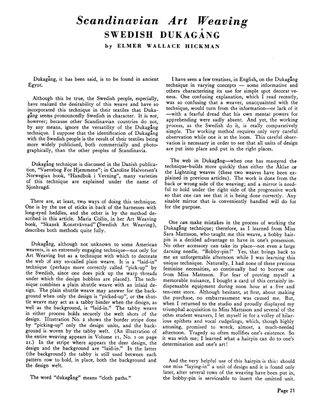
Instructional article by Elmer Wallace Hickman on Swedish dukagång, a laid-in (pick-up) technique worked from the back of a plain-weave web with design bobbins and tabby binder shots. It covers materials, reed and warp setup, bobbin winding and handling, the shed sequence on a four-harness table or floor loom, and 18 numbered troubleshooting tips. A worked example gives a color-by-color row sequence, and the article includes working-side sketches, photographs of experimental pieces, and charted Scandinavian border, pillow-top and spot motifs, with rosepath and twill threading drafts.
Scandinavian Art Weaving: Norwegian Åklae Technique
Article · 11 pages · weaving drafts
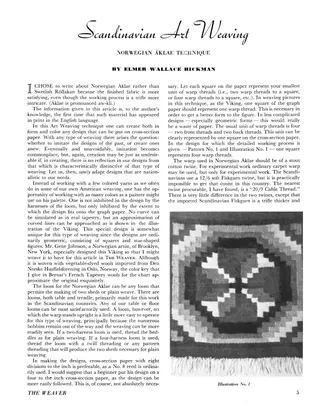
An instructional article by Elmer Wallace Hickman on Norwegian Åklae, a Scandinavian tapestry-like art weaving technique worked with many small hand-wound bobbins on a plain-weave (two-shed) warp. It covers loom, warp and weft choices, bobbin winding and tying, the Pattern and Interlocking sheds, how to advance or retreat design units, and tips for beginners. It gives step-by-step directions for weaving Pattern No. 1, plus charted patterns (including a Viking figure) with Bernat Peasant and French Tapestry wool color keys, and illustrations of finished pieces.
Scandinavian Spetsvav
Article · 4 pages · weaving drafts
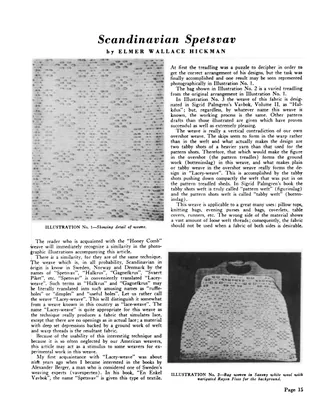
Article by Elmer Wallace Hickman introducing Scandinavian Spetsvav, which he calls "Lacey-weave", a technique he describes as a vertical counterpart of overshot. Heavier tabby shots pack down the pattern weft to form a pattern of depressions. It covers the weave's Scandinavian names, suggested yarns for table covers, evening bags, knitting bags and pillow tops, and treadling and set-up notes for five drafts. A page of seven drafts with a shared tie-up and a list of Scandinavian weaving books are included.
Swedish-English Word List of Textile Terms
Other · 8 pages
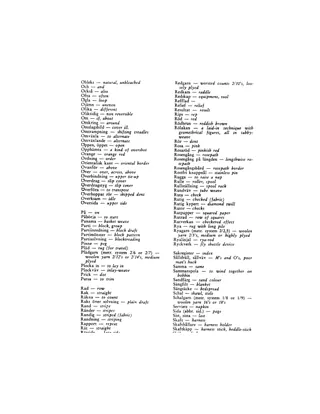
An eight-page Swedish-English glossary of textile and weaving terms, intended for reading Swedish weaving books. It opens with addresses of Swedish wool yarn makers, notes on Swedish versus English yarn count systems, a table converting metric wool and worsted counts to English counts, and a table converting dents per 10 cm to dents per inch. The main part is an alphabetical word list covering looms, weave structures, yarns, colors, finishing and general instruction words, such as dräll (huck), rölakan, upphämta and krabbasnår.
Two Norwegian Bands in Pickup
Article · 2 pages · weaving drafts
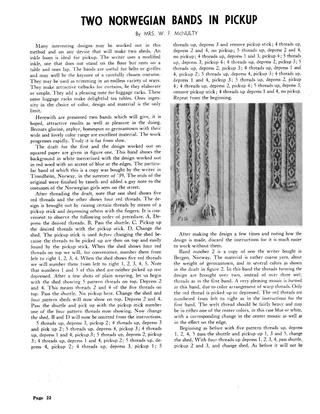
Instructions by Mrs. W. F. McNulty for weaving two Norwegian pickup bands on an inkle loom or any two-shed device. The bands are copies of originals bought in Trondheim and Bergen. Step-by-step pickup sequences are given for each band, with threading drafts and squared-paper designs in the figures. A short second item by Eloise Cobb on page 2 describes making bookmarks and hair bands from a card-weaving pattern of Mrs. Atwater's, with charts.
Aarbog 1911 [1911 Yearbook]
Book · 138 pages · Norwegian
Yearbook for 1911 of the Nordenfjeldske Kunstindustrimuseum in Trondheim. It opens with Hans Dedekam's illustrated study of Nordic bobbin lace, with a German résumé, which covers Swedish, Danish and Norwegian lace, and traces Italian and German pattern-book influence on Norwegian folk lace and white-work embroidery such as that of Rindalen, Hardanger and Nordmøre. The rest is the museum's annual report for 1911 (administration, exhibitions, visits, travel, finances), catalogues of acquisitions including woven silks and brocades, laces, folk textiles and wooden objects, a library accession list, and a membership list.
The Bulletin of the Needle and Bobbin Club, Vol. 47, No. 1 & 2 (1963)
Periodical · 72 pages
Combined issue (Vol. 47, Nos. 1 & 2, 1963) of the Bulletin of the Needle and Bobbin Club with four illustrated articles. Elsa Gudjónsson surveys traditional Icelandic embroidery (laid and couched work, darning stitch, long-legged cross stitch, eye stitch, split stitch) using National Museum of Iceland pieces. Nancy Graves Cabot discusses the tapestries shown in engravings of the 1608 funeral of Charles III of Lorraine. Margery Howe describes the Deerfield Society of Blue and White Needlework, and Marian Powys presents animals and hunting scenes in lace. The issue also has Club Notes, an In Memoriam, a list of officers and advertisements.
Minnesota Weavers Guild Calendar (January-February 1983)
Minnesota Weavers Guild Calendar, January-February 1983
Periodical · 6 pages
January-February 1983 calendar newsletter of the Weavers Guild of Minnesota. It covers the Scandinavian Touch contemporary textile exhibit at the Science Museum of Minnesota, with artist residencies, a People's Loom Rya project, a members program, a master class and a Charles Talley lecture. It also announces the Camp Wilder retreat, committee news, guild workshops and classes, a president's thank-you for the 1982 Fiber Fair, and classified ads for looms, wheels and yarn. The last page is a January and February calendar grid with class listings.
Pattern Book for Norwegian Lace and Embroidery
Elise H. Silljan · 1908
Book · 20 pages
A 1908 pattern book of Norwegian lace and embroidery, edited by Elise H. Silljan and printed in Kristiania. It consists mainly of numbered plate photographs (22 items) of openwork and drawn-thread pieces such as altarcloths, curtains, centrepieces, doilies, collar and cuffs, sideboard covers, towel borders, a bedspread, insertions and appliqué squares and stars. Captions are in Norwegian and English; the plates show finished work rather than charted instructions.
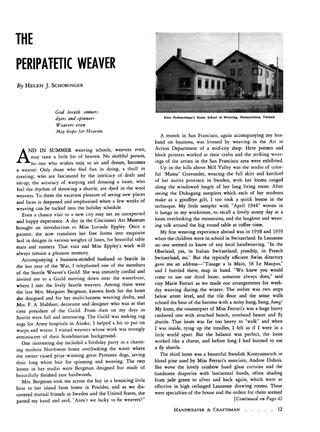
The Peripatetic Weaver
Article · 4 pages
A first-person travel essay by Helen J. Schobinger recounting weaving schools, studios and guilds she visited in the United States and Europe between about 1938 and 1950. Stops include Seattle, San Francisco, Lausanne, Säterglantan in Sweden, Hämeenlinna and Helsinki in Finland, and the Cranbrook summer school in Michigan. It describes teachers, looms, techniques taught and the daily routine of the schools, and closes by encouraging weavers to take summer weaving courses.
Warp & Weft, Vol. 30, No. 7 (September 1977)
September 1977
Periodical · 8 pages · weaving drafts
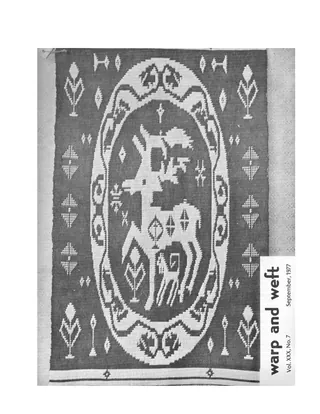
September 1977 issue of Warp and Weft, a monthly newsletter from Robin & Russ Handweavers of McMinnville, Oregon. It includes the editor's summer report, a cover note on a Finnweave piece, a review of Nancy Belfer's Weaving: Design and Expression, and a report on Swedish weaver Malin Selander's workshop and talk. The monthly sample is "Tangleweed," a 4-shaft weft-faced fabric using novelty yarns, with threading, tie-up, treadling, yarn details and cost per yard. The issue ends with classified ads for yarns, books and looms.
Hand Weaving at the New York World's Fair
Article · 5 pages · weaving drafts
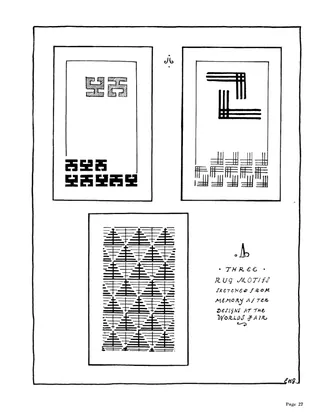
A review of hand-woven textiles seen at the 1939 New York World's Fair, concentrating on the Swedish exhibit from Elsa Gullberg's studio. It covers fringed and long-pile rugs and draperies, Rya and Flossa rugs, and samplers in Finnweave and Dukagang. Shorter sections cover Norwegian tapestry and rugs and the French and Belgian tapestry displays, including the large Floris Jespers hangings. The article includes sketches of three rug motifs and charts of designs suitable for Dukagang or other laid-in techniques. The scan ends with the start of an unrelated item on the National Conference of American Hand Weavers at Hartland, Michigan.
Al'bom tkachestva uzorvb [Album of Weaving Patterns]
Book · 57 pages · Russian · weaving drafts
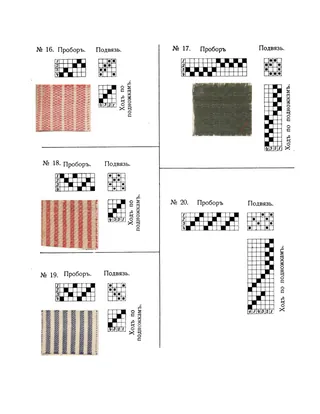
A Russian-language pattern album for hand weavers, issued in a second, expanded edition in St. Petersburg in 1912 by the Department of Rural Economy and Agricultural Statistics. An introductory section explains how to read the drafts (threading into heddles, tie-up to treadles, treadling order) and gives notes on individual patterns. These notes cover uses such as aprons, canvas for embroidery, coverlets, dress goods, towels, rugs, a seamless bag and double-width cloth. They also cover satin and damask-type towel borders, table linens on 8, 10 and 12 shafts, double tablecloths in two colors, and fabrics with cross-wise or lengthwise stripes. The bulk of the book is 112 numbered patterns, each with a threading, tie-up and treadling draft and a drawdown or fabric picture. The patterns progress from simple 4-shaft weaves to complex multi-shaft ones.
Double Weaving on Four Harnesses - the Finnweave
Article · 5 pages · weaving drafts
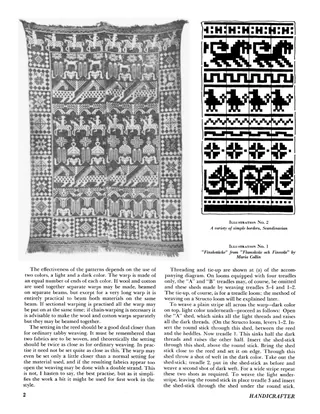
Mary Meigs Atwater introduces the Finnweave, a method of weaving pattern-figured double plain cloth on an ordinary four-harness loom, to American weavers. She explains the equipment (round stick, pattern stick, shed-stick), yarn choice and sett, and step-by-step instructions for weaving plain stripes and pattern rows on treadle and Structo looms. The article includes a threading and tie-up diagram, a worked bag pattern, borders, a coverlet pattern, and two figure motifs (a trumpeter and a peasant woman) adapted from an old Finnish piece.
Gammal Allmogeslöjd från Malmöhus Län; Häftet 6 [Old Peasant Handicraft from Malmöhus County; Booklet 6]
Book · 89 pages · Swedish
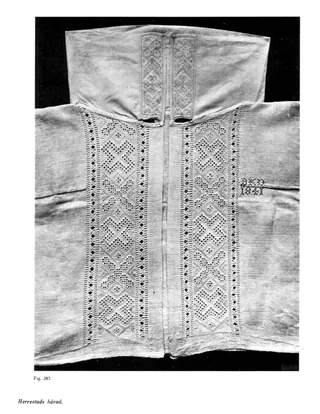
Booklet 6 of the series on old peasant handicraft from Malmöhus County in southern Sweden (Skåne), devoted to white work (hvitvaruslöjd): drawn-thread and cutwork embroidery (udskårssöm, stoppsöm, hålsöm), bobbin and knotted-net lace, and related whitework. A short introduction ties these techniques to the earlier red-sheet (rödlakan) and flamskt weaving covered in earlier booklets and describes regional distribution by härad (district). Most of the booklet is photographic plates of shirts, wedding cloths (förningsdukar), headcloths (klutar), pillowcases, lace bands and aprons, each with a caption giving the district, the owner, the provenance, and a description of the technique and patterns.
Garden Studio Quarterly (October 1932)
Garden Studio Quarterly, October 1932
Periodical · 11 pages · weaving drafts
October 1932 issue of Garden Studio Quarterly and Weaving Service by Myra L. Davis and Kate Van Cleve. It gives instructions for a Swedish embroidery weave, in which cross-stitch patterns from the Danish book Vaevebog for Hjemmene are picked up over groups of warp threads with a sail needle and a binder weft. It includes a twill-threaded draft from the John Landes collection, with full directions and sketches for weaving and making up an under-arm purse, a change purse and a coin purse, and ends with an old coverlet pattern draft from about 1820 with warp, weft and yardage notes for cushions and runners.
222 documents found