Textile Documents › Topic: Native North American textiles
186 documents found
Sort: 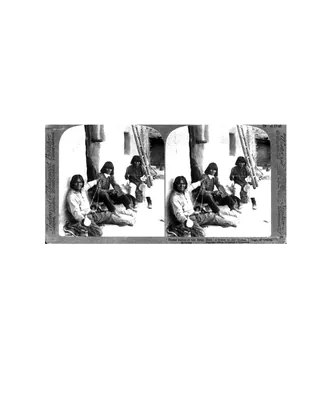
Home Duties of the Hopi Man -- A Scene at the Indian Village of Oraibi, Arizona. Stereo card.
Underwood & Underwood, 1908
Ephemera · 1 page
A single stereograph card published by Underwood & Underwood showing a scene at the Hopi village of Oraibi, Arizona, captioned "Home duties of the Hopi Man." The photograph shows three Hopi men seated against an adobe wall, one of whom appears to be spinning or twisting yarn or cord with a spindle. The card is a visual record of men's textile work in a Hopi village in the early twentieth century.
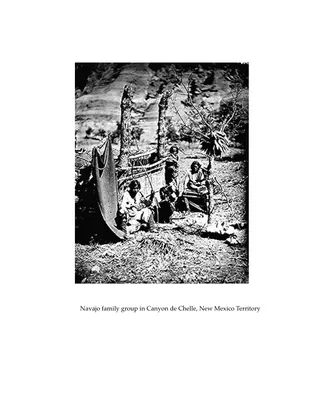
Navajo Family Group
Illustration · 1 page
A single black-and-white photograph of a Navajo family group outdoors in Canyon de Chelle, New Mexico Territory. Several people sit and stand near an upright loom with a partially woven textile. The only text is a printed caption identifying the scene.
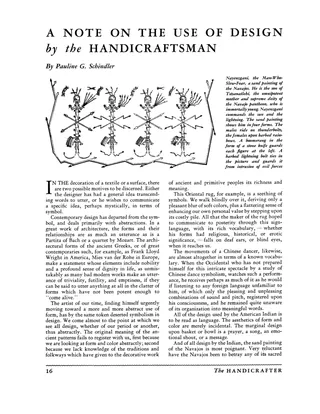
A Note on the Use of Design by the Handicraftsman
Article · 2 pages
A short essay arguing that traditional design, especially that of American Indians, functions as symbolic language rather than abstract decoration, and that modern viewers have lost the ability to read it. Schindler uses Navajo sand paintings as her main example, describing the ritual use of Nayenzgani and of the Sky Man and Earth Mother paintings, and the symbolism of their figures, rainbows, lightning frames and sacred plants. It closes by urging that design should come from intense feeling.
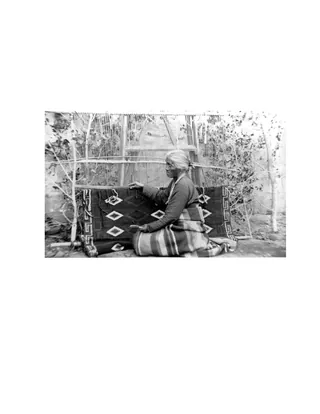
[Tewa Pueblo Weaving]
Illustration · 1 page
A single black-and-white photograph showing an elderly woman seated on the ground at an outdoor loom, weaving a textile with diamond and stepped-border patterns in dark and light wool. The image appears to document Pueblo weaving practice. No text could be read from the scan.
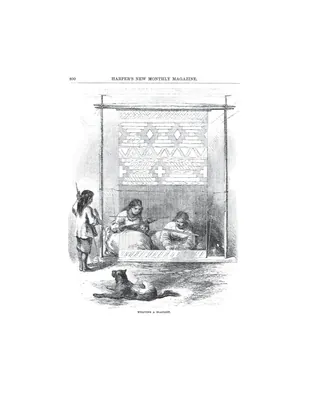
(Indians) Weaving a Blanket
Illustration · 1 page
A single page from Harper's New Monthly Magazine bearing a wood engraving titled "Weaving a Blanket." It shows two Native American women working at an upright loom on a blanket with geometric patterning (diamonds, zigzags, crosses), while a standing man with feathers in his hair looks on. There is no text beyond the caption and running head.
An Interesting Old Weaving Technic
Article · 1 page
A one-page note from Science (1911) by Mary Lois Kissell of the American Museum, New York, describing a nearly vanished wrapped-weaving technique found on an expedition to the Pima of southern Arizona. Stiff slats, often saguaro cactus ribs, are bound with a pliable element such as thong, string, rope, cloth strips or wire. Variations include a simple wrapped weaving and a lattice-wrapped form with a perpendicular slat. The author speculates that it is an early technique and notes similar work in Malaysia, the Lower Congo, Mexico and among Pacific Northwest and Plateau peoples.
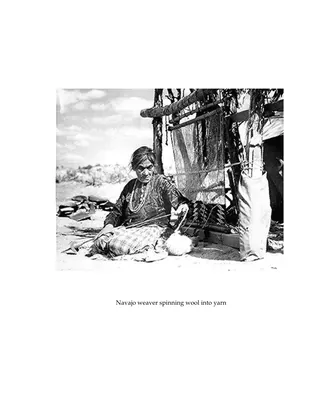
Navajo Weaver Spinning Wool
Illustration · 1 page
A single black-and-white photograph showing a seated Navajo weaver spinning wool into yarn with a drop spindle. Beside her stand an upright loom holding a partly woven textile and a bundle of wool, with a blanket hanging nearby. The image documents traditional Navajo hand spinning and weaving practice.
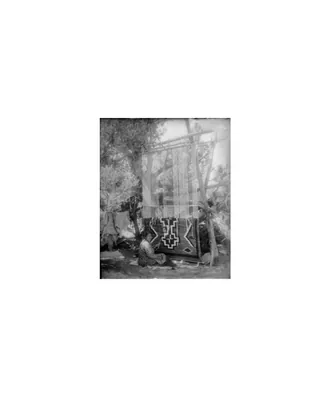
[Navajo woman weaving at an upright loom outdoors]
Illustration · 1 page
A single black-and-white photograph of a Navajo woman seated on the ground weaving at an upright loom set up outdoors under trees. The warp hangs from a horizontal top beam to the partly finished textile. The page has no printed text, so the image shows the vertical loom and weaving posture in use.
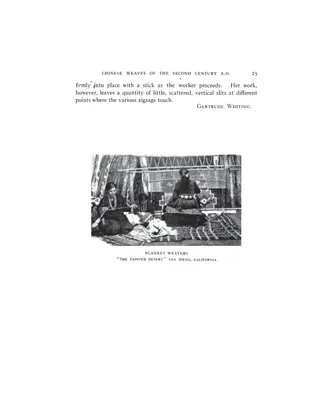
Notes on Navajo Weaving
Article · 2 pages
A short note comparing how weft colors are handled in ordinary weaving, in Gobelins tapestry, and in Navajo weaving. The author explains that a Navajo weaver fills in areas of color with whatever length of yarn she has, producing irregular zigzag boundaries and small scattered vertical slits, and beats the work down with a stick. A photograph shows two blanket weavers at a loom, captioned as from "The Painted Desert," San Diego, California.
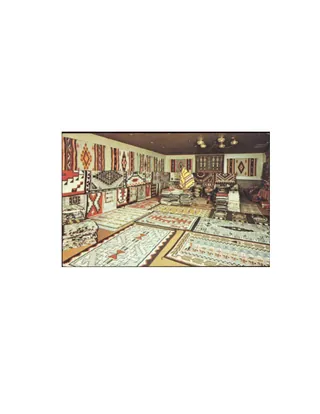
picture postcard
Ephemera · 1 page
A single picture postcard with a color photograph of a showroom interior. Navajo-style woven rugs and textiles hang on the walls and are stacked and spread across the floor. The rugs show geometric patterns in red, black and white. No readable text appears on the scan.
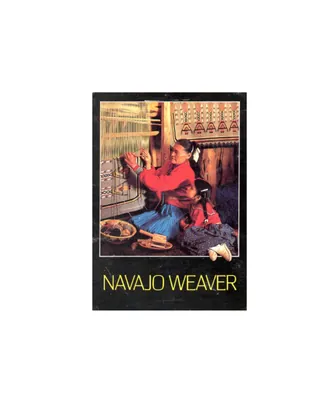
Picture postcards
Ephemera · 3 pages
Scans of three picture postcards showing Navajo women weaving on upright looms. The images show weavers working on geometric-patterned blankets, one beneath an outdoor rock shelter or ramada, and another with a young girl seated beside the weaver. Captions are minimal, such as "A Navajo Blanket Weaver" and "Navajo Weaver".
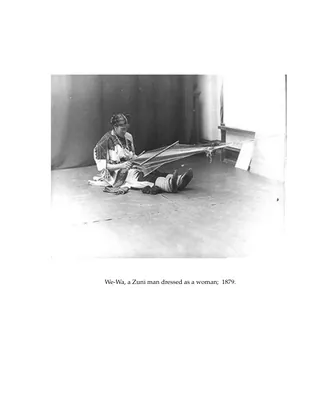
We-Wa, a Zuni Man Dressed as a Woman, Weaving
1879
Illustration · 1 page
A single black-and-white photograph of We-Wa, a Zuni man who lived and worked in the role of a woman, seated at a loom or warp frame stretched across the floor. The setting is a studio with a draped curtain. The only text is a caption giving the subject and the date, 1879.
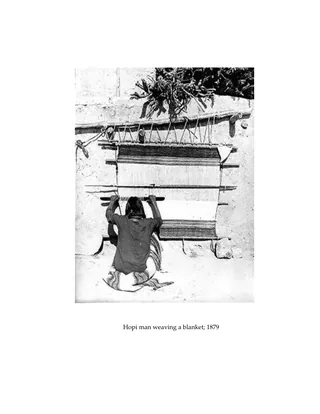
Hopi Man Weaving a Blanket
1879
Illustration · 1 page
A single photograph dated 1879 showing a Hopi man seated on the ground, seen from behind, weaving a blanket on a vertical frame loom attached to a wall or structure. The partly woven textile shows banded patterning with the warp threads stretched on the loom. The only text is a caption giving the subject and date.
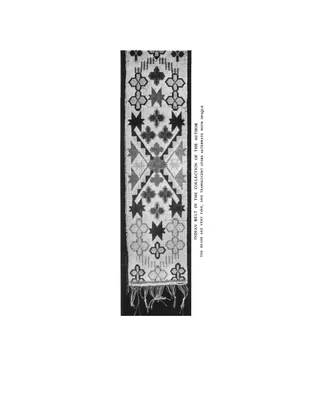
Indian Belt
Article · 6 pages
An essay by Annie Beecher Scoville in the Bulletin of the Needle and Bobbin Club about a Plains Indian beaded belt she bought for fifty cents in a Northwest trader's store about twelve years earlier. She uses the belt to sketch the history of Native American bead weaving, from shell wampum strung on cedar-fibre warps to the use of European glass beads obtained in trade. She describes the belt's "Four Winds" and lightning design in blues, greens, gold and ruby. A photograph of the belt and a photograph of an Inca gauze fragment accompany the text.
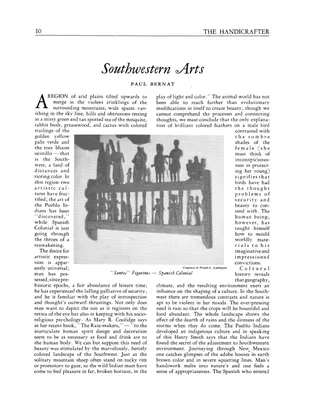
Southwestern Arts
Article · 5 pages
An essay on the arts of the American Southwest, contrasting Pueblo Indian culture with Spanish Colonial culture in New Mexico. It discusses how environment, spiritual belief (the Katchina concept) and symbolism shape Pueblo design, and mentions weaving, basketry, pottery and adobe architecture, with a note on the potters of San Ildefonso. Illustrations show Spanish Colonial santos, a cabinet, furniture, a vegetable-dyed handspun wool blanket, a colcha embroidery, and Indian baskets and pottery. The article is continued in the next issue.
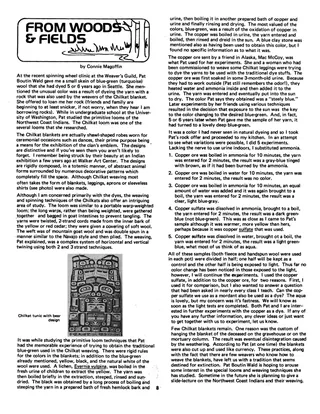
Chilkat loom and dyes
Article · 2 pages
Connie Magoffin's column describes the Chilkat blanket and its loom, a warp-weighted style loom using twining with cedar bark and mountain goat wool. It focuses on the traditional dyes: yellow from lichen, black from hemlock bark and copper, and blue-green from copper oxidized in urine. She reports five kitchen experiments with copper ore and copper sulfate in ammonia or water, and ends with a bibliography. The second page carries travel notes: a visit to a silk importer in Myrtle Creek, Oregon, and announcements of weaving tours and workshops in Norway and Sweden.
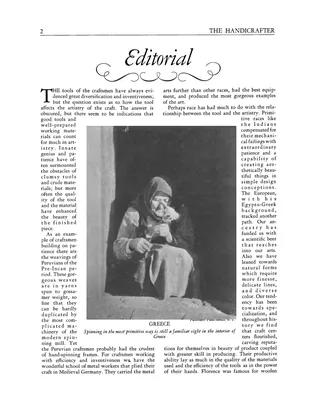
Editorial
Handicrafter, January-February 1932
Article · 3 pages
A 1932 editorial from The Handicrafter on how tools and working materials affect the artistry of handcrafts. It draws examples from pre-Incan Peruvian textiles, Navajo Bayeta blankets, Florentine woolens, the Gobelin tapestry works, and Rodier's fabrics, as well as metalwork, porcelain, ivory and glass. It argues that craftsmen should adopt improved tools and scientific methods rather than revert to primitive ones. Photographs show hand spinning in Greece and Egypt, Navajo rug weaving in Arizona, and cloth weaving in a Czechoslovakian home.
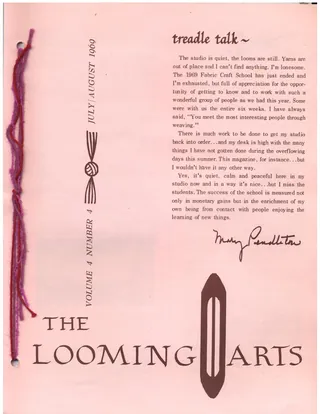
Looming Arts, Vol. 4, No. 4 (July-August 1969)
Looming Arts, July-August 1969
Periodical · 10 pages · weaving drafts
Issue of a small handweaving magazine published by Mary Pendleton in Sedona, Arizona. It includes a four-harness brush-effect fabric draft with warp and weaving directions, the first part of a Navajo weaving series (building a warping frame and winding warp), and a triangular wall hanging in which cut warp ends serve as weft. It also has a report on the 1969 Fabric Craft School, a tip on un-weaving, readers' letters on the weaver's knot, and an eight-harness drapery fabric draft woven for the Sedona Library. Advertisements for yarns, looms and local businesses fill the back pages.
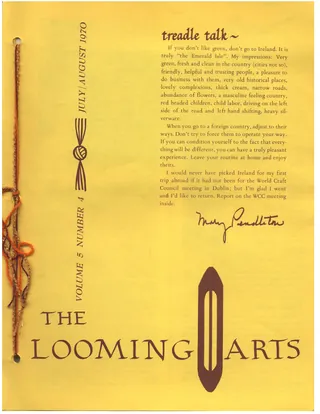
Looming Arts, Vol. 5, No. 4 (July-August 1970)
Looming Arts, July-August 1970
Periodical · 9 pages · weaving drafts
Issue of The Looming Arts (Vol. 5 No. 4, July/August 1970), edited by Mary Pendleton of Sedona, Arizona. It reports on the World Craft Council meeting in Dublin and a tour of Ireland, and includes two fabric projects inspired by Irish textiles: a sticky-warp tabby suiting fabric (4-shaft) and a heavy 10-shaft coat fabric using boucle and loop yarns. It also has handwoven cocktail napkins with pickup on a twill threading, Part 7 of the Navajo weaving series (advancing color blocks, turn warp ends, selvages), a guest article by a 10-year-old student, summer school news, and advertisements.
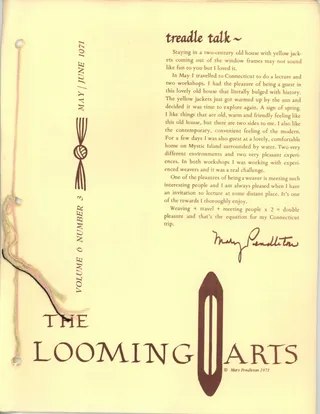
Looming Arts, Vol. 6, No. 3 (May-June 1971)
Looming Arts, May-June 1971
Periodical · 7 pages · weaving drafts
Issue of Mary Pendleton's Looming Arts newsletter from Sedona, Arizona, covering studio news and her May 1971 workshops and lecture for the Handweavers Guild of Connecticut. It gives projects with drafts: a four-harness wool pick-up fabric (Shades of Green), an eight-harness double-weave knitting needle case, and an eight-harness gauze fabric. Other items include an article on beating technique, Part 12 of the Navajo weaving series on interlocking versus single-warp joins, a yarn offering, and advertisements.
Navajo Weaving with Two- or Four-Harness Looms
Article · 3 pages
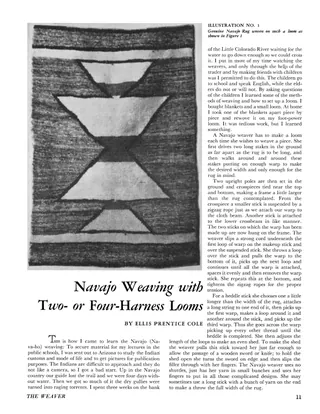
A 1937 article by Ellis Prentice Cole describing how a Navajo weaver sets up an upright loom and weaves, based on the author's observations in Arizona. It explains the heddle stick, sword and fork beater, and how designs are built with finger-placed colored weft, including vertical and diagonal edges. It then advises how to imitate Navajo-style tapestry rugs and cloth on two- or four-harness hand or foot-power looms, with notes on warp spacing, yarns, fringe, and selvages. Illustrations include a loom photograph and line drawings of the loom and design methods.
Textile Fabrics of the New England Indians
Article · 10 pages
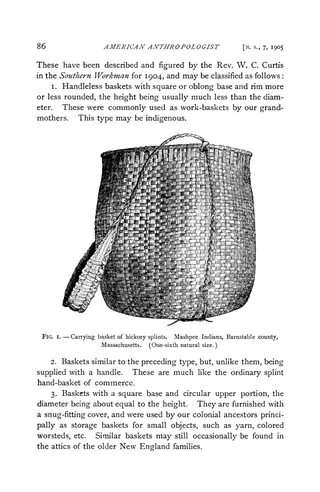
A 1905 article by Charles C. Willoughby surveying the textile arts of the New England Indians, drawing on early colonial accounts and museum specimens. It covers splint basketry (including Mashpee pack-baskets), baskets and bags of rush, maize husk and hemp, wigwam mats, twined robes, and turkey-feather mantles. It closes with a detailed description of a twined Indian-hemp wallet embroidered with moose hair (false embroidery), made by Mollocket of Maine about 1778-1785, with a technical diagram of the weave.
Indian Blanketry
Article · 10 pages
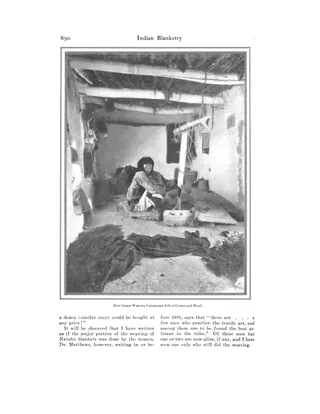
A 1902 magazine article by George Wharton James on weaving among Southwestern Native Americans, chiefly the Navaho, with notes on the Pueblo peoples (Hopi, Zuni), Mexican weavers and the Thlinket of Alaska. It covers the vertical loom and its tools, the preparation of wool, the four grades of Navaho blankets including Germantown yarn, native dyes and bayeta cloth, and the sources of designs. It also describes Hopi cotton bridal garments and ceremonial kilts, and heddle-frame weaving of sashes and belts. Illustrated with photographs of weavers and blankets.
Looming Arts, Vol. 5, No. 1 (January-February 1970)
Looming Arts, January-February 1970
Periodical · 10 pages · weaving drafts
Issue of a handweaving magazine published by Mary Pendleton in Sedona, Arizona. It includes a custom upholstery fabric with a 4-shaft tabby draft and yarn specifications, a description of a Mexican rya-trimmed cotton drapery, Part 4 of a Navajo weaving series (making heddles and sheds on a Navajo frame loom), and a draft for an 8-shaft wool fabric for sport jackets or coats. Other items are an account by Garnette Johnson of founding the Handweavers Guild of America, an announcement of the 1970 Pendleton Fabric Craft School, reader letters, a poem, and advertisements for looms and yarns.
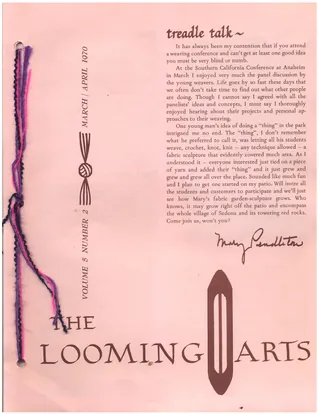
Looming Arts, Vol. 5, No. 2 (March-April 1970)
Looming Arts, March-April 1970
Periodical · 9 pages · weaving drafts
Issue of Looming Arts, a bimonthly published by Mary Pendleton of Sedona, Arizona. It includes a casement fabric draft using rayon flake and Pearl cotton woven wrong side up, a six-harness yellow draperies draft with a paddle-warped mixed warp, and beginner hot pad and pot holder projects. Part 5 of a Navajo weaving series covers splitting warp pairs, selvage handling, beating with a comb and filling in low areas. It also has conference reports (Southern and Northern California Handweavers), a note on hand versus machine finishing of place mats, a guest column by the printer, letters, a schedule for the 1970 Fabric Craft School, and advertisements.
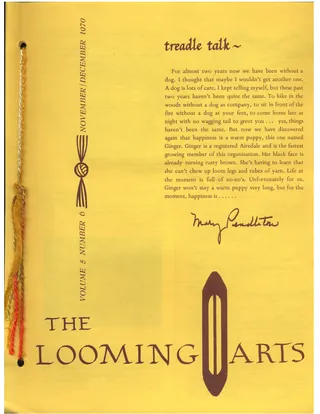
Looming Arts, Vol. 5, No. 6 (November-December 1970)
Looming Arts, November-December 1970
Periodical · 9 pages · weaving drafts
November/December 1970 issue of The Looming Arts, edited by Mary Pendleton of Sedona, Arizona. It includes a weaving sample on a simple twill threading with sextupled warp ends (4 shafts, with draft), a cut-warp brush fabric on 8 harnesses (with draft), and Part 9 of a Navajo weaving series on correcting draw-in, selvage and spacing problems. It also has a knitted Irish lobster claw potholder pattern, a holiday skirt woven from Christmas ribbons, a humorous account of weaving and spinning in a leg cast, a note on winding mixed-fiber warps, reader letters, school announcements and advertisements.
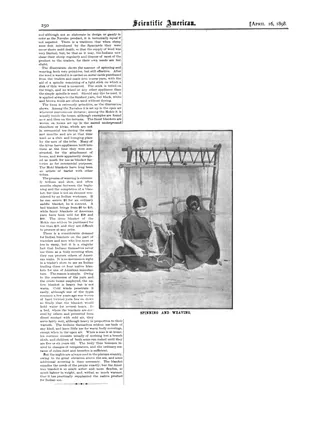
Pueblo Arts and Industries -- II
Article · 2 pages
A 1898 Scientific American article, the second in a series on Pueblo arts, by Cosmos Mindeleff. It describes the native costume of Hopi (Moki) women, especially the black wool lozenge-patterned blanket dress with blue border and green cord, and compares Hopi and Navaho blanket weaving. It covers men's weaving among the Hopi, hand spinning with a spindle, dyeing, the upright loom, weaving in kivas, prices, and why Indians preferred American-made blankets. Two photographs show Hopi maidens with traditional hair dressing and a woman at an upright loom.
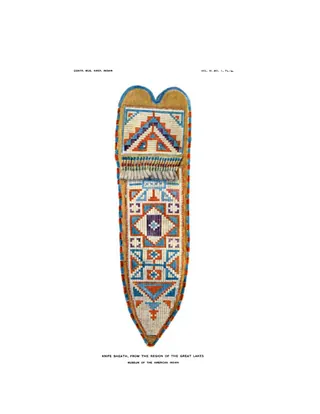
Technique of Porcupine-Quill Decoration among the North American Indians
Monograph · 80 pages
A 1916 monograph from the Museum of the American Indian (Heye Foundation) describing how North American Indian women decorated leather, birchbark and other objects with porcupine quills. It covers the collecting, sorting, dyeing and flattening of quills, the tools used (awls, bone markers, sinew), and the stitches (spot, back, loop). It also describes folding and crossing techniques for bands, plaiting, wrapped coils and hair fillers, wrapped fringe and pipe-stem braiding, edgings, raised lines, and quilled birchbark. A woven technique using sinew warps on a bow loom with quill wefts is described as well. The text is illustrated with numbered line drawings of the stitches and foldings and with plates of museum specimens such as knife sheaths, robes, pipe-stems, pouches and a quiver.
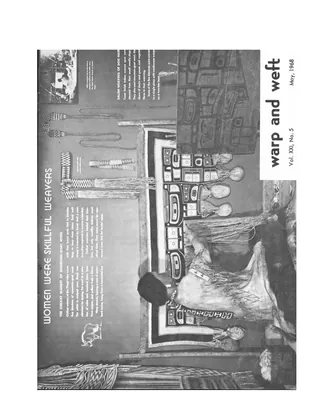
Warp & Weft, Vol. 21, No. 5 (May 1968)
May 1968
Periodical · 8 pages · weaving drafts
May 1968 issue of the monthly Warp & Weft from Robin & Russ Handweavers of McMinnville, Oregon. It features an account of Chilkat blanket weaving (mountain-goat wool, cedar-bark warp, pattern boards, dyes) drawn from a Portland Handweavers program by Mrs. Doris Kyber-Gruber, plus a short note on Coast Salish dog-hair weaving. The monthly sample is "Checkerboard," a 4-shaft upholstery fabric in ramie and English rug wool, with threading, tie-up, treadling, yarn details and costs. The issue also has an editor's letter, a notice of a Michigan weavers' conference, and classified ads and supply listings.
Looming Arts, Vol. 4, No. 5 (September-October 1969)
Looming Arts, September-October 1969
Periodical · 9 pages · weaving drafts
Issue of The Looming Arts, a bimonthly handweaving magazine published by Mary Pendleton of Sedona, Arizona. It includes two projects with threading drafts and tie-ups: a four-harness textured place mat in Swistraw and rug yarn, and a reversible eight-harness chenille fun fur fabric woven like overshot with tabby. Other features are Part 2 of a Navajo weaving series on twining and securing the warp, a column on handling sticky warps, an account of the Northwest Weavers Conference in Seattle, a piece on weaving instruction at Dixie Junior College, news of the new Handweavers Guild of America, and advertisements for looms, yarns and supplies.
Looming Arts, Vol. 6, No. 2 (March-April 1971)
Looming Arts, March-April 1971
Periodical · 8 pages · weaving drafts
Issue of Mary Pendleton's bi-monthly handweaving newsletter from Sedona, Arizona. It includes a four-harness striped wool fabric (Potsy Stripes) with threading, tie-up and treadling, and an eight-harness striped fabric for totes or coats using pearl cotton, fine cotton and wool. Part 11 of the Navajo weaving series explains how to critique a finished rug for width, tension, edges, floats and design balance. Other items: an editor's note on re-doing an eight-harness tie-up, a reader letter, studio news, a spool rack tip, a knitted dunebuggy hat pattern, yarn ordering information and advertisements.
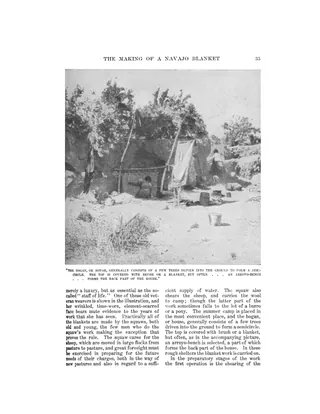
Making of a Navajo Blanket
Article · 11 pages
A 1902 magazine article by George H. Pepper describing how Navajo women make blankets, based on observation in Chaco Canyon, New Mexico. It follows the process from shearing, washing, dyeing (native black and yellow-green dyes versus aniline), carding and spinning with the distaff, to setting up the upright loom with stone weights, healds, batten and comb, and weaving the designs. It closes with criticism of traders' influence (store cord, aniline dyes, Germantown yarn) and the Hyde Exploring Expedition's efforts to revive native wool and dye work. Illustrated with photographs of weavers, camp, loom and finished blankets.
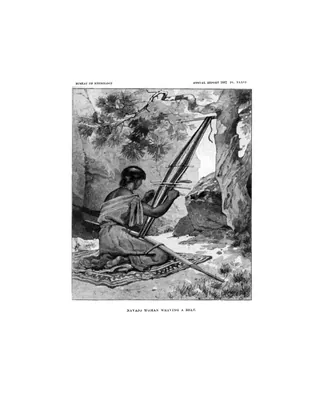
Navajo Weavers
Monograph · 25 pages · weaving drafts
Washington Matthews' 1884 paper from the Third Annual Report of the Bureau of Ethnology describes Navajo weaving as he observed it in the early 1880s. It covers wool spinning, native and imported dyes (black, yellow, reddish, indigo, bayeta), the upright blanket loom, warp formation, heald making, and the weaving process with batten and reed-fork. It also treats diagonal and diamond twill weaving on four sheds, the weaving of belts and sashes with raised figures, and varieties of blankets. A comparison with Zuni belt weaving and an Aztec picture closes the paper. Illustrated with plates, loom and warp diagrams, and photographs of blankets.
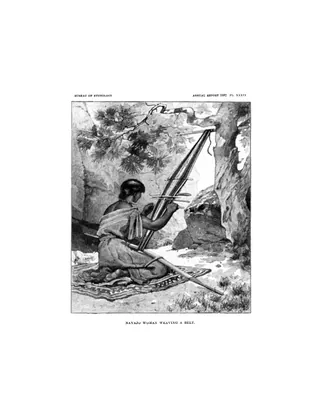
Navajo Weavers
Monograph · 25 pages · weaving drafts
Washington Matthews' 1884 study of Navajo weaving, published in the Third Annual Report of the Bureau of Ethnology. It describes wool, spinning, native and imported dyes (black, yellow, reddish, indigo, bayeta), the upright blanket loom, warping, heald-making and the weaving process. It also covers diagonal and diamond twill weaving on four sheds, blanket types and designs, and belt and sash weaving, compared with Zuñi methods and an Aztec picture. Illustrated with plates, loom diagrams, heald/warp diagrams and photographs of blankets.
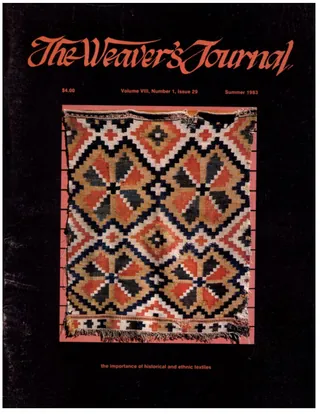
Weaver's Journal, Vol. VIII, No. 1 Issue 29 (Summer 1983)
Weaver's Journal, Summer 1983
Periodical · 96 pages · weaving drafts
Summer 1983 issue of The Weaver's Journal, themed on the importance of historical and ethnic textiles as inspiration for contemporary weavers. Articles cover museum textile research, Chilkat and Northwest Coast weaving, Shaker textiles, Norwegian aklae tapestry, Peruvian complementary-warp weaves, Southwest Indian twill tapestry, Sumbanese warp ikat and tying ikat on the loom, Guatemalan backstrap weaving, Navajo inspiration, damask, and learning to weave in Japan. Technical pieces include part 2 of a series on computers for weavers, four-block double weave on four shafts, 8-shaft double weave with a placemat project, a proposal for standardizing weaving terminology and drafting conventions, and space dyeing with fiber-reactive dyes. Also includes the editor's letter, mail bag, index of Volume VII, errata, book and product reviews, and many advertisements.
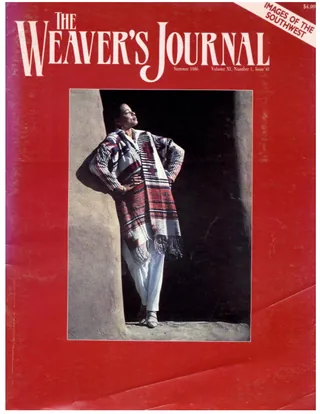
Weaver's Journal, Vol. XI, No. 1 Issue 41 (Summer 1986)
Weaver's Journal, Summer 1986
Periodical · 84 pages · weaving drafts
Summer 1986 issue of The Weaver's Journal, themed "Images of the Southwest." It features an interview with Noël Bennett, a profile of anthropologist Kate Peck Kent, the construction of a Spanish Colonial loom, Mary Rawcliffe Colton's survey of fiber artists inspired by the New Mexico landscape, and articles on contemporary Navajo weaving, Navajo saddle blanket patterns, and the weavers of Chimayó. Projects include huck-lace cotton dresses for narrow looms, twilled cottolin towels in the Weekend Weaver series, and instructions for tying string heddles. Also included are Part IV of the color theory series, a Jack Lenor Larsen profile, book reviews, a directory of museums, shops and galleries in Arizona and New Mexico, product news, a calendar, classifieds and advertisements.
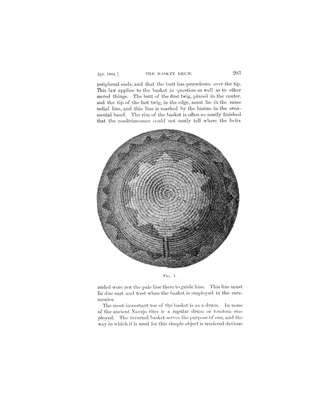
Basket Drum
Article · 7 pages
Article by Washington Matthews on the Navajo ceremonial basket drum, a coiled sumac-twig basket used inverted as a drum in the nine-night night-chant ceremony. It covers the basket's construction, butt-and-tip rules, decorative band with a gap, plaited rim finish and its legend, and the ritual handling of the basket. A second part describes the yucca-leaf drumstick, how its leaves are gathered, its ritual use and ceremonial unraveling. Two figures show the basket and the drumstick.
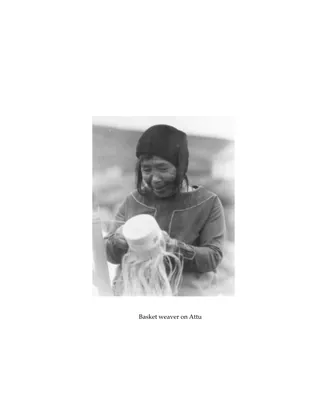
Basket Weaver on Attu
Illustration · 1 page
A single black-and-white photograph of an older woman working with a bundle of pale grass or fibers, captioned as a basket weaver on Attu. She wears a dark hood and a jacket with light piping, and a blurred landscape is visible behind her. The image documents Native basketry practice in the Aleutian Islands.
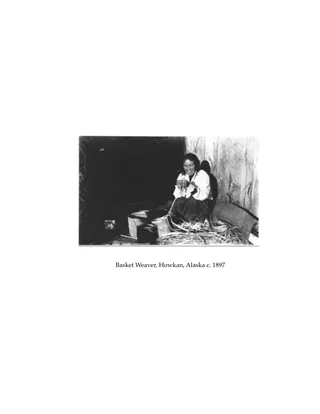
Basket Weaver, Howkan, Alaska
1897
Illustration · 1 page
A single black-and-white photograph, captioned as a basket weaver at Howkan, Alaska, around 1897. It shows a seated woman holding a partially finished woven basket, with other finished baskets and a large woven mat or basket around her. The only text is the caption.
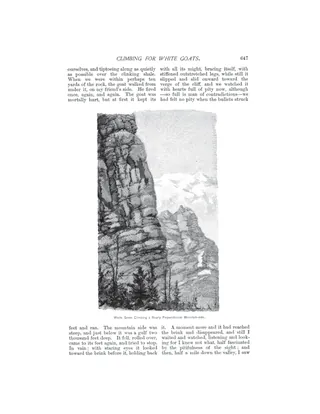
Climbing for White Goats
Article · 5 pages
A May 1894 Scribner's Magazine article by George Bird Grinnell on the mountain goat of the western American and Canadian ranges. It describes the animal's habitat, range, coat, and climbing ability, and narrates hunting trips in the Rocky Mountains. It includes engraved illustrations. Textile content is limited to a short passage noting that the goat's fine white underwool is woven into blankets by British Columbia Indians, with the yarn hand-twisted on the knee and woven on a simple loom.
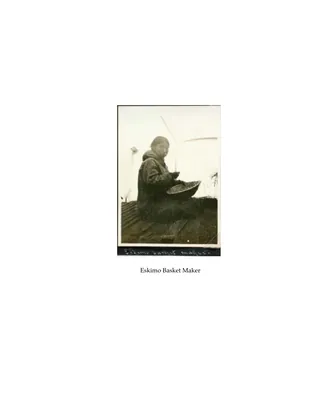
Eskimo Basket Maker
Illustration · 1 page
A single page with a black-and-white photograph of a seated woman in a hooded garment, working on a woven basket held in her lap. The only text is the caption "Eskimo Basket Maker." It is useful as a visual reference for Arctic basketry and its makers.
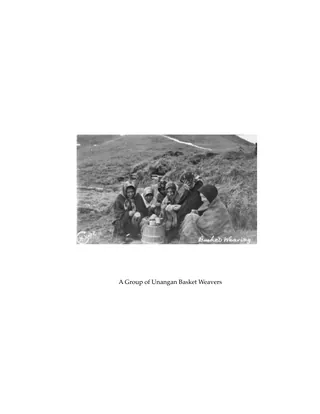
Group of Unangan Basket Weavers
Illustration · 1 page
A single black-and-white photograph showing a group of Unangan (Aleut) women seated outdoors on a grassy hillside in front of a grass-roofed structure. They wear headscarves and shawls and are working with baskets or basketry materials. The only text is the caption identifying them as basket weavers.
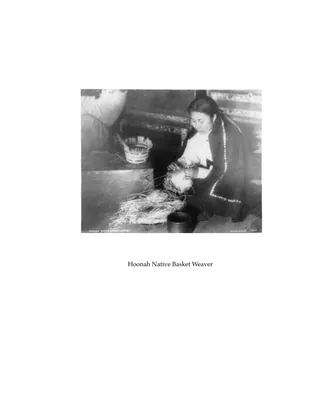
Hoonah Native Basket Weaver
Illustration · 1 page
A single black-and-white photograph captioned "Hoonah Native Basket Weaver." It shows a seated Native woman with long dark hair, wearing a dark dress with beaded trim, holding a partly woven basket with loose fiber strands. The only text is the caption; no date or photographer is given.
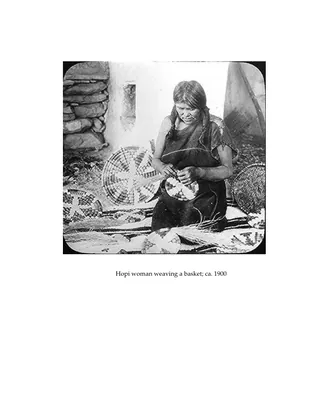
Hopi Woman Weaving Basket
1900
Illustration · 1 page
A single black-and-white photograph, dated about 1900, showing a seated Hopi woman making a coiled basket in her lap. Several partly finished baskets with geometric patterns and bundles of material lie around her. The only text is a caption identifying the scene.
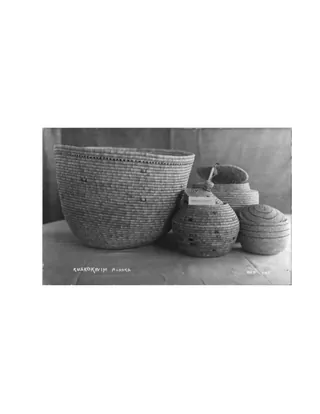
Kuskokwim Baskets from Alaska
Illustration · 1 page
A single-page photograph of four coiled grass baskets from the Kuskokwim region of Alaska, arranged on a draped cloth. The baskets include a large open bowl-shaped basket with a dark decorative band near the rim and small dark tabs on the body. The only text is a brief caption naming Kuskokwim, Alaska.
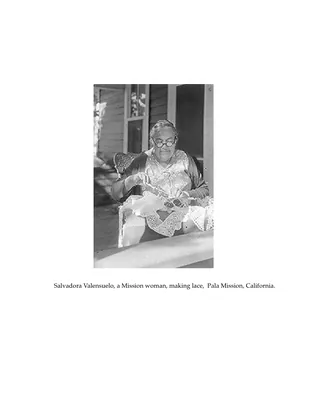
Lace Making
Illustration · 1 page
A single black-and-white photograph of an elderly woman seated on a porch, working on lace held in her lap. The caption identifies her as Salvadora Valensuelo, a Mission woman making lace at Pala Mission, California. It is useful as visual documentation of lace making by Native women at a California mission.
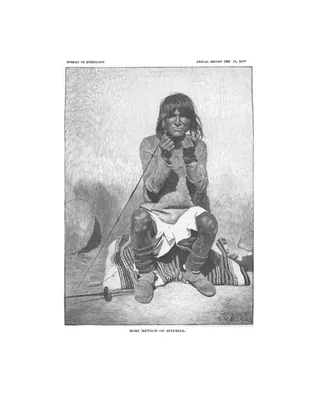
Moki Method of Spinning
Illustration · 1 page
A single plate showing a seated woman spinning fiber with a drop spindle, captioned as the Moki (Hopi) method of spinning. A basket and bundles of fiber or yarn sit beside her. It is Plate XLIV from a Bureau of Ethnology annual report and has no accompanying text.
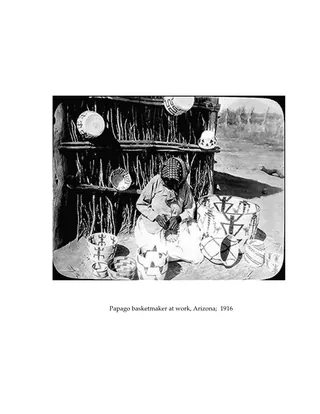
Papago Basketmaker
1916
Illustration · 1 page
A single black-and-white photograph of a Papago (Tohono O'odham) basketmaker seated at work on a basket, Arizona, 1916. She wears a patterned head covering and sits before a wall of upright stalks, with shelves holding finished baskets decorated with geometric designs. The caption is the only text.
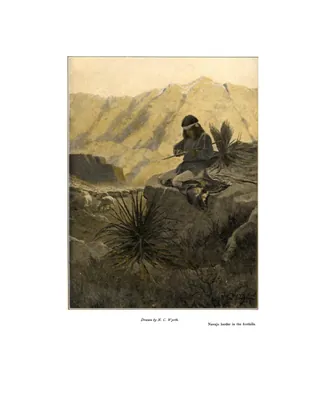
Sheep-Herder of the South-West
Article · 6 pages
A first-person travel narrative by the illustrator N. C. Wyeth, published in Scribner's Monthly in 1909. Wyeth stays at the Two Gray Hills trading post in New Mexico, meets a young Navajo herder named Begay, and accompanies him on a two-day drive of a thousand sheep across the desert to a sheep buyer. The text covers herding methods, the landscape, hogans and trading posts, and only briefly mentions Navajo blanket weavers at their looms. A full-page painting of a Navajo herder with his flock is included.
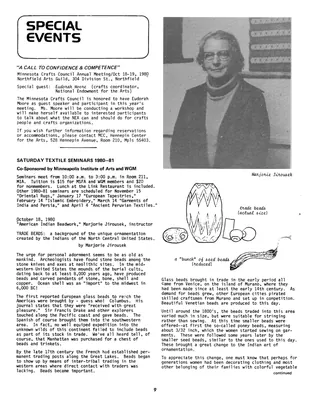
Trade Beads
Minnesota Weaver, September 1980
Article · 2 pages
A short article by Marjorie Jirousek giving background on trade beads and the beadwork of Native peoples of the North Central United States. It traces beads from prehistoric stone and shell ornaments through European glass beads from Venice, the arrival of small seed beads around 1800, and how seed beads replaced porcupine quillwork. It closes by distinguishing the Woodland Ojibwe and Plains Sioux beadwork traditions in Minnesota, with line drawings of a Sioux and an Ojibwe design.
186 documents found