Textile Documents › Topic: Drafting and notation
601 documents found
Sort: 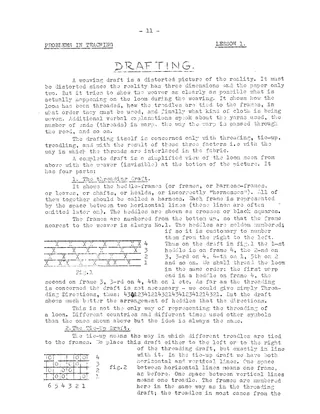
Problems in Teaching 1 - Drafting
Master Weaver, March 1954
Article · 2 pages · weaving drafts
Lesson 1 in a series on problems in teaching weaving, explaining how to read and write a weaving draft. It describes the four parts of a complete draft: threading, tie-up, treadling and draw-down. It covers numbering conventions for frames, heddles and treadles, and the use of threading and treadling directions in place of drawn drafts. Four figures show a 4-shaft threading, a 4-frame, 6-treadle tie-up, a treadling and an assembled draft.
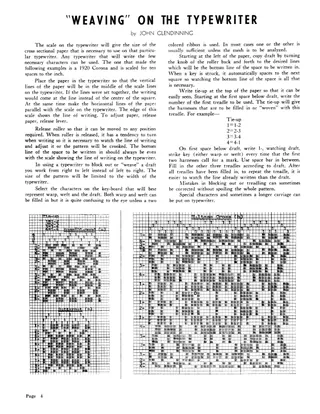
Weaving on the Typewriter
Article · 1 page · weaving drafts
A short article by John Glendinning explaining how to use a typewriter to produce weaving drafts on cross-section paper. It covers aligning the paper with the machine's scale, choosing characters to stand for warp and weft, writing the tie-up, and filling in treadling and blocks. Three examples typed on a 1920 Corona, 'Rose Diamond', 'Buttercup' and 'Maltese Cross', illustrate the method.
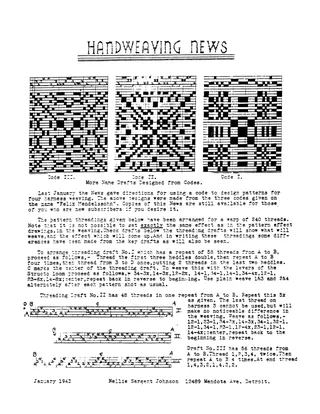
Handweaving News (January 1943): More Name Drafts Designed from Codes
Periodical · 3 pages · weaving drafts
A January 1943 Handweaving News article by Nellie Sargent Johnson continuing her method of designing four-harness patterns from letter codes based on names. It gives seven threading drafts, including ones from the names of Felix Mendelssohn, Wolfgang Amadeus Mozart, and the towns Louisiana, Mississippi and Winchendon Springs, Massachusetts. Each draft comes with repeat counts, warp arrangements for 240 to 600 threads, and treadling instructions for the levers of a Structo loom.
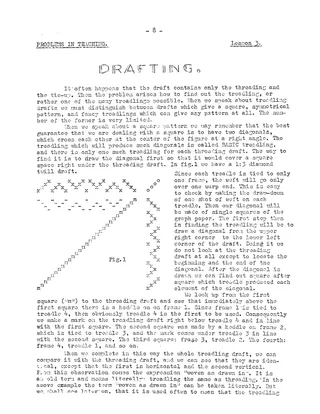
Problems in Teaching 3 - Drafting
Master Weaver, July 1954
Article · 2 pages · weaving drafts
A short lesson from the Master Weaver series on how to work out a treadling when a draft gives only the threading and tie-up. It explains the basic treadling that produces a square, symmetrical pattern by drawing a 45-degree diagonal under the threading and reading off which treadle makes each square. Three figures work through a 1:3 diamond twill and two further drafts where each treadle is tied to two frames. The lesson also explains the origin and extended meaning of the term "woven as drawn in".
Problems in Teaching 4 - Drafting
Master Weaver, September 1954
Article · 2 pages · weaving drafts
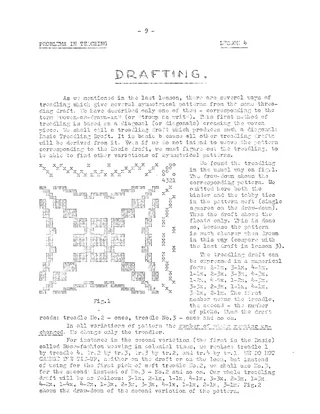
Lesson 4 of the series "Problems in Teaching" from Master Weaver, on drafting treadling for symmetrical patterns from a single threading draft. It explains the basic treadling draft, which produces a diagonal, and how to derive a second variation ("rose-fashion") by swapping treadle numbers or mirroring the treadling marks about a center line. It gives numerical treadling sequences, notes common student errors, and includes three figures with 4-shaft, 4-treadle drafts and treadling diagrams.
Problems in Teaching 4 - Drafting
Master Weaver, January 1955
Article · 2 pages · weaving drafts
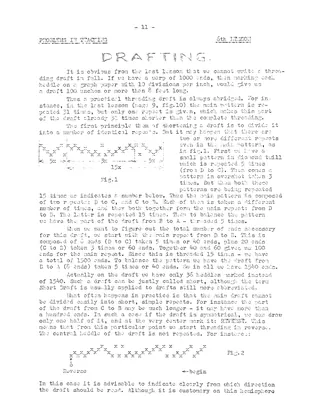
A two-page lesson on drafting from the series "Problems in Teaching" in Master Weaver, explaining how to abbreviate a threading draft by dividing it into repeats, calculating the total number of ends, and using a REVERSE marker for symmetrical drafts. It then describes the short draft method for overshot, which records the position and length of floats instead of marking each heddle, and how to expand such a short draft back into a full threading. Figures 1-6 show threading drafts in x marks and numeric short drafts.
Questions and Answers
Article · 1 page · weaving drafts
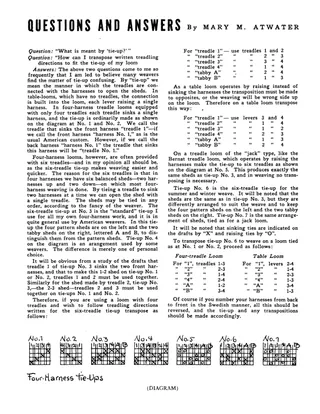
Mary M. Atwater answers two reader questions about what a loom tie-up is and how to transpose written treadling directions to a different loom. She explains tie-ups for table looms, four-treadle and six-treadle sinking looms, and jack-type treadle looms, and gives conversion lists for treadles and levers. A diagram of seven four-harness tie-ups includes the summer and winter arrangement.
A Simple Method for Keeping Samples of Weaving
Article · 2 pages · weaving drafts
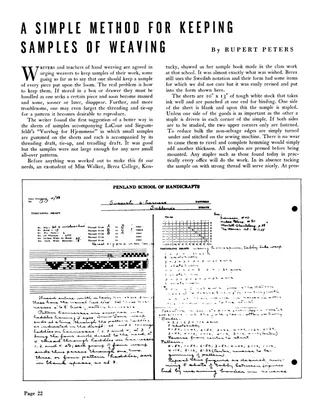
A short 1939 article by Rupert Peters describing a method of keeping weaving samples on large punched sheets (10" x 13") bound into a book, with each sample stapled to one side and its threading draft, tie-up, treadling and other data on the other. He explains the origins of the idea (a Danish sample book and Berea College's sample book), how samples are prepared and mounted, and how the sheets are used in teaching. A Penland School of Handicrafts draft sheet for a 4-harness Swansdown pattern and a photograph of a mounted runner corner illustrate the method.
Accidental Weaves (Drafts based on Theory of Probability)
Master Weaver, March 1956
Article · 6 pages · weaving drafts
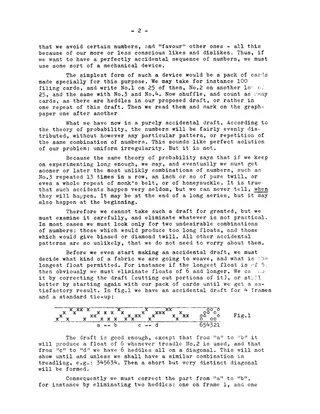
An article from Master Weaver No. 26 (March 1956) on designing irregular, fully random 'accidental' weaving drafts for textured but uniform fabrics. It explains using card packs, dice, telephone directories, roulette or bingo to generate random threading and treadling sequences, then checking for long floats and accidental twill or diamond patterns. Worked examples for 4 and 8 shafts are given in Figs. 1-5, along with a practical coat-length project in heavy wool with a seven-end colour warp (Fig. 6).
Blended Drafts and Weaves, Something New in Honeysuckle and other Patterns
Article · 2 pages · weaving drafts
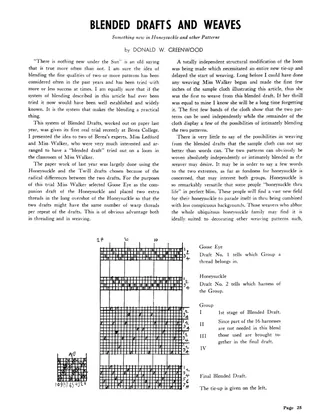
Donald W. Greenwood describes a system of "blended drafts" that combines two four-harness threadings into one draft. The first draft decides which group of harnesses each warp thread goes in, and the second decides which harness within that group. The system was first tried at Berea College, where Miss Walker wove a sample blending Honeysuckle and Goose Eye. The article gives draft diagrams, a worked thread-by-thread example, tie-up notes for ten treadles, and an illustration of the sample cloth.
Code Drafting: Part 1 -- Introduction
Ralph E. Griswold · February 28, 2004
Web Doc · 4 pages · weaving drafts
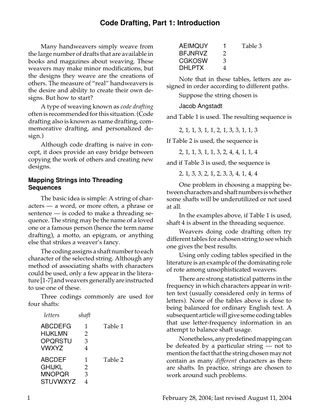
An introductory article by Ralph Griswold on code drafting (also called name drafting or commemorative drafting), in which a string of characters is mapped to shaft numbers to generate a threading sequence. It explains three common four-shaft letter-to-shaft tables, worked examples using the name "Jacob Angstadt", and how to add incidentals to achieve alternating parity for overshot. It also covers reflecting the sequence for symmetry and an alternative method of building parity into the code table. It ends with references to the literature and a page of four sample drafts.
Code Drafting: Part 2 -- Balanced Code Tables
Ralph E. Griswold · February 29, 2004
Web Doc · 2 pages
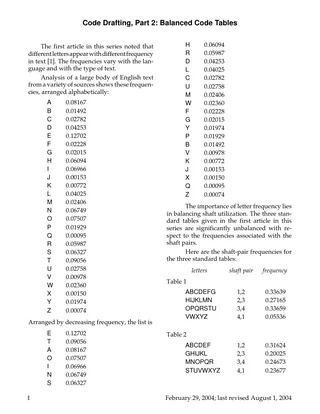
A short web article by Ralph Griswold, the second in a series on code drafting, in which letters of text are mapped to shaft pairs on a four-shaft loom. It gives English letter-frequency tables, alphabetical and by decreasing frequency, and shows that the three standard code tables from Part 1 are unbalanced in shaft-pair use. It then presents three frequency-balanced tables (Tables 4-6) and explains how they were built, with examples of strings that defeat the balance.
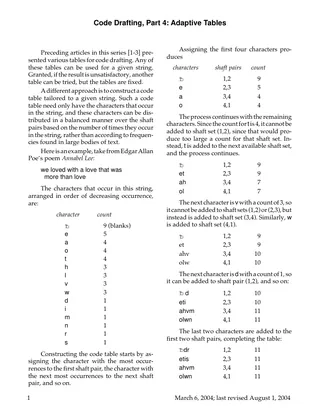
Code Drafting: Part 4 -- Adaptive Tables
Ralph E. Griswold · March 6, 2004
Web Doc · 3 pages
Part 4 of Ralph Griswold's code drafting series, describing how to build a code table tailored to a particular string rather than using a fixed table. Characters are assigned to shaft pairs according to how often they occur in the string, giving a balanced distribution. The worked example uses a line from Poe's poem Annabel Lee and compares the result with a table based on frequencies in large bodies of text. A pattern derived from the table appears at the end.
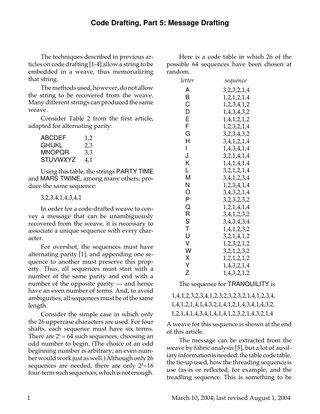
Code Drafting: Part 5 -- Message Drafting
Ralph E. Griswold · March 10, 2004
Web Doc · 3 pages · weaving drafts
Part 5 of Ralph Griswold's Code Drafting series, on message drafting: embedding a text in an overshot weave so the message can be recovered. Earlier methods could not be reversed because different strings gave the same sequence, so he assigns each letter a unique six-term sequence of alternating parity for four shafts. He gives a randomly chosen 26-letter code table and works out the sequence for the word TRANQUILITY. A drawdown of the resulting weave is on the last page, and the text notes limits and the cryptographic aspect.
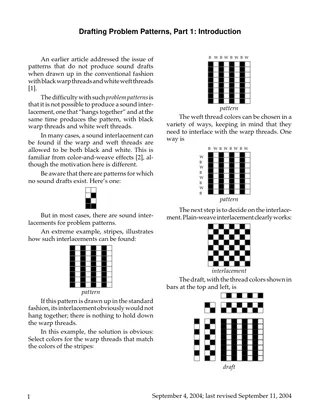
Drafting Problem Patterns, Part 1: Introduction
Ralph E. Griswold · September 4, 2004
Web Doc · 2 pages · weaving drafts
Ralph Griswold's first article in a series on patterns that cannot be woven as sound fabrics when drawn with black warp and white weft. He shows that using both black and white threads in warp and weft, as in color-and-weave effects, can often yield an interlacement that hangs together. A stripe pattern is worked through step by step with pattern, interlacement and draft grids, and a three-step general approach (find colors, choose an interlacement, test soundness) is outlined.
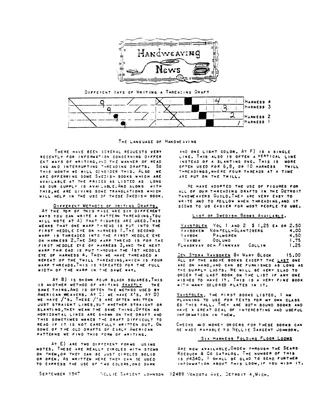
Handweaving News (September 1947): The Language of Handweaving
Periodical · 2 pages · weaving drafts
A two-page September 1947 issue of Handweaving News in which Nellie Sargent Johnson explains the different ways of writing and reading threading drafts (figures, squares, X's, slanted lines, circles and notes) and of indicating tie-ups for jack and counterbalanced looms. It also lists Swedish weaving books for sale and gives a Swedish-English glossary of weaving terms, colors and materials for use with the Vavstolen books. A Sears Roebuck six-harness folding floor loom is also mentioned.
Solving the Mystery of the Strange Draft
Article · 8 pages · weaving drafts
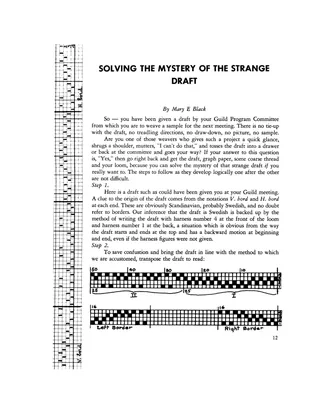
Mary E. Black gives a step-by-step method for working out an unfamiliar weaving draft that arrives with no tie-up, treadling, or draw-down. Using a Swedish four-block draft marked V. bord and H. bord as the example, she transposes the draft, names the blocks, makes a profile draw-down, and derives the tie-up and treadling. She identifies the structure as overshot, weaves samples in cotton, rayon boucle and linen, corrects the unbalanced blocks, and recognizes the result as a Swedish daldrall variation. The article includes drafts, draw-downs, and photographs of the samples.
Designing Four Harness Loom Patterns
Article · 4 pages · weaving drafts
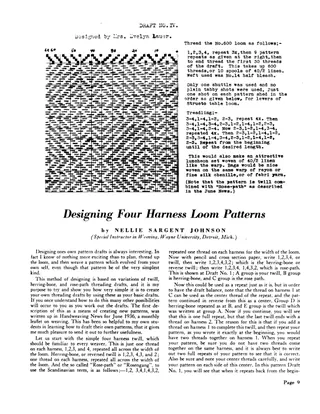
Nellie Sargent Johnson explains a method for designing four-harness threading drafts by combining and varying three basic threadings: twill, herringbone (reversed twill) and rose-path. She covers balancing a draft around center threads, avoiding doubled threads on one harness when repeating, and building pattern blocks of different sizes, with odd-numbered blocks at the reversal point. Draft examples designed by her students Evelyn Lauer and Marie Copland (Hearts and Flowers, Snow-Flake, Electric Light/Copland's Fancy) are given with threading, lever/treadling directions for a Structo loom, and suggested uses and yarns.
Designing New Fabrics A Short Cut
Master Weaver, November 1956
Article · 2 pages · weaving drafts
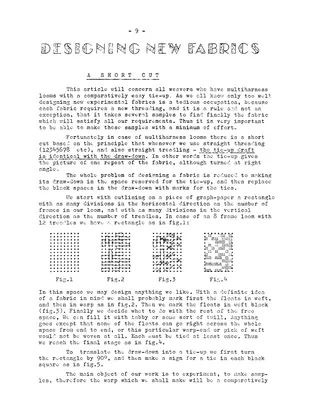
A short two-page article from Master Weaver explaining a shortcut for designing experimental fabrics on multiharness looms with straight threading and straight treadling. In that case the tie-up is identical to the draw-down, turned 90 degrees, so the weaver designs the cloth directly in the tie-up space. It walks through the steps on an 8-frame, 12-treadle loom, then shows 12-frame, 16-treadle examples (diamond twill, waffle, texture, a turned twill pattern weave, and a tabby-rich weave) with suggested uses. It also gives sampling advice and notes the method's limits for larger projects.
Drafting Problem Patterns, Part 2: Thread Colors
Ralph E. Griswold · September 11, 2004
Web Doc · 3 pages · weaving drafts
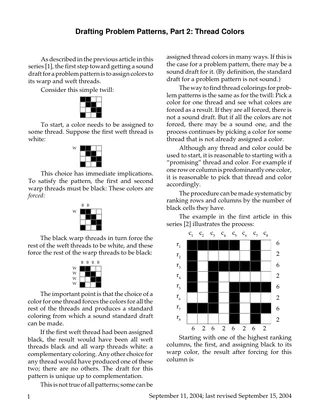
Second article in Ralph Griswold's series on drafting problem patterns, explaining how to assign colors (black or white) to warp and weft threads as the first step toward a sound draft. It shows with a simple twill that choosing one thread color forces all the others, giving a unique standard or complementary coloring. It then uses an 8x8 example from an earlier article to show a systematic procedure that ranks rows and columns by their number of black cells and picks a starting thread. The article ends by leading into the next part, which will build a sound draft from nonstandard colorings.
Drafting Problem Patterns, Part 3: Interlacement Basics
Ralph E. Griswold · September 15, 2004
Web Doc · 3 pages
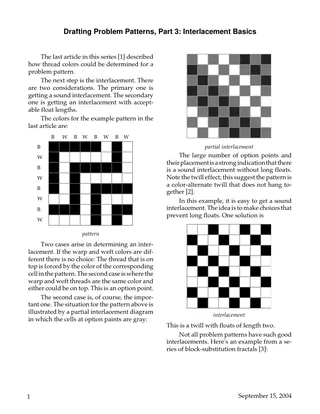
Third article in Ralph Griswold's series on drafting problem patterns, covering how to turn a two-color pattern with assigned thread colors into a sound interlacement. It explains forced cells versus option points where warp and weft share a color, and shows how to choose options to avoid long floats. Worked examples include a color-alternate twill with floats of length two and a block-substitution fractal where a float of length eight is unavoidable. It closes by noting that hand work is tedious and that a program-based method will be the next article's topic.
Drawing in the Warp in its Harness
Article · 1 page · weaving drafts
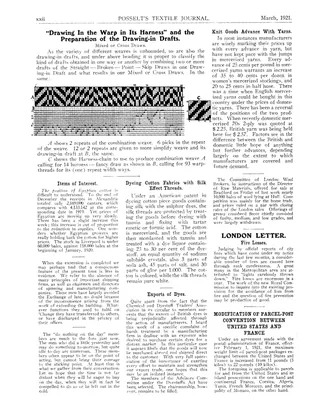
A single page from Posselt's Textile Journal, March 1921, continuing the series on drawing-in drafts with a section on Mixed or Cross Draws, which combine straight, broken, point and skip draws. A figure shows a combination weave, its drawing-in draft (93 warp threads, 14 harness) and the harness chain. The rest of the page is trade news: Egyptian cotton supplies, dyeing cotton fabrics with silk effect threads, dye exports, knit goods and yarn prices, a London letter on fire losses, and a US-France parcel-post change.
Handweaving News (January 1947): Weaving on the Hearthside Table LoomaTwo Block "5 and 1"" and "7 and 1" Threading Drafts
Periodical · 2 pages · weaving drafts
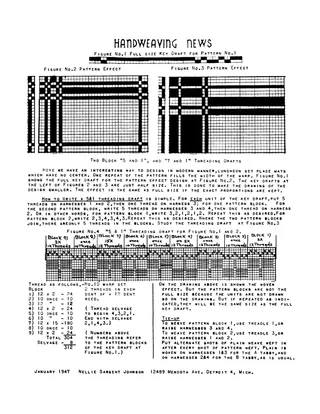
A two-page January 1947 Handweaving News leaflet by Nellie Sargent Johnson on designing two-block threading drafts for a four-harness table loom, for modern luncheon place mats with no center motif. It explains how to build "5 and 1" and "7 and 1" threading drafts from a key draft, with block-by-block thread counts, tie-up, treadling and plain-weave tabby sequence. It also gives sett and warp suggestions (20/2 cotton, 15-dent reed, 419 threads) and notes on planning block lengths in inches.
Interpreting Professional Drafts
Article · 6 pages · weaving drafts
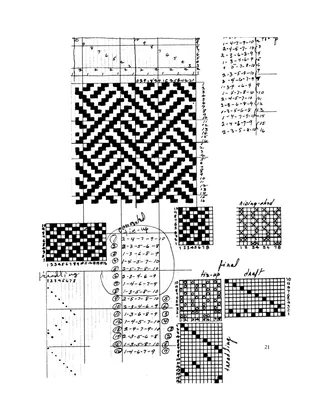
An article from the Shuttle-Craft Bulletin explaining how multiple-harness handweavers can read the square-diagram draft notation used in professional and industrial weaving books. It walks through finding the repeat, numbering threads and shots, reading the tie-up, and converting a sinking-shed tie-up to a rising-shed one, using a worked example of a 10-harness braided twill from Hauptmann. Further figures interpret sample diagrams from Oelsner, Poma, Strong and Watson, including fancy, broken, uneven, combination and waffle weave twills.
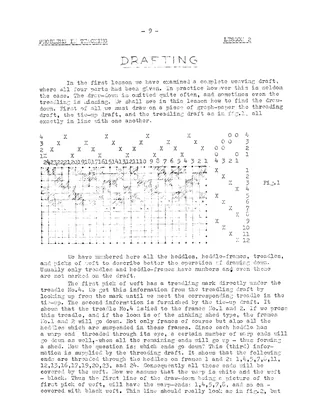
Problems in Teaching 2 - Drafting
Master Weaver, May 1954
Article · 3 pages · weaving drafts
Lesson 2 of the series "Problems in Teaching" explains how to make a draw-down from the threading, tie-up and treadling drafts. It gives a step-by-step reading of a four-frame draft pick by pick, and suggests a paper-strip exercise to help students connect the draft to the cloth on the loom. The issue also has a short section on waffle weaves (honeycomb), covering single and double waffles, single and double face, four- and five-frame drafts, and huckaback-based threadings.
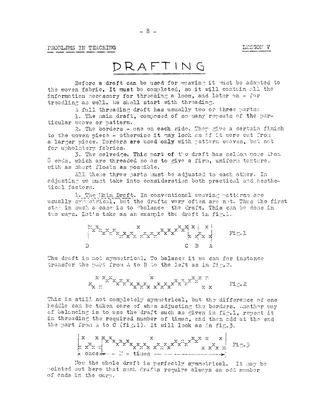
Problems in Teaching 5 - Drafting
Master Weaver, November 1954
Article · 2 pages · weaving drafts
A two-page lesson from the series 'Problems in Teaching' (Lesson V) explaining how to complete a threading draft for a four-shaft loom. It covers balancing an asymmetrical main draft, fitting the repeats to the fabric width, and designing and adjusting borders and selvedges so the design continues and tabby order is kept. A worked example (40-inch linen at 30 ends per inch, 1260 ends) is assembled into a full draft and checked by counting ends.
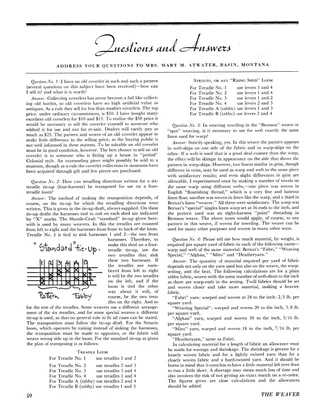
Questions and Answers
Article · 1 page · weaving drafts
A one-page question-and-answer column by Mary M. Atwater from The Weaver, 1936. It covers four reader questions: the selling price of old coverlets, transposing six-treadle tie-up directions to a four-treadle loom (with a conversion table for treadle and rising-shed looms), whether Bronson (spot) weave toweling needs weft identical to the linen warp, and yarn quantities per square yard of plain tabby fabric for several Bernat yarns.
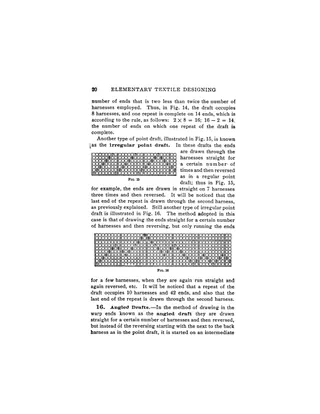
Elementary Textile Designing
Monograph · 31 pages · weaving drafts
An International Correspondence Schools instruction paper (Serial 502) introducing the fundamentals of textile designing for woven fabrics. It explains warp and filling, plain weave, design paper, and how to indicate a weave on it, then covers harness (drawing-in) drafts, chain (pegging) drafts, and the effect of the weave on the cloth. Standard draft types (straight, point, irregular point, angled, skip, satin, section) are described with numbered figures, followed by how harness and chain drafts combine to produce the woven effect and practical points for constructing harness drafts. Practice exercises are included.
The Logic of Tie-ups
Master Weaver, April 1952
Article · 3 pages · weaving drafts
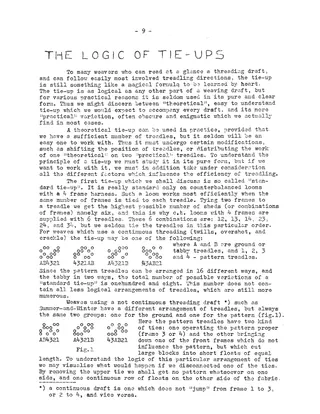
A short article from Master Weaver explaining the tie-up as a logical part of a weaving draft, distinguishing the "theoretical" tie-up from the "practical" one actually used. It covers standard tie-ups for counterbalanced four-harness looms, the three-part tie-up of spot weaves such as Summer and Winter, and tie-ups for diamond twills, turned twills and four-block double weave. It ends with how tie-ups are rearranged when a loom has too few treadles. Illustrated throughout with tie-up diagrams.
Master Weaver, No. 22 (July 1955)
Periodical · 14 pages · weaving drafts
Issue No. 22 (July 1955) of Master Weaver, a bulletin for handweavers published by Z-Handicrafts of Fulford, Quebec. It opens with an essay on colour and design, arguing that creative weaving requires knowledge of the craft, and a short 1844 quotation from Clinton G. Gilroy. The technical sections explain transcribing four- and five-frame drafts onto eight frames (Bronson, summer and winter, rep, diamond twill, waffle), give a chart of basic eight-frame tie-ups A to W, and present Lesson 9 on drafting from profiles using units of weaves such as summer and winter, huckaback, Bronson lace, dimity, dornick and damask. The last page advertises individual weaving lessons at Z-Handicrafts.
Patterns in Warp
Master Weaver, November 1955
Article · 1 page · weaving drafts
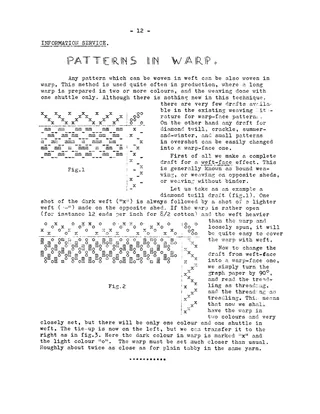
A one-page article from the Master Weaver information service explaining how to convert weft-face (bound weaving) drafts into warp-face pattern drafts. The method is to turn the graph paper 90 degrees and read threading as treadling and the reverse. It uses a diamond twill example with x and o marks for dark and light yarns, and notes that the warp must be set about twice as close as for plain tabby. Figures show the weft-face drafts with tie-ups.
Problems in Teaching 7 - Drafting
Master Weaver, March 1955
Article · 2 pages · weaving drafts
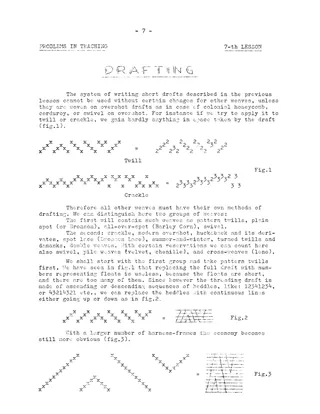
A lesson from the Master Weaver series on writing short drafts for weaves other than overshot. It explains why the number-based shorthand fails for twill and crackle, then groups weaves by suitable notation. It shows continuous diagonal lines for pattern and turned twills, and a continuous line for frame 1 in spot weaves and swivel, with numbers replacing x marks. It also mentions a third system that shows float lengths for analysis.
Warp & Weft, Vol. 4, No. 1 (November 1950)
November 1950
Periodical · 8 pages · weaving drafts
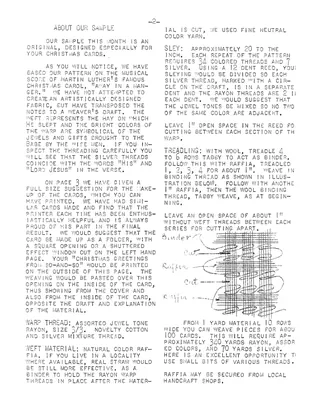
November 1950 issue (Vol. 4, No. 1) of Warp & Weft, a monthly bulletin published by the Norwood Loom Company of Chicago and edited by Gladys Rogers Brophil. The monthly sample is a Christmas card fabric whose four-shaft draft is transposed from the notes of the carol 'Away in a Manger', woven with rayon warp and raffia weft, with instructions for sleying, treadling and mounting cards. Other items include a feature on weaving and music with ten tips for developing weaving rhythm, guild and exhibit news, an editorial, a review of Paul Rodier's 'The Romance of French Weaving', the folk song 'Weave the Wadmal', a note on handwoven hats, and a Christmas order coupon for weaving supplies.
Combination Weaves
Monograph · 27 pages · weaving drafts
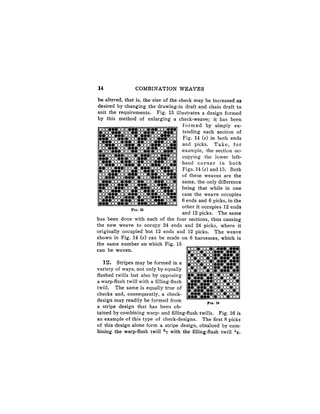
An International Correspondence Schools instruction paper on building new fabric designs by joining whole repeats of different weaves. It explains how weaves must be matched in interlacing so they weave evenly and how to make them 'cut' where they join. It then covers stripe weaves from warp- and filling-flush twills and satins, single-end stripes, and check-weaves made by extending stripes, reversing or transposing a weave, or combining weaves of different structure. The last sections cover weaves built from motives and the four-change method of originating weaves, with drafts, drawing-in drafts and practice examples throughout.
Master Weaver, No. 17 (September 1954)
Periodical · 13 pages · weaving drafts
An issue of Master Weaver, a bulletin for handweavers published by Z-Handicrafts in Fulford, Quebec. It contains an editorial against advertising that calls weaving easy, an article on weaving coded messages using block patterns, and a piece on three-dimensional texture weaving with irregular yarn mixes, mixed-weave drafts and chenille. It also includes a teaching lesson on drafting symmetrical treadling variations (the 'rose' variation) and an article on Hälkrus (lacey weave or colonial honeycomb), with drafts and drawdowns.
Master Weaver, No. 26 (March 1956)
Periodical · 14 pages · weaving drafts
Issue No. 26 (March 1956) of Master Weaver, a bi-monthly bulletin published by Z-Handicrafts of Fulford, Quebec. It explains how to build 'accidental' drafts from random number sequences (cards, telephone directories, dice) and how to check them for long floats, and gives a coat-length project in wool. Other articles cover drafting 3-block patterns from 2-block variations (Lesson 12), multiple and mixed warps (finding average yarn count for sett, tension boxes, warping, beaming and sleying), and mock leno woven on huckaback lace. The issue also carries an ad for individual weaving lessons and an editor's note.
Problems in Teaching 8 - Drafting
Master Weaver, May 1955
Article · 2 pages · weaving drafts
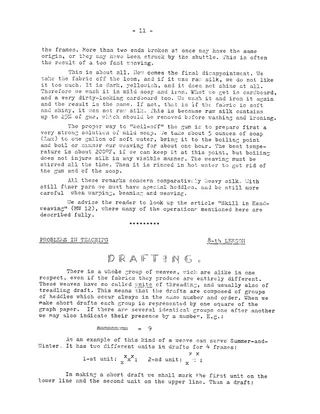
A two-page lesson from the Master Weaver series "Problems in Teaching," on drafting with units of threading. It explains graphical short drafts (profiles) and numerical short drafts, using Summer-and-Winter as the example, then shows one profile developed into Bronson Lace and Huckaback lace. The first page also closes an earlier article with advice on boiling off the gum from raw silk fabric after weaving.
Transposing Warp and Weft
Article · 6 pages · weaving drafts
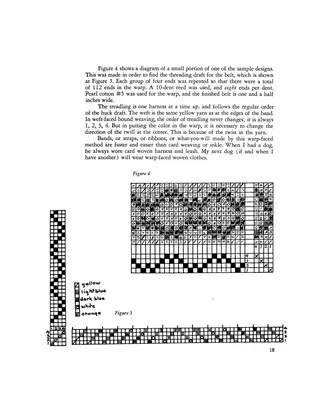
Berta Frey describes the weaver's trick of transposing threading and treadling drafts, so that a draft turned on its side gives the same cloth. She uses it to sample colored warps on a weft-yarn sample loom and to weave warp-faced bands and belts on huck threading in place of slow weft-faced bound weaving. Samples give yarns, colors, sett and the 112-end belt warp, with drafts and photographs of the samples. A short author biography closes the piece.
Drafts for 8 Frames
Master Weaver, July 1955
Article · 4 pages · weaving drafts
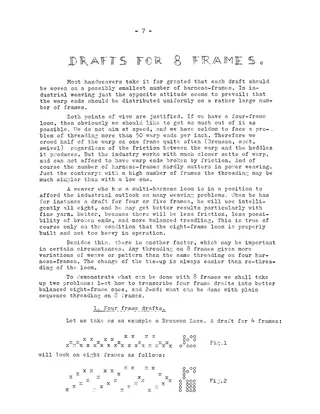
An article from Master Weaver arguing that handweavers with eight-shaft looms should transcribe four- and five-frame drafts onto eight frames. Spreading the warp over more frames reduces friction and broken ends, especially with high setts, and gives more variation through changes of tie-up. It shows conversions of Bronson lace, summer and winter, and two-block rep, plus eight-frame versions of five-frame diamond twills and waffle weave. The last page gives 22 basic tie-ups (A-W) for plain-sequence threading on 8 frames, covering tabby, basket weaves, many twill ratios, and others.
November, 1913
Article · 3 pages · weaving drafts
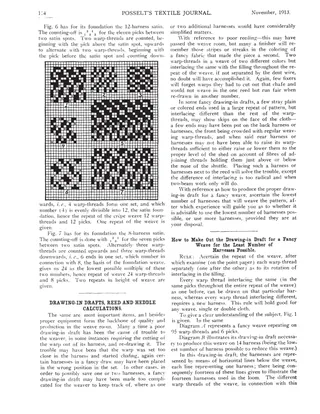
Three pages from the November 1913 issue of Posselt's Textile Journal. They finish a discussion of satin-based crêpe weaves (12- and 8-harness foundations), then explain how to make out drawing-in drafts for fancy weaves using the fewest harnesses, with reed and heddle considerations. They also cover the harness chain, calculating heddles per harness (worked example with 5700 ends and a 95-end repeat), and drafting on point paper. A short item by E. R. Darling on a para-nitraniline test distinguishing jute from hemp closes the scan.
Short Drafts
Master Weaver, June 1952
Article · 3 pages · weaving drafts
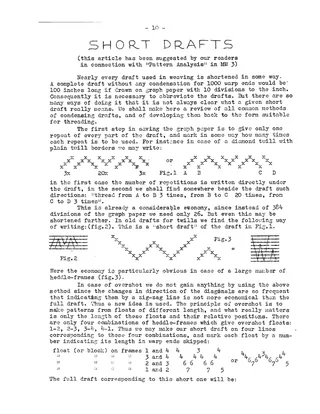
An article reviewing the common methods of condensing weaving drafts and expanding them back into full threading drafts. It covers repeat markings for twills, short drafts for overshot that record float lengths, spot weaves, and unit-based weaves (summer and winter, crackle, lace, huckaback, turned twills, double weave) using profile or numerical short drafts. Diagrams illustrate each method, and the article ends with a pointer to Mary Atwater's Shuttlecraft Book.
Weaving on Paper or Draw-Down Made Easy
Henry A. Hoffman · 1959
Monograph · 17 pages · weaving drafts
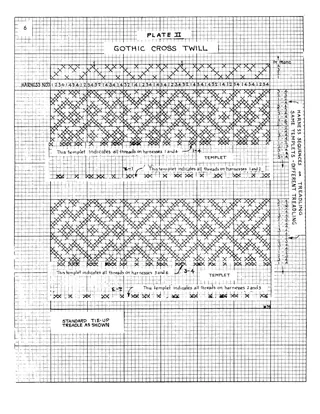
A 1959 monograph by Henry A. Hoffman presenting a method of developing weaving drafts (draw-downs) on cross-section paper using templets, or miniature harnesses, in place of laborious symbol-by-symbol drawing. It explains the layout, how treadling sequences are listed (including the 'as drawn in' rule for overshot), and how templets are made and used. Nine plates give worked examples in twill, overshot, dornik herringbone twill, summer and winter, crackle, Bronson weave, Ms and Os, and an original miniature overshot, 'Kansas Centennial'.
Construction of Weaves, No. 6
Monograph · 30 pages · weaving drafts
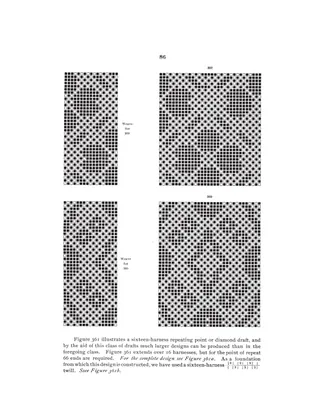
Part No. 6 of Charles G. Petzold's serial textbook on the construction of weaves for textile schools, designers, overseers and loom fixers. It covers drafting and the reduced draft, classes of drafts (straight, point or diamond, broken, stepping-up, section, two-division, irregular and mixed), and calculating harness eyes per inch. It also gives a tartan plaid dressing plan and the construction of checkerboard, ray-like and honeycomb weaves from twill, sateen, rep and basket foundations. Most pages carry numbered drawdown figures (about 347 to 450), and the issue includes advertisements for Lawrence, Mass. loom and mill suppliers.
Draught and Cording
Rees's Cyclopedia, 1819
Article · 5 pages · weaving drafts
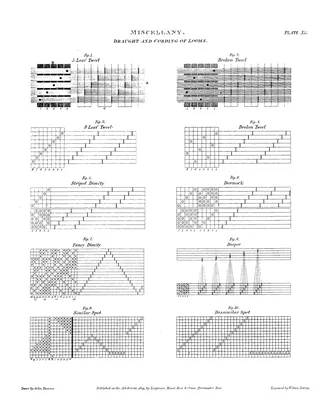
An encyclopedia article from Rees's Cyclopedia explaining draught (the order of drawing warp threads through heddles) and cording (tying leaves to treddles) for looms. It describes how plans are drawn and read, then works through ten figures: five- and eight-leaf tweel and broken tweel, striped dimity, dornock, fancy dimity, diaper mounting, and similar and dissimilar spots. The last page is Plate XII, with the draught and cording diagrams for these figures.
Cyclopedia of Textile Work, Vol. 3
Book · 358 pages · weaving drafts
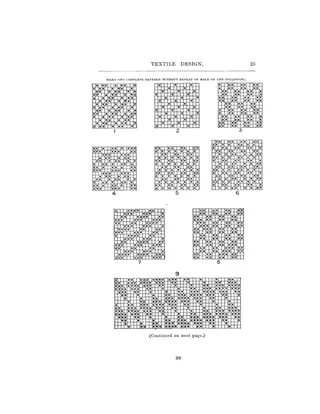
Volume 3 of the seven-volume Cyclopedia of Textile Work (American Technical Society, 1913), made up of instruction papers on textile design with a closing section on textile coloring and a long section on cost finding in cotton mills. The design parts cover plain weave, twills, sateens, ribs, basket and corkscrew weaves, backed cloths, double and triple cloths, pile fabrics (plush, velvet, chinchilla), piqué, gauze and leno. They include drafting, chain plans, point-paper exercises, design paper ruling and review questions. The volume is heavily illustrated with draft and drawdown grids, loom and Jacquard machine photographs, and cost tables for cheviot, print cloth and madras.
Design Texts.
Book · 250 pages · weaving drafts
A 1910 textbook on textile design and fabric construction for weavers and mill students, by Fenwick Umpleby. It begins with the hand loom, harness, heddles and design paper, then covers twills, cut weaves, drafting and reduction, rib, basket, sateen, corkscrew and fancy weaves, and diaper and point draws. Later sections give lectures on color, numbered design problems with thread and pick sections, and yarn counts, reed and sett, and cloth analysis calculations. The book ends with plates of standard weaves for 3 to 12 harnesses and has many drawdowns and review questions.
An Introduction to the Study of Textile Design
Book · 282 pages · weaving drafts
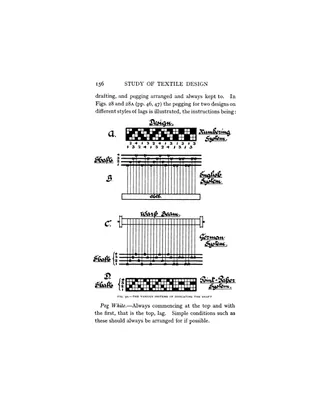
A 1903 technical college textbook on textile design and cloth construction by the head of textile industries at Bradford Municipal Technical College. It covers simple interlacings and drawing flat views and sections, warp preparation, drawing-in and sleying, hand, dobby and power looms, yarn counts and cloth setting calculations, and the designing of weaves on point-paper. Further chapters treat twills, sateens, drafting and pegging plans, colour-and-weave effects, backed and double cloths, lustre goods, and yarn and cloth calculations, with design sheets, plates and photographs throughout. The scan ends with a publisher's catalogue.
Textile Design
Book · 346 pages · weaving drafts
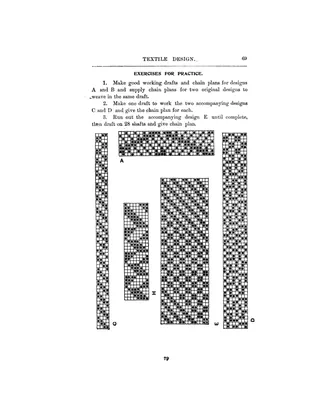
A 1909 correspondence-school manual on textile design by Fenwick Umpleby of the Lowell Textile School. It runs from design paper, drafting and plain cloth through twills, sateens, rib and basket weaves, backed cloths, double and triple cloths, pile/plush, piqué, Jacquard designing, and gauze and leno. It closes with sections on textile coloring and on mill cost finding. The book has many weave plans and drafts, practice exercises, and loom illustrations.
Analysis of Fabrics
Master Weaver, February 1952
Article · 3 pages · weaving drafts
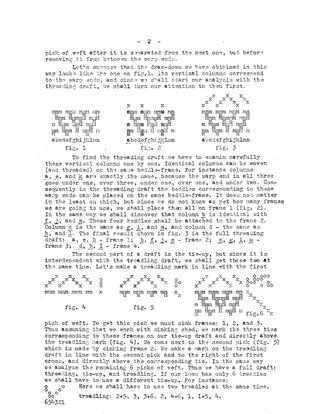
An article from Master Weaver (Z-Handicrafts, Fulford, Quebec) explaining how a handweaver analyses a single-layer fabric sample. It describes marking one repeat, making a draw-down on graph paper, identifying identical warp columns to derive the threading, and deriving the tie-up and treadling together. It also covers counting the frames needed, rearranging threading and tie-up into standard forms, and recording yarn and finishing data. Illustrated with draw-down and draft figures; it closes by announcing follow-up articles on short analysis and three-dimensional fabrics.
Crazy Twills
Master Weaver, March 1963
Article · 4 pages · weaving drafts
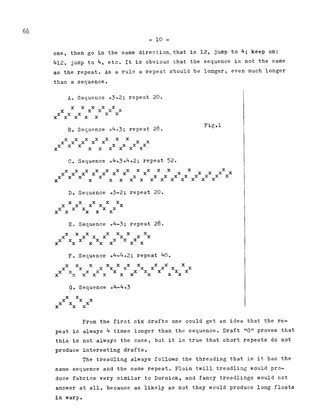
An article from Master Weaver on "crazy twills," four-shaft twills in which the diagonal is broken into short runs separated by gaps, producing irregular texture and pattern that suggests many more shafts. It explains how to design them from a sequence of short diagonals (marked + or -) and a longer repeat, with threading diagrams for sequences A to G and draw-downs in Figs. 2 to 6. It also covers treadling (which follows the threading), the resulting fabric effects (wavy diagonals, arrowheads, distorted diamonds), and balanced sequences. It ends by promising a follow-up article on practical projects.
601 documents found