Drafting Problem Patterns, Part 3: Interlacement Basics
Sample pages
Page 1, at reduced quality. Open the document to read every page in full.
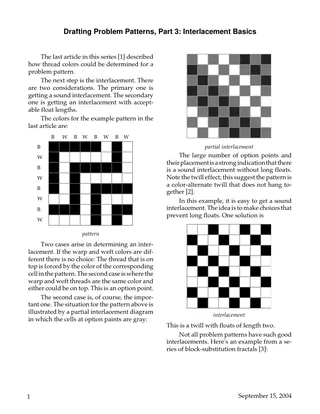
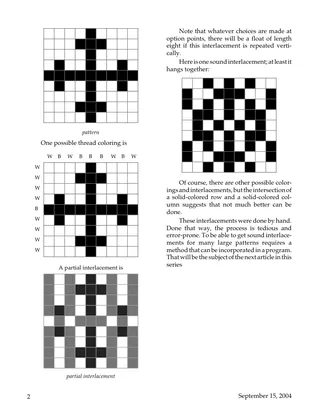
Third article in Ralph Griswold's series on drafting problem patterns, covering how to turn a two-color pattern with assigned thread colors into a sound interlacement. It explains forced cells versus option points where warp and weft share a color, and shows how to choose options to avoid long floats. Worked examples include a color-alternate twill with floats of length two and a block-substitution fractal where a float of length eight is unavoidable. It closes by noting that hand work is tedious and that a program-based method will be the next article's topic.
- Type
- Web Doc
- Date
- September 15, 2004
- Language
- English
- Pages
- 3
(A free account is all you need)
From Ralph Griswold's Digital Archive, delivered by the University of Arizona.
Have missing pages or a better copy of this document, or another document to share? Contributing documents »