Textile Documents › Topic: Twill
938 documents found
Sort: 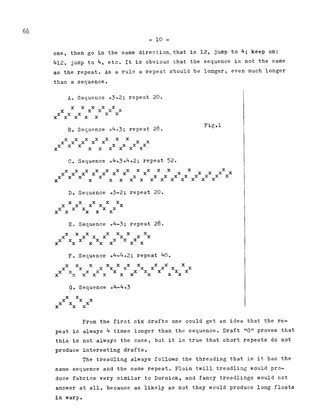
Crazy Twills
Master Weaver, March 1963
Article · 4 pages · weaving drafts
An article from Master Weaver on "crazy twills," four-shaft twills in which the diagonal is broken into short runs separated by gaps, producing irregular texture and pattern that suggests many more shafts. It explains how to design them from a sequence of short diagonals (marked + or -) and a longer repeat, with threading diagrams for sequences A to G and draw-downs in Figs. 2 to 6. It also covers treadling (which follows the threading), the resulting fabric effects (wavy diagonals, arrowheads, distorted diamonds), and balanced sequences. It ends by promising a follow-up article on practical projects.
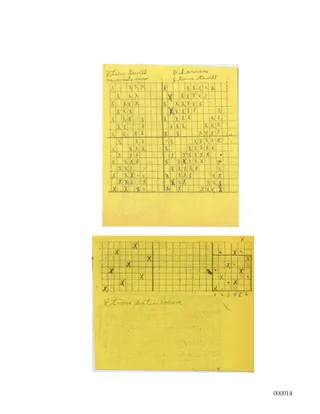
Handwritten drafts and notes
Ephemera · 5 pages · weaving drafts
Five handwritten sheets of weaving drafts on squared graph paper, marked with X grids. They include 8-shaft twill and satin drafts (labeled '8 twine twill' and '8 twine satin weave') and drawdowns with face/back (F/B) labels and lift-order number sequences. One page carries the note 'Thames section'. The notes are brief and appear to be a weaver's working drafts.
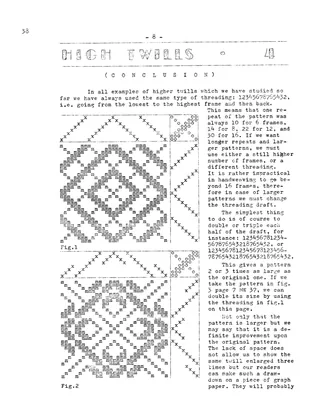
High Twills 4 (Conclusion)
Master Weaver, March 1958
Article · 2 pages · weaving drafts
Concluding installment of a series on higher twills, from Master Weaver no. 38. It explains how to enlarge twill patterns beyond the standard point threading on 6 to 16 shafts by doubling or tripling each half of the threading, repeating or reversing part of the draft, or breaking the threading order irregularly. Four drafts illustrate the options, and the text notes the limits of each method, including loss of tabby weaving.
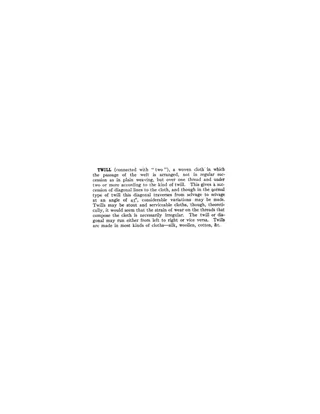
Twill
Article · 1 page
A short encyclopedia entry defining twill as a woven cloth in which the weft passes over one thread and under two or more, producing diagonal lines. It notes the normal 45-degree angle, possible variations, the left or right direction of the diagonal, and that twills are made in silk, wool, cotton and other fibers. It is a brief general definition with no drafts or technical detail.
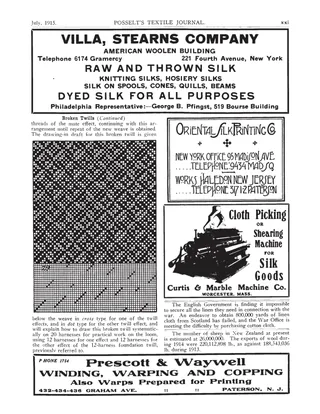
Broken Twills
Article · 1 page · weaving drafts
A single continued page of E. A. Posselt's "Broken Twills" from Posselt's Textile Journal, July 1915. It finishes explaining a broken twill built on a 12-harness foundation twill, with a large drawdown and a drawing-in draft marked in cross and dot type for the two twill effects, for working on 20 harnesses. The page is shared with advertisements and short news items on linen and cotton cloth for the English war effort and New Zealand wool exports.
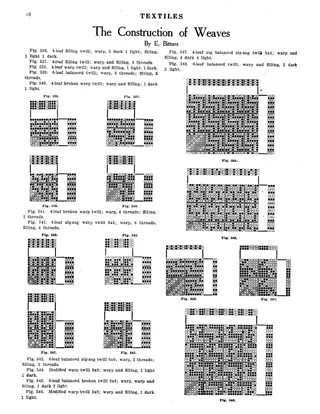
Construction of Weaves, Part 3
Article · 1 page · weaving drafts
A single page from E. Bittner's series on the construction of weaves, printed in Textiles. It presents weaving drafts for figures 536-548, each with threading, tie-up, treadling and drawdown, showing twill constructions in dark and light thread arrangements. Captions identify 4-leaf and 6-leaf filling, warp and balanced twills, broken twills, zig-zag twills and modified warp twills.
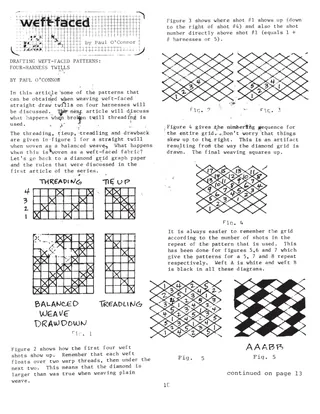
Drafting Weft-Faced Patterns: Four Harness Twills
Article · 2 pages · weaving drafts
Article in a series on drafting weft-faced patterns, covering straight-draw 2/2 twill threaded on four harnesses. It uses diamond grid graph paper to work out how weft shots appear, numbering the shots across the grid and showing 5-, 7- and 8-shot repeat patterns in two colors (white and black). It ends with a 12-shot sequence on a 12-shaft diagram, which is also shown as Plate 52 in Collingwood's book.
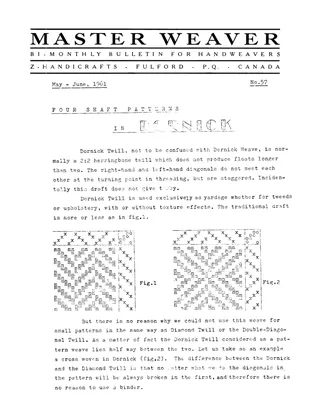
Four Shaft Patterns in Dornick
Master Weaver, May 1961
Article · 3 pages · weaving drafts
A short article from Master Weaver explaining Dornick twill as a four-shaft pattern weave. It distinguishes Dornick twill (a staggered 2:2 herringbone twill with floats no longer than two) from Dornick weave, and shows how to design small and large patterns by skipping a heddle at each turning point. It covers finding treadlings, correcting diamond proportions with weft, beat and sett, and ends with a practical upholstery project in mercerized cotton with warp and weft specifications.
Handweaving News (May 1943): An Experimental Sampler Using 8 Harness Twills
Periodical · 2 pages · weaving drafts
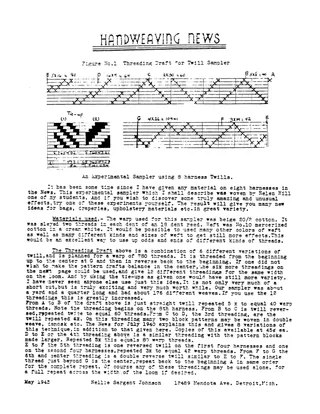
Nellie Sargent Johnson describes an experimental eight-harness twill sampler woven by her student Helen Hill, using 20/2 beige cotton warp sleyed at 2 per dent in an 18-dent reed, with No. 10 mercerized cotton weft. Page 1 gives a combined threading draft of six twill variations (780 warp threads, threaded to a center and reversed) and an explanation of each section. Page 2 offers six more threading drafts, giving 12 alternative threadings, plus fourteen numbered tie-ups and an explanation of how to read them for Structo, jack, and rising-shed looms. The sampler produced about 176 different weaves.
Handweaving News (November 1945): Some Six Harness Twills
Periodical · 2 pages · weaving drafts
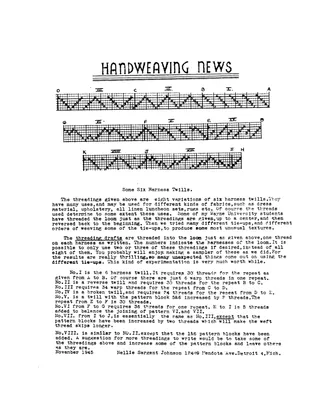
A two-page article by Nellie Sargent Johnson presenting eight six-harness twill threading variations (Nos. I-VIII, marked A through K), with the thread count for each repeat. It suggests sampler warps and wefts, with sett recommendations for carpet warp and 20/2 cotton. The second page explains six-harness tie-up drafts, including single-harness, two-harness and plain weave tie-ups, and four treadling orders for one tie-up.
Problems in Twills 1 - High Twills
Master Weaver, July 1957
Article · 3 pages · weaving drafts
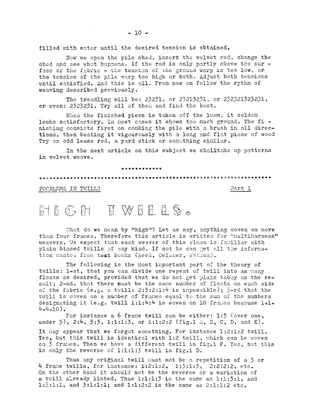
First article in a series on twills from Master Weaver, dealing with 'high' twills woven on more than four shafts. It explains the rules for dividing a twill repeat into floats, listing the distinct six-shaft twills (1:5, 2:4, 3:3, 1:1:1:3, 1:1:2:2) and excluding repeats or reverses of smaller twills. It then gives rules for designing symmetrical pattern twills (threading, treadling, tie-up diagonal) and discusses which twills can be woven 'as drawn in' symmetrically, illustrated with diagrams in Figs. 1-3.
A Study in Weave Formation
Article · 2 pages · weaving drafts
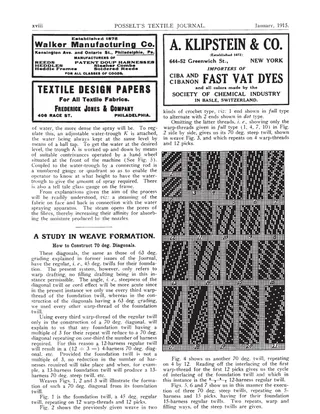
A two-page article from Posselt's Textile Journal, January 1915, explaining how to construct 70-degree steep diagonal twills from regular 45-degree foundation twills by using every third warp thread. It works through examples with weave drawdowns (Figs. 1-29), giving repeat sizes from 4 by 12 up to 16 by 48 and the harness reductions that result when the foundation twill repeat is a multiple of 3.
A Study in Weave Formation
Article · 2 pages · weaving drafts
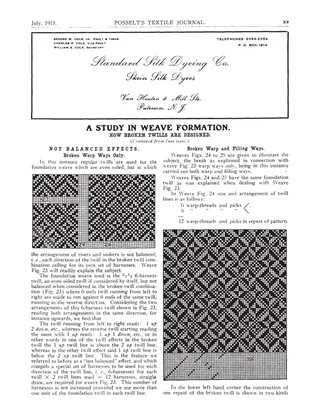
Two journal pages from a continuing series in Posselt's Textile Journal (July 1915) on how broken twills are designed. They cover unbalanced broken twills, where each twill direction needs its own set of harnesses, and breaks carried out both warp and filling ways. Worked examples (Figs. 23-29) use 6-, 8-, 10- and 12-harness foundation twills, with repeat sizes, drafting sequences and drawing-in drafts for up to 20 harnesses. The pages also carry advertisements from textile suppliers.
A Study in Weave Formation: How to Construct Diagonals
Article · 2 pages · weaving drafts
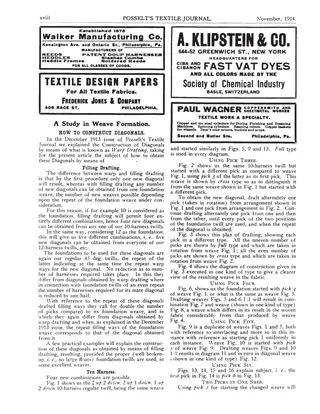
An installment from Posselt's Textile Journal explaining how to construct diagonal weaves by filling drafting, as a follow-up to a December 1913 article on warp drafting. Using 10-harness regular twills as foundations, it shows how alternating picks from two starting positions of the twill yields four new diagonals, with figures of the drafts and resulting weaves. It then summarizes the 12-harness case, which gives five diagonals per foundation twill. The pages also carry short trade notes on cotton lustre, moth-proofing and wartime export restrictions, plus advertisements.
Swatch Page - Sixteen Harness Point Twills
Article · 1 page · weaving drafts
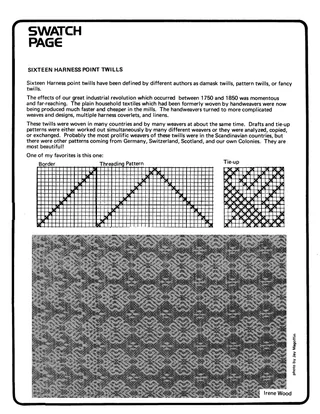
A one-page Swatch Page from Minnesota Weaver in which Irene Wood introduces sixteen-harness point twills, also called damask, pattern, or fancy twills. She briefly links their popularity to handweavers turning to complex weaves after the Industrial Revolution and notes their spread across Scandinavia, Germany, Switzerland, Scotland, and the American Colonies. It includes a threading draft with border, a tie-up, and a photograph of the woven swatch.
Turned Twills 2 - The Tie-up
Master Weaver, July 1959
Article · 3 pages · weaving drafts
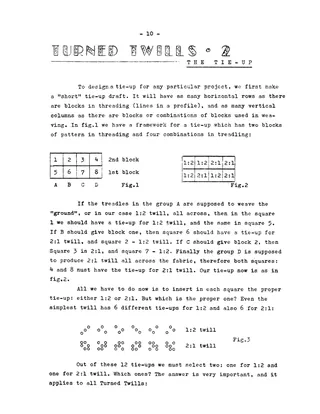
Second article in a Master Weaver series on turned twills, focusing on how to design the tie-up. It explains making a short tie-up draft from the pattern profile, choosing matching pairs of 1:2 and 2:1 twill tie-ups (and 1:3, 1:4, 1:5), and exchanging vertical lines of ties to derive alternatives. It ends with limits on the number of blocks and treadles possible on 8-, 12- and 16-shaft looms.
Twill Counters
Ralph E. Griswold · May 16, 2002
Web Doc · 4 pages
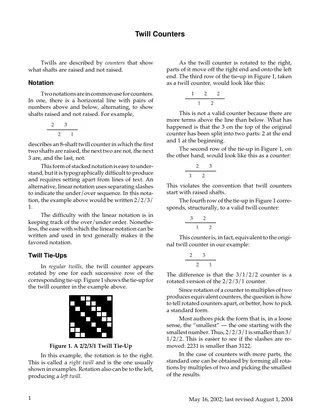
A short mathematical essay by Ralph Griswold on twill counters, the notation that describes which shafts are raised and not raised in a twill. It explains stacked and linear (slash) notation, how counters relate to twill tie-ups through rotation, and how to choose a standard form. It then presents a method for enumerating counters by treating them as compositions with an even number of terms, encoded as bit patterns, and distinguishes proper from inherited counters. A table gives counts of twill counters for 2 to 20 shafts.
Twills - 1
Master Weaver, January 1963
Article · 4 pages · weaving drafts
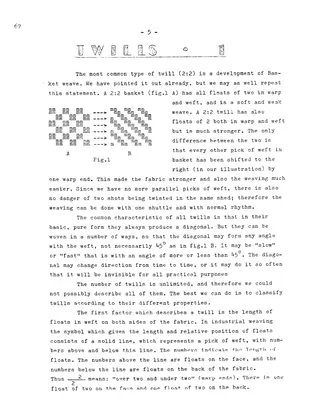
First article in a series on twills from Master Weaver, No. 67. It explains how 2:2 twill develops from 2:2 basket weave and describes the notation for float lengths (2/2, 3:1:1:2). It also covers twill classes: balanced, biased, reversible, warp-face and weft-face, and LH and RH diagonals. It lists reversible and non-reversible twills up to 8 shafts, warns about false twills, and suggests drawing down the listed twills as an exercise.
16-Harness Patterns: The Fanciest Twills of All
Ralph E. Griswold · October 22, 2004
Web Doc · 12 pages · weaving drafts
A browsing catalog of 16-harness twill patterns from Irene K. Wood's book 16 Harness Patterns: The Fanciest Twills of All, which reproduces patterns from the weaving notebooks of Fred A. Pennington. Ralph Griswold derived small black-and-white drawdown images from the WIFs digitized by Kris Bruland and posted on handweaving.net. The patterns are arranged by size, width first, and each is labeled with the number of its WIF file (e.g. 34686 for 34686.wif). A few duplicate patterns are included.
Again the Twill Weave
Article · 4 pages · weaving drafts
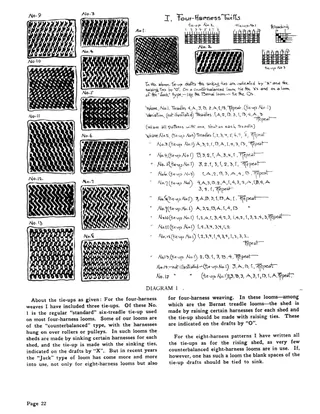
Mary M. Atwater's second Weaver article on twills presents a selection of fancy twill patterns for four and eight harnesses. It gives threading and tie-up drafts with treadling sequences for 15 four-harness and 23 eight-harness patterns, with drawdown swatches and a few woven samples. The text comments on the suitability of individual patterns for suitings, coats, blankets and afghans, how they look on the wrong side, and how to tie up counterbalanced versus jack looms.
Another Texture Weave
Master Weaver, November 1957
Article · 3 pages · weaving drafts
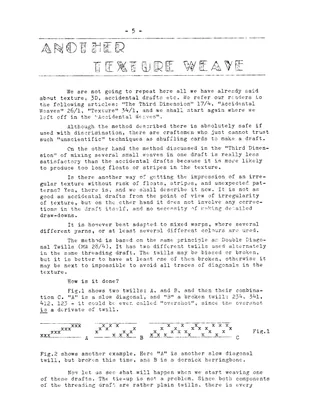
A short article from Master Weaver describing a method of producing an irregular, textured (3D) fabric surface by alternating two twill threadings, at least one of them broken, in a single draft. It gives example threadings and two draw-downs with different treadlings, and explains how mixed warp colors or yarns, with a warping repeat that does not divide evenly into the threading repeat, lengthen the effective texture repeat. It includes a table of recommended threading and warping repeat combinations and a practical project for a mercerized cotton upholstery fabric with warp colors, sett, threading and treadling.
Broken Twills
Article · 1 page · weaving drafts
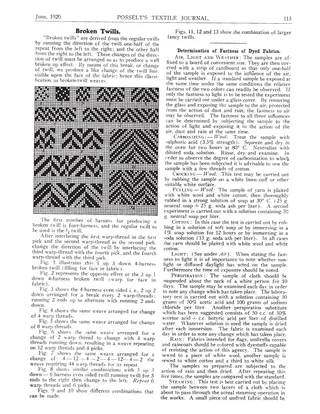
A one-page article from Posselt's Textile Journal explaining broken twills, which are derived from regular twills by reversing the twill direction partway through the repeat so the twill line breaks up. It starts with the 4-harness 1/3 broken twill and works through Figs. 1-13, including 2/2 and 3/3 even-sided twills with breaks every 2, 4 or 8 threads, and larger fancy combinations, illustrated with a drawdown grid. The page also begins a separate piece on testing the fastness of dyed fabrics to air, light, weather, carbonizing, crocking, fulling, perspiration, rain and steaming.
Code Drafting: Part 6 -- Point Twills
Ralph E. Griswold · March 13, 2004
Web Doc · 3 pages · weaving drafts
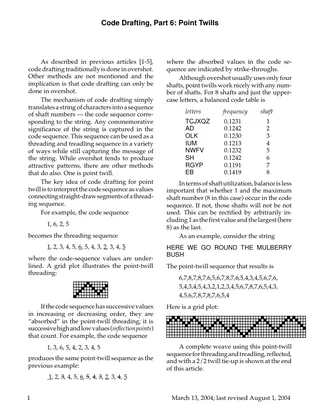
Part 6 of Ralph Griswold's Code Drafting series applies code drafting, which turns a text string into a sequence of shaft numbers, to point twills instead of overshot. Code-sequence values are treated as inflection points joined by straight-draw runs in the threading, and values that continue an ascending or descending run are absorbed. The article gives an 8-shaft balanced code table for uppercase letters and works through the example 'HERE WE GO ROUND THE MULBERRY BUSH'. It ends with a drawdown of that example, threaded and treadled with the point-twill sequence, reflected, with a 2/2 twill tie-up.
The Construction of Curved Twills
Article · 2 pages · weaving drafts
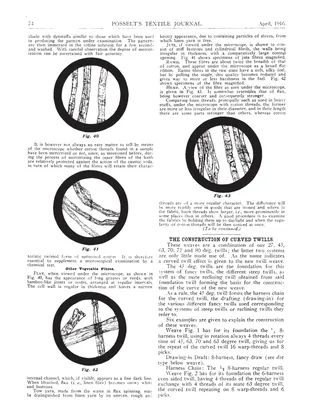
A two-page article from Posselt's Textile Journal (April 1916) explaining how curved twills are constructed by combining 27, 45, 63, 70 and 75 degree twills over a 45 degree foundation twill. Six examples (Figs. 1-6) give fancy drawing-in drafts, harness chains and repeat sizes on 5-, 6-, 8- and 10-harness twills, including broken curved twills, with a drawdown for Fig. 6. The first page also carries the end of a preceding article on microscopic identification of flax, jute, ramie and hemp fibres and the detection of mercerized cotton. A design for a grass rug from the Waite Grass Carpet Co. of Oshkosh, Wisconsin, appears at the end.
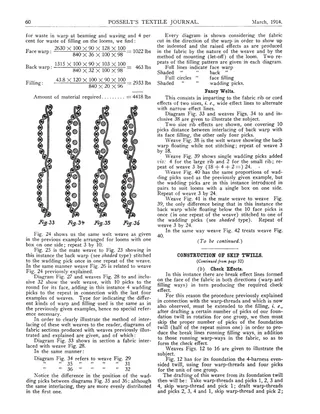
Construction of Skip Twills
Article · 2 pages · weaving drafts
Two pages from a continuing series in Posselt's Textile Journal on the construction of skip twills. The check-effects section explains how to draft skip twills from 4-, 6- and 10-harness even-sided foundation twills, skipping ends and picks to make break lines in both warp and filling directions (Figs. 12-16). Fig. 16 is worked out as a broken-effect skip twill of 78 ends, with its construction draft. The first page also ends an installment on welt weaves, with wadding picks, fancy welts and fabric-section diagrams (Figs. 24-42) and a material-quantity calculation. The second page closes with a short note on cotton spinning in Japan.
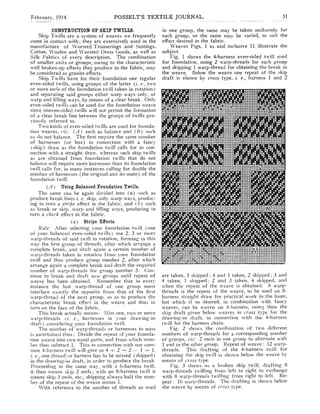
Construction of Skip twills
Article · 2 pages · weaving drafts
Part of a serial article from Posselt's Textile Journal explaining how skip twills are constructed from even-sided foundation twills. It gives the rule for choosing groups of warp threads and for working out how many harnesses to skip, and describes Figs. 1-11 (4-, 6- and 10-harness foundations, with stripe effects, alternating group sizes and broken skip twills). The second page also begins a separate article on Jacquard point-paper designing, with a diagram of the straight-through tie-up of a 400 Jacquard machine.
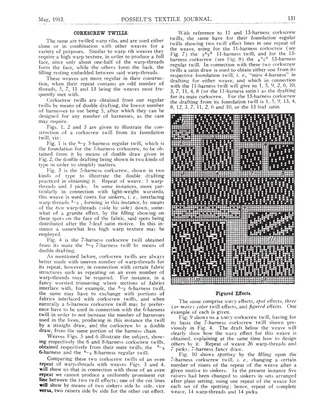
Corkscrew Twills
Article · 2 pages · weaving drafts
An article from Posselt's Textile Journal explaining corkscrew twills, which are twilled warp ribs made from regular twills by double drafting. It covers 5, 6, 7, 8, 11 and 13-harness examples and their drafting orders, then shows wavy, spot, three-color and figured corkscrew effects (Figs. 9-12) with a page of weave diagrams. The scan also includes the start of an unrelated article on faults in dyeing and how to correct them, including stripping and re-dyeing of vegetable fibres, wool and silk.
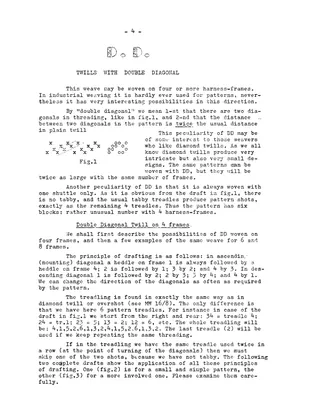
D.D. Twills with Double Diagonal
Master Weaver, July 1956
Article · 5 pages · weaving drafts
An article from Master Weaver explaining double diagonal (DD) twills, in which the threading has two diagonals and the spacing between diagonals in the pattern is twice that of plain twill. It covers drafting rules and treadling for 4 frames, then variations for 6 and 8 frames, tie-up options, and the lack of tabby. Treadling suggestions and two practical projects (upholstery on 4 frames, curtains on 8 frames) with sett, reed and yarn details are included, along with advice on combining treadles on a direct tie-up.
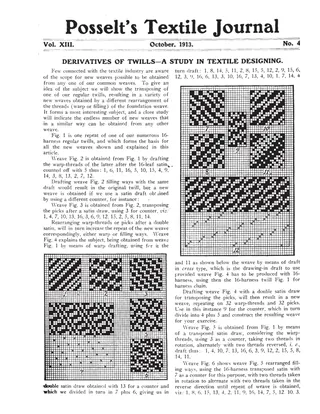
Derivatives of Twills -- A Study in Textile Designing
Article · 2 pages · weaving drafts
An article from Posselt's Textile Journal explaining how new weaves can be derived from a single 16-harness regular twill by rearranging its warp threads or picks. It gives thirteen numbered weave diagrams with drafting orders based on satin counters, double satin draws, transposed satins, and sets of threads, along with cross-type drawing-in drafts. The scan ends with the opening of an unrelated piece on increasing the figuring capacity of Jacquard machines by W. Watson.
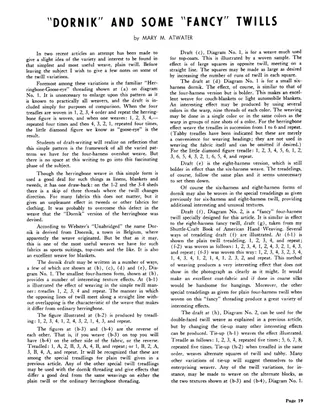
Dornik and Some Fancy Twills
Article · 3 pages · weaving drafts
Mary Atwater's article on dornik, a herringbone-type twill variation that avoids the three-thread skip where ordinary herringbone changes direction. It gives four-, six- and eight-harness dornik drafts with treadling sequences, and notes uses for suitings, top-coats and blankets. It also presents a four-harness fancy twill and an eight-harness double twill with alternative tie-ups. Two diagram pages give the drafts, tie-ups and woven samples.
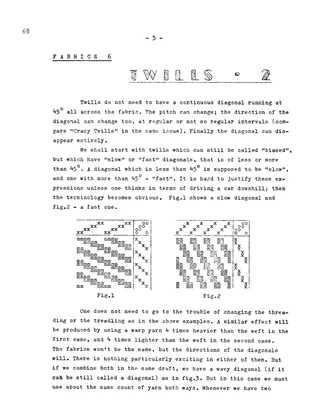
Fabrics 6 - Twills 2
Master Weaver, March 1963
Article · 4 pages · weaving drafts
Instalment 6 in the "Fabrics" series from Master Weaver, the second on twills. It covers biased twills with slow and fast diagonals, wavy diagonals, and the basic 4-shaft treadling types on a plain twill threading: Wave, Dornick, Stockinet, Broken twill and Satinet. It closes with twill-and-tabby mixtures and fancy twills, illustrated with thirteen drafts, and suggests weaving a sampler from the figures.
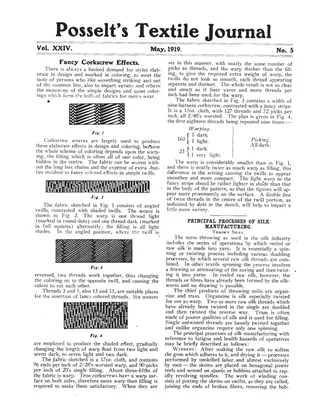
Fancy Corkscrew Effects
Article · 1 page · weaving drafts
A one-page article from Posselt's Textile Journal on fancy corkscrew weaves used in men's wear suitings, where the coloring comes from the warping and the filling is often a single color. It describes two sample fabrics: one of angled twills contrasted with shaded twills, with warp and filling counts, and a nine-harness corkscrew with a fancy stripe, with warping and picking plans. The page also begins an unrelated section on thrown silks (organzine and tram) from a series on the principal processes of silk manufacturing.
Fancy Twills
Ralph E. Griswold · August 17, 2004
Web Doc · 92 pages · weaving drafts
A pattern book of fancy twill drawdowns by Ralph E. Griswold, generated by a cellular automaton program. The patterns are shown as black-and-white thumbnail drawdowns arranged by size, from 6 x 6 up to 70 x 70, each labeled with the number of its downloadable WIF file on handweaving.net. A brief introduction explains the source of the patterns, how the numbers map to WIFs, and the usage terms, and cites two of Griswold's Drawdown Automata papers.
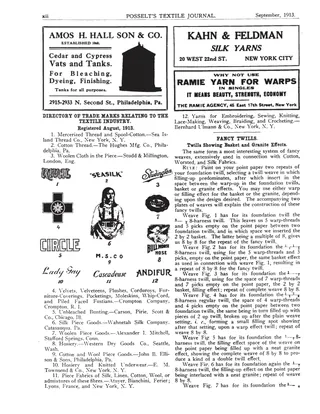
Fancy Twills
Article · 3 pages · weaving drafts
An article from Posselt's Textile Journal on fancy twills with basket and granite effects, giving a construction rule and descriptions of Weave Figs. 1 to 25. Each weave is built on an 8-, 10-, 12- or 16-harness foundation twill, with basket or granite weaves filling the empty space between twill lines, and repeats are stated. The point-paper drafts appear on the second and third pages. The scan also includes the journal's trade mark directory and advertisements.
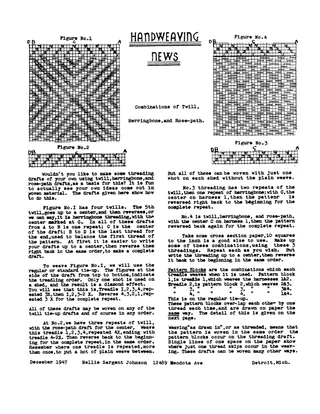
Handweaving News (December 1947): Combinations of Twill, Herringbone, and Rose-path
Periodical · 2 pages · weaving drafts
A two-page instructional article from Handweaving News (December 1947) by Nellie Sargent Johnson on designing original four-harness threading drafts by combining twill, herringbone and rose-path units. It explains how to write a draft up to a center and reverse it, how to treadle on the standard tie-up, and how pattern blocks overlap. The second page gives step-by-step instructions for drawing the woven effect (draw-down) of a threading on paper.
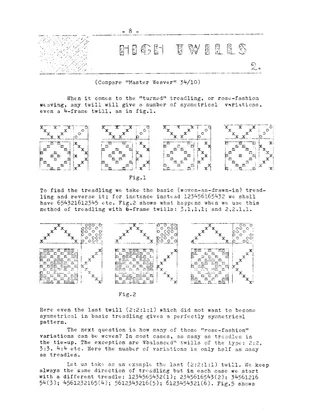
High Twills 2
Master Weaver, November 1957
Article · 3 pages · weaving drafts
A short article from Master Weaver (No. 36, November 1957) on treadling higher-order twills in "rose-fashion" (turned) order, a sequel to an earlier article on high twills. It explains how reversing the basic treadling gives symmetrical variations for 4-, 6-, 8-, 12- and 16-shaft twills, and how many variations and distinct twills each shaft count allows, with treadling sequences and drawdown figures. It ends with guidance on designing such twills (tie-up first, conservative threading, treadling from the threading) and a practical project for a linen tablecloth in 5:1:1:1 twill with warp, sett, reed and weft details.
Modern Unsymmetric Diamond Twill
Master Weaver, November 1961
Article · 3 pages · weaving drafts
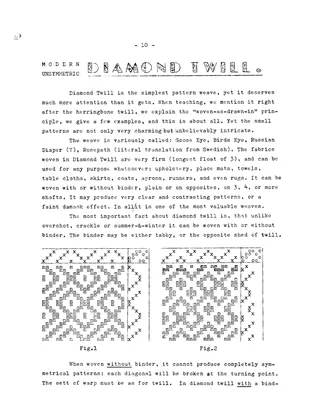
A short article from Master Weaver on diamond twill, which it calls the simplest pattern weave and one that deserves more attention. It explains weaving diamond twill with or without a binder (tabby or the opposite twill shed), and gives rules for sett, for the number of shots on each treadle, and for placing the binder. Four drafts show woven-as-drawn-in and fancy treadlings, diamond twill alternating with plain twill, and tiny diamonds inserted into a biased twill. It ends with a practical project for woolen yardage for sports coats, giving warp, sett and treadling.
The Multiple-Harness Weaver: Braided Twills
Article · 4 pages · weaving drafts
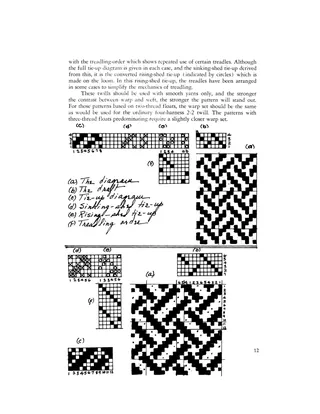
An article from the Multiple-Harness Weaver series by Harriet Tidball on braided twills, patterned twills with a double-diagonal design in which no float exceeds three threads. It gives drafts, tie-ups, treadling orders and weaving directions for braided twills on four, six, seven and eight harnesses, with sinking-shed and rising-shed tie-ups. It also advises on yarns and warp set. Most pages are weaving diagrams, and the last page shows a woven sample in red-orange and yellow-green.
Practical Weaving Suggestions, Vol. 3-63 (c. 1953): Variations on a Familiar Theme -- Point Twill
Periodical · 4 pages · weaving drafts
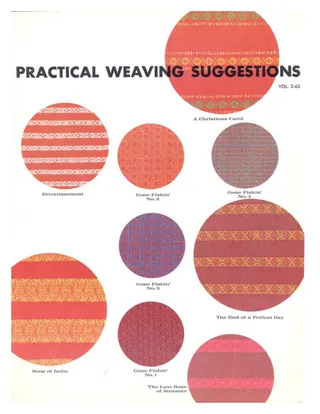
A Lily Mills leaflet from the Practical Weaving Suggestions series in which Geraldine Wood describes a sampler of point twill variations woven on an 8-harness threading with a red Lily Fine-Weave cotton warp. Each sample is named after a song title, with tie-up numbers, weft and tabby colors, and notes on stripe spacing and treadling. The leaflet includes a cover showing the nine swatches and a handwritten draft sheet with threading, tie-ups and treadlings I through VIII.
Regular Twills
Ralph E. Griswold · June 9, 2004
Web Doc · 5 pages · weaving drafts
A pattern book by Ralph Griswold presenting all regular right twills for 2 to 10 shafts, shown as small drawdown thumbnails grouped by size from 2 x 2 to 10 x 10. Each thumbnail is labeled with the catalog number of its WIF file at Handweaving.net, so readers can browse and identify patterns to download. Left twills can be obtained by reflecting the right twills. The patterns were generated by a program using the standard definition of twill counters.
Scottish Pattern Twills
Article · 3 pages · weaving drafts
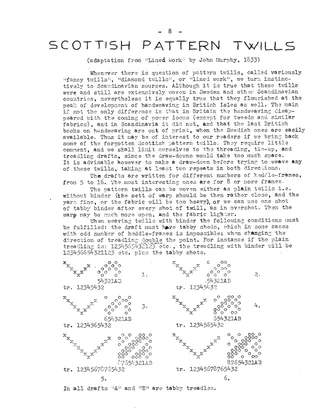
An adaptation of John Murphy's 1833 "Lined Work" presenting Scottish pattern twills (fancy, diamond or lined-work twills) as threading, tie-up and treadling drafts, with no draw-downs. The introduction compares British and Scandinavian traditions and explains weaving the twills plain or with tabby binder, including doubling the point when treadling changes direction. Thirty-one drafts follow, for 5 to 16 shafts, mostly 8 or more.
Steep Twills or Diagonals. Also Basket Effects.
Article · 1 page · weaving drafts
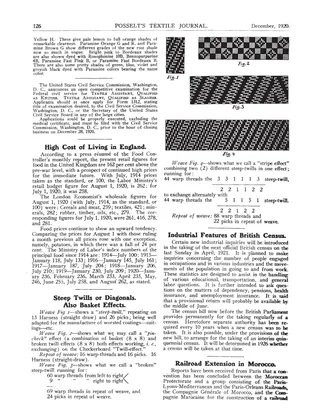
A single page from Posselt's Textile Journal (December 1920) with a short piece on steep twills or diagonals and basket effects. It describes four weave drafts: a 13-harness steep twill for worsted coatings and suitings, a 16-harness pin-check combining basket and broken twill, a broken steep twill repeating on 69 threads and 24 picks, and a stripe effect combining two steep twills on 88 threads and 22 picks. The page also carries unrelated trade news items.
Steep-Twills, having a Grading of 75°
Article · 1 page · weaving drafts
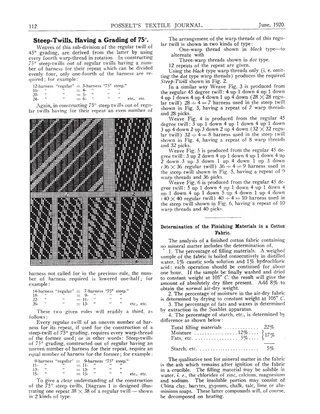
A short article from Posselt's Textile Journal (June 1920) explaining how to construct steep twills of 75° grading from regular 45° twills by using every fourth warp thread. It gives rules relating the number of harnesses in the regular twill to those in the steep twill, and works through examples (Figs. 2-6) with 7-, 8-, 9- and 10-harness steep twills derived from 28, 32, 36 and 40-harness regular twills. The page also carries a brief unrelated item on determining finishing materials in a cotton fabric.
A Study in Weave Formation
Article · 1 page · weaving drafts
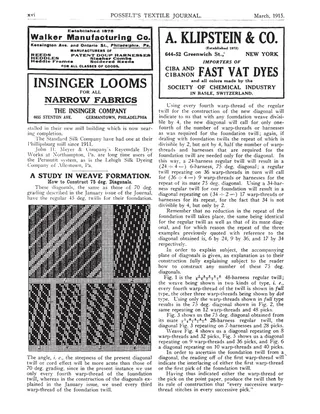
A single-page article from Posselt's Textile Journal, March 1915, explaining how to construct 75-degree diagonal weaves from regular 45-degree twills by taking every fourth warp thread of the foundation twill. It gives worked examples (24-, 36- and 34-harness foundation twills) and describes a plate of six diagonals (Figs. 1-6) with their repeats, plus how to work back from a diagonal to its foundation twill. It follows an earlier January article on 70-degree diagonals.
A Study in Weave Formation
Article · 3 pages · weaving drafts
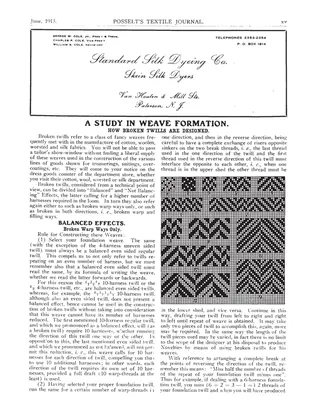
Part of a series from Posselt's Textile Journal (June 1915) explaining how broken twill weaves are designed for dobby looms. It sets out rules for choosing a balanced even-sided foundation twill, reversing its direction with a clean break, and the break-thread rule (skip half the repeat minus one). It then describes Figs. 1 to 22, covering broken warp ways only and broken warp and filling ways (check effects), with harness requirements and draft arrangements. The pages are interleaved with trade advertisements and a short item on industrial alcohol use in Russia.
A Study in Weave Formation: Combining Twills with their Mate Basket Weaves
Article · 2 pages · weaving drafts
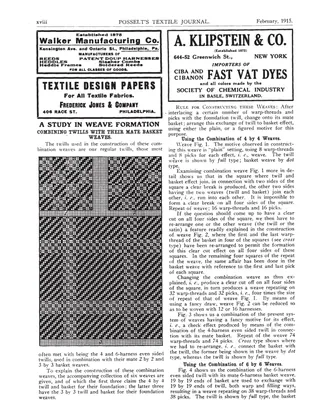
A two-page article from Posselt's Textile Journal (February 1915) on building combination weaves that join a regular even-sided twill with its mate basket weave. It explains the construction rule and walks through six figures: three based on 4-harness twill and 2 by 2 basket, and three based on 6-harness twill and 3 by 3 basket. It discusses clear cut-off edges where twill and basket squares meet, repeat sizes, and how fancy drawing-in can reduce the harness count. Large drawdown diagrams accompany the text.
A Study in Weave Formation; Tricot Weaves
Article · 1 page · weaving drafts
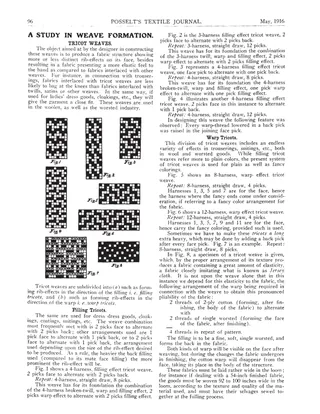
A single-page article from Posselt's Textile Journal (May 1916) explaining the design of tricot weaves, which produce rib effects and an elastic fabric used for trouserings, dress goods, cloakings and suitings. It divides them into filling tricots and warp tricots and describes eight drawdown figures (3-, 4-, 8- and 12-harness) with repeats and their twill foundations. The last example is a Jersey-cloth imitation built on a cotton and worsted warp arrangement, with notes on loom width and fulling.
Twill
Article · 1 page
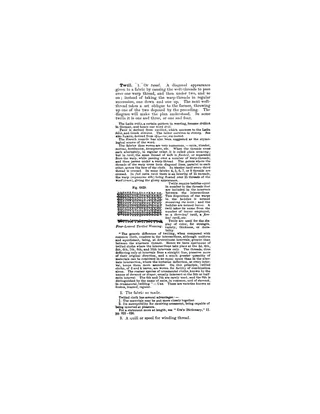
A dictionary entry on twill from Knight's American Mechanical Dictionary. It defines twill as a diagonal weave, discusses its etymology (drill, dimity, samite), and describes how twills of various intervals (blanket twill, satin) are produced and mounted on leaves of heddles. It includes a quotation from Ure on twilled cloths and a figure of four-leaved twilled weaving, and ends with a secondary sense of the word as a quill or spool.
Woolen and Worsted Designing
Article · 1 page · weaving drafts
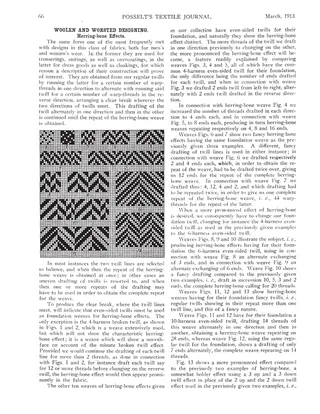
A one-page article from Posselt's Textile Journal on designing herring-bone effects in woolen and worsted fabrics. It explains how herring-bone weaves are derived by drafting even-sided twills alternately in opposite directions, and how the number of threads per direction changes the effect. Thirteen numbered weave drafts illustrate examples on 4-, 6- and 10-harness twill foundations, including fancy drafting sequences and repeat sizes.
16 Harness Patterns: The Fanciest Twills of All
Book · 130 pages · weaving drafts
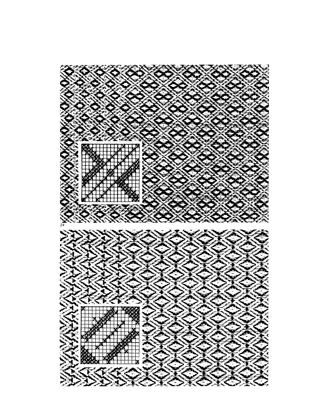
A collection of sixteen-harness point twill patterns compiled by Irene K. Wood from the weaving notebooks of Fred A. Pennington of Des Moines, Iowa. It opens with a short history of these damask-like twills and a biographical sketch of Pennington, then explains the common threading and treadling, with differences in design coming entirely from the tie-up. Most of the book consists of photographs of woven swatches (20/2 mercerized cotton, 36 epi) paired with drawdown and tie-up grids. A comparison section adapts selected patterns to twenty, twelve and eight harnesses, and a closing section shows step by step how to design your own diamond, star, circle and square point twills.
938 documents found