Textile Documents › Authors › Author: Rupert Peters
5 documents found
Sort: 
Practical Weaving Suggestions, Vol. 2-55 (1955): Cloth Analysis
Periodical · 8 pages · weaving drafts
An instructional bulletin on analyzing handwoven cloth to recover yarn grist, sett, threading draft, tie-up and treadling from a finished sample. Rupert Peters works through four examples: an overshot runner (Bachelor's Button), a Finnish bird's-eye towel, a Bronson weave cushion (Rose and Compass pillow top), and a summer and winter stand cover. Each comes with a drawdown or profile, a threading and tie-up, and weaving directions with yarn and reed data. It also covers the profile method, tabby treadling, and tie-ups for counterbalanced versus jack looms.
Practical Weaving Suggestions, Vol. 2-57 (1957): Some Notes on Crackle Weave
Periodical · 12 pages · weaving drafts
A 12-page instructional leaflet on crackle weave by Rupert Peters. It covers the origin of the name, how crackle differs from overshot, the four threading units (each a point twill on three harnesses) and the use of incidental threads. It explains how to transpose an overshot pattern (Honeysuckle) into crackle and how to analyze a woven crackle piece to derive threading, tie-up and treadling. It ends with several patterns with drafts, treadlings and yarn notes: Goose Eye, a diamond, Isles of the Sea, a Bergman adaptation, a Berger upholstery pattern and Rhythm.
Practical Weaving Suggestions, Vol. 4-60 (1960): Weaving Records
Periodical · 8 pages · weaving drafts
A bulletin from Lily Mills showing how weavers can keep records of their work on notebook record sheets. Five sample records give warp and weft yarns, sett, width in reed, threading and treadling for a twill/basket weave drapery, a summer and winter cushion cover (Stars and Roses), a Monk's Belt overshot place mat, a warp-face Log Cabin place mat, and an Isles of the Sea crackle place mat. The records are by Mary Virginia Munford and Rupert Peters, and the back page is a Lily Mills yarn advertisement.
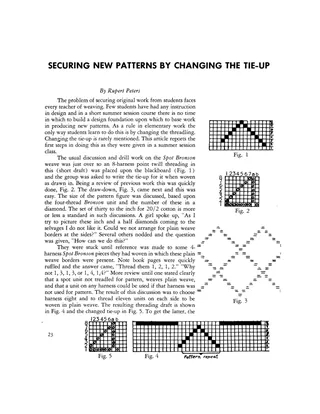
Securing New Patterns by Changing the Tie-Up
Article · 3 pages · weaving drafts
A teaching article describing how a summer session weaving class created new patterns by altering the tie-up rather than the threading. Starting from an 8-harness point twill threading in Spot Bronson, students added plain weave borders, then put spots and diamonds inside the large diamond figures and worked out the matching tie-ups. Over twenty variations resulted, shown in Figs. 1-21, and the article ends by noting that new patterns come from changed threading, treadling, or tie-up.
A Simple Method for Keeping Samples of Weaving
Article · 2 pages · weaving drafts
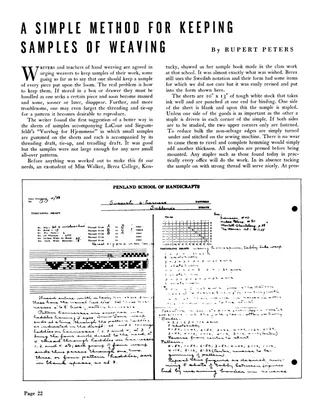
A short 1939 article by Rupert Peters describing a method of keeping weaving samples on large punched sheets (10" x 13") bound into a book, with each sample stapled to one side and its threading draft, tie-up, treadling and other data on the other. He explains the origins of the idea (a Danish sample book and Berea College's sample book), how samples are prepared and mounted, and how the sheets are used in teaching. A Penland School of Handicrafts draft sheet for a 4-harness Swansdown pattern and a photograph of a mounted runner corner illustrate the method.
5 documents found