Textile Documents › Topic: Supplementary warp, lappet, and swivel
91 documents found
Sort: 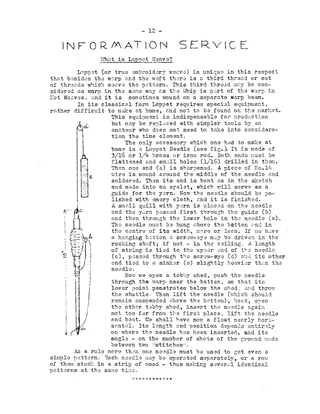
Information Service - What Is Lappet Weave?
Master Weaver, April 1952
Article · 1 page
A short explanatory piece from the Information Service column of Master Weaver defining lappet weave, in which an extra third thread, which may be wound on a separate beam, forms the pattern. It gives instructions for making a simple lappet needle from brass or iron rod with a wire guide eyelet. It also explains how to suspend the needle above the batten and use it between tabby shots to produce floats. A line drawing shows the needle assembly.
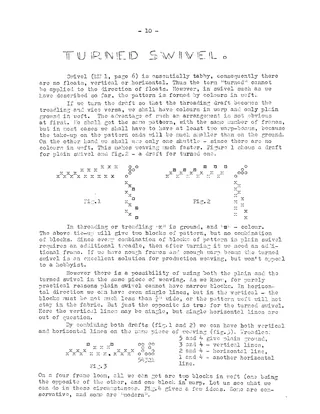
Turned Swivel
Master Weaver, July 1954
Article · 3 pages · weaving drafts
An article from the Master Weaver newsletter explaining turned swivel, in which the swivel draft is turned so that pattern colours lie in the warp and only a plain ground weft is used, allowing a single shuttle. It shows how to combine plain and turned swivel in one piece for both vertical and horizontal lines, and gives drafts and treadling variations for six patterns on four frames. It also covers practical points such as separate warp beams or bobbins for the colour warp ends, loom tie-up, sett, beating and yarn choice, and trimming floats.
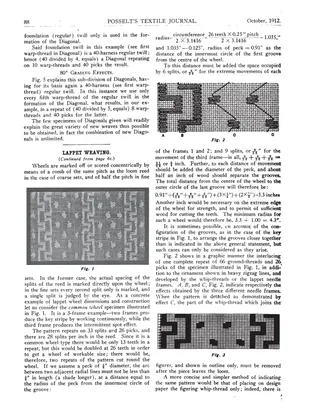
Lappet Weaving
Article · 2 pages
Continuation of E. A. Posselt's article on lappet weaving, covering how lappet wheels are dimensioned and laid out. It works through a 3-frame example pattern (key stripe and spot effect) repeating on 33 splits and 26 picks, calculating wheel radius, groove spacing and peck travel. It also explains how lappet patterns are marked on design paper and how the full wheel is drawn. The first page also carries the end of a piece on Diagonal weaves and grading effects.
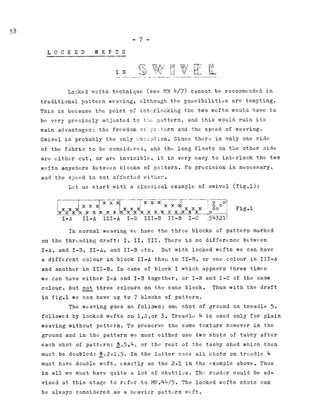
Locked Wefts in Swivel
Master Weaver, July 1961
Article · 4 pages · weaving drafts
A four-page article from Master Weaver explaining how to combine the locked wefts technique with swivel (spot) weave on four shafts. It covers a classic swivel threading with three blocks, which can yield up to seven pattern blocks with different colours, plus the treadling sequence with ground and double tabby shots. It also introduces a left/right treadling notation for the two colours, with examples for the figures. Drawdowns show how one-colour patterns can look like six-block designs, and the article closes with practical advice on weft tension.
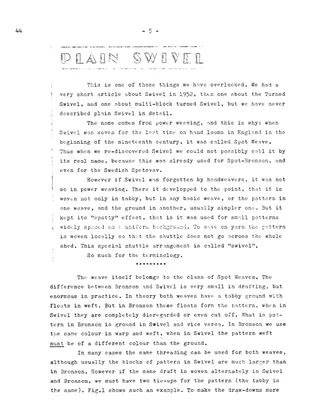
Plain Swivel
Master Weaver, March 1959
Article · 5 pages · weaving drafts
An article from Master Weaver (No. 44, March 1959) describing plain Swivel, a spot-weave variant in which pattern weft is woven locally on a tabby ground. It explains the terminology, the difference between Swivel and Spot Bronson, and classifies the variations (Spot Swivel, All-Over Swivel, Swivel Effect, Turned Swivel). It gives three treadling methods for a four-shaft, three-block draft, with advice on weft twisting, selvedges, slack pattern weft and two-colour pattern. It ends with a practical project for cotton and rayon place mats with warp, weft and treadling details.
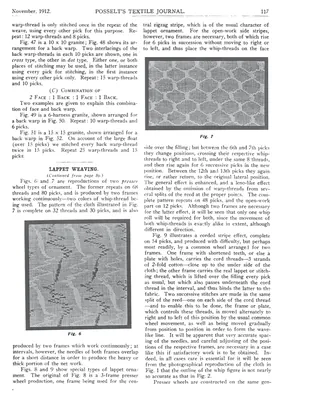
Combining Two Systems of Warp with One System of Filling
Article · 2 pages
Two journal pages from the November 1912 issue of Posselt's Textile Journal. The first finishes a discussion of combining face and back warps on granite weaves (6-harness and 10 x 10 and 15 x 15 granites, with repeats given). It then continues a series on lappet weaving, describing presser-wheel ornaments with whip threads, multi-frame effects, a corded stripe, and how presser wheels are constructed. The second page ends with an excerpt on defective shedding by Thomas Roberts, covering how troughing the shed affects cover and twill appearance.
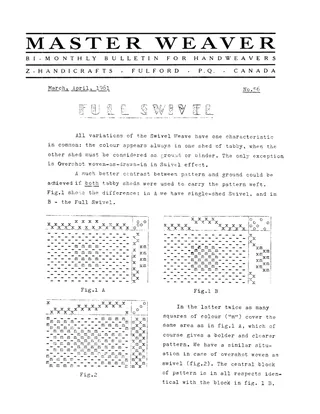
Full Swivel
Master Weaver, March-April 1961
Article · 5 pages · weaving drafts
An article from the Canadian bulletin Master Weaver explaining Full Swivel, a variant of swivel weave in which both tabby sheds carry the pattern weft for bolder contrast. It covers why the technique is limited on four shafts, how diamond-type patterns avoid slits on 8 or more shafts, and how to use a skeleton tie-up with conversion table for looms with 8 or 10 treadles. Two practical projects are given, a four-shaft chess-board and eight-shaft cotton place mats, and the article ends with remarks on the history of the name and the older term "Paper Spots" in Murphy's Art of Weaving.
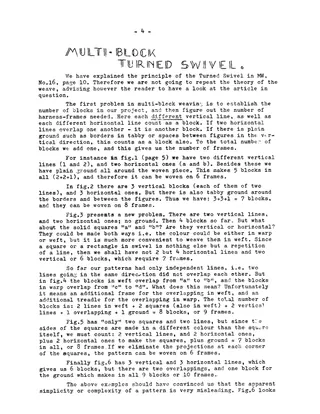
Multi-Block Turned Swivel
Master Weaver, January 1956
Article · 5 pages · weaving drafts
An article from Master Weaver (No. 25, January 1956) on multi-block turned swivel, a technique for weaving colored figures on a tabby ground. It explains how to count the blocks in a design and derive the number of harness frames needed, using six example patterns. It then works out profiles, threading drafts, tie-ups and treadling for three examples on 6 to 8 frames. It closes with a section on adapting turned swivel to three-dimensional weaving with heavy yarns, plus notes on heddles, reed choice and sleying.
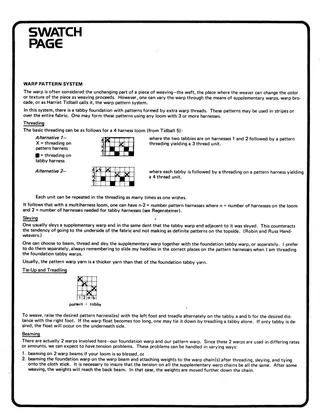
Swatch Page - Warp Pattern System
Article · 2 pages · weaving drafts
A Minnesota Weaver swatch page by Joy Rosner explaining the warp pattern system, in which extra supplementary warp threads form patterns over a tabby foundation on looms with three or more harnesses. It covers threading (two 4-shaft alternatives), sleying, tie-up and treadling, and ways to manage tension between the two warps, including double beams and hanging weights on warp chains. It ends with a bibliography, a postscript on the M's and O's name reversal from a Handweaver and Craftsman article, and an erratum for a Waffle Weave swatch page.
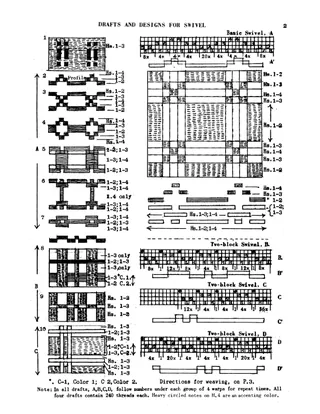
The Swivel Weave, Folio 28
Monograph · 6 pages · weaving drafts
Folio 28 from the Osma Gallinger Tod Studio explains the swivel weave, in which pattern blocks appear as colored tabby blocks on the cloth surface with floats on the back. It describes Basic Swivel (three blocks on harnesses 2, 3 and 4) and Two-block Swivel (harness 4 used for accent warps), with four 240-thread drafts, tie-ups for jack and counterbalanced looms, and treadling directions. It also shows how to weave overshot patterns and Summer and Winter as swivel, with the overshot pattern 'Salem Streets' by Helen D. Young as a worked example, including warp plans for fine and coarse settings.
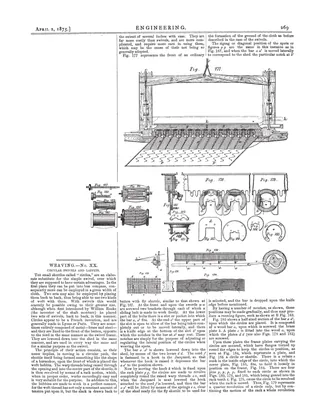
Weaving. -- No. XX: Circular Swivels and Lappets
Article · 2 pages
Installment No. XX of a series on weaving from the British journal Engineering, dated April 2, 1875. It describes circular swivels ("circles"), small horseshoe-shaped shuttles moved by a rack motion to weave silk spots or figures on a ground cloth. It covers how they are mounted on the batten and operated by the Jacquard, and details the spring-tensioned bobbin and spindle. It closes with the older lappet needle-frame method of producing figures, including a gauze-like variant. Illustrated with engineering figures (Figs. 177-196).
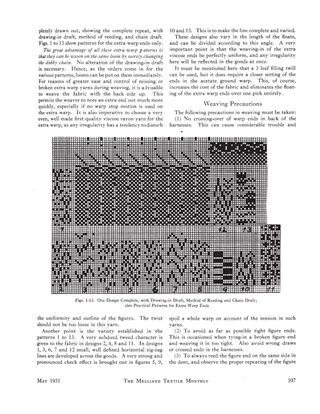
Flamengo -- A New Parisian Mixture Fabric
Article · 4 pages · weaving drafts
A 1931 trade-journal article describing Flamengo, a Parisian mixture dress fabric with an acetate plain-weave ground warp, an extra viscose figure warp and a worsted crepe filling. It covers dobby loom setup, the 6-end ground to 1-end figure arrangement, reeding, drawing-in on 12 harnesses, float length limits and weaving precautions. Thirteen extra-warp patterns are shown as swatch photographs and as a drawdown, with one design drawn out in full with its draft, reeding and chain draft.
Master Weaver, No. 56 (March-April 1961)
Periodical · 14 pages · weaving drafts
Issue No. 56 of Master Weaver, a bimonthly bulletin for handweavers published by Z-Handicrafts in Fulford, Quebec. It covers Full Swivel weaving, with 8-shaft drafts, skeleton tie-ups, a conversion table, and practical projects for a chessboard on four shafts and cotton place mats on eight. It also covers Texture Overshot, an overshot variation woven without a binder for relief effects, and part 3 of the Two-Warp Weaves series, which introduces two-warp double weaves with sampling exercises on tension. The issue ends with an article on shed regulators for counterbalanced looms, including a spring-based conversion to a reversed jack-type action.
Shuttle-Craft Bulletin, Vol. XXXI, No. 6 (June 1954)
Periodical · 16 pages · weaving drafts
June 1954 issue of the Shuttle Craft Guild Handweaver's Bulletin (Portfolio Edition), devoted to Warp-Pattern weaving, in which pattern threads are added as a superficial second warp over a plain tabby base warp. It gives an 8-harness Point-derived profile draft and threading, treadling directions for many space-encircled and stripe designs, a pick-up method for 3- and 4-harness looms, and a sampler by Mrs. Robert S. Leather. A second article covers handling a double-beamed warp: single plain beam, sectional beam, and two-beam looms, with tensioning, beaming and threading advice. It closes with a profile draft, tie-up and treadling for a tree motif, and notes on uses such as draperies, skirts and wall hangings.
Warp & Weft, Vol. 34, No. 2 (February 1981)
February 1981
Periodical · 9 pages · weaving drafts
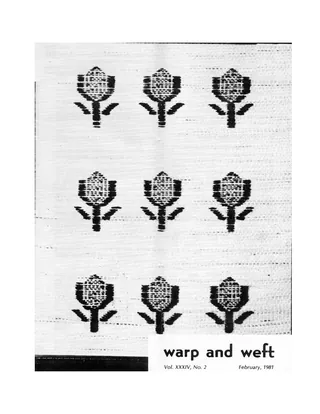
February 1981 issue of Warp & Weft, the monthly bulletin of Robin & Russ Handweavers in McMinnville, Oregon. It includes the editor's column on rising costs and summer workshops, a cover photograph note, a review of Karen Leigh Casselman's Craft of the Dyer, and a four-shaft swivel weave sample in shades of blue with tie-up, threading, treadling and reed details. It also has an announcement for two one-week workshops on designing handwoven clothing with Jean Scorgie, plus classified yarn and book advertisements.
Warp & Weft, Vol. 34, No. 6 (June 1981)
June 1981
Periodical · 8 pages · weaving drafts
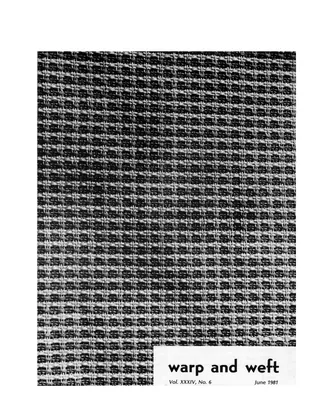
June 1981 issue of Warp & Weft, the monthly newsletter of Robin & Russ Handweavers in McMinnville, Oregon. It includes the editor's column on yarn shipments, buying trips and book publishing, a review of Helene Bress's The Weaving Book: Patterns and Ideas, and the monthly sample, a 4-shaft ribbed swivel weave in 6-strand cotton floss with threading, tie-up, colors, treadling, yardage and cost per yard. It also describes the cover fabric (a canvas weave in linen and ramie), and carries classified yarn advertisements and ads for a weaving tour to Australia and New Zealand and Norwood looms.
Weaving. -- No. XIX: Tissue Weaving
Article · 2 pages
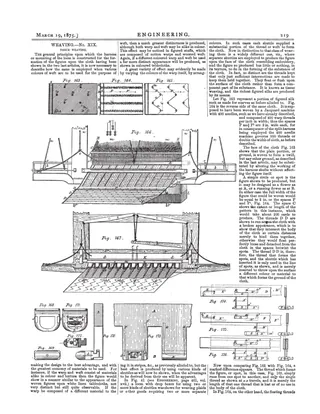
Nineteenth installment of a serial on weaving in the engineering journal Engineering, dated 19 March 1875, describing tissue weaving for figured silks on a Jacquard loom. It explains how a separate figure shuttle floats weft on the cloth surface, bound only at intervals, and compares full-width shuttles with small shuttles used only where spots occur, which saves silk. The second half details swivel shuttles mounted in a frame on the batten, including the slide-and-peg mechanism, the swivel's construction, bobbin tension pressers and horsehair loops. Illustrated with numbered engineering figures (Figs. 163-176) and no weaving drafts.
Weft Face Swivel
Master Weaver, May 1961
Article · 2 pages · weaving drafts
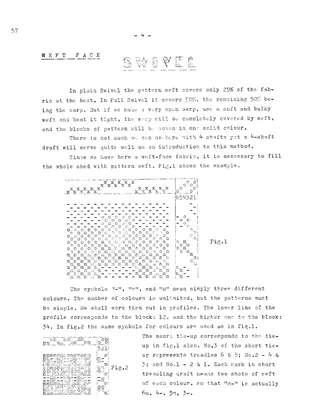
A two-page article from the Master Weaver series explaining weft-face swivel weaving on four shafts, in which a soft, bulky weft is beaten to cover the warp completely so that pattern blocks appear in solid colour. It explains the use of profiles, short tie-ups and short treadling drafts, compares the block structure to rep weave and four-shaft summer and winter, and relates full swivel to brocade and tapestry-like effects. It ends with a practical upholstery project with warp, sett, weft and treadling details, and four drafts.
December, 1913
Article · 4 pages · weaving drafts
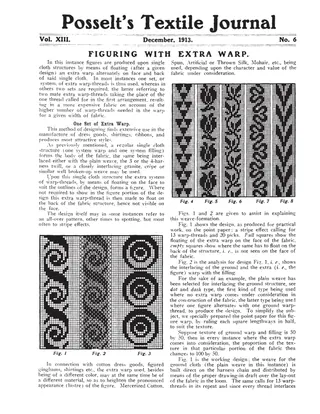
Four pages from the December 1913 issue of Posselt's Textile Journal (Vol. XIII, No. 6). The first article, 'Figuring with Extra Warp', explains how figures and stripes are made on single-cloth structures by floating an extra warp set on the face and back. It gives point-paper designs, analyses, drawing-in drafts, harness counts, reed plans and a color warp arrangement for a silk shirtwaisting. The second, by W. Watson, 'How Mitcheline Quilts Are Made', describes the Mitcheline quilt as a double cloth bound with a binding warp. It covers yarn counts, densities, shrinkage, and Jacquard and shaft loom mounting with comber-boards.
Lappet Weaving
Article · 3 pages · weaving drafts
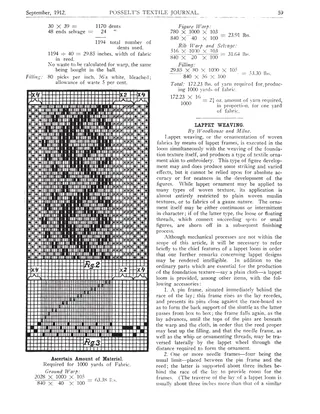
Three pages from the September 1912 issue of Posselt's Textile Journal. The first part of an article on lappet weaving by Woodhouse and Milne explains how lappet ornament is woven with the ground cloth and describes the lappet loom's pin frame, needle frames, whip rolls and pattern wheels (common and presser types), including pattern wheel size and pick calculations. The scan opens with the end of a warp and yarn quantity calculation for a lappet fabric. It closes with a section on adding weight and bulk to fabric with back filling, with weave drafts 57-67 showing 3 face : 1 back arrangements stitched with satins on rib, basket and granite weaves.
Master Weaver, No. 1 (December 1951)
Periodical · 14 pages · weaving drafts
First issue (December 1951) of Master Weaver, a bi-monthly bulletin for handweavers issued by Z-Handicrafts of Fulford, Quebec. It contains practical articles on weaving single linen (warping, beaming, threading, loom adjustment, weaving, edge problems), the first part of a series on spot weaves covering swivel weave with drafts and treadlings, a reflective essay on why people weave, and a study of the variations obtainable from four-block patterns, shown as grids of pattern diagrams. It also includes a note on the terms harness, heddle-frame and leaf (from the Encyclopedia of Hand-Weaving) and a piece on shed regulators for counterbalanced looms, with diagrams. An advertisement for the Encyclopedia of Hand-Weaving appears inside the cover.
Master Weaver, No. 58 (July-August 1961)
Periodical · 15 pages · weaving drafts
Issue No. 58 (July-August 1961) of Master Weaver, S. A. Zielinski's bi-monthly bulletin for handweavers, published by Z-Handicrafts in Fulford, Quebec. It opens with an essay urging handweavers to do individual research in technique, designing and history, with suggested topics and advice on collecting books, drafts and samples. Two technical articles follow: one on combining locked wefts with swivel (a four-shaft weave with a special two-colour treadling notation), and one on multishaft (eight-shaft) overshot with stitching ties. The issue ends with an advertisement for Zielinski's Encyclopaedia of Handweaving, and an advertisement for Handweaver & Craftsman is bound in.
Warp & Weft, Vol. 29, No. 3 (March 1976)
Warp & Weft, March 1976
Periodical · 8 pages · weaving drafts
March 1976 issue of Warp & Weft, a monthly bulletin from Robin & Russ Handweavers of McMinnville, Oregon. It includes the editor's column, an announcement of two August workshops with guest instructor Jack Womersley, and a review of Marian Powell's book on 4, 6 and 8 harness shadow weaves. The sample project is a four-harness swivel-weave drapery fabric in grey linen with Krispie Krunchie and chenille, with threading, tie-up, treadling, sectional warping notes and cost per yard. The issue closes with classified ads for yarns, books, loom plans and equipment, plus a Weaver's Marketplace advertising page.
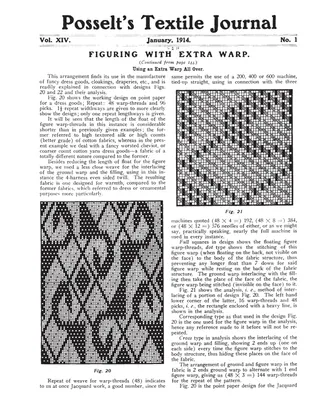
January, 1914
Article · 4 pages · weaving drafts
Four pages from the January 1914 issue of Posselt's Textile Journal. They continue a series on figuring with extra warp, covering an extra warp used all over for dress goods and two systems of figure warp in different colors, with Jacquard point-paper designs and analyses. A second article explains how double satins are made by adding risers on top or obliquely to 5-, 6-, 7-, 8- and 10-harness satins, with fourteen draw-down diagrams. A short item describes the Aubusson carpet industry in France.
Broché or Brocade
Klara Cherepov · 1970s
Monograph · 30 pages · weaving drafts
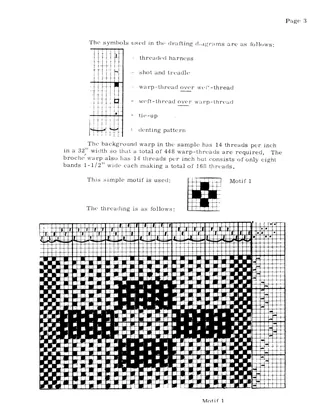
A study of broché (brocade) weaving by Klara Cherepov of the Handweaving Studio, Greenwich, Connecticut. It defines broché as a loom-controlled technique in which warp or weft threads are brought to the surface in spots over a tabby ground, then explains planning and treadling for warp broché on 4, 6 and 8 harnesses and for weft broché on 4, 6 and 8 harnesses. It ends with combined warp and weft broché on 16 harnesses. Thirty numbered motifs are given as drafts with threading, tie-up and treadling.
Spot Weaves - 1 (Swivel)
Master Weaver, December 1951
Article · 3 pages · weaving drafts
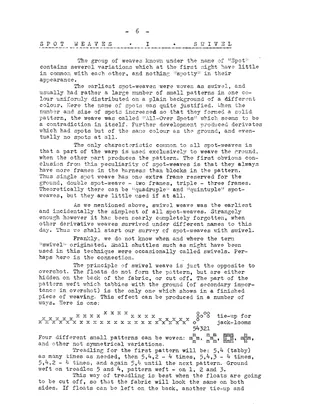
An instructional article from Master Weaver, December 1951, introducing the spot weave family and focusing on swivel, the earliest and simplest spot weave. It explains how swivel differs from overshot, with pattern floats hidden or cut off. It gives threading, tie-up and treadling drafts for five and six shafts, tie-ups with one treadle per block, short draft notation, and notes on setting the warp, weft weight, cutting floats and uses. The last page begins an unrelated essay, "Why Do We Weave?", on the motives for taking up handcrafts.
Why do We Weave?
Master Weaver, December 1951
Article · 2 pages
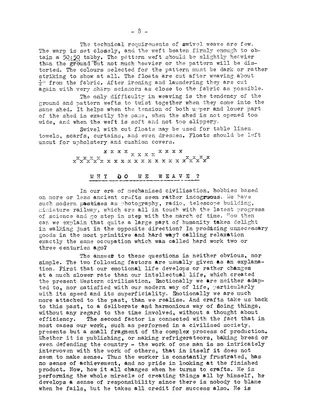
Two pages from the first issue of Master Weaver (December 1951). The main piece, "Why Do We Weave?", considers why people take up handweaving as a hobby in a mechanised age, citing emotional attachment to the past and the satisfaction of making a whole product oneself, and invites readers to write in with their views. The pages also include the end of a note on swivel weave technique (warp and weft setting, cutting floats, uses) and a short piece on variations of four-block patterns, showing how block combinations yield 64 symmetrical patterns on 5 frames in swivel or lace.
Dictionary of Textile Terms
Article · 3 pages
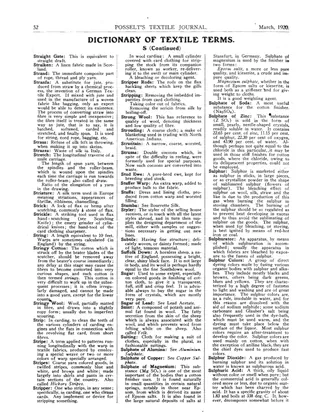
Installment of E. A. Posselt's serialized Dictionary of Textile Terms from Posselt's Textile Journal, March 1920, covering entries from 'Straight Gate' through 'Syra Gaza' (the S section). Entries define fibres, fabrics, dyes and finishing chemicals, loom and carding parts, and silk and wool trade terms, including swivel weaving, sumac, sulphur colors, and many regional fabrics. The scan also includes a trade-news item on alkali chemical shortages and short notes on mill openings and sales.
Dictionary of Weaves
Article · 2 pages · weaving drafts
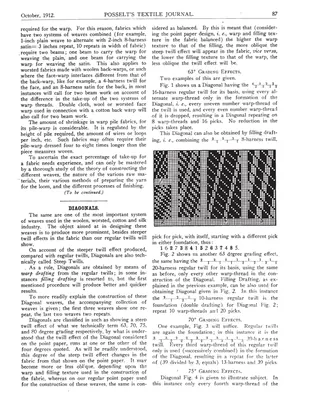
Two journal pages from Posselt's Textile Journal, October 1912, containing a section on Diagonals (steep twills) and a continuation of a series on lappet weaving. The Diagonals text explains how steep twills of 63, 70, 75 and 80 degrees are derived from regular twills by warp or filling drafting, with five numbered examples and a drawdown for a 16-harness diagonal. The lappet section covers lappet wheel dimensions, tooth and groove calculations, and a 3-frame specimen with a key stripe and spot figuring. The first page also opens with the end of a piece on warp take-up and two-beam work.
Manufacture of Ribbons, Trimmings, Edgings, Etc.
Article · 2 pages · weaving drafts
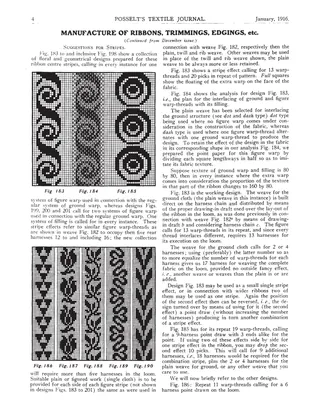
Two-page installment from Posselt's Textile Journal (January 1916) continuing a series on ribbon, trimming and edging manufacture. It presents figs. 183-201, designs for figured ribbon centre stripes using one or two systems of extra figure warp over a plain-weave ground warp, with notes on repeats, harness counts and drawing-in drafts. It also explains an analysis of ground and figure warp interlacement on point paper, including two-color figure effects.
Swivel Effect in Overshot
Master Weaver, August 1952
Article · 3 pages · weaving drafts
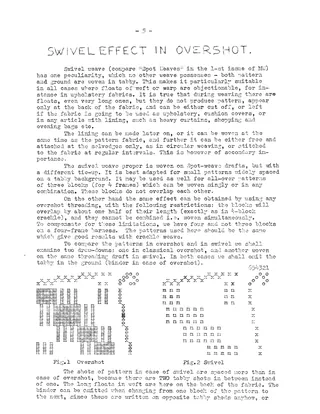
A 1952 Master Weaver article explaining the swivel effect woven on overshot threadings, where both pattern and ground are woven in tabby with long weft floats left on the back. It compares overshot and swivel drawdowns on the same threading and describes treadling variations (binder in the same shed, staggered swivel, swivel on opposites), color use, and sett and weft grist. A short note on weaving terminology, arguing against the use of 'two-harness method' for weaving on two frames, follows.
Construction of Spot Weaves
Monograph · 26 pages · weaving drafts
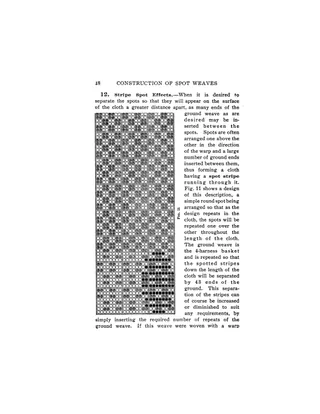
An International Correspondence Schools instruction pamphlet (Serial 509) on designing spot weaves. It explains how to lay out spots in plain, satin and broken crow order on design paper and how to choose and fit ground weaves, covering both warp-spot and filling-spot weaves, including corkscrew and cord grounds. It then treats spots formed by an extra warp or extra filling, with tying of floats, stripe spot effects, and harness and chain drafts. Practice examples follow each section, and many pages carry design-paper drawdowns and drafts.
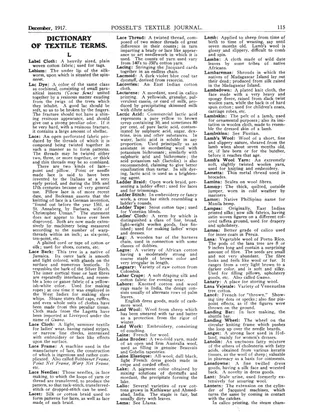
Dictionary of Textile Terms
Article · 2 pages
Two pages of the serialized Dictionary of Textile Terms from Posselt's Textile Journal, December 1917, covering entries beginning with L from Label Cloth to Lease Rod. Entries define fabrics, fibers, dyes and chemicals, lace and embroidery terms, and loom and machine parts. Longer entries cover lace, lappet weaving, lawn, lap feeding and lead acetate.
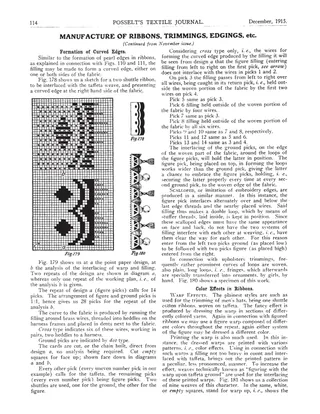
Manufacture of Ribbons, Trimmings, Edging, Etc.
Article · 2 pages · weaving drafts
Two pages from Posselt's Textile Journal (December 1915), continuing a series on the manufacture of ribbons, trimmings and edgings. They explain how curved and scalloped edges are formed with filling around brass wires, and how color effects are produced with dyed or printed warps and fillings, printed finishing and imitation printed ribbons. They also cover raised and open-work effects, and how to prepare the drawing-in draft and harness chain for a figured ribbon with an extra figure warp on a taffeta ground, with a worked 16-harness example.
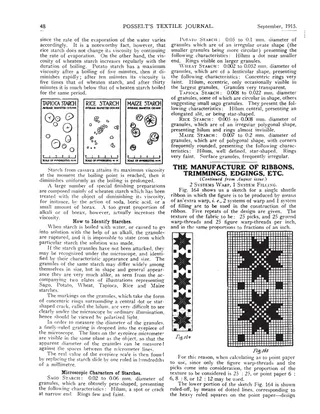
The Manufacture of Ribbons, Trimmings, Edgings, Etc.
Article · 2 pages · weaving drafts
Two journal pages from Posselt's Textile Journal, September 1915, continuing a series on ribbon manufacture. It explains how to make figured single-shuttle ribbons using an extra figure warp (2 systems warp, 1 filling) and ribbons with two figure warp systems plus a ground warp (3 systems warp, 1 filling). It covers point-paper calculation, drawing-in arrangement and interlacing diagrams (Figs. 164-169), and begins a continuation on double cloth reversibles for harness and Jacquard work.
Master Weaver, No. 16 (July 1954)
Periodical · 13 pages · weaving drafts
Issue No. 16 (July 1954) of Master Weaver, a bulletin for handweavers published in Fulford, Quebec. It contains a business article on costing and selling handwoven goods, a note on the terms "harness" and "heddle-frame", and a scheme for weaving coded messages in overshot floats and picks, with a worked example and a "Merry Xmas" border. A teaching lesson explains how to find the basic treadling for a square pattern, and a final article covers turned swivel (colour in the warp) with drafts, treadling variations and loom requirements. A short editor's note reports the Encyclopedia of Handweaving is out of print.
Master Weaver, No. 57 (May-June 1961)
Periodical · 15 pages · weaving drafts
Issue No. 57 (May-June 1961) of Master Weaver, a bi-monthly bulletin for handweavers written by S. A. Zielinski in Fulford, Quebec. It contains an article on four-shaft Dornick twill patterns with drafts and a practical upholstery project, and an article on weft-face Swivel weaving with an upholstery project. It also describes a homemade automatic take-up and let-off for a handloom, with diagrams, and discusses two-warp double weaves on 10 to 21 shafts. The last page advertises Zielinski's Encyclopaedia of Handweaving.
October, 1913
Article · 2 pages · weaving drafts
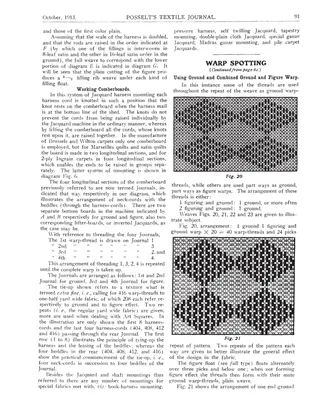
Two pages from Posselt's Textile Journal, October 1913, pages 91-92. They finish a discussion of Jacquard harness mountings, including working comberboards and the threading of four 'Journals' for Ingrain carpet, and then continue the series 'Warp Spotting'. The warp spotting section covers weaves that use ground warp together with combined ground-and-figure warp. Figs. 20-23 give drawdowns with 3-pick figure floats on plain or 2-1 filling rib ground.
Spotting with Extra filling or Warp for Harness and Jacquard
Article · 5 pages · weaving drafts
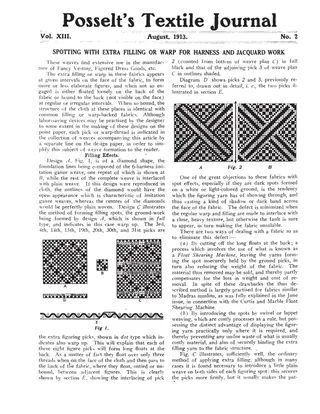
An article from Posselt's Textile Journal on spotting with extra filling or warp for harness and Jacquard fabrics such as fancy vestings and figured dress goods. It explains how extra figuring picks form spots on the face and float or are stitched at the back, and covers the shadowing defect, float shearing, swivel and lappet alternatives, and modified ground weaves. Weave plans, sections and photographs of woven cloth are included, along with a Jacquard card-stamping and yarn layout for a worsted, spun silk and mercerized cotton vesting. The scan also ends with the start of a separate article on fancy honeycomb weaves (check, checkerboard, diamond effects).
Designing
Textile Mercury, 1890
Article · 2 pages · weaving drafts
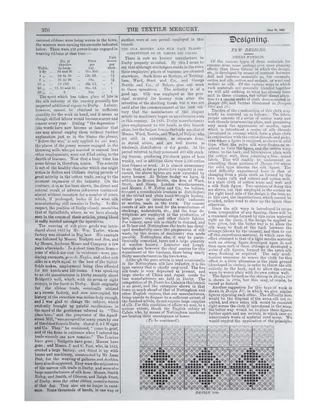
A two-page extract from The Textile Mercury (31 May 1890) with the 'Designing' column. It describes a summer dress fabric of cotton warp and weft in plain weave with an extra silk warp that flushes to form figures, illustrated by Designs 106, 106a and 107. It also gives pattern and draft instructions for Zephyr Tartans and a Skirting Pattern. The first page opens with the end of an article on the Derby silk and ribbon trades.
Lappet Weaving
Article · 4 pages · weaving drafts
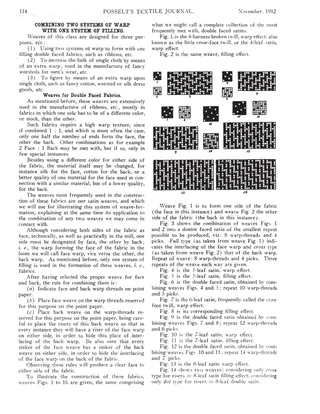
A four-page installment from Posselt's Textile Journal (November 1912) on combining two systems of warp with one filling. It explains how to build double-faced satin fabrics and how to add an extra back warp for bulk in men's wear worsteds, with rules for placing face and back weaves on point paper. Figures 1-52 give draft examples for 1:1, 2:1 and mixed face-to-back arrangements using satins, twills, baskets and granite weaves. The last page continues the Lappet Weaving series, describing presser wheel and common wheel lappet ornaments (Figs. 6-9), including multi-frame work, open-work stripes and corded stripes.
Modern Weaver, Vol. 1, No. 2 (October 1954)
Modern Weaver, October 1954
Periodical · 21 pages · weaving drafts
Issue no. 2 (October 1954) of Modern Weaver, a Canadian bulletin for handweavers published by Nilus Leclerc Inc. of L'Isletville, Quebec, with S.A. Zielinski as technical editor. It includes articles on achieving good selvedges (bobbin winding, warp tension, beating) and on the swivel weave, plus the start of a series on drafting that explains threading, tie-up and treadling. A glossary section (Angora through Batten and beyond) defines weaving terms, and there are sample drafts for 2-2 and 3-3 basket weave with warp, weft, sett and finishing details. The issue also has questions and answers on loom problems, a call for entries to the Canadian weaving exhibition in London, Ontario, a reed calculating table and advertisements for Clerco wool dressing and weaving lessons.
Master Weaver, No. 7 (January 1953)
Periodical · 14 pages · weaving drafts
Issue No. 7 of Master Weaver, a bi-monthly bulletin for handweavers published by Z-Handicrafts in Fulford, Quebec. It includes a blank draft/sample card form, a practical article on circular and double-width double weaves (fold, take-up, friction, reed choice), and an article on weaving borders on all sides with only four shafts using lace, swivel and simplified single-block overshot. It also has a quoted letter from Mary Atwater on weaving terminology and an article on building and using a front-hung pattern harness with a cumber board and wire heddles for dropped weaves such as spot weave, swivel and paper spots.
Modern Weaver, Vol. 1, No. 3 (February 1955)
Modern Weaver, February 1955
Periodical · 19 pages · weaving drafts
Issue of a Canadian handweavers' bulletin published by Nilus Leclerc Inc. of L'Isletville, Quebec, with S.A. Zielinski as technical editor. It opens with a loom equipment advertisement for warping reels and mills, then an essay on texture weaving and a technical article on swivel-overshot (overshot without floats), with drafts and treadling sequences. A second lesson in reading and drawing down weaving drafts is included, along with a draft for a tabby linen tablecloth. The issue also reports on an exhibition of Canadian hand weaving in London, Ontario, listing patrons, judges and prize winners, and includes part of a weaving glossary (bight, binder, block, bobbin, bobbin rack) with a bibliography. It ends with an advertisement for weaving lessons at Z-Handicrafts, Fulford, Quebec.
Swatch Page - Overshot
Article · 2 pages · weaving drafts
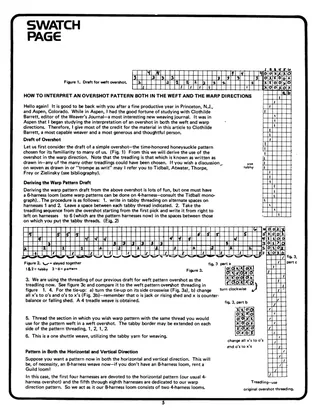
A Swatch Page column from Minnesota Weaver explaining how to read an overshot pattern in both the weft and warp directions. It starts from a honeysuckle weft overshot draft and shows how to derive a warp-pattern draft (tabby on harnesses 1 and 2, pattern on 3-6, with the tie-up turned and x/o swapped). It then combines the two on 8 harnesses for pattern in both directions, with threading and tie-up drafts. Yarn, sett and notes on the sample photos are included, plus a short bibliography.
Designing Made Easier - Proportions
Master Weaver, May 1957
Article · 4 pages
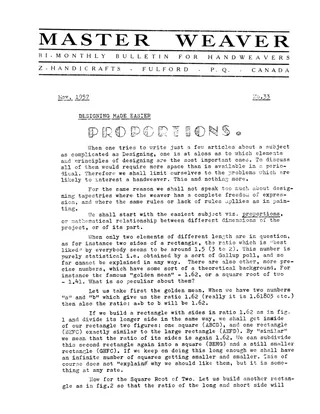
An article from the Master Weaver bulletin (No. 33, May 1957) on proportions in design for handweavers. It explains the golden mean (1.62) and the square root of two (1.41) rectangles, and shows how to apply 1.62 ratios to pattern areas, such as a Turned Swivel project, and to colour stripe sequences, with tables of pick counts and examples. The last page begins a new article on rugs in bound weaving (overshot, crackle, summer and winter on four frames, with no tabby).
July, 1913
Article · 1 page
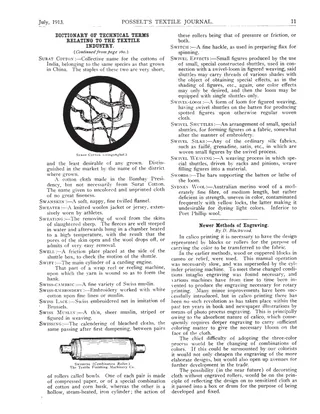
A single page from the July 1913 issue of Posselt's Textile Journal. It continues a dictionary of technical textile terms from Surat cotton through Sydney wool, covering entries such as swivel loom, swivel weaving, swissing, swords and sweating. It also opens a short article by D. Blackwood, "Newer Methods of Engraving," on engraved rollers and blocks for calico printing and the prospects of photo-process and three-color methods. Illustrations show a micrograph of Surat cotton fibers and a Swissing combination roller.
Ribbons, Trimmings, Edgings, etc
Article · 3 pages · weaving drafts
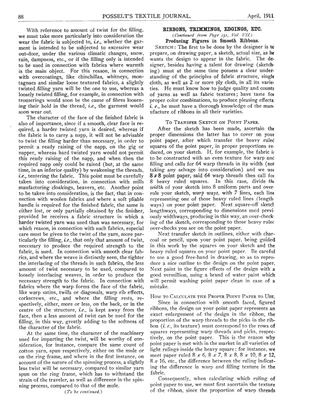
Three pages from Posselt's Textile Journal, April 1911, continuing a series on ribbons, trimmings and edgings. The section on producing figures in smooth ribbons explains how to transfer a sketch to point paper, how to choose point paper rulings (e.g. 8 x 5, 12 x 8) to match the warp-to-pick texture, and works through an extra-warp figured ribbon with a sketch, point-paper design and interlacing analysis (Figs. 164-166). The pages also include a 'Novelties from Abroad' section with loom specifications (warp, reed, filling, finish) for woolen and worsted dress goods, suiting and cloaking with weave drafts, and a short piece on silk weaving in Szechuan Province, China.
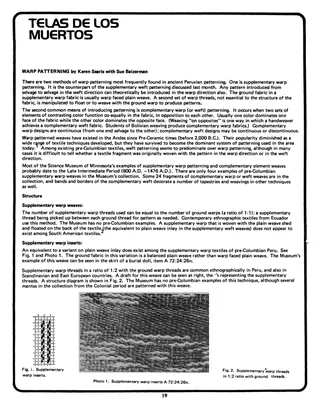
Telas de los Muertos - Warp Patterning
Article · 4 pages · weaving drafts
Part of the Minnesota Weaver series "Telas de los Muertos," this article surveys warp patterning in ancient Peruvian textiles, using examples from the Science Museum of Minnesota's collection. It covers supplementary warp weaves (inserts, 1:1 and 1:2 ratios), plain-weave-derived float weaves, complementary warp/weft weaves including two-color and multicolor pebble weave, turned weave, and warp/weft substitution. Entries give sett, thread counts, fibers, spin direction and approximate dates, with structure diagrams, drafts, photographs and a reference list (Rowe, Emery, Cason and Cahlander, Atwater).
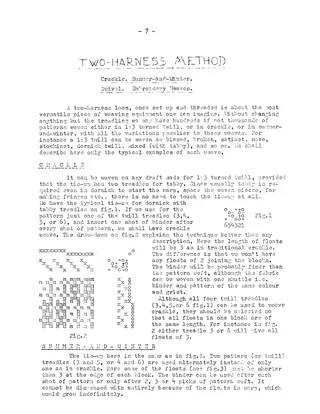
Two Harness Method - Crackle, Summer-and-Winter, Swivel, Embroidery Weaves
Master Weaver, May 1954
Article · 2 pages · weaving drafts
A short 1954 article from Master Weaver explaining how a four-harness-style draft can be woven using a simple tie-up with two tabby treadles, producing crackle, summer-and-winter, swivel and embroidery weaves from 1:3 turned twill threadings. It covers treadling for crackle with binder shots, summer-and-winter float lengths and binder use, the modified tie-up for swivel, and two embroidery weave examples. Six figures give tie-ups and draw-downs.
91 documents found