Textile Documents › Topic: Selvages, fringes, and edge finishes
212 documents found
Sort: 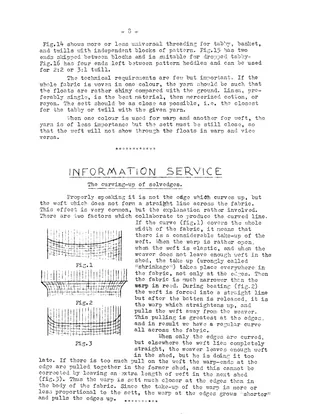
Information Service - The Curving Up of Selvages
Master Weaver, July 1953
Article · 1 page
A one-page Information Service item from Master Weaver explaining why the weft curves up at the selvedges of handwoven cloth. It distinguishes curvature across the whole width, caused by weft take-up with an open warp and elastic weft, from curvature at the edges only, caused by too little weft left in the shed and the warp being drawn closer at the edges. Three small diagrams illustrate the weft lines. The page also begins with the end of a preceding note on threading and yarn requirements for tabby, twill and block patterns.
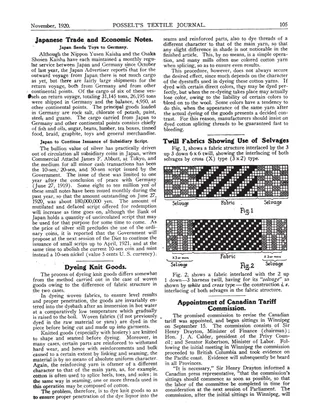
Twill Fabrics Showing Use of Selvages
Article · 1 page · weaving drafts
A single page from Posselt's Textile Journal (November 1920) with a short item on twill fabrics showing the use of selvages. Two drawdown figures show a 3 up 3 down 6x6 twill and a 2 up 1 down 3-harness twill, with the selvage and fabric areas labeled and the selvage interlacing marked. The page also carries unrelated trade notes on Japan, dyeing knit goods, and the Canadian tariff commission.
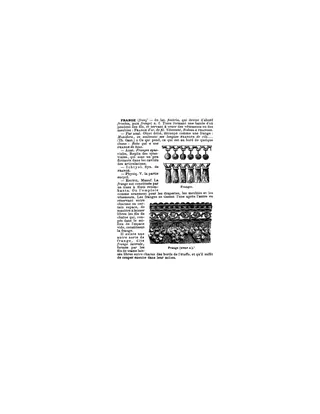
Frange [Fringe]
Article · 1 page · French
A one-page French dictionary entry on the fringe (frange) from the Nouveau Larousse Illustré. It gives the etymology and definitions, including figurative, anatomical and ichthyological senses, then an encyclopedic note on how fringes are woven. Fringes are woven one after another with spaces left between them so that the warp threads, cut in the middle of each space, form the fringe; a side fringe is made from weft threads left free at the fabric edges. Illustrations show sample fringes, including an 18th-century example.
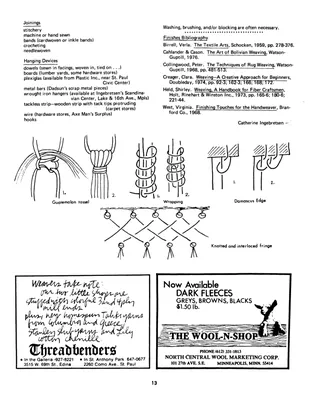
Joinings, Hanging Devices
Minnesota Weaver, April 1977
Article · 1 page
A one-page handout from the Minnesota Weaver on finishing handwoven work, by Catherine Ingebretsen. It lists joining methods (stitchery, bands, crocheting, needleweaving) and hanging devices (dowels, boards, plexiglas, metal bars, tackless strip, wire, hooks) with local Twin Cities suppliers. It also gives a short finishes bibliography and line drawings of a Guatemalan tassel, wrapping, Damascus edge, and knotted and interlaced fringe. The page includes advertisements for Threadbenders and The Wool-N-Shop.
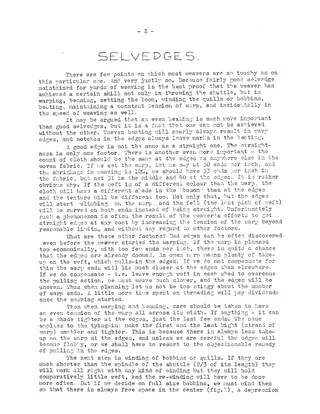
Selvedges
Master Weaver, October 1952
Article · 3 pages
A short article on achieving good selvedges in handweaving, arguing that even edges reflect overall skill in warping, beaming, tension, bobbin winding, beating and shuttle handling. It covers sett and warp planning, tying on, winding bobbins with a central depression (Fig. 1), shuttle brakes for springy yarns, rhythm and beat timing, and a tabby test with white and black slippery yarns. It also explains why one edge may be worse than the other because of weft twist.
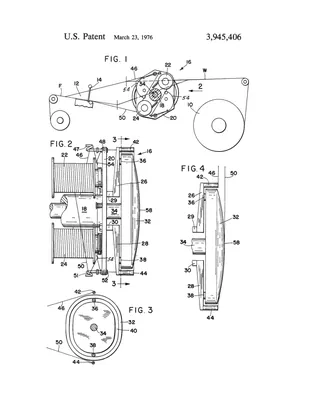
Leno Selvedge Device and Method of Forming a Leno Selvedge, US Patent No. 3945406
Patent · 7 pages
US Patent 3,945,406, granted March 23, 1976 to Karl W. Wueger and assigned to Crompton & Knowles Corporation, describes a mechanism and method for forming a leno selvage on a loom. Two selvage threads run from supply packages through guides that rotate about a horizontal axis. A stationary cam and pivoted levers with followers make the threads dwell in the open upper and lower shed positions and then cross quickly, which suits higher-speed looms. The document includes the full patent text from a USPTO database printout, a scan of the printed patent, the claims (7), and drawings (Figs. 1-4).
Questions and Answers
Article · 1 page
A one-page Questions and Answers column by Mary M. Atwater answering two weaver questions. The first covers causes of poor left-hand selvedges, including lighting, shuttle habits, uneven warp tension and loom frame misalignment. The second explains why the warp should not always be stretched very tight, especially on jack-type looms, where it lifts the harnesses and spoils the shed. An errata note corrects the author credit of the previous issue's "Coverlet Samplers" article to Marguerite P. Davison.
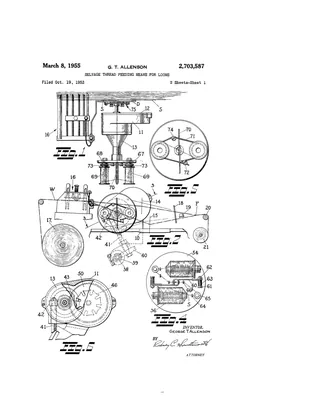
Selvage Thread Feeding Means for Looms, US Patent No. 2703587
Patent · 5 pages
US Patent 2,703,587, granted March 8, 1955 to George T. Allenson of Lincoln, R.I., and assigned to Draper Corporation. It describes a compact unit mounted near the fell of the cloth that feeds and sheds a pair of selvage threads to make a twisted (leno-type) selvage on looms that do not form a selvage naturally. Concentric inner and outer shafts carry the thread supplies and a feeding disk, driven from the loom camshaft through gears and a Geneva movement for intermittent rotation. The document has two drawing sheets, the specification, and nine claims.
Swap Shop
Minnesota Weaver, March 1977
Article · 1 page
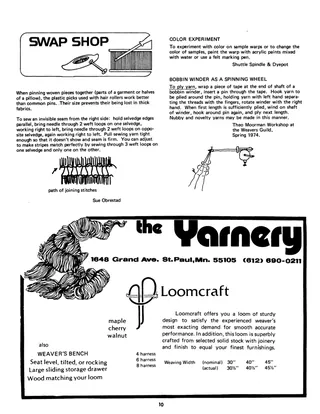
A one-page "Swap Shop" column of weaver-submitted tips from the Minnesota Weaver. It covers using plastic hair-roller picks instead of pins when joining woven pieces, sewing an invisible seam from the right side by catching weft loops on facing selvedges, coloring sample warps with acrylic paint or felt pens, and plying yarn with a bobbin winder. The page also carries advertisements for the Yarnery (St. Paul) and Loomcraft looms and benches.
Textile Machinery
Engineering Weekly, September 28, 1900
Article · 1 page
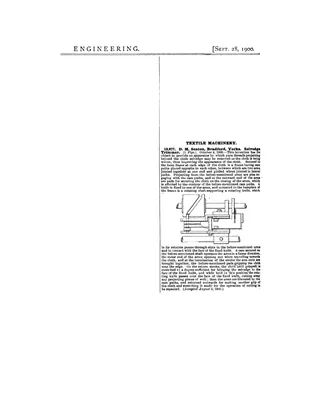
A one-page patent abstract from Engineering, September 28, 1900, describing British patent no. 19,877 (D. M. Seaton, Bradford) for a selvedge trimmer. The device removes projecting weft threads at the cloth edges during weaving, using cam-operated gripping arms, a fixed knife and a rotating knife. A side-elevation drawing of the mechanism is included.
The Finish of Edges
Article · 4 pages
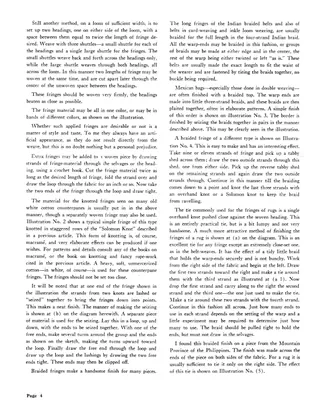
Mary Atwater's article on finishing the edges of woven pieces, mostly with fringes. It covers deciding whether to fringe, finishing in the loom with Spanish open-work weaving, and weaving separate applied fringes on an inkle or harness loom. It also describes knotted macramé (Solomon knot) fringes, seizing, braided fringes and tops, a braided rug-fringe tie from the Philippines, and three Maori twined finishes. Diagrams and five photographs illustrate the methods.
Questions and Answers
Article · 1 page
A one-page spread from The Weaver with Mary M. Atwater's question-and-answer column, covering weaving problems with selvedges and edges (ruffly rug edges, loops, doubled selvage threads, fancy twills) and how to beat and open sheds in close-set warp-face fabric. The page also carries John H. Clayton's short piece 'Try This on Your Loom', which advises keeping extra beams, harnesses and reeds pre-set for a popular pattern to cut changeover time for weavers working to order.
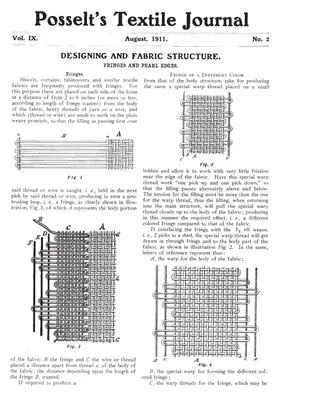
Design and Fabric Structure
Article · 2 pages
Two pages from Posselt's Textile Journal (August 1911) on fabric structure. The article explains how fringes are woven at the edges of shawls, curtains and tablecovers using heavy threads or wires that form protruding loops, including fringes of a different color made with a special warp thread. It also describes pearl edges, the looped ribbon selvages formed over temporary horsehair or wire threads, with labeled structure diagrams. The second page begins a separate piece on the importance of sizing woolen and worsted warps.
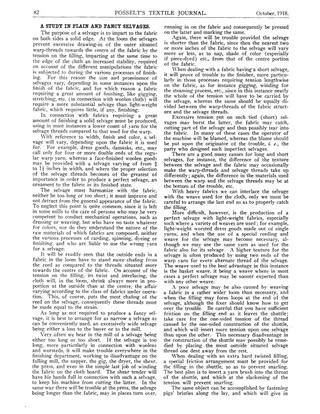
A Study in Plain and Fancy Selvages
Article · 2 pages · weaving drafts
An article from Posselt's Textile Journal (October 1918) on the purpose, construction and faults of selvages in woven cloth, especially woolen and worsted goods. It covers selvage width and yarn choice, problems caused by selvages that are too long or too short in finishing, and loom causes of poor selvages such as shuttle tension, temples and filling stop motion. A section on fancy selvages gives two drawdown diagrams: a 6 by 4 basket selvage with a 6-harness twill, and a heavy-float selvage with a 3-harness twill. The article ends "To be continued." Two short unrelated items follow on the same pages.
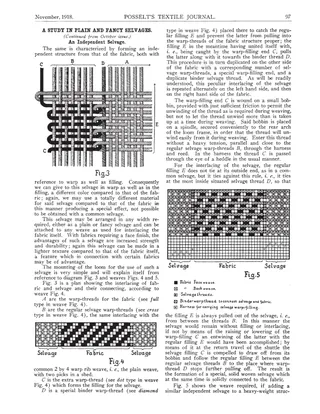
A Study in Plain and Fancy Selvages
Article · 2 pages · weaving drafts
Continuation of a series on selvage construction from Posselt's Textile Journal, November 1918, describing the independent selvage, a selvage built as a structure separate from the fabric, in its own color or material. It explains the loom setup with a plan diagram (Fig. 3) and two weave drafts (Figs. 4 and 5), including a version for a two-filling-system twill fabric. A second, unrelated article abstracts the Silk Association of America's 1918 report on silk's role in World War I, covering labor shortages, the War Industries Board, military uses of silk and wartime fashion fabrics.
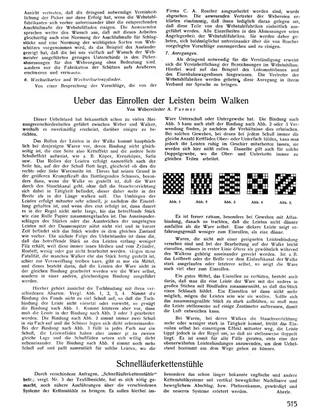
Ueber das Einrollen der Leisten beim Walken [On the Curling of Selvedges During Fulling]
Article · 1 page · German
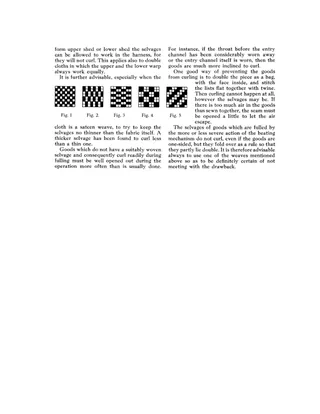
A short 1927 German trade-journal article by weaving manager A. Farmer on why selvedges curl or roll inward during fulling of woolen cloth, especially in twills, cross twills and satins with uneven face and back effects. He recommends weaving the selvedges in a balanced binding (plain weave and its variants, shown in five small diagrams, Abb. 1-5) instead of the ground weave. He also gives practical tips: keep selvedges as thick as the cloth, stretch the cloth during fulling, and sew the two selvedges together into a tube. The page also carries the end of a meeting report on loom standardization (pickers, pattern chain cylinders) and the start of a note on high-speed warp knitting machines by Aberle.
The Curling of the Selvages in Fulling
Article · 2 pages · weaving drafts
A short article by a weaving mill manager on why selvages curl during fulling, particularly in one-sided fabrics such as twills and sateens where weft floats lie on one side. It recommends weaving the selvages in a different, balanced weave (plain-weave derivatives shown in Figures 1-5) and offers practical fulling-room measures such as opening out the pieces, keeping selvages as thick as the cloth, and sewing the piece into a bag.
Modern Weaver, Vol. 1, No. 2 (October 1954)
Modern Weaver, October 1954
Periodical · 21 pages · weaving drafts
Issue no. 2 (October 1954) of Modern Weaver, a Canadian bulletin for handweavers published by Nilus Leclerc Inc. of L'Isletville, Quebec, with S.A. Zielinski as technical editor. It includes articles on achieving good selvedges (bobbin winding, warp tension, beating) and on the swivel weave, plus the start of a series on drafting that explains threading, tie-up and treadling. A glossary section (Angora through Batten and beyond) defines weaving terms, and there are sample drafts for 2-2 and 3-3 basket weave with warp, weft, sett and finishing details. The issue also has questions and answers on loom problems, a call for entries to the Canadian weaving exhibition in London, Ontario, a reed calculating table and advertisements for Clerco wool dressing and weaving lessons.
Weaver, Vol. 7, No. 2 (July 1942)
Weaver, July 1942
Periodical · 32 pages · weaving drafts
July 1942 issue of The Weaver, published by Emile Bernat & Sons, with eleven articles and features on handweaving technique. Mary Atwater covers finishing edges: fringes, knotted and braided fringes, and Maori rolled edges. Other pieces cover warp-face "Log Cabin" rugs and mats with drafts, a woven Christmas tree card, a classification of overshot pattern types after the Shuttlecraft Book, and six-harness summer and winter variations. The issue also has two Norwegian pickup bands, card-woven bookmarks and hair bands, "Humanesque Figures" variations, a questions and answers column, and Bronson (Barley Corn) weave drafts from old German manuscripts by Johann Schleelein.
Posselt's Textile Journal, Vol. 4, No. 3 (March 1909)
Periodical · 52 pages · weaving drafts
March 1909 issue of Posselt's Textile Journal, a Philadelphia trade monthly for the textile industries. Articles cover plain and fancy selvages with weave drafts, combining weaves, the Knowles fancy worsted loom, silk production including wild silk and artificial silks, silk warping with the Hover Swiss Attachment, and cotton spinning (ring and fly frames). Also included are wool scouring, decatizing, knitting splicers, Ciba and sulphur dyes, a German dyeing apparatus, a Dictionary of Weaves page of twelve-harness weaves, and a history of the Jacquard machine with the Halton firm. The issue also has mill news, a buyers' index, many machinery advertisements, and notes for a chart of weaves.
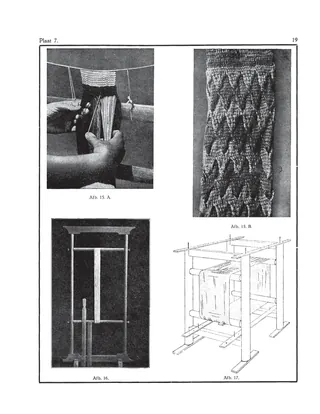
Egyptisch Vlechtwerk [Sprang]
Book · 36 pages · Dutch
A Dutch-language instruction manual on sprang, called "Egyptisch vlechtwerk" (Egyptian plaiting), by E. Siewertsz van Reesema, with a foreword by Elis. M. Rogge. It covers the history of the technique, the frame and its set-up, the hand movements, and methods for joining and finishing work, including fringes, tassels and cord fringe. It also covers increasing, holes, sticks, left-hand plaiting, and double-field work in two colors. Twenty plates of photographs and drawings show the process and finished pieces such as caps, bags, bottles, sashes and scarf ends.
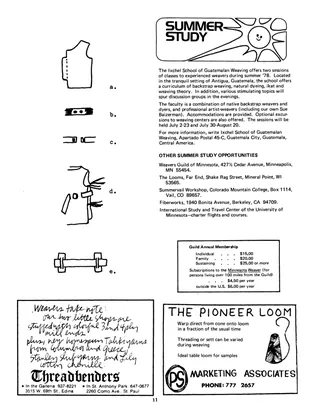
Garments - Seams, Surfaces and Closings for Garments
Article · 2 pages
A short article by Gloria Rither on designing handwoven shaped garments, with lists of ideas for seams, surface treatments, and closings that must be planned into the warp. It offers design notes and numbered idea lists (fringe and selvedge seams, textured borders, pickup, double weave pockets, tabs, slits, weft ties, toggles and latches), with line drawings of closing types, and ends with a four-title bibliography on costume and wearable weaving.
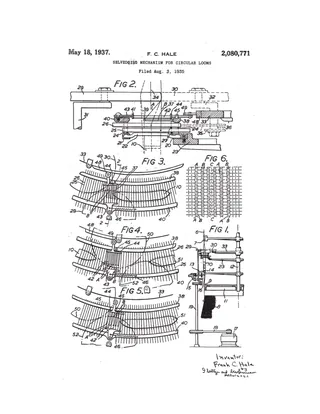
Selvedging Mechanism for Circular Looms, US Patent No. 2080771
Patent · 5 pages
US Patent 2,080,771 by Frank Corbyn Hale, assigned to Celanese Corporation of America, describes a shedding mechanism that weaves doup selvedges in circular looms. Pairs of warp threads cross over each other at every pick so the tubular fabric can be split lengthwise without the edges unravelling. The text covers the combs with eyed and long dents, the cam and spring that move the comb, shedding wheels and stops, and 10 claims, with one drawing sheet showing Figures 1 to 6.
Technical Perfection
Master Weaver, February 1952
Article · 1 page
A short essay from Master Weaver on how much technical perfection handweavers should pursue. The author refers to Mary Atwater's warning about deliberate mistakes and argues that handweaving should not imitate power-loom regularity. The essay discusses threading and treadling accuracy, edges, beating and knots, and contrasts the neatness of industrial weaving with the looser standards of European peasant and American Indian weaving.
Warp & Weft, Vol. 34, No. 7 (September 1981)
September 1981
Periodical · 9 pages · weaving drafts
September 1981 issue of Warp & Weft, a monthly from Robin & Russ Handweavers of McMinnville, Oregon. It includes the editor's column on a buying trip and a planned reprint of Marta Hoffman's The Warp Weighted Loom, an article on selvage problems and remedies, and the month's project: a rectangular pumpkin pattern in crackle weave on 4 shafts, with a threading and tie-up draft, treadling, and materials. It ends with classified yarn advertisements and a notice for a 1982 weaving tour of Australia and New Zealand.
Leaves from a Weaver's Notebook
Article · 3 pages
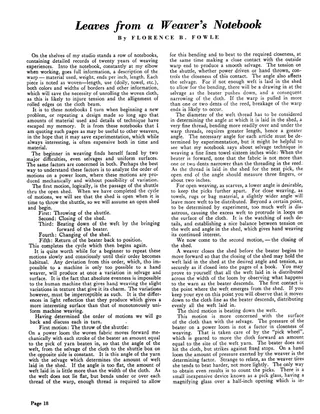
A 1939 article from The Weaver in which Florence B. Fowle draws on her weaving notebooks to advise beginners. She explains the cycle of loom motions (throwing the shuttle, closing the shed, beating, changing the shed, returning the beater) and how each affects selvages and cloth surface. She then works through a yarn-calculation example for a linen luncheon set, covering warp length, shrinkage allowance, warp yardage and filler estimation. A reference table of yarns lists suggested uses, ends per inch and yards per pound.
Practical Weaving Suggestions, Vol. VIII, No. 1 (c. 1958): Trouble Shooting for the Hand Weaver
Practical Weaving Suggestions, c. 1958
Periodical · 8 pages
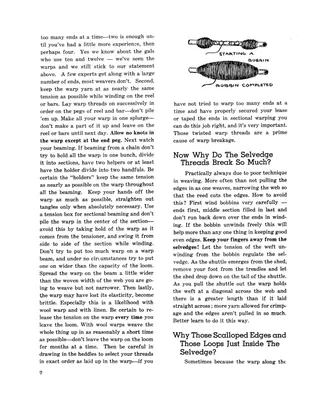
An issue of Lily Mills' Practical Weaving Suggestions written as a question-and-answer troubleshooting guide for beginning hand weavers. It covers causes and remedies for warp breakage, selvedge problems, warp and weft skips, uneven beating, centering the warp, tying on to the front apron, and weaving speed and rhythm. It also explains how to weave a pattern "as drawn in" when no treadling draft is given. The last page advertises Lily hand weaving yarns and the Weaver's Notebook.
Ribbons, Trimmings, Edgings, etc
Article · 1 page · weaving drafts
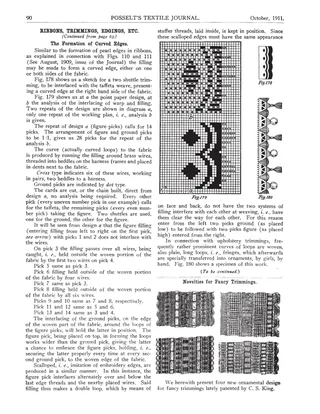
One page from Posselt's Textile Journal (October 1911), part of a continuing series on ribbons, trimmings and edgings. It explains how curved and scalloped edges are woven in two-shuttle taffeta trimmings by running the figure filling around brass wires set in heddles and dents beside the fabric. It gives a point paper design and an interlacing analysis (Figs. 178-180), with a pick-by-pick description of how the loops are held, and mentions upholstery trimmings with loops and fringes. A short note on patented fancy trimming designs by C. S. King begins at the end.
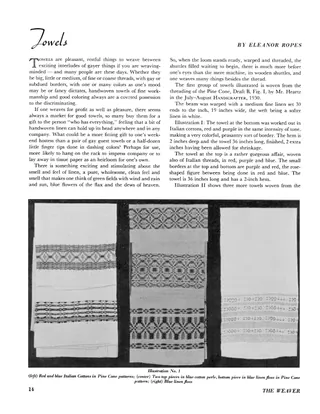
Towels
Article · 3 pages · weaving drafts
A 1936 article from The Weaver in which Eleanor Ropes describes handwoven linen and cotton towels, with notes on colors, threads, setting, hems, fringes and border treatments. The towels are woven from two threadings, Heartz's "Pine Cone" and Mrs. Atwater's "Drifting Shadows", and are shown in photographs. She also describes two old Turkish towels she owns. The last page gives both drafts and treadling instructions for the borders.
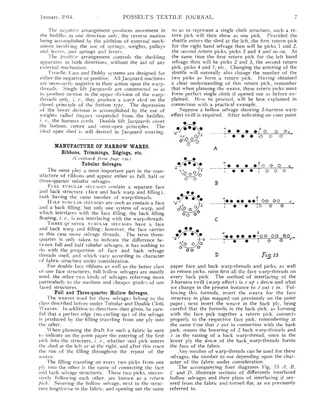
History of Dyeing
Article · 3 pages · weaving drafts
Three journal pages from Posselt's Textile Journal, January 1914, continuing a series on the manufacture of narrow wares (ribbons, trimmings, edgings). They cover full, half and three-quarter tubular (hollow) selvages, return picks, and how to plan the weave on point paper, with Figs. 53-59 showing hollow selvages in plain weave, 2x4 warp rib, 3-harness twill, 5-harness satin and 4-harness broken twill, with stuffer warp threads. Short items on flameproofing fabrics with alum and ammonium sulphate and on making absorbent surgical cotton follow. A brief passage on negative and positive shedding motions opens the first page.
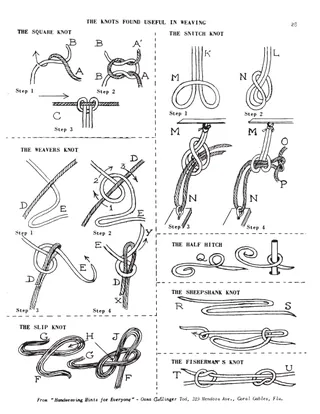
Manual of Helpful Hints for Handweavers
Monograph · 33 pages · weaving drafts
A compilation of practical hints for handweavers by Osma Gallinger Tod, made up of separate illustrated leaflet pages. Topics include weaving posture, loom placement, adjustment and tie-up, threading, making a bobbin winder and warping board, winding bobbins, piecing wefts, and achieving good selvages with threading rules for several weave structures. It also covers mending broken warps, shuttle placement, combined wefts, parallel weaving, ways to take cloth off the loom, hem and fringe finishes, joining stitches, tassels, rope, knots, drawing down drafts, and adapting reed dentage.
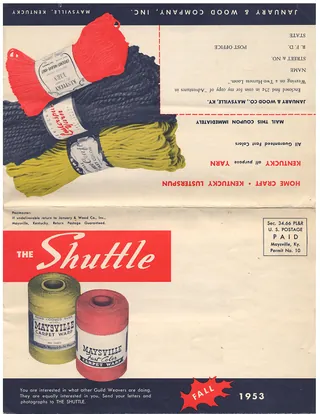
Shuttle (Fall 1953)
Shuttle, Fall 1953
Periodical · 8 pages · weaving drafts
Fall 1953 issue of The Shuttle, a promotional magazine for the Maysville Guild, published by January & Wood Co. of Maysville, Kentucky, for users of Maysville carpet warp. It includes readers' methods for keeping rug fringes from fraying in the washing machine, and Alice K. Cripps's directions for a colorful two-harness pattern called "Gentleman's Choice" (bath mats, bags, tray cloths, slipper cases). It also has profiles of guild weavers, a Kentucky State Fair rug contest report, and a Pharaohs Wheel rug draft. Much of the text promotes Maysville warp and Kentucky yarns.
Warp & Weft, Vol. 9, No. 10 (December 1956)
December 1956
Periodical · 9 pages · weaving drafts
December 1956 issue of Warp & Weft, a monthly handweaving newsletter from Robin & Russ Handweavers in Santa Barbara. It includes the editor's column on price increases and a chenille double-weave rug, a profile of weaver Karin Haakonsen Melander, and a project for an 8-harness Diamond Lace pattern in linen with threading, tie-up, treadling, uses and cost figures. Shorter items cover selvages for overshot, huck, Swedish lace and Bronson, the Mary Meigs Atwater Memorial Fund, classified ads and seasonal advertisements.
Master Weaver, No. 6 (October 1952)
Periodical · 15 pages · weaving drafts
Issue No. 6 (October 1952) of Master Weaver, a bi-monthly bulletin for advanced handweavers published by Z-Handicrafts in Fulford, Quebec. It opens with an editorial on renewals and a planned series of equipment-building descriptions, then an article on achieving good selvedges (bobbin winding, warp tension, beating rhythm, weft twist). It also includes a Louis Crommelin (1705) excerpt on dressing linen warp, an introduction to the drafting theory of double weaves (double-width and circular fabrics, double twill, stitched double cloth, stitching treadles and extra frames), and an article on designing modern block patterns in traditional weaves with profile drafts, worked through in summer-and-winter and 1:2 turned twill. The last page advertises an Encyclopedia of Hand-Weaving.
Shuttle-Craft Bulletin, Vol. XXX, No. 4 (April 1953)
Periodical · 17 pages
April 1953 issue of the Shuttle Craft Guild Handweaver's Bulletin, edited by Harriet Tidball. The main article gives instructions for nine handwoven stoles for different occasions (shopping, suit, afternoon, at-home, evening), with warp and weft materials, sett, widths, lengths, fringes and finishing, including Flossa knot fringes, bead-decorated weft, Atwater lace and a leno-woven triangular stole. Also included are a report on a California trip (a five-day seminar in Los Angeles, visits to weaving studios and guilds) and a survey of Guild membership and of handweaving periodicals of the time.
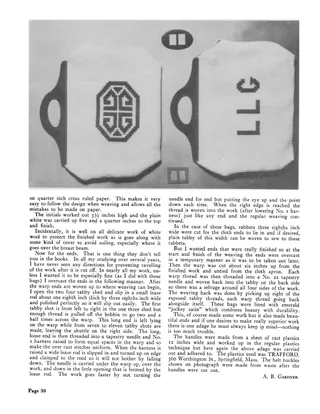
Adaptation of Dukagang to a Modern Work Bag
Article · 2 pages
A.B. Gardner describes adapting the Scandinavian Dukagang technique, as presented by Elmer Wallace Hickman in an earlier issue of The Weaver, to make a white wool work bag with an octagonal green medallion and initials. She explains her departures from Hickman's method: weaving right side up with a bobbin bin clamped to the cloth beam, weaving in pattern ends instead of knotting them, and carrying the pattern to the selvedges. She also covers warp and yarn choices, a twill threading, overcast and woven-back finishing of the ends, and plastic handles. A photograph shows the finished handles and belt buckles.
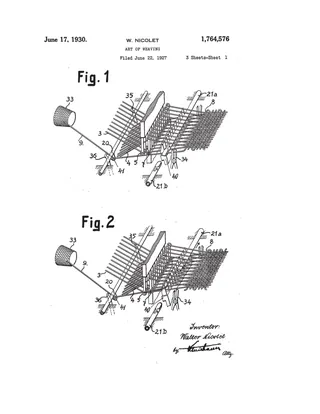
Art of Weaving, US Patent No. 1764576
Patent · 7 pages
US Patent 1,764,576, granted 17 June 1930 to Walter Nicolet of Leipzig, Germany, for a loom that weaves two fabrics' worth of shedding at once using two sets of warp threads and guide combs. A single rigid weft bobbin supplies weft that is entered into a closed front shed and an open rear shed as a hairpin loop, then cut off, which produces a proper selvedge. The scan has three sheets of drawings (Figs. 1-6 showing consecutive loom positions), the specification, and 17 claims covering the method and the loom.
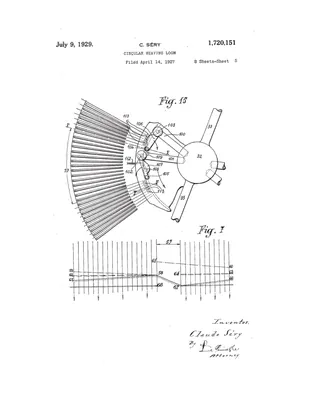
Circular Weaving Loom, US Patent No. 1720151
Patent · 14 pages
US Patent 1,720,151, granted July 9, 1929 to Claude S\u00e9ry of Aix-en-Provence, France, for a circular weaving loom with radially arranged warp threads. Rotating shuttles ride on a circular plate and are driven through the upper warp shed by rounded pulleys. The patent also describes an electric weft-break stop motion and a mechanism that cuts and folds the weft ends to form selvedges on flat fabric. It includes eight sheets of drawings, a description of the figures and 20 claims; the loom is described as set up for plain (calico) weave and for tubular fabrics, including weaving a covering directly onto a cable.
Doubling Stand
Master Weaver, January 1957
Article · 2 pages
A short how-to article from Master Weaver (No. 31, January 1957) on making and using a doubling stand, a simple accessory for winding two or more different yarns together for use as a single weft. It explains why combining yarns in one shed causes problems such as parallel running and loops at the selvedges. It gives dimensions for building the stand from boards, wire and a tube, and describes threading and set-up for tubes, bobbins and cones. It also covers twist and rewinding onto shuttle bobbins for neat edges.
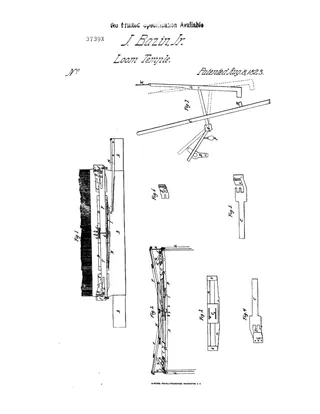
Loom Temple, US Patent No. X0003739
Patent · 2 pages
Patent drawing sheet and handwritten reference list for a loom temple patented by J. Bazin Jr. in 1823. The drawings show the temple assembly on cloth, its centre frame, left and right sliders, and a view of how the temples are worked in the loom. The reference page explains Figs. 1-7. No printed specification is available.
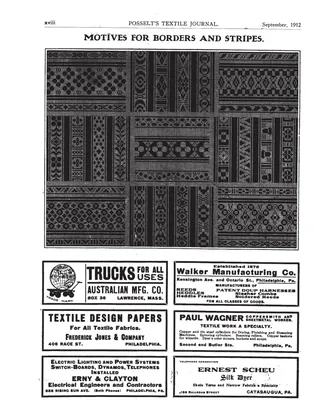
Motives for Borders and Stripes
Article · 1 page
A single journal page showing a large plate of black-and-white design motifs for textile borders and stripes, with geometric and floral repeats arranged in panels. The page carries no text discussion of the designs. The rest of the page is advertising from Philadelphia-area textile suppliers.
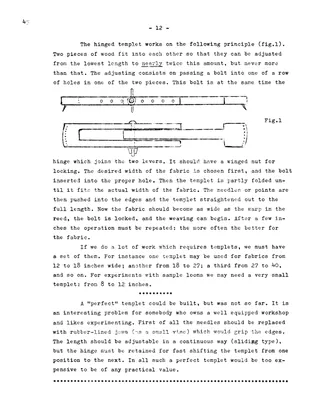
Shortcuts - Templets or Stretchers
Master Weaver, May 1959
Article · 3 pages
A short article from Master Weaver's Shortcuts series on templets (temples, stretchers) used in handweaving to keep fabric at width. It explains the origin of the names, how hinged and sliding templets are built and used, and their drawbacks such as wavy edges, needle holes and slower weaving. It lists five cases where a templet is justified (very low sett, elastic weft on stiff warp, wide weak warp, bound weaves, and cross or net weaves) and suggests an improved design with rubber-lined jaws. One figure shows a hinged templet.
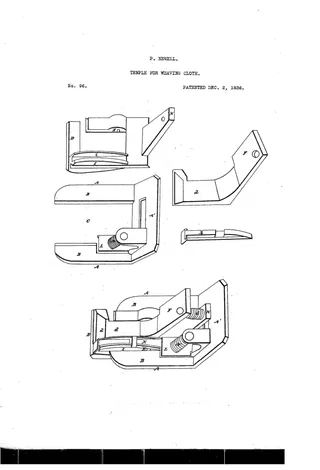
Temple for Weaving Cloth
Peter Newell · December 2, 1836
Patent · 2 pages
Reissued U.S. Patent No. 96 (reissued December 2, 1836) for an improved temple for weaving cloth, invented by Peter Newell of Waterford, New York. The specification describes an iron frame with guides, sliding upper and lower jaws that hold the selvage, a spring-closed mechanism opened by the lathe striking a projection, and a slide that lets the jaws recede to protect the reed when the shuttle stops. It lists three claims and is accompanied by a patent drawing showing several views of the parts.
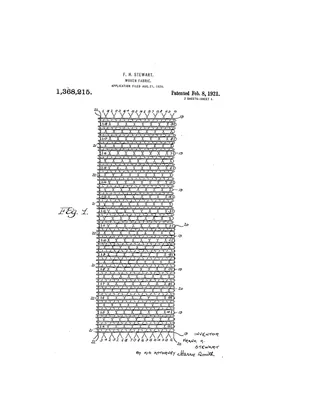
Woven Fabric, US Patent No. 1368215
Patent · 4 pages · weaving drafts
US Patent No. 1,368,215, granted to Frank H. Stewart of Elkins Park, Pennsylvania, on Feb. 8, 1921, for a woven fabric with reversely diagonal warps and transverse wefts. The fabric behaves like bias-cut cloth but has woven selvages and does not fray at the edges. The specification describes a continuous weft thread running to and fro, optional selvage warp and loop-locking threads, and a heddle arrangement on sliding bars and semicircular guides that moves the warps diagonally. Two sheets of drawings show the fabric structure (Fig. 1) and four successive heddle positions (Figs. 2-5), followed by three claims.
A Few Simple Braids
Article · 6 pages
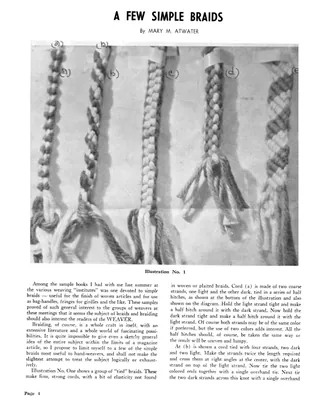
Mary Atwater introduces a selection of simple braids and knotted cords that handweavers can use for finishing woven pieces, bag handles, drawcords and girdle fringes. She gives step-by-step directions for tied braids (half-hitch and crowning knot), Solomon knot cords, looped or bight braids (twin-bight, Antique Sennit), multi-strand Indian, combing and Girdle of Rameses braids, and sailors' sennits. Photographs of sample cords and hand-drawn diagrams accompany the text, and she recommends a further reference on knots and rope work.
Macramé
Book · 49 pages
A DMC Library album on macramé by Th. de Dillmont, offering an introduction and instructions on materials, the cushion and accessories, and how to form the knots. Line drawings show flat knots, picots, shell knots, bars, collecting knots and joining methods. Written directions follow for fringes, grounds, insertions and gimps (including gimps worked with macramé bobbins and a gimp with a corner). The second half is a series of photographic plates with numbered samples of knotted bands and fringes, ending with a list of DMC threads.
Practical Weaving Suggestions, Vol. 3-58 (1958): Café Curtains
Periodical · 8 pages · weaving drafts
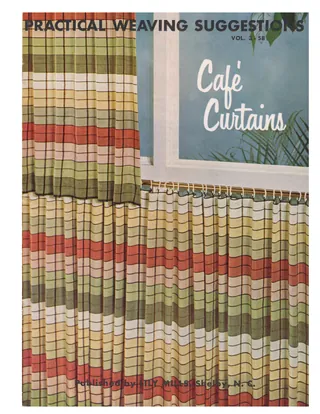
An issue of Lily Mills' Practical Weaving Suggestions with Lillian Hunter's directions for weaving five café (tier) curtain designs, with matching valances. It explains a method of attaching curtain rings to the selvage during weaving, using a weft loop. Each design gives a threading and tie-up draft, materials (mercerized cotton, pearl cotton, linen, novelty yarn), warping plan, sleying, weaving sequence, and finishing and hemming notes. Photographs show the finished curtains and fabric swatches.
Shuttleless Loom, US Patent No. 3613741
Patent · 23 pages
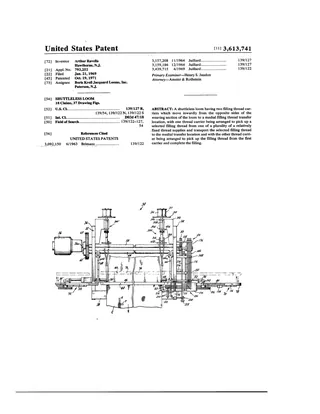
US Patent 3,613,741, granted 19 October 1971 to Arthur Ravella and assigned to Boris Kroll Jacquard Looms, Inc., for a shuttleless loom. Two filling thread carriers enter the shed from opposite sides and meet at a medial transfer point. The first carrier picks a selected filling thread from fixed supplies and the second carrier takes it and completes the pick. The patent has 12 sheets of drawings (37 figures) covering the frame, thread-selection fingers, gripper jaws, thread presentation and transfer mechanisms, and selvage-binding mechanisms. It also includes the written description and 18 claims.
Swap Shop
Article · 1 page
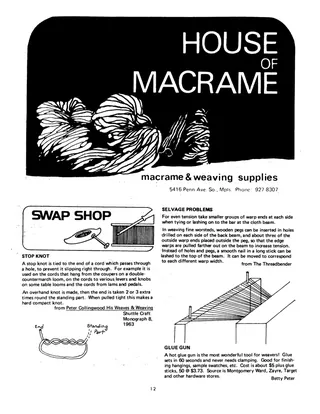
A one-page 'Swap Shop' column of weaving tips from Minnesota Weaver. It explains how to tie a stop knot for loom cords, gives two methods for improving selvage tension (smaller lashing groups, and pegs or a nail on the back beam for fine worsteds), and recommends a hot glue gun for finishing hangings and sample swatches. The page carries a House of Macrame advertisement header and credits to Peter Collingwood's Shuttle Craft Monograph and The Threadbender.
Triaxially Woven Fabrics of Uniform Compliancy and Porosity, US Patent No. 3874422
Patent · 8 pages
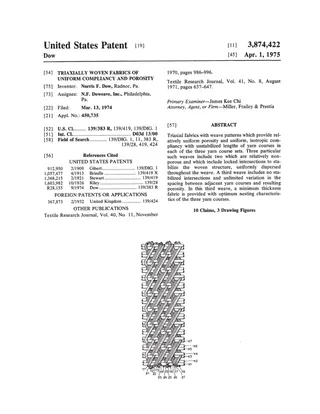
US Patent 3,874,422, granted April 1, 1975 to Norris F. Dow of N.F. Doweave, Inc., describes triaxially woven fabrics with uniform porosity and isotropic compliancy. Three weaves are described: the "bi-satin", the "double basic", and the "substrate" weave. They are built from three yarn sets (wefts plus 1 o'clock and 11 o'clock warps) crossing at about 60 degrees, and the text covers yarn paths, selvage configurations and ten claims. The fabrics are intended for reinforcing molded or curved articles. The scan includes two certificates of correction dated 1979 and 1983, and drawings of the three weave structures.
212 documents found