Textile Documents › Topic: Jacquard
408 documents found
Sort: 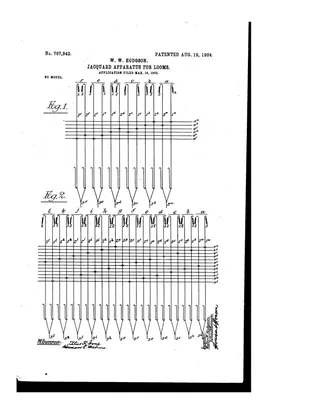
Jacquard Apparatus for Looms, US Patent No. 767942
Patent · 3 pages
US Patent No. 767,942, granted August 16, 1904 to Walter W. Hodgson of Philadelphia, for an improvement to double-lift jacquard machines. The needles are connected to hooks in pairs so that, without changing the card, the warps can be shed alike or differently on successive lifts, depending on how the card is punched. The patent has a sheet of drawings with two figures (six-pair and twelve-pair hook arrangements), a specification, and two claims. It is a divisional application of Serial No. 137,815, filed January 5, 1903.
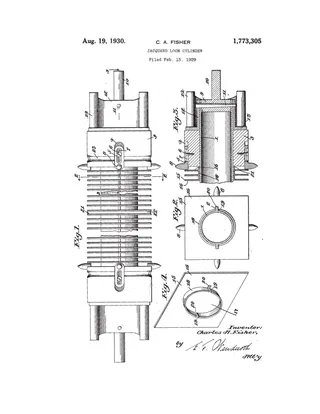
Jacquard Loom Cylinder, US Patent No. 1773305
Patent · 5 pages
US Patent No. 1,773,305, granted August 19, 1930 to Charles A. Fisher of Kannapolis, North Carolina (filed February 15, 1929), for an improved Jacquard loom cylinder. The cylinder is built from thin rectangular plates spaced along a shaft, so the needles enter the gaps rather than striking solid sides, and a damaged plate can be replaced without replacing the whole cylinder. The document has a drawing sheet with four figures, the specification describing the shaft, heads, pins for card tapes, spacing flanges and collars, and 17 claims.
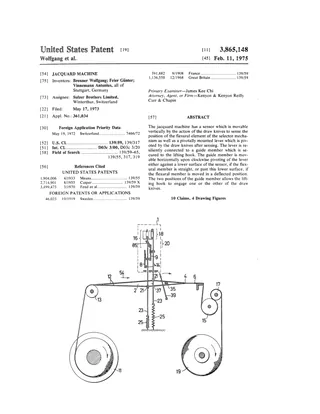
Jacquard Machine, US Patent No. 3865148
Patent · 7 pages
US Patent 3,865,148, granted Feb. 11, 1975 to Sulzer Brothers Limited, describes a jacquard machine in which lifting hooks are shifted between two alternately moving draw knives. A sensor and a pivoted lever, together with a flexural control element (magnetostrictive or electrostrictive) that bends under an applied field, control the shifting. The patent explains the problem with earlier selector and transmission mechanisms, gives the objects of the invention, and walks through the operating cycle of a double-lift open-shed machine on a loom. It includes three sheets of drawings (Figs. 1-4) and 10 claims.
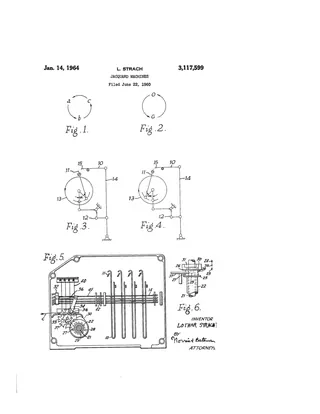
Jacquard Machines, US Patent No. 3117599
Patent · 4 pages
US Patent No. 3,117,599 (granted Jan. 14, 1964, filed June 22, 1960) by Lothar Strach of Heidelberg, Germany, describing a mechanism for reverse operation of Jacquard looms. After a weft breakage the loom must be run backwards to remove weft picks, and the correct pattern card must be returned to the reading position for each shed. The invention phases the governing cycle against the lifting cycle and uses a hollow shaft carrying pins and cams that shift axially to engage the card-feeding star wheel. This stores the card sequence for reverse and subsequent forward weaving. The document includes six patent drawings, a description, three claims and a list of cited foreign patents.
Jacquard Motion for Loom, US Patent No. 5937
Patent · 3 pages
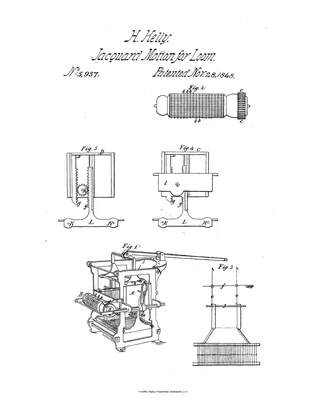
US patent specification No. 5,937, granted November 28, 1848 to Henry Kelly of Manayunk, Philadelphia County, Pennsylvania, for an improved Jacquard machine. It replaces the square four-sided cylinder and pattern cards with a round cylinder fitted with pins, plus a cogged wheel and two pairs of racks with pinions. The racks raise and sink the warp sheds equally, which suits the machine to power looms. The scan has one sheet of patent drawings, the specification text, and the claim.
Jacquard Reversing Mechanism for Looms, US Patent No. 3941161
Patent · 19 pages
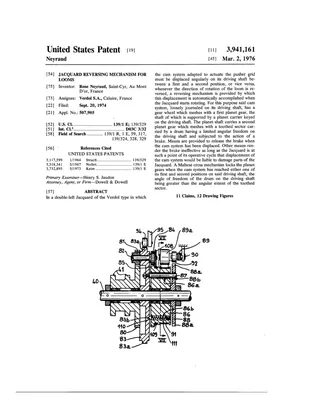
US Patent 3,941,161 (granted March 2, 1976) to Rene Neyraud, assigned to Verdol S.A., describes a reversing mechanism for double-lift Jacquards of the Verdol type. When the loom's direction of rotation is reversed, the mechanism automatically shifts the cam system that drives the pusher grid. It uses planet gears, a braked drum, a Maltese cross lock and an electromagnet, and it prevents the shift during the part of the cycle when it could damage the hooks. The scan has the USPTO web database printout with abstract, claims and description, followed by the printed patent with five sheets of mechanical drawings and a certificate of correction.
Loom Jacquards of the Double-Lift Type, US Patent No. 3835895
Patent · 8 pages
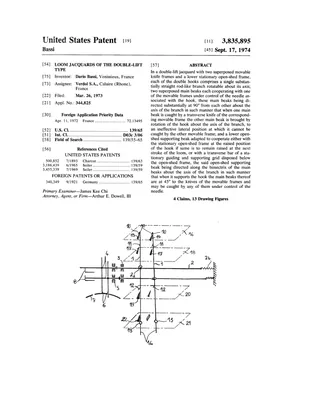
US Patent 3,835,895, granted 17 September 1974 to Dario Bassi and assigned to Verdol S.A. of France, for an improved double-lift jacquard. Each hook has a single rotatable rod-like branch with two main beaks set 90° apart and a lower open-shed beak. When one beak is caught by a knife frame, the other turns to an ineffective lateral position, so the pushing period of the needles can be shorter. This allows more time for cylinder rotation and card selection on high-speed looms. The document has the abstract, four sheets of mechanical drawings (13 figures), a description of the mechanism and four claims.
Three-Position-Jacquard Machine, US Patent No. 6581646
Patent · 21 pages
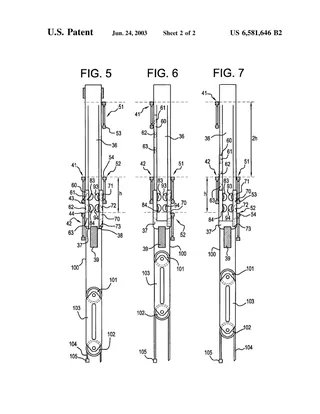
US Patent 6,581,646, granted 24 June 2003 to Andre Dewispelaere and assigned to N.V. Michel Van de Wiele, for a three-position shed-forming device used in jacquard machines. Two lifting blades with different lifting heights (h and 2h) move in phase, and a selection device lets a hook be carried by the upper blade, the lower blade, or neither. This gives upper, center and lower warp positions. A second embodiment pairs two such sets, moving in opposition, with a single pulley block element, for an open-shed machine. The document includes the abstract, claims, background discussion of prior patents (DE, EP), description of the figures and two sheets of mechanism drawings.
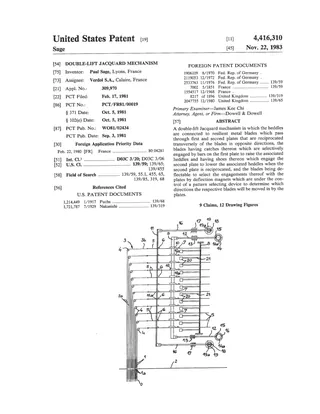
Double-Lift Jacquard Mechanism, US Patent No. 4416310
Patent · 16 pages
US Patent 4,416,310, granted 22 November 1983 to Paul Sage of Lyons, France (assignee Verdol S.A.), for a double-lift Jacquard shed-opening mechanism. Resilient metal blades attached to the heddles pass through two reciprocating plates. Electromagnets controlled by a pattern selecting device (perforated paper or magnetic band) deflect the blades so that each heddle is raised or lowered. The design is aimed at weaving fine, high-density fancy fabrics such as silk, and it is modular so units can be removed for lower warp densities. The scan includes a USPTO database printout with abstract, claims and description, plus the printed patent with five sheets of drawings (Figs. 1-12).
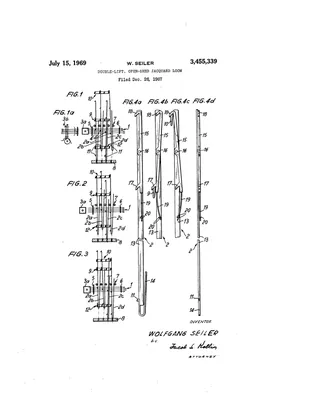
Double-Lift, Open-Shed Jacquard Loom, US Patent No. 3455339
Patent · 3 pages
US Patent 3,455,339, granted 15 July 1969 to Wolfgang Seiler of Rheydt, Germany, and assigned to Maschinenfabrik Oskar Schleicher. It describes a double-lift, open-shed Jacquard loom in which two sets of griffes move in opposite directions without their paths crossing, which shortens the loom. Each hook has a two-armed pivoting lever with two noses and a bar spring, so the hook is deflected by the main needles for a shorter time and wears less. The document has drawings of the hook and shedding positions, a description of the operating sequence, three claims and cited references.
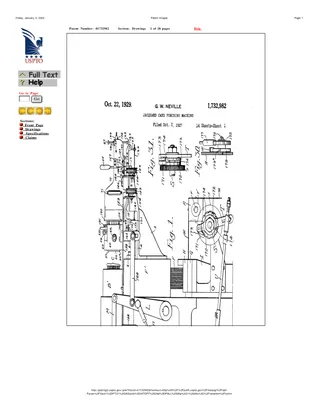
Jacquard Card Punching Machine, US Patent No. 1732982
Patent · 1 page
First drawing sheet (of 14) from US Patent No. 1,732,982 for a Jacquard card punching machine by G. W. Neville. It shows a side elevation of the punching mechanism with numbered parts, along with detail views Fig. 30 and Fig. 31. The scan is a printout from the USPTO patent image database and contains drawings only, with no specification text.
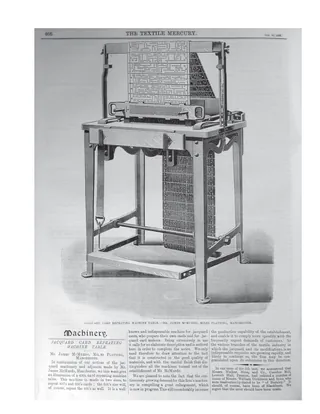
Jacquard Card Repeating Machine Table
Textile Mercury, 1889
Article · 1 page
A short trade notice from The Textile Mercury (19 October 1889) describing a Jacquard card repeating machine table made by Mr. James McMurdo of Miles Platting, Manchester, with an engraving. The machine is made in 400s and 600s sizes for repeating jacquard cards and is used by jacquard card makers and by manufacturers who prepare their own cards. The piece also notes the growing demand for McMurdo's machinery and a planned enlargement of his works. It ends with a correction about the location of loom makers William Dickinson and Sons.
Jacquard Connection for Weaving Mechanisms, US Patent No. 1076523
Patent · 11 pages
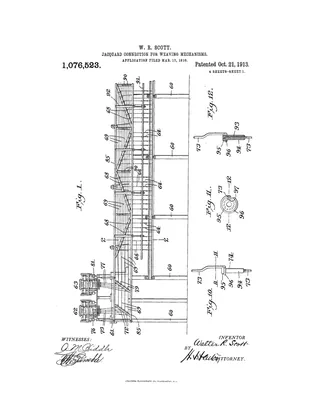
US Patent No. 1,076,523, granted 21 October 1913 to Walter R. Scott of Philadelphia, assignor to Joseph H. Bromley, for a jacquard connection for weaving mechanisms. It replaces the long textile cords between a jacquard machine and the thread-controlling jacks of a Nottingham lace machine with metal wires, chains and guide pulleys. This lets the jacquard sit low and to one side of the machine, and lets two jacquards control the same sets of jacks. The document has four sheets of patent drawings, a specification describing the lace machine and the connection mechanism, and six claims.
Jacquard Machine Equipped with Lifting Wires and Stationary Arresting Blades, US Patent No. 4041987
Patent · 7 pages
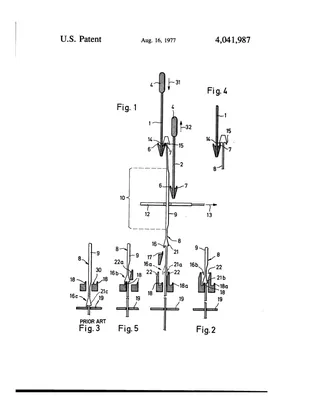
US Patent 4,041,987, granted August 16, 1977 to Robert Bucher of Frick, Switzerland, and assigned to Sulzer Brothers Limited. It describes an improvement to a double lift open-shed Jacquard machine with single-leg lifting wires. A stationary guide edge at the lower-shed arresting blade works with a projection on the lifting wire. It deflects the wire so that its arresting hook always couples with the blade, preventing the wire from dropping to the lifting wire board and stopping the loom. The scan includes a USPTO web database printout with abstract and claims, the printed patent front page, five drawing figures (one labelled prior art), and the two-column patent text with 3 claims.
Jacquard Machine with an Open Shed Carrying Hook Needles, Providing a Double Positive Action, US Patent No. 3289707
Patent · 6 pages
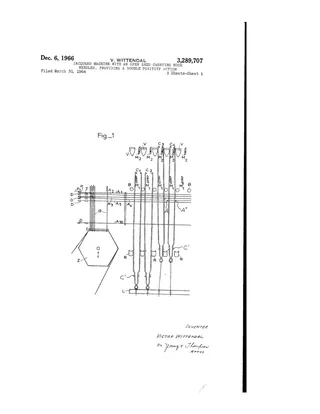
US Patent No. 3,289,707 granted to Victor Wittendal of Croix, France, for an open-shed Jacquard machine whose hook needles are moved by a double positive action. The patent describes flexible main needles with right-angle bends that are pushed by one series of bars and pulled by another, replacing springs and pulley-block arrangements. It also describes double-armed hooks with inward-facing upper noses, arresting bars, and deflecting members, and it gives three claims. Three sheets of drawings (Figs. 1-3) show the machine at successive stages of its cycle.
Jacquard Machine, US Patent No. 1332122
Patent · 4 pages
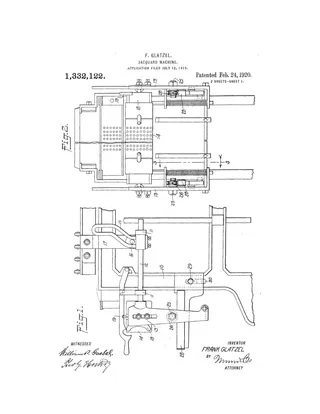
US Patent 1,332,122, granted 24 February 1920 to Frank Glatzel of Paterson, New Jersey, for an improvement to the Jacquard machine. Grooved, oil-filled rails bolted to the main frame carry rollers on the frame holding the card cylinder. The rollers take the cylinder's weight off the bearings and rods, which reduces binding and wear, and the attachment can be fitted to a standard machine without altering it. The scan has two sheets of drawings (Figs. 1-7), the specification and two claims.
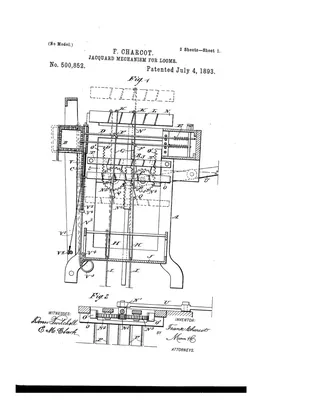
Jacquard Mechanism for Looms, US Patent No. 500852
Patent · 5 pages
US Patent No. 500,852, granted July 4, 1893 to Frank Charcot of Paterson, New Jersey, for an improved Jacquard mechanism. It uses a stationary grate and two sliding griffs moving toward and away from each other, which is meant to increase loom efficiency and reduce wear on the harness. The patent also describes a spring-loaded plate that locks the needles away from the pattern cylinder so the same card stays in place while the operator fixes threads. It includes two sheets of drawings (Figs. 1-4), the specification and seven claims.
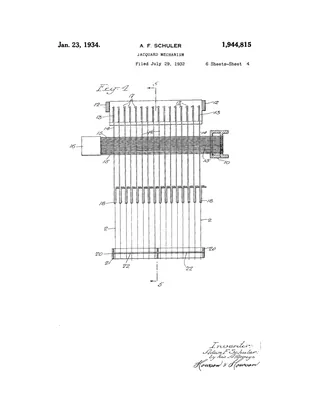
Jacquard Mechanism, US Patent No. 1944815
Patent · 10 pages
US Patent 1,944,815, granted January 23, 1934 to Adam F. Schuler of Philadelphia, for an improved Jacquard mechanism used on wide Nottingham lace-making machines. It adds a second 'rectifying' grid that descends as the lifting grid rises, taking up sag in the long harness cords running to the outer jacks. This removes the need for slack in the central cords and roughly halves the grid's travel, so the machine can run faster. The document has six sheets of drawings (Figs. 1-8) followed by the specification and four claims.
Jacquard Mechanism, US Patent No. 4566499
Patent · 14 pages
US Patent 4,566,499 (granted January 28, 1986) describes an electronic jacquard mechanism for controlling warp shedding on a loom. Solenoids are mounted directly on a printed circuit board, and their movable cores are fixed to the dropper needles, so the needles are selected by computer command rather than by punched pattern cards. The document includes the abstract, claims, description of the embodiments, and four sheets of patent drawings. It also includes a USPTO database printout of the text and a copy of the printed patent.
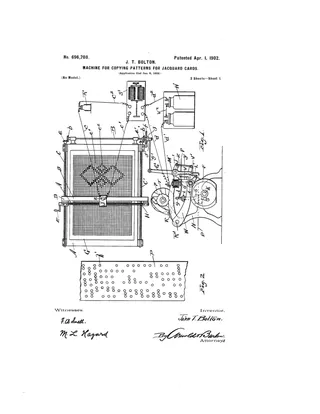
Machine for Copying Patterns for Jacquard Cards, US Patent No. 696708
Patent · 5 pages
US Patent No. 696,708, granted April 1, 1902 to John T. Bolton of Fall River, Massachusetts, for a machine that copies Jacquard design patterns onto punched paper strips. A selenium cell on a case moves square by square over a design laid out on a board, and its changing resistance with light and dark squares controls a relay and electromagnets that decide which punches strike. The document has two sheets of drawings (Figs. 1-5), the specification, and four claims.
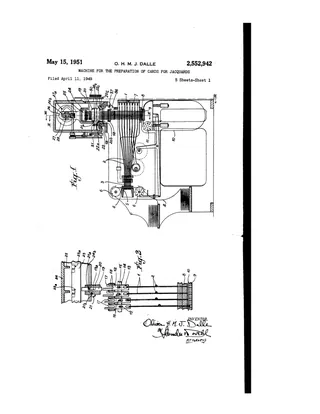
Machine for the Preparation of Cards for Jacquards, US Patent No. 2552942
Patent · 11 pages
US Patent 2,552,942, granted 15 May 1951 to Olivier H. M. J. Dalle of Ecully, France, assignor to Societe des Mecaniques Verdol, Lyon. It describes a machine for punching pattern cards or paper bands for Verdol-type Jacquard looms. An operator follows the design on a board with a pointer and eight finger keys, and electromagnets and hooks control the feeler needles of a punching device. The machine can also duplicate existing cards. The patent has five sheets of drawings, a specification describing the mechanism and its operation, and seven claims.
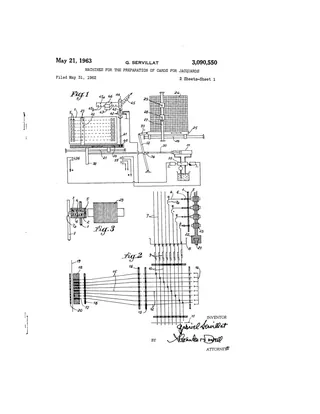
Machines for the Preparation of Cards for Jacquards, US Patent No. 3090550
Patent · 7 pages
US Patent 3,090,550 by Gabriel Servillat, assigned to Société des Mécaniques Verdol, Lyon, describes a machine for preparing Jacquard pattern cards, specifically continuous paper bands for Verdol Jacquards with 1,344 hooks. A carriage with an obliquely arranged row of electromagnets moves continuously past rows of retaining members that control the feeler needles of the punching device. The electromagnets are driven by photo-electric reading of a squared pattern drawing or by a perforated tape memory, through electronic "and" gate circuits. The document includes two sheets of drawings, the specification, nine claims and cited references.
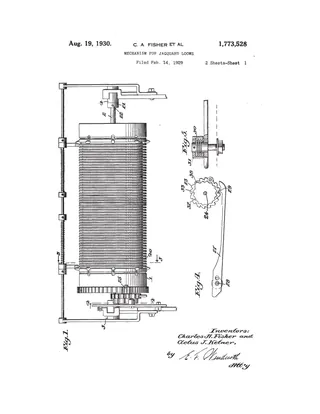
Mechanism for Jacquard Looms, US Patent No. 1773528
Patent · 6 pages
US Patent 1,773,528, granted 19 August 1930 to Charles A. Fisher and Cletus J. Ketner of Kannapolis, North Carolina, assignors to Cannon Mills Company. It describes a Jacquard card cylinder that advances in small steps of one row of perforations instead of a whole card, so one card serves 8 or 12 picks when weaving narrow figures, saving about 90% of cards. The mechanism uses a ratchet, pawl, and detent cam, and the cylinder has continuous circumferential grooves in place of individual holes so vertical misalignment with the needles cannot cause defects. The scan has two sheets of drawings, the specification, and seven claims.
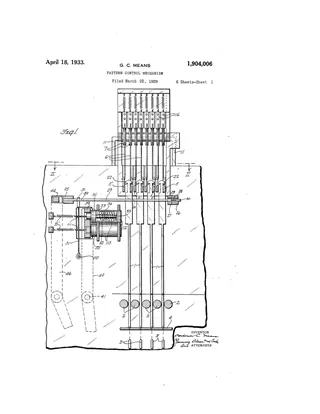
Pattern Control Mechanism, US Patent No. 1904006
Patent · 15 pages
US Patent 1,904,006, granted 18 April 1933 to Gardiner C. Means of Poughkeepsie, New York, for a pattern control mechanism for looms. It replaces the jacquard card with a photographic or light-and-dark pattern sheet read by a photoelectric cell, whose amplified current varies the field of electromagnets that release heddle-moving armatures. The document has six sheets of drawings (mechanical views and a wiring diagram), the specification, numbered claims, and a certificate of correction dated May 1933.
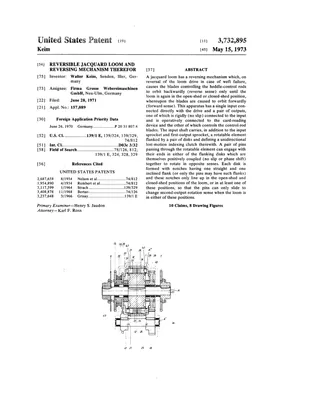
Reversible Jacquard Loom and Reversing Mechanism Therefor, US Patent No. 3732895
Patent · 9 pages
US Patent 3,732,895 (granted 15 May 1973) to Walter Keim, assigned to Firma Grosse Webereimaschinen GmbH, describes a reversing mechanism for a double-stroke open-shed jacquard loom. When the loom is reversed after a weft break, the blades that actuate the heddle-control rods first back up only to the open-shed or closed-shed position and then orbit forward again, so the rods and drop needles are not damaged. The mechanism uses an input shaft, a rotating element carrying spring-centered sliding pins, and two counter-rotating notched disks, and the card reader is reversed along with the drive. The document has the abstract, background, description, 10 claims and four sheets of mechanical drawings.
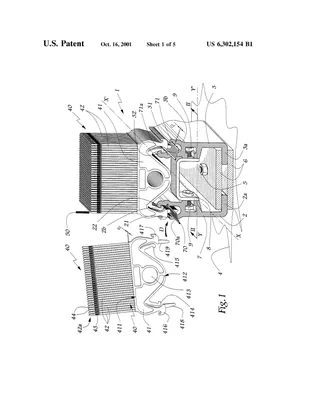
Spring Connection Device and Assembly in a Jacquard Harness, US Patent No. 6302154
Patent · 17 pages
US Patent 6,302,154, granted October 16, 2001 to Dario Bassi and Patrick Vessella and assigned to Staubli Lyon, describes a device and assembly for anchoring the return springs of a Jacquard harness to a loom frame. Each device has a common base carrying a row of rods (thirty-two in the described embodiment) that engage helical springs. Resilient hooks on the base snap onto beak-shaped rails and can be unhooked with a tool, so single devices can be installed or replaced quickly. The document gives the abstract, claims, background on earlier designs, description of two embodiments, and five sheets of drawings. It is supplied in both a USPTO web printout and the printed patent.
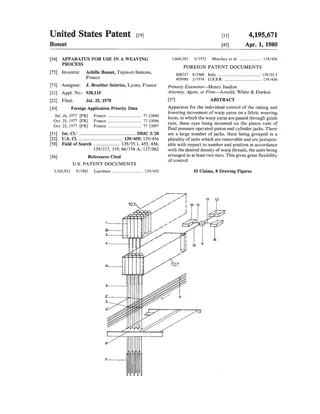
Apparatus for Use in a Weaving Process, US Patent No. 4195671
Patent · 21 pages
US Patent 4,195,671, granted 1 April 1980 to Achille Bossut and assigned to J. Brochier Soieries of Lyons, describes a loom apparatus for controlling each warp yarn individually. Each warp yarn passes through an eye on the piston rod of a fluid-pressure jack. The jacks are grouped in removable, juxtaposable units arranged in at least two tiers, so warp density can be changed (up to about 150 threads/cm) for jacquard-type silk patterning without a repeat across the fabric width. The scan has a USPTO web printout with abstract, claims and description, followed by the patent's original front page, five drawing sheets and the printed specification and claims.
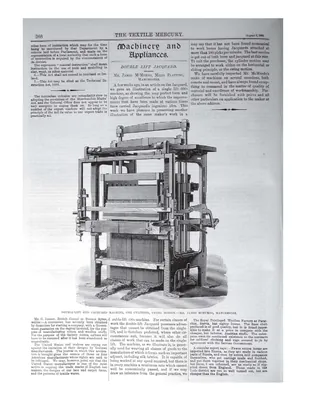
Double Lift Jacquard
Textile Mercury, 1889
Article · 1 page
A short trade piece from The Textile Mercury (3 August 1889) describing James McMurdo's double-lift 400s Jacquard machine with one cylinder and swing motion, made at Miles Platting, Manchester. It compares double-lift and single-lift Jacquards, notes a practical working limit of about 180 picks per minute, and mentions cylinder motion options. An engraving shows the cylinder, card chain, hooks and harness cords on a loom frame.
Electric Loom
Article · 1 page
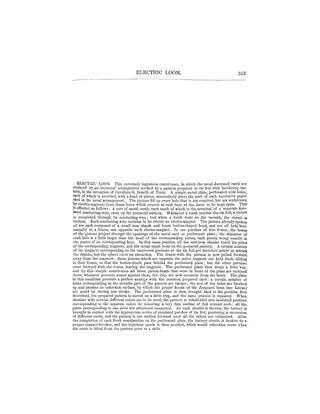
A one-page encyclopedia entry describing Cavaliere G. Bonelli's electric loom, which replaces Jacquard punched cards with an electromagnetic arrangement. A pattern made of tin foil and insulating varnish is read by a metal comb, and electro-magnets position pistons in a perforated plate that stands in for the card. It also explains how multiple colors and shuttles are handled and how sparking is avoided.
Electric Loom, US Patent No. 12050
Patent · 11 pages
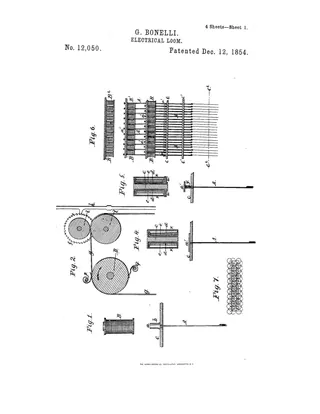
US Patent No. 12,050, granted December 12, 1854 to Gaetan Bonelli of Turin, Sardinia, for operating looms by electricity. It replaces the punched cards of the Jacquard machine with electro-magnets that hold up the hooks and healds. The pattern is carried on a varnished metal cylinder or sheet, or set up with type-like pieces in a grate, which opens or breaks the current to each magnet. The text covers magnet and hook arrangements, ratchet and lever mechanisms for advancing the pattern cylinder, comb contacts, and methods for multicolor wefts such as shawls. Four sheets of drawings (Figs. 1-24) precede the specification and claims.
Improved Jacquard Card Repeating Machine and Peg and Lace Hole Cutting Machine
Textile Mercury, 1889
Article · 3 pages
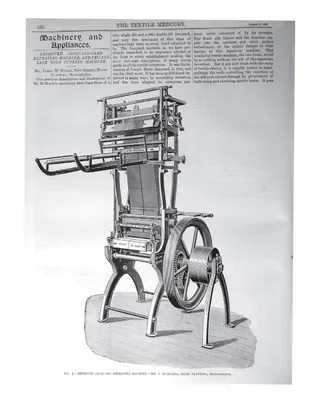
A trade-journal article from The Textile Mercury (31 August 1889) describing James McMurdo's improved Jacquard card repeating machine and his companion peg and lace hole cutting machine, both made in Miles Platting, Manchester. It explains how a jacquard mounted above the punches operates them automatically to duplicate sets of cards (about 40 cards per minute), and how the second machine cuts peg and lace holes in blank cards. Two engraved illustrations accompany the text. The scan also includes the start of a 'News in Brief' column on Lancashire and Yorkshire mills.
Jacquard
Article · 1 page · French
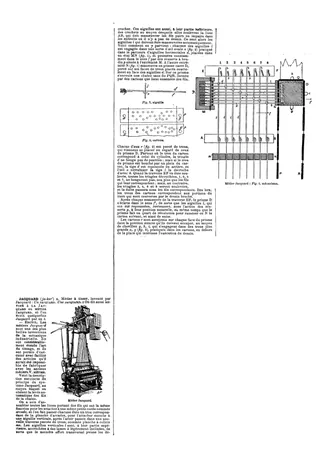
A one-page French encyclopedia entry on the Jacquard loom from the Nouveau Larousse Illustré. It gives the definition and spelling variants, then explains how the Jacquard mechanism automatically lifts warp threads using vertical needles, horizontal needles, a rotating prism and a chain of punched cards. The page includes an illustration of the loom with detail figures of the mechanism, a needle and the cards.
Jacquard Apparatus, US Patent No. 551510
Patent · 10 pages
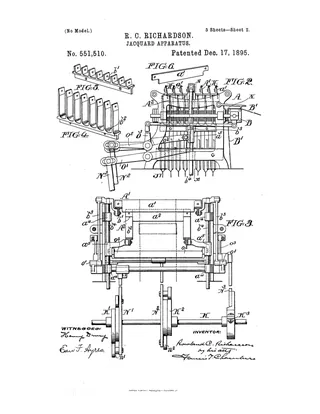
US Patent No. 551,510, granted December 17, 1895 to Rowland Creasey Richardson of Philadelphia, for an improved double-lift Jacquard apparatus. One set of cards indicates the hooks for two sets of griffs at once, and the griffs are raised partway to hold the selected hooks in place. A single jacquard can then do the work of two, or run at half the speed, which suits Nottingham lace-curtain and upholstery looms. The patent has five sheets of drawings (Figs. 1-24) and a specification with eight claims. It describes the lace-loom mechanism, including shuttles, guide-bars and pattern threads, and explains stitch formation (net, clothing, shading) in diagrams.
Jacquard Loom
Zell's Encyclopedia, 1876
Article · 1 page
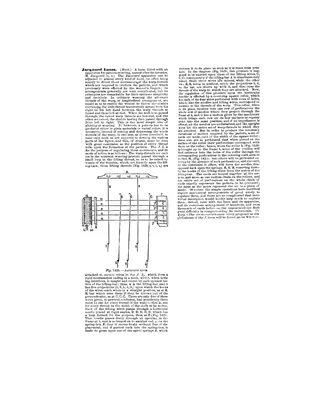
A one-page encyclopedia entry explaining the Jacquard loom and how its apparatus controls the warp threads to weave patterns. It describes the lifting bar, hooked lifting wires, horizontal needles and springs, and the rotating square roller covered by perforated cards that select which warp threads rise. A diagram (Fig. 1429) illustrates the mechanism, and the entry compares the card chain to musical notation.
Jacquard-Harness of a Weaving Machine, US Patent No. 4057084
Patent · 11 pages
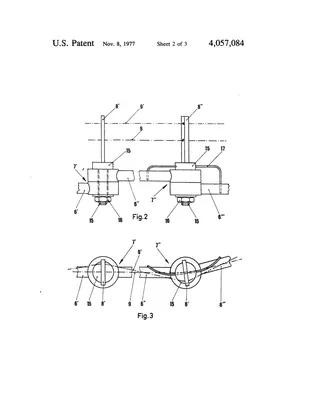
US Patent 4,057,084 (granted 8 November 1977) for an improved Jacquard harness on a weaving machine, specifically the edge or name-weaving Jacquard that weaves names and trademarks into fabric selvedges. Rigid connecting rods joined by pivotal joints carry comber boards with mirror-image guide bores, so heddle spacing can be adjusted for different fabric widths without retying the harness cords. The scan holds the USPTO web printout (abstract, claims, description) and the original patent print with three sheets of drawings (Figs. 1-4).
Loom for Weaving Figured Fabrics, US Patent No. 7861
Patent · 6 pages · weaving drafts
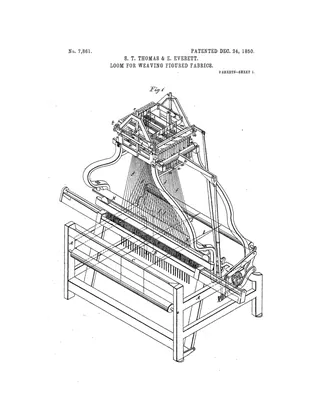
US Patent No. 7,861, granted December 24, 1850, to Samuel T. Thomas of Lowell and Edward Everett of Lawrence, Massachusetts, for an improved Jacquard loom for weaving figured fabrics. It replaces the knot-cord with horizontal harness bars that carry the mail cords (heddles), so the warp strain is more even in broad work and mountings can be changed more easily. It also describes a mechanism that rotates the pattern prism with a compound slide-rod and pawl movement. The document has three sheets of patent drawings, the specification and two claims.
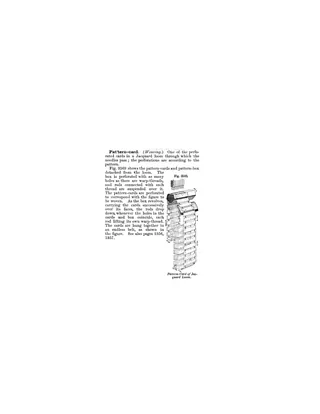
Pattern-Card
Article · 1 page
A short dictionary entry defining the pattern-card of a Jacquard loom: a perforated card through which the needles pass, with holes arranged according to the pattern. It explains how the cards, hung in an endless belt, revolve over a perforated box so that rods drop where holes coincide and each rod lifts its warp-thread. Illustrated with an engraving (Fig. 3569) of the pattern-cards and pattern-box detached from the loom.
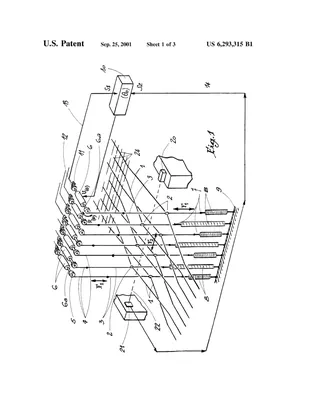
Process and Device for Positioning Weaving Loom Warp Yarns, US Patent No. 6293315
Patent · 16 pages
US Patent 6,293,315 (granted 25 September 2001) assigned to Staubli Faverges, describing a process and device for positioning warp yarns on electronically controlled weaving looms, especially Jacquard looms. A detector common to many warp yarns (laser beam and cell, filiform sensor, or movable contact carriage) senses when a yarn reaches a set position, and the actuator control parameter at that moment is used as a control point. This replaces manual levelling of the harness. The scan includes a USPTO web database printout with claims and description, plus the printed patent with three sheets of drawings.
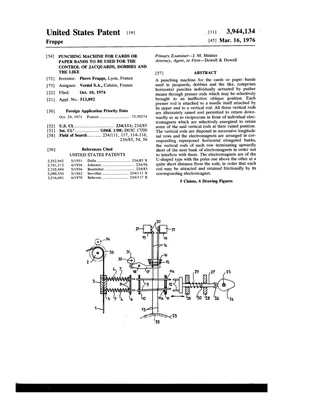
Punching Machine for Cards or Paper Bands to be Used for the Control of Jacquards, Dobbies and the Like, US Patent No. 3944134
Patent · 12 pages
US Patent 3,944,134 (granted March 16, 1976) to Pierre Frappe of Lyon, assigned to Verdol S.A., describes a machine for punching the cards or paper bands that control jacquards and dobbies. Horizontal punches are driven through presser rods selected by vertical retaining rods, which are held in place by banks of U-shaped electromagnets receiving signals from a photo-electric reader or other source. The scan includes a 2001 USPTO web printout of the full text, the printed patent with claims, and four sheets of drawings (Figs. 1-6).
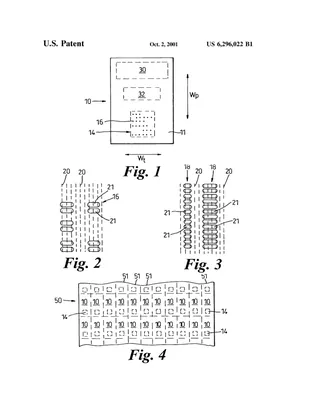
Woven Fabric with Machine-Readable Code, US Patent No. 6296022
Patent · 8 pages
US Patent 6,296,022 (granted 2 October 2001) to John Charles Lowe, assigned to J&J Cash Limited of Coventry, describes a woven label with a machine-readable code formed by an array of dots. The dots are weft floats on a plain-weave (taffeta) ground, woven on an electronically controlled jacquard loom, and can form a two-dimensional dot code or a one-dimensional bar code. The document gives the claims, a description, a yarn example (110 dtex textured polyester, 0.5 mm dots), and four figures showing the label, the dot floats and ribbons of labels woven side by side. It appears both as a USPTO web database printout and as the patent's own pages.
August, 1913
Article · 2 pages · weaving drafts
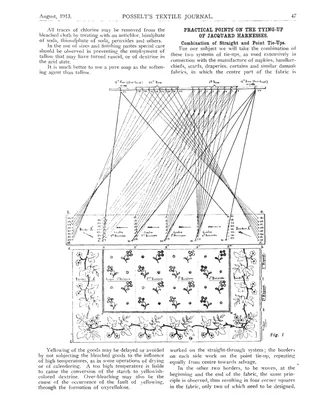
Two pages from the August 1913 issue of Posselt's Textile Journal (pp. 47-48) on tying up Jacquard harnesses. The article covers combining straight-through and point tie-ups for damask fabrics such as napkins, handkerchiefs and draperies, with worked needle and warp-end counts for 200 and 600 machines and diagrams of the tie-ups and fabric ground plans. A short note on waterproofing tulle with collodion, amyl acetate and gum-lac, and a few lines on removing chlorine and avoiding yellowing in bleached cloth, also appear.
Damask
Article · 1 page
A short encyclopedia passage describing the Jacquard mechanism, invented by Jacquart of Lyons for silk or muslin looms to replace draw-boys in weaving figured goods. It explains how the device groups the warp threads that rise together to form the figure and is operated by a pedal. It also notes that it came into general use soon after its invention in 1800 and gives its cost in France and the United States.
Improvements in Jacquards
Article · 3 pages
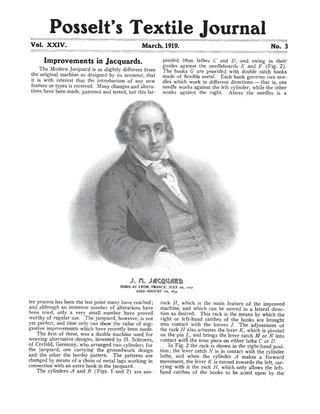
A March 1919 Posselt's Textile Journal article describing recent improvements to the jacquard machine. It covers H. Schroers' double-cylinder jacquard of Crefeld for alternating ground and border designs, and L. A. Garchey's Paris jacquard that works without a needle case or spring needle guides. Mechanical line drawings and a portrait of J. M. Jacquard accompany the text. The scan also includes a short piece on narrow ware looms built by the Fletcher Works.
The Jacquard
Textile Mercury, 1889
Article · 2 pages
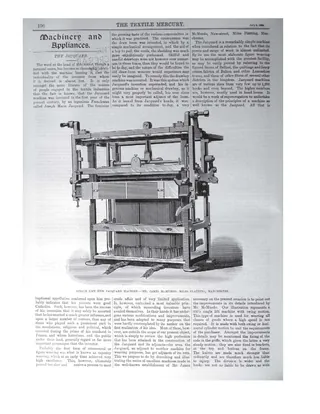
A trade-journal article from The Textile Mercury (6 July 1889) on the Jacquard machine, briefly tracing figure weaving from tapestry and the draw loom to Joseph Marie Jacquard's invention. It describes and illustrates a single lift 600s Jacquard with swing motion made by James McMurdo of Miles Platting, Manchester, and lists his improvements: griffe rods, stronger knives, wider division, open frame, improved hammer or drop, and cast iron grid. The second page carries unrelated trade news items on mills, machinery orders and the French textile export decline.
Jacquard Designing,Lesson 2
Article · 4 pages
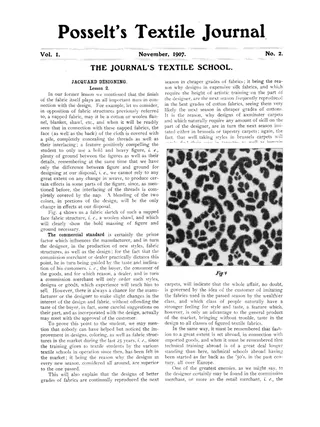
Second lesson in a serial course on jacquard design from Posselt's Textile Journal, November 1907. It discusses how fabric finish (especially napped fabrics) and commercial demand shape design choices, how to select designs for different fabric uses, and how jacquard machine capacity and harness tie-up limit the pattern. It also covers take-up and shrinkage in finishing, and how to prevent striping in all-over designs by sketching several repeats, illustrated with floral design figures (Figs. 4-7).
Jacquard Loom
Article · 1 page
A short dictionary entry from Knight's American Mechanical Dictionary describing the Jacquard loom, which uses a chain of perforated cards passing over a drum to control which warp threads are raised for figured weaving. It also gives a brief account of Jacquard's career as a Lyons straw-hat manufacturer, his improvement on Vaucanson's model, the opposition from Lyons weavers, and his rewards.
Jacquard Mounting
Article · 1 page · weaving drafts
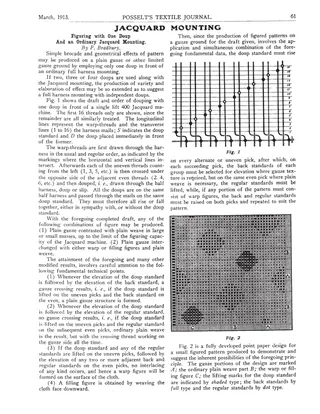
A short technical article explaining how to produce figured patterns on a plain gauze ground by using a single doup in front of an ordinary full-harness Jacquard mounting on a single-lift 400 machine. It describes the drawing-in and douping of the warp threads and lists the lifting rules that produce gauze, plain weave, and warp or filling figures. Fig. 1 is the threading and doup draft for the first 16 threads, and Fig. 2 is a point paper design showing gauze, plain, and figure areas.
Jacquards and Harnesses: Card-Cutting, Lacing and Repeating Mechanism
Book · 477 pages · weaving drafts
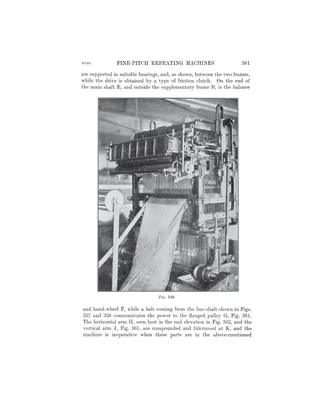
A technical treatise on Jacquard machines and their accessories, covering harness ties (straight-through, repeating, centre and mixed ties), the preparation of Jacquard cards, and the machines that cut, lace, stitch and repeat them. It covers hand and power card-cutting, reading boards, hand and mechanical lacing, peg- and lace-hole machines, and ordinary-, medium- and fine-pitch repeating machines. It is heavily illustrated with mechanical line drawings and photographs, plus some design and harness diagrams and a few weave-strip drafts. The volume also has a subject index and period advertisements from Jacquard and loom makers.
A Museum Treasure
Web Doc · 4 pages
A short web document describing a set of four hand-woven Jacquard silk panels of La Marseillaise, the French national anthem, designed by Eugene Grasset and woven in Lyon by Tassinari & Chatel in an edition of 300. It gives a brief history of the firm, founded in 1680, and describes each panel's imagery and the woven musical score. It notes the set came in its original cardboard portfolio and that the CVMT association acquired a copy.
November, 1913
Article · 2 pages · weaving drafts
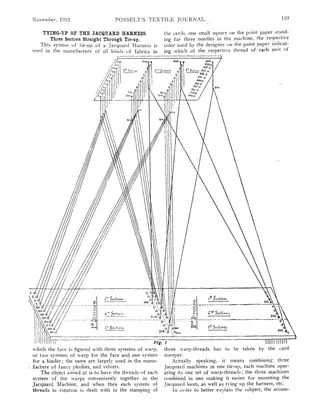
Two pages from Posselt's Textile Journal, November 1913, explaining the three-section straight-through tie-up of a Jacquard harness. It describes a 900-hook machine tied to the comber-board in the English system, how neck-cords and leashes are divided into sections, how the cords are leased, and how card stamping assigns each section to a warp set (three figure threads, or two figure threads and a binder). Two diagrams illustrate the harness and lease-rod threading. A short item on the depressed Scotch tweed industry and the effect of the American tariff follows.
408 documents found