Textile Documents › Topic: Expositions and exhibitions
287 documents found
Sort: 
Chicago's Part in the World's Fair
Article · 7 pages
A 1892 magazine article by Franklin MacVeagh on Chicago's role in organizing the World's Columbian Exposition of 1893. It explains the division of responsibility between the federal commission and the Chicago corporation, argues that Chicago bore a disproportionate share of the financing, and describes the site, buildings and arrangements. It also covers transportation, lodging, police and the city's water supply for visitors. It contains no textile or weaving content.
Crystal Palace
Harper's New Monthly Magazine, c. 1851
Article · 4 pages
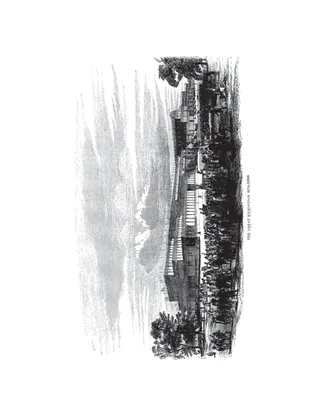
A mid-19th-century magazine article on the Crystal Palace, built in Hyde Park for the Great Exhibition of 1851 in London. It tells how Joseph Paxton's glass-and-iron design, inspired by his greenhouse for the Victoria Regia lily, replaced the Building Committee's own plan. It then gives the building's dimensions, construction methods, ventilation and drainage, interior color scheme, cost, and proposed future use. One page carries an engraving of the building's exterior.
Decoration of the Exposition
Article · 17 pages
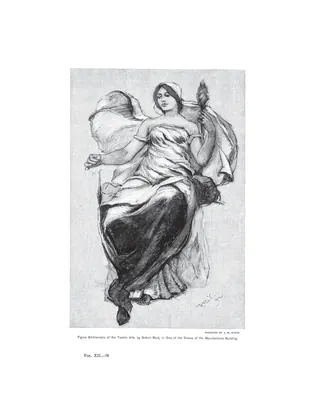
Article from Scribner's Magazine describing the architectural, sculptural, and mural decoration of the 1893 World's Columbian Exposition buildings in Chicago, written as the fair was nearing completion. It covers the classical architecture under D. H. Burnham, the painted domes and panels by American artists in the Manufactures and Liberal Arts, Agricultural, and Administration buildings, outdoor sculpture, and planned banners and flags. Textile content is limited to allegorical dome figures of the Textile Arts, Needle-work, and Spinning (with a spider-web motif) by Robert Reid, J. Alden Weir, and Kenyon Cox, and a panel on textiles by Walter MacEwen and Gari Melchers.
Exhibition in Paris
Living Age, September 28, 1884
Article · 4 pages
A travel-style account, reprinted from Chambers' Journal, of a visit to the French national industrial exposition in Paris. The author walks through the exhibition building and compares French and English manufactures, including ironware, machinery, glass, silver, furniture, pianos, paper, leather and shoes. Textiles get only a short passage near the end, covering lace, silk and gold brocades, carpets, woollens and cotton fabrics, with a note on the cotton manufacturer Richard Lenoir.
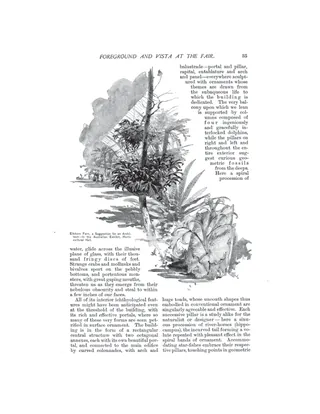
Foreground and Vista at the Fair
Article · 9 pages
A descriptive magazine article by W. Hamilton Gibson on the 1893 World's Columbian Exposition in Chicago, illustrated by the author. It describes the lagoon and Wooded Island landscaping by Olmsted and Codman, the rose garden, the Japanese building and dwarf trees, the sculptural ornament of the Fisheries Building, and the Australian elkhorn fern as a model for architectural design. It concerns gardens and architecture rather than textiles or weaving.
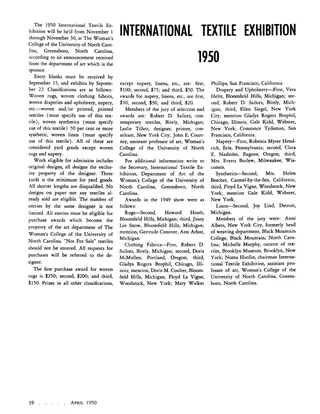
International Textile Exhibition 1950
Handweaver and Craftsman, April 1950
Article · 1 page
A short announcement of the 1950 International Textile Exhibition, held November 1-30, 1950 at The Woman's College of the University of North Carolina in Greensboro. It gives entry and exhibit deadlines, the classifications, eligibility rules, prize amounts and the jury members. It also lists the winners and jury of the 1949 show.
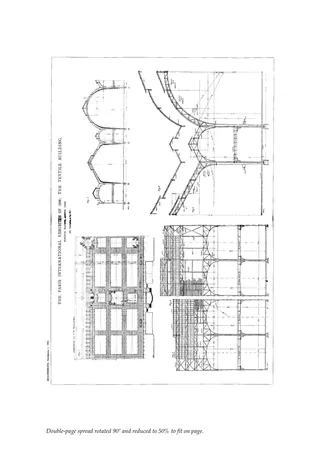
Paris Exhibition of 1900 (Textile Building)
Engineering Weekly, September 1, 1899
Article · 3 pages
An 1899 article from the engineering journal Engineering describing the Textile Building under construction on the Champ de Mars for the Paris Exhibition of 1900. It covers the building's location, facades, dimensions, naves, galleries and steel roof framing, along with the contractors' travelling erection staging and steam hoists. A plate of engineering plans, sections and elevations is included. It deals with the building's architecture and construction, not with textiles or weaving.
Paris Exposition: Notes and Impressions
Article · 18 pages
A magazine essay in Scribner's Magazine giving the author's impressions of the 1889 Paris Centennial Exposition. It discusses the Exposition's political significance for the French Republic, its unified architectural and spectacular design, the Eiffel Tower, the Cairo Street and other exotic attractions (Japanese rooms, Spanish gypsies, Javanese dancers), and a long section on French, American and Dutch painting. Textiles and weaving are not discussed in the sampled text.
Types and People at the Fair
Article · 8 pages
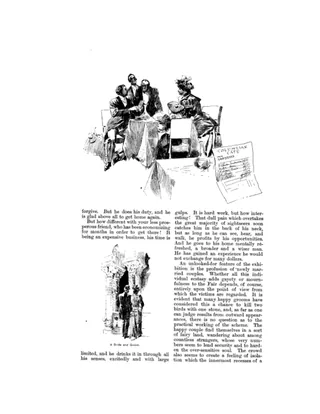
A humorous 1893 magazine essay on the visitors and atmosphere of the World's Columbian Exposition in Chicago. J. A. Mitchell comments on the crowds, American attitudes toward art, architecture and machinery, newlyweds, rolling-chair attendants, and the high prices of Chicago hotels and food. It is illustrated with pen-and-ink drawings by the author and Charles Howard Johnson, and has no textile or weaving content.
World's Fair at Chicago I: The Making of the White City
Article · 20 pages
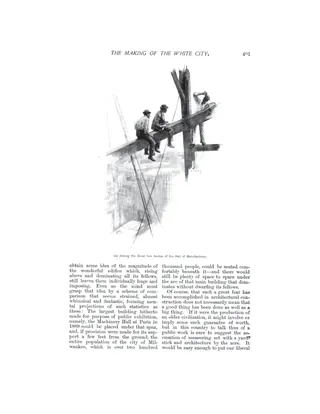
An illustrated article from Scribner's Magazine (October 1892) by H. C. Bunner describing the construction of the World's Columbian Exposition buildings at Jackson Park, Chicago, about a year before opening. It covers the transformation of the sand plain, the scale of the iron and 'staff' (plaster and jute fibre) buildings, the layout of grounds and lagoons, and the architects and workforce under D. H. Burnham. It is illustrated by W. T. Smedley and others with scenes of workmen and buildings, and ends with statistical notes on building dimensions. It has no textile or weaving content.
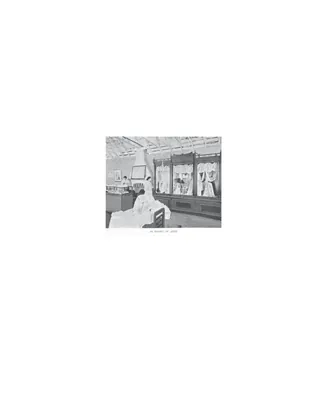
[An exhibit of laces at the 1893 World's Columbian Exposition]
The Book of the Fair, 1893
Illustration · 1 page
A single illustration page from The Book of the Fair (1893), captioned "An Exhibit of Laces." It shows a photograph of an exhibition interior with a white brick fireplace, a glass display case, and a tall glass-paneled wooden cabinet displaying draped lace garments and fabrics. The page has only a caption and no explanatory text.
Exhibitions
Master Weaver, May 1958
Article · 3 pages
An editorial from The Master Weaver (No. 39, May 1958) on how handweaving exhibitions and competitions should be run. It sets out six prerequisites for a good exhibition: freedom in classification of entries, recognition through diplomas, named and qualified jurors, explanations of decisions, anonymous entries, and final verdicts. It then gives five rules for weavers who enter: submit only recent work, don't aim at prizes, and make the work your own.

Picture postcard
Ephemera · 1 page
A single picture postcard showing Textile Hall in Greenville, South Carolina, captioned "Textile Hall, Greenville, S. C.—17". The image is a colorized view of a red-brick, multi-story building with an American flag and a sign reading "Textile Hall". The card has no weaving content and is useful mainly as visual documentation of a southern textile industry exhibition building.
Picture postcards
Texas Cotton Palace Exposition, 1911-1912
Ephemera · 1 page
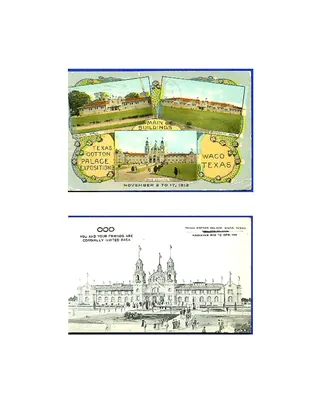
A single color picture postcard promoting the Texas Cotton Palace Exposition in Waco, Texas. The front shows a collage of views of the main exhibition buildings, with the 1912 dates (November 2 to 17). The back carries a printed invitation to return to the Cotton Palace, which gives dates in 1911.
The English Arts and Crafts Exhibition at the Royal Academy
Article · 9 pages
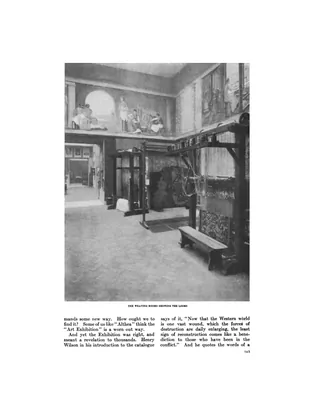
An open letter from architect and Arts and Crafts figure C. R. Ashbee to the editor of the American Magazine of Art, giving his impressions of the 1916 English Arts and Crafts Exhibition at Burlington House, the Royal Academy. He describes Henry Wilson's reorganization of the galleries into themed rooms (domus, ecclesiastical, civic, university, treasury, weaving room), comments on individual exhibitors and notable absences, and reflects on the role of the arts and crafts in a society disrupted by war. Illustrated with a floor plan and photographs of the rooms, including the weaving room with looms and the retrospective room with Burne-Jones and Morris tapestry.
[Glass Weaving]
The Book of the Fair, 1893
Illustration · 1 page
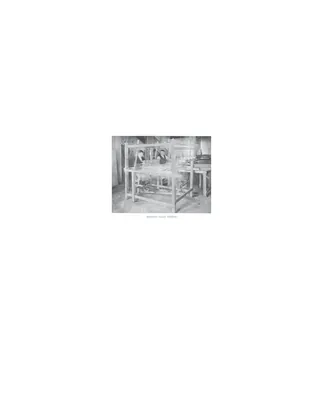
A single illustration captioned "Weaving Glass Fabrics" from The Book of the Fair (1893), the account of the World's Columbian Exposition in Chicago. It shows two workers at a wooden loom with glass threads as the warp, with a second loom visible at the right in a workshop interior. There is no technical or structural detail beyond the image and caption.
The Great Exhibition
North American Review, October 1852
Article · 30 pages
A review essay from the North American Review (October 1852) on the Great Exhibition of 1851 in London, based on the Official Catalogue, the Lectures of the Society of Arts and John Timbs's Year-Book. The author argues that the Exhibition showed few real novelties, worked more as a giant shop-window than as a scientific collection, and drew fewer foreign visitors than expected. He disputes the lecturers' claim that science drove industrial progress, citing the steam engine, ironmaking, the power loom and cotton machinery as the work of practical workmen. He also compares Indian and Turkish textiles favorably with European manufactures, and ends with digressions on juggling and mesmerism.
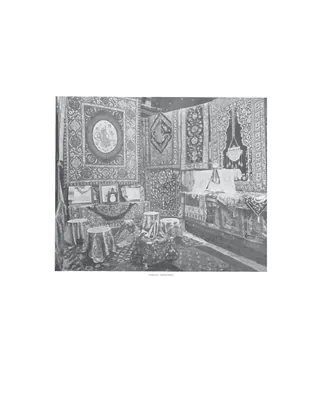
[Turkish Tapestry]
The Book of the Fair, 1893
Illustration · 1 page
A single illustrated page from The Book of the Fair (1893), the souvenir record of the World's Columbian Exposition in Chicago. It shows a photograph of an interior display of Turkish tapestries and rugs, with carpets hung on a wall, one bearing a large oval medallion with calligraphic script, and smaller rugs with floral and geometric patterns. The only text is the caption 'Turkish Tapestries'.
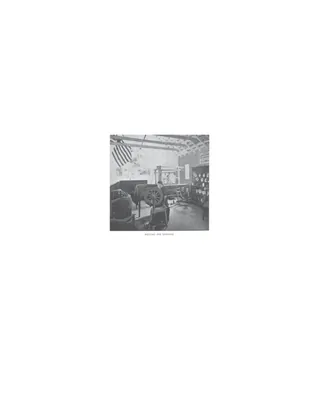
[Weaving and Spinning]
The Book of the Fair, 1893
Illustration · 1 page
A single illustration from The Book of the Fair (1893), captioned "Weaving and Spinning." It is a photograph of a workshop interior with exposed ceiling beams and an American flag on the wall. A large spinning wheel stands in the foreground with a seated person behind it, and a loom is visible in the background.
American Federation of Arts
Article · 4 pages
An article by Leila Mechlin describing the American Federation of Arts, founded at a Washington convention in 1909 to unify art organizations across the United States. It covers the Federation's Octagon headquarters, its chapters, its traveling exhibitions (including textiles and handicraft), its illustrated lectures (one on lace by Frances Morris), and its publications, The American Magazine of Art and the American Art Annual. It also mentions regional offices in New York and Lincoln, Nebraska.
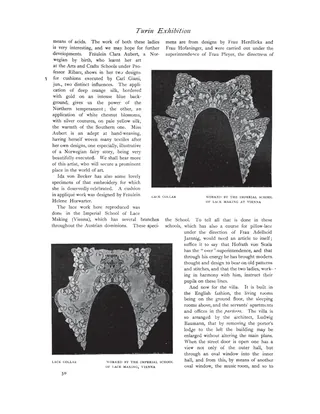
Austrian Section at the Turin Exhibition
Article · 6 pages
A 1902 International Studio article by A. S. Levetus reviewing the Austrian section at the Turin International Exhibition of decorative arts. It describes the Austrian pavilion and villa designed by Ludwig Baumann, furniture, glass, metalwork, enamel, leather and pyrogravure exhibits, and room interiors. Textile content is brief: cushions designed by Clara Aubert (who also hand-weaves), embroidery by Ida von Becker, and lace collars and a 'Sun' lace handkerchief from the Imperial School of Lace Making in Vienna and the lace school at Drosan, Bohemia.
Biggest Export Fair at Canton
Article · 4 pages
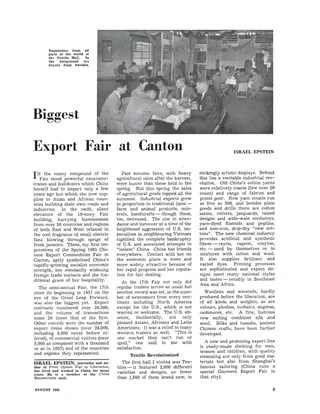
A 1965 magazine article from China Reconstructs describing the 17th (Spring 1965) Chinese Export Commodities Fair in Canton, from a Chinese government perspective. It surveys the halls and product lines on show, including textiles, machinery, chemicals, farm and animal products, metals and light industry, and reports comments from foreign buyers. The textile section mentions fabric varieties, yarn counts, synthetic fibres, dyes, woollens, silks and ready-made clothing. The article also carries political commentary on trade and diplomacy.
Conclusions
Master Weaver, September 1958
Article · 4 pages
An editorial from the Canadian bulletin Master Weaver (September 1958) criticizing the state of contemporary handweaving: poor looms and yarns, and exhibition juries with little knowledge of weaving. The author gives examples of technically fine work rejected by juries, quotes reader letters praising an earlier article on exhibitions, and notes some shows that adopted fairer judging practices. The last page begins a 'Shortcuts - 3' piece on multishaft looms, advising against buying looms with more than four shafts unless necessary.
International Cotton Exposition
Harper's Weekly, May 7, 1881
Article · 2 pages
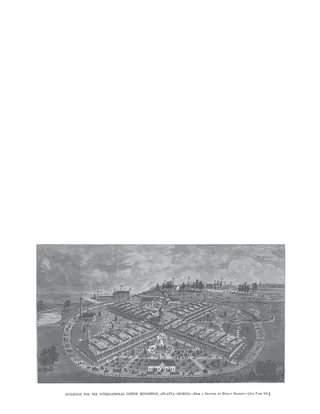
A Harper's Weekly article from May 1881 announcing the International Cotton Exposition to be held in Atlanta, Georgia, opening October 5 of that year. It explains that the show will feature cotton and other textiles, plus Southern food products, manufactures and minerals, and Northern manufacturers' exhibits. It also covers the hoped-for benefits (better agricultural machinery, closer ties between producer and manufacturer), Atlanta's rail accessibility, and the estimated $200,000 cost and fundraising by director-general H. J. Kimball. A bird's-eye engraving after Horace Bradley shows the exposition buildings.
Textile Industry at the Vienna Exhibition -- No. XI
Article · 2 pages
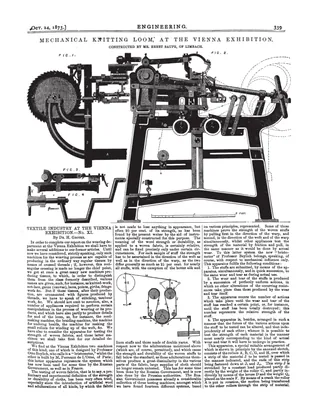
Part XI of a series on the textile industry at the 1873 Vienna Exhibition, by Dr. H. Grothe. It describes machines for testing the strength of woven fabrics, chiefly Professor Beylich's "bristometer" (friction and wear testing) and the Perreaux de L'Orne tension tester. It then turns to knitting machines, surveying German, French and other exhibitors and giving a detailed mechanical description of Ernst Saupe's knitting loom, illustrated with engraved figures.
Textile Industry at the Vienna Exhibition -- No. XIV
Article · 3 pages
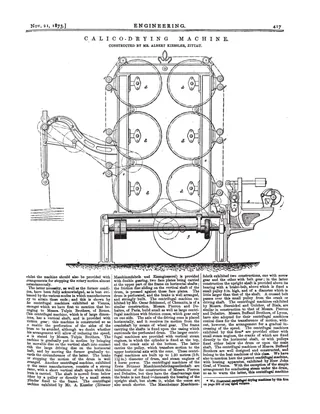
Installment No. XIV of Dr. H. Grothe's series on the textile industry at the 1873 Vienna Exhibition, printed in Engineering. It first describes F. Gebauer's apparatus for laying down the continuous band of calico in printing works, then turns to finishing machinery for removing water from fabric and drying it. It surveys centrifugal hydro-extractors and steam-heated cylinder and tenter drying machines from firms in France, Germany, Austria, Belgium and England, with an illustrated calico-drying machine by Albert Kiessler of Zittau.
Atlanta Cotton Exposition
Century, January 1882
Article · 5 pages
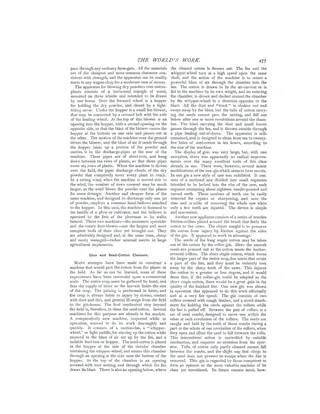
A five-page article from The Century (January 1882) reviewing the machinery and appliances shown at the 1881 Atlanta Cotton Exposition, with attention to what would benefit the cotton planter. It describes a seed-dropping cotton planter, horse-drawn sprinklers and dust-blowers for killing insects, seed-cotton cleaners, saw-gins and a roller-gin with steel combs, a gin-saw sharpener, a continuous self-packing baling press, and a proposal to feed a gin directly onto a carding machine. The focus is on cotton growing, ginning and baling rather than spinning or weaving.
Exhibitions of Interest to Handweavers
Handweaver and Craftsman, April 1950
Article · 5 pages
A news section from the first issue of Handweaver and Craftsman (April 1950) listing craft and design exhibitions for April through September 1950, followed by short reports on current shows and events. Items include the "Good Design" exhibition in Chicago, a profile of the Anni Albers textile exhibition from the Museum of Modern Art, news from Dorothy Liebes' studio, handweaving demonstrations at the J. L. Hudson Company in Detroit, Texas craft exhibition awards, and the Southern Highland Handicraft Guild's Craftsmen's Fair at Gatlinburg. Photographs show fabrics by Liebes, Albers and Antoinette Webster, and weavers from Greenfield Village.
Give Life to Your Exhibit
Article · 2 pages
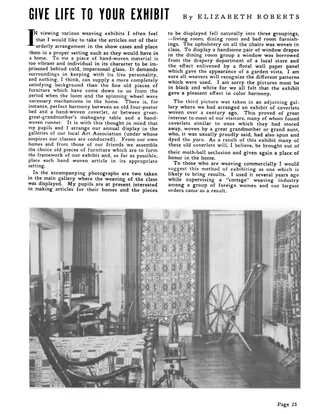
A short 1939 article in which weaving teacher Elizabeth Roberts argues for displaying handwoven textiles in room settings with period furniture rather than in glass cases. She describes her pupils' annual exhibit in a local Art Association gallery, with living room, dining room and bedroom groupings and upholstery and drapes woven in class. A separate gallery held coverlets woven over a century earlier, and she recommends the approach to weavers selling commercially. Photographs of the displays accompany the text.
Significant Aspects of the Atlanta Cotton Exposition
Century, February 1882
Article · 12 pages
A February 1882 magazine article reflecting on the 1881 International Cotton Exposition in Atlanta, Georgia, directed by H. I. Kimball. It argues the fair is neither truly international nor chiefly about cotton, but a showcase of new processes, machinery for ginning, baling, spinning and weaving, and cotton-seed treatment, and also of Southern minerals and resources. Much of the text discusses post-Civil War social and economic change in the South: attitudes toward slavery (quoting Senator Hammond), Black labor, planter credit and commission merchants, small-farm cotton growing, roller versus saw gins, cotton grading, and railway growth.
Textile Awards: Fourth A. I. D. Design Competition
Handweaver and Craftsman, April 1950
Article · 3 pages
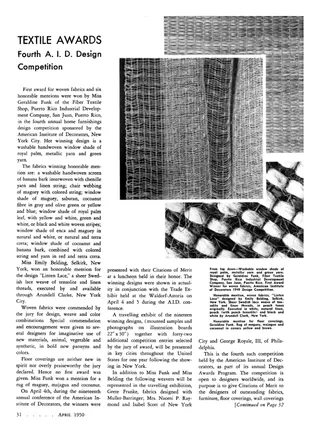
Report from the first issue of Handweaver and Craftsman on the fourth American Institute of Decorators design competition, in which Geraldine Funk of Puerto Rico won first award for woven fabrics with a palm window shade. It lists honorable mentions, the jury, and the traveling exhibit. Shorter news items follow on weaver Floyd La Vigne's one-man show, Sigvard Bernadotte's rugs, a Philadelphia Art Alliance exhibition, and the Virginia Highlands Festival. Photographs show winning fabrics, a Polish tapestry, a twill plaid, and a crackle afghan.
Textile Industry at the Vienna Exhibition -- No. II
Article · 2 pages
Second installment of a series by Dr. H. Grothe reviewing textile machinery at the 1873 Vienna Exhibition, focusing on the woollen industry. It surveys exhibited machines for wool washing, combing, carding and spinning of carded wool (self-actors, water-spinning frames, Avery's continuous spinner), plus card clothing and grinding apparatus, naming exhibitors from Germany, Austria, Belgium, England, Switzerland and the U.S. Detailed descriptions and illustrations are deferred to later installments.
Textile Industry at the Vienna Exhibition -- No. III
Article · 1 page
Third installment of a series by Dr. H. Grothe reviewing textile machinery at the 1873 Vienna Exhibition. It covers silk reeling, throwing and waste-silk spinning machinery from Italy, France, Switzerland, Germany and Austria, naming exhibitors and assessing their workmanship. It closes with brief remarks on the sparse cotton-spinning exhibits, notably Platt Brothers of Oldham and Rieter of Switzerland.
A Traveling Exhibit of Hand Weaving
Handicrafter, November-December 1931
Article · 1 page
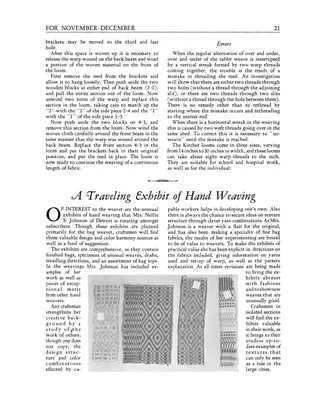
A short 1931 Handicrafter article describing a traveling exhibit of hand weaving circulated among subscribers by Mrs. Nellie S. Johnson of Detroit. The exhibits include finished bags, samples of unusual weaves, drafts, treadling directions and bag tops, with notes on yarns and warp set-up, and are meant as sources of design and color ideas for bag weavers. The page also carries the end of an unrelated piece on operating a Kircher loom, covering advancing the warp and correcting threading errors.
Arts and Industries of To-Day
Art Journal, 1898
Article · 4 pages
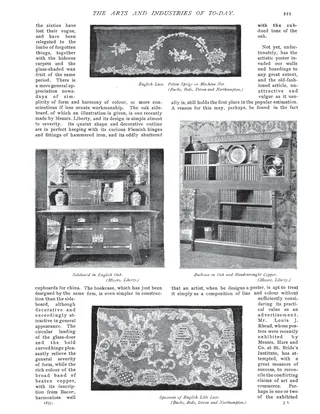
A review from The Art Journal of the Home Arts and Industries Association exhibition at the Royal Albert Hall, with illustrations of crafts from several schools and workshops. It covers Haslemere appliqué linen "peasant tapestry", Harris linen portière and frieze embroidery from the Cockermouth Mills, and English pillow lace (sprigs on machine net and English Lille) shown by the Bucks, Beds, Devon and Northampton stall. It also describes carved oak, repoussé copper and Liberty furniture, and ends with a note on Louis J. Rhead's posters.
Handweaving News (October 1940): Some Notes on the 1940 New York Worlds Fair, Connecticut Craftsman Society, and National Conferences of Handicrafts at Penland, N. C.
Periodical · 3 pages · weaving drafts
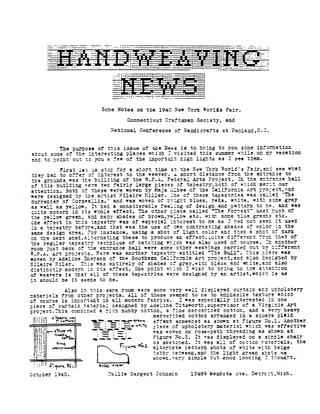
An October 1940 issue of a handweaving newsletter in which Nellie Sargent Johnson reports on her summer travels. She describes WPA Federal Arts Project tapestries and curtain and upholstery fabrics at the New York World's Fair, plus glass curtain and laid-in drapery pieces in the Finnish building. She also covers the Society of Connecticut Craftsmen sale and its jury questions on standards and originality, and the National Conference of Handicrafts at Penland, N.C. Short notices follow on loom plans, Bergman looms, regional craft groups, and an 8-harness threading idea. Sketches show a plaid warp arrangement, a rose-path threading, a glass curtain weave and a laid-in tree design.
The Java village Midway Plaisance. World's Columbian Exposition ...
Ephemera · 3 pages
A three-page promotional guide to the Java Village on the Midway Plaisance at the 1893 World's Columbian Exposition in Chicago. It walks visitors through the numbered houses and describes the crafts and daily life shown by about 125 Javanese residents, including weaving on a simple loom, batik wax-resist dyeing, embroidery, hat making, and metalwork. It also covers the theatre, gamelan, and the Serimpi dancers, and explains that the exhibit promoted Java tea and coffee.
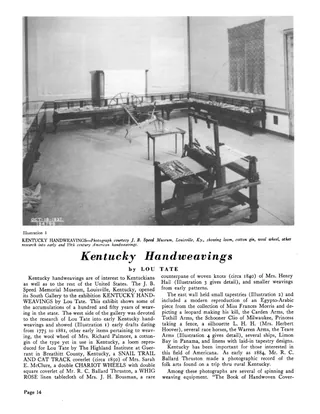
Kentucky Hand-Weaving
Article · 4 pages
An article describing the October 1937 exhibition Kentucky Handweavings by Lou Tate at the J. B. Speed Memorial Museum in Louisville. It covers her research into early Kentucky drafts and coverlets, the old equipment displayed, and her modern tapestries and heraldic weavings. It also notes Kentucky's weaving history, the exhibit's demonstrations and talks, and a quoted Courier-Journal review. Illustrated with photographs of the exhibit and woven pieces.
Textile Industry at the Vienna Exhibition -- No. IV
Article · 1 page
A single page from Engineering (5 September 1873) reporting on flax, hemp and jute preparation and spinning machinery at the 1873 Vienna Exhibition. It describes flax-breaking and scutching machines from Belgian, Austrian, Hungarian, German and American exhibitors, and a Reynolds-system spinning machine shown by T. Barraclough. It also notes the exhibits of Combe, Lawson and other firms, Dutch hand tools for flax, and wood-shaving and cane or straw preparation for plaiting and weaving.
Textile Machinery at the Paris Exposition
Engineering Weekly, April 27, 1900
Article · 4 pages
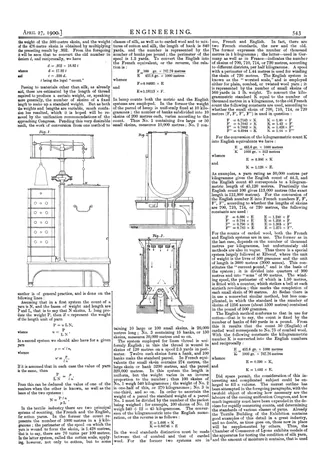
An installment of a serial report on the Textile Building at the 1900 Paris Exposition. It surveys the confusion among national systems for numbering yarn counts (silk, cotton, hemp, linen, combed and carded wool), with conversion formulas between French, metric and English systems, and mentions the planned international congress to standardize counts. It closes by describing the Lyons Chamber of Commerce's silk conditioning (drying) apparatus, from the 1840 inverted-bell stove through the 1883 and 1889 improvements, and promises a continuation.
Textile Machinery at the Paris Exposition
Engineering Weekly, November 23, 1900
Article · 2 pages
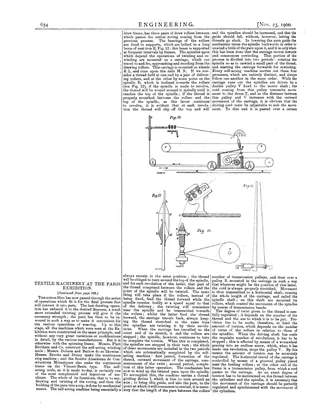
A two-page installment of a series on textile machinery shown at the 1900 Paris Exhibition. It explains the operation of the self-acting spinning mule (twisting, winding and cop formation) and the ring spinning frames of Brooks and Doxey and the Société Alsacienne, including the Vimont-Bezin traveller. It ranks the exhibiting countries for cotton spinning machinery and briefly outlines wool preparation (washing, oiling, carding, gill box, combing) and its machinery, with rankings for combed and carded wool machinery.
Textiles at Newark
Article · 2 pages
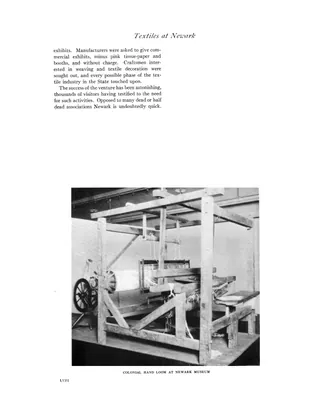
A short 1916 International Studio article describing the textile exhibition at the Newark Museum in New Jersey, organized under director John Cotton Dana. The exhibition traced textiles from fibre to yarn to cloth, showing spinning and weaving from primitive devices to modern machines, with a colonial loom, spinning wheels, colonial coverlets and homespuns. The author also covers how the museum involved club women, immigrant communities, schools, manufacturers and craftsmen. Illustrated with photographs of spinning wheels and a colonial hand loom.
Cotton Manufacture in the International Exhibition
Illustrated London News, August 9, 1862
Article · 3 pages
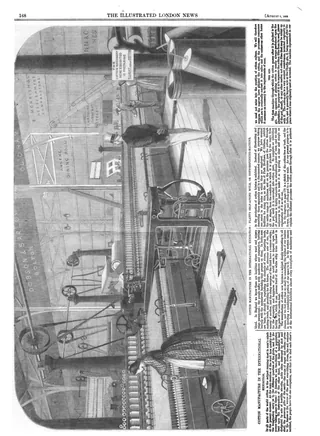
An 1862 Illustrated London News article describing the cotton machinery shown at the International Exhibition in London, mainly the Platt Brothers of Oldham display. It follows cotton from ginning, opening, carding, lap-doubling, drawing, slubbing and roving through spinning on the self-acting mule, then covers sizing and the hand and power loom. It ends with short notes on cloth types such as calico, shirting, chintz, gingham and muslin. Engravings show the Platt machines and the stages of cotton from plant to yarn.
Hand Weaving at the New York World's Fair
Article · 5 pages · weaving drafts
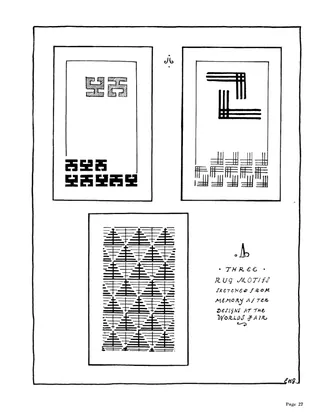
A review of hand-woven textiles seen at the 1939 New York World's Fair, concentrating on the Swedish exhibit from Elsa Gullberg's studio. It covers fringed and long-pile rugs and draperies, Rya and Flossa rugs, and samplers in Finnweave and Dukagang. Shorter sections cover Norwegian tapestry and rugs and the French and Belgian tapestry displays, including the large Floris Jespers hangings. The article includes sketches of three rug motifs and charts of designs suitable for Dukagang or other laid-in techniques. The scan ends with the start of an unrelated item on the National Conference of American Hand Weavers at Hartland, Michigan.
Textile Industry at the Vienna Exhibition -- No. I
Article · 3 pages
First installment of a series by Dr. H. Grothe in the journal Engineering reviewing textile industry exhibits at the 1873 Vienna Universal Exhibition. It first discusses how prominently textiles figure among different nations' displays, outlines the planned scope (raw materials, spinning, weaving, dyeing, printing, finishing), and gives exhibitor counts by country. It then surveys raw fibres on show, including nettle/rhea, Brazilian and palm fibres, cotton, jute, bamboo, Panama-hat leaf, New Zealand flax, flax, hemp, wool, silk and sea-silk (Pinna).
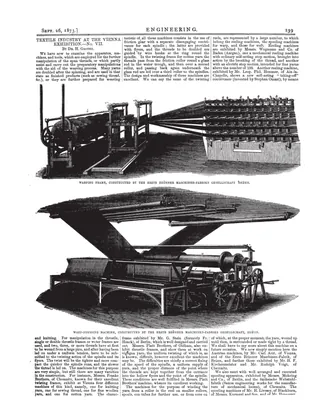
Textile Industry at the Vienna Exhibition -- No. VII
Article · 2 pages
Part VII of a series on textile industry exhibits at the 1873 Vienna Exhibition, written by Dr. H. Grothe for Engineering. It surveys machinery for twisting, reeling, spooling, warping, warp dressing and beaming, balling, and the auxiliary pattern-making devices (shaft/dobby machines, Jacquard machines), plus reeds, mill furnishings, regulators and temples, naming exhibitors by country. Two engravings show a warping frame and a warp-dressing machine by the Erste Brünner Maschinen-Fabriks Gesellschaft, Brünn.
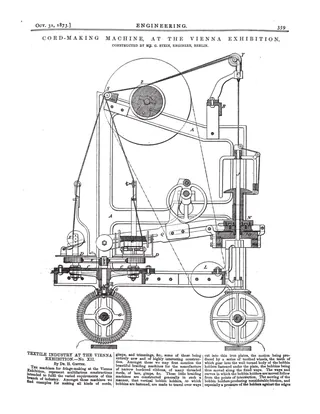
Textile Industry at the Vienna Exhibition -- No. XII
Article · 4 pages
Part XII of Dr. H. Grothe's report on the textile industry at the 1873 Vienna Exhibition, printed in the journal Engineering. It covers machines for making fringe, cords, gimps and trimmings: braiding machines (Diebold, Demuth), G. Stein's Berlin cord-making machine and his covering and twisting machine, and other covering machines. It ends with embroidering machines, including tambouring machines and Heilmann-system embroidery machines. Engraved illustrations show Stein's machines.
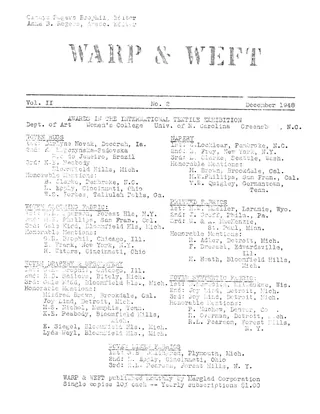
Warp & Weft, Vol. 2, No. 2 (December 1948)
December 1948
Periodical · 8 pages · weaving drafts
December 1948 issue of Warp & Weft, a small monthly for hand weavers. It lists award winners in an international textile exhibition held at the Women's College of the University of North Carolina, and includes a four-shaft wool plaid draft with color rotation. Short articles cover types of animal fibers for yarn, unweaving a mistaken piece, a coat-hanger spool holder, weaving with wool warps, and a new warp dressing oil. Also included are filler humor, poems, and notices of a farm show and a hobby exposition.
Weaver, Vol. 5, No. 2 (April-May 1940)
Weaver, April-May 1940
Periodical · 30 pages
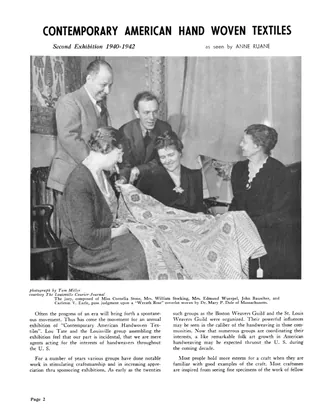
Issue of The Weaver (Emile Bernat & Sons) devoted almost entirely to the second exhibition of Contemporary American Handwoven Textiles (1940-1942), assembled by Lou Tate and the Louisville group. Anne Ruane's illustrated article describes the exhibition's organization, jury, and awards, and discusses selected pieces in clothing, bags, linens, household fabrics, runners, and tapestries, with photographs and weaver credits. The issue ends with Mary M. Atwater's Questions and Answers on uneven selvedges and warp tension, an erratum, and a Bernat Superior Looms advertisement.
Contemporary American Hand Woven Textiles, Second Exhibition 1940-1942
Article · 25 pages
Anne Ruane's illustrated report on the second national exhibition of Contemporary American Handwoven Textiles, organized by Lou Tate and the Louisville group at the J. B. Speed Memorial Museum, 1940-1942. It describes how the show was organized, juried and awarded, then goes through the five divisions (clothing, linens, household fabrics, runners and wallhangings, tapestries) with photographs and captions naming each weaver. It discusses overshot, summer-and-winter, geometric double weave, doukagang, laid-in tapestry, Khilim, and Norwegian and Coptic techniques, and comments on design, yarns, simple looms and guild activities. It contains no weaving drafts.
287 documents found