Textile Documents › Topic: Mill workers and child labor
213 documents found
Sort: 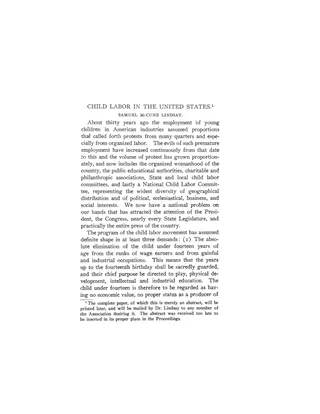
Child-Labor in the United States
Article · 4 pages
An abstract of a paper by Samuel McCune Lindsay on child labor in the United States in 1906. It outlines the child labor movement's three demands: no employment under age 14, no night work or dangerous work under 16, and employment certificates for ages 14 to 16. It also discusses reliance on state legislation, the pending Beveridge-Parsons federal bill, and closes with tables of 1880 and 1900 census statistics on children aged 10 to 15 in gainful occupations, by sex and by industry group.
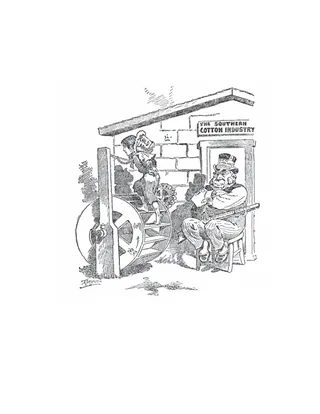
Legislators! To the Rescue!
Other · 1 page
A single-page item from the St. Paul Pioneer Press, dated 1902, built around a political cartoon in ink-hatching style. The cartoon shows a large spinning wheel beside a wooden post and a seated figure in a top hat wearing a sash. The title and the catalog topic 'Child' suggest a commentary on child labor and legislation. The text could not be read, so the specific argument cannot be determined.
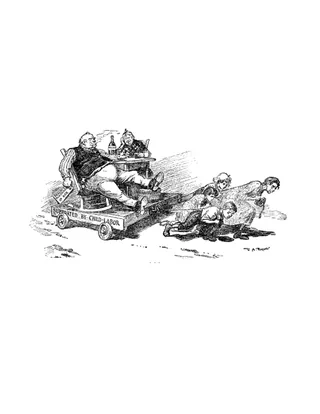
One Reason for the Child Labor Problem
Other · 1 page
A single-page satirical editorial cartoon from the New York Herald, 1903, criticizing child labor. It shows a wealthy, well-dressed man reclining in an ornate carriage, with a bottle and glass beside him, pulled along by exhausted children. The caption reads 'Supported by Child Labor'. It contains no weaving content.
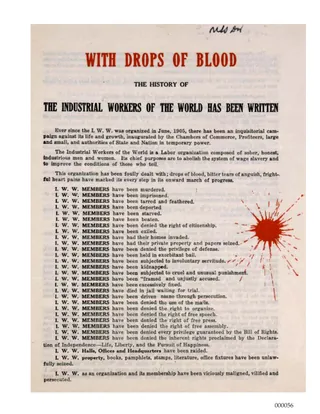
With drops of blood. The history of the Industrial workers of the world has been written
Haywood, William, 1919
Ephemera · 4 pages
A four-page 1919 broadside issued by the Industrial Workers of the World (I.W.W.) listing abuses suffered by its members, including murder, imprisonment, tarring and feathering, deportation, denial of citizenship, and excessive bail. It gives named cases and places, among them Lawrence, Bisbee, Everett, and Topeka, and cites the Commission on Industrial Relations and press reports as sources. It closes with an appeal to the working class for funds for the General Defense Committee in Chicago, signed by Wm. D. Haywood as Secretary.
Child Labor and Women
Cosmopolitan, 1904
Article · 2 pages
A short 1904 magazine piece from the 'Highways and Byways' section of Cosmopolitan on child labor in the United States, especially in Southern cotton mills. It reports that about twenty thousand children under fourteen worked in those mills, and that mill-owners, including New England investors, resisted legislation. It also notes violations of age laws in the East and in New Jersey glass factories, and reports that the General Federation of Women's Clubs resolved to campaign for stronger laws and better enforcement.
Child Labor in the Textile Industries and Canneries of New England
Article · 8 pages
A 1909 article by Everett H. Lord on child labor in New England textile mills and Maine sardine canneries. It covers how children get around age limits, the lack of schooling and industrial training among young mill workers, and the near-absence of legal protection for children in Maine's canneries, including long hours, unguarded machinery and seasonal work. It is a social-reform text about the textile workforce and does not deal with weaving technique.
Child Wage-Earners in England: Why the "Half-Time" System Has Failed to Solve the Problem
Article · 7 pages
A 1907 magazine article by Mary Rankin Cranston criticizing the English "half-time" system, under which school-age children worked outside school hours. It traces the history of British factory legislation from 1802 through the acts of 1876 and 1902-03, and describes the jobs half-timers held (milk boys, newsboys, laundry helpers, domestic servants) and their hours and pay in London, Liverpool, Belfast and elsewhere. It argues that the system harms children's health and schooling and warns against adopting it in the United States.
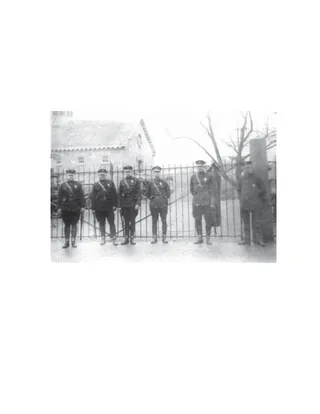
Connecticut State Troopers guarding gate during strike at American Thread, Willimantic, Connecticut
Connecticut State Troopers guarding gate during strike at American Thread, Willimantic, Connecticut, 1925
Ephemera · 1 page
A single black-and-white photograph showing six uniformed men in dark caps and jackets with chest straps or sashes, standing before a wrought-iron fence on a paved street. According to the catalog record, they are Connecticut State Troopers guarding a gate during a 1925 strike at the American Thread company in Willimantic, Connecticut. The image carries no printed or handwritten text.
Family in a Typical Mill Town
Article · 14 pages
A 1909 paper by Margaret F. Byington describing family life in Homestead, Pennsylvania, a steel-mill town near Pittsburgh, based on a six-month cost-of-living investigation. It examines how a single dominant industry shapes family structure: men as sole breadwinners, women at home, and sons entering the mill. It also covers wages, household budgets, housing, overcrowding among Slavic immigrant lodgers, long shifts, and the lack of amusements and labor organization. It concludes that low wages and long hours keep families from realizing their ideals.
Picture
Ephemera · 1 page
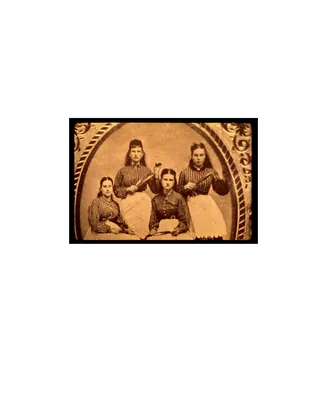
A single sepia-toned photograph of four young women in striped and patterned dresses with aprons, set in an ornate oval frame. Two of the women in the back row hold wooden tools that may be shuttles or spindles. The catalog lists the publication as Lowell Girls, which suggests the women are mill workers or are connected with the Lowell textile mills. The page has no readable text.
Child Labor and its Attendant Evils
Article · 14 pages
A 1908 magazine article by A. J. McKelway arguing against child labor, focusing on Southern U.S. cotton mills. It traces the history of child labor from eighteenth-century England and the British factory acts, and cites British physical-degeneration evidence after the Boer War. It then uses census figures to show high illiteracy among mill children, discusses the effect on family life, and reviews child labor laws state by state in the South. It has no weaving content; it is background on labor conditions in the textile industry.
Child Labor in the Carolinas
Article · 20 pages
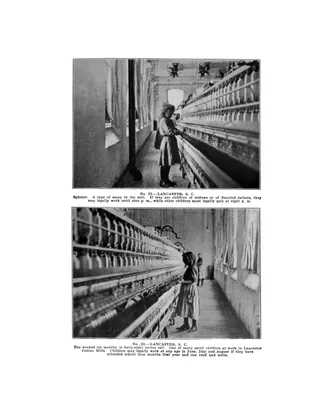
National Child Labor Committee Pamphlet No. 92 reports investigations of child labor in North and South Carolina cotton mills, carried out in 1908 by photographer Lewis W. Hine and investigators Rev. A. E. Seddon and A. H. Ulm. The text covers mill by mill findings on children's ages, night shifts, wages, illiteracy and mill schools, and summarizes the state child labor laws and their lack of enforcement. Twenty-six numbered plates, mostly Hine's photographs of child workers in spinning rooms and outside mills, are reproduced with captions.
Child Labor in the South
Outlook, 1907
Article · 8 pages
A 1907 Outlook feature closing a debate on child labor in Southern cotton mills. It opens with an editorial urging federal legislation and criticizing South Carolina's lack of labor statistics, factory inspection and compulsory education. It is followed by letters from mill officer Captain Ellison A. Smyth and from Dr. A. J. McKelway of the National Child Labor Committee, who dispute the number of children employed, mill goods prices and the age limits in South Carolina law.
Child Labor Legislation in the South
Article · 17 pages
Reprint of an address by Rev. Neal L. Anderson given at the first annual meeting of the National Child Labor Committee in 1905. It surveys child labor laws in the Southern states, covering age limits, proof of age, hours, education requirements and enforcement, with attention to the cotton mills of the Carolinas, Georgia and Alabama. It also gives the author's account of a visit to two Alabama mills, discusses obstacles to effective legislation, and ends with practical recommendations.
Child Labor Policy of New Jersey
Article · 231 pages
A monograph by Arthur Sargent Field tracing the history of child labor legislation and policy in New Jersey from the early 1800s to 1910. It covers the early protection of child employees, the 1883 law, the limited public sentiment up to 1904, the stronger law of 1904 and later amendments, and the merits and defects of the present standard. Further chapters examine enforcement through factory inspectors, school attendance laws, politics and personnel, prosecutions, and the success of the policy, supported by statistical tables on children employed, discharged, and withdrawn from school. It includes textile industries (cotton, silk) among the occupations of working children, but contains no weaving content.
Child-Labor
Article · 64 pages
A 1890 monograph by William F. Willoughby on the employment of children in factories and workshops, published in the Publications of the American Economic Association. It covers the history of child labor and factory legislation in England, the growth of child employment in the United States using 1870 and 1880 census tables and state labor bureau reports, and the state laws regulating it. It then argues from political economy (Ricardo's wage law, the standard of comfort, wage competition, international trade) for state regulation, and closes with the social effects on children, families and society. Textile mills figure as the main example of child employment.
Child-Labor
Article · 78 pages
An 1890 article by Clare de Graffenried surveying child labor in the United States, with comparisons to England and Germany. It draws on factory inspectors' reports, census data and the author's own observations of workshops and mills. Topics include working conditions, illiteracy, accidents, health effects, tobacco, textile and yarn mills, Southern and New England states, and the state of factory and school legislation. It concludes by arguing for uniform factory regulation and better enforcement of existing laws.
Children's Labor: A Problem
Article · 6 pages
A late-19th-century magazine article on child labor in Massachusetts factories and mills. It cites state school-attendance statutes and inspectors' findings of widespread non-compliance, and uses anecdotes and family budgets to show how working-class households depended on children's wages. It closes by arguing that child labor lowers adult wages and increases poverty, and it compares conditions in England.
Condition of Labor in Southern Cotton Mills
Article · 5 pages
A 1909 article by Lewis W. Parker, a South Carolina cotton mill owner, defending conditions in southern cotton mills against critics. He argues that the character of mill workers is improving and that child labor is declining as adult workers prove more economical, citing other observers. He also describes manufacturers' support for compulsory school laws and for restrictions on night work by children in South Carolina. It is reprinted from a child labor debater's handbook.
Cover of magazine produced by women employed by the Lowell Textile Mills
Ephemera · 1 page
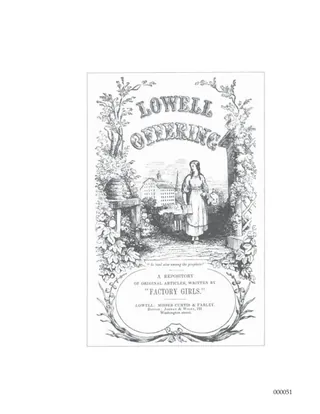
A single-page decorative engraved cover of the Lowell Offering, a magazine of original articles written by the women mill workers ("factory girls") of Lowell, Massachusetts. The cover shows the title arched over a vignette of a young woman in a garden, framed by vines and flowers, with the publishers' imprint for Lowell and Boston. It contains no articles or technical textile content.
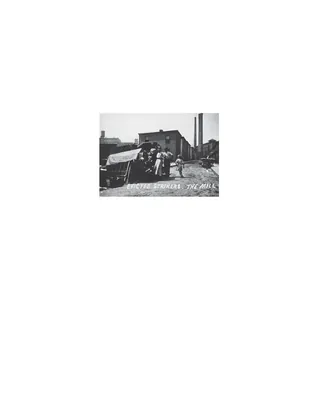
Evicted Workers from Strike at Fulton Bag & Cotton Mills, Atlanta, Georgia
Ephemera · 1 page
A single-page black-and-white photograph showing evicted workers from the strike at the Fulton Bag & Cotton Mills in Atlanta, Georgia. A woman and a child stand on a dirt lot beside a horse-drawn wagon loaded with household goods under a canvas cover. The only printed text is a short caption, 'Evicted Strikers. The Mill'.
Family in a Typical Mill Town
Article · 14 pages
A 1909 paper by Margaret F. Byington describing family life in Homestead, Pennsylvania, a steel-mill town near Pittsburgh dominated by a single industry. Drawing on a six-month cost-of-living investigation, it covers wages, household budgets, the roles of women and children, Slavic lodgers and overcrowded housing, long hours, and the lack of labor organization. It concludes that the nature of the dominant industry shapes family type and limits families' ability to achieve their ideals.
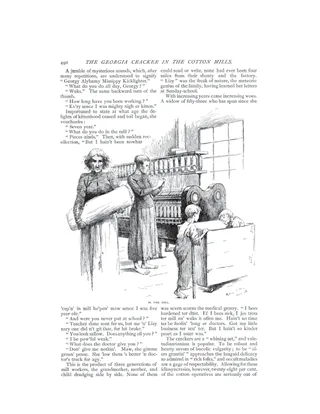
Georgia Cracker in the Cotton Mills
Article · 16 pages
A 1891 magazine article by Clare de Graffenried on the poor white "crackers" of Georgia and the Southern cotton mills where they work. It describes their homes, dress, diet, habits, dialect, religion, and schooling, and the labor of women and children in the mills while the men stay idle. The text is illustrated with sketches by Kemble, including scenes of cracker homes, mill women, and the mill interior. It is a social commentary of its time and has no technical weaving content.
Lowell Offering, No. 1 (April 1841)
April 1841
Periodical · 35 pages
First volume title page, editor's preface, and opening pages of the Lowell Offering, a periodical of original writings by women employed in the Lowell, Massachusetts textile mills. The preface explains how the Improvement Circles began and defends the claim that the contributions are by mill operatives, with little editorial change. The issue contains a serialized story of a New Hampshire farm girl's year working in Lowell, plus sketches, moral essays, and poems. It ends with the music for 'Song of the Spinners'. There is no technical weaving content.
Lowell Offering, No. 1 (October 1840)
Lowell Offering, October 1840
Periodical · 16 pages
First issue (October 1840) of the Lowell Offering, a magazine of original essays, sketches, and poems written by female factory operatives in the Lowell, Massachusetts mills. Contents include the allegorical "History of a Hemlock Broom," pieces on old maids, woman's proper sphere, memory, science, autumn, Mount Auburn cemetery, and religious reflections. The closing Editorial Corner explains the publication's purpose of showcasing the talent and intelligence of mill workers and sets out rules for contributors.
Lowell Offering, No. 10-11 (December 1841)
December 1841
Periodical · 64 pages
Issue of the Lowell Offering, a periodical of prose and verse written by women mill operatives in Lowell, Massachusetts, dated December 1841. It contains allegorical sketches ("Leaves" from the port-folio of a dreamer), the serialized story "Harriet Greenough" about a farm girl who goes to work in the Newburyport mills, the fairy tale "The Princess," an account of a second visit to the Shakers, essays, and poems. It also includes three pages of hymn music and engravings of the Unitarian Church and the Appleton Street Congregationalist Church in Lowell. There is no weaving content; it is mainly useful for the literary and social history of New England mill girls.
Lowell Offering, No. 12 (December 1841)
December 1841
Periodical · 28 pages
The final issue (No. 12, December 1841) of the first volume of the Lowell Offering, a literary periodical written by women mill workers of Lowell, Massachusetts. It contains an allegory on Ambition and Contentment, patriotic and religious verse, two pieces of sheet music, short fiction (Emma and Grace), a reminiscence of an old farm-house, a sketch of Elder Isaac Townsend, and an engraving of the First Universalist Church in Lowell. It closes with an editorial concluding the volume that answers critics who say the magazine shows only the bright side of factory life, followed by the volume's index of contents, poetry and engravings.
Lowell Offering, No. 2 (December 1840)
Lowell Offering, December 1840
Periodical · 16 pages
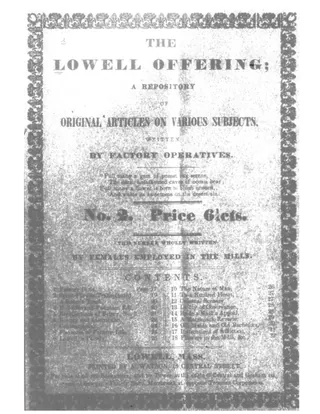
Issue No. 2 (December 1840) of the Lowell Offering, a periodical of original essays, poems and sketches written by women working in the Lowell, Massachusetts textile mills. It opens with a defense of factory girls against Orestes Brownson's charge that mill work brings infamy, and includes a piece on the pleasures of factory life, along with sentimental verse, moral essays, a satirical piece on old maids and old bachelors, and an imaginary tour of the planets. The issue is of interest for the social history of New England mill operatives, not for weaving technique.
Lowell Offering, No. 2 (May 1841)
May 1841
Periodical · 31 pages
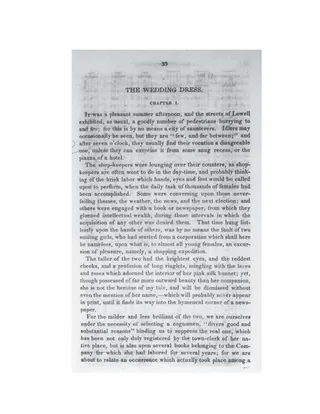
Issue No. 2 (May 1841) of the Lowell Offering, a periodical of prose and verse written by female operatives in the Lowell, Massachusetts textile mills. It opens with a two-chapter story, "The Wedding Dress," about a factory girl who buys a silk gown and marries a wealthy old bachelor. The rest is short sketches, essays on nature and happiness, poems, translations from the French, and a closing musical score, "Song of the Weavers." There is no technical weaving content; it is useful as a primary source on mill girls' writing and life.
Lowell Offering, No. 3 (February 1841)
Lowell Offering, February 1841
Periodical · 20 pages
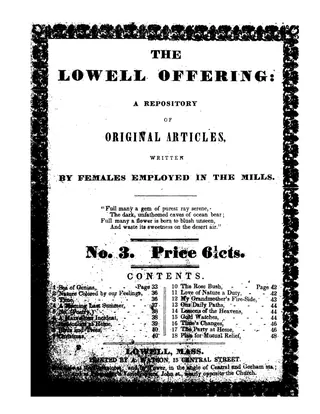
No. 3 (February 1841) of the Lowell Offering, a periodical of original prose and verse written by women employed in the Lowell, Massachusetts textile mills. It contains essays, poems, sketches and reflections on genius, nature, time, Christmas, home life and the dress of factory girls ("Gold Watches"), plus a plea for mutual relief among mill women. It opens with a prospectus for a proposed volume, "The Garland of the Mills", and ends with local Lowell business advertisements. It has no technical textile content, but is a primary source on mill-girl culture and the social attitudes surrounding factory work.
Lowell Offering, No. 3 (June 1841)
June 1841
Periodical · 32 pages
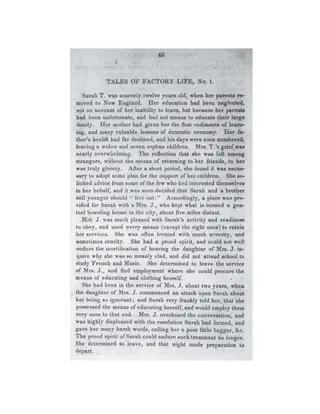
Issue No. 3 (June 1841) of the Lowell Offering, a periodical of prose and verse written by women mill operatives in Lowell, Massachusetts. It opens with 'Tales of Factory Life, No. 1', about a runaway servant girl who finds work and independence in the Lowell mills. Other pieces include the sketches 'Childhood's Home', 'Our Physician', 'Ann and Myself' (on prejudice against factory girls) and 'Recollections of My Childhood', and the tales 'The Old Fashioned Coat' and 'Clara Stanly'. Poems include 'Past Hours', 'Night', 'The Funeral of Harrison' and 'Welcome May'. The issue has no technical textile content, but it gives a contemporary view of mill workers' lives and attitudes.
Lowell Offering, No. 4 (July 1841)
July 1841
Periodical · 32 pages
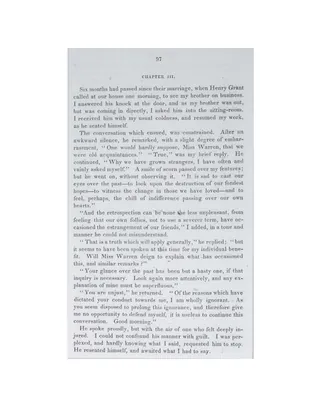
Issue No. 4 (July 1841) of the Lowell Offering, a periodical of writings by women mill operatives in Lowell, Massachusetts. It contains the conclusion of the story 'Clara Stanly' (Chapters III and IV), a poem on 'Old Ironsides', essays such as 'Playthings' and 'Saturday Night', and sketches including 'The Spirit of Discontent', which discusses factory life, the mill bell and long hours. The remainder is poetry, moral tales and reminiscences, including 'The Old Clock', 'The Lock of Gray Hair' and 'Familiar Sketches, No. 2: The Fig Tree'. It has no weaving content.
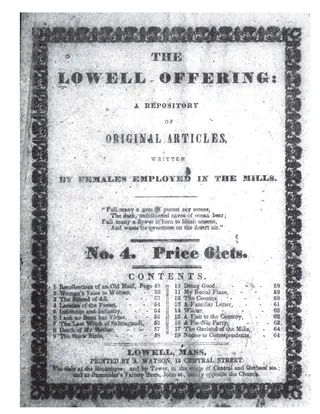
Lowell Offering, No. 4 (March 1841)
March 1841
Periodical · 20 pages
No. 4 (March 1841) of the Lowell Offering, a monthly of original prose and verse written by women working in the Lowell, Massachusetts textile mills. It opens with an editorial on the permanence of the Offering and proposals for a new subscription series starting in April 1841. The issue then carries sketches, moral tales, allegories and poems such as Recollections of an Old Maid, A Woman's Voice to Woman, The Last Witch of Salmagundi, The Cousins and A Pic-Nic Party. Local advertisements for Lowell businesses are printed at the end. It has no weaving content, but it is a primary source for the writing and social standing of mill operatives.
Lowell Offering, No. 5 (July 1841)
July 1841
Periodical · 32 pages
Issue No. 5 (July 1841) of the Lowell Offering, a periodical of writings by women mill operatives in Lowell, Massachusetts. It contains essays, serialized moral tales, poems and a shape-note hymn. Items include "Woman" on women's proper sphere and rights, the story "Prejudice Against Labor" about a factory girl facing social snobbery, essays on burial places and small talk, and engravings of St. Ann's Episcopal Church and the First Baptist Church in Lowell. It has no weaving content, but it is a primary source on the literary life and social attitudes surrounding New England mill workers.
Lowell Offering, No. 6 (August 1841)
August 1841
Periodical · 32 pages
Issue No. 6 (August 1841) of the Lowell Offering, a periodical of writings by women who worked in the Lowell, Massachusetts textile mills. It opens with the serialized story "Susan Miller," about a farm girl whose father dies of drink and who decides to work in the Lowell factory to pay off the family mortgage, with debate about the reputation of factory girls. The rest is essays and poems, including "Choice of Friends," "The Whortleberry Excursion" (which mentions homewoven coverlet patterns), "Lessons of Flowers," "Beauty," "Lowell Cemetery," "A Weaver's Reverie," and "A New Society." Engraved illustrations show Lowell's First Congregationalist and Methodist churches.
Lowell Offering, No. 7 (September 1841)
September 1841
Periodical · 32 pages
Issue No. 7 (September 1841) of the Lowell Offering, a periodical of writings by women mill operatives in Lowell, Massachusetts. It contains essays, short fiction and verse, among them a reflection on Joan of Arc, an essay on tears, the story 'La Brainard' about a wandering madman near Lake Winnipesaukee, 'Moving into the New House', 'Familiar Sketches No. 3: The Contrast', and the allegory 'Hope and Despair'. It also has a hymn with musical notation and an engraving of the Roman Catholic church in Lowell.
Lowell Offering, No. 8 (October 1841)
October 1841
Periodical · 32 pages
Issue No. 8 (October 1841) of the Lowell Offering, a magazine of prose and verse written by women mill workers in Lowell, Massachusetts. It includes a sugar-making excursion sketch, a story about mill-girl roommates on the evening before pay-day, essays on shade trees for schoolhouses, friendship, and home, a dedication poem for the high-school house, and a song with music. The issue ends with an engraving of the Second Universalist Church in Lowell.
Lowell Offering, No. 9 (November 1841)
November 1841
Periodical · 31 pages
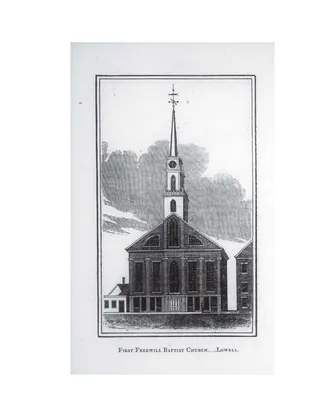
Issue No. 9 (November 1841) of the Lowell Offering, a periodical of prose and verse written by women mill workers in Lowell, Massachusetts. It contains moral tales, sketches and poems, including the narrative 'Fortune-Telling', 'Tales of Factory Life No. 2: The Orphan Sisters' about two sisters who go to work in the Lowell mills, an essay 'Aristocracy of Employment', a visit to a Shaker village, temperance pieces with a page of musical rounds, and 'The Life of a Pocket Testament'. Engravings of two Lowell churches (First Freewill Baptist and John Street Congregationalist) are included.
Picture postcard
Ephemera · 1 page
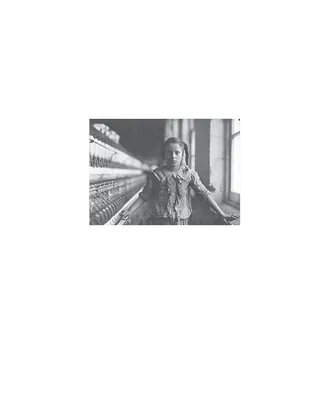
A single picture postcard showing a black-and-white photograph of a young girl with braided hair and a ruffled blouse standing beside a row of spinning frames in a factory. Large windows are visible at the right. The card has no legible text, so its date, place, and mill cannot be determined from the scan.
Some Greek Children
Article · 3 pages
A 1907 magazine article in which a U.S. Department of Commerce and Labor official describes a visit to a silk factory in Kalamata, Greece. He observes women reeling raw silk on treadle wheels and young children working in steaming cocoon-soaking troughs for about five cents a day, from six in the morning to seven at night. The manager says Greece has no child labor laws. The article ends with a visit to a Catholic boys' school in Salonica.
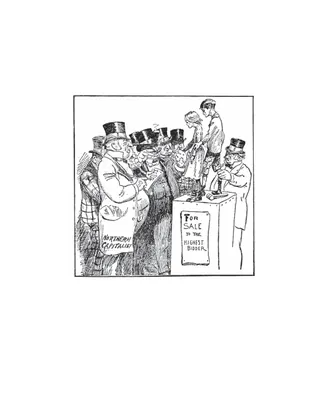
White Slavery: Northern Capital and Southern Child Labor
Other · 1 page
A single-page newspaper cartoon from 1902 criticizing Northern capital invested in Southern child labor, likened to slavery. It shows top-hatted capitalists crowding around a block where a young child stands under a sign reading 'For Sale to the Highest Bidder.' The only text is the sign and a caption label identifying a Northern capitalist.
Child Labor in Eastern Pennsylvania
Article · 7 pages
A 1904 magazine article by Peter Roberts reporting on child labor in eastern Pennsylvania factories, especially silk-throwing, hosiery, and other textile mills. It describes evasion of the age-13 minimum through false certificates, weak enforcement by politically influenced factory inspectors, overtime of 60 to 75 hours a week, and night work for girls in silk mills in the anthracite coal towns. It ends by arguing for a law that would bar boys under 16 and girls under 18 from working between 7 p.m. and 6 a.m.
Child Labor in the Southern Cotton Mills
Article · 11 pages
An address by A. J. McKelway of the National Child Labor Committee arguing against the employment of young children in Southern cotton mills. It opens with an account of a train carrying Tennessee mountain families to South Carolina mills, then reviews the history of child factory labor in Manchester and New England. It also covers the growth of Southern cotton manufacturing, with spindle counts, mill numbers and workforce figures, and the economic, health, educational and moral case for child labor legislation.
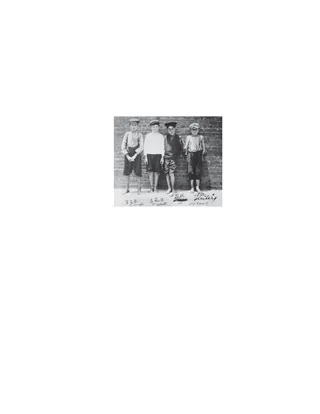
Child Laborers at Fulton Bag & Cotton Mills, Atlanta, Georgia
Ephemera · 1 page
A single black-and-white photograph of four barefoot boys in caps, suspenders, and short trousers standing against a brick wall, identified in the catalog as child laborers at the Fulton Bag & Cotton Mills in Atlanta, Georgia. Handwritten captions beneath the image give each boy's weekly wage, apparently 32¢ and 50¢ a week. It documents child labor in the American cotton textile industry.
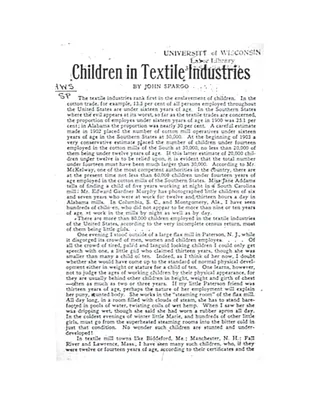
Children in Textile Industries
Article · 4 pages
A four-page Socialist Party leaflet reprinting John Spargo's account of child labor in the textile industries, with statistics on children under sixteen in U.S. cotton mills, especially in the South, and his observations of mill children in Paterson, Fall River, Lawrence and other towns. It adds excerpts on children in coal breakers, glass factories, and street trades from Robert Hunter's "Poverty", and Elizabeth Barrett Browning's poem "The Cry of the Children". It ends with Socialist Party publication and ordering information.
Constitution of the Silk Ribbon Weavers Progressive Union
1889
Other · 13 pages
Printed 1889 constitution and member's receipt book of the Silk Ribbon Weavers Progressive Union of New York, a labor union of silk-ribbon weavers. It opens with a declaration of principles on class conflict and trade unionism, followed by twelve articles on membership, dues, officers, meetings, funds and disbandment, plus general regulations and shop rules covering strikes, collectors and delegates. The back pages are a blank receipt book with monthly stamp-payment grids for 1889 to 1896 and assessment ledgers.
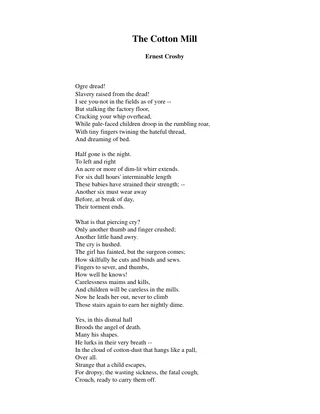
Cotton Mill
Other · 3 pages
A three-page protest poem, "The Cotton Mill," by Ernest Crosby, condemning child labor in cotton mills. It describes children working night shifts, injured by machinery and sickened by cotton dust, and attacks mill owners, lawmakers, and the profit-driven trade system. It is social and literary commentary, with no technical weaving content.
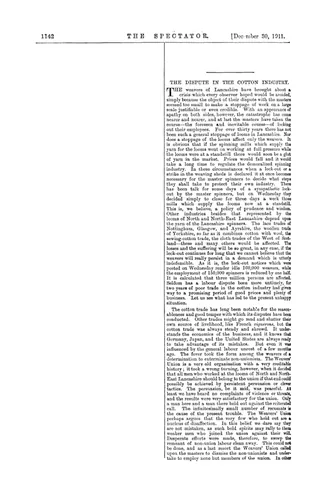
Dispute in the Cotton Industry
Spectator, December 30, 1911
Article · 2 pages
A Spectator editorial from December 1911 on the Lancashire cotton dispute, in which master manufacturers locked out about 160,000 weavers. It explains how the Weavers' Union demand that non-union workers be dismissed led to strikes and then the lock-out. It also covers the effect on spinners and on other trades that depend on Lancashire yarn, and a secondary demand for a five per cent wage increase. The writer strongly opposes the union's position and argues from the principle of freedom of labour.
Education of Mill Children in the South
Article · 8 pages
A 1908 article by Rev. Alfred E. Seddon arguing that welfare work in Southern cotton mills does not replace compulsory education. He reports his own examinations of mill children in South Carolina and Mississippi, with counts of illiterate children by mill and school enrolment versus attendance figures. He also discusses the half-time school system, the harm of mill work for girls and boys, false statements about children's ages, and the need to pair child labor laws with compulsory schooling.
Foreigners in the Clothing Trade
Article · 3 pages
A short 1906 encyclopedia article on how immigration shaped the American clothing trade, especially tailoring and garment manufacture in New York and Chicago. It covers the division of labor in ready-made work, the roles of Russian Jewish, Italian, Polish, Scandinavian and other workers, tenement home-finishing, wages, and labor organization. The characterizations of nationalities reflect the attitudes and stereotypes of the period.
213 documents found