Textile Documents › Publications › Publication: American Economic Association
9 documents found
Sort: 
Child Labor Policy of New Jersey
Article · 231 pages
A monograph by Arthur Sargent Field tracing the history of child labor legislation and policy in New Jersey from the early 1800s to 1910. It covers the early protection of child employees, the 1883 law, the limited public sentiment up to 1904, the stronger law of 1904 and later amendments, and the merits and defects of the present standard. Further chapters examine enforcement through factory inspectors, school attendance laws, politics and personnel, prosecutions, and the success of the policy, supported by statistical tables on children employed, discharged, and withdrawn from school. It includes textile industries (cotton, silk) among the occupations of working children, but contains no weaving content.
Child-Labor
Article · 64 pages
A 1890 monograph by William F. Willoughby on the employment of children in factories and workshops, published in the Publications of the American Economic Association. It covers the history of child labor and factory legislation in England, the growth of child employment in the United States using 1870 and 1880 census tables and state labor bureau reports, and the state laws regulating it. It then argues from political economy (Ricardo's wage law, the standard of comfort, wage competition, international trade) for state regulation, and closes with the social effects on children, families and society. Textile mills figure as the main example of child employment.
Child-Labor
Article · 78 pages
An 1890 article by Clare de Graffenried surveying child labor in the United States, with comparisons to England and Germany. It draws on factory inspectors' reports, census data and the author's own observations of workshops and mills. Topics include working conditions, illiteracy, accidents, health effects, tobacco, textile and yarn mills, Southern and New England states, and the state of factory and school legislation. It concludes by arguing for uniform factory regulation and better enforcement of existing laws.
Child-Labor in the United States
Article · 4 pages
An abstract of a paper by Samuel McCune Lindsay on child labor in the United States in 1906. It outlines the child labor movement's three demands: no employment under age 14, no night work or dangerous work under 16, and employment certificates for ages 14 to 16. It also discusses reliance on state legislation, the pending Beveridge-Parsons federal bill, and closes with tables of 1880 and 1900 census statistics on children aged 10 to 15 in gainful occupations, by sex and by industry group.
Cotton and the General Agricultural Outlook
Article · 10 pages
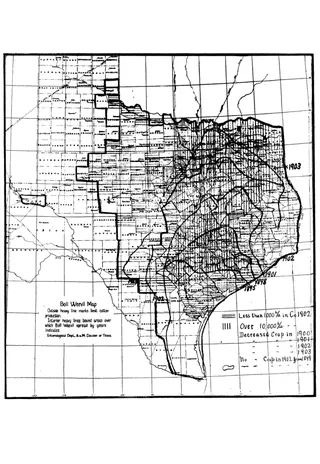
A 1904 address by D. F. Houston on the outlook for American cotton production, focusing on the spread of the Mexican boll weevil through Texas since 1892-93 and its effect on yields. It includes a boll weevil spread map of Texas and county production comparisons. It also covers farm methods to cope with the pest, tenancy and yield statistics from the census, and the broader post-Civil War agricultural progress of the South (corn, forage, livestock, truck and fruit farming, farm numbers and values).
The Cotton Industry. An Essay in American Economic History: Part I. The Cotton Culture and the Cotton Trade
Article · 394 pages · weaving drafts
M. B. Hammond's economic history of the American cotton industry, Part I, covers the cotton culture and the cotton trade. The first half traces how cotton was introduced and spread across the South, its ties to slavery, Southern agriculture before and after the Civil War, the agricultural credit system, and proposed remedies for over-production, including co-operative credit. The second half covers the history of the cotton trade from colonial times to 1897, including the Lancashire cotton famine, the evolution of the cotton market and futures trading, and trade patterns from 1866 to 1897. It includes many statistical tables, price charts, a map of slave labor and cotton production in 1860, a bibliography, an appendix of statistics and an index.
Family in a Typical Mill Town
Article · 14 pages
A 1909 paper by Margaret F. Byington describing family life in Homestead, Pennsylvania, a steel-mill town near Pittsburgh, based on a six-month cost-of-living investigation. It examines how a single dominant industry shapes family structure: men as sole breadwinners, women at home, and sons entering the mill. It also covers wages, household budgets, housing, overcrowding among Slavic immigrant lodgers, long shifts, and the lack of amusements and labor organization. It concludes that low wages and long hours keep families from realizing their ideals.
Family in a Typical Mill Town
Article · 14 pages
A 1909 paper by Margaret F. Byington describing family life in Homestead, Pennsylvania, a steel-mill town near Pittsburgh dominated by a single industry. Drawing on a six-month cost-of-living investigation, it covers wages, household budgets, the roles of women and children, Slavic lodgers and overcrowded housing, long hours, and the lack of labor organization. It concludes that the nature of the dominant industry shapes family type and limits families' ability to achieve their ideals.
The Negro in the Yazoo-Mississippi Delta
Article · 38 pages
A 1902 paper by Alfred Holt Stone, a Mississippi cotton planter, on Black agricultural labor and race relations in the nine-county Yazoo-Mississippi Delta, presented at the American Economic Association's fourteenth annual meeting. It gives census population figures, describes plantation tenancy systems (cropping, renting, the crop lien), housing, cotton yields and picking wages, and the "benders" cotton grade. It closes with the author's own plantation experiment, with account figures for tenant families. The paper reflects the racial views of its period and is of interest chiefly for the economic history of cotton.
9 documents found