Textile Documents › Publications › Publication: Outlook
5 documents found
Sort: 
Child Labor in Eastern Pennsylvania
Article · 7 pages
A 1904 magazine article by Peter Roberts reporting on child labor in eastern Pennsylvania factories, especially silk-throwing, hosiery, and other textile mills. It describes evasion of the age-13 minimum through false certificates, weak enforcement by politically influenced factory inspectors, overtime of 60 to 75 hours a week, and night work for girls in silk mills in the anthracite coal towns. It ends by arguing for a law that would bar boys under 16 and girls under 18 from working between 7 p.m. and 6 a.m.
Child Labor in the South
Outlook, 1907
Article · 8 pages
A 1907 Outlook feature closing a debate on child labor in Southern cotton mills. It opens with an editorial urging federal legislation and criticizing South Carolina's lack of labor statistics, factory inspection and compulsory education. It is followed by letters from mill officer Captain Ellison A. Smyth and from Dr. A. J. McKelway of the National Child Labor Committee, who dispute the number of children employed, mill goods prices and the age limits in South Carolina law.
In the Cotton Field
Article · 10 pages
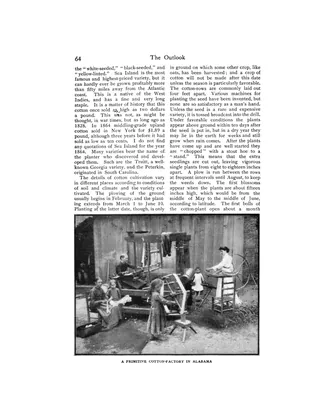
A 1901 magazine article in The Outlook in which Max Bennett Thrasher describes a visit to an Alabama cotton plantation and surveys cotton culture in the American South. It covers plantation and tenant systems, planting, picking, ginning (roller and Whitney saw gins), baling, cottonseed uses, prices and crop statistics, the history of cotton growing worldwide, and cotton market time in Southern towns. Illustrated with halftone photographs of pickers, fields, a primitive cotton factory, and an Alabama village.
The Negro Cotton-Mill Failure
Outlook, 1901
Article · 1 page
A short 1901 editorial from The Outlook on the failure of a Charleston, South Carolina cotton mill that employed Black workers. Drawing on a Charlotte Observer interview with the mill manager, it argues that the failure was due to local conditions, such as scarce housing near the mill and workers' alternative livelihoods in oyster-fishing and farming, rather than the supposed unreliability of Black labor. It notes the mill began in 1882 with white labor and also failed under white operators.
A Woman's Work for Women in Italy
Article · 6 pages
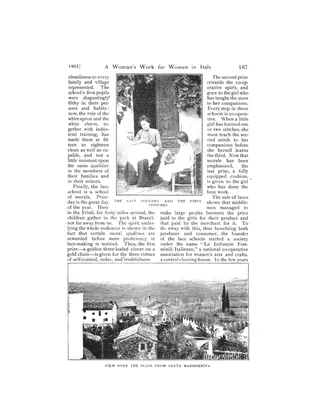
A 1905 illustrated magazine article describing the lace school founded by Countess Cora di Brazzà at Santa Margherita (San Vito) in the Friuli region of Italy. It covers how peasant girls learn bobbin lace, their earnings, the moral and cleanliness training, the annual prize day, and the national cooperative society Le Industrie Femminili Italiane, which sells women's lace and other crafts. It also mentions a summer school for women established that year. Photographs show the lace school, pupils at work, the village and park, and a detail of a linen tablecloth with imitation Genoese lace border.
5 documents found