Textile Documents › Topic: Latin American and Andean textiles
211 documents found
Sort: 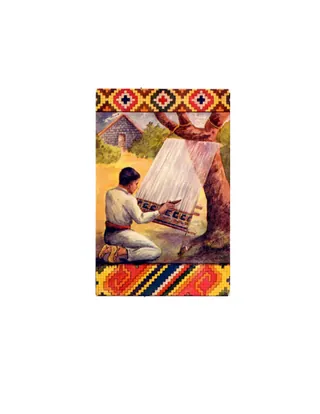
Picture postcard
Ephemera · 1 page
A single picture postcard titled in the catalog as from the Mexican Weaver. It shows a painted illustration of a seated man in a white shirt and light trousers with a red item, framed by geometric woven-pattern borders of red, yellow, black, and brown diamond motifs at top and bottom. No readable text could be extracted from the scan.
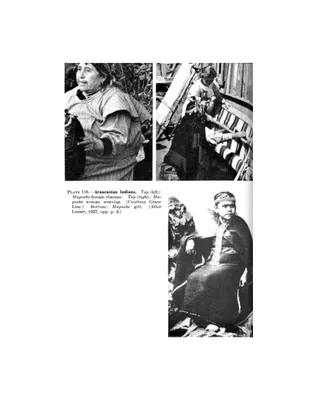
Handbook of South American Indians, The Araucanians
Illustration · 3 pages
Extract of three pages from Handbook of South American Indians, Volume 2 (Bulletin 143, Bureau of American Ethnology, 1946), containing the volume title page, the heading of John M. Cooper's chapter on the Araucanians, and Plate 156. The plate shows black-and-white photographs of Mapuche (Araucanian) people, including a female shaman, a woman weaving, and a girl. Only the illustration is included, not the chapter text.
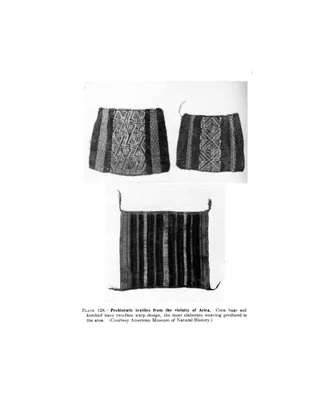
Handbook of South American Indians, The Cultural Sequence of the North Chilean Coast
Illustration · 4 pages
Excerpt from Bulletin 143 of the Smithsonian Bureau of American Ethnology, Handbook of South American Indians, Volume 2 (The Andean Civilizations), containing the title page and the opening of Junius B. Bird's chapter on the cultural sequence of the North Chilean coast. Only two plates of textiles are included: Plate 126 shows textiles from a child burial at Playa Miller, Arica, including a kerchief, meal bag, matting fragment and coca bag, and Plate 128 shows prehistoric coca bags and a kerchief from the Arica area with two-face warp designs.
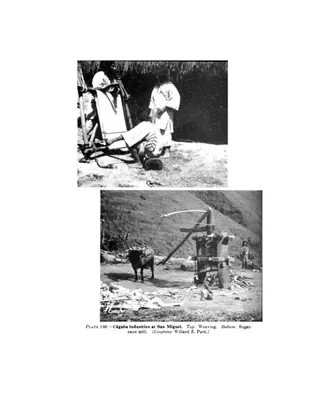
Handbook of South American Indians, Tribes of the Sierra Nevada de Santa Marta, Colombia
Illustration · 3 pages
Excerpt of three pages from the Handbook of South American Indians (Bureau of American Ethnology Bulletin 143, Volume 2, The Andean Civilizations, 1946), containing the volume title page, the chapter heading for Willard Z. Park's 'Tribes of the Sierra Nevada de Santa Marta, Colombia', and Plate 180. The plate shows Cágaba (Kogi) industries at San Miguel: a woman weaving at a ground or backstrap loom, and a sugar-cane mill.
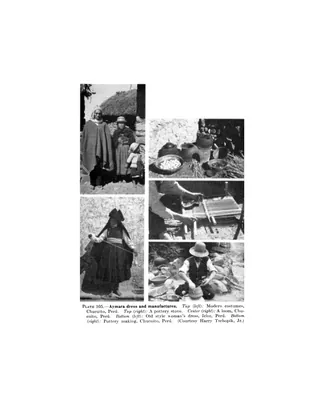
Handbook of South American Indians, The Aymara
Illustration · 3 pages
Excerpt from Bureau of American Ethnology Bulletin 143, Handbook of South American Indians, Volume 2 (The Andean Civilizations), edited by Julian H. Steward. It includes the volume title page, the opening page of Harry Tschopik Jr.'s chapter on the Aymara, and Plate 105 with five photographs of Aymara dress and manufactures. The plate shows modern and old-style costumes, a pottery stove, pottery making, and a loom, all from Chucuito and Ichu, Peru.
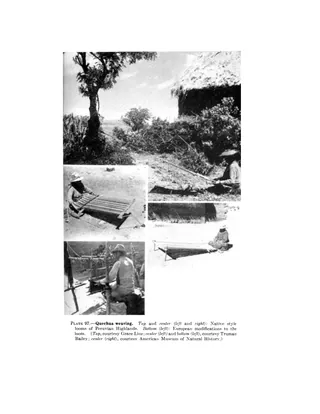
Handbook of South American Indians, The Contemporary Quechua
Illustration · 3 pages
Excerpt from Volume 2 (The Andean Civilizations) of the Handbook of South American Indians, Smithsonian Bureau of American Ethnology Bulletin 143, 1946. It contains the volume title page, the chapter heading for Bernard Mishkin's 'The Contemporary Quechua', and Plate 97 showing Quechua weaving. The plate shows native-style looms of the Peruvian Highlands and European modifications to the loom.
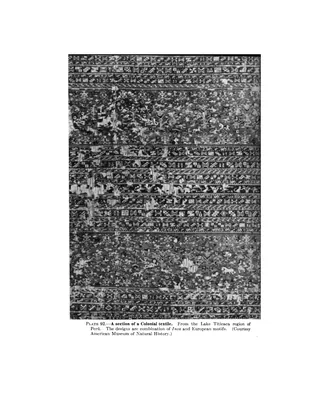
Handbook of South American Indians, The Quechua in the Colonial World
Illustration · 4 pages
A four-page extract from the Handbook of South American Indians, Volume 2 (Bulletin 143, Bureau of American Ethnology, 1946), containing the title page, the section heading for George Kubler's chapter on the Quechua in the colonial world, and two plates. Plate 91 shows a Colonial poncho from the Lake Titicaca region alongside a Cuzco School painting; Plate 92 shows a section of a Colonial textile from the same region combining Inca and European motifs. Useful for researchers of colonial Andean textile design.
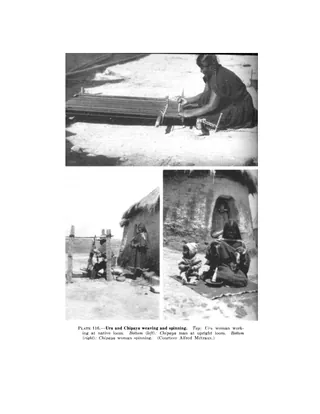
Handbook of South American Indians, The Uru-Chipaya
Illustration · 3 pages
Excerpt from the Smithsonian's Handbook of South American Indians, Volume 2 (Bureau of American Ethnology Bulletin 143, 1946), consisting of the volume title page, the heading of Weston La Barre's chapter on the Uru-Chipaya, and Plate 116. The plate shows photographs of an Uru woman at a native loom, a Chipaya man at an upright loom, and a Chipaya woman spinning. Only these illustrative pages are included, not the chapter text.
Mexican Motifs Portfolio
Other · 5 pages
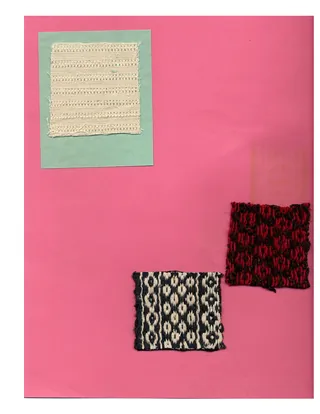
A five-page portfolio of mounted textile sample photographs accompanying Harriet Tidball's Shuttle Craft Monograph Six, "Mexican Motifs" (1962). It consists of a cover with the title and pages of photographed woven samples, including striped, black-and-white geometric, openwork and plaited examples. There are no weaving drafts and almost no printed text.
Diagrams of Peruvian Weaves
Article · 4 pages
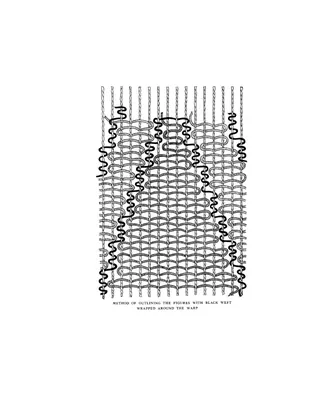
A short note in the Bulletin of the Needle and Bobbin Club reproducing plates from M. D. C. Crawford's 1916 article on Peruvian textiles, published by the American Museum of Natural History. The plates diagram a leno stripe worked in tapestry, outlining figures by wrapping the warp with an additional black weft, and interlocking weft in a Nazca tapestry. A halftone of a tapestry belt is also included. The brief text suggests these methods as possibilities for weaving members.
Handbook of South American Indians, Inca Culture at the Time of the Spanish Conquest
Illustration · 3 pages
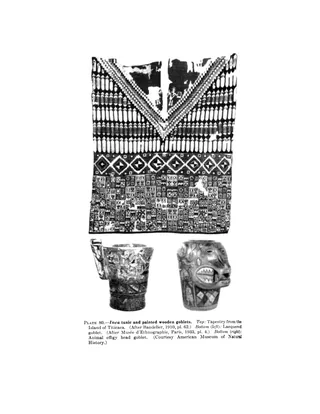
Excerpt of three pages from John Howland Rowe's chapter 'Inca Culture at the Time of the Spanish Conquest' in the Handbook of South American Indians, Volume 2 (Bureau of American Ethnology Bulletin 143, 1946). It includes the volume title page, the chapter title page, and Plate 80, which shows an Inca tapestry tunic from the Island of Titicaca with bands of stylized figures and stepped and diamond motifs, along with painted wooden goblets.
Handbook of South American Indians, The Highland Tribes of Souther Columbia
Illustration · 4 pages
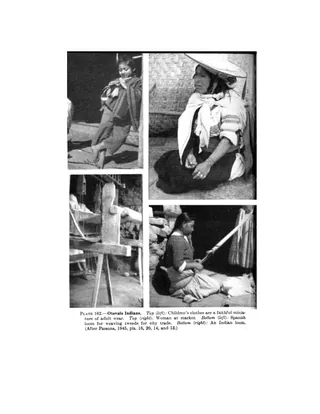
Excerpt of four pages from Smithsonian Bureau of American Ethnology Bulletin 143, Handbook of South American Indians, Volume 2 (The Andean Civilizations), edited by Julian H. Steward. It includes the title page, the opening page of John Murra's chapter 'The Historic Tribes of Ecuador', and two plates of photographs of Otovalo Indians. The plates show children's clothing, a market woman, a Spanish treadle loom used for tweeds, an indigenous loom, and Cholo girls weaving rugs and blankets on an outdoor loom at Riobamba, Ecuador.
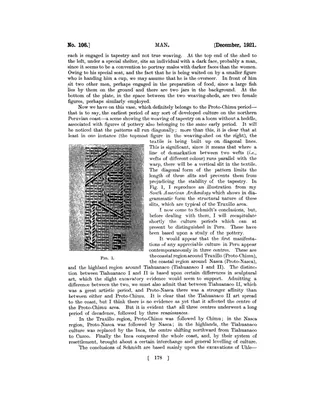
Peruvian Loom in the Proto-Chimu Period
Article · 5 pages
A short note from the journal Man by T. A. Joyce on a Proto-Chimu pottery bowl from the Chicama Valley, Peru, whose painted lip shows eight women weaving at looms under matting-roofed sheds. Joyce observes that none of the looms has a heddle, so the textiles are tapestry, and the patterns run diagonally to limit vertical slits. He then discusses Max Schmidt's conclusions on Peruvian tapestry slit treatments (open slits, sewing, overlap, interlocking wefts) and suggests the heddle came late to Peruvian weaving, possibly not before contact with the Inca.
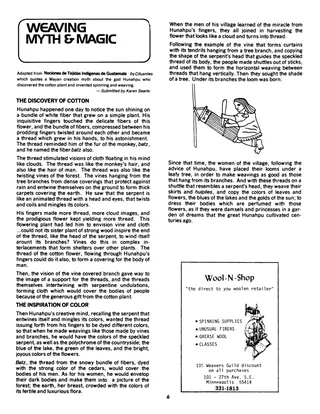
Weaving Myth and Magic-Cotton
Article · 1 page
A short article adapted by Karen Searle from Cifuentes's Nociones de Tejidas Indígenas de Guatemala, retelling a Mayan creation myth in which the god Hunahpu discovers the cotton plant, invents spinning, dyeing and weaving, and inspires the first loom under a tree. It explains the origin of the backstrap loom, the shuttle and the colors of Guatemalan women's clothing such as skirts and huipiles. A line drawing of a woman at a backstrap loom accompanies the text, and a Wool-N-Shop advertisement shares the page.
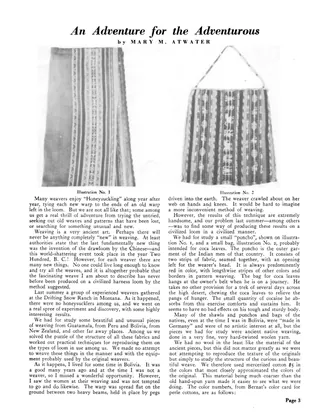
An Adventure for the Adventurous
Article · 3 pages · weaving drafts
Mary Atwater describes a warp-face pattern weave studied from a Bolivian poncho and coca-leaf bag, which she and a group of weavers reproduced on a harness loom at a Montana summer gathering. She gives the warp color plan and sett (48 ends per inch, 4 per dent in a 12-dent reed), treadling for the dark and light square figures, and pick-up stick directions for an X-figure. She also covers a technique for beating up the dense fabric, possible uses, and the needle-woven braid edging on the originals. The last page has the draft with tie-ups and 6- and 4-harness threadings.
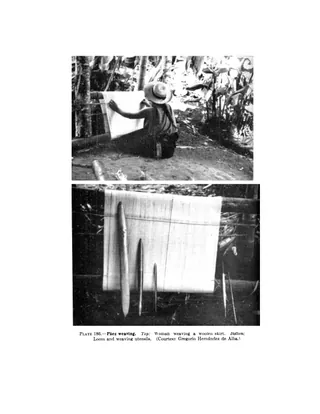
Handbook of South American Indians, The Historic Tribes of Ecuador
Illustration · 4 pages
A four-page excerpt of illustrations from Handbook of South American Indians, Volume 2 (The Andean Civilizations), Bureau of American Ethnology Bulletin 143, edited by Julian H. Steward. It includes the title page, the opening heading of Gregorio Hernández de Alba's chapter on the highland tribes of southern Colombia, and two plates showing Páez weaving and spinning. The plates show a woman weaving a woolen skirt on a backstrap-style loom, loom and weaving utensils, a woman spinning wool while walking in Tierradentro, and men weaving straw hats.
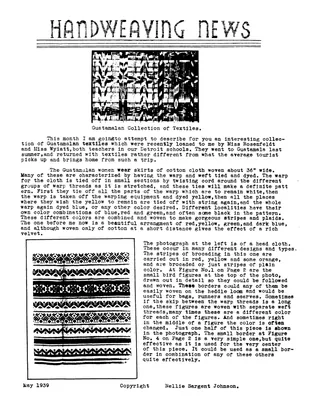
Handweaving News (May 1939): Guatamalan Collection of Textiles
Periodical · 3 pages · weaving drafts
A May 1939 Handweaving News article by Nellie Sargent Johnson describing a collection of Guatemalan textiles loaned by two Detroit teachers. It covers tie-dyed warp skirt cloths, brocaded head cloths, and blouse pieces with small bird and human figures woven in weft-float technique. Pages 2 and 3 provide graph-paper drawdowns of the border and figure patterns, plus a pattern-weave technique worked over three and under one warp thread, with photographs of the textiles.
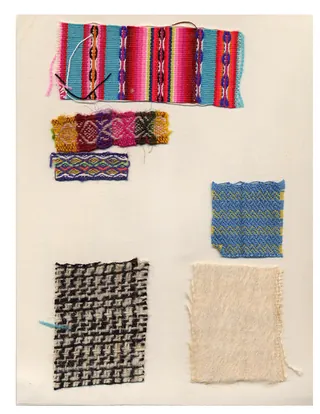
Peru: Textiles Unlimited Portfolio
Other · 5 pages
A portfolio of mounted textile samples from Peru, issued as an accompaniment to Shuttle Craft Guild Monograph Twenty-Five by Harriet Tidball. It consists of a cover and photographs of swatches on colored cards, including ancient Chancay cotton fragments, modern Andean wool and alpaca weavings, edging tapes, and a strip of feathers. A caption page describes each sample's structure, fibers, origin and maker, including weft-face point-twill, floating-weft patterns and warp-stripe designs.
Shuttle-Craft Bulletin (September 1963)
Periodical · 6 pages · weaving drafts
A reprinted September 1963 issue of the Shuttle Craft Guild Handweavers Bulletin, edited by Harriet Tidball. It opens with a history of the Guild (founded 1922 by Mary Meigs Atwater), its Bulletins, Monographs, Portfolios, workshops and membership terms, then gives a travel account of Oaxaca and the weaving village of Mitla, Mexico. The issue includes the article "A Bath Huipil from Mexico", with a three-shaft twill draft with red and white warp stripes, warp and weft specifications, tie-up and treadling, and instructions for weaving the head slit. It ends with descriptions and prices of Monographs 1-11 and other Tidball publications.
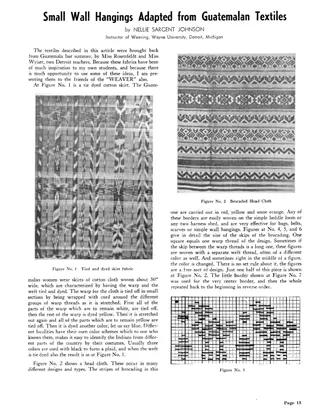
Small Wall Hangings Adapted from Guatemalan Textiles
Article · 3 pages · weaving drafts
Article by Nellie Sargent Johnson describing Guatemalan textiles brought back by two Detroit teachers: a tie-dyed cotton skirt, a brocaded head cloth, and brocaded blouse cloths with stylized women, birds and animals. It explains how the brocaded figures are charted, with one square per warp thread, and how they can be woven on a simple two-harness heddle loom. It then describes small wall hangings woven by student Nell Byster Keyser, adapting the Guatemalan figures in plain weave with brocaded and laid-in motifs in Shetland and tapestry yarns.
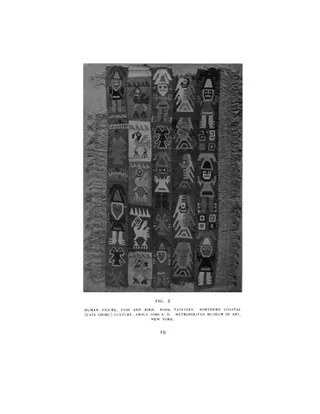
Some Peruvian Textile Motives Based on Life Forms
Article · 14 pages
An article by John Goldsmith Phillips on motifs in Peruvian textiles drawn from life forms: man, puma, bird and fish. It discusses conventionalization of the motifs and the animal cult, and notes the Tiahuanaco tradition. It closes with descriptions of ten textiles, mostly tapestry-woven wool, in the Metropolitan Museum of Art, grouped as more naturalistic or more conventionalized. The plates are photographs of textile details, and the last page also shows an unrelated sampler.
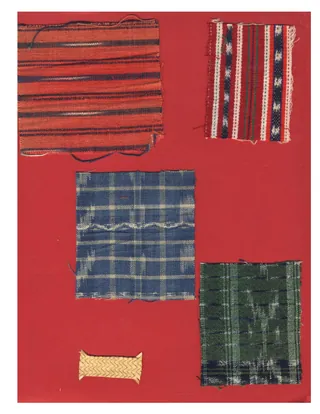
Guatemala Visited Portfolio
Other · 6 pages
A portfolio of mounted fabric samples that accompanies Mary Meigs Atwater's Shuttle Craft Guild Monograph 15, Guatemala Visited (1965). Four pages of photographs show the swatches, and a final page lists and describes each sample. The samples include ikat skirt cloths, a man's trouser, huipiles, a stiff belt (faja), an apron, a tapestry head-band, a terminal selvage, palm braid and a draw-loom fabric. The notes give dimensions, looms (counter-balanced treadle, back-strap, draw-loom), regions and cross-references to pages in the monograph.
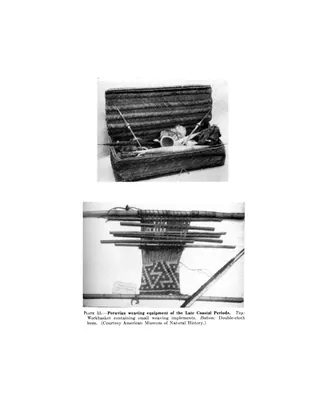
Handbook of South American Indians, The Archeology of the Central Andes
Illustration · 6 pages
Extract of selected plates from Wendell C. Bennett's chapter on the archeology of the Central Andes in the Handbook of South American Indians, Volume 2 (Bulletin 143, Bureau of American Ethnology, 1946). It consists of a title page, a chapter heading page and four pages of textile photographs: Paracas Necropolis embroidered shawl and shirt, Coast Tiahuanaco embroidered fragment and velvet-technique hat, a double cloth detail and Middle Ica shirt, and Late Coastal Peruvian weaving equipment including a workbasket and a double-cloth loom.
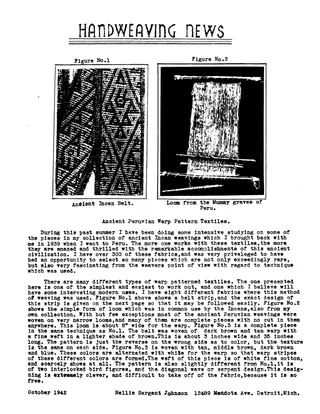
Handweaving News (October 1942): Ancient Peruvian Warp Pattern Textiles
Periodical · 3 pages · weaving drafts
A 1942 Handweaving News leaflet by Nellie Sargent Johnson on a warp-patterned technique found in ancient Peruvian (Incan) textiles from her own collection. It describes the narrow belt loom, a twill threading on four harnesses with alternating white and dark warp threads, and the lever order for plain background and for picking up pattern threads with pickup sticks. Photographs, side-view sketches of the shed, and a charted diagonal pattern design from an ancient belt are included, with a note about future leaflets on double weaving.
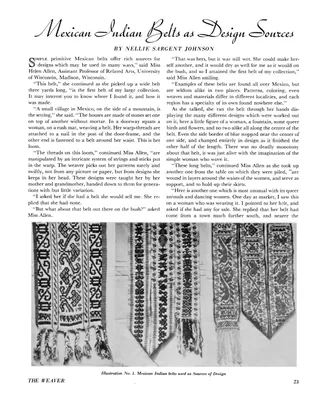
Mexican Indian Belts as Design Sources
Article · 2 pages · weaving drafts
A short 1936 article in The Weaver in which Nellie Sargent Johnson relays Helen Allen's account of collecting woven belts in Mexico. It describes how village women weave them on a simple backstrap loom with sticks and strings, working patterns from memory, and how designs vary by region. A photograph page of belts and a charted page of figurative designs (a woman, animals, flowers, a tree motif) accompany the text, with suggestions for adapting the motifs to embroidery weaving, table linens, children's bibs, chair-back sets and draw-loom weaving.
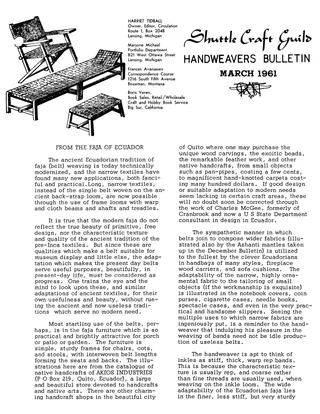
Shuttle-Craft Bulletin (March 1961)
Periodical · 4 pages · weaving drafts
Issue of the Shuttle Craft Guild Handweavers Bulletin, edited by Harriet Tidball. The main article covers Ecuadorian faja (belt) weaving adapted to frame looms, including faja-woven furniture, warp-pattern technique with fine cotton base warp and heavier pattern warp, sett and reed advice, and three ways to handle tension differences between the two warps. It gives design principles and the draft for an eight-shaft Portfolio sample, with a four-shaft simplification. Shorter items cover a new two-shaft ribbon loom from Norwood Loom Co., binders for publications, subscriptions, the correspondence course, and a review of Russell Groff's Card Weaving booklet along with an announcement of Tidball's The Weaver's Book.
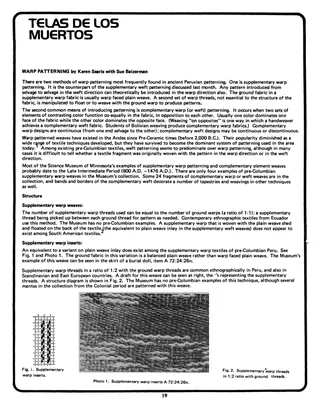
Telas de los Muertos - Warp Patterning
Article · 4 pages · weaving drafts
Part of the Minnesota Weaver series "Telas de los Muertos," this article surveys warp patterning in ancient Peruvian textiles, using examples from the Science Museum of Minnesota's collection. It covers supplementary warp weaves (inserts, 1:1 and 1:2 ratios), plain-weave-derived float weaves, complementary warp/weft weaves including two-color and multicolor pebble weave, turned weave, and warp/weft substitution. Entries give sett, thread counts, fibers, spin direction and approximate dates, with structure diagrams, drafts, photographs and a reference list (Rowe, Emery, Cason and Cahlander, Atwater).
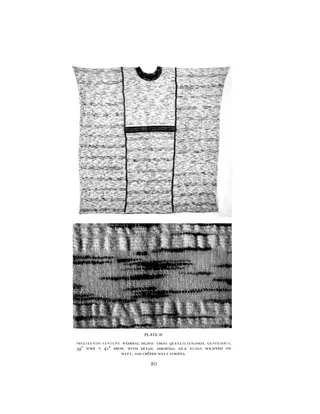
Two Guatemalan Wedding Huipils
Article · 11 pages
Junius Bird examines two 19th-century wedding huipils from Quetzaltenango, Guatemala, from the Elsie McDougall collection, shown at the American Museum of Natural History for the Needle and Bobbin Club. The first is a sheer cotton plain-weave huipil with creped weft stripes, silk floss wrapped on the weft, Purpura shellfish-dyed purple cable-twist yarn, and twill stripes. The second is a brocaded cotton huipil with white and purple brocading. Bird compares these techniques (creped stripes, wrapped fibers, twill, brocading) with Peruvian and Maya evidence, including Cupisnique and Paracas textiles. Illustrated with plates; no weaving drafts.
An Exhibition of Peruvian Spanish-Colonial Textiles
The Textile Museum · 1961
Other · 8 pages
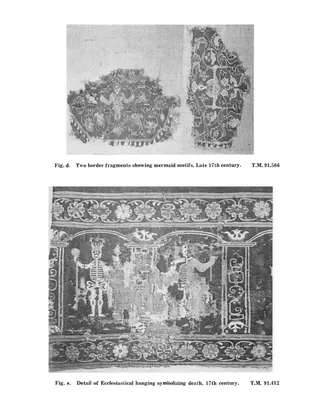
Catalogue of a 1961 exhibition of Peruvian Spanish-Colonial textiles at The Textile Museum in Washington, D.C., written by director Alan R. Sawyer. It lists 38 items with short descriptions, dimensions and accession or lender information. These include Inca-style shirts and mantles, interlocking tapestry hangings, rugs, ponchos and painted church cloths, plus Mexican and Guatemalan pieces, a Spanish design prototype rug, silver and a painting. An introduction covers provenience, tapestry technique and materials (cotton and alpaca warps, cochineal and indigo dyes, silver thread). Six black-and-white figures illustrate selected pieces.
Note on a Peruvian Loom of the Chimu Period
Article · 3 pages
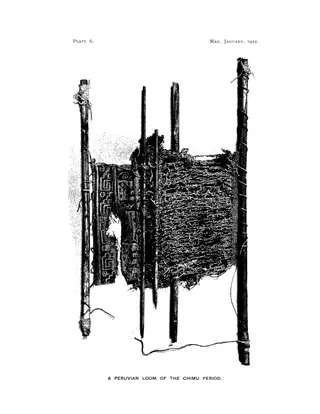
A short note by T. A. Joyce describing a miniature pre-Spanish Peruvian loom of the Chimu period in the British Museum, with its dimensions and construction. The loom is set up for double-faced cloth with two warps and two wefts, white and brown cotton, and has two heddle rods and a reed shed-stick. Joyce describes the continuous warping, the twined selvage, the cat-and-stepped-coil design, and the thread counts. He compares the heddle-leash arrangement with looms elsewhere and dates the piece to after about 1400 A.D. and before the Spanish arrival.
Some Ancient Peruvian Textiles
Article · 6 pages · weaving drafts
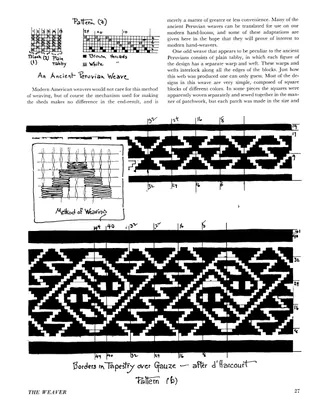
Mary Atwater reflects on ancient Peruvian weaving and adapts several fabrics from Raoul d'Harcourt's 'Textiles Anciens du Pérou' for modern handlooms. Drafts and pattern diagrams are given for a block tabby with separately interlocked figures, a tabby and rep fabric, tapestry over gauze, and Peruvian double weave (suggested for the four-harness Finnweave technique). Patterns include condor, pelican and llama motifs, and the article ends with instructions for a flat braid for belts and bag handles.
Unusual Border Construction from Peru
Article · 16 pages
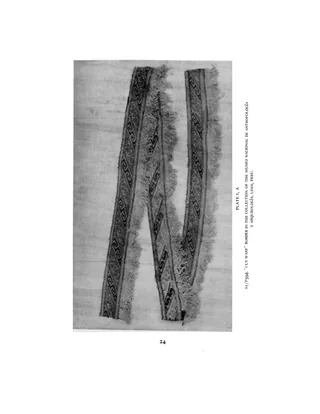
Article by Mary Elizabeth King on a little-known construction method for ancient Peruvian borders, in which narrow weft-faced bands were woven with the warp running in the short direction. Several bands were woven on one loom set-up with bare warp left between them. The warps were then cut and run back into the band edge, and the sections were sewn together into a long border. The study centers on a band from Ancon in the Museo Nacional in Lima and on related Textile Museum pieces in weft-patterned and slit tapestry techniques. It covers loom set-up diagrams, the method of running back cut warps, shaping by subtracting warps, fiber analysis, and theories about why weavers worked this way. The bands are dated to the late coastal periods, about 1300-1532 A.D.
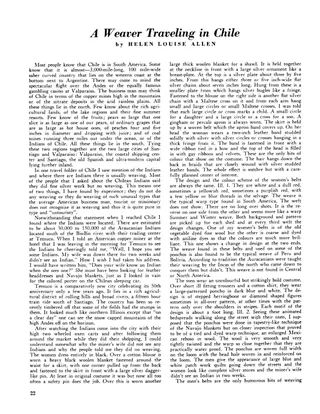
A Weaver Traveling in Chile
Article · 4 pages
A travel account by weaver Helen Louise Allen describing her visit to Temuco, Chile, to find the weaving of the Araucanian (Mapuche) Indians. She describes women's dress and belts, men's tied-and-dyed warp ponchos, double-weave men's belts, saddle blankets, pile-knotted choapina saddle rugs and saddle bags. She also covers the warp-faced weave structures, the upright looms and how pieces are woven complete from both ends. Illustrated with eight photographs of the textiles she collected; no drafts are given.
Minnesota Weaver, Vol. 3, No. 1 (September 1977)
Minnesota Weaver, September 1977
Periodical · 20 pages
September 1977 issue of the Weavers Guild of Minnesota's newsletter. It covers the 1977-78 guild program calendar, board meeting summaries, profiles of new officers, a Spotlight on coiled-basket maker Marilyn Herrmann, and school news. Feature articles include the first of Sue Baizerman's series "Telas de los Muertos" on ancient Peruvian textiles in the Science Museum of Minnesota, with a section on knotted weft wrapping and openwork. Also included are a Rigid Heddle column on soumak, a report on the Midwest Weavers Conference, a guilds column on a Long Island spinning group, a dye plant record sheet, a loom reed ordering advertisement, and classifieds.
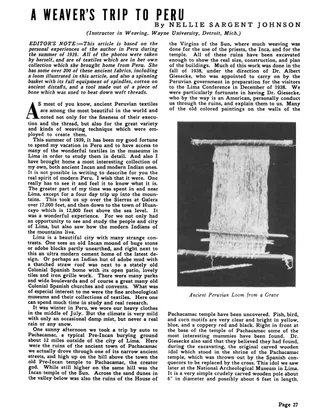
A Weaver's Trip to Peru
Article · 3 pages
A first-person account by weaving instructor Nellie Sargent Johnson of her summer 1939 trip to Peru, covering museum study in Lima, a visit to the Pachacamac ruins, and a four-day trip to the Andes and Huancayo. She describes pieces from her own collection of ancient Peruvian textiles: a narrow backstrap-type loom from a mummy bundle, a puma-head brocade with a tapestry-woven fringe, double weave pieces with bird and fish motifs, a slit tapestry variation and a tapestry-woven gauze. Photographs illustrate the loom and textiles; no drafts are given.
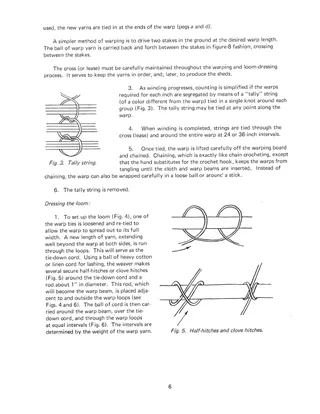
Weavers of the Jade Needle: Textiles of Highland Guatemala
Other · 23 pages
Catalog of a Maxwell Museum of Anthropology exhibit on the handwoven textiles of highland Guatemala. It opens with a cultural and historical background on the highlands (Mexican influxes, Spanish conquest, markets, the cofradía system), then describes traditional men's and women's dress, natural and aniline dyes, and the types of looms in use. A step-by-step guide covers the backstrap loom: warping, dressing the loom, making heddles, weaving, and pick-up brocade. Captioned illustrations of belts, sashes, ribbons, huipils and motifs from named villages give yarn counts, techniques, fibers and colors. A bibliography closes the work.
The Bulletin of the Needle and Bobbin Club, Vol. 50, Nos. 1 & 2 (1967)
Periodical · 72 pages
Double issue (Vol. 50, Nos. 1 & 2, 1967) of the Needle and Bobbin Club Bulletin. Ina VanStan examines seventeen Peruvian textiles from Pachacamac, patterned in wool on cotton plain-weave grounds, to decide whether they are brocades or embroideries, analysing yarns, colors, design types and techniques. Rachael G. Mossman describes Kashmir handloom textiles: fibers such as pashmina, twill tapestry shawls, embroidery, felt, and influences from Persia, China and Central Asia. She adds plates with technical descriptions of nine pieces and reconstructed weave diagrams. The issue also has a printing award certificate, club notes, obituaries and a list of officers.
The Bulletin of the Needle and Bobbin Club, Vol. 9, No. 1 (1925)
Periodical · 56 pages
Volume 9, number 1 (1925) of the Bulletin of the Needle and Bobbin Club, a New York society for needlework and lace. The main article is Philip Ainsworth Means's study of ten ancient Andean textiles from his own collection, covering Andean fibers, dyes, and decorative art. It describes tapestry, the kelim (returned weft) technique, brocade and double-faced cloth, and includes Crawford's diagrams of weft interlocking. The issue also has Part II of Mrs. Lockwood's American Colonial Needlework (crewel work, petit point chair seats, quilting, memorial pictures) and Gertrude Whiting's article on Hawaiian netted feather robes and helmets. It closes with Club Notes, Guild Notes, and Book Notes, including a notice of Mary Meigs Atwater's pattern book of John Landes drawings, plus advertisements for lace and embroidery shops.
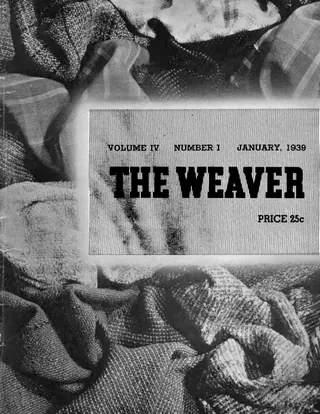
Weaver, Vol. 4, No. 1 (January 1939)
Weaver, January 1939
Periodical · 32 pages · weaving drafts
January 1939 issue of The Weaver, a quarterly published by Emile Bernat & Sons. It opens with Mary Atwater's article on reproducing a Bolivian warp-faced pick-up pattern weave on a six-harness loom, with threading and treadling directions. Other items cover a woven book cover-carrier, the Weaver's Guild of Boston exhibition (photos of coverlets, rugs, tapestry, tartans, stoles, linens and Finnweave), the Penland weaving institute, openwork shawls with drafts, wall hangings in summer and winter, a thread-sizes and sett chart from the National Conference of American Handweavers, a Dukagang work bag, and a Q&A on adding harnesses to a loom.
The Bulletin of the Needle and Bobbin Club, Vol. 11, No. 1 (1927)
Periodical · 41 pages
Issue of the Bulletin of the Needle and Bobbin Club (New York), Vol. 11 No. 1, 1927. It contains Eleanor Saxe's article on the embroidered and woven eighteenth-century gentleman's waistcoat, drawn from a Metropolitan Museum exhibition, and Philip A. Means's catalogue of a group of ancient Peruvian tapestry and basket-weave fragments (Tiahuanaco and Chimu styles), with plates. It also has a report on a retrospective exhibition of Lyons silks from the H. A. Elsberg collection, a biographical note on the designer Jean François Bony, club notes, book notes, and period advertisements for lace and handweaving shops.
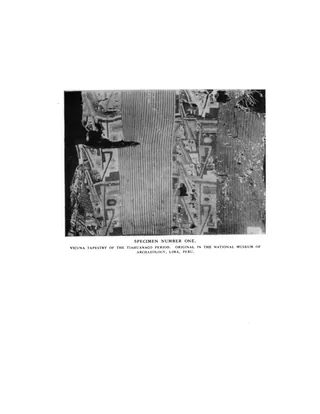
Series of Ancient Andean Textiles
Article · 25 pages
Philip Ainsworth Means introduces ancient Andean civilization and textile art, covering the chronology of coastal and highland cultures, simple looms and tools, cotton and camelid wool fibers, dyes, and decorative trends. He then describes ten specimens, mostly from his own collection: six tapestries, three brocades and one double-faced cloth. The discussion focuses on the kelim (returned weft) slit technique, the structure of brocade on a plain-weave or gauze ground, and thread counts, colors and probable periods. Illustrations include photographs of each specimen, Crawford's diagrams of weft-interlocking methods (Figures 1-6) and a brocade structure diagram (Figure 7).
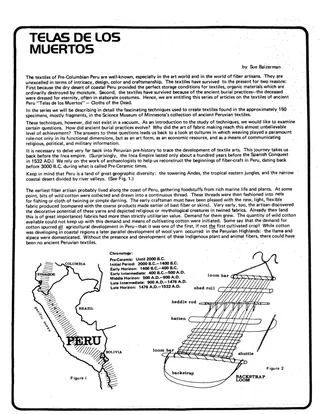
Telas de los Muertos-Pre-Columbian Burial Cloths
Article · 5 pages
First article in a series on ancient Peruvian textiles drawn from the Science Museum of Minnesota's collection of about 150 mostly fragmentary specimens. It surveys Peruvian prehistory and chronology, the development of cotton and camelid fibers, spinning, dyeing, the backstrap loom, textile specialization, and burial practices. It then describes knotted weft wrapping, an openwork technique especially associated with Chancay on the Central Coast, covering its structure, materials, and patterning variations (embroidery, tapestry, scaffold weaving), with museum examples and a note on how a weaver can reproduce it.
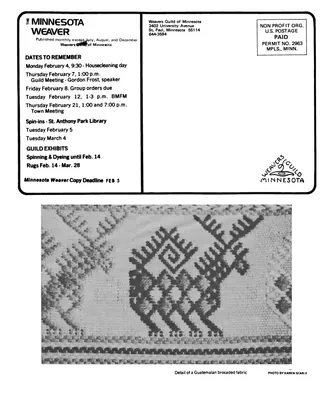
Detail of Guatemalan Brocaded (photo)
Minnesota Weaver, February 1980
Article · 1 page
A single black-and-white photograph of a Guatemalan brocaded fabric, credited to Karen Searle, printed on the back cover of an issue of The Minnesota Weaver. The detail shows geometric brocade motifs in a diamond or stepped pattern. The page also carries the Weavers Guild of Minnesota's February calendar of meetings, exhibits and deadlines, along with mailing information.
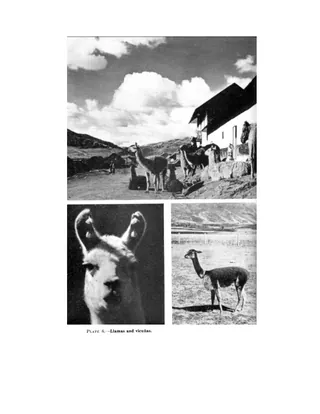
Handbook of South American Indians, The Andean Highlands
Illustration · 4 pages
Four-page excerpt from Bureau of American Ethnology Bulletin 143, Handbook of South American Indians, Volume 2 (The Andean Civilizations), edited by Julian H. Steward. It includes the title page, the opening page of Wendell C. Bennett's introduction to the Andean Highlands, and two plates of photographs showing alpacas on the Bolivian puna and llamas and vicuñas. The excerpt is limited to the illustrations relevant to camelid fiber animals.
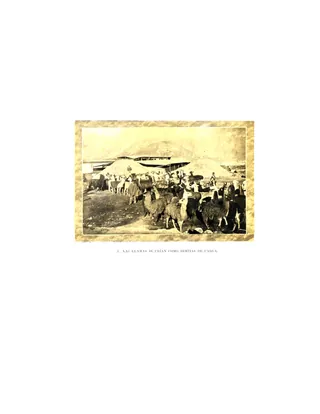
Las llamas se crían como bestias de carga [Llamas Are Raised as Beasts of Burden]
Enciclopedia Comercial, 1922
Illustration · 1 page · Spanish
A single-page sepia photograph from the Enciclopedia Comercial (1922) showing a large herd of llamas gathered with several people in an open yard in Peru. Piles of material, possibly grain or wool, lie nearby, with a long low building and a hillside behind. The printed caption says llamas are raised as beasts of burden.
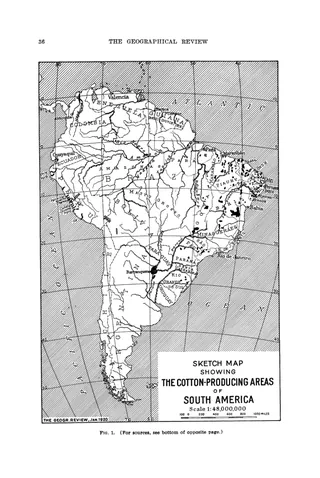
Cotton Growing in South America
Article · 16 pages
A 1920 Geographical Review article surveying the state and prospects of commercial cotton growing in South America. It treats Peru's irrigated desert valleys in the most detail (varieties, planting seasons, labor, transport, exports), then Brazil's history, regions, methods, production and boll weevil problems, then northern Argentina, Paraguay and Bolivia. A final section covers the Guianas, Venezuela, Colombia, Ecuador, Chile and Uruguay. It includes a sketch map of cotton-producing areas, three pages of field photographs, and footnoted sources.
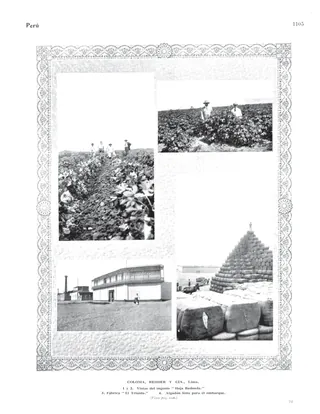
[Cotton plantation and factory of Coloma, Rehder y Cía., Lima, Peru]
Enciclopedia Comercial, 1922
Illustration · 1 page · Spanish
A single illustrated page from a commercial encyclopedia showing four photographs related to cotton production in Peru by the Lima firm Coloma, Rehder y Cía. The views show cotton plants growing in fields with workers, the factory 'El Triunfo', and cotton ready for shipment. The captions are in Spanish and refer to the plantation or mill 'Hoja Redonda'.
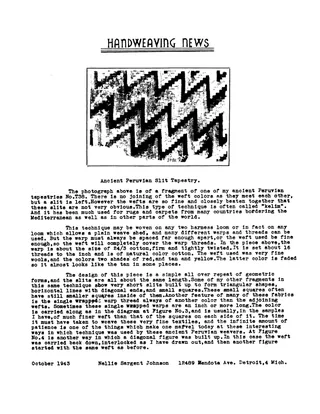
Handweaving News (October 1943): Ancient Peruvian Slit Tapestry
Periodical · 3 pages · weaving drafts
A short 1943 article by Nellie Sargent Johnson describing a fragment of an ancient Peruvian slit tapestry (kelim-type) from her collection. She gives the warp and weft materials, colors and sett, a charted design on cross-section paper, and diagrams showing how to work the slits and turn colors around warp threads. Two variations seen on other fragments are also drawn, and she offers one fragment for sale.
picture postcard
Ephemera · 1 page
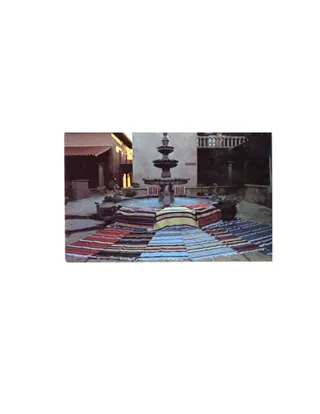
A single picture postcard with a color photograph of a courtyard with a tiered stone fountain in a tiled pool. Many striped woven rugs or blankets in red, blue, black, cream and light blue are displayed in the foreground. The postcard has no readable text, so the place and publisher cannot be determined from the scan.
Picture postcards
Ephemera · 1 page
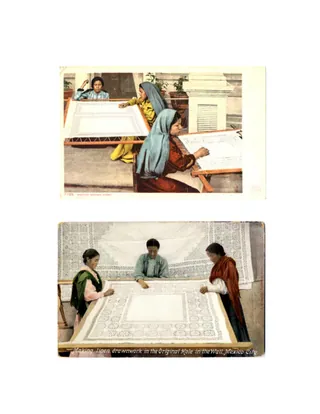
A single page showing two hand-colored picture postcards of women making linen drawnwork (drawn-thread embroidery) on wooden frames. The top card is captioned "Making Drawn Work" and numbered 7758. The bottom card is captioned as showing linen drawnwork being made in the Original Hole in the Wall, Mexico City.
211 documents found