Textile Documents › Topic: Embroidery and beadwork
636 documents found
Sort: 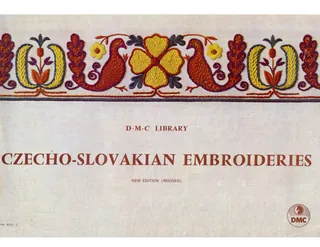
Czecho-Slovakian Embroideries
Book · 51 pages
A DMC Library album of 67 Czecho-Slovakian (Bohemian, Moravian and Slovak) embroidery models on twenty plates, issued by Th. de Dillmont's Mulhouse house. The text gives directions for each border, naming the linen, DMC thread types, sizes and colour numbers, and the stitches used (cross, plaited Slav, stroke, flat, stem and button-hole stitches, openwork rivières, raised satin stitch and French knots). It includes diagrams for working the rivières, instructions for tracing, pouncing and enlarging patterns, and squared-ground patterns for plates IX to XX, followed by colour plates. The back pages list DMC threads and other DMC Library titles.
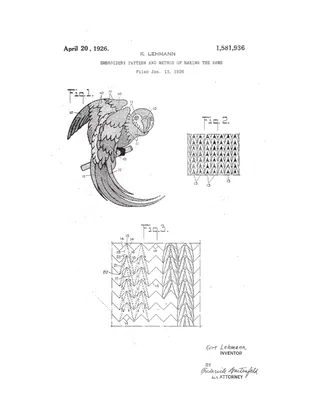
Embroidery Pattern and Method of Making the Same, US Patent No. 1581936
Patent · 5 pages
US Patent 1,581,936, granted April 20, 1926 to Kurt Lehmann of New York, assignor to So-Me-On Corporation, for an embroidery pattern and the method of making it. It describes rows of straight stitches laid as nested, overlapping angles that look like chain stitch but cover the base fabric more completely, and that can be produced on Schiffli embroidery machines. The patent includes drawings of a parrot figure, an enlarged stitch pattern, and a cartoon diagram of the stitching sequence, plus eight claims.
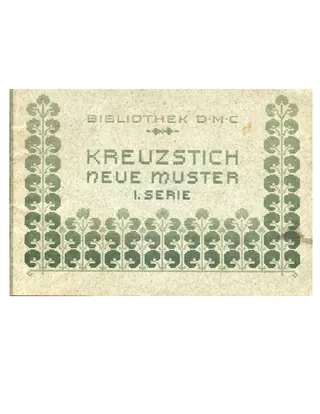
Kreuzstich Neue Muster 1. Serie [New Designs in Cross Stitch. Series 1]
Book · 33 pages · German
A German-language pattern album from the D.M.C library, with 24 colored plates (Tafeln) of counted cross-stitch designs: borders, repeating all-over patterns, motifs such as flowers, tulips, birds, bees and children, and a plate of monograms. Each chart is drawn on a numbered grid (0-170 by 0-100) in two or three colors. The back pages advertise D.M.C threads and list the other titles in the Bibliothek D.M.C series.
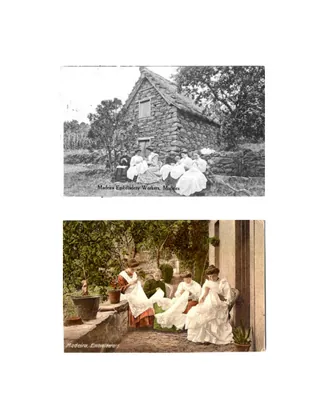
Picture postcards
Ephemera · 3 pages
Three pages of picture postcards showing women embroiderers in Madeira. The photographs show women in white dresses sitting outside thatched stone cottages and in gardens, and one woman holding up a large piece of embroidered work. Captions include 'Madeira, Embroiderers' and 'Hand Embroidering native of Madeira Islands'. The postcards document the Madeira embroidery industry and the working conditions of its home workers.
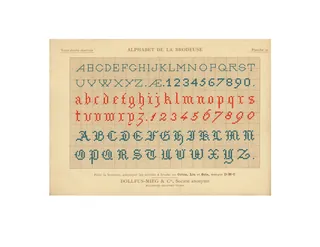
Alphabet de la Brodeuse [The Embroiderer's Alphabet]
Book · 151 pages · French
A French-language edition of Th. de Dillmont's pattern album of counted-thread (cross-stitch) alphabets, numerals, monograms and ornamental motifs, published for the D·M·C embroidery thread brand. Most of the book is numbered colour plates (Planches) of charted letters, borders, corners and figural motifs in red and blue, followed by plates of monograms with tracing patterns (calques) for white embroidery. The final pages are a catalogue of other Bibliothèque D·M·C titles, covering filet, macramé, Irish lace, crochet, knitting, Colbert, Yugoslav, Turkish, Norwegian and Coptic embroidery, bobbin and needle lace, and tatting.
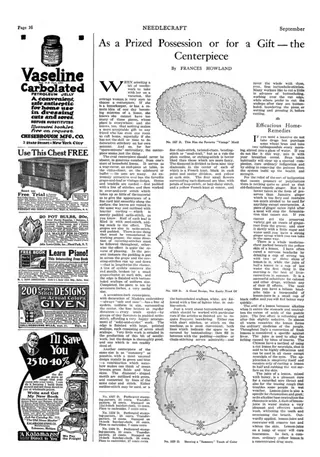
As a Prized Possession or for a Gift - the Centerpiece
Article · 1 page
A 1919 Needlecraft magazine page on embroidered centerpieces, describing three designs: an oval grape-and-leaf (vintage) piece in padded satin stitch, cording and seed stitch, a Madeira-style piece with eyelets and scalloped edge, and a summery green and blue diamond-motif piece with French knots and lazy-daisy flowers. It also gives advice on working buttonholed scalloped edges, and lists pattern numbers and prices for stamped patterns. The page also includes a short unrelated column of home remedies and several advertisements.
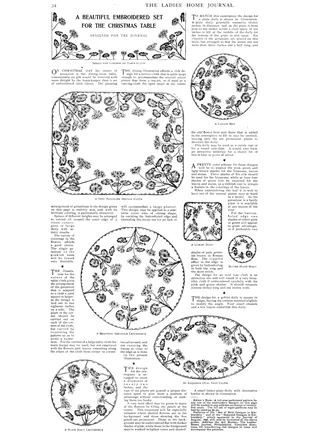
A Beautiful Embroidered Set for the Christmas Table
Article · 1 page
A page from the Ladies' Home Journal (1898) presenting a set of embroidered table linens with geranium designs for Christmas. It describes designs for table-cloth corners, a service or carving cloth, a round centrepiece, plate, carafe, goblet and butter-plate doilies, and an oval tray cloth, with sizes, color schemes (pinks, greens, light browns), filo silk and Roman floss, and buttonhole edging. An editor's note offers perforated patterns by mail from the Art Bureau.
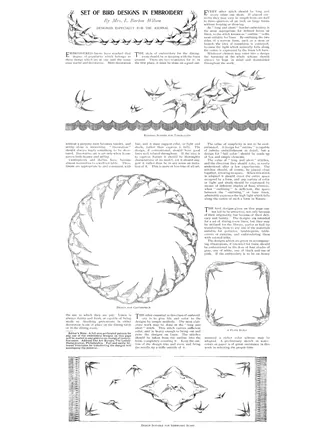
A Beautiful Embroidered Set for the Christmas Table
Ladies' Home Journal, 1898
Article · 1 page
A 1898 Ladies' Home Journal page by Mrs. L. Barton Wilson presenting swallow-themed embroidery designs for a set of dining-room linen: a running border for a tablecloth, a round centrepiece, a plate doily, and a sideboard scarf design. The text gives advice on long-and-short stitch and outline stitch, simplicity of design, and a color scheme of grays, white, black and pink floss. It notes that full-size perforated patterns could be ordered from the journal's Art Bureau.
Breakfast Set in Blue and White
Ladies' Home Journal, June 1898
Article · 1 page
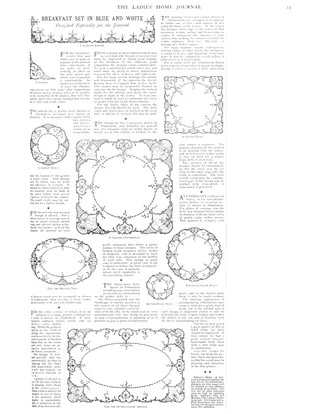
A 1898 Ladies' Home Journal page presenting a set of embroidered table linens designed in Delft blue and white to match blue-and-white breakfast china. It describes designs for a running border, corner, goblet doily, carafe doily, breakfast-plate and butter-plate doilies, a square centrepiece, a serving-tray cloth and a coffee-service cloth, with sizes, silks (Asiatic Roman floss, Caspian floss, filo silk) and stitches (buttonhole outlines, satin stitch, cross-stitch). Perforated patterns were offered by mail from the magazine's Art Bureau.
A Budget of Christmas Novelties
Article · 1 page
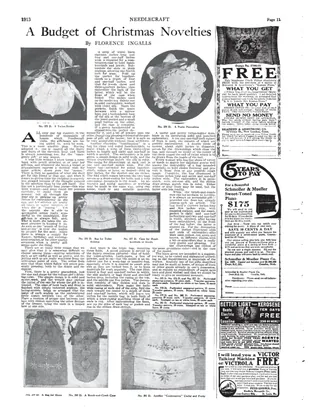
An article from Needlecraft Magazine offering ideas for handmade Christmas gifts in embroidered linen. It describes a twine-holder, pincushion, triple toilet-article bag, handkerchief and jewel case, double handkerchief bag, shoe bag, and brush-and-comb case, with dimensions, stitches (solid, eyelet and satin-stitch embroidery) and colors. It ends with prices for perforated stamping patterns, transfer patterns and pre-stamped linen.
Chamber Linens
Article · 1 page
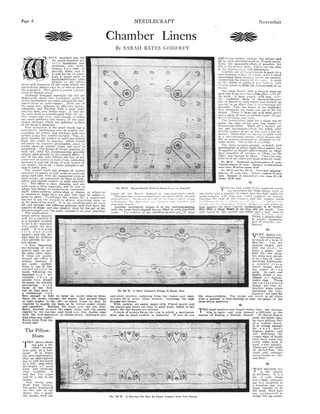
A November 1912 Needlecraft Magazine article on embroidered chamber linens, chiefly eyelet-embroidered dresser scarfs, stand-covers and pillow-shams. It gives sizes, stitch hints (including how to work oval eyelets), design ideas using French knots, punched work and stem stitch, and pattern numbers with prices. It closes with short unrelated household hints on curtain straps, bead necklace thread and hats.
The Embroiderer's Alphabet
Book · 143 pages · weaving drafts
A D.M.C Library album of counted-thread embroidery charts by Th. de Dillmont, published by Dollfus-Mieg & Cie of Mulhouse. It consists of numbered plates of cross-stitch alphabets (script, Gothic, upper and lower case), numerals, monograms, borders, dates, butterflies and other ornaments, followed by tracing sheets for white embroidery monograms. The back of the book carries advertisements for other D.M.C albums (French net work, crochet, cross stitch, Teneriffe lace, macramé) and tables of D.M.C cotton, linen and silk thread sizes.
A Handsome Beaded Bag
Article · 1 page
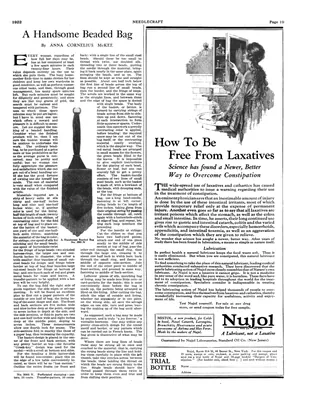
A 1922 Needlecraft Magazine article by Anna Cornelius McKee giving instructions for making a beaded handbag from satin or silk, trimmed with cut-steel beads and a beaded basket-and-flower design. It lists materials, cutting dimensions, beading methods (outlining, lattice basket, fringe, couching), and how to make the ring handles and inside pockets. Pattern numbers and prices for a perforated stamping pattern and a transfer pattern are given.
Heavy Embroideries in Color
Article · 1 page
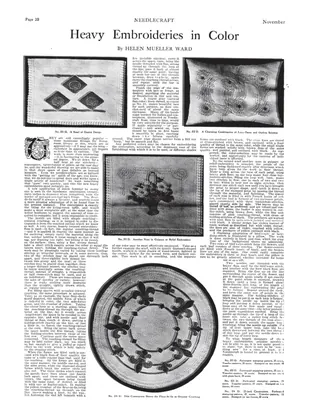
A one-page article from Needlecraft Magazine (November 1912) describing heavy embroidery worked in coarse floss and couching thread. It gives instructions for a scarf with diamond-shaped couched motifs, a guipure or relief rose design with buttonhole-stitch petals, a pillow worked in bird's-eye (lazy-daisy) stitch, and a centerpiece with fleur-de-lis in Oriental couching. It also covers edging a centerpiece with lace or fringe and lists stamping and transfer patterns with prices.
Holbeinova Technika [Holbein Technique]
Ottův slovník naučný, 1897
Article · 1 page · Czech
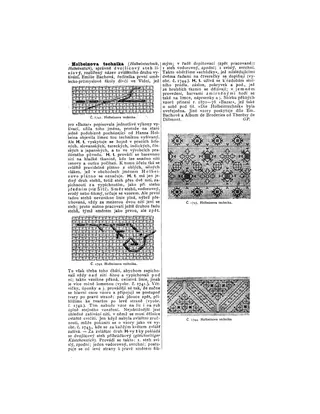
A one-page Czech encyclopedia entry on Holbein technique (Holbeinstich), a double-running line stitch used in counted-thread embroidery on evenweave fabric. It explains how the stitch is worked in two passes to make a continuous line, how branching motifs and thread ends are handled, and the related boxed stitch variant. Four numbered diagrams (figs. 1741-1744) illustrate the stitch, and the entry cites pattern sources by Emilie Bach and Thérèse de Dillmont.
Imitation-Bead Embroidery, US Patent No. 322582
Patent · 2 pages
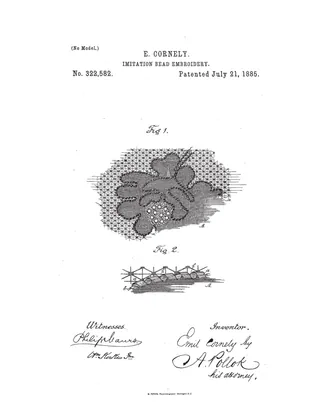
US Patent No. 322,582, granted July 21, 1885 to Emil Cornely of Paris, describes a way to imitate bead embroidery by using an embroidering or sewing machine to wind a narrow strip of shining leather, cloth, patent leather or metal around the stitch thread. The strip lies in successive spirals on lace or other fabric and is held by the machine stitch, giving a cheap substitute for beadwork. The scan has a drawing sheet with two figures and a one-page specification with two claims. It refers to Cornely's earlier patents of 1880 and 1882 for the thread-winding mechanism.
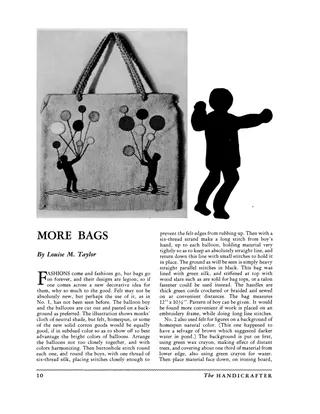
More Bags
Article · 2 pages
A short 1932-33 magazine article by Louise M. Taylor describing two decorative felt appliqué and embroidered bags. The first has a balloon boy with balloons cut from felt and buttonholed onto monks' cloth; the second has a pond scene with ducks and a water lily, with the water and trees colored in wax crayon set by ironing. It gives materials, stitches, lining, handle and stiffening instructions, and suggests framing the designs as samplers.
Needleweaving
Article · 1 page
A single page from the May 1977 issue of The Minnesota Weaver, captioned 'Needleweaving by Laura Thompson'. It is the back-cover layout, showing the masthead of editors and staff, a May calendar of dates to remember, and the Weavers Guild of Minnesota's address and mailing indicia. The article text on needleweaving is not on the page, and the illustration area is a solid black circle.
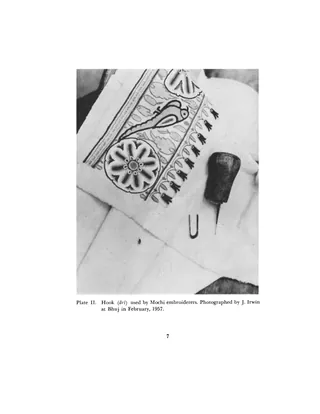
Notes on the Use of the Hook in Indian Embroidery
Article · 13 pages
Article by John Irwin and Babette Hanish on the use of the hook (ārī) for chain-stitch embroidery in India, based on their separate field enquiries at Bhuj, Kutch, in 1957 and 1967. It covers the historical background of Gujarat and Sind chain-stitch embroidery, the Mochi caste embroiderers, how the hook is held and used, and how hookwork can be told from needlework. The earliest known published reference (1839) and a Kashmir painting of c. 1820 showing hook embroiderers are discussed, with plates, line drawings and footnotes.
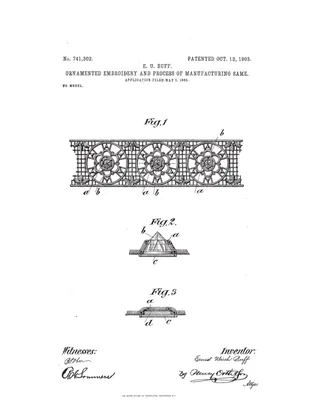
Ornamented Embroidery and Process of Manufacturing Same, US Patent No. 741302
Patent · 3 pages
US Patent No. 741,302, granted October 13, 1903 to Ernest Ulrich Buff of Herisau, Switzerland. It describes embroidery in which tinsel ornaments such as spangles and glass gems are held in pockets or eyes formed in the embroidery, rather than sewn on the front surface. The process embroiders the design on a corrodible material, inserts the ornaments behind perforations with a backing fabric, then etches away the base and trims the backing. The scan has a sheet of drawings (Figs. 1-3) and the specification with four claims.
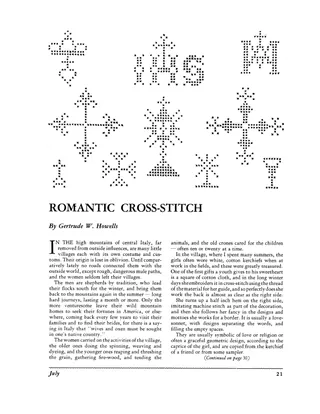
Romantic Cross-Stitch
Article · 2 pages
An article on the cross-stitch embroidery of mountain villages in central Italy, where girls embroider cotton kerchiefs with love-sonnet borders and symbolic motifs given by sweethearts. It describes the old "Santa Croce" linen samplers worked in red cotton, from which about 200 designs were collected, and lists common love and religious emblems. The scan also includes the end of a separate article on woven bags, with warp and color details.
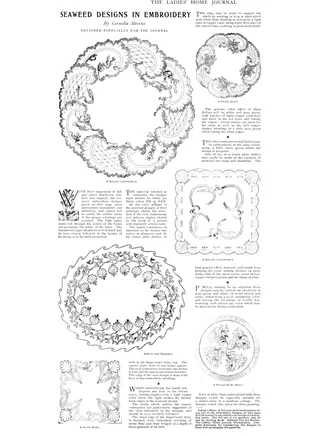
Seaweed Designs in Embroidery
Article · 1 page
A single-page 1898 Ladies' Home Journal article by Cornelia Stevens presenting six seaweed-themed embroidery designs for table linens: round, square and oval centrepieces, plate doilies and a finger-bowl doily. The text gives color schemes (white, gray green, copper, wood brown), suggested stitches such as long and short stitch, stem stitch and buttonhole edging, and the sizes of each piece. It also gives ordering information for perforated patterns from the magazine's Art Bureau.
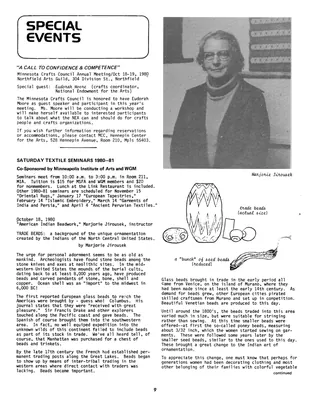
Trade Beads
Minnesota Weaver, September 1980
Article · 2 pages
A short article by Marjorie Jirousek giving background on trade beads and the beadwork of Native peoples of the North Central United States. It traces beads from prehistoric stone and shell ornaments through European glass beads from Venice, the arrival of small seed beads around 1800, and how seed beads replaced porcupine quillwork. It closes by distinguishing the Woodland Ojibwe and Plains Sioux beadwork traditions in Minnesota, with line drawings of a Sioux and an Ojibwe design.
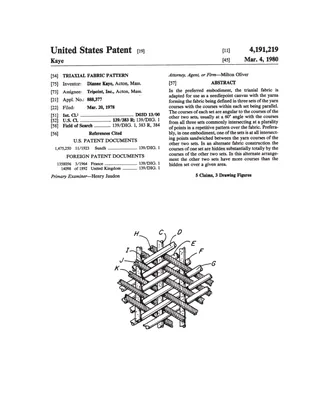
Triaxial Fabric Pattern, US Patent No. 4191219
Patent · 8 pages
US Patent 4,191,219, granted March 4, 1980 to Dianne Kaye of Acton, Massachusetts and assigned to Tripoint, Inc., for a triaxial woven fabric intended mainly as needlepoint canvas. Three sets of yarn courses cross at about 60 degrees, with the warp sandwiched between two weft sets at each intersection to leave large triangular pores. A second embodiment hides the warp behind more closely spaced wefts. The scan includes a web-database printout and the original patent pages with claims, drawings and description, and contrasts the design with earlier triaxial patents such as the Dow (Doweave) patents.
Adhesively Applied Schiffli Embroidery, US Patent No. 4788922
Patent · 8 pages
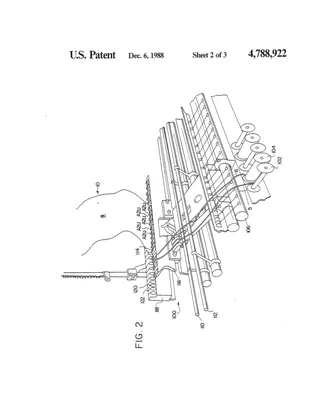
US Patent 4,788,922, granted to H. William Clarius and assigned to Lion Brothers Co., describes a heat-sealable Schiffli embroidery appliqué. The design is stitched in mirror image on a heat-degradable cellulosic backing, with bobbin yarn forming the top surface. The needle yarn combines a fusible thermoplastic monofilament with a non-fusible one, so the design bonds to a garment under heat and pressure and keeps its structure while the backing is brushed away. The document includes background on prior art, a description of the Schiffli loom setup, three drawing sheets and 20 claims.
Adoration of the Magi in Embroidery
Article · 7 pages
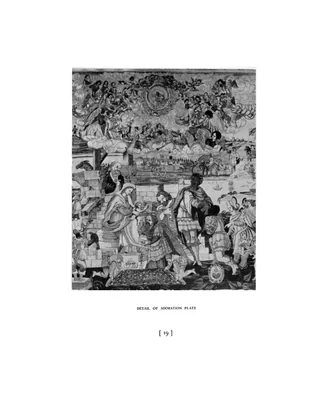
An iconographic essay by Phyllis Ackerman on a seventeenth-century Italian embroidered altarfrontal showing the Adoration of the Magi. It describes the central scene and the many surrounding episodes (animals, travelers, Old Testament parallels, heavenly choir) and reads them as a Christian allegory of the Fall and Redemption. It also notes Oriental influences such as a Persian-style textile pattern and a Polonaise-type carpet. Illustrations include the altarfrontal, a detail of the Adoration, and a center panel of embroidered netting.
Album
Other · 6 pages
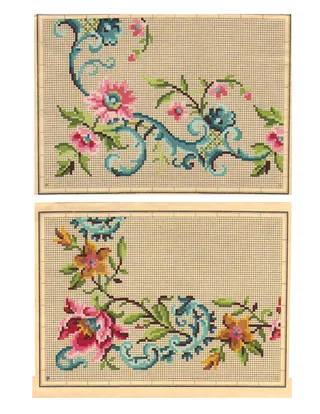
A small German-made pattern album (No. 383) of colored cross-stitch charts, sold by Gimbels for 25 cents. It includes a foldout strip of six reduced needlepoint canvas designs, followed by full-size charts on squared grid paper. The charts are floral and scrolling-foliage borders and corner designs in pinks, reds, yellows, blues, teals and greens. There are no weaving drafts.
Austrian Peasant Embroidery
Article · 8 pages
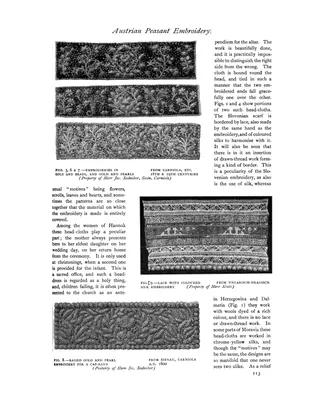
An illustrated 1906 article from The International Studio by A. S. Levetus on the peasant embroidery of the Austrian Empire's provinces, including Moravia, Bohemia (Egerland), Carniola, Dalmatia, Herzegovina, Salzburg, Upper Austria and the Tyrol. It describes head-cloths, shirts, cuffs, caps, neckerchiefs, chalice covers and belts, along with their motifs, colours, stitches (cross, satin, plaited, drawn-thread, gold and pearl relief work), materials, and the customs attached to them. Twenty-one photographed figures show pieces from museum and private collections.
Bayeux Tapestry
Article · 15 pages
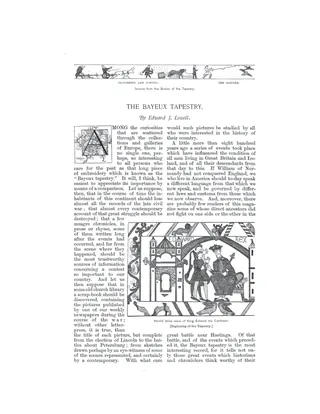
An illustrated 1887 magazine article by Edward J. Lowell on the Bayeux Tapestry, an embroidered linen strip about 230 feet long depicting the Norman Conquest of England. It describes the object's dimensions, materials (worsted wool stitched on linen), figure style and colouring, the debate over its maker and date, and its survival through fires, pillage and removals. It then narrates the scenes from Harold's journey to Normandy, his oath, Edward's death and Harold's coronation, through the invasion and the Battle of Hastings, with reproductions of many scenes and Latin inscriptions.
Beaded Lace
Godey's Lady's Book and Magazine, October 1879
Article · 1 page
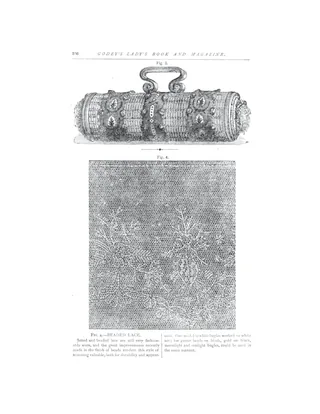
A short fashion-magazine item on beaded lace from Godey's Lady's Book. It notes that jetted and beaded lace are fashionable trimmings and describes a model of white bugle beads worked on white net, with suggested colour variations such as garnet on black or gold on black. The page shows a beaded bag or case (Fig. 3) and a panel of beaded lace on net (Fig. 4).
Broderies Yougoslaves 2me Series [Yugoslavian Embroideries, 2nd Series]
Book · 46 pages · French
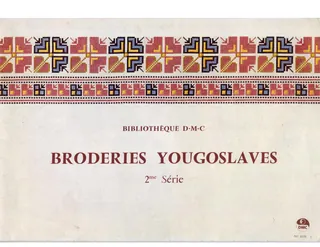
Second series of Yugoslavian embroidery patterns published by Th. de Dillmont's DMC library, with 83 mostly polychrome models on 20 plates. The designs are copied from originals in Bosnia, Herzegovina, Dalmatia and Montenegro, mainly borders for women's shirts and shawls. An introduction describes regional styles and stitches, and the plate-by-plate instructions give fabric, DMC thread numbers and colours, and stitches (cross stitch, outline stitch, Slavic bias stitch, darning stitch, laid stitch, Bosnian stitch). The book has colour plates of the models, stitch figures, and squared line drawings for enlarging models 64-67, followed by DMC product and publication lists.
Cross Stitch
Book · 28 pages
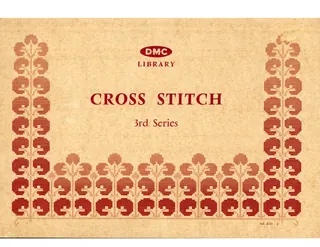
A D·M·C Library pattern album, Cross Stitch, 3rd Series, issued by Editions Th. de Dillmont (Mulhouse). It presents about twenty colour charts of cross-stitch borders (wide and narrow), corners, powderings and grounds, plus three plates of children's subjects. The short introduction recommends D·M·C threads (pearl cotton, embroidery twist, stranded cotton, Persian silk) and says designs can be worked in one to four colours. The back pages list D·M·C thread products and other D·M·C Library titles.
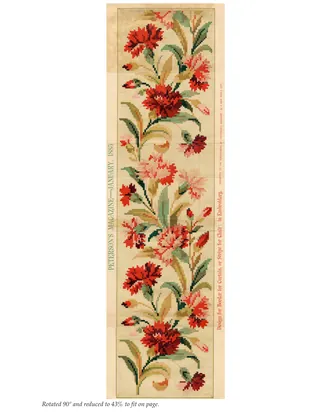
Design for Border for Curtain or Stripe for Chair in Embroidery
Peterson's Magazine, 1885
Illustration · 1 page
A single-page charted embroidery design from Peterson's Magazine, January 1885, issued to subscribers as a New Year's gift. It shows a vertical border or stripe worked on squared grid paper, with red and pink carnations, buds, and green and olive leaves on scrolling stems. It is meant for a curtain border or a chair stripe.
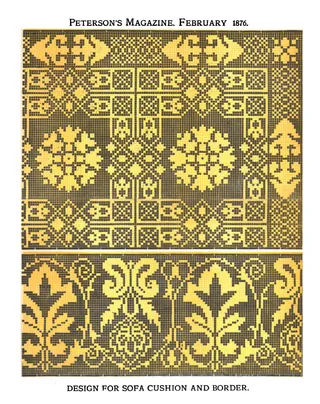
Design for Sofa Cushion and Border
Peterson's Magazine, February 1876
Illustration · 1 page
A single-page illustration from Peterson's Magazine, February 1876, showing a charted needlework design for a sofa cushion with a matching border. The square field is filled with repeating geometric and floral motifs including scrolling leaves, lozenges, checkered panels and rosettes. No instructions are included in the scanned text.
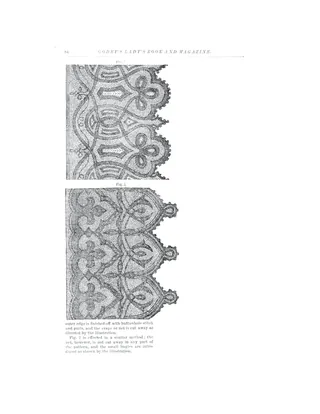
Designs for Lace Edging
Godey's Lady's Book and Magazine, January 1876
Article · 2 pages
A short needlework article from the Work Department of Godey's Lady's Book giving two designs for lace edging to trim fichus and veils. Materials are fine black Brussels net, crape, purse silk and small bugles. Fig. 1 is worked in overcast and satin stitch with a buttonhole and purl edge, with the crape or net cut away; Fig. 2 is worked similarly but the net is not cut away and bugles are added.
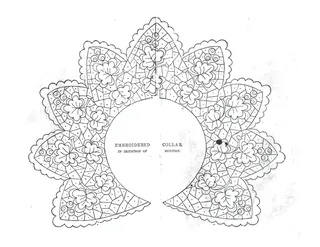
Embroidered Collar in Imitation of Honiton
Godey's Lady's Book and Magazine, October 1855
Illustration · 1 page
A single full-page line drawing from Godey's Lady's Book (October 1855) showing an embroidered collar pattern designed to imitate Honiton lace. The scalloped collar has pointed lobes around a central opening, filled with stylized leaves, flowers, berry-like circles and other motifs. The page carries only the caption and no instructions.
Embroidered Gifts
Article · 1 page
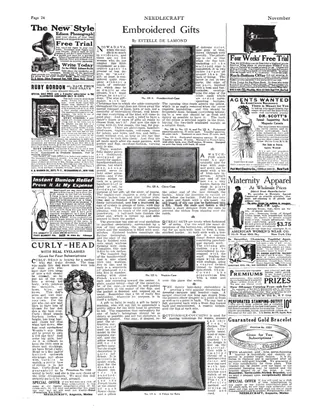
A one-page article from Needlecraft Magazine, November 1912, by Estelle de Lamond on embroidered gift items. It discusses handkerchief, glove and napkin cases made of linen with scalloped and punched embroidery, plus a baby's pillow, and adds short tips on a lace watch-fob, scrim bureau-sets, lazy-daisy embroidery and buttonhole-couching. The page also carries period advertisements and subscription premium offers.
Embroideries for the Summer Home
Article · 1 page
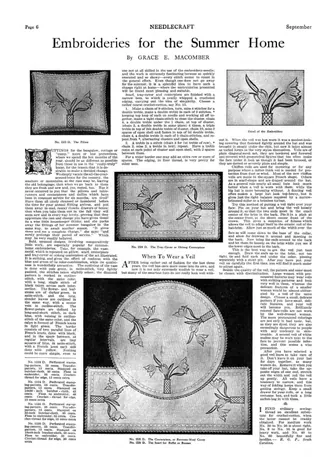
A 1919 Needlecraft magazine article by Grace E. Macomber describing a set of summer-home embroideries (pillow, scarf, centerpiece and tray-cover) worked with a vase-and-tulip motif in blue, green, black and yellow on butcher-cloth. It gives the stitches used (satin stitch, outline stitch, long-and-short stitch, French knots) and written crochet instructions for a narrow edging in coarse cotton. Pattern numbers and prices for stamped goods and floss are listed. The page also carries a short unrelated piece on wearing and caring for veils and a reader tip on substituting sewing thread for crochet cotton.
The Embroidery Basket
Article · 1 page
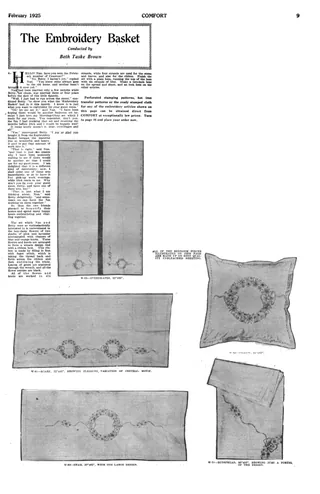
A one-page embroidery column from Comfort magazine, February 1925, presented as a dialogue between two friends planning a guest-room bedroom set. It describes a wreath design worked in lazy-daisy flowers, knots, and a fagot-stitch ribbon bow, with thread counts, hem advice, and ordering information for stamped patterns. Photographs show the overdrapes, pillow, scarf, sham, and bedspread, with sizes and pattern numbers.
Fancy Designs - Ornamenting Oriental Work
Mary Haehnlen · 1884
Monograph · 25 pages
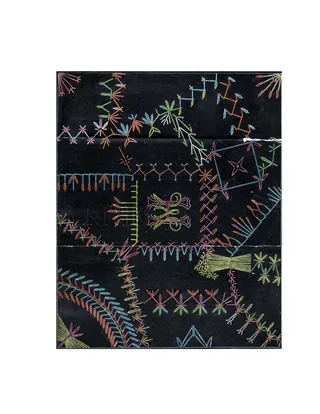
A small 1884 pattern book of embroidery stitch designs for decorating Oriental or "crazy" work (patchwork of silk and velvet pieces), designed and published by Mrs. M. Haehnlen of Chicago. After a short introduction on preparing the pieces, it presents twelve numbered basic stitches (straight, cat, buttonhole, feather, herringbone, coral, loops and knots). The remaining pages show white-on-black diagrams of decorative stitch borders, each with brief instructions on how to combine the basic stitches, loops and knots.
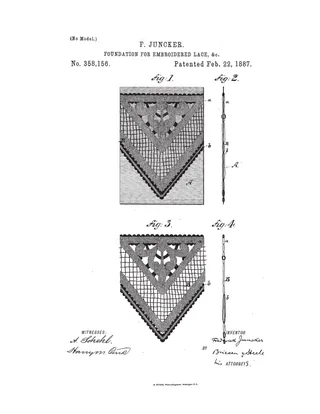
Foundation for Embroidered Lace, US Patent No. 358156
Patent · 3 pages
US patent specification and drawing sheet for Frederick Juncker of Paris, granted February 22, 1887 (filed June 10, 1886). It describes making lace, galloon, and guipure by embroidering by hand or machine on a sheet of gutta-percha or india-rubber, then dissolving the backing in benzine or carbon sulphide to leave an open-work embroidered fabric. The patent contrasts this with older paper or fabric foundations removed by acid or heat, which damaged the threads. The claim covers lace or open-work fabric secured on a soluble gum, india-rubber, or gutta-percha ground.
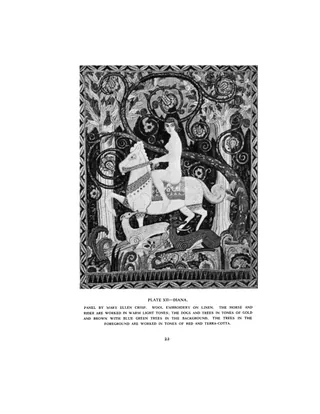
The Four Moderns in America, Exponents of the Newer Embroidery
Article · 7 pages
Article by Georgiana Brown Harbeson on four American women artists who work in crewel embroidery or "needlepainting" as a form of modern art: Marguerite Zorach, Marcia Stebbins, Mrs. Arthur Crisp (Mary Ellen Crisp) and the author. It compares their styles, stitch choices, backgrounds and compositions, and argues for crewel work over canvas work as a medium for individual design. Illustrated with plates of Stebbins's boating panel and Crisp's "Diana" panel, plus a plate of the seven most-used stitches (Cretan, feather, buttonhole, chain, fly, satin).
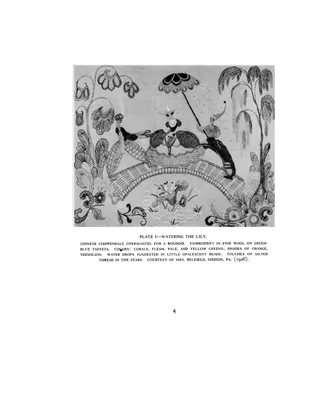
Georgiana Brown Harbeson, a Painter in Needlework
Article · 11 pages
An introductory biographical article by Frances Morris on Georgiana Brown Harbeson, an American embroiderer and trained painter regarded as a leading exponent of modern embroidery in the 1920s-30s. It covers her background, her design process (pictorial cartoon, choice of ground, a 'palette of wools') and her use of stitches like brush strokes. Seven plates show her embroidered panels, portraits, an overmantel and a zodiac wall hanging, with captions giving materials, colors and stitches, plus a panel by Mrs. Theodore Roosevelt, Jr. and a needlepoint monkey screen.
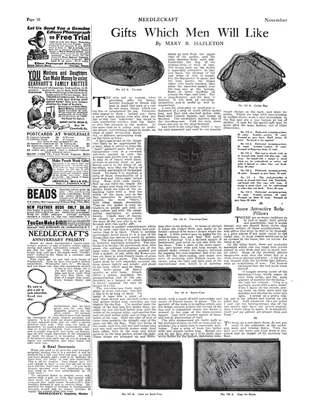
Gifts Which Men Will Like
Article · 1 page
A November 1912 Needlecraft Magazine article by Mary B. Hazleton suggesting embroidered gifts for men, made on crash or linen. It gives directions for a shirt case, tie-rack, traveling-case, stick-pin case, collar-bag and razor-case, with notes on colors and stitches such as satin stitch, outline stitch, punchwork and French knots. The page also carries a short piece on washable lace sofa pillows, a household hint, and advertisements.
John Nelham's Needlework Panel
Article · 14 pages
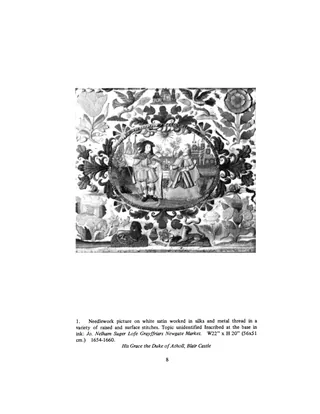
Article by Margaret Swain on a seventeenth-century English raised-work (stumpwork) picture on white satin at Blair Castle, inscribed in ink with the name and address of John Nelham, a London embroiderer and pattern drawer at the Sugar Loaf, Grayfriars, Newgate Market. She compares it with related oval-medallion panels in the V&A, Bayou Bend, St. Louis, Nottingham, the Metropolitan Museum and the Fitzwilliam, and discusses how designs were drawn out on satin from printsellers' engravings. She dates the panel to 1654-1660 and cautions against attributing all similar panels to Nelham's workshop. Nine plates, references and a table of oval dimensions are included.
Moderne Stickvorlagen. Dessins de Broderies Modernes [Modern Embroidery Patterns. Modern Embroidery Designs]
H.K. Berlin · c. 1879-1890
Monograph · 15 pages · German
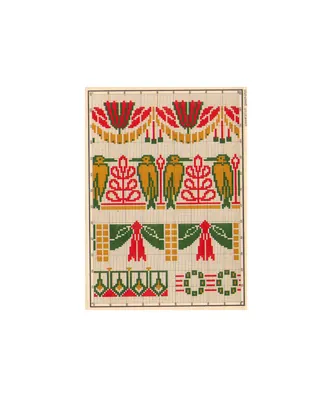
A German/French pattern book of modern counted-thread embroidery designs, numbered 548 and issued in Berlin. It consists of a cover, an overview sheet of reduced designs, and full-page colored cross-stitch charts with borders, floral motifs, alphabets, a lion and crown, a female figure, a rider and animal, and a peacock. The back cover shows a trademark and exhibition crest listing medals from 1844 to 1879.
Motifs pour Broderies 1st Série [Embroidery Motifs, 1st Series]
Book · 113 pages · French
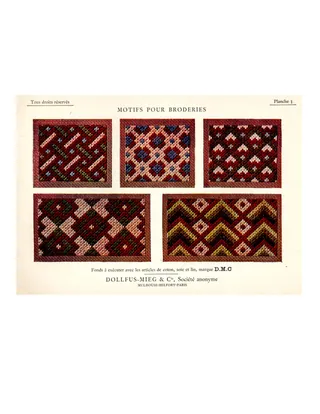
A French-language DMC Library album of embroidery and needlepoint motifs by Th. de Dillmont, first series, with an introduction and notes on canvases and fabrics. Its numbered color plates show grounds, borders, corners and scattered-motif patterns (semis) worked in cross stitch, half cross stitch, Hungarian stitch, satin-type passé embroidery and similar stitches. Each plate has a caption naming the stitch, fabric, DMC thread and color numbers, with variants and suggested uses. Gridded tracing patterns (calques) for enlarging and transferring designs follow, with instructions for their use. The back matter has a specimen page from the Encyclopédie des Ouvrages de Dames, advertisements for other DMC library albums, and DMC thread and silk product lists.
Motivi per Ricami (3a Serie) [Embroidery Motifs (3rd Series)]
Book · 29 pages · Italian
Italian-language edition of the third series of DMC's "Motivi per Ricami" (Embroidery Motifs), published by Th. de Dillmont in Mulhouse. It opens with an introduction on suitable fabrics (counted-thread linens and canvas) and threads (DMC perlé cotton, mouliné, linen and Persian silk). It then presents 20 color plates of counted-thread cross-stitch backgrounds (fondi) and borders (bordi) in stylized floral and geometric designs. The front and back matter include advertisements for DMC threads and lists of other DMC Library albums with prices.

The New Lace Embroidery (Punto Tagliato)
Louisa A. Tebbs · 1905
Book · 76 pages
A 1905 second-edition instruction manual by Louisa A. Tebbs on Punto Tagliato, a cutwork lace embroidery in which fancy filling stitches are worked in floss silk on linen, silk or velvet, then the fabric is cut away behind them to leave lace-like openwork. Part I is a practical first lesson on working a collar, with hints on needles, finishing cut edges, pressing and cutting out. Part II describes individual filling stitches (Tudor Rose, Crossbar, Diamond Filling, Point de Fillet, Spider's Web, Woven Bars, Cone Insertion, Turkish Point, Marguerite, Star Filling) with line diagrams. Photographic plates show finished collars, a blouse yoke and cuffs, cushion covers, table centres, tea cloths and a bedspread square.
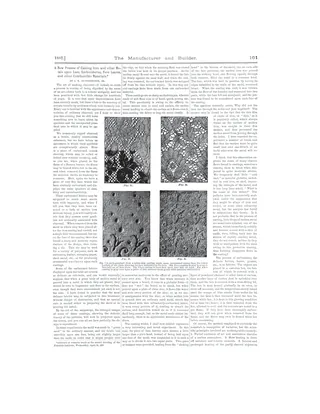
New Process of Casting Iron and other Metals upon Lace, Embroideries, Fern Leaves, and other Combustible Materials
Manufacturer and Builder, 1887
Article · 3 pages
Abstract of remarks by A. E. Outerbridge, Jr. to the Franklin Institute (April 20, 1887) describing a process for casting iron and other metals against lace, embroidery, fern leaves and other delicate materials after carbonizing them. The carbonized fabrics survive molten iron intact and leave a sharp impression of their pattern on the casting, which can serve as a die for embossing. The article explains the sand-mold method, the carbonizing procedure in a closed iron box with powdered charcoal, and a suggested explanation of casting flaws. Illustrated with photographs of cast iron pieces showing reproduced lace patterns.
636 documents found