Textile Documents › Topic: Bobbin lace
495 documents found
Sort: 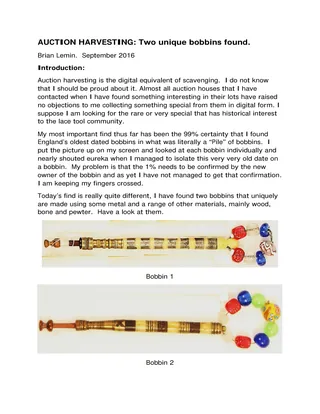
AUCTION HARVESTING: Two unique bobbins found
Brian Lemin · 2016
Web Doc · 4 pages
A short 2016 web article in which Brian Lemin describes two unusual lace bobbins he found in online auction listings. Both combine wood, bone, brass and pewter, and he analyzes their construction, decoration (knurling, turned rings, bitting-like cutaways, spangle beads) and resemblance to Jesse Compton bobbins. He concludes they are adapted or repaired bobbins, probably the work of a skilled turner, and is unsure whether they are modern or period adaptations.
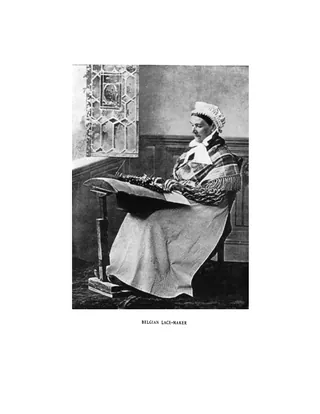
Belgian Lace-Maker
Illustration · 1 page
A single-page illustration from The Bulletin of the Needle and Bobbin Club, captioned "Belgian Lace-Maker." The photograph shows a seated woman in a white cap and striped shawl making bobbin lace on a pillow mounted on a wooden stand, beside a leaded-glass window. The page has only the caption and no accompanying text.
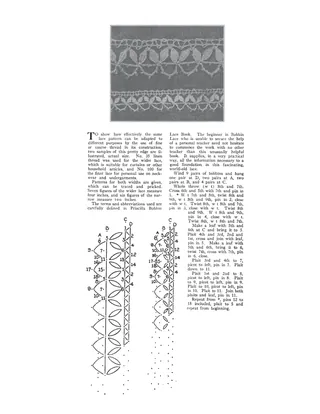
[Bobbin lace edging in two widths, Modern Priscilla]
Modern Priscilla, c. 1921
Article · 1 page
A one-page Modern Priscilla article presenting a bobbin lace edging in two widths, with photographs of both at actual size. The wider lace is worked in No. 35 linen thread for curtains and household use, the finer in No. 100 thread for neckwear and undergarments. Written instructions cover bobbin winding, whole throws, leaves, plaits and picots, and two pricking diagrams with numbered pins and bobbin groups A to D are provided for tracing.
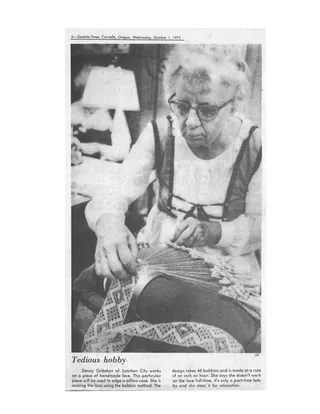
Clipping
Gazette-Times, Corvallis, Oregon, "Tedious Hobby", October 1975
Ephemera · 1 page
A short newspaper clipping with a photo and caption about Denny Gribskov of Junction City, Oregon, making bobbin lace. The lace is an edging for a pillow case, worked with 46 bobbins at about an inch an hour. She does it as a part-time hobby for relaxation.
A Dissertation on the Open and Closed Methods of Making Lace
Elaine Merritt · 1998
Web Doc · 3 pages
A short essay by Elaine Merritt explaining the difference between the open and closed methods of making bobbin lace. It describes the basic equipment (bobbins, pillow, pricking), the cross and twist movements, and how cloth stitch, half stitch and double (whole stitch, twist) are formed under each method. It also notes the regional preferences for each method and advises lacemakers to check which system a book or diagram assumes.
Kantklossen Techniek [Bobbin Lace Technique]
Book · 49 pages · Dutch
A Dutch-language beginner's handbook on bobbin lace (kantklossen) by L. J. de Jager-Meezenbroek, former director of the lace school at Wijdenes, issued as No. 3 in the Raad en Draad series. It covers equipment (pillow, bobbins, pins), winding bobbins, and the basic stitches (net stitch, linen stitch, spijltjes/plaits, double stitch), then turns to corners, picot edges and the use of coloured pairs. Progressive projects include a tea cosy cover, handkerchief edgings, collars, circular motifs, a shell motif and a tray cloth, each with working diagrams and photographs. It closes with general remarks and notes on applying lace to fabric.
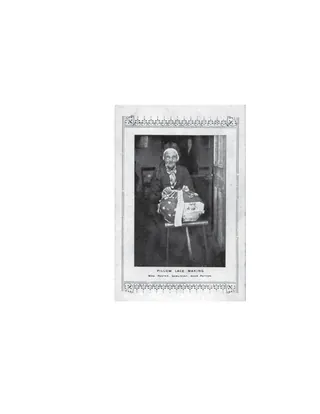
Pillow Lace Making
Illustration · 1 page
A single-page photographic illustration of an elderly woman making pillow (bobbin) lace. She sits on a stool working at a lace pillow with a strip of finished lace hanging over it, in a dark interior with a doorway behind her. The printed caption names her as Mrs. Panter of Gamlingay, near Potton.
A Text Book on Cluny and Torchon Laces
Book · 102 pages
A 1901 instruction manual for making Cluny and Torchon bobbin lace by Mary Eva Woodward. It opens with general directions on bobbin handling, stitches (point, half point, point grille, point d'esprit, point matte), cords and their crossings, and grounds such as Point de Dieppe, Point de Tulle and Brussels Point. The bulk is a series of numbered patterns (edges, insertions and borders in Cluny, Torchon, Point Vierge and point d'esprit), each with bobbin count, thread size, a numbered pin pricking diagram, a photograph of the finished lace, and pair-by-pair working instructions. It ends with directions for turning corners.
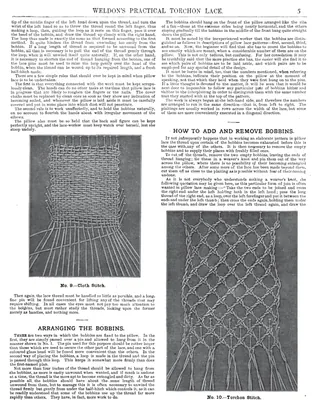
"Weldon's Practical Torchon Lace" in Weldon's Practical Needlework
Monograph · 12 pages
An instruction booklet on making Torchon bobbin (pillow) lace, issued as the First Series of Weldon's Practical Needlework. It covers the pillow, bobbins, pins and thread, how to hang the bobbins and handle the threads, then the basic stitches (half stitch, cloth stitch, Torchon stitch, twisted Torchon, double rose stitch, wheels, bars). Graduated patterns follow, including insertions, simple laces, lace for children's clothes and lace and insertion for a bedspread, each with a photograph and a pricked-pattern diagram showing pin holes. It ends with advice on finishing and pressing the lace.
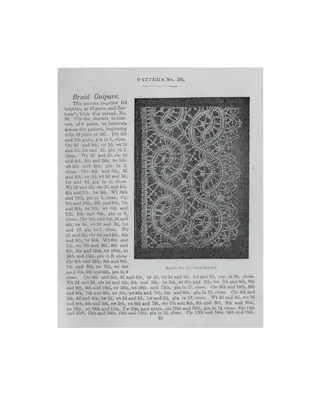
The American Lace Maker; Vol. 2
Torchon Lace Company, 1904
Monograph · 36 pages
Volume Two of a three-volume instruction series on bobbin lace published by the Torchon Lace Company of St. Louis in 1904. It gives written bobbin-by-bobbin directions, using abbreviations such as ctc, wt, tw and ht with pin numbers, for numbered patterns (Nos. 26 to 32) in braid guipure, Russian lace, Cluny lace and Honiton lace. Each pattern is shown in a photograph of the finished lace sample. The volume opens with an introduction and closes with a price list of lace-making materials.
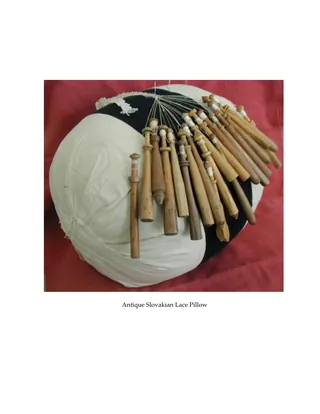
[Antique Slovakian Lace Pillow]
Illustration · 1 page
A single photograph of an antique round bobbin lace pillow from Slovakia. The pillow is covered in black and white fabric and set against a red background. Many wooden bobbins hang from it in a fan arrangement, and a piece of white lace is pinned to the pillow.
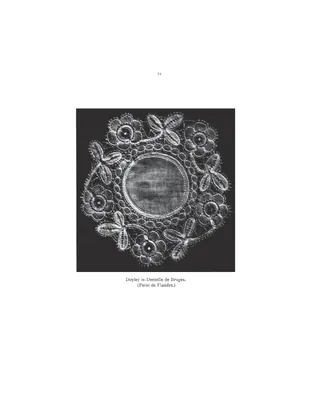
The Art of Bobbin Lace
Book · 105 pages
A practical instruction manual on making bobbin lace, written by a London lace teacher and published in 1907. It covers equipment and preparation (cushion, bobbins, winding, thread and pins), the basic cloth, half and plait stitches, and step-by-step directions for specimen pieces in Italian, Dentelle de Bruges (Point de Flandre), Guipure de Flandre, Honiton (including appliqué and raised work), Duchesse and Brussels lace. Separate sections explain ornamental filling stitches such as reseau, honeycomb, festoon, spider web, lead, diamond, double reseau and rose, and the book closes with advice on repairing and cleaning valuable lace. It is illustrated with photographs of finished pieces (doyley, collars, yoke, vest, bolero, scarf, flounce, handkerchief, berthe), pattern line drawings and stitch diagrams.
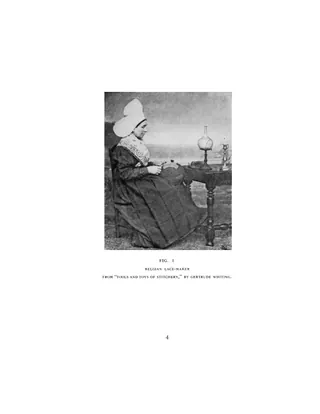
Belgian Lace-Maker
Illustration · 1 page
A single page carrying a black-and-white halftone photograph of a Belgian lace-maker seated at a lace pillow and working bobbins. The caption identifies it as Fig. 1, reproduced from Gertrude Whiting's "Tools and Toys of Stitchery." It illustrates bobbin lace-making practice and is an illustration only, with no instructional text.
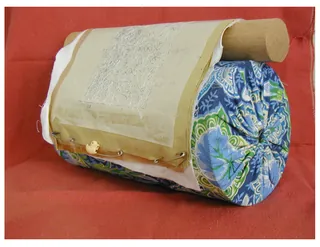
[Bolster lace-making pillow with pattern sheet]
Illustration · 1 page
A single photograph of a cylindrical lace-making pillow (bolster) covered in blue and green patterned fabric and gathered at the ends, with a wooden roller at the top. A pale parchment-like pattern sheet is shown on the pillow. The image has no text.
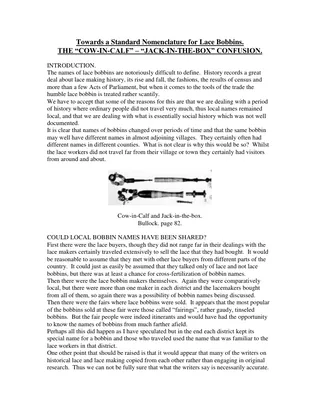
Cow and Calf or Jack in the Box
Brian Lemin · 2010
Web Doc · 6 pages
A short web article by Brian Lemin on the confusing names "cow-in-calf," "cow and calf," and "jack-in-the-box" for hollow-shanked lace bobbins that conceal a miniature bobbin. It reviews how nine published authors (Wright, Whiting, Freeman, Hopewell, Bellerby, Springett, Bullock) describe these bobbins, noting where they disagree on whether the small bobbin is loose or attached. Lemin proposes a standard nomenclature: cow in calf for the attached type, cow and calf for the loose type, and jack-in-the-box for the South Bucks "thumper." Photographs of bobbins and a reference list are included.
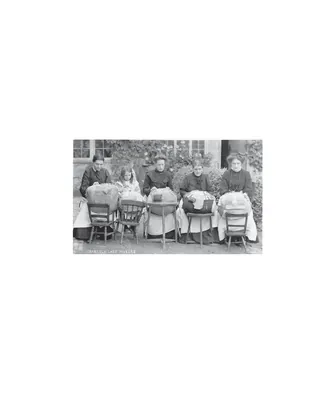
Cranfield Lace Makers
Illustration · 1 page
A single-page illustration titled "Cranfield Lace Makers". It is a photograph of five women seated outdoors in front of a cottage, each working bobbin lace on a lace pillow. Several wear dark dresses and aprons, and a young girl is among them. The only text is the caption.
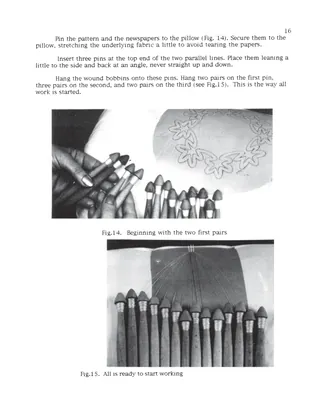
Cretan Bobbin Lace [Kritiko Kopanelli]
Book · 43 pages
An English translation (1997) of a 1985 Greek manual on Cretan bobbin lace by Kristina Koustouraki-Koukoulari. It covers the lace's introduction to Crete around 1906-1908, supplies, winding bobbins, pillow and pattern setup, and step-by-step instructions for the panaki (tape) with themata, ouyia and fifikaki edges. It also explains fillings (tulle, fil tiré), leaves (fylla), plaits, curves, sharp corners, circles, daisy motifs and the old-style and modern tapes, with photographs and motif designs for tablecloths. Appendices give a Greek-English glossary, definitions of edge treatments and a note on open versus closed method stitch notation.
La dentelle crétoise aux fuseaux [Kritiko Kopanelli; Cretan Bobbin Lace]
Book · 34 pages · French
A French translation (by Hélène Panitska) of a manual on traditional Cretan bobbin lace by Christina Koustouraki-Koukoulari, from the village of Gavalochori near Chania. It explains how to make the pillow, wind the bobbins, prepare thread, paper and patterns, and work the basic cloth stitch ("panaki") with picots and edge variations ("ouya", "fifikaki", "stylaki"). It also covers decorative motifs such as tulle, "filtiré", leaf, daisy and "koulourakia" rings, curved and pointed corners, and the older and newer Cretan lace styles. The photographs are not included; the text refers to the original Greek or the English translation.
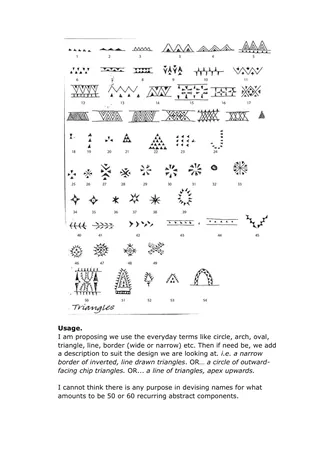
An Early effort to devise terms to describe genres of East Devon Lace Bobbin Decorations (v1)
Brian Lemin · 2019
Web Doc · 9 pages
A short 2019 working paper by Brian Lemin proposing descriptive terms for classifying the decorations on East Devon (Honiton and Branscombe) lace bobbins. Building on H. J. Yallop's ten decorative categories, it covers decorating methods (chip carving filled with sealing wax, aquafortis staining), then circumferential rings, abstract patterns, foliage and flowers, living creatures, human figures, words, initials and dates, ships, nautical, naive, bricks and diamonds. Illustrated with charts of numbered hand-drawn motifs for triangles, foliage, creatures, humans and ships.
East Midland Spangled Bobbins
Brian Lemin · 1998
Web Doc · 15 pages
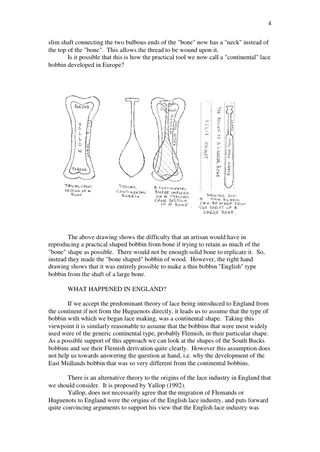
A July 1998 discussion paper by Brian Lemin speculating on why England developed the thin East Midland bobbin and why it came to be spangled. He reviews references to bone as the first lace bobbins (Palliser, Yallop, Whiting, Tornehave, Morris) and argues that English bobbins stayed thin because they were made of bone. He then weighs several explanations for spangles, including preventing rolling, thread untwisting, thread quality, and flatter English pillows. It ends with a summary, a call for further discussion, and an annotated reference list.
East Midland Spangled Bobbins some Speculations
Brian Lemin · 2010
Web Doc · 10 pages
A July 1998 discussion paper by Brian Lemin speculating on why English East Midland lace bobbins are thin and spangled (beaded). He argues that early bobbins were unmodified animal bones, that English makers kept bone as a material and so had to make thin bobbins, and that spangles were added to stop bobbins rolling, to cope with thread untwisting or breaking, and to suit flatter English pillows. He draws on Palliser, Yallop, Whiting, Levey, Tornehave and Carole Morris's article on a Gloucester bone bobbin, and closes with an annotated reference list.
En su honor los Almagreños 1982 [In Her Honor, the People of Almagro, 1982]
c. 1982
Ephemera · 1 page · Spanish
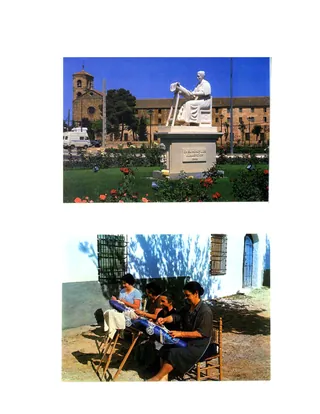
A single page of photographs showing a white marble statue of a seated woman holding a spinning wheel or distaff and a bobbin, set on a stone pedestal in a garden with roses. A church with a bell tower and a long stone building stand behind it. The only text is a caption reading "En su honor los Almagreños 1982", which suggests a monument to a lacemaker or spinner erected by the people of Almagro.
Das Formenklöppeln [Shape Bobbin Lacemaking]
Book · 102 pages · German
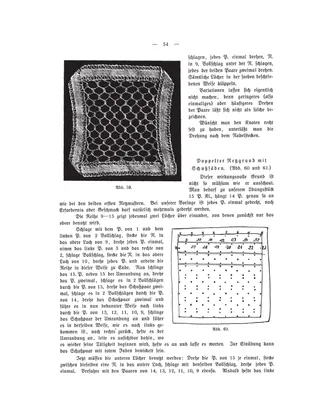
A German-language instruction manual on bobbin lace worked in shapes (Brugge, Brussels, Honiton style lace), written for beginners with no prior knowledge. It begins with a short history of lace and a list of equipment (pillow, bobbins, thread, pins, pricking), then moves through numbered practice exercises in whole stitch and half stitch, leaves, bows, rings, flowers and a Bruges collar. Later chapters cover filling stitches and net grounds (moss ground, spiderweb, honeycomb, tulle), a curtain panel, butterflies and a garniture piece. It is illustrated with photographs and pricking diagrams (Abb.), and the final pages carry publisher advertisements.
Further Steps in Honiton Lace
Book · 111 pages
A 1993 Batsford instruction book on bobbin lace by Susanne Thompson, continuing from her earlier Honiton lace book. It opens with a glossary of working methods (back stitch, bowing off, coarse pair, turning stitch, magic thread, etc.) and then gives six step-by-step patterns: Leaf Spray, Rosette, Summer Scene, Cone Flower, Treble Clef and Umbellifer. Each pattern has numbered line diagrams, prickings and detailed instructions for taps, rolls, ribs, side veins, leadwork and fillings. It ends with a bibliography, a list of suppliers in England and an index.
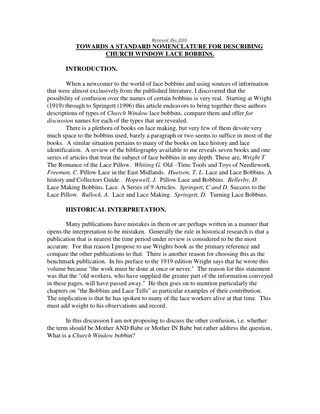
A Historical Analysis of Church Window Bobbins
Brian Lemin · 2010
Web Doc · 7 pages
An article by Brian Lemin that compares how eight published authors, from Wright (1919) to Springett (1996), describe Church Window, Mother-in-Babe, Cow-in-Calf and Jack-in-the-Box lace bobbins. It treats Wright as the benchmark source, points out contradictions (for example Huetson's 'baby bobbin'), and proposes standard definitions: Church Window (empty slots), Mother in Babe (contains a small bobbin), Other Inserts or 'Lantern', Jack in the Box and Cow in Calf. It ends with a speculation that the inserts may originally have been candles, a call for collectors' feedback, and a reference list. Three photographs of example bobbins are included.
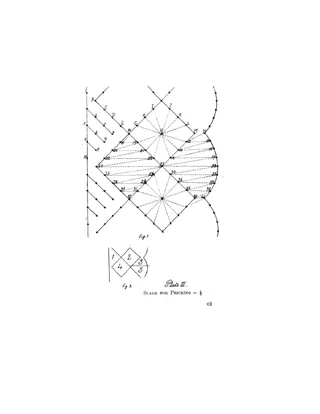
Home Lace-Making: A Handbook for Teachers and Pupils
Book · 57 pages
A 1909 handbook for teaching bobbin lace-making (Torchon) to children and other pupils, by M. E. W. Milroy. It opens with a preface and hints for the teacher on materials and costs, making prickings with a hektograph, and running a class. Six progressive patterns follow, each with a step-by-step numbered stitch sequence by pairs of bobbins and pin holes, plus pricking diagrams (Plates I-VII) and photographs of the six finished laces.
Honiton Lace
Book · 120 pages · weaving drafts
A 1985 instruction book on making Honiton bobbin lace, by Susanne Thompson. It covers equipment, preparing the pillow and bobbins, and the basic stitches. Five progressive patterns follow (basic flower, handkerchief corner motif, flower spray, trillium motif and bell flower spray), each with a section on working methods, fillings, ribs, purls and leadwork. The final chapters cover mounting Honiton lace on net and designing for it, followed by a bibliography, a list of lace organisations and suppliers, and an index. It is illustrated with many numbered line diagrams and prickings.
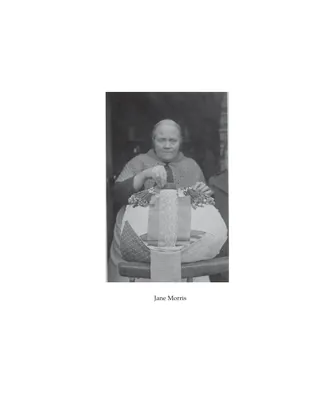
Jane Morris, Lacemaker
Illustration · 1 page
A single black-and-white photograph of an elderly woman, identified by the caption as Jane Morris, seated at a lace pillow. She wears a knitted shawl and is working bobbins, with a strip of lace and checked fabric draped across the pillow. The only printed text is her name.
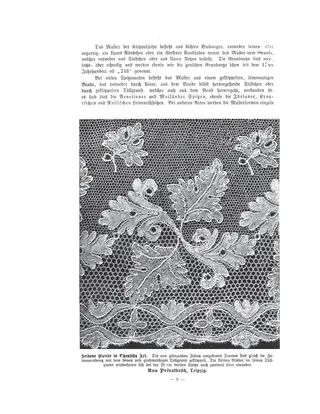
Klöppel-Spitzen [Bobbin Lace]
Book · 64 pages · German
A German-language instruction book on bobbin lace (Klöppelspitzen) by Gussy von Reden, published in Leipzig in 1909 by the Deutsche Moden-Zeitung. It opens with a history of bobbin lace and a survey of lace types (Genoese, Brabant, Brussels, Mechlin, Cluny, Honiton and others), then teaches the basic techniques, materials and stitches (Flechtschlag, Löcherschlag, Netzschlag, Leinenschlag, Formschlag). About 100 numbered patterns follow, from narrow edgings and insertions to wide church lace, handkerchief corners, rosettes, doilies, collar and tie ends, and ribbon-type (Bandspitze) lace in Russian and Hungarian styles. Each pattern gives bobbin pair count, thread size, a description and working instructions keyed to pricking sheets (Klöppelbriefe). Photographs of historic and model laces, including models from the Vienna lace course, illustrate it. Publisher advertisements are at the end.
Lace Bobbin Repairs
Brian Lemin · 2010
Web Doc · 2 pages
A short essay by Brian Lemin on how broken lace bobbins were repaired by bobbin makers and lacemakers. It covers the cricket bat splice for broken necks, riveting of loose bone bitting, repairs to chipped short necks (heads) with sealing wax, buttons or beads, problems with pewter inlay, and fixes for spangle fastenings. The author also discusses which splices may be original construction rather than repairs, and notes how little evidence of repair survives in collections.
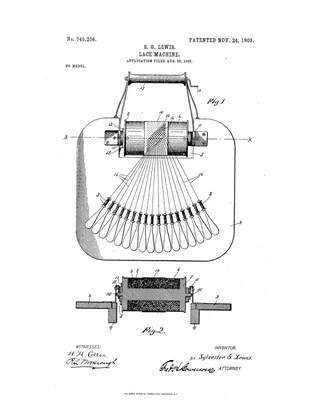
Lace Machine, US Patent No. 745206
Patent · 3 pages
US Patent No. 745,206, granted November 24, 1903 to Sylvester G. Lewis of Chicago, for a hand-operated aid to pillow-lace making. The device combines a portable bobbin-table with a rotating cylindrical cushion that has a ratchet and detent to limit rotation to one direction, an optional endless paper pattern, and a crank-driven reel to wind up the finished lace. It includes two drawing figures, the specification, and four claims.
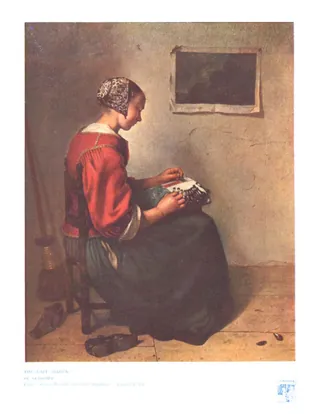
Lace Maker
Illustration · 1 page
A single-page color reproduction of a painting titled The Lace Maker, showing a young woman in a red bodice and patterned white cap seated at a table working lace bobbins. A dark landscape painting hangs on the wall behind her. The caption credits the picture to M. Vischer and to the series "Great Pictures by Great Painters" (Gresch & Co.).
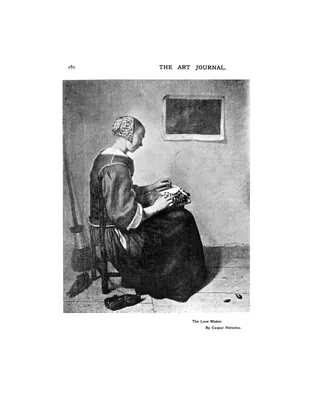
The Lace Maker
Illustration · 1 page
A single page from The Art Journal reproducing Caspar Netscher's painting "The Lace Maker" as a halftone illustration. It shows a woman in a headscarf and dark dress seated at a window, working bobbin lace on a pillow. The page carries only the title and artist credit, with no descriptive text.
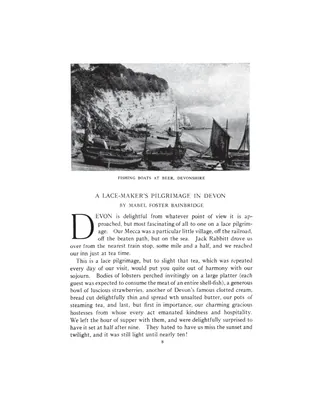
Lace-Maker's Pilgrimage in Devon
Article · 6 pages
A travel narrative by Mabel Foster Bainbridge about a visit to a South Devon fishing village (Beer) to study and buy bobbin lace. She describes village life, the cottage lace industry, the pillow, pricking and bobbin ('sticks') technique, her lessons with a local lace-maker, the dealers' shops, and the debated origins of Devon lace. Illustrated with photographs of Beer and a piece of modern Devonshire lace after a design by Marian Powys.
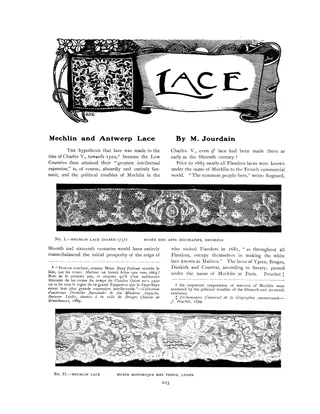
Mechlin and Antwerp Lace
Article · 6 pages
An illustrated article from The Connoisseur by M. Jourdain on the history and characteristics of Mechlin lace and Antwerp lace (Potten Kant). It covers the trade names and English fashion for Mechlin, its development from straight-edged laces, its réseau ground, fancy fillings, cordonnet, and Alençon and French influence in design. A short section on Antwerp peasant lace describes the flower-pot motif and its Annunciation symbolism. Twelve numbered photographs show examples from museums in Brussels, Lyons and London.
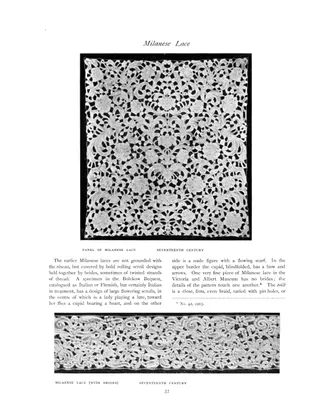
Milanese Lace
Article · 6 pages
A 1906 Connoisseur article by M. Jourdain on the history and characteristics of Milanese pillow lace. It covers Milan's early embroidery guilds, the Sforza inventory references to trina and bobbins, and the 17th-century scroll designs joined by brides. It also discusses the réseau ground (introduced by 1664), the animal and heraldic motifs, a dated 1733 piece in Brussels, and the later "Genoese tape" and peasant laces. Illustrated with photographs of museum and private-collection specimens.
Non-carved Honiton Bobbin Decoration
Brian Lemin · 2019
Web Doc · 5 pages
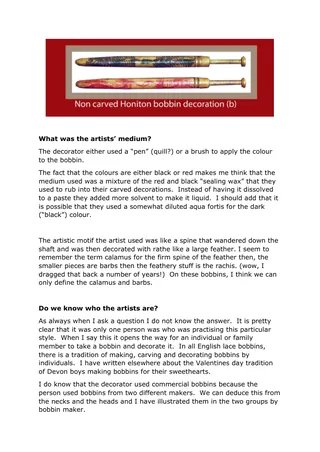
A short 2019 web article by Brian Lemin, written for the East Devon and Downton bobbin project, on Honiton lace bobbins decorated by methods other than the usual chip carving. He proposes the term "non-carved" for bobbins decorated with pen or brush in black and red, speculates on the medium (diluted sealing wax or aqua fortis), and notes that commercial bobbins from two makers were used. He also discusses whether black bobbins are true ebony or ebonised wood, and describes a standout ebonised bobbin with red printed or painted decoration. Photographs of the bobbins illustrate the text.
South Bucks Bobbins; Some Difficulties in Identification and Naming
Brian Lemin · 2003
Web Doc · 10 pages
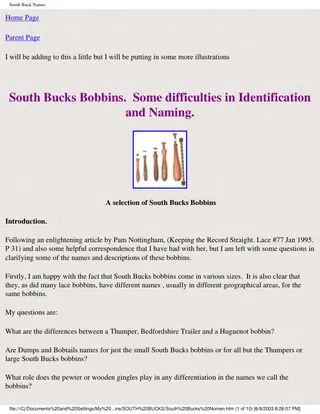
A web essay by Brian Lemin on the confusing names used for South Bucks lace bobbins. It sets out quotations from Wright, Whiting, Freeman, Huetson, Hopewell, Bellerby and Bullock on Dumps/Bobtails, Huguenots/Thumpers, South Bucks bobbins and Bedfordshire trailers/Huntingdon trollies, with the author's comments on each. It ends with the author's proposed definitions, which divide the family by size and by the presence of loose pewter or wooden rings (gingles), followed by a reference list.
Torchon Lace-Work
Book · 69 pages
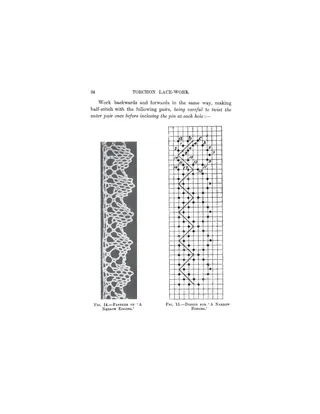
A beginner's instruction manual for making torchon bobbin lace on a pillow, written for young women and girls' schools in India and printed in Lahore in 1904. The introduction covers the pillow, bobbins, winding, hanging the bobbins, the half-hitch and weaver's knot, and the half-stitch, cloth-stitch and torchon stitch. Twelve patterns follow (edgings and insertions with Vandykes, wheels, diamonds, stars, a Maltese cross and double rose-stitch), each with a photograph of the finished lace, a pricking diagram and hole-by-hole directions naming the pairs of bobbins to work.
Two-Pair Inventions
Tamara P. Duvall · 2004
Monograph · 37 pages
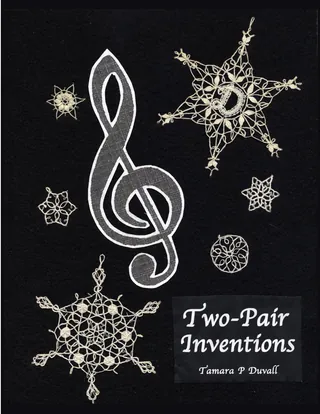
A booklet of bobbin lace patterns by Tamara P. Duvall for small ornaments and snowflakes, each worked continuously with only two pairs of bobbins. Part I gives ten circular centres (1 inch) with instructions, technique tips and diagram conventions; Part II adds seven larger snowflakes (Starflowers, Christmas Trees, Tulips, Airpuff, Lilies, Maple Leaf, Gaslights) that can be combined with any centre. It also includes a bonus wire-lace pendant variation by Paula Harten, advice on combining prickings and personalizing with initials, photographs, prickings, thread-path diagrams and polar grid graph paper for designing your own.
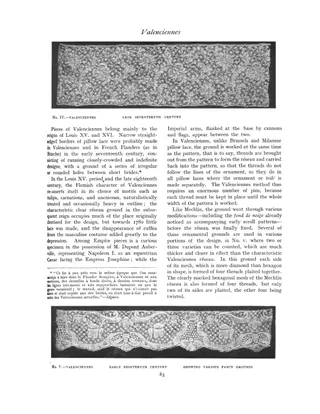
Valenciennes, Part I
Article · 4 pages
An article from The Connoisseur on the history of Valenciennes bobbin (pillow) lace. It traces the introduction of lace-making from Le Quesnoy and Antwerp, its peak between 1725 and 1780, and its decline after the Revolution. It also describes the characteristic ground (fond de neige and the clear réseau), how the ground is worked together with the pattern, and the true versus 'fausse' Valenciennes debate. Illustrated with six plates of Valenciennes lace specimens from the late 17th to the 18th century.
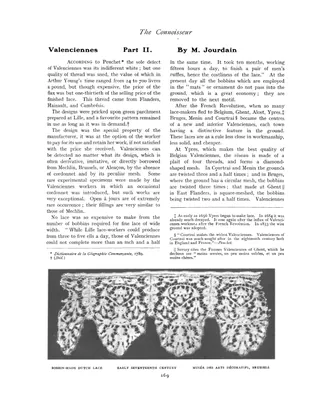
Valenciennes, Part II
Article · 2 pages
Second part of M. Jourdain's article on Valenciennes lace in The Connoisseur. It covers the thread, parchment patterns, and slow production of true Valenciennes, and the Belgian centres (Ypres, Courtrai, Menin, Bruges, Ghent) that made inferior versions after the French Revolution, with their different ground meshes. It also covers Fausses Valenciennes from northern France and Dieppe, then begins a section on Dutch bobbin lace of the seventeenth century and Haarlem thread. Illustrated with plates of Dutch bobbin lace.
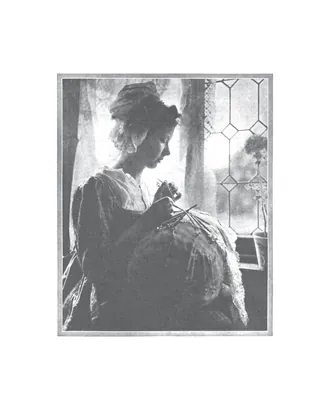
[Young Lady Lace-Maker]
The Graphic, 1907
Illustration · 1 page
A single black-and-white photograph from The Graphic showing a young woman in profile seated beside a leaded-glass window with a potted plant. She wears a head covering and dark dress and works bobbin lace on a pillow, with bobbins at her lap. No text could be read from the page.
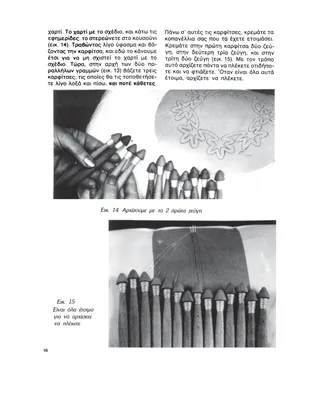
Κρητικό Κοπανέλλι [Cretan Bobbin Lace]
Book · 46 pages · Greek
A Greek-language instruction book on Cretan bobbin lace (kopanelli), published in 1985 by Christina Koustouraki-Koukoulari, a home economics teacher in Athens. It gives the history of the lace, which was brought to the Chania region around 1906-8 and spread from the village of Gavalochori. It covers materials (the straw-filled pillow, bobbins, DMC thread, pricked paper patterns) and winding and hanging the bobbins. The step-by-step techniques include the basic cloth stitch strip (panaki), picots (ouga), tulle, filtires, leaves, the daisy, rings, round and acute corners, and the old and new plaits. The book is illustrated with photographs of hands at work, pattern diagrams and finished lace motifs, including a blouse collar, a tablecloth and doilies.
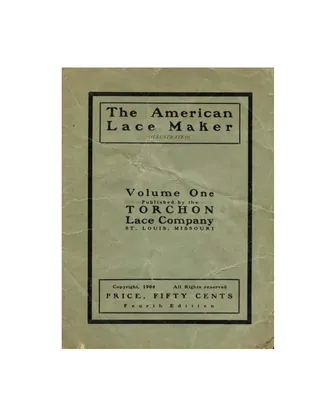
The American Lace Maker; Vol. 1
Torchon Lace Company, 1904
Monograph · 36 pages
A 1904 instruction manual (fourth edition) from the Torchon Lace Company of St. Louis for learning bobbin lace on a cylinder lace loom. It gives general directions on equipment, abbreviations (half-throw, whole-throw, cross, twist) and winding bobbins. It then presents 25 graded lessons, from basic net and hole grounds to edgings and insertions such as Copenhagen, Smyrna, Medici, Maltese, Tondern and Nile lace, each with bobbin counts, thread sizes and pin-by-pin instructions. Photographs of finished samples illustrate each lesson. The end matter describes the Princess bobbin winder and lists prices for materials.
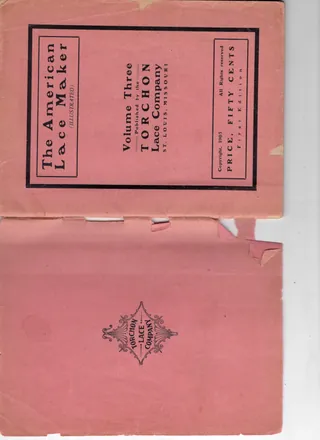
The American Lace Maker; Vol. 3
Torchon Lace Company, 1905
Monograph · 32 pages
Volume Three of a 1905 illustrated series of bobbin lace lessons published by the Torchon Lace Company of St. Louis. It gives written instructions, with photographs of the finished lace, for Patterns 33 to 46: Honiton, Guipure, Italian thread lace, Mechlin, Saxony, several Valenciennes edgings and grounds, Binche, Regency Point and Duchess lace. Directions use abbreviations for crossing (ctc), twisting (tw) and half-stitch (ht), and refer to numbered pin positions, grounds, brides, gimp threads and picots. It opens with an essay on the art of lace making and ends with a price list of threads, pins, bobbins and pillow attachments.
An Analysis of Maritime Decorations and Possible Decorators of Ships Depicted on East Devon Bobbins
Brian Lemin · 2010
Web Doc · 23 pages
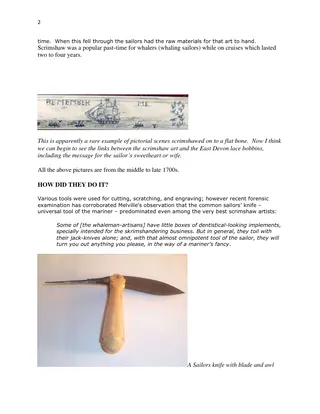
A December 2010 study by Brian Lemin of maritime decoration on East Devon lace bobbins, arguing that ship, anchor, whale, fish and mermaid motifs link the bobbins to sailors' scrimshaw. It begins with the history and tools of scrimshaw, then presents photographs of decorated bobbins grouped by motif (anchors, fish, mermaids, a wedding toast) and by ship type (the ASP, gunship, commercial vessel, fishing boat, Vioktoria, two-ships bobbin). Each bobbin is annotated with possible identifying features such as banding, tail decoration and lettering. Lemin tentatively groups possible decorators or makers, concludes that the maritime genre is linked to scrimshaw, and invites reader input. An endnote quotes Jane Austen's Persuasion on the sloop Asp.
Anchors as Decoration on East Devon (Honiton) Bobbins
Brian Lemin · April 2020
Web Doc · 4 pages
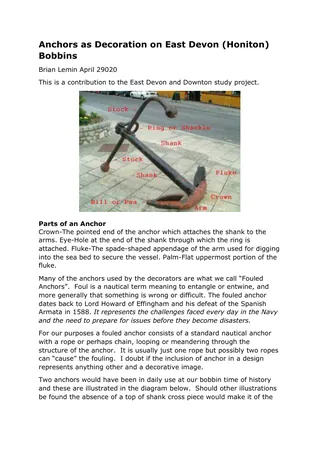
A short illustrated web document by Brian Lemin on anchor motifs used as decoration on East Devon (Honiton) lace bobbins, written as a contribution to the East Devon and Downton study project. It explains the parts of an anchor and the "fouled anchor" motif, compares two anchor types in use in the bobbin period, and shows close-up photographs of anchors painted or incised on bobbins. The author concludes that anchors mark a maritime genre of bobbin and that the area of Beer is the best source of maritime bobbins.
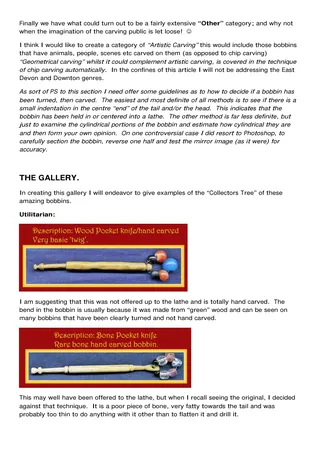
Antique English, Hand Carved and or Decorated, Lace Bobbins
Brian Lemin · 2011
Web Doc · 11 pages
A June 2011 collector's article by Brian Lemin on antique English hand carved and chip carved lace bobbins. It gives a short history of chip carving and proposes a classification (utilitarian, turned and carved, hand carved; cylindrical or square; church window, lantern, mother and babe, artistic carving). A photographic gallery of bobbins from the Luton Museum, Fitzwilliam Museum and private collections illustrates the types, with notes on East Midland and South Bucks styles and on telling turned bobbins from fully hand carved ones.
Bobbins of St Scania by Axel Hörlén
Brian Lemin · 2010
Web Doc · 8 pages
English translation of Axel Hörlén's 1969 study of lace pillows and bobbins in the southern part of Scania (Skåne), Sweden, centered on Valleberga and nearby villages. It covers the shift from the bolster pillow to the Swedish roller pillow, pillow cover materials such as linen and oilcloth, and bobbin shapes, including spangled bobbins with baskets or metal leaves that make a clatter. It compares them with Estonian bobbins from Runo and Bohemian bobbins from Vamberk. The translation is followed by notes on Czech bobbin names and a summary by editor Brian Lemin.
495 documents found