Textile Documents › Topic: Jacquard design
257 documents found
Sort: 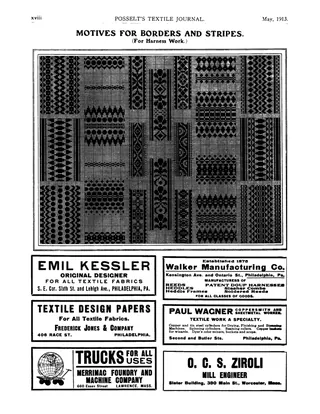
May, 1913
Article · 1 page
A single page from Posselt's Textile Journal, May 1913, showing a large grid of point-paper style motifs for borders and stripes intended for harness work (loom threading). The motifs include diamond, dot, and banded forms. The page also carries advertisements from Philadelphia and New England textile suppliers.
Importing Adobe Illustrator Images into JacqCAD
Garth Fletcher · July 3, 1998
Web Doc · 4 pages
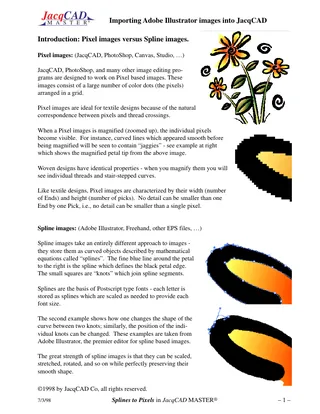
A four-page tutorial by Garth Fletcher (JacqCAD Co) on converting spline-based Adobe Illustrator artwork into pixel images usable in JacqCAD MASTER for Jacquard weaving. It contrasts pixel and spline images, then steps through saving as EPS, rasterizing in Photoshop to the desired ends and picks (with a non-square aspect ratio), converting to RGB and indexed color, saving as PICT, and opening in JacqCAD. It closes with a cautionary note on resolution limits in Jacquard design, illustrated with letterforms rasterized at 208, 104, 52 and 26 ends.
Novel Piano Card Stamping Machine
Textile World Record, November 1903
Article · 3 pages
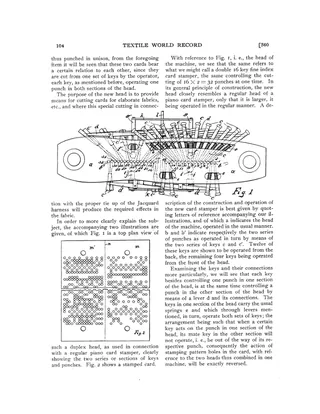
Describes a duplex head for a piano card stamper that combines two standard heads side by side, with paired keys linked by levers so that when a key punches a hole in one card, its mate leaves the corresponding position unpunched in the other. The pair of cards cut together has reversed hole patterns, intended for elaborate Jacquard fabrics with a suitable harness tie-up. The article explains the 16-key double head (32 punches), the key pairing schemes, peg-hole punches, and a worked comparison of hole positions on two cards, with two figures.
Weaving Designs
Indian Textile Journal, November 1897
Article · 1 page
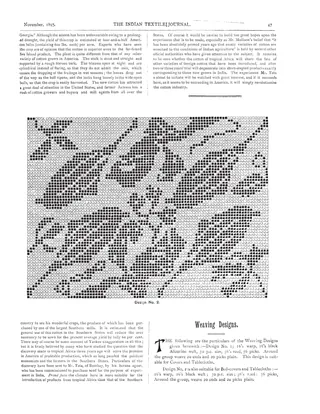
A single page from the Indian Textile Journal (November 1897, p. 47) with the article "Weaving Designs". It gives particulars for two designs, Design No. 1 and Design No. 2, for covers, bed-covers and tablecloths: 16's warp, 16's black weft, 50 percent size, 56's reed, 56 picks, with 20 ends and 20 picks of plain weave around the group. Design No. 2 is shown as a pixel-style grid of filled and open squares. The page also carries unrelated text on a new African cotton variety and a plan by Mr. Tata of Bombay to try it in India.
Jacquard Designing, Lesson 1
Article · 5 pages
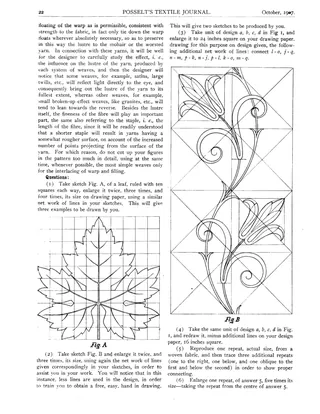
The first lesson in a series on Jacquard designing from Posselt's Textile Journal, October 1907. It covers the training of a Jacquard designer: free hand drawing, sketching from woven fabrics, squaring-off with guide lines to copy, enlarge and reduce designs, brushing up outline sketches into solid forms, and studying nature and historical ornament. It also considers yarn, texture, weave and finish when planning a design, with attention to silk, cotton and lustre worsted or mohair. It ends with six practice questions on enlarging sketches and reproducing a repeat.
Methods of Enlarging Jacquard Designs
Article · 6 pages
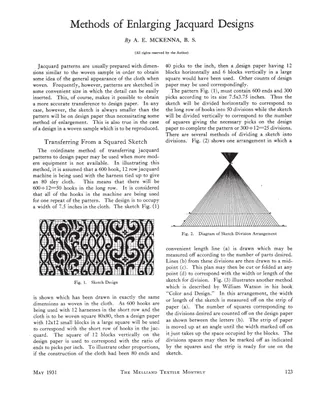
A 1931 article from The Melliand Textile Monthly on how to enlarge small sketches or woven samples onto point (design) paper for Jacquard card cutting. It covers the squared-sketch coordinate method, tracing from cloth with celluloid sheets, the pantograph, and projection lanterns, including the use of a mirror to correct the reversed image. It also treats ribbon and label designs woven face down and the Saentis enlarging machine. Illustrated with sketches, point paper designs, woven samples and apparatus diagrams.
Photography in Textile Design
Engineering Weekly, September 21, 1900
Article · 1 page
A one-page report from the journal Engineering (21 September 1900) on a paper by Professor R. Beaumont about applying photography to textile design. It describes Jan Szczepanik's photographic apparatus for enlarging a sketch and automatically marking weave units on point paper, using a lantern, a perforated raster plate, weave plates and selecting plates. It also summarizes the comments of Mr. Barker of the Bradford Technical School, who favored simpler processes.
Points on Jacquard Designing
Article · 2 pages
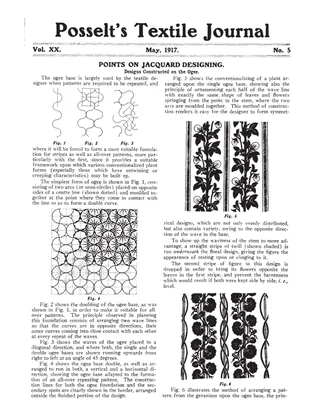
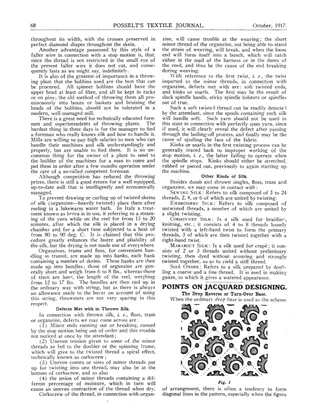
Article from Posselt's Textile Journal (May 1917) explaining how Jacquard designers build repeating patterns and stripes on the ogee wave base. It covers single, double and diagonal ogee foundations, all-over repeats, and plant-form designs (including a geranium pattern, a trailing leaf pattern and interlaced ribbon-like waves), illustrated with Figs. 1-8. The scan also includes a short note on wool-like cotton yarns and the opening of H. Barlow's article on terry pile fabrics.
Points on Jacquard Designing
Article · 2 pages
Two pages from Posselt's Textile Journal, October 1917. The main item explains the drop reverse (turn-over) base for Jacquard design repeats, which breaks up the diagonal lines produced by an ordinary drop base, and describes how to plan such designs with tracing paper and two diamond spaces. Four figures illustrate the arrangements, with Fig. 4 a fancy-figured velvet design. The pages also carry the end of an article on silk throwing, covering defects in thrown silk and other silk types, and a short note on the Lyon silk-conditioning house testing tariffs.
Designing
Textile Mercury, 1892
Article · 2 pages · weaving drafts
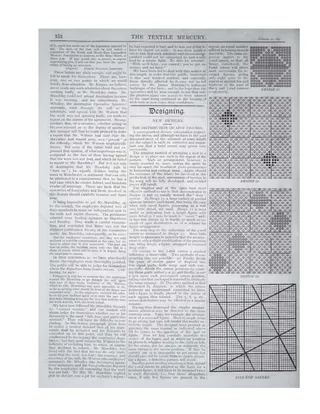
Two pages from The Textile Mercury of 27 February 1892 on textile design. The first part explains how to distribute spot figures in a repeat: the simple drop system (Designs 11 and 12), the 4-end sateen arrangement (Design 13), 5-, 7- and 8-end sateen placement, and how to handle reversed figures. The second part gives an original dobby design for a reversible cotton vesting cloth with two differently coloured faces, with a draft, pegging plan and drawdown. It specifies 64 picks, 15 shafts and a 96-end draft, along with suggested yarn counts, sett and colour combinations.
Designing and Fabric Structure; Various Settings for Jacquard Effects
Article · 5 pages · weaving drafts
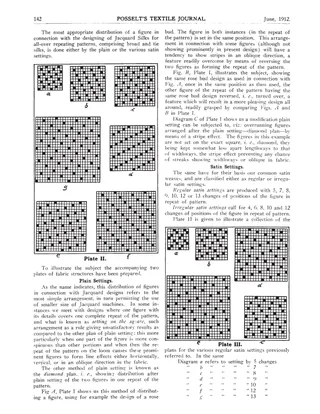
An article from Posselt's Textile Journal (June 1912) on how to distribute figures in Jacquard silk designs for all-over repeating patterns. It compares plain settings (square and diamond plans) with regular and irregular satin settings of 4 to 13 changes, and explains the advantages and drawbacks of each. It includes a geometric method for placing a figure in five positions, notes on the Royle card stamper and repeater, and the start of a section on spider weaves with honeycomb effects. Plates show sample repeat designs and point-paper diagrams of the satin settings.
Jacquard Designing
Article · 1 page
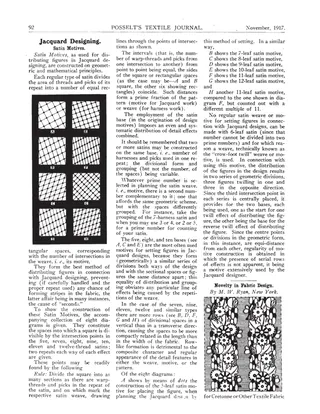
A one-page article from Posselt's Textile Journal (November 1917) on satin motives used to distribute figures in Jacquard design. It explains how the motives are constructed by dividing a square according to the satin repeat, and describes eight diagrams (A-H) for the 5, 7, 8, 9, 10, 11 and 12-leaf satins. It explains why the 5, 8 and 10 bases are preferred, and why 6-leaf designs use a crow-foot twill motive instead. The page also begins a separate piece, "Novelty in Fabric Design" by M. W. Ryan, with a black and white floral/medallion design for cretonne.
Jacquard Designing,Lesson 3
Article · 3 pages
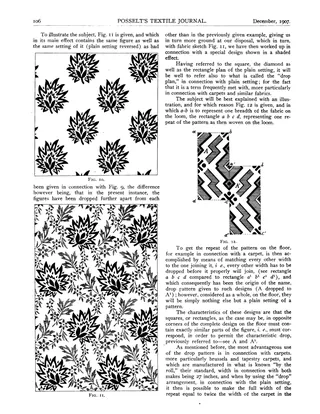
Lesson 3 of a serial course on Jacquard designing from Posselt's Textile Journal, December 1907. It explains the principles of setting designs for repeat, concentrating on plain setting (square, diamond, rectangle and drop plans) and showing how reversing one figure in the repeat avoids diagonal striping in the woven fabric. The drop plan is explained with reference to carpets, specifically Brussels and tapestry carpets woven by the roll at 27 inches wide. Illustrated with Figs. 8-12 of figure repeats and fabric sketches.
Novelties in Design
Article · 1 page
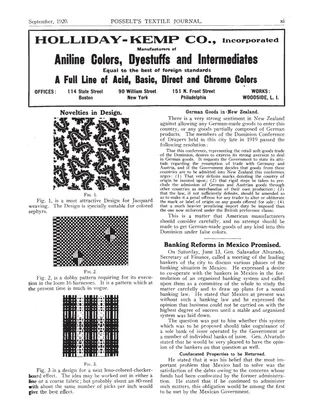
A single page from Posselt's Textile Journal, September 1920, with three short designs for textile manufacturers: a Jacquard design for colored zephyrs, a 16-harness dobby pattern, and a leno checkerboard effect suggested for an 80-reed fabric with about 80 picks per inch. The page also carries two unrelated trade news items, on New Zealand drapers' resolution against German goods and on promised banking reforms in Mexico, plus an advertisement for Holliday-Kemp Co., aniline dye makers.
Novelties in Jacquard Designs
Article · 1 page
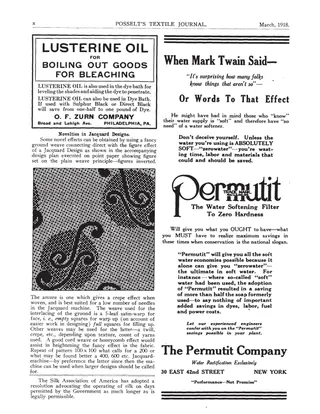
A short 1918 trade-journal article on using a fancy ground weave directly connected to the figure in a Jacquard design, illustrated by a design plan on point paper with the figures inverted. It describes a crepe-effect ground woven as a 5-leaf warp-face satin, suited to a low number of needles, and suggests alternative ground weaves such as twill, crepe, cord or honeycomb. It gives a pattern repeat of 100 x 100 and recommends a 400- or 600-needle Jacquard machine. The page also carries advertisements for Lusterine Oil and the Permutit water softener, and a note on the Silk Association of America.
Points on Jacquard Designing
Article · 2 pages
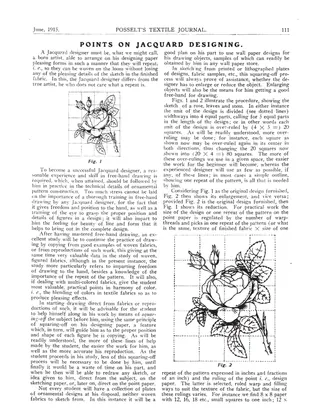
A June 1915 installment from Posselt's Textile Journal on training for Jacquard design. It explains free-hand drawing practice, copying from fabrics, wall paper or plates, and the squaring-off (over-ruling) method for enlarging or reducing a sketch, illustrated with rose and leaf figures. It also covers point paper rulings and their relation to Jacquard machine size and fabric texture. The scan also includes a continued article on cotton card clothing (tension, tail-ends, covering cylinders and flats).
Points on Jacquard Designing
Article · 2 pages
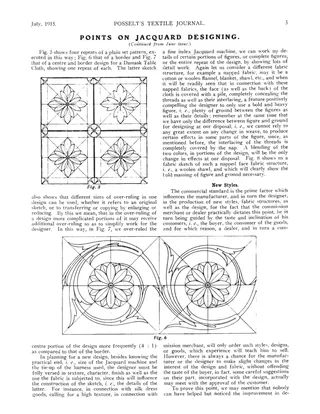
Two pages from the July 1915 issue of Posselt's Textile Journal, continuing a series on Jacquard designing. The text discusses over-ruling of designs on point paper, designing for napped fabrics such as woolen shawls, and how commercial taste, commission merchants and retailers shape new styles. It also covers how designs pass from expensive to cheaper fabrics and how a design must suit its use and the capacity of the Jacquard machine. Figures 5 to 8 show sample Jacquard designs. A short item on silk tenders for the Egyptian Holy Carpet follows.
Points on Jacquard Designing
Article · 2 pages · weaving drafts
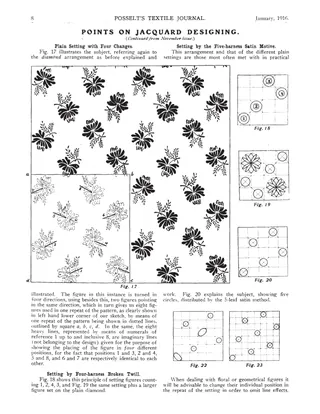
A continuation article from Posselt's Textile Journal (January 1916) on how to arrange figures in the repeat of Jacquard designs. It covers plain setting with four changes, setting by the five-harness satin motive, setting by four-harness broken twill, and settings based on 6- and 8-harness satins. Figures 17 to 24 show the placement grids and floral repeats, and the text includes a step-by-step method for dividing a repeat into 25 squares and placing a figure at five different angles.
Points on Jacquard Designing
Article · 2 pages
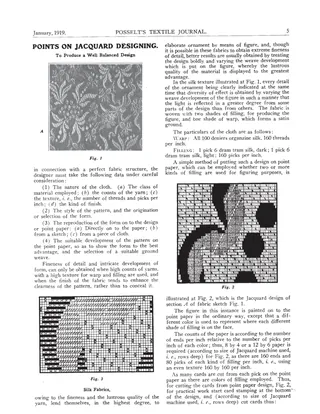
The first part of an article from Posselt's Textile Journal on designing for Jacquard looms. It lists the factors a designer must weigh (cloth, pattern style, transfer to point paper, ground weave) and shows a silk brocade with two filling shades and a satin ground. It gives the cloth particulars, a point-paper method with colour-coded filling, and card-cutting instructions. The second page begins a short piece, "Rusty Silk," on brownish stain defects in silk ribbons traced to stained cocoons.
Design in the Weaving Manufactures
Rees's Cyclopedia, 1819
Article · 3 pages · weaving drafts
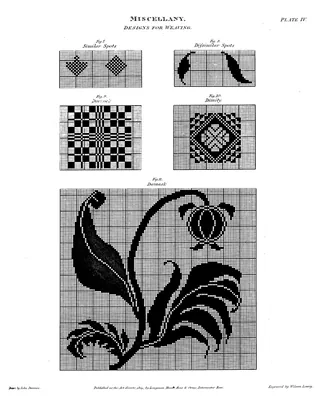
An encyclopedia article on 'design' in woven manufactures, explaining how ornamental patterns are drawn on ruled design paper and translated to the loom. It covers how squares represent warp and weft threads, how oblique and curved lines are approximated, and includes a table of angles of obliquity for 1 to 9 squares of warp and weft. A worked example calculates the size of a damask flower on cloth versus on paper. The last page is Plate IV, 'Designs for Weaving', showing grid designs for similar spots, dissimilar spots, dornock, dimity and damask.
Designing
Textile Mercury, 1890
Article · 2 pages · weaving drafts
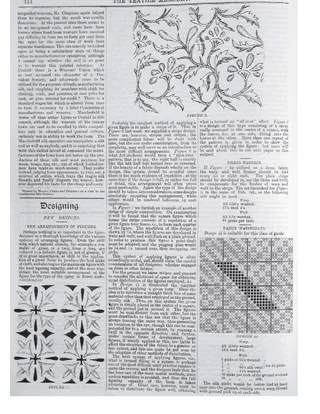
A two-page installment of a Textile Mercury designing series on arranging figures in woven fabrics, covering stripe arrangements, turn-over patterns, placing a figure in the centre of a square, and the all-over filling-in-a-square system. It gives sett and yarn details for dress fabrics and fancy waistcoats (Design 44), and begins a section on cotton shirtings with an 8-shaft draft, pegging plan, and notes on thread diameters. Illustrated with point-paper figures, pegging plans and drafts.
Jacquard Designing
Article · 5 pages · weaving drafts
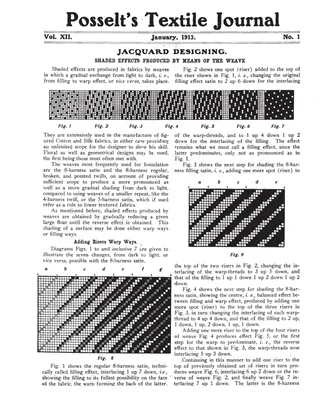
An installment of a series on Jacquard designing from Posselt's Textile Journal, covering shaded effects produced by the weave itself. It explains how adding risers step by step moves an 8-harness satin or twill from filling effect to warp effect, with seven graded changes. It then covers shading twills in stripes, shading satins by adding risers filling ways, and shading circles, geometric figures and floral designs. It ends with a poppy design worked on point paper (264 warp threads, 336 picks). Illustrated with drawdown figures (Figs. 1-17).
Jacquard Designing
Article · 2 pages
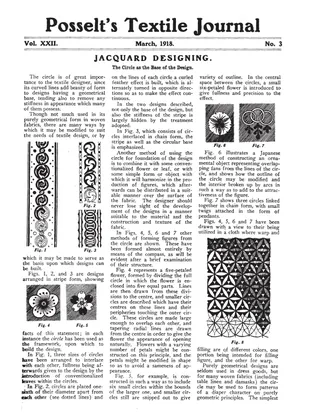
An installment of a series on Jacquard design from Posselt's Textile Journal, March 1918, explaining how the circle can serve as the geometric base for textile patterns. It describes stripe designs and figures built from circles with a compass (a five-petaled flower, overlapping circles, a Japanese fan motif, linked circles with pendants) and notes their use in dress goods, table linen and damasks. The second page carries other journal items, including pieces on the Knowles Fancy Worsted Loom and a new service flag, and a scalloped pattern design and carpet design illustration.
Points on Jacquard Designing
Article · 2 pages
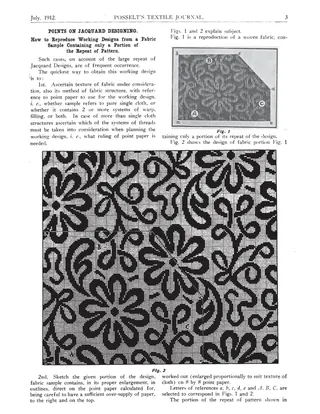
A two-page article from Posselt's Textile Journal (July 1912) explaining how to reconstruct a full Jacquard working design from a fabric sample showing only part of the pattern repeat. It covers sketching the sample on point paper, spotting mirrored figures, and calculating the repeat width in warp threads and length in picks. It also covers the number of Jacquard needles and cards needed, and the 4-harness satin setting of figures. The text then begins a section on adding weight and bulk to woolens and worsteds with back filling.
Points on Jacquard Designing
Article · 2 pages
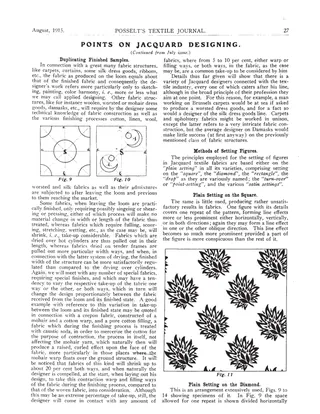
Two pages from the August 1915 issue of Posselt's Textile Journal, continuing a serial on Jacquard designing. This installment explains how finishing processes such as fulling, mercerizing and drying change a fabric's dimensions, so the designer must allow for take-up. It then begins describing methods of setting figures, with plain setting on the square and on the diamond, illustrated by repeat diagrams (Figs. 9-13). The pages also carry short items on applying logwood to cotton to make blacks and on a patent for a cotton and mohair outing cloth.
Points on Jacquard designing
Article · 2 pages · weaving drafts
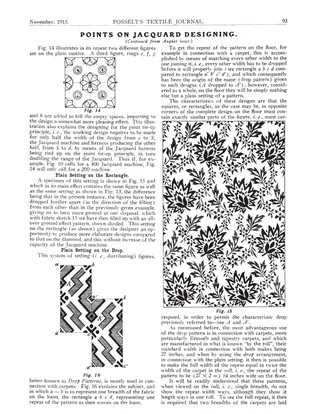
Two pages from Posselt's Textile Journal, November 1915, continuing a series on Jacquard designing. The first part covers plain settings of figures on the rectangle and on the drop (drop patterns for carpets), and the point tie-up principle that halves the Jacquard machine capacity needed. The second part continues a series on ribbon, trimming and edging manufacture, explaining point paper designs and their analysis for figuring with two extra warp and two extra filling systems, for cutting Jacquard cards or building dobby chains.
A Study in the Designing of Cotton, Silk, and Worsted, Figured Dress Goods
Article · 4 pages · weaving drafts
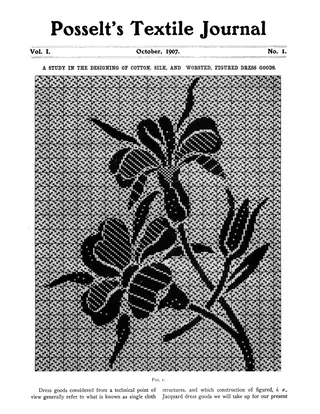
An article from the first issue of Posselt's Textile Journal explaining how to design Jacquard figured dress goods in cotton, silk, worsted, mohair and union single-cloth structures. It works through a 90 x 112 texture example, covering the point paper ratio calculation, the choice of a 400 (8-row) Jacquard machine, reed and comberboard planning, repeat size of the sketch, and the point paper layout. A portion of the sketch is worked out as a point paper design with a 4-harness broken twill ground and filling-float figure.
Treinis System of Designing
The Melliand, July 1930
Article · 2 pages
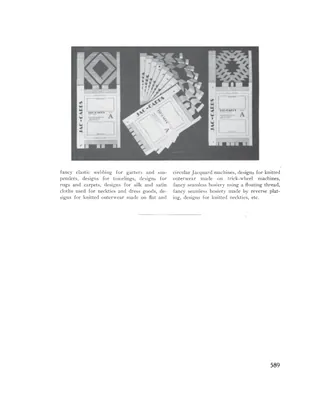
A short trade article from The Melliand describing the patented Treinis system of mechanical design creation, developed by Leonard R. Treinis of Brooklyn and licensed to mills. Designs are laid out on numbered "Jac-cards" and new patterns are produced by rearranging the order of the cards, so that one set of hosiery selectors can serve many designs. The article lists the textile applications suggested for the method, including hosiery, knitted outerwear, webbing, rugs, towelings, neckwear and worsted weaves. Illustrations show a master design for seamless hosiery, rearranged variations and photographs of the punched card stacks.
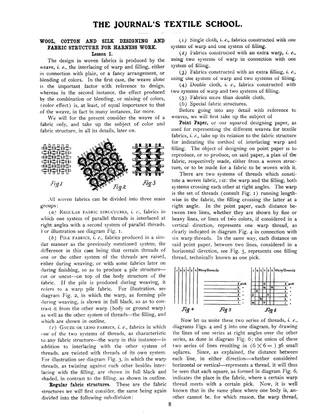
Wool, Cotton and Silk Designing and Fabric Structure for Harness Work: Lesson 1.
Article · 4 pages · weaving drafts
First lesson in a Posselt's Textile Journal correspondence course on designing and fabric structure for harness work. It classifies woven fabrics into regular, pile and gauze/leno structures, then explains point paper (squared design paper), how warp and filling are represented on it, and the convention of marking warp-up squares. It also covers common point paper sizes such as 8x8, choice and trimming of brush, vermilion paint, and ends with five review questions for students.
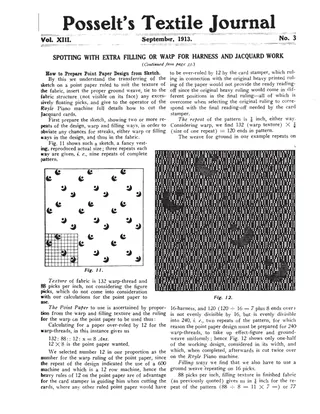
September, 1913
Article · 6 pages · weaving drafts
Pages from the September 1913 issue of Posselt's Textile Journal (Vol. XIII, No. 3, pp. 58-62) continuing a series on spotting with extra filling or warp for harness and Jacquard work. It explains how to turn a sketch into a point-paper design, including calculating point-paper ruling, repeat size, and ground-weave fit on a 600 Jacquard machine, and how to cut cards on the Royle piano machine. It also covers spotting by the warp on a 4-harness twill ground, English and German Jacquard harness tie-ups, a movable comberboard, and the start of a section on honeycomb weaves for Jacquard bedspreads.
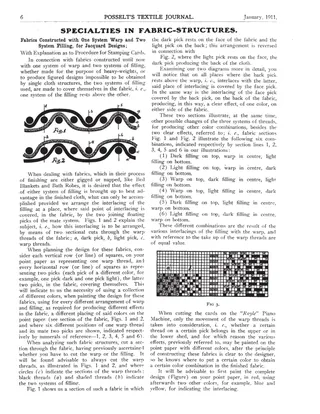
Specialties in Fabric Structures
Article · 4 pages · weaving drafts
Article from Posselt's Textile Journal, January 1911, on designing Jacquard fabrics with one warp system and two filling systems (dark and light picks) that cover each other, as used for gigged or napped goods like blankets and bath robes. It explains point-paper painting, card stamping for the Royle piano machine, and binding weaves (4-harness broken twill, uneven-sided regular twill, 5-leaf satin), with Figs. 1-8 showing sections and interlacing diagrams. The last page begins an unrelated article on making artificial silk from cellulose with an improved apparatus.
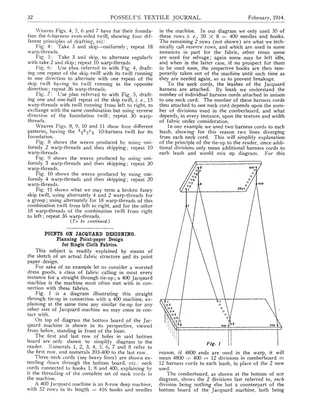
Welts, Piques, Toilet Cloth, Quiltings, Bed Spreads
Article · 4 pages
Four pages from Posselt's Textile Journal covering the end of a series on skip twill weaves, an installment of 'Points on Jacquard Designing' on planning a point-paper design for single cloth fabrics, and the start of an article on winding and beaming cotton yarn. The Jacquard article uses a worsted dress goods example with a 400 Jacquard machine, explaining the straight-through tie-up, comberboard divisions, reed choice, repeat size, number of cards, and choosing 8 by 10 point paper. The winding and beaming piece by Ibzan Sagar discusses yarn strength, conditioning, winding speeds, and bobbin size for cotton warps.
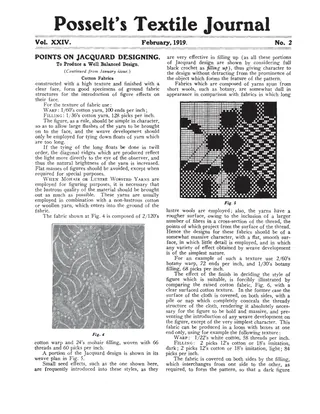
Points on Jacquard Designing
Article · 2 pages
Continuation of a serial article on designing for the Jacquard loom, from Posselt's Textile Journal, February 1919. It covers how yarn type (cotton, mohair, lustre worsted, botany wool) and fabric finish affect the choice of figure and weave development, with example warp and filling counts. It also gives details for raised cotton fabrics woven with satin weaves and for tapestry design on a 12-row 600 Jacquard machine, including point paper counts and card cutting. A second short piece continues a series on the influence of yarn twist direction on twill fabrics.
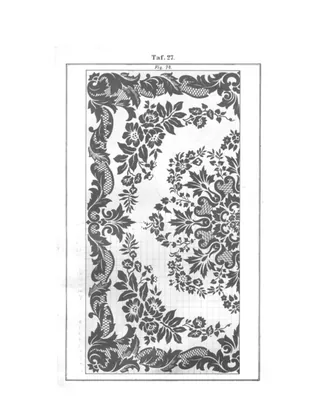
VIII. Abschnitt der Deutschen Webschule: Theoretisch-praktisches Handbuch ... die Lehre des Musterzeich für Jacquard [Section VIII of the German Weaving School: Theoretical-Practical Handbook ... the Teaching of Pattern Drawing for Jacquard]
Book · 61 pages · German · weaving drafts
An 1868 German handbook, the eighth section of the Deutsche Webschule, on designing patterns (Musterzeichnen) for Jacquard weaving, written for manufacturers and weavers. The text explains point-paper (Patronenpapier) ratios such as 8 auf 8, how to sketch designs, enlarge them onto the grid and paint them, and how to choose warp and weft density for a 400-hook machine with 12-gang harness. It also covers ground and figure bindings (plain weave, twill, satin), satin and twill shading, warp-setting schedules (Scheerzettel) with silk, wool and twist threads, and brocaded weft. About 35 engraved plates carry point-paper types, sketches and pattern charts for dress goods, furnishing fabrics, shawls, and borders, along with weave drawdowns.
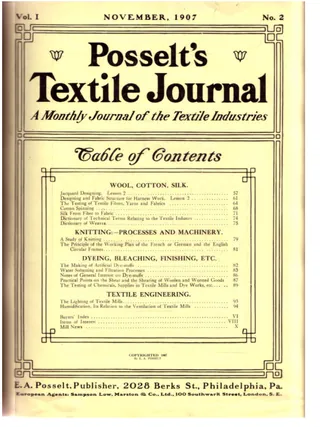
Posselt's Textile Journal, Vol. 1, No. 2 (November 1907)
Periodical · 60 pages · weaving drafts
November 1907 issue (Vol. 1, No. 2) of Posselt's Textile Journal, a monthly trade and educational journal of the textile industries published in Philadelphia. It carries instructional lessons on jacquard designing and on weave construction for harness work (plain, twill and satin foundation weaves), and a Dictionary of Weaves with eight-harness weave plates. Other articles cover testing of fibres, cotton ring spinning, silk from fibre to fabric, knitting machinery, dye-stuff manufacture, water softening, shearing of woolen and worsted goods, and mill lighting and humidification. The issue also has short trade items, mill news and many machinery and yarn advertisements.
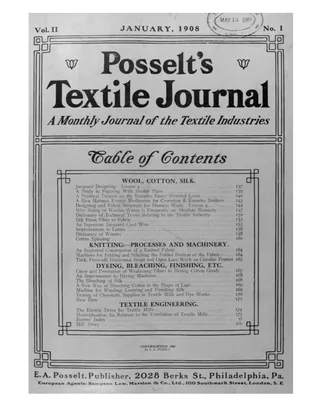
Posselt's Textile Journal, Vol. 2, No. 1 (January 1908)
Periodical · 60 pages · weaving drafts
January 1908 issue (Vol. 2, No. 1) of Posselt's Textile Journal, a Philadelphia trade and educational monthly covering wool, cotton and silk manufacture. It includes lessons on Jacquard designing and on fabric structure for harness work (rib and basket weaves), a study of figuring with double plain, and a Dictionary of Weaves page of ten-harness weaves. Other articles cover Knowles fancy worsted loom setup, loom and dobby improvements, sizing of woolen warps, silk reeling and throwing, cotton spinning, knitting, dyeing and bleaching, new dyes, electric drive and humidification for mills. The issue also has a technical-terms dictionary, advertisements, a buyers' index and mill news.
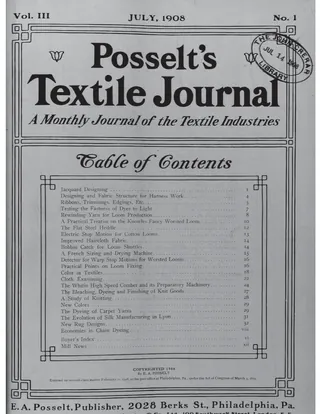
Posselt's Textile Journal, Vol. 3, No. 1 (July 1908)
Periodical · 50 pages · weaving drafts
July 1908 issue (Vol. 3, No. 1) of Posselt's Textile Journal, a Philadelphia monthly for the textile industries. It carries instructional series on jacquard designing, fabric structure for harness work (diagonal twills and hollow selvage weaves, with drafts), narrow ware manufacture, color effects in textiles, and knitting. Technical articles cover looms and loom fixing (Knowles fancy worsted loom, flat steel heddle, electric stop motion, shuttle bobbin catch, warp stop-motion detector), dyeing (light fastness, chain dyeing, carpet yarns), cloth examining, the Whitin comber and lap machines, silk manufacturing in Lyon and new rug designs. Trade news, mill news and many machinery and supply advertisements fill the rest.
Posselt's Textile Journal, Vol. 3, No. 2 (August 1908)
Periodical · 52 pages · weaving drafts
August 1908 issue (Vol. 3, No. 2) of Posselt's Textile Journal, a monthly American trade journal for the textile industries. Articles cover cotton combing and ring spinning, artificial and wild silk, Jacquard designing with one warp and two fillings, checkerboard twills, Knowles loom shuttle-box motion, narrow ware manufacture, double pile weaving, Draper shuttles, a woolen yarn dresser, knitting devices, dyestuff fastness, and fulling machinery. Weave drafts and point-paper designs appear with the Jacquard, checkerboard twill, selvage and double pile articles. A serialized textile dictionary, a dictionary of weaves page, mill news and many machinery advertisements are also included.

The Woven Pixel: Designing for Jacquard and Dobby Looms Using Photoshop®
Book · 364 pages · weaving drafts
A comprehensive manual for designing woven cloth for computer-driven jacquard and dobby looms using Adobe Photoshop. It covers the history of figured textile production, getting images into the computer, the Photoshop tools weavers need, and building weave structures as Pattern Presets and Layer Styles, then walks through projects from two-color designs to compound cloth. Later chapters treat double weave, taqueté, samitum, lampas, weft-backed and warp-backed structures, warp tapestry, supplementary brocading and network drafting, with appendices on fabric simulation, loom file preparation, mills and tutors. It includes many drawdowns, Photoshop screenshots, and peg plan tables.
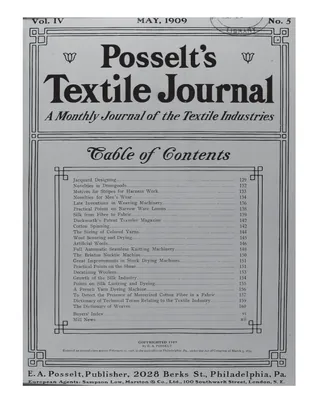
Posselt's Textile Journal, Vol. 4, No. 5 (May 1909)
Periodical · 52 pages · weaving drafts
May 1909 issue of Posselt's Textile Journal, a monthly trade journal of the textile industries published in Philadelphia. Articles cover Jacquard designing and card stamping for reversible figured bed blankets, harness-stripe motives, dress goods and men's wear fabric specifications with weave diagrams, and new loom and shuttle devices. Other articles deal with narrow ware looms, silk production, cotton ring spinning, yarn sizing, wool scouring, artificial wools and shoddy, knitting machinery, shear grinding, decatizing, silk lustring and dyeing, and detecting mercerised cotton. The issue also has a Dictionary of Weaves installment, a weave chart advertisement, mill news, and many machinery and supply advertisements.
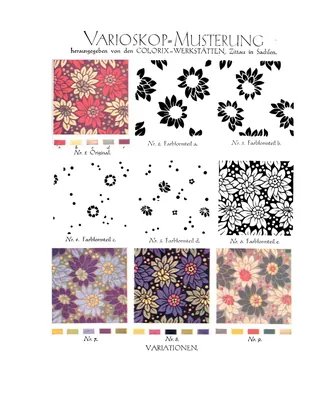
Varioskop Musterung [Varioskop Patterning]
Article · 2 pages · German
A two-page illustrated item on the Varioskop pattern system published by the Colorix-Werkstätten in Zittau, Saxony. Page 1 shows an original floral pattern, five separated color-form parts (a–e), and variations produced from them. Page 2 shows a projection dianegative and the projected image without filters. Text is limited to figure captions.
Fabric Analysis, Part 3
Article · 3 pages
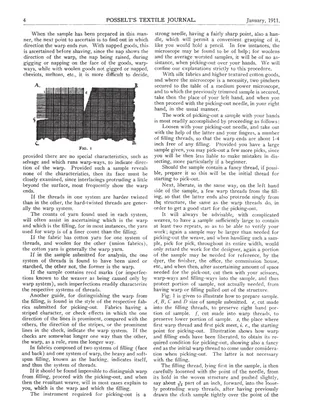
Part 3 of E. A. Posselt's serial on fabric analysis, from the January 1911 issue of Posselt's Textile Journal. It covers ascertaining the weave of a sample by picking-out: point paper (8 x 8 ruling) and how to mark risers and sinkers, preparing napped or felted samples by shaving or singeing, and telling warp from filling. It then gives step-by-step instructions for loosening picks with a needle, recording each pick's interlacing on point paper, and finding the repeat. Two figures show how to cut and prepare a sample and how to hold it while picking out a filling thread.
Fabric Analysis, Part III
Article · 3 pages
Part III of E. A. Posselt's serial 'Fabric Analysis' from the January 1911 issue of Posselt's Textile Journal, dealing with ascertaining the weave of a fabric sample by picking-out. It explains point paper (8 x 8 ruling) and how to record risers and sinkers, preparing a sample by shaving or singeing nap, and working out which threads are warp and which are filling. It then gives a step-by-step needle procedure for picking out each filling thread and recording the interlacing, including finding the repeat of the weave and of the warp color pattern. Two figures show how to cut and prepare a sample and how the pick is loosened with a needle.
Jacquard Card Punching Machine, US Patent No. 1732982
Patent · 1 page
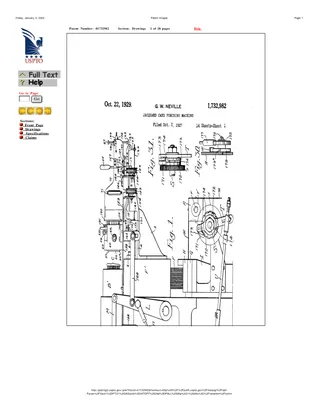
First drawing sheet (of 14) from US Patent No. 1,732,982 for a Jacquard card punching machine by G. W. Neville. It shows a side elevation of the punching mechanism with numbered parts, along with detail views Fig. 30 and Fig. 31. The scan is a printout from the USPTO patent image database and contains drawings only, with no specification text.
Machine for Copying Patterns for Jacquard Cards, US Patent No. 696708
Patent · 5 pages
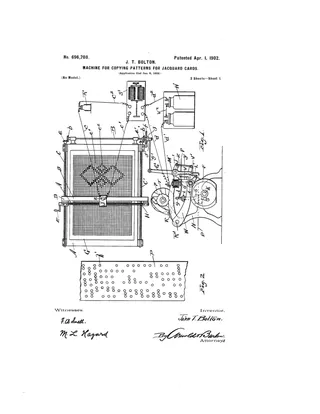
US Patent No. 696,708, granted April 1, 1902 to John T. Bolton of Fall River, Massachusetts, for a machine that copies Jacquard design patterns onto punched paper strips. A selenium cell on a case moves square by square over a design laid out on a board, and its changing resistance with light and dark squares controls a relay and electromagnets that decide which punches strike. The document has two sheets of drawings (Figs. 1-5), the specification, and four claims.
Machine for the Preparation of Cards for Jacquards, US Patent No. 2552942
Patent · 11 pages
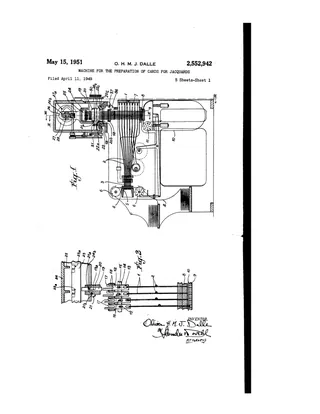
US Patent 2,552,942, granted 15 May 1951 to Olivier H. M. J. Dalle of Ecully, France, assignor to Societe des Mecaniques Verdol, Lyon. It describes a machine for punching pattern cards or paper bands for Verdol-type Jacquard looms. An operator follows the design on a board with a pointer and eight finger keys, and electromagnets and hooks control the feeler needles of a punching device. The machine can also duplicate existing cards. The patent has five sheets of drawings, a specification describing the mechanism and its operation, and seven claims.
Machines for the Preparation of Cards for Jacquards, US Patent No. 3090550
Patent · 7 pages
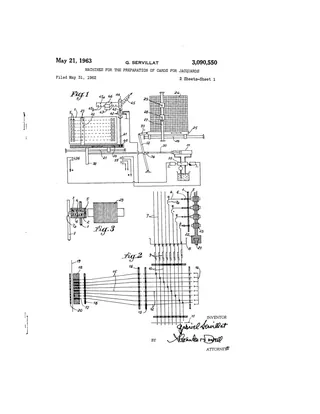
US Patent 3,090,550 by Gabriel Servillat, assigned to Société des Mécaniques Verdol, Lyon, describes a machine for preparing Jacquard pattern cards, specifically continuous paper bands for Verdol Jacquards with 1,344 hooks. A carriage with an obliquely arranged row of electromagnets moves continuously past rows of retaining members that control the feeler needles of the punching device. The electromagnets are driven by photo-electric reading of a squared pattern drawing or by a perforated tape memory, through electronic "and" gate circuits. The document includes two sheets of drawings, the specification, nine claims and cited references.
The Origination of New Designs
Article · 3 pages
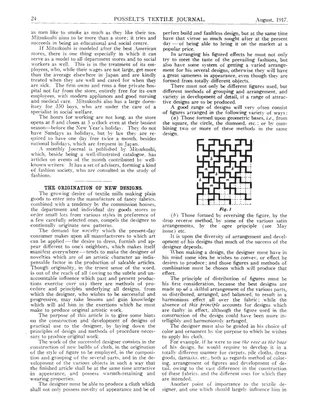
An article from Posselt's Textile Journal (August 1917) on the principles of originating new textile designs. It covers the designer's need for variety in figure arrangement, the influence of yarn and fabric type on design, and the use of the square and other geometric bases as frameworks for repeating patterns. Five figures show square-based designs, including a key pattern, a floral design built from circles, and a damask tablecloth border. The scan ends with a short unrelated item on England's raw cotton situation.
Reversibles
Article · 2 pages · weaving drafts
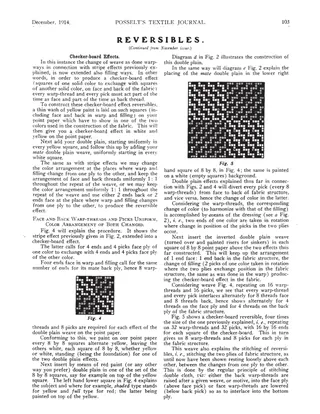
Continuation of Posselt's series on reversible double-plain fabrics, covering checker-board effects in which every warp thread and pick serves alternately as face and back. It explains how to build the weaves on point paper by painting squares and adding a double plain and its mate. It describes two color/ply arrangements (Figs. 4 and 5, then Fig. 6 with a 24 by 24 repeat) and how the two plies are stitched together. The pages also carry short unrelated items on an embossed fabric patent, spinning mill management and waterproofing fabrics.
Weave Design
Indian Textile Journal, February 1898
Article · 1 page · weaving drafts
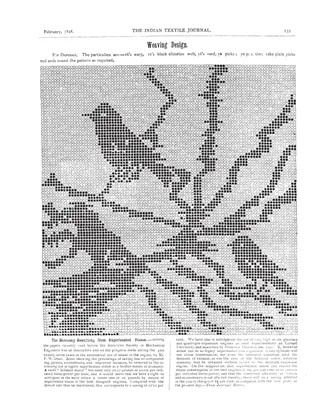
A single page from the Indian Textile Journal (February 1898) presenting a damask weaving design as a large dot-matrix drawdown, with particulars of 16's warp, 16's black alizarine weft, 56's reed and 56 picks, 50 percent size, and plain picks and ends around the pattern. The page also carries a short unrelated item on the economy of superheated steam in engines.
257 documents found