Textile Documents › Topic: Fabric analysis
354 documents found
Sort: 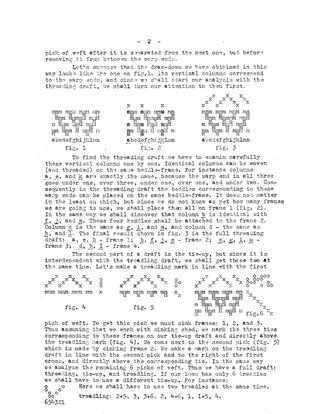
Analysis of Fabrics
Master Weaver, February 1952
Article · 3 pages · weaving drafts
An article from Master Weaver (Z-Handicrafts, Fulford, Quebec) explaining how a handweaver analyses a single-layer fabric sample. It describes marking one repeat, making a draw-down on graph paper, identifying identical warp columns to derive the threading, and deriving the tie-up and treadling together. It also covers counting the frames needed, rearranging threading and tie-up into standard forms, and recording yarn and finishing data. Illustrated with draw-down and draft figures; it closes by announcing follow-up articles on short analysis and three-dimensional fabrics.
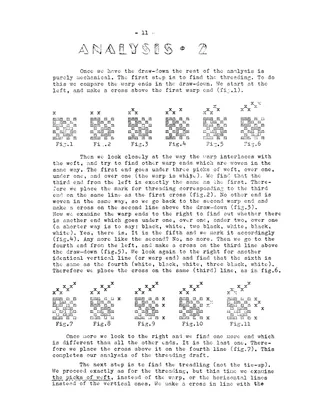
Analysis 2
Master Weaver, September 1956
Article · 2 pages · weaving drafts
A two-page instructional lesson from Master Weaver on analysing a woven fabric from its draw-down. It explains step by step how to find the threading by comparing warp ends, then the treadling by comparing weft picks, and finally how to deduce the tie-up for a four-shaft sample. Illustrated with small numbered figures (1-17) showing the marks being built up on the grid.
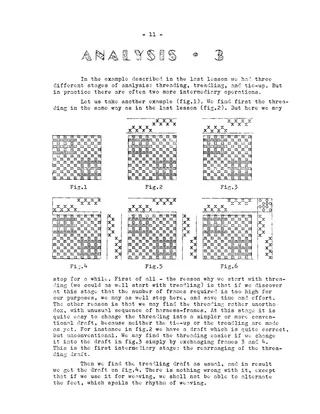
Analysis 3
Master Weaver, November 1956
Article · 2 pages · weaving drafts
A short lesson from the Master Weaver series on analyzing woven cloth into a draft, continuing from the previous lesson. It adds two intermediary steps, rearranging the threading and rearranging the treadling, to make a five-stage analysis. It explains how to simplify drafts, make them easier to thread, adapt them to standard tie-ups, and arrange treadling so the feet alternate. Nine figures illustrate the examples.
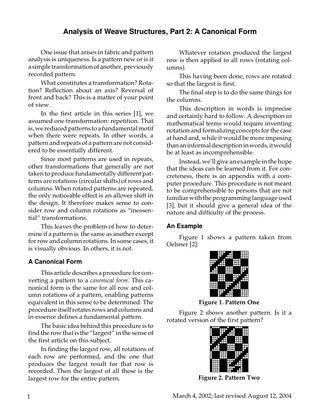
Analysis of Weave Structures, Part 2: A Canonical Form
Ralph E. Griswold · March 4, 2002
Web Doc · 4 pages
A short article by Ralph Griswold on determining whether two weave or fabric patterns are the same apart from row and column rotations (circular shifts). It describes a procedure for reducing a binary pattern to a canonical form that is identical for all rotated versions. A worked example compares two patterns, one taken from Oelsner's Handbook of Weaves, using a 24 by 20 binary array. An appendix gives the procedure in the Icon programming language.
Fabric Analysis
Article · 1 page
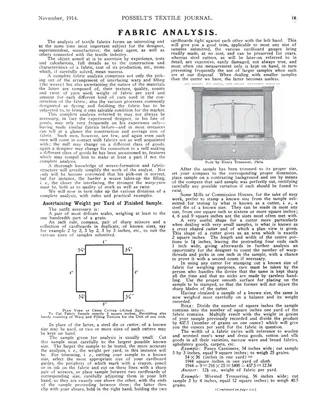
A single-page installment of E. A. Posselt's series on fabric analysis, introducing what a complete analysis of a textile involves: weave, materials, texture, yarn counts and twist, weight per yard, and dyeing and finishing. It then explains how to find a fabric's weight per yard. The method is to trim a sample to a known size with cardboard guides, a compass or a steel cutter, including a cross-shaped cutter that gives 2 square inches, and then to weigh it on a delicate balance. Worked examples convert grains to ounces per yard. The text ends with a note that it continues on page xii.
Fabric Analysis, Part 3
Article · 3 pages
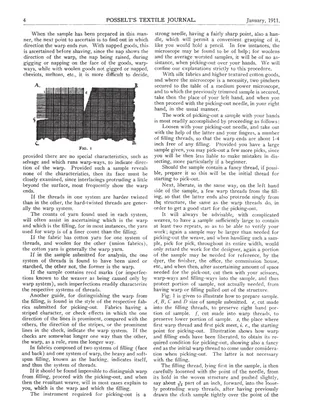
Part 3 of E. A. Posselt's serial on fabric analysis, from the January 1911 issue of Posselt's Textile Journal. It covers ascertaining the weave of a sample by picking-out: point paper (8 x 8 ruling) and how to mark risers and sinkers, preparing napped or felted samples by shaving or singeing, and telling warp from filling. It then gives step-by-step instructions for loosening picks with a needle, recording each pick's interlacing on point paper, and finding the repeat. Two figures show how to cut and prepare a sample and how to hold it while picking out a filling thread.
Fabric Analysis, Part III
Article · 3 pages
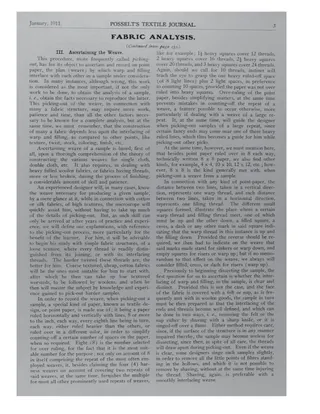
Part III of E. A. Posselt's serial 'Fabric Analysis' from the January 1911 issue of Posselt's Textile Journal, dealing with ascertaining the weave of a fabric sample by picking-out. It explains point paper (8 x 8 ruling) and how to record risers and sinkers, preparing a sample by shaving or singeing nap, and working out which threads are warp and which are filling. It then gives a step-by-step needle procedure for picking out each filling thread and recording the interlacing, including finding the repeat of the weave and of the warp color pattern. Two figures show how to cut and prepare a sample and how the pick is loosened with a needle.
Lessons of Drafting Analysis 1
Master Weaver, July 1956
Article · 3 pages · weaving drafts
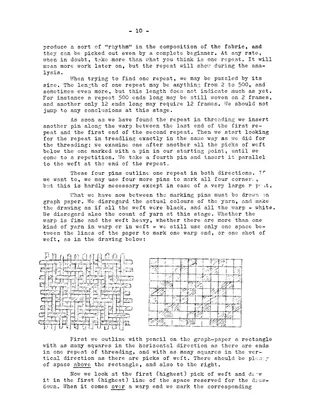
An installment of a drafting lesson series from Master Weaver explaining how to analyze a woven fabric or pattern so its weaving directions can be reconstructed. It describes finding one repeat in threading and treadling with marking pins, then drawing the repeat as a drawdown on graph paper, and tips such as picking out weft to count overs and unders. The last page begins a short piece on compound sleying, discussing how much the warp sett may be adjusted to suit available reeds.
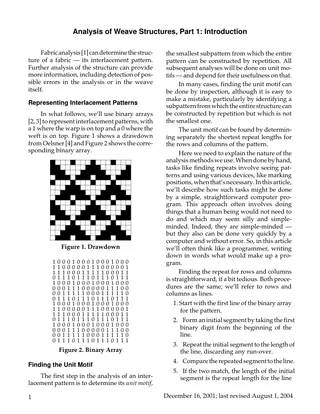
Analysis of Weave Structures, Part 1
Ralph E. Griswold · December 16, 2001
Web Doc · 5 pages · weaving drafts
Introductory article by Ralph Griswold on computational analysis of weave structures. It represents interlacement patterns as binary arrays (1 for warp up, 0 for weft up) and gives a step-by-step, program-style procedure for finding a pattern's unit motif by computing row and column repeat lengths and their least common multiple. It then introduces line patterns, circular permutations, canonical forms and block-length patterns, and works through an 8 x 8 example drawn from Oelsner's Handbook of Weaves, ending with a complete line analysis of the rows and columns.
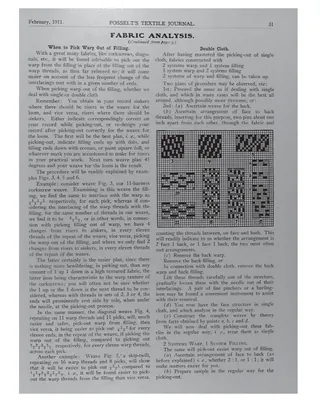
Fabric Analysis
Article · 2 pages · weaving drafts
Two pages from the February 1911 issue of Posselt's Textile Journal, continuing a series on fabric analysis. The article explains when to pick the warp out of the filling rather than the reverse, using corkscrew, diagonal and skip-twill weaves as examples, and describes procedures for analyzing double cloth (2 systems of warp with 1 of filling), including 1 face 1 back and 2 face 1 back arrangements. Weave diagrams accompany the text. Page 2 also begins a short section, 'Novelties from Abroad', with dressgoods specifications (warp, weave repeat, reed, dress, filling, finish).
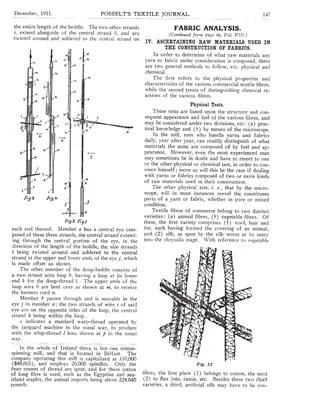
Fabric Analysis
Article · 3 pages
Installment of E. A. Posselt's serial "Fabric Analysis" (December 1911), section IV on ascertaining the raw materials in yarns and fabrics. It contrasts physical and chemical tests, describes the compound microscope and how to prepare yarns and fibres for it, and explains the microscopic appearance of wool fibres, woolen versus worsted slivers, and imperfect fibres (untrue fibres and kemps), illustrated with figures. The pages also include a short passage describing a jacquard doup-heddle for leno and a brief note on Irish cotton spinning.
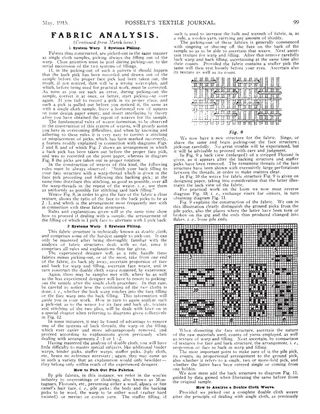
Fabric Analysis
Article · 2 pages · weaving drafts
Two pages from the May 1915 issue of Posselt's Textile Journal, continuing E. A. Posselt's series on fabric analysis. They cover picking out double cloth (two warp and two filling systems) and pile fabrics such as Floconé and Montagnac overcoatings. They also explain, with seven diagrams, how to analyze a picked-out double cloth weave into its face weave, back weave and stitching. The scan ends with a directory of textile trade marks registered in April 1915.
Fabric Analysis
Article · 1 page
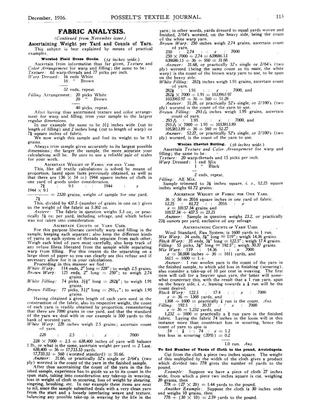
A page from Posselt's Textile Journal (December 1916) continuing a series on fabric analysis. It shows by worked examples how to find fabric weight per yard from a trimmed sample and how to calculate yarn counts from the weights and lengths of liberated warp and filling threads. Examples include a 54-inch worsted plaid dress goods fabric (worsted system) and a 56-inch woolen cheviot suiting (run system), plus a short rule for yards of cloth per pound.
Fabric Analysis
Article · 2 pages
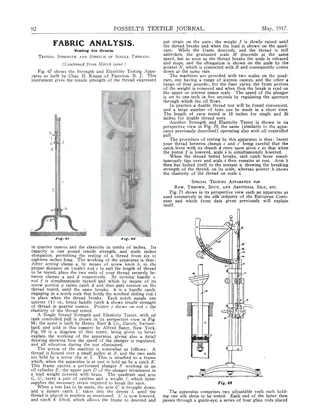
Installment of E. A. Posselt's 'Fabric Analysis' series from Posselt's Textile Journal, May 1917, on testing the strength and stretch of single threads. It describes hand- and oil-controlled strength and elasticity testers (Knapp, Henry Baer & Co.), a silk skein tester, a continuous-acting strength tester, and the Moscrop multiple-thread tester made by the Draper Corporation. Practical advice is given on how many tests to run and how to interpret results. The second page also carries a short news item on British requisition of Russian flax.
Fabric Analysis
Article · 2 pages
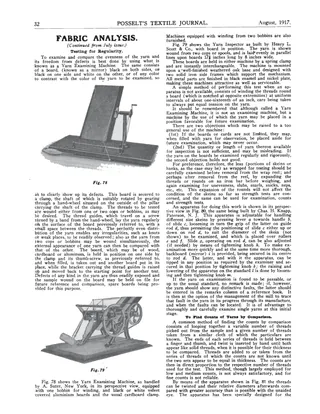
A two-page installment of E. A. Posselt's "Fabric Analysis" series, continued from the July 1917 issue. It describes yarn examining machines (A. Suter, Henry L. Scott & Co., Chas. H. Knapp) for checking yarn evenness, and methods for finding yarn counts by comparison, including a microscope and twisting apparatus. It also covers measuring thread diameter with a worked square-root rule for cotton, wool, worsted and silk, and begins a section on identifying and separating fibres by chemical analysis.
Fabric Analysis
Article · 2 pages
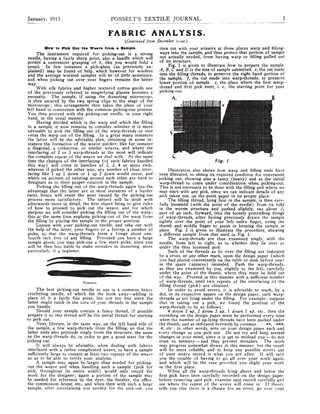
Installment of a serialized article on fabric analysis from Posselt's Textile Journal, January 1915, explaining how to pick out the weave from a fabric sample. It covers the picking-out needle, forceps and pick-glass, choosing whether to pick filling from warp or the reverse, preparing and cutting the sample, and recording each pick's interlacing on design paper. It also advises on finding the weave repeat, handling colored warps, and reconstructing incomplete repeats from theory. The scan also includes the start of an unrelated piece on cotton spinning mule straps.
Linen-Prover
Article · 1 page
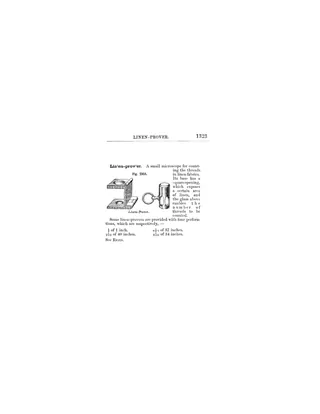
A one-page dictionary entry on the linen-prover, a small microscope used to count threads in linen fabric. The base has a square opening that exposes a known area of cloth, and a magnifier above allows the threads to be counted. It includes an engraved illustration in side and front views, a note that some provers have four perforations of different sizes, and a cross-reference to the entry for Reed.
Analysis 4
Master Weaver, March 1957
Article · 2 pages · weaving drafts
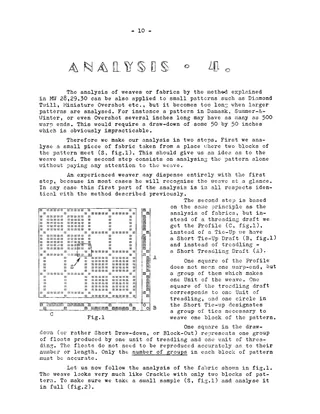
Fourth and final lesson in a series on analyzing woven fabrics, from the Master Weaver newsletter. It explains a two-step method for large patterns: first analyze a small sample to identify the weave, then reduce the pattern to a profile draft, short tie-up, and short treadling draft. A worked example of a two-block fabric that resembles Crackle turns out to be Summer-and-Winter woven Crackle-style, and the full threading and treadling are reconstructed from the profile.
Designing and Fabric Structure
Article · 1 page · weaving drafts
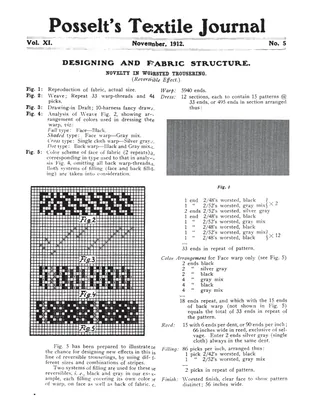
A one-page article from Posselt's Textile Journal (November 1912) on designing a reversible worsted trouserings fabric. It gives a fabric swatch reproduction, the weave for a 33-end by 44-pick repeat, a 10-harness fancy drawing-in draft, and a color analysis. Written specifications cover warp dress, yarn counts, reed, filling and finishing.
Fabric Analysis
Article · 3 pages · weaving drafts
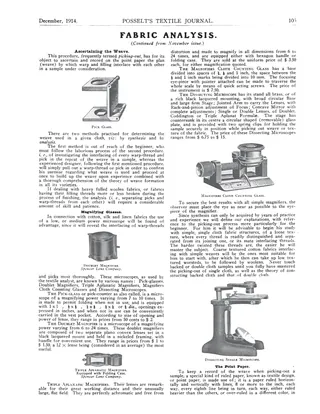
Installment of E. A. Posselt's serial "Fabric Analysis" from Posselt's Textile Journal, covering how to pick out the weave of a cloth sample. It describes magnifiers (pick glass, doublet, triple aplanatic, cloth counting glass, dissecting microscope), dissecting scissors, point paper, preparing a sample, and the rules for telling warp from filling. The last page continues a separate series on ribbons, trimmings and edgings, with pile fabrics such as carriage borders, double velvet ribbons and terry or loop pile, illustrated by weave diagrams.
Fabric Analysis
Article · 2 pages · weaving drafts
Two pages from Posselt's Textile Journal, March 1915, continuing a series on fabric analysis. The text covers when to pick warp out of filling rather than filling out of warp (corkscrews, diagonals, skip twills), and how to analyze double cloth with two warp systems and one filling, including 1 face 1 back and 2 face 1 back arrangements. Diagrams illustrate pick-out procedure. The first page also ends an article on flax-tow preparation and yarn boiling and bleaching.
Fabric Analysis
Article · 2 pages
Installment of Posselt's "Fabric Analysis" series covering yarn twist: why twist is applied, how much is used for singles and folded cotton yarns, and how twist direction affects fabric appearance. It explains open-band and cross-band twist, how twist direction relates to twill line prominence, and how to test twist and measure contraction (take-up), including a description of the Knapp twist counter. Includes a table of turns per inch for 2-fold cotton yarns from 2/20 to 2/200.
Fabric Analysis
Article · 2 pages
Installment of Posselt's serial on fabric analysis, covering the testing of fabric strength and stretch. It describes in detail a small pocket-size cloth tester with clamping jaws, rack and pinion, dial pointer and magnifying glass for watching the weave as it breaks, and the Henry L. Scott & Co. power tester for tough fabrics such as tire cloth. The second page also carries short trade items on British khaki orders, imitation leather, Fehling's solution for cellulose bleaching, the Bradford wool situation and Uruguayan export duties.
Fabric Analysis
Article · 3 pages
Three pages from Posselt's Textile Journal, November 1921, on the chemical analysis and testing of cloth. It covers determining size and finishing matter in cotton cloth, analyzing sizing compositions, and diagnosing stained, mildewed or tendered (weakened) goods. It also gives laboratory tests for cotton bleached for guncotton, and begins a section on silk thread finishing and finishing of pure and half-silk fabrics. The pages open with the end of an unrelated article on boiler houses.
A Handbook of Weaves [Fabric analysis pages]
Other · 10 pages
Excerpt from the Dover edition of Oelsner's A Handbook of Weaves (translated and revised by Samuel S. Dale), consisting of the title page and Dale's supplement on the 'straight line' analysis of weaves, patterns and fabrics. It explains how to pick out a cloth sample to record the weave draft, drawing-in draft and color pattern, then how to find yarn counts, cloth weight and yards per pound from a standard 1/300 square yard sample. A worked example analyzes a cross rib cloaking of cotton, worsted and carded woolen yarn, with conversion formulas between yarn numbering systems.
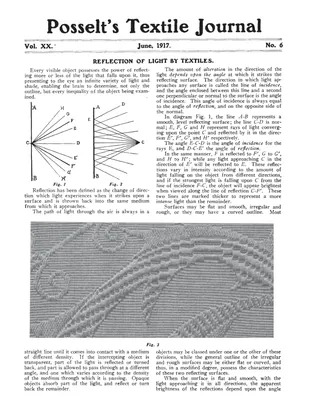
Reflection of Light by Textiles
Article · 3 pages
A 1917 article from Posselt's Textile Journal explaining how light reflects from flat, rough and curved surfaces and how this governs the lustre, light and shade, and color of woven fabrics. Ray diagrams (Figs. 1, 2, 4, 5) illustrate the principles, and photographs of a fancy repp fabric with floating warp figures (Figs. 3 and 6) show the effect of changing the viewing angle. It also discusses the influence of yarn twist, fibre shape, finishing and the nature of the light source on a fabric's appearance.
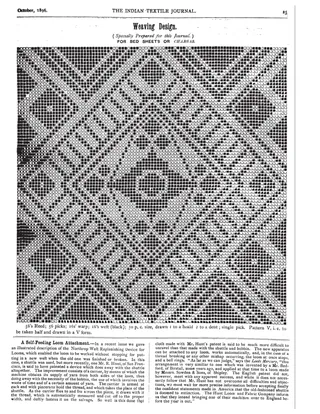
Weaving Design
Indian Textile Journal, October 1896
Article · 1 page · weaving drafts
A single page from the Indian Textile Journal (October 1896) with a weaving design for bed sheets or charsas, given as a large drawdown with specifications for reed, picks, warp and weft, sizing and drawing-in (Pattern V, drawn in a V form). The page also carries a short news item on a shuttleless, self-feeding loom attachment patented by R. Hunt of San Francisco, with comparison to the Northrop weft replenishing device and an earlier English invention.
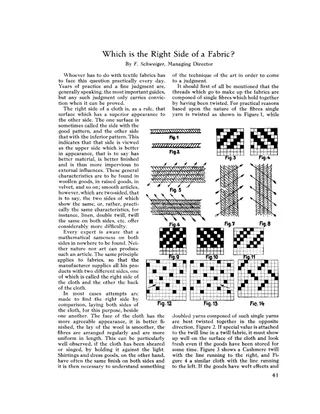
Which is the Right Side of a Fabric?
Article · 2 pages · weaving drafts
A short 1929 article by F. Schweiger on how to tell the right side (face) of a woven cloth from the back, especially for smooth fabrics that look much the same on both sides. It explains how yarn twist direction (single and doubled yarns) interacts with the direction of the twill line in twill and sateen weaves, and when a right- or left-hand twill gives the better face. Fourteen figures show twist diagrams, twill drawdowns and sateen weaves.
Woolen Cheviot Trousering
Article · 1 page
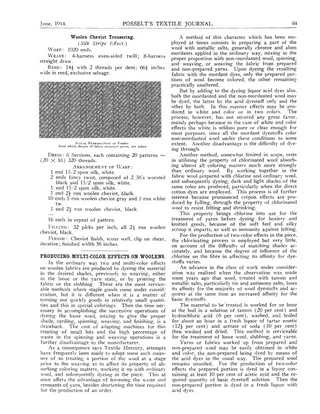
A single page from Posselt's Textile Journal giving the specifications for a woolen cheviot trousering with a silk stripe effect, including warp and filling details, reed, weave, dressing, and finishing. It is followed by an article on producing multi-color effects on woolens by treating part of the wool with mordants, chlorine, or tannin and metallic salts before piece dyeing.
Analysis of Woolen and Worsted Cloths
Article · 3 pages
Three pages from Posselt's Textile Journal, January 1921, mainly on how to analyze a woolen or worsted cloth sample. It covers burning tests to tell animal from vegetable fibres, distinguishing cotton from linen and flax from jute, and removing rubber from waterproofed cloth. It then gives rules and worked examples for estimating loom width, finished length, ends and picks per inch, and the shrinkage and take-up allowances. The scan also includes a short note on Norwegian import prohibitions and the start of an article on bleaching silk by the sulphur process.
Analysis of Woolen and Worsted Fabrics
Monograph · 28 pages · weaving drafts
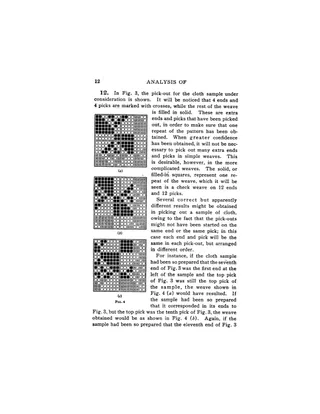
An International Correspondence Schools instruction paper (Serial 504) on analyzing woolen and worsted cloth samples so they can be reproduced in a mill. It covers making out warp and filling patterns, picking out the weave on design paper, and deriving the harness (drawing-in) draft and chain draft. It also treats finding face and back, warp and filling, twist direction and amount, shrinkage allowances, number of beams, and identifying fibers (wool vs. worsted, silk, linen, cotton, union fabrics) by burning and chemical tests.
Construction of Skip Twills
Article · 1 page
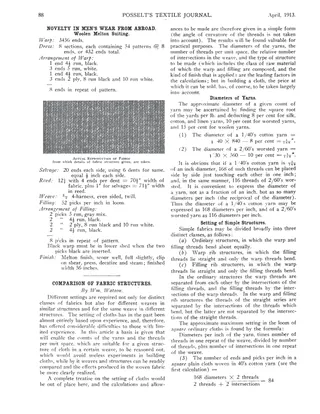
A single page from Posselt's Textile Journal (April 1913) with two items. The first is a fabric specification for a woolen melton men's suiting: warp and filling arrangement, reed, 4-harness even-sided twill weave, picks per inch, and finishing. The second is the start of Wm. Watson's article on comparing fabric structures, covering yarn diameters and the setting of simple cloths (ordinary, warp rib and filling rib structures). It includes a photograph of the fabric sample but no weaving drafts.
Designing
Textile Mercury, 1891
Article · 2 pages · weaving drafts
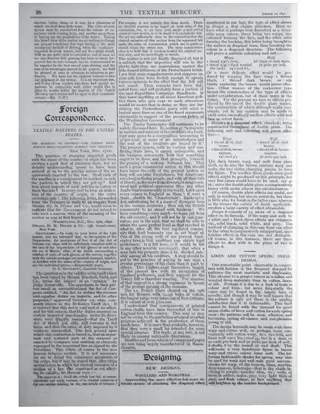
Two pages from The Textile Mercury of January 10, 1891, with a 'Designing' column on new woollen and worsted designs and a linen and cotton spring dress design. The column describes a reversible warp sateen effect, double plain diagonal effects, and sett, yarn and colour suggestions. It also gives warp and weft colour patterns for silk spring dress fabrics in a cassimere or 6-end twill. Page 2 has point-paper drawdowns with a working plan and drafts for the designs. The pages also include a 'Foreign Correspondence' column on US textile trade matters.
Designing
Textile Mercury, 1892
Article · 2 pages · weaving drafts
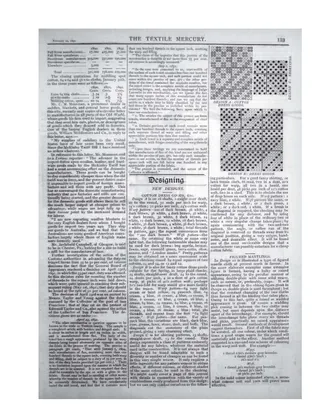
Two pages from The Textile Mercury of 20 February 1892. The first gives specifications for new power-loom designs (cotton dress goods in large plaid checks, a shirting pattern, and a figured mantle cloth made in double plain), including shafts, drafts, sett, yarn counts and colour sequences. The second continues a series, 'Analysis of Pattern IV: Fancy Combinations', on working out the weaves of stripes and checks from cloth samples. The first page also opens with trade news on cotton prices, the McKinley tariff, and US customs rulings on thread counts in fringed linen towels.
Designing
Textile Mercury, 1892
Article · 2 pages · weaving drafts
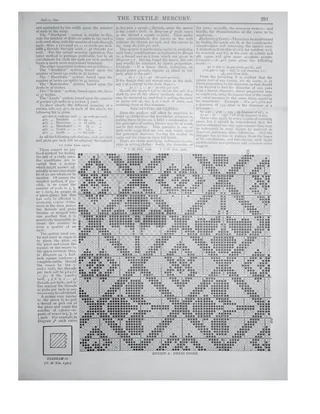
Two pages from The Textile Mercury, 23 April 1892, with a 'Designing' column for the power-loom trade. It gives a suggested dress goods design (Design A, repeating on 66 ends and 66 picks, with a satin ground) along with colour and yarn suggestions, and warp-colour sequences for cotton stripes, checks and gingham in plain weave. It also includes part X of 'The Analysis of Pattern', covering the systems for stating setts (Stockport, Bradford, Blackburn, Manchester, Scotch, Leeds), methods of finding the sett of a cloth, and calculation of yarn diameters for setting cloths. Page 1 also carries short book reviews and trade notes.
Designing and Fabric Structure
Article · 2 pages · weaving drafts
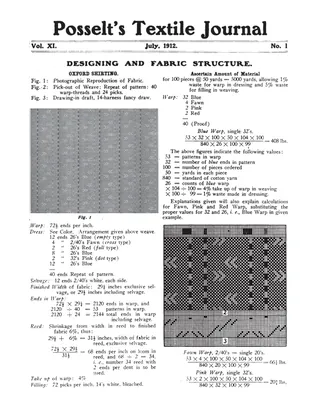
Two-page installment from Posselt's Textile Journal (July 1912) in the "Designing and Fabric Structure" series. It gives the full specification of an Oxford shirting fabric: warp color order, reed and ends calculations, take-up, and yarn weight calculations for 100 pieces of 50 yards, totaling 1492 lbs. It also presents three worsted trousering weaves (hair line, stripe, filling rib) with repeat sizes, harness draws, warp dress, reed, filling and finish. Drafts and pick-outs accompany both parts, and the page ends with short news items on world sheep numbers and a cotton exposition.
Fabric Analysis
Article · 2 pages · weaving drafts
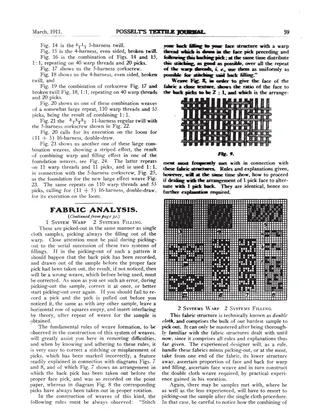
Two pages from the March 1911 issue of Posselt's Textile Journal (pp. 59-60) continuing the series on fabric analysis. They cover picking out samples of double cloth (2 systems warp, 2 systems filling) and 1 warp/2 filling fabrics, rules for stitching back filling to the face, and how to pick out pile fabrics such as Flocone and Montagnac overcoatings, with weave diagrams on point paper. The pages open with the end of a discussion of combination weaves (twill and corkscrew, 16-harness double-draw) and close with 'Novelties from Abroad' dressing and finishing details for a woolen cheviot suiting and a worsted suiting.
Fabric Analysis
Article · 3 pages · weaving drafts
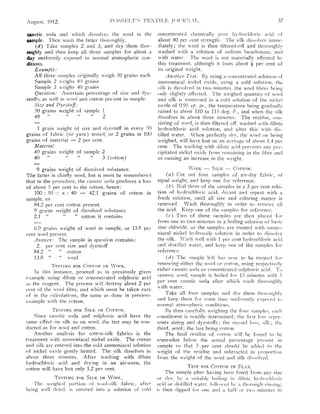
Three pages from the August 1912 issue of Posselt's Textile Journal. They open with the end of a discussion of Jacquard card cutting for terry pile-warp fabrics, including how to weave smooth headings with two-section, one-section and three-section tie-ups, and a pile-warp drawdown diagram (Fig. 6). The main part continues the Fabric Analysis series with chemical methods for finding the proportions of wool, cotton, silk and flax in union yarns and fabrics, with a worked percentage example. The last page begins a separate section on recent foreign improvements in textile machinery (doffing mechanisms, flyers, card condensers, spinning).
Fabric Analysis
Article · 5 pages · weaving drafts
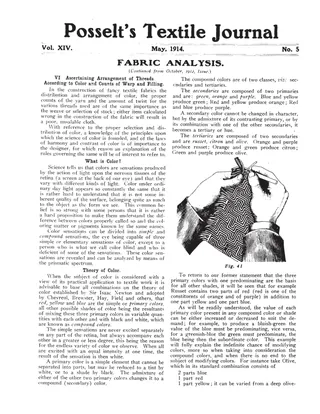
Installment of E. A. Posselt's serial on textile fabric analysis, covering how to determine the arrangement of warp and filling threads by color and yarn count. It opens with a discussion of color theory (primary, secondary and tertiary colors, contrast, complementary colors, harmony), then explains how to record color and count information on point paper when analyzing a sample. Worked examples include a worsted trousering and a black-and-white worsted suiting, with a plate of standard color-and-weave effect diagrams. It closes with a specification for a fancy worsted stripe trousering woven on a 13-harness fancy draw, giving warp dressing, reed, filling and finish.
Fabric Analysis
Article · 2 pages
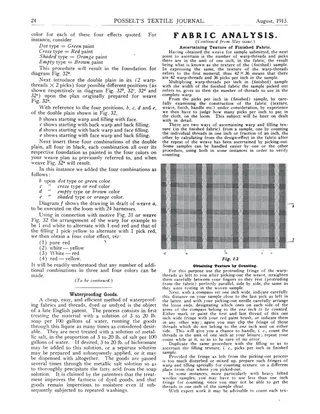
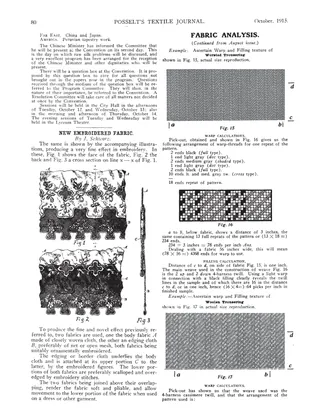
Two pages from the August 1915 issue of Posselt's Textile Journal, continuing a series on fabric analysis. They explain how to find the texture (warp threads and picks per inch) of a finished fabric sample, either by counting the fringe against a one-inch compass span or by calculating from the pattern repeat. A worked example uses a fancy cotton dress goods sample (Figs. 13 and 14) and ends with the warp and filling calculations. The pages also include a short note on a patented soap and metallic-salt waterproofing process, and the start of a passage on yarn diameters and Ashenhurst's formula.
Fabric Analysis
Article · 2 pages · weaving drafts
Two pages from the October 1915 issue of Posselt's Textile Journal (pp. 80-81) with a continuation of the "Fabric Analysis" series. Worked examples show how to find warp ends per inch and picks per inch from actual-size swatches (worsted trousering, woolen trousering, silk waisting) using pick-outs, pattern repeats and measured distances. The pages also carry a short item on a new embroidered fabric with an attached net edging, and a report on how magnesium and zinc chlorides affect cotton tendering during singeing.
Fabric Analysis
Article · 3 pages
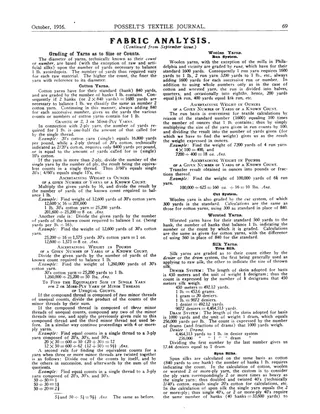
Installment of E. A. Posselt's serial 'Fabric Analysis' from the October 1916 Posselt's Textile Journal, covering yarn counting systems for cotton, woolen (run and cut), worsted, true silk (denier and dram), spun silk and artificial silk, with worked examples for weights, plied-yarn equivalents, and analysis of union yarns of cotton and worsted, including a chemical caustic-soda test. The issue pages also include John Skinner's short article on a novel woven tire fabric with floating diagonal warp threads, and a brief note on shawl fashion in Russia.
Fabric Analysis
Article · 2 pages · weaving drafts
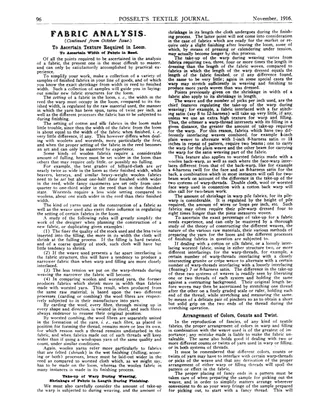
Installment of E. A. Posselt's serial on fabric analysis from Posselt's Textile Journal, November 1916. It explains how to determine the loom setting (width in reed versus finished width), the take-up of the warp in weaving, and shrinkage in finishing for cotton, silk, woolen and worsted fabrics. It then covers recording color, count and twist arrangements on point paper while picking out a weave, with worked examples of a worsted trousering and a worsted suiting (Figs. 51-53) and their warp dressings and weave drafts.
Fabric Analysis
Article · 2 pages
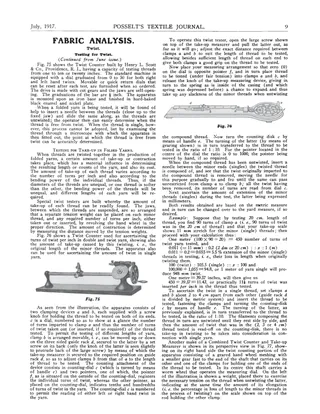
Installment of Posselt's serial on fabric analysis (July 1917), continuing the section on testing yarn for twist. It describes commercial twist counters (Henry L. Scott & Co. and a combined twist counter and take-up measurer), how to operate them, and a worked metric example for calculating turns per inch and take-up in folded yarns. It then discusses the effect of twist direction and amount on the length and counts of 2-ply cotton yarn, with a table of yardage by counts and turns per inch. A short item on dyeing and cleaning (D. B. Lake on dye bleeding and stain removal) follows.
Fabric Analysis
Article · 2 pages
Installment of E. A. Posselt's "Fabric Analysis" series (continued from December 1918 issue's predecessor) on testing yarns and fabrics for moisture, or conditioning. It explains the hygroscopic nature of fibres, over-conditioning of purchased yarn, oven-drying test methods and temperatures, and worked regain calculations for cotton and union yarns. It gives normal moisture figures for wool, silk, cotton and flax and reproduces the 1875 Turin standard regain table. The second page also carries a short item with a table of Argentine wool exports by destination, 1912-1917.
Fabric Analysis
Article · 2 pages
A two-page installment of E. A. Posselt's serial "Fabric Analysis" (March 1918), continued from the February issue. It covers conditioning of unscoured material and silk (gum or sericin removal, boil-off testing), and how atmospheric moisture affects yarn count and the strength of wool, cotton and linen cloth, with a table of test results at different relative humidities. It also explains the psychrometer (wet bulb hygrometer) and how to read relative humidity from a table, and ends by introducing a test for the moisture-absorbing qualities of cloth.
Fabric Analysis
Article · 3 pages
Three pages from Posselt's Textile Journal, April 1918, containing the continuation of the 'Fabric Analysis' series on conditioning and testing fabrics. It argues for testing at a standard moisture regain (8\u00bc%) rather than bone-dry, with a table of breaking strengths at different temperatures, and describes a regain scale and testing room. It also covers keeping yarn numbers uniform and machines for testing cloth wear (to-and-fro rubbing, Figs. 88-90). The scan begins with the end of an article on Nilsap for softening raw silk before throwing and ends with part of 'The Dyestuff Situation in the Textile Industries' on wool manufacturers' dyestuff use in 1913 and 1916.
Fabric Analysis
Article · 1 page
A one-page installment of E. A. Posselt's "Fabric Analysis" series on conditioning textile samples for testing. It explains how to determine moisture, yolk, dirt, gum and oil in unscoured material, and how silk is conditioned and boiled off to find its gum (sericin) content. It also discusses how atmospheric moisture affects yarn count and the strength of wool, cotton and linen cloths, with results from Manchester Testing House experiments.
Fabric Analysis
Article · 3 pages
An October 1922 installment of Posselt's Textile Journal on chemical analysis of cotton cloth. It covers determining size, weighting and finish by boiling, analysis of size compositions, and causes of stained, mildewed or tendered goods, including zinc chloride as an antimildew agent and strength testing. It also gives test methods for cotton bleached for gun-cotton (moisture, ash, fats, residual acid, free chlorine, hydrocellulose and oxycellulose). The last page begins an article on hosiery dyeing, discussing aniline black, diazotized and developed, direct, and sulphur dye processes for cotton hosiery.
January, 1914
Article · 1 page · weaving drafts
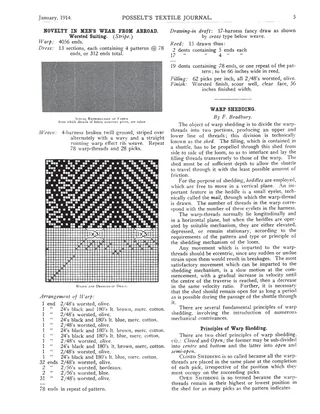
A single page from Posselt's Textile Journal, January 1914, with two items. The first is a fabric analysis of a novelty worsted men's suiting with a striped warp effect, giving warp arrangement, a 4-harness broken twill ground with wavy and straight rib stripes, a 17-harness fancy draw, reed, filling and finishing details, and a drawdown. The second is the opening of F. Bradbury's article on warp shedding, explaining sheds, heddles and the principles of closed and open shedding.
354 documents found