Textile Documents › Topic: Bronson and spot weaves
192 documents found
Sort: 
Questions and Answers
Article · 1 page
A one-page question-and-answer column by Mary M. Atwater explaining the "Bronson" weave, which she says is properly called Spot weave and is of English origin. She describes straight Bronson threading, the variant threadings that allow a lace effect, and how Bronson lace differs from Swedish lace weave. She cites specific draft numbers and pages in her Shuttle-Craft Book.
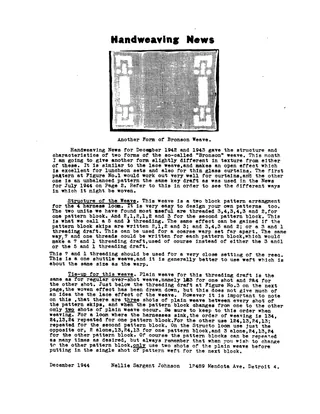
Handweaving News (December 1944): Another Form of Bronson Weave
Periodical · 2 pages · weaving drafts
A short article from Handweaving News (December 1944) by Nellie Sargent Johnson describing a third form of Bronson weave, a two-block threading for four harnesses that gives an open, lace-like fabric suited to luncheon sets, place mats and thin curtains. It explains the 5-and-1, 3-and-1 and 7-and-1 threading units, the tie-up and the treadling order, including the plain weave shots between pattern shots. Page 2 gives key and threading drafts for a curtain border and an unbalanced place mat pattern.
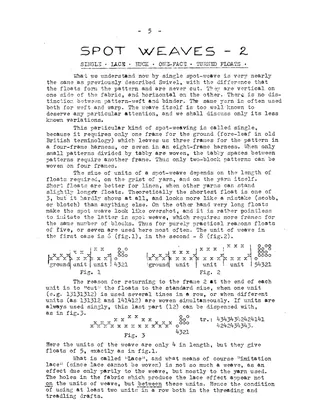
Spot Weaves 2 (spot, lace, turned)
Master Weaver, February 1952
Article · 3 pages · weaving drafts
A three-page article, the second in a series on spot weaves, from Master Weaver (February 1952). It describes single spot weave, with floats that are vertical on one face and horizontal on the other, and discusses float lengths and unit sizes. It then covers imitation lace effects, huckaback worked on spot threading, single-face spot weave, and turned floats, in which vertical and horizontal floats are combined in one fabric. Drafts, tie-ups, drawdowns and treadling sequences accompany the text.
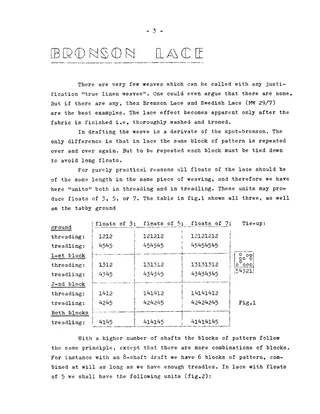
Bronson Lace
Master Weaver, November 1960
Article · 3 pages · weaving drafts
A short article from Master Weaver explaining Bronson Lace, a linen-friendly weave derived from spot Bronson in which the same pattern block repeats and is tied down to avoid long floats. It gives threading and treadling units for floats of 3, 5 and 7, extends the principle to 8 shafts with 6 pattern blocks, and discusses the number of possible block combinations and patterns. It also walks through designing a pattern from a draw-down and profile to a threading, treadling and tie-up, and notes practical issues such as sett and sagging warp ends.
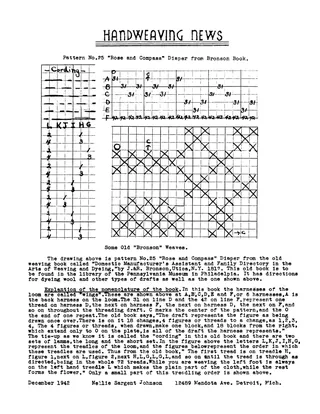
Handweaving News (December 1942): Some Old "Bronson" Weaves
Periodical · 3 pages · weaving drafts
A short article by Nellie Sargent Johnson in Handweaving News (December 1942) presenting old drafts of Bronson weave. It begins with pattern No. 25 "Rose and Compass" Diaper from J. & R. Bronson's 1817 "Domestic Manufacturer's Assistant" and explains the book's nomenclature (harnesses as "wings", tie-up as "cording"). It then gives modern tie-ups, threadings and weaving directions for 4-, 5- and 6-harness Bronson weave patterns taken from old linen samples, with notes on warp and weft sizes and setts for fine linens.
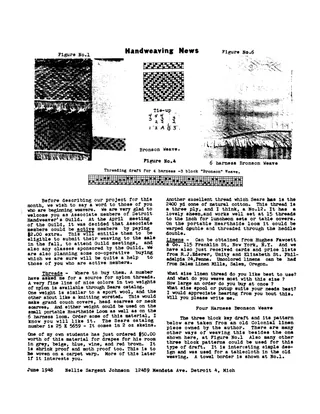
Handweaving News (June 1948): Bronson Weave
Periodical · 2 pages · weaving drafts
A two-page June 1948 issue of Handweaving News in which Nellie Sargent Johnson describes Bronson weave. She gives a 4-harness, 3-block threading from an old Colonial linen piece, with warp, sley, tie-up and treadling directions for a luncheon set. She also gives a 6-harness, 5-block version with a threading arrangement and notes on weaving it with two feet. The first page also carries guild news and sources for nylon, cotton and linen threads.
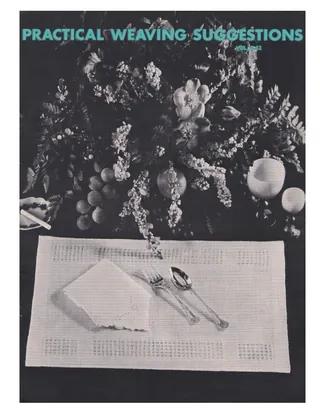
Practical Weaving Suggestions, Vol. 2-62 (1962): Place Mats in Lace Bronson
Periodical · 8 pages · weaving drafts
Instructions by Mae D. Aldrich for weaving six linen place mats in Lace Bronson on a single four-harness threading. Gives the threading draft, warp and weft specifications (20/2 linen, 10-dent reed), heddle counts, and yarn requirements for mats and matching plain-weave napkins. Border design drawdowns and block-by-block treadling directions for Place Mats 1 to 6 are included, with photographs of the finished mats and Lily Mills yarn advertising.
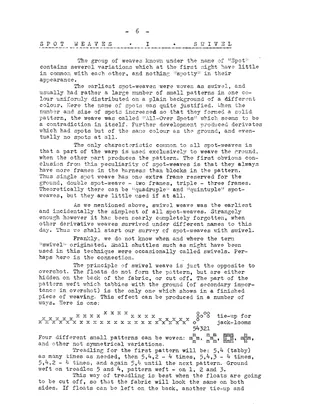
Spot Weaves - 1 (Swivel)
Master Weaver, December 1951
Article · 3 pages · weaving drafts
An instructional article from Master Weaver, December 1951, introducing the spot weave family and focusing on swivel, the earliest and simplest spot weave. It explains how swivel differs from overshot, with pattern floats hidden or cut off. It gives threading, tie-up and treadling drafts for five and six shafts, tie-ups with one treadle per block, short draft notation, and notes on setting the warp, weft weight, cutting floats and uses. The last page begins an unrelated essay, "Why Do We Weave?", on the motives for taking up handcrafts.
Dropped Weaves
Master Weaver, July 1953
Article · 6 pages · weaving drafts
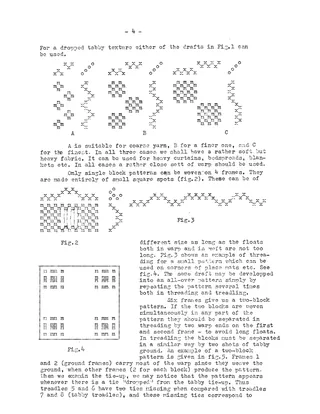
An article from Master Weaver No. 10 explaining dropped weaves, a family of spot-type structures in which blocks of warp and weft are left uninterwoven to form floats. It covers dropped tabby on 4, 6 and 8 frames, the historical 'Paper Spots', dropped twills (2:1, 3:1, 2:2) with frame counts and tie-ups, and weaving dropped patterns with a pattern harness. It closes with material and sett advice, followed by a short Information Service note on why weft curves up at the selvedges.
Go Exploring with your Loom
Article · 3 pages · weaving drafts
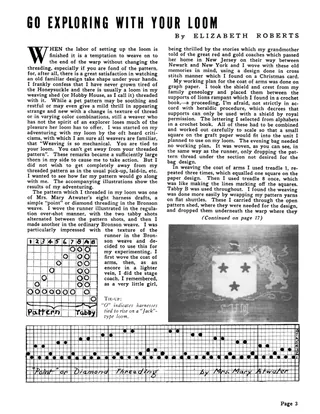
Elizabeth Roberts describes how she used a Bronson weave threading (one of Mary Atwater's eight-harness point or diamond drafts) to weave pictorial designs: a coat of arms with lions and lettering, a stage coach, and an evening bag. She explains how she planned the designs on graph paper, the treadling, the yarns and colors used, and how pattern wefts were dropped under the warp where not needed. The scan also includes the end of an article on variations of the Honeysuckle pattern and the end of one on the Woven Sheaf Stitch.
Master Weaver, No. 44 (March-April 1959)
Periodical · 16 pages · weaving drafts
Issue No. 44 (March-April 1959) of Master Weaver, a bi-monthly bulletin for handweavers published by Z-Handicrafts of Fulford, Quebec. It contains practical tips on sectional warping (bobbins and tubes, tension box rollers, getting enough warp tension) and on warping mill use with 2 or 10 tubes. The main article covers plain Swivel, a spot-weave relative of Bronson, with draw-downs, classification of variants, three treadling methods, two-colour patterning and a place mat project. It also has a Whip Net lesson on doup setup, tie-up and weft take-up, a humorous piece on confused weaving terminology in books by non-weavers, and advertisements for books and Canadian yarns.
Personalized Linens
Article · 6 pages · weaving drafts
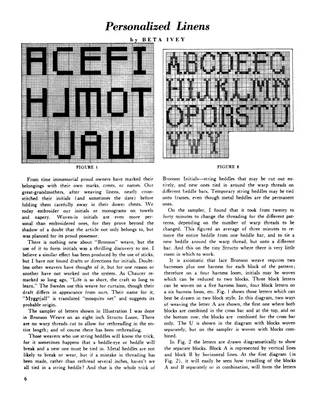
An article by Beta Ivey on weaving personal initials and monograms into linens using Bronson (lace) weave. She explains how letters are broken into two or four blocks, gives threading and treadling directions for blocks A and B on four harnesses, and describes changing string heddles to rethread for each letter. Practical notes cover a sampler woven on a Structo loom and an IB monogram towel in 40/2 linen sleyed at 30 ends per inch. Also included are proportion planning, place mat layouts, and loom suitability. Figures show letter drafts and diagrams, and there are photographs of the finished sampler and towels.
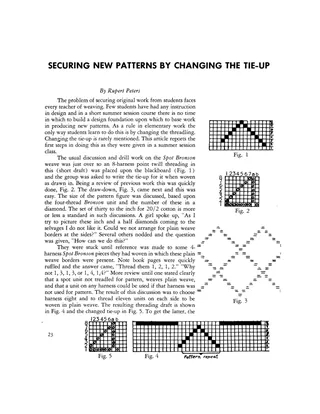
Securing New Patterns by Changing the Tie-Up
Article · 3 pages · weaving drafts
A teaching article describing how a summer session weaving class created new patterns by altering the tie-up rather than the threading. Starting from an 8-harness point twill threading in Spot Bronson, students added plain weave borders, then put spots and diamonds inside the large diamond figures and worked out the matching tie-ups. Over twenty variations resulted, shown in Figs. 1-21, and the article ends by noting that new patterns come from changed threading, treadling, or tie-up.
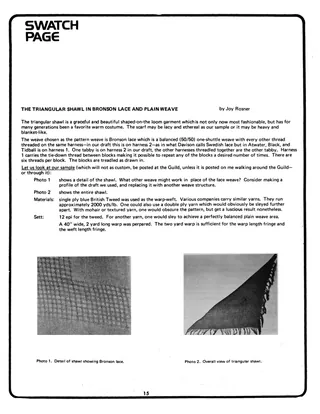
The Triangular Shawl in Bronson Lace and Plain Weave
Article · 2 pages · weaving drafts
A short article from the Minnesota Weaver swatch page describing how to weave a 40-inch triangular shawl on the loom in Bronson lace and plain weave. It gives the threading and jack-loom tie-up, materials (single-ply British tweed at 12 epi), and the method of breaking each warp thread in turn to use as the weft so the shawl takes shape. It also covers problems such as even beating, finishing and fringes, and ends with a reference list.
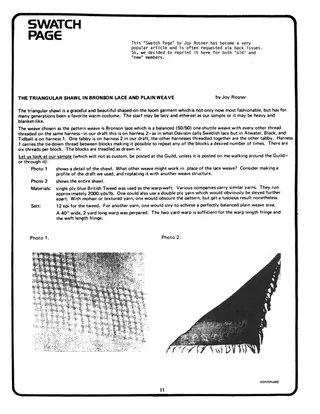
The Triangular Shawl in Bronson Lace and Plain Weave
Article · 2 pages · weaving drafts
Joy Rosner describes how to weave a 40" x 40" triangular shawl on the loom using Bronson lace and plain weave in single-ply blue British tweed. The article covers the threading and tie-up, materials, a 12 epi sett, and a method in which each warp end is broken at the back and used as the weft. It also covers problems in weaving, finishing and washing, and ends with a reference list. Two photos show a detail and the full shawl, and a weaving plan page gives the threading, tie-up and warp layout.
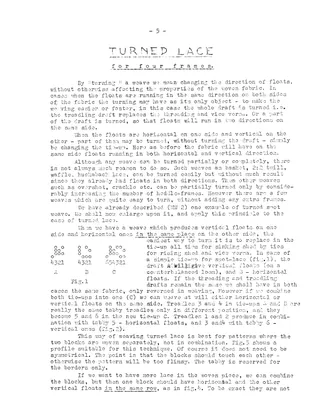
Turned Lace for Four Frames
Master Weaver, January 1954
Article · 3 pages · weaving drafts
An article from Master Weaver explaining how to "turn" a weave, that is, change the direction of floats, and applying it to spot-lace on four frames (six treadles). It covers tie-up changes that allow horizontal or vertical floats on the same side, profile drafts for separate and combined blocks, threading sequences for six-end units, and a complete linen project with treadling to square the pattern. A short editorial note by S.A. Nielinski on a forthcoming series of drafting lessons follows.
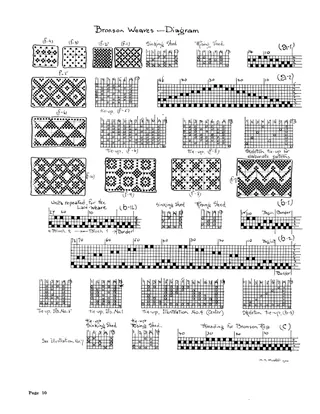
The Bronson Weave - Four Ways
Article · 9 pages · weaving drafts
Mary Atwater explains the so-called Bronson weave (spot weave), how it got its name from the 1817 Bronson 'Domestic Manufacturer's Assistant', and its two threading forms, (a) and (b). She describes four uses: fine linens, an openwork lace-weave, a weft-effect upholstery and bag fabric, and a warp-face rep for furniture covering. The article gives treadling sequences, sett and yarn recommendations, and seven illustrations of woven samples, plus a page of diagrams with threadings, tie-ups and drawdowns.
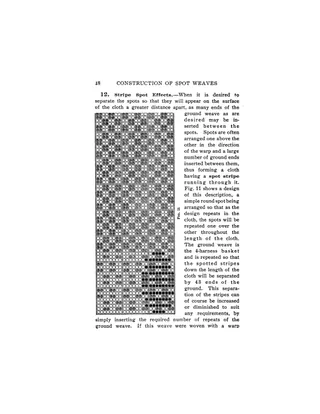
Construction of Spot Weaves
Monograph · 26 pages · weaving drafts
An International Correspondence Schools instruction pamphlet (Serial 509) on designing spot weaves. It explains how to lay out spots in plain, satin and broken crow order on design paper and how to choose and fit ground weaves, covering both warp-spot and filling-spot weaves, including corkscrew and cord grounds. It then treats spots formed by an extra warp or extra filling, with tying of floats, stripe spot effects, and harness and chain drafts. Practice examples follow each section, and many pages carry design-paper drawdowns and drafts.
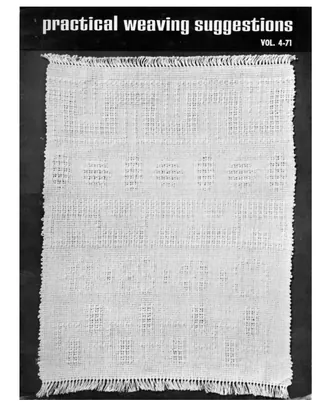
Practical Weaving Suggestions, Vol. 4-71 (1971): Bronson Lace
Periodical · 6 pages · weaving drafts
Article by Nell Steedsman describing a method of weaving Bronson lace on a four-harness (counter-balanced) loom using pick-up sticks, so that designs are not limited to two blocks. It explains the equipment, the Bird's Eye threading used in place of a Bronson threading, pick-up procedures for warp floats, weft floats, and both together, and how to prepare the graph-paper cartoon. Six linen samples (10/2 and 40/2 Lily linen) show borders, corner motifs, monograms, and designs adapted from Mexican and Ojibway sources, with setts and warp counts given.
Shuttle-Craft Bulletin, Vol. XXX, No. 2 (February 1953)
Periodical · 14 pages · weaving drafts
February 1953 issue of the Shuttle Craft Guild Handweaver's Bulletin, devoted to three related linen unit weaves: Spot Bronson, Swedish Lace and Atwater Lace (then called Lace Bronson). It explains threading units, tie-ups for rising-shed looms, treadling rotations and the role of the tie-down thread. It also proposes the name Atwater Lace for the Lace Bronson weave, and includes a short section on false tie-ups for counter-balanced looms. A page of drafts gives Spot Bronson, Swedish Lace in Swedish and Norwegian conventions, Atwater Lace for four and six harnesses, and profile drafts.
Shuttle-Craft Bulletin, Vol. XXX, No. 3 (March 1953)
Periodical · 14 pages · weaving drafts
March 1953 issue of the Shuttle Craft Guild Handweaver's Bulletin, continuing the introduction of Atwater Lace (formerly Bronson Lace) begun in February. It explains profile drafts and shortened draft forms, then covers warp settings, suitable materials, tension problems and variations such as weft-pattern, tie-down shed color effects, dukagang inlay and warp rep. It gives treadling directions for table mats, luncheon squares and wool baby blankets on 4 to 10 harnesses, including Helen Macdonald's Oak Leaf luncheon square.
Shuttle-Craft Bulletin, Vol. XXXI, No. 5 (May 1954)
Periodical · 16 pages · weaving drafts
May 1954 issue of the Shuttle Craft Guild Handweaver's Bulletin (Portfolio Edition) by Harriet and Martin Tidball. It continues the study of two-shuttle pattern weaves with figures encircled by tabby, giving a 6-harness, 82-thread threading with tie-up and treadling, an 8-harness extension, and a 6-harness Tabby and Point draft with two tie-ups. It reports on the completed Ceylon Project, in which Guild members gave a Macomber loom and equipment to Dr. Edith Ludowyk-Gyomroi's weaving workshop in Menikdiwela. It ends with advice on finishing and preventing raveling of handwoven edges, including a Duco cement and acetone edge preservative, and a page of woven samples.
Shuttle-Craft Bulletin, Vol. XXXII, No. 11 (November 1955)
Periodical · 18 pages · weaving drafts
November 1955 issue of the Shuttle Craft Guild Handweaver's Bulletin (Portfolio Edition, with woven samples). It gives directions for weaving and making up string ties and bow ties, using a spot-weave-type tabby pattern on 4, 5 and 6 harnesses and a 4-harness twill-with-tabby with lashes. It also covers an eight-harness twill fabric, the causes of and remedies for weft streaking, Christmas gift offerings, a reader question on sympathetic raising of untied harnesses in Summer and Winter, and short Threadbender notices.
Shuttle-Craft Bulletin, Vol. XXXII, No. 6 (June 1955)
Periodical · 24 pages · weaving drafts
June 1955 issue of the Shuttle Craft Guild Handweaver's Bulletin (Portfolio Edition). It covers the Spot (Spot Bronson) weave for linens, with drafts taken from old Colonial American homespun linens, including a four-harness diamond, a five-harness diamond and a dresser scarf/table cloth pattern. It continues the 'Understanding Drafts' series with an explanation of the Profile draft and 16 substitution units (keys) for unit weaves such as Summer and Winter, Atwater-Bronson lace, Bateman weaves and Warp Pattern weaves. It ends with a four-harness modern linen dress fabric variation of the Spot Weave. The Portfolio pages carry fabric samples and a Colonial Heritage 'Distaff' card.
The Woven Sheaf Stitch
Article · 3 pages
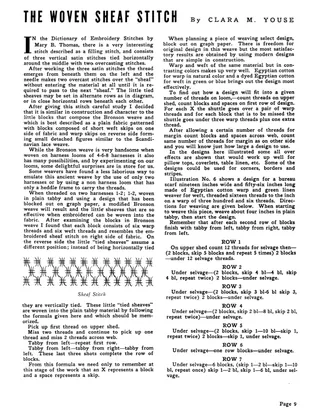
Clara M. Youse describes adapting the embroidery 'sheaf stitch' from Mary B. Thomas's Dictionary of Embroidery Stitches to a modified Bronson weave, woven on two harnesses or a simple heddle-frame loom over plain tabby. She gives the block formula, advice on fitting a design to the warp, materials (Egyptian cotton, linen weft), and row-by-row directions for a bureau scarf. Ten block designs are illustrated, including Cambridge Beauty, Rosebuds, Young Lovers Knot, and eight-harness border and tree designs. The scan also includes the end of an article on weaving variations of the Honeysuckle pattern.
Baby Blankets
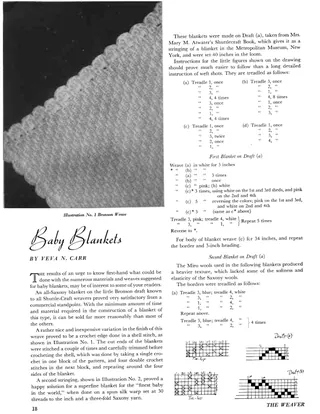
Article · 3 pages · weaving drafts
Veva N. Carr describes her experiments weaving baby blankets, a carriage robe and a lap pad in wool, mainly on the Bronson weave and a basket-weave draft from Mary M. Atwater's Shuttle-Craft Book. She gives threadings, tie-ups, treadling sequences, color borders, sett (30 and 15 threads per inch), yarns (Saxony, Miro, Bernat Laurel) and finishing methods such as crochet shell edges and ribbon binding. The scan also includes continuation fragments of other articles in the same issue: a Rosengang treadling and pieces on Loja Saarinen and Scandinavian art weaving.
Master Weaver, No. 13 (January 1954)
Periodical · 14 pages · weaving drafts
Issue No. 13 (January 1954) of Master Weaver, a bulletin for handweavers published by Z-Handicrafts in Fulford, Quebec. It opens with an editorial essay, "Problems," criticizing rigidity and poor experimentation in texture weaving, vegetable dyeing and loom design, and urging weavers to learn more theory. Technical articles follow on turned lace for four frames, with tie-ups, profile drafts and a sample linen project, and on the two-harness method (ground and pattern harness) with draw-down instructions. The issue also has a Leclerc horizontal warping mill advertisement, an editor's note about forthcoming drafting lessons, and a reprinted passage on taste from John Murphy's Treatise on the Art of Weaving.
Master Weaver, No. 54 (c. 1960)
Periodical · 14 pages · weaving drafts
Issue No. 54 of Master Weaver, a bi-monthly bulletin for handweavers published by Z-Handicrafts in Fulford, Quebec. It announces weaver certificates (Junior Weaver, Journeyman, Junior Master and Senior Master) with sample requirements for each level, and includes an article on Bronson lace with threading and treadling units and counts of possible pattern variations. Shorter pieces cover deknotting woven cloth, formulas for counting pattern variations, and a second article on two-warp fabrics with cord and pile effects. The issue ends with a subject index for 1958-1960 and advice on binding back copies.
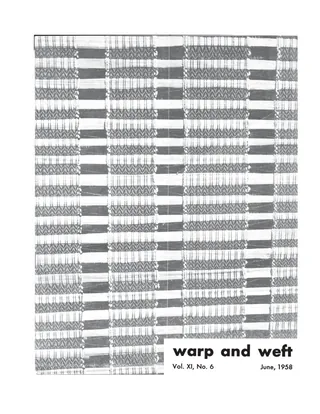
Warp & Weft, Vol. 11, No. 6 (June 1958)
June 1958
Periodical · 9 pages · weaving drafts
June 1958 issue of Warp and Weft, a monthly handweaving periodical from Robin & Russ Handweavers in Santa Barbara. It includes the editor's report on the Northern California Handweavers Conference, a reprinted article on varying overshot through tie-up changes, and a full draft and cost breakdown for "A Linen Cross", a Bronson lace fabric woven in 50/4 linen with gold metallic weft. It also has two book reviews (Tibetan rug looms, miniature overshot patterns) and pages of classified and loom advertisements.
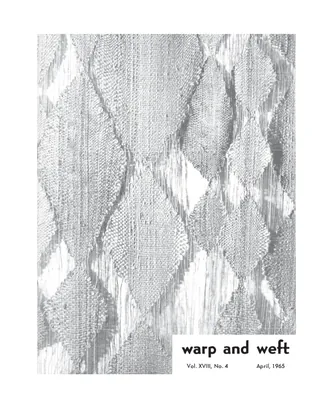
Warp & Weft, Vol. 18, No. 4 (April 1965)
April 1965
Periodical · 9 pages · weaving drafts
April 1965 issue of Warp & Weft, a monthly bulletin from Robin & Russ Handweavers of McMinnville, Oregon, edited by Russell E. Groff. It gives a four-shaft barleycorn (Bronson-type) upholstery fabric with warp and weft specifications, tie-up, treadling, tabby treadle notes, take-up remarks and a yarn cost breakdown. A second project for drapes and place-mats in natural and white with ramie, rayon and silver boucle wefts is given as a tie-up and treadling. The issue also has an editor's letter, a cover note on a diamond-pattern tapestry, a review of Amsden's Navaho Weaving, a registration slip for the 1965 Pacific Northwest Weaving Conference, and classified and display ads.
Warp & Weft, Vol. 25, No. 5 (May 1972)
Warp & Weft, May 1972
Periodical · 8 pages · weaving drafts
May 1972 issue of Warp & Weft, a monthly published by Robin & Russ Handweavers of McMinnville, Oregon. It includes an editor's column on importing yarns and shop news, a review of Doreen Wright's "Bobbin Lace Making," and a cover note on a Scottish linen mill's hackling machine and the Mayflower II sails. The main pattern, "Butterscotch Chiffon," is a four-shaft Barleycorn weave for suiting or coat fabric, given with threading, tie-up, treadling, yarns, sett, selvage advice and cost per yard. The issue closes with yarn specials, a list of recommended books, and classified and marketplace advertisements.
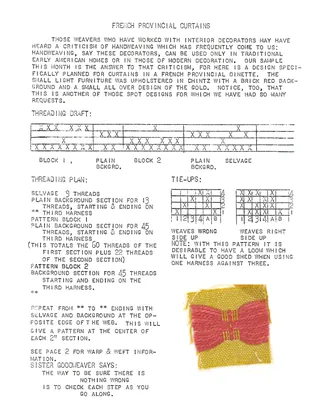
Warp & Weft, Vol. 6, No. 6 (June 1953)
June 1953
Periodical · 8 pages · weaving drafts
June 1953 issue of Warp & Weft, a small American handweaving newsletter published in Baldwin, Michigan. The monthly sample is a French Provincial curtain fabric in single spot weave on 4 harnesses, with a threading draft, tie-ups, treadling, yarn and sett details, and ideas for upholstery and evening wear. Other items include a report on the Hull House weaving department in Chicago, a short explanation of spot weaves, a review of the Wisconsin Federation of Handweavers exhibit, a Gaelic weaver's prayer, a Q&A on how long a scarf takes to weave, a review of Elmer Hickman's Folio 4 of New Weaves from Old, and classified ads. The editors announce a summer break with no issues until September.
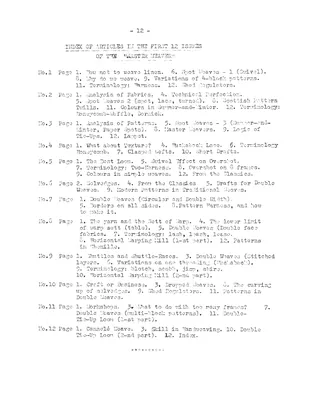
Index
Master Weaver, November 1953
Article · 1 page
A one-page index to the first twelve issues of the periodical Master Weaver, listing article titles and page numbers issue by issue. Topics include spot weaves, summer and winter, double weaves, overshot, huckaback, terminology, shed regulators, warping mills, and the double tie-up loom. It is useful for locating specific articles in the run of the periodical.
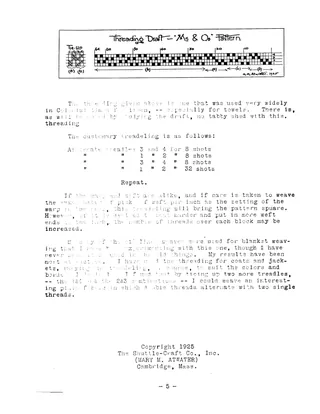
Shuttle-Craft Bulletin (1925)
Periodical · 59 pages · weaving drafts
A bound run of Mary Meigs Atwater's Shuttle-Craft Guild Bulletins from 1925, roughly issues 5 through 14 (January to November). Issues mix practical weaving instruction with Guild business. Topics include color and dyeing advice, baby blanket weaves, the "Bronson" weave on four harnesses, a threading draft in the "Ms & Os" pattern, and twill and sateen treadlings. Other items cover estimating yarn quantities, selling handwoven dresses, warping and beaming small table looms, Structo loom tips, coverlid pincushions, signed weaving, a yarn swift, and plans to publish the John Landes pattern book. Many pages carry weaving drafts with tie-ups and treadling sequences.
Shuttle-Craft Bulletin, Vol. XXX (c. 1953-1954)
Periodical · 4 pages
Annual subject index for the 1953 volume (Vol. XXX) of the Shuttle-Craft Bulletin and its companion Shuttle Craft STYLES sheets, giving month and page or STYLES number for each entry. Topics include Atwater/Bronson lace, shadow weave, inlay, basket weave, two-, four- and eight-harness weaves, Scotch tartans, warping and beaming, stoles, table mats and the Ceylon Fund. The last page is a price list of Shuttle Craft Guild publications, memberships and courses for 1954.
Weaver, Vol. 3, No. 4 (October 1938)
Weaver, October 1938
Periodical · 31 pages · weaving drafts
October 1938 issue of The Weaver, a quarterly published by Emile Bernat & Sons Co. It opens with Kate Van Cleve's author and subject indexes to the first three volumes. Articles cover woven-in initials in Bronson weave, laid-in tapestry for beginners, an "Alternate Weaving" technique for two harnesses, point weaving on an 18-harness Jacquard-controlled loom, twice-woven rugs, Mapuche weaving in Chile, Czechoslovakian weaving taught at an Ohio institute, and a Questions and Answers column on selling handwoven goods. Drafts, cards and photographs accompany many articles, and the issue ends with Bernat yarn and loom advertisements.
Shuttle-Craft Bulletin (December 1959)
Periodical · 37 pages · weaving drafts
December 1959 Portfolio Edition of Shuttle Craft, the monthly bulletin of the Shuttle Craft Guild (Bedford, Nova Scotia), Volume XXXVI, No. 12. It includes a Christmas wall hanging in flossa and dukagang, the Church Windows sample, and Part III of Evelyn Longard's profile draft series comparing Spot Bronson and Lace Bronson with drafts. It also has plans for the Devereaux Mansion loom, a 16-harness table loom, instructions for adding a second warp beam to LeClerc looms, and Grace Duryea's article on many ways to weave one draft. A Loom Language glossary, the 1959 index, equipment notes and advertisements are included.
Loom Music, Vol. VI (1949)
Loom Music, 1949
Periodical · 92 pages · weaving drafts
Bound volume of Loom Music for 1949 (Vol. VI, Nos. 1-12), a Canadian monthly for handweavers edited by Mary Sandin (Edmonton) and Ethel Henderson (Winnipeg). Issues give project instructions with threadings, tie-ups and treadlings for place mats, drapery fabrics with metal threads, Scottish tartan sett charts, baby shawls and carriage covers in Bronson lace, purses, table squares in Swedish lace and overshot, warp-face bags, and a round cord. Other features cover the 1949 Banff School weaving session, gauze weave borders drawn from a study of Peruvian gauze weaves, yarn sources, exhibition advice, reader letters and news, and an annual index.
Minnesota Weaver, Vol. 3, No. 6 (March 1978)
Minnesota Weaver, March 1978
Periodical · 24 pages · weaving drafts
March 1978 issue of the Weavers Guild of Minnesota's monthly newsletter. It covers the Guild's March program on frame loom weaving, workshops (primitive spinning, tatting), a April silent auction, board and treasurer reports, school class listings, library news, and member profiles (Cathy Ingebretsen, Karen Searle, and fibers artist Bev Skoglund). Technical content includes a Swatch Page on a triangular shawl in Bronson lace and plain weave with a draft and weaving plan, a textile printing paste recipe, a Chilkat blanket article, a Mary Atwater letter from 1943, and a Telas de los Muertos installment on Peruvian warp patterning (supplementary and complementary warp, float weaves, weft substitution). Also includes exhibit notices, travel notes, Convergence '78 information, and ads.
Weaver, Vol. 4, No. 4 (October-November 1939)
Weaver, October-November 1939
Periodical · 32 pages · weaving drafts
October-November 1939 issue of The Weaver, published by Emile Bernat & Sons Co. It mixes weaving instruction and drafts with features on exhibits and guilds. Articles cover pictorial weaving in Bronson weave (coat of arms, stage coach), crackle and summer and winter on a long linen warp, a woven sheaf stitch with charted motifs, and many ways of weaving the Honeysuckle pattern (overshot, Italian, Lace-Bronson, Mattor, Halkrus). Further pieces cover leno gauze on a non-harness loom, Mary Atwater's answers on tie-ups and her series on four- and eight-harness twills with numbered drafts, setting up a weaving exhibit in period rooms, a trip to Peru with ancient Peruvian textiles and looms, and the Seattle Weavers Guild. It ends with a Bernat loom advertisement.
Weaver, Vol. 5, No. 4 (October-November 1940)
Weaver, October-November 1940
Periodical · 32 pages · weaving drafts
Issue of The Weaver (Vol. 5, No. 4, Oct.-Nov. 1940) with articles for handweavers. Mary Atwater answers a question on Bronson (spot) weave and Swedish lace weave, and also contributes a crackle-weave drapery pattern, "Rain on the River". Florence Fowle explains faster loom warping and beaming, with a tassel-head device and a warp-tying knot shown in illustrations. Other pieces cover a hand-woven wool suit, wall hangings adapted from Guatemalan textiles, Navajo-method parka, jacket and sofa pieces, leno-effect table mats, striped bags and runners with treadling schedules, curtains, and an exhibit by the Weaver's Guild of Saint Louis. The issue ends with a Bernat loom advertisement.
Weaver, Vol. 6, No. 2 (April-May 1941)
Weaver, April-May 1941
Periodical · 32 pages · weaving drafts
Issue of The Weaver (April-May 1941) published by Emile Bernat & Sons. It opens with an account of the handwoven upholstery, bedspreads and curtains made for Timberline Lodge on Mt. Hood, Oregon, and continues with Mary Atwater's article on four uses of the Bronson weave (linen, lace-weave, weft-effect, warp-face rep) with diagrams and photographs. Other articles cover damask, reworking one hollow-block pattern in overshot, crackle and summer and winter, a system of blended drafts (Honeysuckle with Goose Eye), and laid-in technique for purses and linen runners. The issue ends with Atwater's questions and answers, a Penland School announcement and a Bernat loom advertisement.
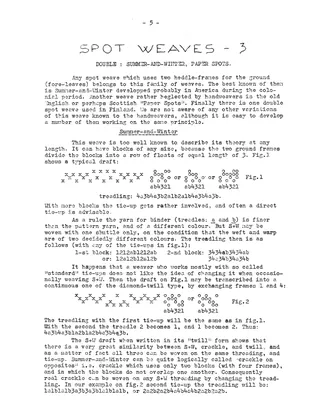
Spot Weaves 3 - Double: Summer-and-Winter, Paper Spots
Master Weaver, April 1952
Article · 3 pages · weaving drafts
Third article in the Master Weaver series on spot weaves, covering double spot weaves that use two heddle frames for the ground. It explains Summer-and-Winter drafts and treadlings, including a twill-form transcription, its relation to crackle, and bound weaving with one to four colours. It then describes Paper Spots, a 6-frame double spot weave: how it is drafted, how it can be woven on four frames, how blocks can be turned, and its suitable uses. Threading, tie-up and draw-down diagrams accompany the text (figs. 1-7).
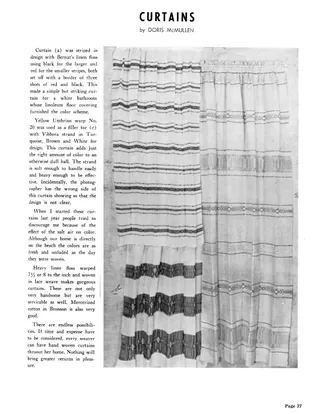
Curtains
Article · 1 page
A short 1940 article by Doris McMullen on hand-woven curtains for a seaside home. She describes a striped bathroom curtain woven with linen floss in black and red, and a hall curtain using yellow Umbrian warp as filler with Vibbora strand in turquoise, brown and white. She reports that the colors did not fade in salt air and recommends heavy linen floss in lace weave or mercerized cotton in Bronson weave. A photograph shows the finished curtains; no drafts are given.
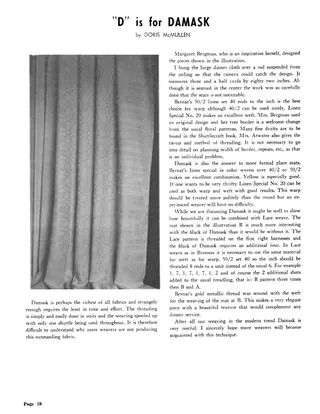
D is for Damask
Article · 2 pages
A short 1941 magazine article encouraging handweavers to try damask, which the author describes as rich yet quick to weave because threading is done in units and only one shuttle is used. It describes a tree-bordered linen dinner cloth designed by Margaret Bergman, recommends linen warps and wefts and sett, and suggests place mats. It also explains how to combine damask with Lace weave on eight ends per unit, with gold metallic thread in the weft. No drafts are given, but the author refers readers to the Atwater Shuttle-Craft book for drafts and tie-ups.
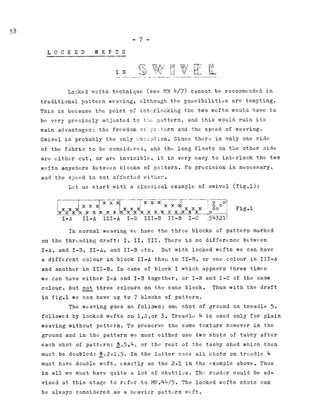
Locked Wefts in Swivel
Master Weaver, July 1961
Article · 4 pages · weaving drafts
A four-page article from Master Weaver explaining how to combine the locked wefts technique with swivel (spot) weave on four shafts. It covers a classic swivel threading with three blocks, which can yield up to seven pattern blocks with different colours, plus the treadling sequence with ground and double tabby shots. It also introduces a left/right treadling notation for the two colours, with examples for the figures. Drawdowns show how one-colour patterns can look like six-block designs, and the article closes with practical advice on weft tension.
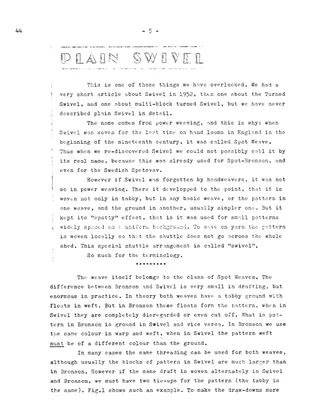
Plain Swivel
Master Weaver, March 1959
Article · 5 pages · weaving drafts
An article from Master Weaver (No. 44, March 1959) describing plain Swivel, a spot-weave variant in which pattern weft is woven locally on a tabby ground. It explains the terminology, the difference between Swivel and Spot Bronson, and classifies the variations (Spot Swivel, All-Over Swivel, Swivel Effect, Turned Swivel). It gives three treadling methods for a four-shaft, three-block draft, with advice on weft twisting, selvedges, slack pattern weft and two-colour pattern. It ends with a practical project for cotton and rayon place mats with warp, weft and treadling details.
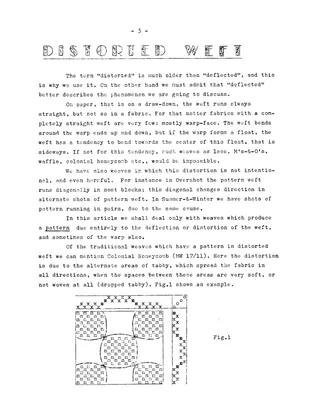
Distorted Weft
Master Weaver, September 1961
Article · 4 pages · weaving drafts
A short article from Master Weaver explaining distorted (deflected) weft, where the pattern comes from weft or warp shifting out of its straight path rather than from a conventional interlacement. It covers colonial honeycomb with alternating tabby and 4:4 basket blocks, sett recommendations (50 to 80 percent closer than for tabby), and Bronson and Overshot based drafts in which heavy pattern weft floats over a fine ground. It includes seven figures with drafts, a variant with long and short floats, and a practical project for a centerpiece in 10/2 cotton with warp and weft details.
Practical Weaving Suggestions, Vol. XV: Woven Monograms
Periodical · 8 pages · weaving drafts
An issue of Lily Mills' Practical Weaving Suggestions in which Berta Frey explains how to weave initials and monograms into lace-weave cloth. It covers picked-up Bronson (Bratton lace), square and diagonal Brooks Bouquet (backstitching on the loom), and a combined Brooks and Danish Medallion technique, with notes on sampler making, yarn choice, sett, and charting letters on squared paper. It includes a simple practice design, photos of a sampler, towels and a blouse, and ends with Lily yarn color and size listings.
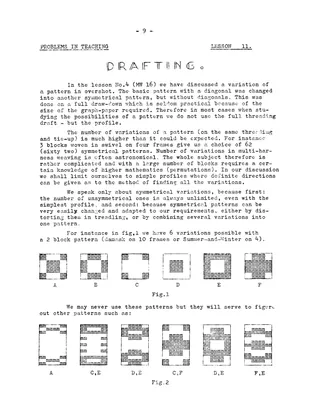
Problems in Teaching 11 - Drafting
Master Weaver, November 1955
Article · 3 pages · weaving drafts
Lesson 11 in the Master Weaver series 'Problems in Teaching' explains how to use profile drafts to find all the symmetrical variations of a block pattern instead of working on a full draw-down. It uses a two-block Bronson lace threading as the worked example, deriving variations A through H by replacing blocks with tabby, reversing blocks, or combining both blocks. A table gives treadling directions and pick counts for each variation, and the lesson ends by pointing to the next lesson, which covers three-block patterns.
192 documents found