Textile Documents › Topic: Profile drafts and block design
112 documents found
Sort: 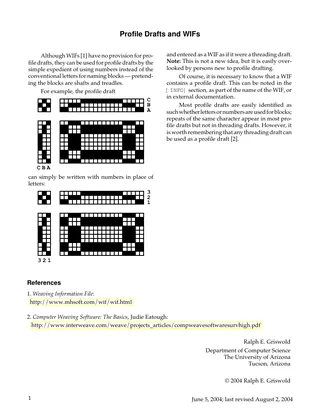
Profile Drafts and WIFs
Ralph E. Griswold · June 29, 2002
Web Doc · 1 page · weaving drafts
A short note by Ralph Griswold explaining how profile drafts can be stored in WIF (Weaving Information File) files even though the format has no provision for them. The trick is to name blocks with numbers instead of letters, treating blocks as shafts and treadles, and entering the profile as a threading draft. It also suggests flagging such a WIF in the [INFO] section, in the file name, or in external documentation, and notes that any threading draft can serve as a profile draft.
Handweaving News (June 1938): Designing Three Block Patterns
Periodical · 3 pages · weaving drafts
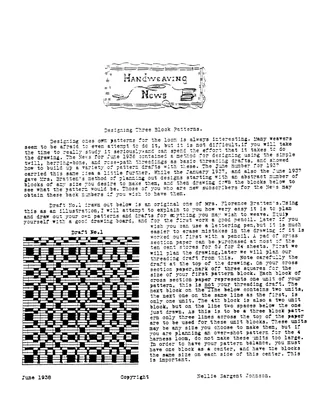
A 1938 Handweaving News article by Nellie Sargent Johnson explaining how to design three-block patterns on paper. Using an original draft by Mrs. Florence Bratten, it shows how to lay out unit pattern blocks on cross-section paper, mark the center, build a key draft, and draw down the blocks on the diagonal. It then shows how changing block order or unit sizes produces different patterns from the same threading, with drawdown figures and a table comparing two variations.
Profile Tie-Ups, Part 1: Basic Concepts
Ralph E. Griswold · July 3, 2004
Web Doc · 2 pages · weaving drafts
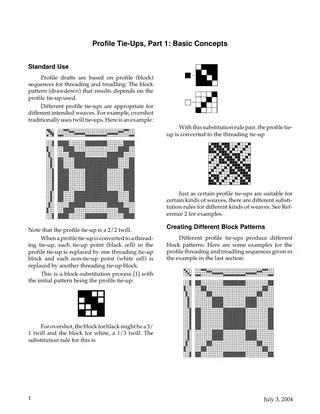
A short web document by Ralph Griswold introducing profile tie-ups in profile (block) drafts. It explains how a profile tie-up, such as a 2/2 twill for overshot, shapes the block pattern, and how it is converted to a threading tie-up by block substitution (e.g. 3/1 twill for black cells and 1/3 twill for white). Diagrams show profile tie-ups, substitution rules and the resulting block patterns for sample profile threading and treadling sequences.
Variations of Four-Block Patterns
Master Weaver, December 1951
Article · 3 pages · weaving drafts
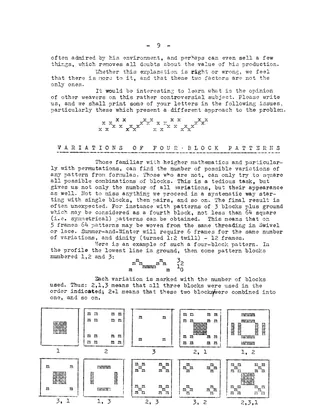
A short article from Master Weaver (Dec. 1951) on working out all the possible variations of a four-block pattern (three pattern blocks plus ground). It explains a notation for combining blocks and presents grids of small profile and drawdown diagrams showing 64 symmetrical variations woven from one threading. The final page begins a note on weaving terminology, taken from the 'Encyclopedia of Hand-Weaving', discussing the word 'harness' and its synonyms (heddle-frame, shaft, leaf, heald). The scan opens with the end of an unrelated discussion about weavers' motivations.
Designing with L-Systems, Part 10: Profile Drafts
Ralph E. Griswold · June 12, 2004
Web Doc · 2 pages · weaving drafts
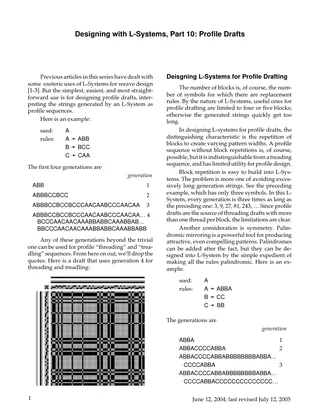
Part 10 of Ralph Griswold's series on designing with L-Systems, showing how to interpret L-System strings as profile (block) threading and treadling sequences. It gives two worked examples with seeds, rewriting rules and the first four generations, one with a three-times growth in length and one with palindromic rules, and shows profile drafts generated from generation 4. It also discusses limiting the number of blocks, using block repetition to vary pattern widths, and ideas such as separate L-Systems for threading and treadling or width-sequence interpretation.
Problems in Teaching 10 - Drafting
Master Weaver, September 1955
Article · 2 pages · weaving drafts
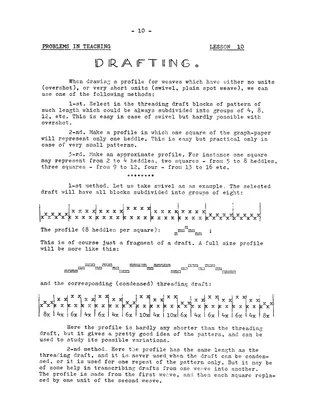
Lesson 10 of the Master Weaver series 'Problems in Teaching', on drawing profile drafts for weaves without clear units (overshot) or with very short units (swivel, plain spot weave). It describes three methods: choosing blocks divisible into equal groups, one square per heddle, and an approximate profile with one square for a range of heddles. Examples show threading drafts with matching profiles for swivel, overshot, barley corn and Bronson spot weave, and the text notes that the third method distorts the pattern.
Problems in Teaching 11 - Drafting
Master Weaver, November 1955
Article · 3 pages · weaving drafts
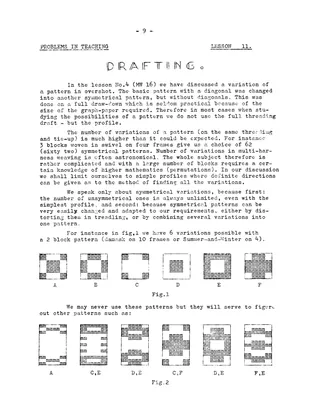
Lesson 11 in the Master Weaver series 'Problems in Teaching' explains how to use profile drafts to find all the symmetrical variations of a block pattern instead of working on a full draw-down. It uses a two-block Bronson lace threading as the worked example, deriving variations A through H by replacing blocks with tabby, reversing blocks, or combining both blocks. A table gives treadling directions and pick counts for each variation, and the lesson ends by pointing to the next lesson, which covers three-block patterns.
Problems in Teaching 12 - Drafting
Master Weaver, March 1956
Article · 2 pages · weaving drafts
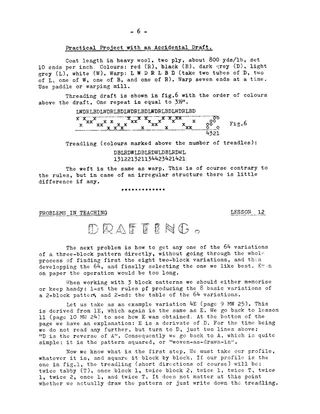
Lesson 12 of the Master Weaver series 'Problems in Teaching' on drafting block patterns. It explains how to derive one of the 64 variations of a three-block pattern directly from a profile, using the rules for two-block variations and the table of 64 variations, with a worked example (variation 4E) and treadling directions. It is preceded by a short practical project for a multicolour wool coat length, with a colour-striped warp, a four-shaft threading draft and treadling.
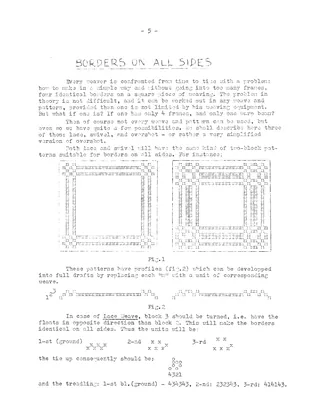
Borders on All Sides
Master Weaver, January 1953
Article · 3 pages · weaving drafts
An article from Master Weaver (No. 7, January 1953) on weaving identical borders on all four sides of a square piece using only four shafts and one warp beam. It gives profile and unit drafts, tie-ups and treadlings for lace weave and swivel, then discusses a simplified single-block overshot (spot-weave) on three shafts with a fourth shaft carrying colored pattern warp for vertical borders. A complete project draft is included with color, sleying, treadling and loom tips. The last page begins a short 'Weaving Terminology' item quoting remarks from Mary M. Atwater on vague technical terms.
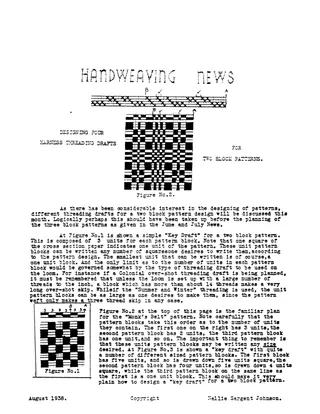
Handweaving News (August 1938): Designing Four Harness Threading Drafts for Two Block Patterns
Periodical · 3 pages · weaving drafts
An August 1938 Handweaving News article by Nellie Sargent Johnson on designing four-harness threading drafts for two-block patterns from a simple 'key draft' on cross-section paper. It shows how one key draft can be turned into Colonial overshot threadings using only the 1&2 and 3&4 blocks, and into M's and O's threadings, with the Monk's Belt plan as the main example. It covers unit sizes, repeats and centers, tie-up, weaving order, and the origin of the M's and O's name, with eight figures of drafts and drawdowns.
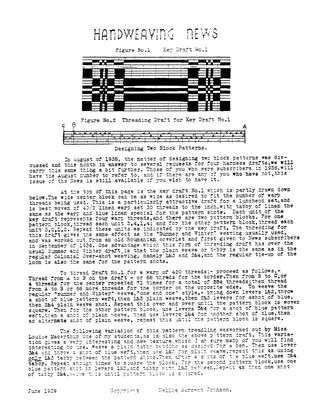
Handweaving News (June 1939): Designing Two Block Patterns
Periodical · 3 pages · weaving drafts
A June 1939 Handweaving News article by Nellie Sargent Johnson on designing two-block patterns for four-harness looms, continuing a discussion from August 1938. It gives key drafts and threading drafts in Colonial overshot, Summer and Winter, and Single M's and O's, with warp counts of 420 threads, border and center unit instructions, and treadling directions. Designs by her students (Louise MacArthur, Beatrice Carruthers, Lillian Cowley) are included, along with suggestions for linen and mercerized cotton yarns.
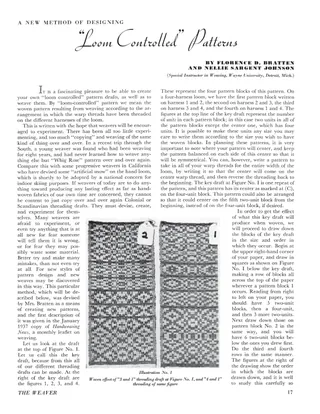
Loom Controlled Patterns
Article · 6 pages · weaving drafts
An article describing a method for designing "loom controlled" patterns on a four-harness loom, starting from a key draft of pattern blocks and units that is drawn down on paper to preview the effect. The key draft is then converted into threadings such as 3 and 1 (crackle), 4 and 1, 5 and 1, 6 and 1, 7 and 1, overshot, and summer and winter on six harnesses. Block threading orders are given, along with photographs of woven samples and several key and threading drafts. The authors urge weavers to experiment rather than copy traditional drafts.
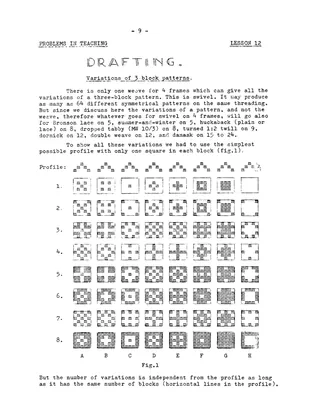
Problems in Teaching 12 - Drafting Variations of 3 block patterns
Master Weaver, January 1956
Article · 2 pages · weaving drafts
Lesson 12 of the 'Problems in Teaching' series in Master Weaver, on drafting variations of three-block patterns. It explains that a simple profile with one square per block yields 64 symmetrical variations for three blocks (8 for two, 1024 for four), regardless of weave structure. It shows how to build the variations from a grid (Fig. 1) and works a practical example (variation 5F) on a profile in Fig. 2. It notes that weaves producing two-sided patterns, such as summer and winter, need only 32 samples.
Practical Weaving Suggestions, Vol. IV, No. 1: The Profile System of Writing Drafts
Periodical · 12 pages · weaving drafts
An issue of Lily Mills' Practical Weaving Suggestions explaining the profile system of writing weaving drafts, in which each block of a pattern is reduced to a single unit on a row of graph paper. It shows how to draw down a pattern on paper from the profile and how one 2-block design can be woven in five techniques: patch pattern overshot, summer and winter, Bronson lace weave, M's and O's, and 8-harness damask. Each technique has unit threadings, weaving plans, texture notes, and Lily yarn suggestions with sett. The last page is a Lily yarn advertisement.
Swatch Page - The Profile Draft
Minnesota Weaver, May 1978
Article · 3 pages · weaving drafts
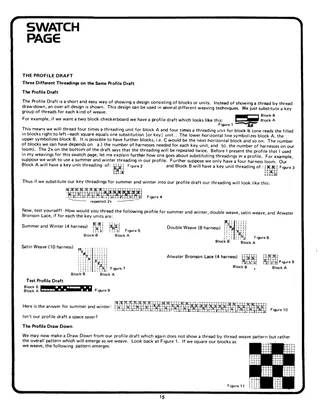
A Swatch Page column from the Minnesota Weaver explaining the profile draft, a shorthand for showing block designs in which a key threading unit is substituted for each block. It works through substitution for summer and winter, gives a test exercise covering double weave, satin weave and Atwater Bronson lace, and explains the profile draw-down. It then presents three woven samples from one profile: a summer and winter pillow, a double weave crib coverlet or hanging, and a linen satin (damask) table runner, with warp, weft, sett, size and references for each, plus a bibliography.
Master Weaver, No. 25 (January 1956)
Periodical · 13 pages · weaving drafts
Issue No. 25 (January 1956) of Master Weaver, a bi-monthly bulletin from Z-Handicrafts, Fulford, Quebec. It proposes graded standards (Apprentice, Journeyman, Junior Master, Senior Master) for weavers and teachers, with sample requirements and a jury system. It continues with an article on multi-block turned swivel, explaining how to count blocks and frames and work out threading, tie-up and treadling for several patterns, including a 3D variant. Further sections cover a drafting lesson on variations of 3-block patterns and an article on mixing crackle and diamond twill in one draft, with a table cloth project.
Modern Patterns in Traditional Weaves
Master Weaver, October 1952
Article · 4 pages · weaving drafts
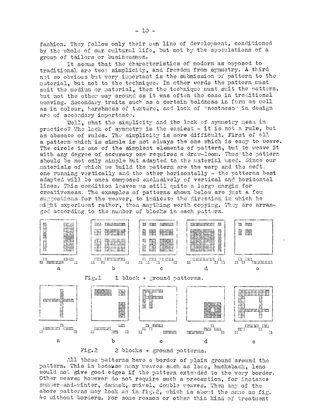
An article from Master Weaver arguing that handweavers can design modern, simple, asymmetrical block patterns within traditional unit weaves such as summer and winter, turned twill (dimity), huckaback, lace weaves and double weaves. It presents sample patterns of 1 to 9 blocks plus ground, each with a profile draft, and explains how to convert a profile into a full threading draft by calculating units per block from total ends and sett. Worked examples cover summer-and-winter napkins and a 45 by 45 inch bridge table cover in 1:2 turned twill, with tie-up and treadling notes.
Practical Weaving Suggestions, Vol. XXVIII: Planned Weaving for the Handweaver's Wardrobe
Periodical · 12 pages · weaving drafts
A reprinted issue of Lily Mills' Practical Weaving Suggestions bulletin explaining the profile system of writing weaving drafts, devised by Helen L. Allen and presented with Osma Gallinger. It contrasts long drafts written with harness numbers against short profiles in which blocks are reduced to units on design rows, and shows how to draw down a pattern on paper and rearrange units to refine a design. The second half applies one 2-row profile to five two-block techniques: patch (on opposite) pattern, Summer and Winter, Bronson lace weave, M's and O's, and 8-harness damask. Each technique gets unit threadings, a weaving plan, texture notes, and Lily yarn suggestions for coarse and fine versions. The last page advertises Lily hand weaving yarns.
Problems in Teaching 9 - Drafting
Master Weaver, July 1955
Article · 2 pages · weaving drafts
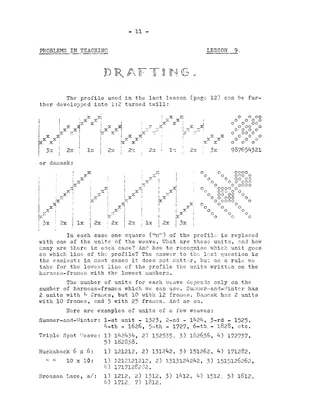
Lesson 9 in the Master Weaver series "Problems in Teaching," on converting a design profile into a threading draft. It explains how each profile square is replaced by one or more weave units, with lists of unit threadings for summer and winter, triple spot, huckaback, Bronson lace, dimity, dornick and damask. Worked examples show how to scale the number of units per square to fit a given warp width and sett, with condensed threading drafts.
Handweaving News (October 1941): 8 Block Pattern for 10 Harness "Summer and Winter"
Periodical · 3 pages · weaving drafts
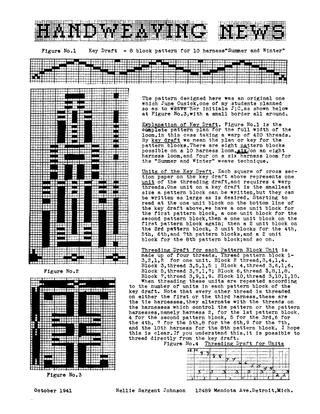
A three-page October 1941 Handweaving News issue by Nellie Sargent Johnson on designing eight-block Summer and Winter patterns for a 10-harness loom. It explains the key draft, the four-thread threading units for each pattern block, and the tie and pattern harnesses. It then shows how to vary the design by combining blocks into verticals, horizontals, checkerboards and stepped combinations (Figures 5-15). It also covers solid borders and weaving with several colors, and offers a sampler and photographs for sale.
Swatch Page - Crackle Weave
Article · 2 pages · weaving drafts
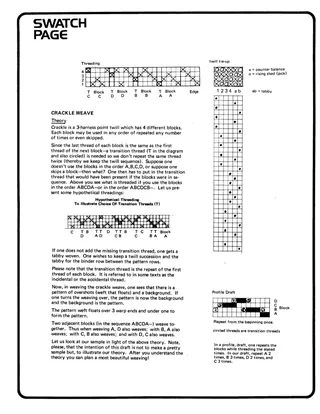
A two-page swatch page from the Minnesota Weaver explaining crackle weave as a 4-block, 3-harness point twill structure. It covers transition threads, which blocks weave together, a profile draft and a 4-shaft threading and tie-up for jack and counterbalance looms. Two sample grids are included, one with block treadling and tabby and one with random treadling, along with materials (10/2 cotton warp, Rya wool pattern weft), sett, uses, notes and a short bibliography.
Bronson Lace
Master Weaver, November 1960
Article · 3 pages · weaving drafts
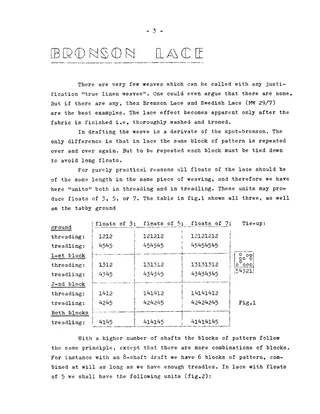
A short article from Master Weaver explaining Bronson Lace, a linen-friendly weave derived from spot Bronson in which the same pattern block repeats and is tied down to avoid long floats. It gives threading and treadling units for floats of 3, 5 and 7, extends the principle to 8 shafts with 6 pattern blocks, and discusses the number of possible block combinations and patterns. It also walks through designing a pattern from a draw-down and profile to a threading, treadling and tie-up, and notes practical issues such as sett and sagging warp ends.
Crackle Weave, Part 1: Designing with Blocks and Motifs
Ralph E. Griswold · April 30, 2004
Web Doc · 3 pages · weaving drafts
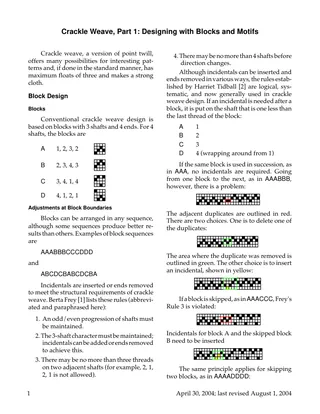
A short article by Ralph Griswold on designing crackle weave, a version of point twill, using blocks and motifs. It gives the four-shaft block threadings (A-D), the rules of Berta Frey and Harriet Tidball for inserting incidentals or deleting ends at block boundaries, and extends the approach to six or more shafts. It also presents a motif-along-a-path approach to design, illustrated with drawdowns, and ends with a large sample pattern image.
Design Sequences: Meandering Strings
Ralph E. Griswold · May 7, 2002
Web Doc · 3 pages · weaving drafts
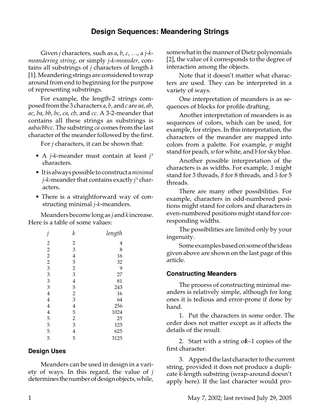
A short article by Ralph Griswold on using j-k-meandering strings, sequences containing every substring of length k over j characters, as a source of design sequences. It gives a table of minimal meander lengths, a step-by-step method for constructing them with a worked 3-2 example, and suggests interpreting the characters as profile-draft blocks, stripe colors, or thread widths. The last page shows profile drafts for mirrored 3-2 and 3-3 meanders and striped color sequences from 3-3, 3-4 and 4-3 meanders.
Handweaving News (February 1940): Designing "Crackle" Weave Patterns
Periodical · 3 pages · weaving drafts
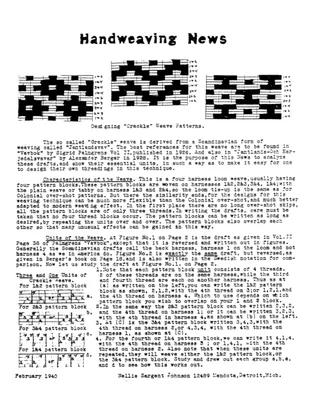
A three-page instructional article from February 1940 by Nellie Sargent Johnson on designing crackle weave threadings for four harnesses. It explains the weave's Scandinavian (Jamtlandsvav) origins, the four overlapping pattern blocks (1&2, 2&3, 3&4, 1&4) built from three- and four-thread units, and how to draw down and key-draft them. It also covers building twill, herringbone and rose-path orders, repeating unit blocks, and the tie-up, including the Structo loom, with threading drafts, drawdowns and key drafts.
Handweaving News (July 1938): Designing Over-Shot Threading Drafts
Periodical · 4 pages · weaving drafts
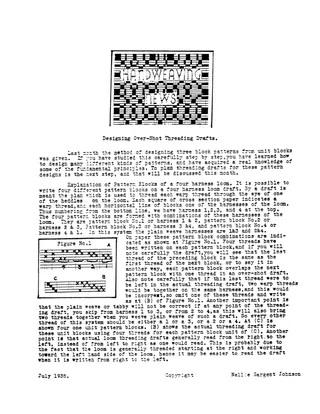
A July 1938 installment by Nellie Sargent Johnson in Handweaving News on turning unit-block pattern designs into actual four-harness overshot threading drafts. It explains the four pattern blocks (1&2, 2&3, 3&4, 4&1), how adjacent blocks overlap by one thread, keeping plain-weave alternation correct, and breaking up long skips with single threads or shorter blocks. It also covers weaving as drawn, loom tie-up for treadle and jack looms, weaving on opposites, accidentals, and fitting a draft to a given number of warp threads. A page of figures gives the key draft and threading drafts Nos. 3-9.
Handweaving News (June 1942): Designing Four Block Over-shot Patterns
Periodical · 3 pages · weaving drafts
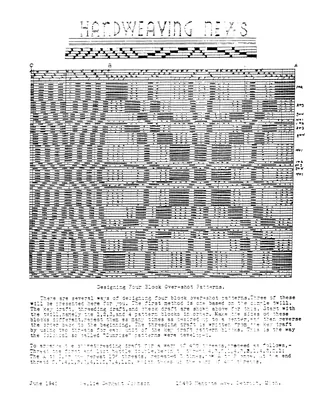
A three-page article in Handweaving News on three methods of designing four-block overshot patterns. The first builds the threading from a simple twill order of blocks (the colonial 'Sunrise' patterns), the second uses a herringbone block order (1,2,3,4,3,2), and the third designs 'on opposites' with paired blocks. Each method includes key, threading and check drafts, with warp-count instructions for 400- and 420-thread warps and suggestions for uses such as runners, bags and towels.
Symmetry with Independent Blocks
Allan Wentink · 2004
Web Doc · 3 pages · weaving drafts
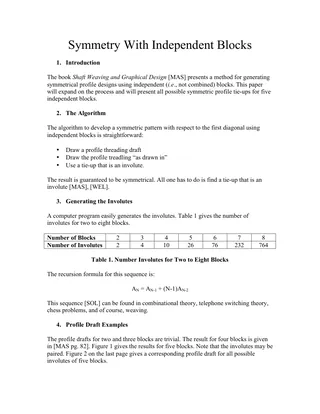
A short mathematical paper expanding on a method from Masson and Roussel's Shaft Weaving and Graphical Design for making symmetrical profile designs with independent blocks. It explains that a profile threading, a treadling "as drawn in", and an involute tie-up together give a symmetric result. It tabulates the number of involutes for two to eight blocks, with the recursion formula, and illustrates all 26 involutes for five blocks. A second figure gives the corresponding profile drafts.
Analysis 4
Master Weaver, March 1957
Article · 2 pages · weaving drafts
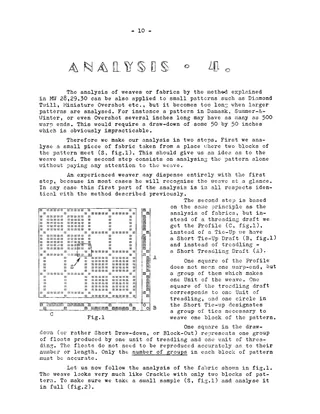
Fourth and final lesson in a series on analyzing woven fabrics, from the Master Weaver newsletter. It explains a two-step method for large patterns: first analyze a small sample to identify the weave, then reduce the pattern to a profile draft, short tie-up, and short treadling draft. A worked example of a two-block fabric that resembles Crackle turns out to be Summer-and-Winter woven Crackle-style, and the full threading and treadling are reconstructed from the profile.
Double Weaves - Multi-Block Patterns
Master Weaver, September 1953
Article · 4 pages · weaving drafts
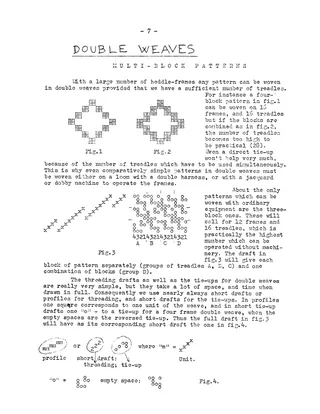
An article from Master Weaver on designing multi-block double weave patterns. It explains the frame and treadle limits (three blocks on 12 frames and 16 treadles), the use of profiles and short drafts, and how to work out warp ends per profile square. It also covers double weaves with twill layers (1:2, 2:1, 2:2) and combinations of tabby with twill or basket in different blocks, illustrated by threading and tie-up drafts on every page.
A Mathematical Weaver's Notes and Guide to: Shaft Weaving and Graph Design by Olivier Masson and Francois Roussel
Anne Wells · June 2000
Web Doc · 60 pages
Anne Wells's June 2000 study notes for the English translation of Olivier Masson and Francois Roussel's book Shaft Weaving and Graph Design. Part One summarizes the whole book and rates each section's relevance to weavers. Part Two gives chapter-by-chapter notes that explain the mathematics (functions, relations, matrices, the fabric formula F = TR o TU-1 o T) in plainer terms. The notes cover transformation bases (amalgamation, telescoping, digitizing) and the design methods of contexturizing: the block method and drafting on a network.
Multi-Block Turned Swivel
Master Weaver, January 1956
Article · 5 pages · weaving drafts
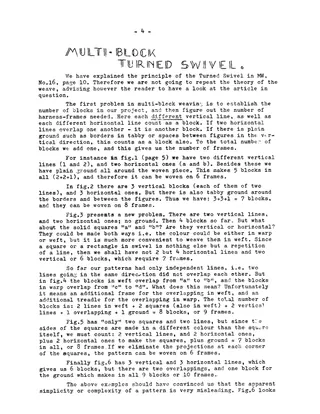
An article from Master Weaver (No. 25, January 1956) on multi-block turned swivel, a technique for weaving colored figures on a tabby ground. It explains how to count the blocks in a design and derive the number of harness frames needed, using six example patterns. It then works out profiles, threading drafts, tie-ups and treadling for three examples on 6 to 8 frames. It closes with a section on adapting turned swivel to three-dimensional weaving with heavy yarns, plus notes on heddles, reed choice and sleying.
Shuttle-Craft Bulletin, Vol. XXIX, No. 4 (April 1952)
Periodical · 17 pages · weaving drafts
April 1952 issue of the Handweaver's Bulletin (Portfolio Edition) from the Shuttle Craft Guild, devoted to formal draperies woven in warp-pattern, where both base and pattern threads are in the warp and the weft is plain tabby. It describes two drapery projects (an 8-harness one with a vine and geometric pattern, and a 4-harness two-block one) with warp colors, yarns, sleying, threading profiles and treadling directions. It also includes the Guild's handweaver's calculation sheet for yarn, costing and labor, with an article explaining its use, and a list of sources of looms, yarns and publications for weavers.
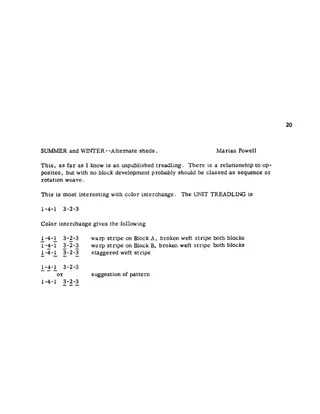
Summer and Winter Study of Des Moines Weavers Guild
Marian Powell · c. 1959
Monograph · 39 pages · weaving drafts
A study booklet prepared by Marian Powell for the Des Moines Weavers Guild on Summer and Winter weave. It covers unit structure, blocks and profiles, tie-ups, and weft variations. It then gives many treadling methods, including classical, six-shot rotation, one-and-one, four-and-four, two-and-two, opposites, huck, sequence and twill textures, lace texture, honeycomb, 3D, eyelashes, novelty, polychrome, part polly and spider webs. It closes with warp suggestions and references to sources such as Shuttlecraft Bulletins (Tidball), Master Weaver (Zelinski) and Frey's Designing and Drafting for Handweavers.
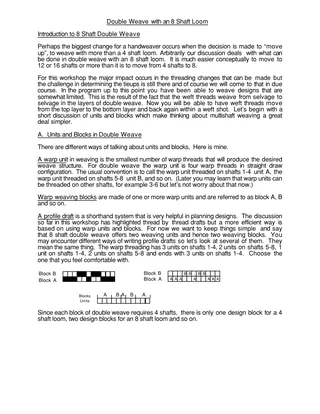
Double Weave Workshop Notes: Double Weave with an Eight-Shaft Loom
Web Doc · 13 pages · weaving drafts
Workshop notes by Paul O'Connor on double weave for an eight-shaft loom, continuing from a four-shaft double weave program. They explain warp units, blocks and profile drafts, then the window and checkerboard designs with threadings, tieups and treadling, followed by color-planning exercises. Further sections cover skeleton tieups for 10- and 12-treadle looms, twill structures (1/3, 3/1 and 2/2) in double-width cloth, and four-layer multilayer weaving, ending with an analysis of a Kay Sekimachi monofilament hanging.
Master Weaver, No. 22 (July 1955)
Periodical · 14 pages · weaving drafts
Issue No. 22 (July 1955) of Master Weaver, a bulletin for handweavers published by Z-Handicrafts of Fulford, Quebec. It opens with an essay on colour and design, arguing that creative weaving requires knowledge of the craft, and a short 1844 quotation from Clinton G. Gilroy. The technical sections explain transcribing four- and five-frame drafts onto eight frames (Bronson, summer and winter, rep, diamond twill, waffle), give a chart of basic eight-frame tie-ups A to W, and present Lesson 9 on drafting from profiles using units of weaves such as summer and winter, huckaback, Bronson lace, dimity, dornick and damask. The last page advertises individual weaving lessons at Z-Handicrafts.
Patterns in 1:2 Twill on Four Shafts
Master Weaver, September 1958
Article · 3 pages · weaving drafts
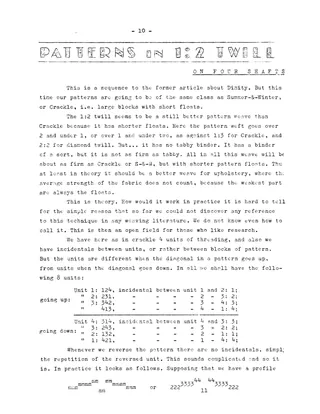
A short article from Master Weaver describing a pattern weave based on 1:2 twill on four shafts, which gives large blocks like crackle or summer and winter but with shorter floats and no tabby binder. It lists eight threading units (going up and going down) with incidentals between blocks, shows how to convert a block profile into a threading draft, and includes a draft with its drawdown. It then gives five treadling applications: overlapping-block pattern weave, half-tone pattern, woven-as-drawn-in, a four-colour bound weave for rugs, and texture weaves. The author notes that no reference to this technique could be found in the weaving literature.
Shuttle-Craft Bulletin, Vol. XXX, No. 3 (March 1953)
Periodical · 14 pages · weaving drafts
March 1953 issue of the Shuttle Craft Guild Handweaver's Bulletin, continuing the introduction of Atwater Lace (formerly Bronson Lace) begun in February. It explains profile drafts and shortened draft forms, then covers warp settings, suitable materials, tension problems and variations such as weft-pattern, tie-down shed color effects, dukagang inlay and warp rep. It gives treadling directions for table mats, luncheon squares and wool baby blankets on 4 to 10 harnesses, including Helen Macdonald's Oak Leaf luncheon square.
Shuttle-Craft Bulletin, Vol. XXXI, No. 2 (February 1954)
Periodical · 20 pages · weaving drafts
February 1954 issue of the Shuttle Craft Guild Handweaver's Bulletin (Portfolio Edition), devoted to the unit weaves developed by Dr William G. Bateman of Seattle. It explains the Unit system of drafting and Profile drafts, then covers the Boulevard Weave and the Bateman Blend (Atwin) Weave with threading units, tie-ups, treadling rotations and texture variations such as hollow squares and Dukagang effects. A closing section explains how to adapt the weaves for 4 and 6 harnesses, and the Tag Weave is promised for the March issue.
Shuttle-Craft Bulletin, Vol. XXXII, No. 6 (June 1955)
Periodical · 24 pages · weaving drafts
June 1955 issue of the Shuttle Craft Guild Handweaver's Bulletin (Portfolio Edition). It covers the Spot (Spot Bronson) weave for linens, with drafts taken from old Colonial American homespun linens, including a four-harness diamond, a five-harness diamond and a dresser scarf/table cloth pattern. It continues the 'Understanding Drafts' series with an explanation of the Profile draft and 16 substitution units (keys) for unit weaves such as Summer and Winter, Atwater-Bronson lace, Bateman weaves and Warp Pattern weaves. It ends with a four-harness modern linen dress fabric variation of the Spot Weave. The Portfolio pages carry fabric samples and a Colonial Heritage 'Distaff' card.
Tissue Weaves - Broché
Master Weaver, September 1961
Article · 4 pages · weaving drafts
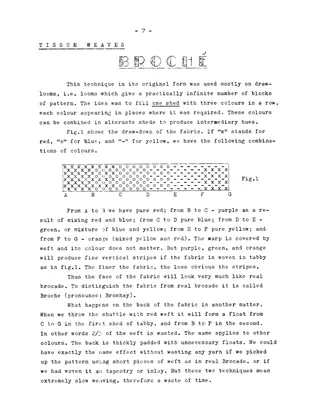
An article from the Master Weaver series on tissue weaves, explaining Broché, a technique for imitating brocade on multi-shaft looms by laying several colours of weft in a single shed. It covers colour mixing from adjacent pure colours, the wasted floats on the back, tabby and twill grounds (1:2, 1:3, 3:1), and tie-ups and treadlings for 8-shaft drafts with profile drafts. It also discusses locked wefts as in Full Swivel to increase the number of blocks, and ends with a practical upholstery project with warp, sett and colour details.
Warp & Weft, Vol. 12, No. 2 (February 1959)
February 1959
Periodical · 8 pages · weaving drafts
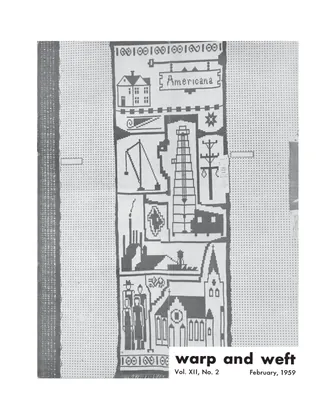
February 1959 issue of Warp and Weft, a monthly handweaving bulletin from Robin & Russ Handweavers of Santa Barbara, California. The main feature is a huckaback lace project with tie-up, threading and profile drafts, a treadling for the sample swatch, warp and weft yarns, reed sleying, uses (drapery, table linens, place mats) and a cost breakdown per yard. Other items are an editor's column, a note on a Finnweave cover piece, an article on the Mt. Lassen Weavers Guild of northern California, classified ads, and supplier and loom advertisements.
Analysis of Patterns
Master Weaver, April 1952
Article · 4 pages · weaving drafts
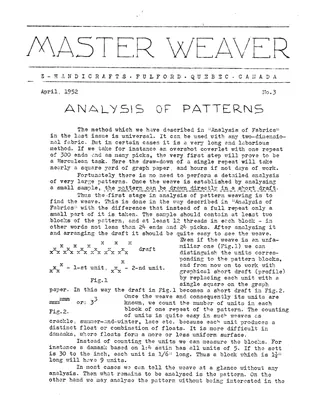
An article from Master Weaver (April 1952) on analyzing woven pattern structure without drawing down a full repeat. It explains how to identify the weave from a small sample, convert units to graphical short drafts (profiles), and develop them into full drafts for lace and summer-and-winter. For overshot, all-over spot, and crackle, which lack distinct units, it describes numerical short drafts and how to read float lengths and positions from a sample.
The Classical M's and O's Weave
Article · 10 pages · weaving drafts
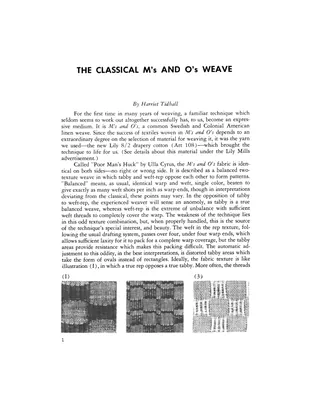
An article by Harriet Tidball on the classical four-harness M's and O's weave, a balanced two-texture structure in which tabby and weft-rep oppose each other. It covers the character of the fabric, yarn selection (especially soft Lily 8/2 cotton versus hard-twisted linen), and the history of the technique in Swedish, Finnish and early American sources. It explains the A and B threading units, tie-up, profile drafts and the four main pattern arrangements. It also surveys published drafts from Worst, Perheentupa, Cyrus, Ingers and others, and ends by proposing a 1,4 threading to add true tabby stripes.
Master Weaver, No. 24 (November 1955)
Periodical · 13 pages · weaving drafts
Issue No. 24 (November 1955) of Master Weaver, a bi-monthly bulletin for handweavers published by Z-Handicrafts of Fulford, Quebec. It opens with an editorial on the need for standards and guild certification of weaving teachers and of hand-woven goods sold to tourists, including four categories of handwoven goods. A long article explains crackle weave: threading units, incidental heddles, three treadling methods, upholstery variations, and a practical linen project. The issue also has a drafting lesson on profile variations for two-block patterns (Bronson lace) and an item on converting weft-face drafts into warp-face patterns.
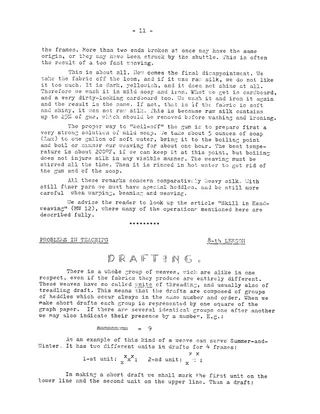
Problems in Teaching 8 - Drafting
Master Weaver, May 1955
Article · 2 pages · weaving drafts
A two-page lesson from the Master Weaver series "Problems in Teaching," on drafting with units of threading. It explains graphical short drafts (profiles) and numerical short drafts, using Summer-and-Winter as the example, then shows one profile developed into Bronson Lace and Huckaback lace. The first page also closes an earlier article with advice on boiling off the gum from raw silk fabric after weaving.
Shuttle-Craft Bulletin, Vol. XXXI, No. 3 (March 1954)
Periodical · 20 pages · weaving drafts
March 1954 issue of the Shuttle Craft Guild Handweaver's Bulletin, Portfolio Edition. It continues Dr William G. Bateman's series on unit weaves with an article on the Tag weaves (5-, 7- and 9-thread extensions of the Boulevard technique), giving profile drafts, tie-ups and treadling rotations for four sample textures. It also continues The Bateman Blend with treadling directions for "hollow square" and "alternated ovals" yardages, plus an all-over texture weave on the Atwater Lace tie-up. The issue closes with reviews of Mary Meigs Atwater's Byways in Hand-Weaving and Louis Cheskin's Color-Tune Your Home, and Harriet Tidball's notes on looms.
Shuttle-Craft Bulletin, Vol. XXXIII, No. 11 (November 1956)
Periodical · 23 pages · weaving drafts
November 1956 issue of the Shuttle Craft Guild Handweaver's Bulletin (Portfolio Edition), edited by Harriet Tidball. It covers reading drafts from woven overshot profiles, drafts on "opposite" blocks, designing borders for overshot patterns, and a Kentucky colonial coverlet given in two forms: a simplified interpretation and the true, unconventional draft with threading schedule. The newsletter announces changes to the Guild and Bulletin for 1957 (move to San Francisco, Boris Veren as business manager) and reports on the disposition of Mrs. Atwater's collections. The portfolio page describes samples from the coverlet and early American prepared flax and handspun linen.
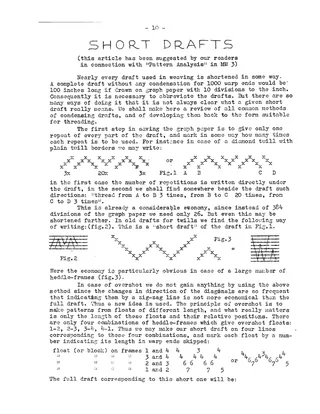
Short Drafts
Master Weaver, June 1952
Article · 3 pages · weaving drafts
An article reviewing the common methods of condensing weaving drafts and expanding them back into full threading drafts. It covers repeat markings for twills, short drafts for overshot that record float lengths, spot weaves, and unit-based weaves (summer and winter, crackle, lace, huckaback, turned twills, double weave) using profile or numerical short drafts. Diagrams illustrate each method, and the article ends with a pointer to Mary Atwater's Shuttlecraft Book.
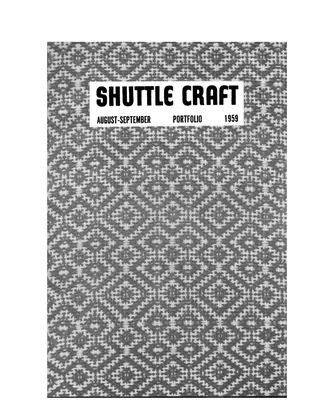
Shuttle-Craft Bulletin (August-September 1959)
Periodical · 39 pages · weaving drafts
Combined August-September 1959 issue (Vol. XXXVI, No. 8-9) of the Shuttle Craft Guild's monthly bulletin, Portfolio edition with woven samples. It opens with the editors' letter and the start of Evelyn Longard's series on the profile draft, converting one profile draft into twill-block, overshot and patch-pattern (on opposites) samples. Mary E. Black's main article explores Mary Atwater's shadow weave with drafts and numbered experiments on 4, 6 and 8 shafts, using Atwater's and Tidball's drafts. The issue also gives Christmas project ideas (warp-pattern tree tablecloth, afghan, cards, woven trees, mittens, bed jacket, skirt, stoles), a reprinted Atwater girdle/belt draft, a Boris Veren book column on Hooper, Murphy and Gilroy, and advertisements.
112 documents found