Textile Documents › Topic: Machine lace
248 documents found
Sort: 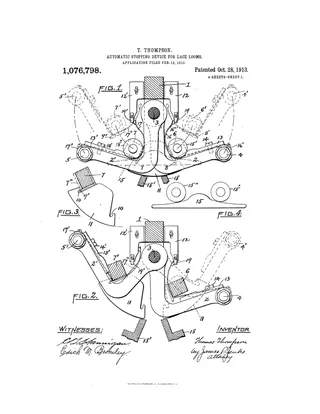
Automatic Stopping Device for Lace Looms, US Patent No. 1076798
Patent · 8 pages
US Patent No. 1,076,798, granted October 28, 1913 to Thomas Thompson of Pawtucket, Rhode Island, for an automatic stopping device for "lever" or "go through" lace looms. The device uses the loom frame as part of an open electric circuit. When a displaced shuttle forces the catch bars out of engagement, spring contacts close the circuit and an electromagnet trips the shipper to move the belt to the loose pulley. A variant breaks the fuses of a motor-driven loom. The scan has four sheets of mechanical drawings (Figs. 1-15) followed by the specification and four claims.
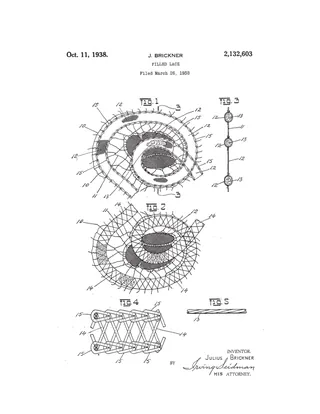
Filled Lace, US Patent No. 2132603
Patent · 2 pages
US Patent 2,132,603, granted to Julius Brickner of Brooklyn and assigned to C. H. D. Robbins Co., describes a filled lace with a raised, relief design. A heavy filling thread is laid behind the dense areas of a machine-made lace and held by cross stitches on the back and parallel chain stitches on the face. The text covers the manufacturing method, which sews the lace to a buckram backing, stitches in the filler, and then heat-disintegrates the buckram, and it gives one claim. Two pages, with a drawing sheet of five figures.
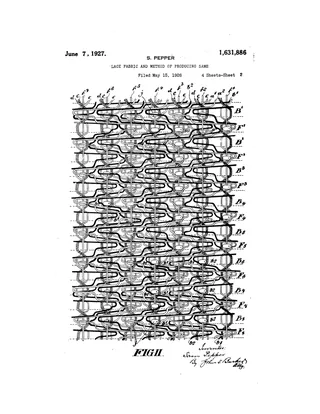
Lace Fabric and Method of Producing Same, US Patent No. 1631886
Patent · 9 pages · weaving drafts
US Patent 1,631,886, granted to Sam Pepper of Nottingham, England, on June 7, 1927 (filed May 15, 1926; British priority May 12, 1925). It describes double-fronted lace fabrics, with relief on both faces, made on twist lace machines of the curtain type. The method uses two guide bars carrying the basic warp and spool threads, together with pickers or jacks. Intermediate bars carry right- and reverse-twisted threads to produce wickering, plaited pillars, combination nips, filet net and fast-edged scallops. The text covers the machine threading, a table of quarter motions for the bars and pickers, picker-sequence formulas for filet, and six claims. Four sheets of drawings show the machine and the thread movements.
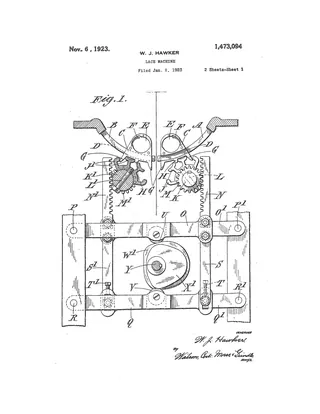
Lace Machine, US Patent No. 1473094
Patent · 5 pages
US Patent No. 1,473,094, granted 6 November 1923 to William John Hawker of Chard, England, assignor to Gifford Fox & Company Limited, for an improved lace machine. It describes a three-toed bobbin carriage for plain net lace machines, driven through the comb bars by two oscillating locker members with T-shaped or undercut teeth. The locker members are worked by racks, pinions and parallel levers from cams on a single shaft. The document includes two sheets of drawings (Figs. 1 and 2), the specification and five claims.
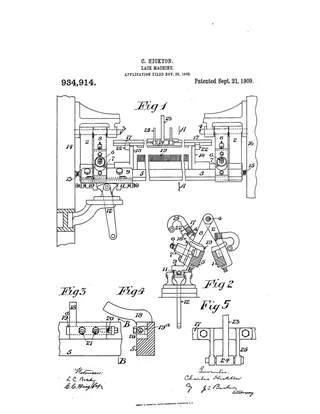
Lace Machine, US Patent No. 934914
Patent · 3 pages
US Patent No. 934,914, granted 21 September 1909 to Charles Hickton of Long Eaton, England, for an improvement to twist lace machines of the Levers and go-through types. The invention moves the catch bar endwise together with the comb bar, so the lace carriages are not bent or strained when traversed to equalize yarn lengths drawn from the bobbins. It has one sheet of drawings (Figs. 1-5), a specification and five claims.
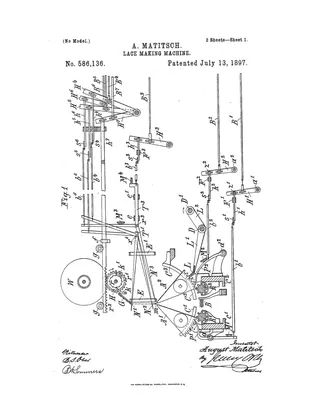
Lace Making Machine, US Patent No. 586136
Patent · 2 pages
Two sheets of drawings from US Patent No. 586,136, granted July 13, 1897, for a lace making machine invented by August Matitsch. Sheet 1 shows the machine's mechanism (levers, cams, gears, flywheel, rods and pivoting arms) with reference numerals. Sheet 2 has diagrams of the lace fabric with numbered threads 1-12 and interlaced thread paths, plus diagrams of thread movements. The scan contains only the drawing sheets, with no specification text.
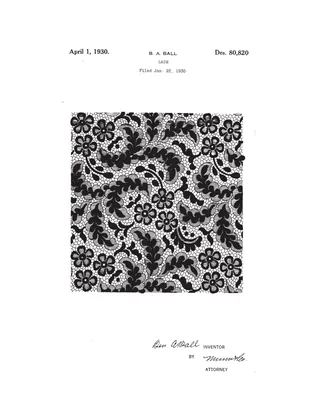
Lace, US Patent No. D0080820
Patent · 2 pages
US design patent D80,820, granted April 1, 1930 to Ben A. Ball of Pawtucket, Rhode Island, assignor to American Textile Company, Inc. The first page is a drawing of a square lace design with floral motifs and scrollwork on a fine hexagonal mesh ground. The second page gives the brief specification and a single claim for the ornamental design for lace.
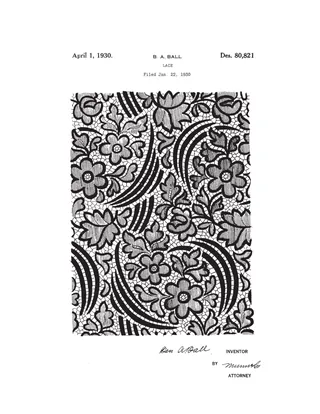
Lace, US Patent No. D0080821
Patent · 2 pages
US design patent D80,821 for a lace pattern, granted April 1, 1930 to Ben A. Ball of Pawtucket, Rhode Island, assignor to American Textile Company, Inc. The drawing shows an all-over design of stylized flowers, leaves and sweeping curved stripes on a fine mesh ground. The text is a short specification with a single claim for the ornamental design, filed January 22, 1930, with a term of 7 years.
Lace, US Patent No. D0080825
Patent · 2 pages
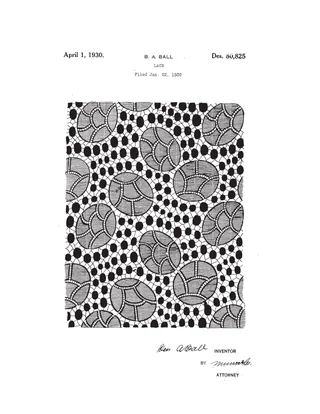
US design patent D80,825, granted April 1, 1930 to Ben A. Ball of Pawtucket, Rhode Island, assignor to American Textile Company, Inc. It consists of a drawing sheet showing an ornamental lace design of interlocking outlined circles and ovals with hatched shading, solid dots and a net-like ground, plus a one-claim specification for the design.
Lace, US Patent No. D0080826
Patent · 2 pages
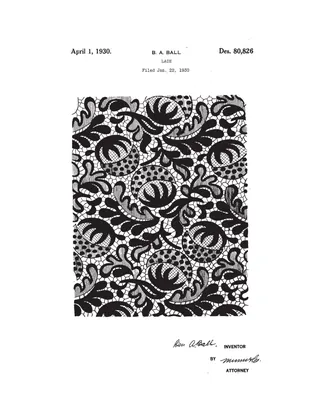
US design patent Des. 80,826, granted April 1, 1930 to Ben A. Ball of Pawtucket, Rhode Island, assignor to American Textile Company, Inc. The first page is a drawing of an ornamental lace design with repeating scrolling leaf and paisley-like motifs on a mesh ground. The second page gives the brief specification and a single claim for the ornamental design for lace.
Lace, US Patent No. D0081018
Patent · 2 pages
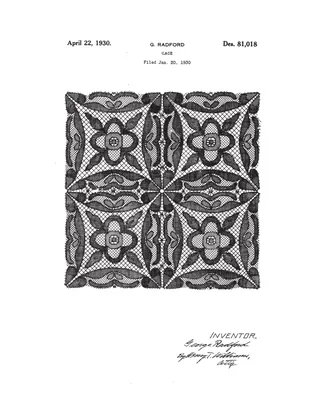
US design patent Des. 81,018 for a lace pattern, granted to George Radford of Apponaug, Rhode Island, on April 22, 1930 (filed January 20, 1930). It is assigned to Richmond Lace Works, Inc. The drawing shows a square, four-fold symmetric motif of stylized flowers, leaves and scrolls on a crosshatched ground. The text is a brief specification claiming the ornamental design for lace as shown.
Lace, US Patent No. D0081884
Patent · 2 pages
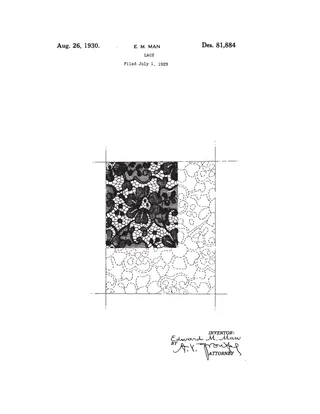
US design patent D81,884 for an ornamental lace design, granted to Edward M. Man of Philadelphia on August 26, 1930 and assigned to John Bromley & Sons, Inc. The first page is a drawing of a floral and scroll lace panel on a mesh ground, with a dotted continuation showing how the unit extends. The second page holds the short specification and a single claim for the design as shown. The patent has a term of 3½ years.
Lace, US Patent No. D0082543
Patent · 2 pages
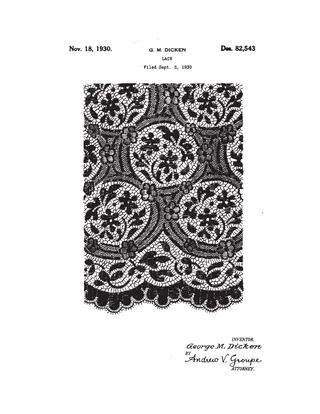
US design patent Des. 82,543 for an ornamental lace design, granted November 18, 1930 to George M. Dicken of Hulmeville, Pennsylvania, assignor to John Bromley & Sons, Inc. The first page is the patent drawing of a rectangular lace panel with a mesh ground, dense symmetrical floral and scroll motifs, and a scalloped lower border. The second page has the brief specification and a single claim for the design, noting that the upper edge merges into a straight selvage.
Pattern Mechanism for Twist Lace Machines, US Patent No. 1647798
Patent · 5 pages
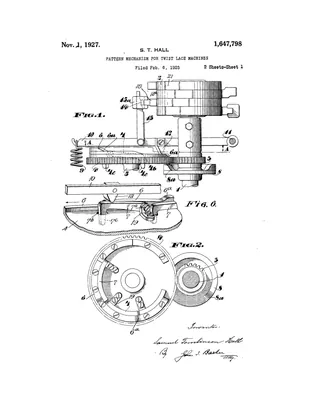
US Patent 1,647,798, granted 1 November 1927 to Samuel Tomlinson Hall of West Bridgford, England, assignor to Henry Gamble. It describes a pattern mechanism that lets a plain net curtain twist lace machine produce patterned fabric by adding guide bars that shog extra patterning threads. The mechanism uses a stepped cam wheel, gravity-pivoted arms, a stepped rod and a bell-crank lever to shog quickly so the thread does not foul the bobbin carriages. The document has two sheets of drawings, the specification and ten claims.
Stop Mechanism for Lace Weaving Machines, US Patent No. 1335218
Patent · 5 pages
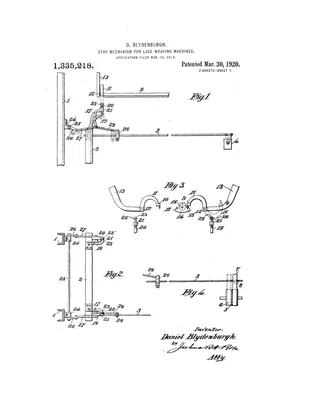
US Patent No. 1,335,218, granted 30 March 1920 to Daniel Blydenburgh of South Attleboro, Massachusetts, for an attachment that automatically stops a lace weaving machine when a catch bar flies out of engagement with the bobbin carriages (a "smash"). The mechanism uses bell crank levers, vertically sliding pins, an oscillatory shaft and links connected to the machine's shift rod, and it prevents restarting until the catch bars are back in place. A modified form mounts on the existing rail bracket bolt without altering the machine. The patent has two sheets of drawings (Figs. 1-6), a specification and six claims.
Torchon Lace
Article · 1 page
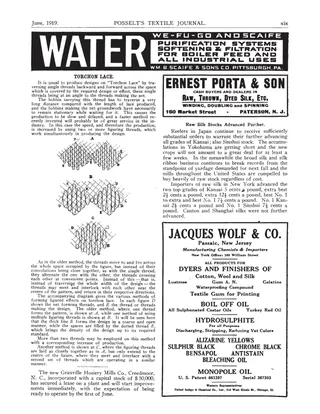
A short 1919 trade-journal article on machine production of figured torchon lace. It contrasts the older method, in which a single figuring thread traverses the design while the net-forming bobbins wait, with a newer faster method using two or more figuring threads that work simultaneously. Three diagrams (A, B, C) show the single-thread method and two multiple-thread arrangements.
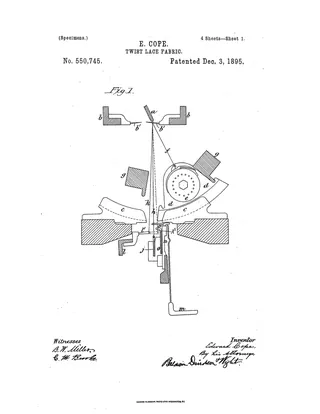
Twist Lace fabric, US Patent No. 550745
Patent · 6 pages
US Patent No. 550,745, granted December 3, 1895 to Edward Cope of New Basford, Nottingham, England, for a twist-lace fabric. It describes modifying an ordinary twist-lace machine so that the same spool threads cover both faces, giving a double-faced lace with a pattern on each side. The patent has four sheets of drawings showing the machine and thread movements, followed by the specification and three claims.
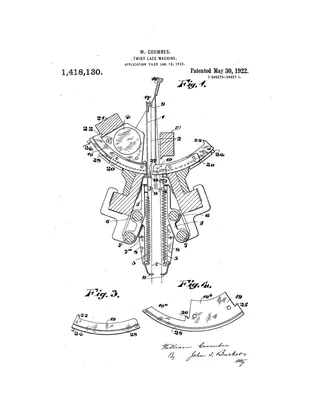
Twist Lace Machine, US Patent No. 1418130
Patent · 10 pages
US Patent No. 1,418,130, granted 30 May 1922 to William Coombes of Hyson Green, Nottingham, for improvements to twist lace machines. The invention lays the weft threads beneath the carriages and then lifts them into the shed. The machine therefore does not need to slow or stop during the weft traverse, and it can run faster. The document has five sheets of drawings (Figs. 1-12) and a specification with twelve claims. It describes pivoted weft carriers, deflecting angle bars, shock-absorbing catches, thread-retaining members, and a variant with tube-guided carriers and weft lifters.
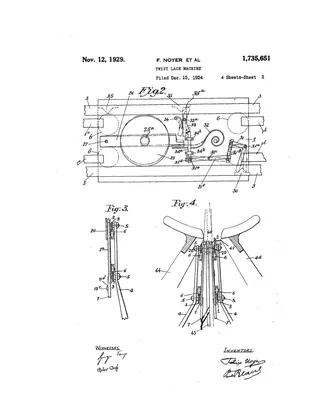
Twist Lace Machine, US Patent No. 1735651
Patent · 8 pages
US Patent 1,735,651, granted 12 November 1929 to Félix Noyer and Paul Pilard of Calais, France, for a twist lace machine of the "Levers" or "go-through" type. It describes a needle-carrying bar with levers, cams and a thread-assist wheel that carries a supplementary weft thread across the full width of the fabric, so tulle and lace machines can produce a tighter, woven-like net or lace. The document has four sheets of patent drawings (Figs. 1-13), a written specification and seven claims.
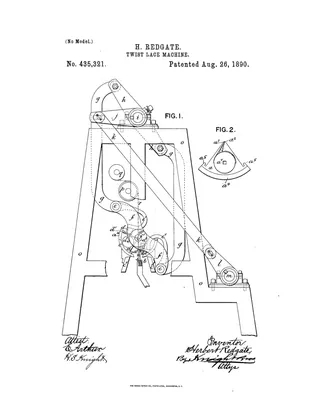
Twist Lace machine, US Patent No. 435321
Patent · 3 pages
US patent specification for a twist-lace machine invented by Herbert Redgate of Nottingham, England. It replaces the usual points and point-bars with a triangular bobbin carriage on whose top the lace is formed, moved by catch-bars, levers and combs. The document has a drawing sheet (end elevation and carriage face view), the specification, and four claims.
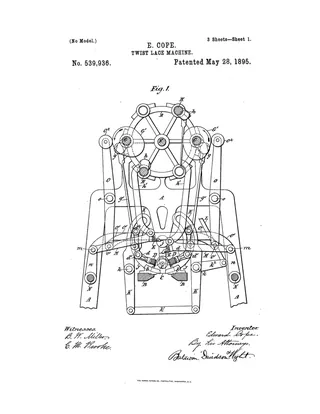
Twist Lace Machine, US Patent No. 539936
Patent · 5 pages
US Patent No. 539,936, granted May 28, 1895 to Edward Cope of Nottingham, England, for improvements to twist-lace machines. The three sheets of drawings show the machine in section, the central gearing and a modified arrangement. The specification describes how the catch bars and point bars are driven from shafts arranged in a circle around a central shaft through intermittent gearing, and it ends with seven claims.
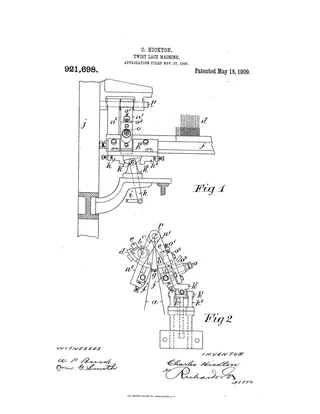
Twist Lace Machine, US Patent No. 921698
Patent · 3 pages
US Patent No. 921,698, granted May 18, 1909 to Charles Hickton of Long Eaton, England, for an improvement to twist lace machines of the levers and go-through type. The back comb bar is mounted on rocking arms and can be shifted sideways one gait by a T-ended lever and cam-shaped blocks, so bobbins and carriages can be traversed along the machine. This evens out yarn use across all bobbins, giving longer lengths of lace per set of full bobbins and saving time and material. The scan has a drawing sheet (Figs. 1 and 2) and the printed specification with one claim.
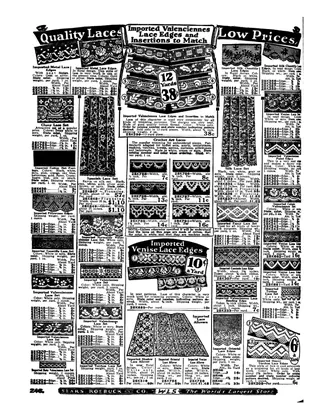
Advertisement for lace
Ephemera · 1 page
A single page from a 1927 Sears, Roebuck & Co. catalog (page 246) advertising machine-made laces and trimmings sold by the yard. It lists catalog numbers, widths, colors and prices for edgings, insertions, flouncings and allovers, including Valenciennes, Torchon, Cluny, Venise, Chantilly, Tenerife, Oriental and metal laces. Useful as a record of commercial lace types and prices in the 1920s.
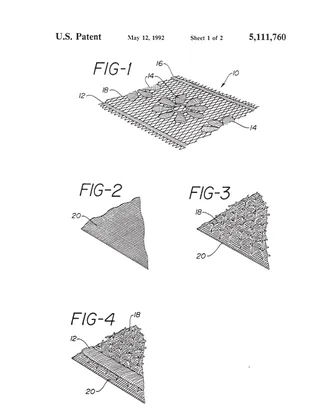
Double-Embroidered Lace, US Patent No. 5111760
Patent · 10 pages
US Patent No. 5,111,760, granted to Raymond G. Garzone Jr., describes a double-embroidered lace made on a Schiffli embroidery machine. A first design in metallic or lustrous yarn (gold, silver, pearlescent) is embroidered onto a ground fabric, and a second design in a different yarn is embroidered over it, so the metallic yarn shows through. The ground fabric may be soluble and dissolved away. The scan has a USPTO database print-out with abstract, claims, cited patents and description, followed by the patent's cover page, two drawing sheets (Figs. 1-6), and the printed patent text with six claims.
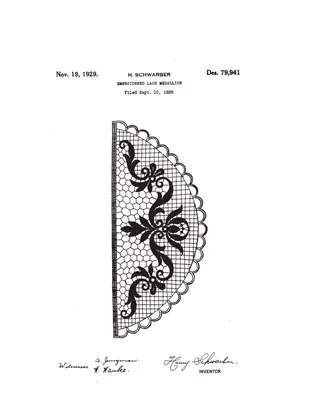
Embroidered Lace Medallion, US Patent No. D0079941
Patent · 2 pages
US design patent D79,941, granted 19 November 1929 to Henry Schwarber of Weehawken, New Jersey, for an ornamental design for an embroidered lace medallion. The first page is the patent drawing, a semicircular medallion with a fine net-like ground, scalloped outer edge and embroidered motifs. The second page gives the brief specification and a single claim for the design as shown.
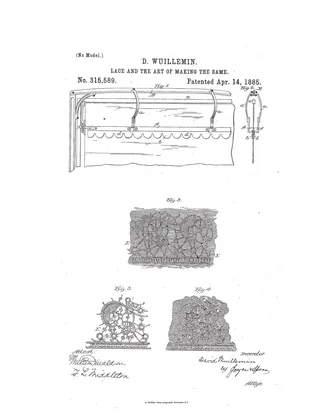
Lace and the Art of Making the Same, US Patent No. 315589
Patent · 3 pages
US Patent No. 315,589, granted April 14, 1885 to David Wuillemin of Courgevaux, Fribourg, Switzerland, for a method of making lace with an embroidery machine. Figures are embroidered with understitches and connecting threads on a soluble ground such as paper, and the ground is then dissolved to leave only the thread lace. The patent includes a drawing sheet of the ground-holding frame and embroidery figures, a specification, and two claims.
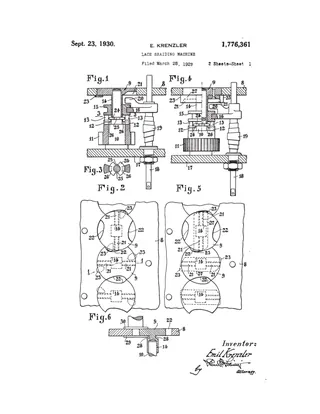
Lace Braiding Machine, US Patent No. 1776361
Patent · 2 pages
Two sheets of drawings for US Patent No. 1,776,361, a lace braiding machine invented by Emil Krenzler, filed March 28, 1929 and dated September 23, 1930. Sheet 1 shows sectional elevations and plan views (Figs. 1-6) of the machine, including a bobbin carrier head. Sheet 2 shows Figs. 7-9 with end and sectional views of the spool-like bobbin carriers. Only the drawings and reference numerals are present; the patent specification text is not included.
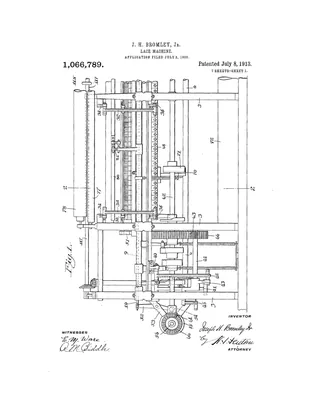
Lace Machine, US Patent No. 1066789
Patent · 18 pages
US Patent No. 1,066,789, granted July 8, 1913 to Joseph H. Bromley Jr. of Philadelphia for a lace machine. It covers a machine in which thread-controlling jacks move one set of threads between and around another set, unlike ordinary weaving. The jacks are selected independently by electric solenoid circuits controlled by a chain of Jacquard cards. The scan has seven sheets of mechanical drawings (Figs. 1-14), followed by the specification and claims.
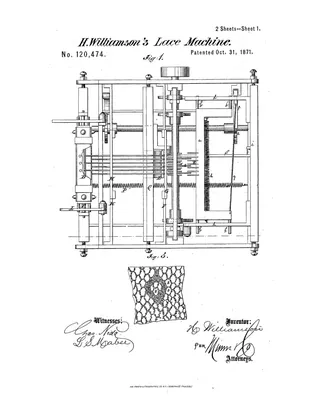
Lace Machine, US Patent No. 120474
Patent · 4 pages
US Patent No. 120,474, granted October 31, 1871 to Henry Williamson of Williamsburg, New York, for an improved lace-knitting (crocheting) machine. The needles work independently of each other and are driven by Jacquard pattern cards or cylinders, while all the thread-guides are mounted on a single guide bar. This replaces the many guide bars of earlier machines and allows wide, non-repeating patterns. The document has two sheets of mechanical drawings and a two-page specification with a single claim.
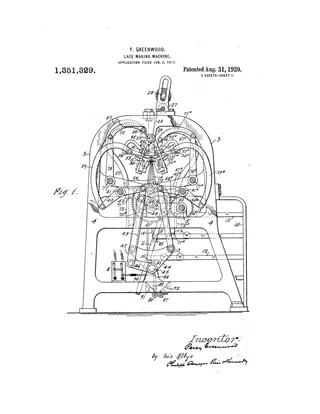
Lace Making Machine, US Patent No. 1351329
Patent · 7 pages
US Patent No. 1,351,329, granted 31 August 1920 to Percy Greenwood of New York (assignor to August A. Follmer) for a lace-making machine, applied for 8 January 1917. The machine is a more compact, accessible version of the Leavers-type machine with a jacquard mechanism. The cam and crank mechanisms driving the point bars and catch bars are moved below the bars and to the sides of the lace-making space. A second feature is an automatic stop that halts the machine when a warp thread breaks. The document has three sheets of mechanical drawings (Figs. 1-6), a detailed specification of the bobbin carriages, catch bars, point bars and cams, and two claims.
Lace Manufactures
Scientific American, 1852
Article · 1 page
A short 1852 note from Scientific American on the machine-made silk lace trade at Nottingham. It reports that manufacturers blame slack trade on French laws that bar English lace from France. It argues that admitting English lace to Paris would affect fashion in France, England and the United States.
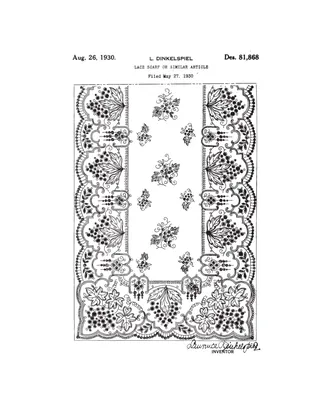
Lace Scarf or Similar Article, US Patent No. D0081868
Patent · 2 pages
US design patent D81,868, granted 26 August 1930 to Lawrence Dinkelspiel of West New York, New Jersey, for the ornamental design of a lace scarf or similar article. The drawing shows one half of a rectangular scarf with a border of stylized grape clusters, leaves, scrolls and beaded edging; the other half repeats it in reverse. The text is a brief specification with a single claim for the design as shown.
Lace, US Patent No. 854619
Patent · 7 pages
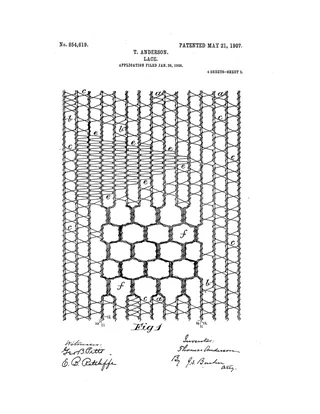
US Patent No. 854,619, granted 21 May 1907 to Thomas Anderson of Glasgow, Scotland, for an improved twist lace fabric made on a curtain lace machine. Each pillar of the fabric has three longitudinal threads (a warp thread, a thick spool thread and a thin spool thread) bound by a bobbin thread. This gives cross net, Swiss, combination, muslin, clothing and openwork effects. The text covers the machine's thread-guide bars, cams, jacks/pickers and jacquards, and ends with three claims. Four sheets of drawings show the lace diagrams, machine elevations, cams and picker movements.
Lace, US Patent No. D0080822
Patent · 2 pages
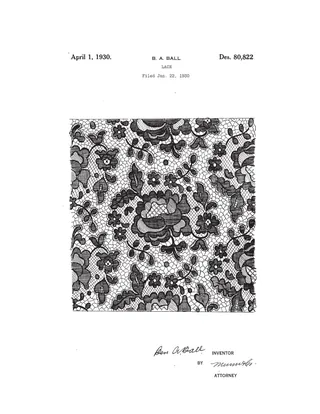
US design patent Des. 80,822, granted April 1, 1930 to Ben A. Ball of Pawtucket, Rhode Island, assignor to American Textile Company, Inc. It consists of a drawing sheet showing a square lace design with a dense mesh ground and stylized floral motifs, leaves and tendrils, plus a one-page specification with a single claim for the ornamental design. The term of the patent is 7 years.
Lace, US Patent No. D0080823
Patent · 2 pages
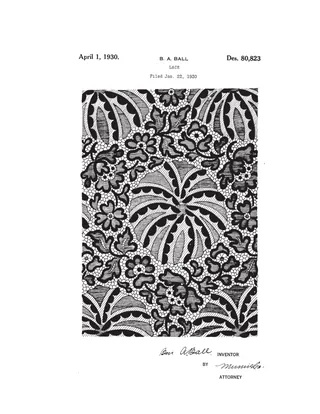
US design patent Des. 80,823, granted April 1, 1930 to Ben A. Ball of Pawtucket, Rhode Island, assignor to American Textile Company, Inc. It claims the ornamental design for a lace fabric. The drawing shows a rectangular panel with a symmetrical floral and leaf motif on a mesh ground. The text is a brief specification with a single claim and no technical weaving details.
Lace, US Patent No. D0080824
Patent · 2 pages
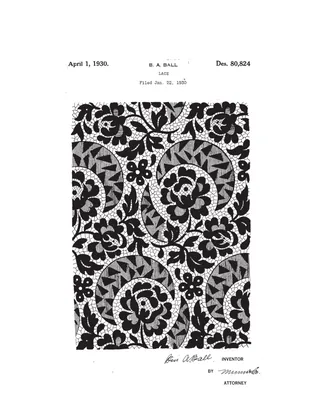
US design patent D80,824 for an ornamental lace design, granted April 1, 1930 to Ben A. Ball of Pawtucket, Rhode Island, assignor to American Textile Company, Inc. The first page is a drawing of the design: a dense mosaic-like ground with large stylized floral motifs, rosettes, scrolling leaves and arched panels. The second page gives the brief specification and a single claim for the ornamental design, with a 7-year term.
Lace-Making
Manufacturer and Builder, 1870
Article · 1 page
A short 1870 magazine piece on machine lace-making in England, centered on Nottingham. It reports that over 660 patents were taken out in ninety years, mostly by working-men, and that much machinery was discarded as obsolete. It recounts Charles Babbage's visit to a Nottingham lace machine and argues that inventors would benefit from theoretical mechanical education. The data come from remarks at a British Association meeting in Nottingham.
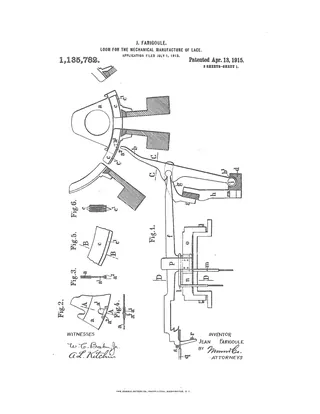
Loom for the Mechanical Manufacture of Lace, US Patent No. 1135782
Patent · 5 pages
US Patent No. 1,135,782, granted 13 April 1915 to Jean Farigoule of Paris, for improvements to a jacquard-controlled loom that makes lace mechanically. The improvements are guide plates on the carriage notches, combs that keep the selecting levers and pull rods from rubbing against each other, and fixed locking bars for the pull rods. The scan has two sheets of drawings (Figs. 1-11), a specification explaining the mechanism, and six claims.
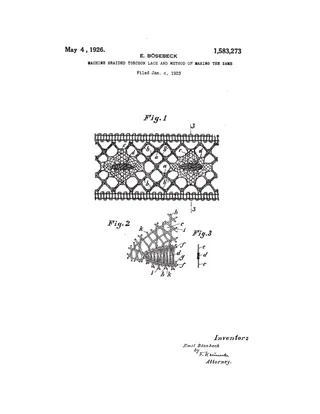
Machine Braided Torchon Lace and Method of Making the Same, US Patent No. 1583273
Patent · 3 pages
US Patent 1,583,273, granted 4 May 1926 to Emil Bösebeck of Barmen, Germany, and assigned to Max Henkels of New York. It describes a method for making leaflet motifs in machine-braided torchon lace on a single-thread lace braiding machine. Three sets of small-meshed ground threads are interbraided (lengthwise skeleton threads, transverse threads, and a meandering filling thread) so the leaflet stands out in relief on both sides and is firmly joined to the ground all around. The patent consists of a drawing sheet (Figs. 1-3) and the specification with two claims.

Method of Coating Bobbin Net or Lace with Copper
Scientific American, 1847
Article · 1 page
A short 1847 Scientific American note in the "Curious Arts" column describing how to coat bobbin net or lace with copper by electroplating. The net is stretched on a copper wire and brushed with powdered plumbago (black lead). It is then placed between copper plates connected to a galvanic battery. The coated lace can be gilded or silvered and used for small articles such as jewel cases.
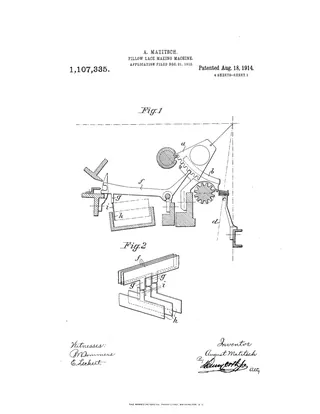
Pillow Lace Making Machine, US Patent No. 1107335
Patent · 8 pages · weaving drafts
US Patent No. 1,107,335, granted 18 August 1914 to August Matitsch of Nottingham, England, for an improvement to pillow lace making machines built on the Matitsch system. It describes using substitute pickers and substitute lifting bars so that wide lace can be made from a small number of lifting bars. Lace of multiple width replaces the adjoining border and selvage of narrow strips with a connecting pattern. The document has four sheets of drawings, including diagrammatic grid plans of picker and lifting-bar arrangements, followed by the specification and three claims.
Process of Producing Sculptured Lace from Flat Lace, US Patent No. 3498737
Patent · 7 pages
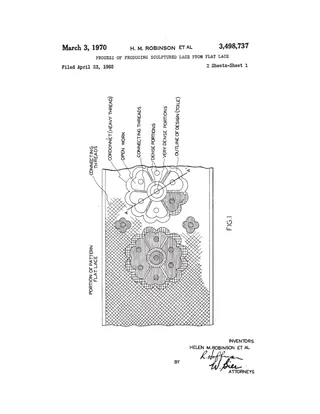
US Patent 3,498,737 (granted 3 March 1970) describes a chemical finishing process that turns machine-made flat lace into sculptured, relief-textured lace. Cellulosic lace is soaked in sodium hydroxide so that open areas shrink more than dense areas, then crosslinked with dimethylol ethylcarbamate for dimensional stability and easy care. The document includes two sheets of drawings, a detailed description of the process steps, nine examples with toughness, growth and shrinkage test data, and two claims.
Process of Weaving, US Patent No. 1942152
Patent · 5 pages
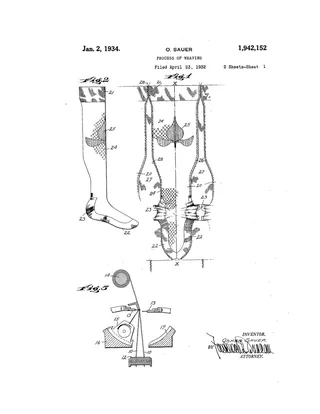
US Patent 1,942,152 (granted Jan. 2, 1934) by Oskar Sauer of Philadelphia describes a method of weaving fabrics with a three-dimensional surface, aimed mainly at woven lace hosiery blanks. Fullness at the heel is formed on a Levers lace machine by selectively suppressing warp shifting and interrupting take-up, with warp threads drawn from individual beams. The text covers the machine's operation, blanks with selvages separated by lacer threads, an alternative on an ordinary loom with partial shuttle throws, and four method claims. It includes two sheets of drawings of the stocking blank, mesh fabric and machine details.
Der Streifentüll [Striped Tulle]
Article · 2 pages · German
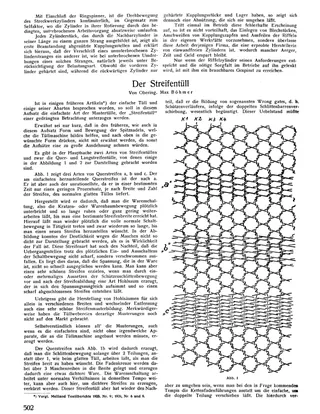
German-language technical article by Max Böhmer on striped tulle (Streifentüll), the simplest kind of patterned tulle made on tulle (bobbinet) machines. It describes three ways of making cross stripes (by interrupting take-up, by shifting the carriage over two divisions, and by continuous carriage-bar shifting) and longitudinal stripes made with an additional guide bar. It also covers zigzag and wave stripes, rectangles, and the use of many guide bars with a Jacquard device for small floral motifs, with a note on uses for curtains and stores. Illustrated with two diagrams of the mesh structures.
Twist Lace Fabric, US Patent No. 1053478
Patent · 5 pages · weaving drafts
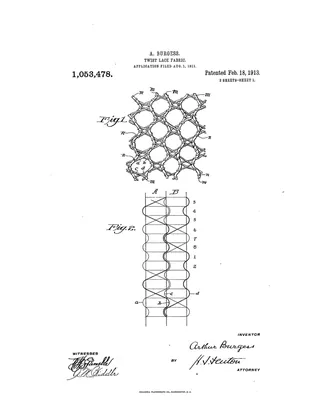
US Patent No. 1,053,478, granted 18 February 1913 to Arthur Burgess of Philadelphia, for a twist lace fabric with a new cross-net ground made on the Nottingham lace curtain machine. The new net has a double crossing of warp threads in each mesh, which turns the usual diamond-shaped cable net mesh into a nearly round one. The specification describes modified guide-bar cams, jacquard-controlled jacks, and the eight-motion gait sequence of the warp bars, and ends with two claims. Two sheets of drawings show the fabric, the thread course diagram, the machine layout and the cams.
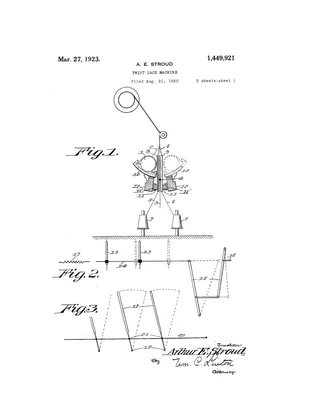
Twist Lace Machine, US Patent No. 1449921
Patent · 4 pages
US Patent No. 1,449,921, granted March 27, 1923 to Arthur Edward Stroud of Long Eaton, England, for improvements to twist lace machines. The invention adds weft thread carriers, in tube or needle form, that lay a weft thread between the warp threads and bobbin threads. The specification describes how the carriers are mounted on bars carried by the comb bars and how jacquard-driven levers or pivoting arms actuate them. Two sheets of drawings and two claims are included.
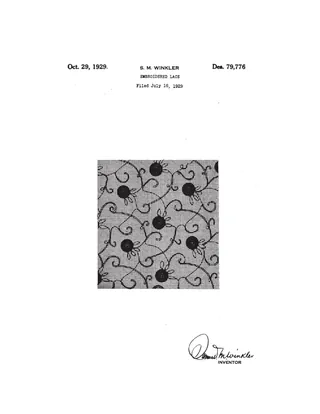
Embroidered Lace, US Patent No. D0079776
Patent · 2 pages
US design patent Des. 79,776, granted 29 October 1929 to Samuel M. Winkler of New York for an ornamental design for embroidered lace. The first page is the patent drawing, a plan view of a scrolling pattern of dark dots connected by looping curved lines on a grid background. The second page is the short specification and single claim for the design as shown, with a term of 3½ years.
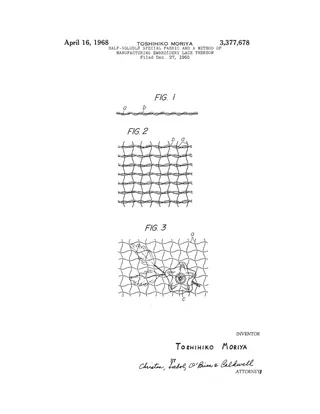
Half-Soluble Special Fabric and a Method of Manufacturing Embroidery Lace Thereon, US Patent No. 3377678
Patent · 3 pages
US Patent 3,377,678 (granted 16 April 1968 to Toshihiko Moriya, assignor to Nihon Vinylon Co., Tokyo) describes a method of making embroidery lace. A fine foundation cloth is woven from hot-water-insoluble yarn (nylon, polyester, silk or cotton, 10-40 denier) combined with hot-water-soluble polyvinyl alcohol or alginic acid yarn. The cloth is embroidered with insoluble thread, then immersed in hot water to dissolve the soluble yarns, leaving a delicate guipure-like lace. The patent includes a drawing sheet with three figures, four worked examples with yarn sizes and dissolving temperatures, and nine claims.
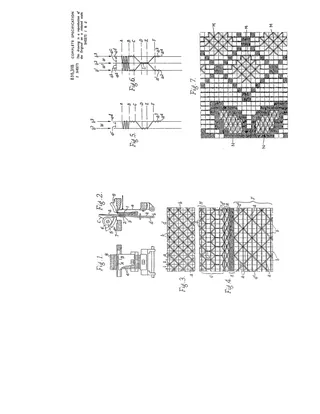
Improvements in Lace Fabric, GB Patent No. GB836318
Patent · 9 pages · weaving drafts
British patent specification GB836318 (filed 1958, published 1 June 1960) by Charles Goodley of Pennsylvania for an improved lace fabric made on a Nottingham curtain machine. The fabric uses warp pillars, double spool threads with dropped ties floated between pillars, bobbin tie threads and a strengthening background net of beam threads. It describes a four-colour drafting system (red, green, yellow, white) that controls how jacquard cards are punched for the jacks, with the claims and drawing sheets showing the machine parts, thread paths and lace pattern grids.
Lace Machine, US Patent No. 1112996
Patent · 18 pages
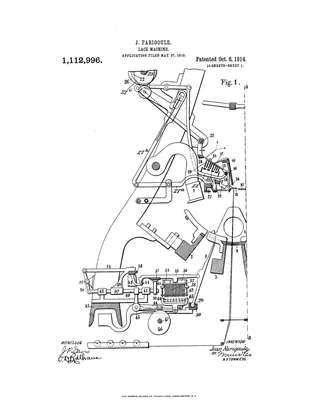
US Patent No. 1,112,996, granted 6 October 1914 to Jean Farigoule of Paris (application filed 27 May 1910), for a lace machine that imitates handmade bobbin lace. Ten sheets of drawings show side elevations, end views, and details of the machine's levers, comb bars, catch bars, needles, and jacquard-operated points. They are followed by the specification and claims. The text describes how the machine crosses bobbin threads and warp (spool) threads in a single motion, controlled by jacquards, to produce patterns such as Point d'Esprit.
248 documents found