Producing a Substitute for Wool from Jute, US Patent No. 6372
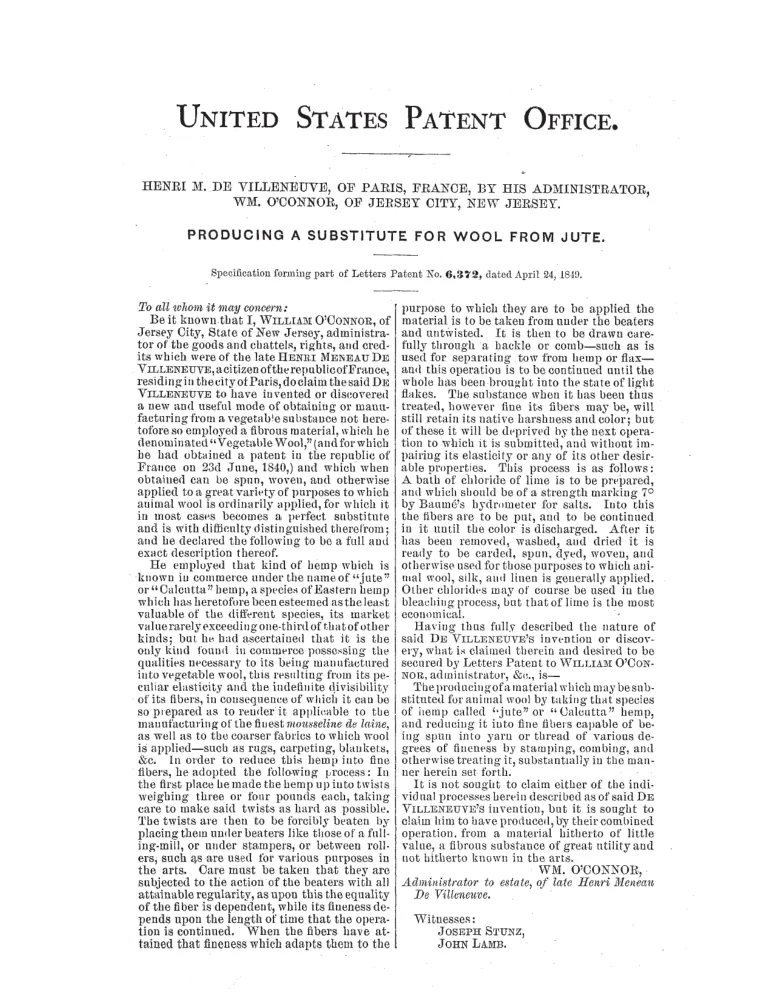
Page 1 of 1, a sample page, at reduced quality. Open the document to read it in full.
US Patent No. 6,372, granted April 24, 1849, for a process of turning jute (Calcutta hemp) into a fibrous "vegetable wool" that can substitute for animal wool. The inventor was Henri Meneau de Villeneuve of Paris, and the patent was taken out by his administrator William O'Connor of Jersey City. The specification describes hard-twisting the hemp, beating it under fulling-mill beaters or rollers, combing it, and bleaching it in a chloride of lime bath. The fiber can then be carded, spun, dyed and woven into fabrics such as mousseline de laine, rugs, carpeting and blankets.
- Type
- Patent
- Date
- April 24, 1849
- Language
- English
- Pages
- 1
(A free account is all you need)
From Ralph Griswold's Digital Archive, delivered by the University of Arizona.
Have missing pages or a better copy of this document, or another document to share? Contributing documents »