Textile Documents › Topic: Tatting
107 documents found
Sort: 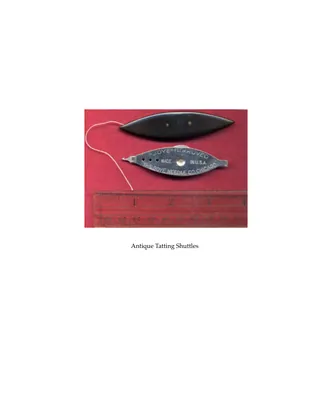
[Antique Tatting Shuttles]
Illustration · 1 page
A single photograph of two antique tatting shuttles laid on a red background beside an inch ruler for scale. The upper shuttle is dark, smooth and boat-shaped with two small brass dots; the lower one is a different style. The only text is the caption "Antique Tatting Shuttles."
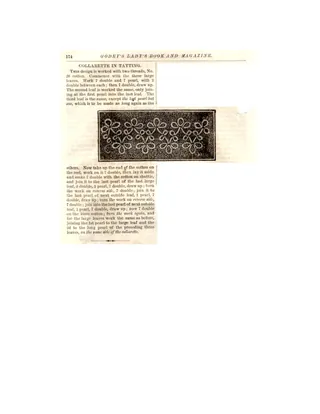
Collarette in Tatting
Godey's Lady's Book and Magazine, August 1872
Article · 1 page
A one-page article from Godey's Lady's Book giving written instructions for tatting a collarette with two threads of No. 20 cotton. It describes working the large leaves in double stitches and picots (pearls), then joining them with smaller leaf motifs. An engraved illustration shows the finished repeating leaf and floral band.
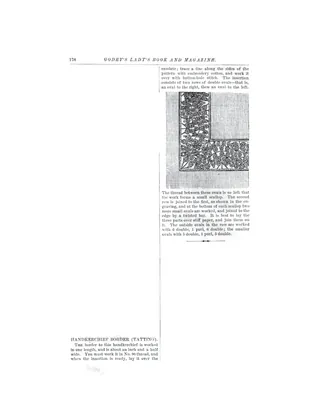
Handkerchief Border (Tatting)
Godey's Lady's Book and Magazine, August 1873
Article · 1 page
A one-page instructional item from Godey's Lady's Book (August 1873) on tatting a handkerchief border and insertion. It describes working double ovals to the right and left, joining the second row to the first, adding small ovals joined by a twisted bar, and gives the double-stitch and purl counts. An engraving shows the floral and vine border with scalloped edging at a handkerchief corner.
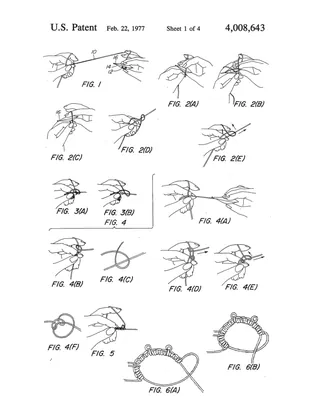
Knotless Tatting, US Patent No. 4008643
Patent · 16 pages
US Patent 4,008,643, "Knotless Tatting," granted to Dora M. Young of Kittery, Maine, on February 22, 1977 (filed November 24, 1975). It describes a tatting method that reduces the number of knots, using reversed double stitches along a single thread with a hooked shuttle. Instructions cover picots, rings, joining rings, ring-and-chain edgings, knotless rings and chains, tatting on a hemstitched edge, and solid work. The scan includes a USPTO web printout, the patent text and four sheets of line drawings showing hand and shuttle positions and finished lace pieces, with two numbered claims.
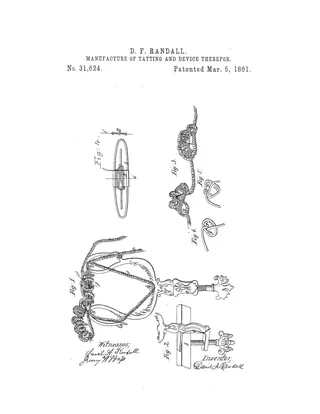
Manufacture of Tatting and Device Therefor, US Patent No. 31624
Patent · 3 pages
US Patent No. 31,624, granted March 5, 1861 to David F. Randall of Hartford, Connecticut, for a tatting frame and a method of making tatting (scalloped trimming for dress). The frame, clamped to a table edge, holds a separate warp thread on pins so both hands can work the shuttle while forming loops. The patent also describes a wire shuttle made in two halves joined by a clasp. It includes a drawing sheet of six figures and a specification comparing the method with the old way of tatting with one thread held on the fingers.
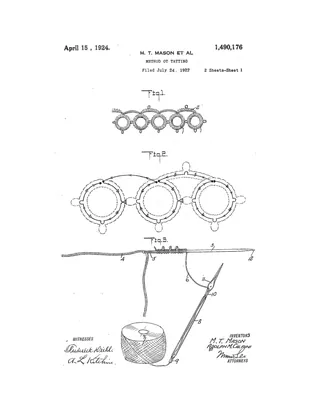
Method of Tatting, US Patent No. 1490176
Patent · 4 pages
US Patent No. 1,490,176, granted April 15, 1924 to Mary T. Mason and Adolph M. Calpini (filed July 24, 1922), for a method of tatting using a needle with an eye, a base thread and a looper tool instead of a shuttle. Thread is taken from a full ball, loops are cast onto the needle and pushed onto the base thread to form rings, arches and picots, with carried threads used for variation. The text describes the steps for a sample pattern and gives five claims. Two drawing sheets illustrate the finished tatting, a construction diagram, and the needle and looper in use.
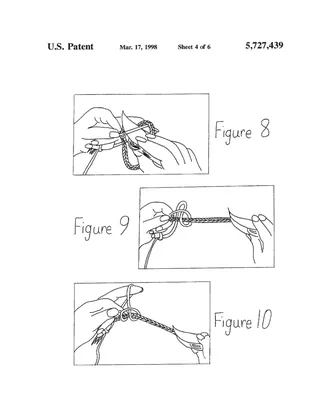
Multiple Bobbin Tatting Shuttle, Method of Tatting and Tatted Articles, US Patent No. 5727439
Patent · 12 pages
US Patent 5,727,439, granted March 17, 1998 to Lauren P. Pelc, for a tatting shuttle that holds multiple thread bobbins between paired planar plates so that three or more colors can be tatted without cutting and tying threads. It includes the abstract, four claims, a description of a method of tatting with two carrier threads plus a working thread, and six sheets of drawings showing the shuttle, hand positions for the knots, and sample tatted chains and rings in three colors. The document is present as both a USPTO database printout (2002) and the patent's printed pages.
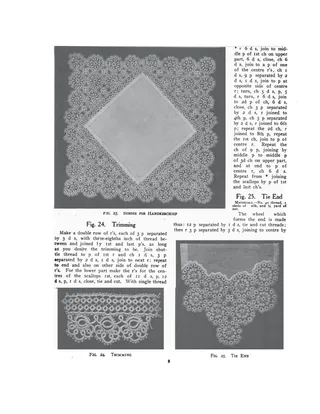
Priscilla Tatting Book No. 1
Monograph · 34 pages
A 1909 instruction book of shuttle tatting edited by Jessie M. De Witt, with selections from The Modern Priscilla plus new designs. It opens with general directions on shuttles, thread, hand positions, rings, picots, joining, chains, Josephine knots and working with shuttle and ball. The rest gives written patterns with photographs for edgings, insertions, doilies, handkerchief borders, collars, yokes, caps, medallions, trimmings and a waist set. It closes with an advertisement for other Priscilla needlework books.
Tatting Edging
Article · 1 page
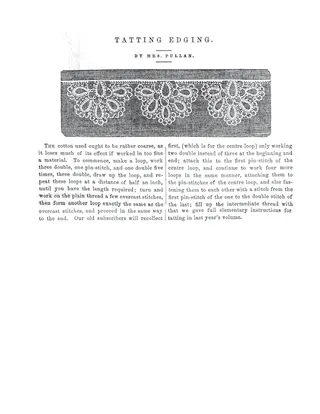
A one-page nineteenth-century magazine pattern for a tatted edging by Mrs. Pullan, with an engraved illustration of three repeated scalloped floral and teardrop motifs. The text gives brief working directions using double stitches, pin-stitches (picots) and overcast stitches, recommends a rather coarse cotton, and refers readers to earlier elementary instructions for tatting.
Tatting: Edgings and Inserts
Monograph · 17 pages
A Victorian pattern booklet of tatting edgings and insertions designed from Greek and Roman lace, published in London in 1861. It opens with notes on materials and rules for the double stitch, pearl loop and a new method of joining that makes tatting firmer. Written instructions with engraved illustrations follow for Scallop, Florentine, Oeillet, Etruscan and Gothic edgings, Venetian and Etruscan insertions and a Venetian border, with thread sizes and crochet headings. It closes with advertisements for the author's other publications, including The Tatting Book.
The Royal Tatting Book
Monograph · 28 pages
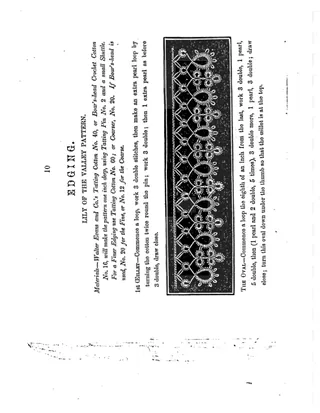
A Victorian pattern book of written instructions for tatting, published in London in 1867 by Mlle. Riego de la Branchardiere. It gives shuttle-and-pin directions for an antimacassar in raised tatting (the Denmark Antimacassar), an oval d'oyley, and several edgings, borders, an insertion and a beaded guipure trimming, with thread and pin sizes for each. Illustrations of the finished lace accompany the patterns, and an advertisement for Walter Evans & Co. thread appears at the end.
The Simple Tatting Book
Monograph · 14 pages
A mid-19th-century English tatting pattern booklet by Mlle Riego de la Branchardiere with written instructions for six tatted designs: the Metternich cravate and edging, Trellis edging, the Irene necktie or lappet, a lace edging and a Vandyke edging. Each pattern lists materials (Boar's-head crochet cotton sizes, tatting pin sizes, shuttle) and gives stitch-by-stitch directions with rosettes, dots, ovals and pearl loops, plus crochet headings. Illustrations show the finished edgings, and the last page advertises the author's other tatting, crochet and knitting books, tatting case and steel tatting pins.
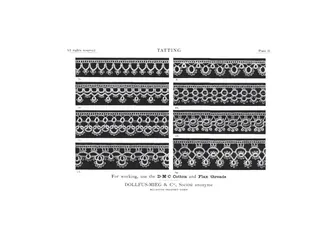
Tatting
Book · 64 pages
A D·M·C Library album on tatting by Th. de Dillmont. It opens with general directions covering the shuttle, winding the thread, hand positions, making double stitches, single picots and Josephine knots, joining motifs, and working with two shuttles. The second part gives row-by-row directions for 38 models on eight plates: galoons, insertions, edgings, medallions, grounds, pieces combined with embroidered net, and edgings sewn to cambric or net foundations. The book ends with D·M·C product and publication lists.
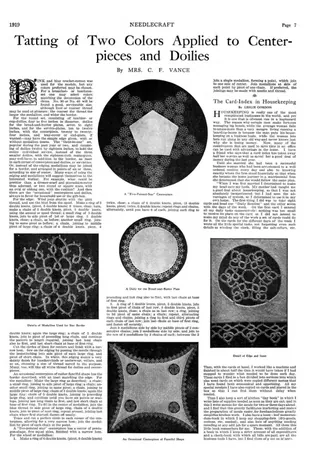
Tatting of Two Colors Applied to Centerpieces and Doilies
Article · 1 page
A 1919 Needlecraft magazine page giving instructions for tatting edgings and medallions worked in two colors (pink and blue crochet cotton) for centerpieces, doilies and breakfast or luncheon sets. It describes sizes of round and 'three-in-one' sets, written directions for the edge, a six-point medallion, and a five-pointed star centerpiece, and is illustrated with photographs of the finished pieces. The page also carries an unrelated housekeeping article, 'The Card-Index in Housekeeping' by Leslie Gordon.
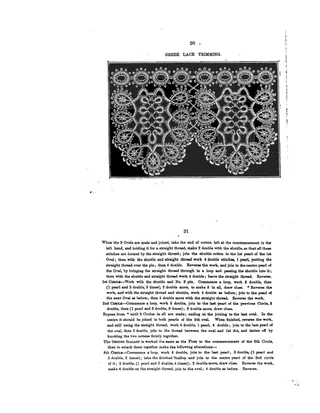
The Complete Tatting Book
Monograph · 18 pages
A Victorian pattern book of tatting designs by Mlle. Riego de la Branchardiere, second edition, published in London. It gives shuttle-and-pin instructions with cotton and pin sizes for a round d'oyley or head-dress, Œillet, Pearl, Gymp and Vandyke edgings, a Corfu lace antimacassar with knotted joining, Greek lace trimming, a Vandyke lappet or cravate, and a beaded Parisian gymp trimming. A closing section explains knotting, the lace wheel and the straight thread. Engravings illustrate the patterns, and the book includes advertisements for the author's other books, Walter Evans & Co. cotton and Rowlands' toiletries.
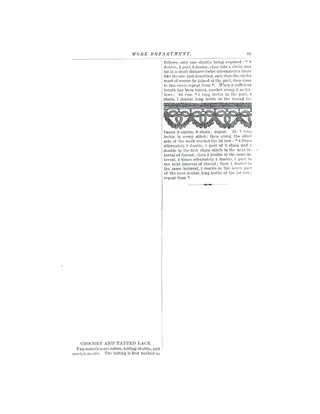
Crochet and Tatted Lace
Godey's Lady's Book and Magazine, July 1874
Article · 1 page
A single-page excerpt from the Work Department of Godey's Lady's Book giving instructions for a lace edging that combines tatting and crochet. Circles are tatted with one shuttle, joined at picots, then worked along both sides with crochet rows of long trebles, chain loops and picots. One illustration shows the scalloped edging.
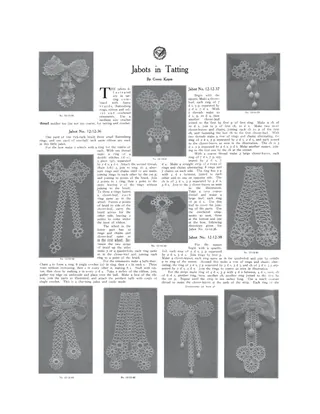
Jabots in Tatting
Article · 2 pages
A two-page article from Modern Priscilla by Gwen Keyes with tatting directions for jabots (decorative neck frills) combining tatting with rick-rack and other braids, Battenberg rings, ribbon, velvet and crocheted ball ornaments. Full written instructions are given for Nos. 12-12-36, 12-12-37 and 12-12-38, using clover-leaves, quadrefoils, wheels and ring-and-chain strips. The second page lists the other jabots illustrated (Nos. 12-12-39 to 12-12-45) with the prices of materials and kits, plus tatting shuttles for sale.
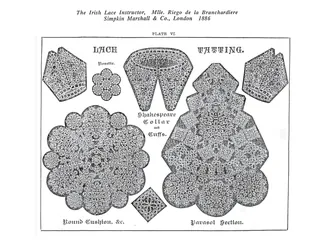
Lace Tatting
Monograph · 6 pages
Six-page excerpt from Mlle. Riego de la Branchardiere's Irish Lace Instructor (London, 1886), giving written shuttle-tatting patterns with a plate of engravings. Patterns include a parasol cover with diamonds, trefoils, cones and border stars, a simple edging, a round doily or cushion cover, a Shakespeare collar and cuffs, and another lace edging. It closes with a Maltese lace cushion or couvre-pied worked in crochet and joined by ribbon bands. Each pattern lists materials (Walter Evans Boar's Head cotton, tatting pins, shuttle) and stitch-by-stitch directions.
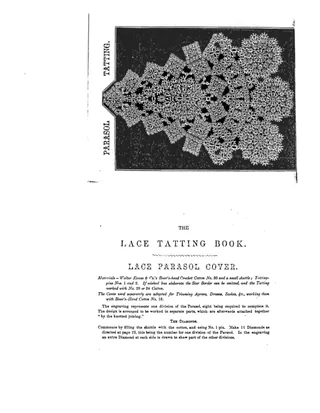
Lace Tatting Book
Monograph · 18 pages
A Victorian pattern book of shuttle tatting by Mlle. Riego de la Branchardiere, published in London in 1866. It gives written instructions with engravings for a lace parasol cover (diamonds, cones, trefoils, beading and border stars), lace and Dresden edgings, ribbon and rosette insertions, a round d'oyley or head-dress, and a two-colour diamond antimacassar. A closing section explains the straight thread and knotted joining and recommends cotton and tatting pin sizes; advertisements for the publisher's other books, Rowlands' toilet preparations and Walter Evans & Co. cotton follow.
Pearl Tatting Book
Monograph · 32 pages
A Victorian pattern book of shuttle tatting by Mlle. Riego de la Branchardiere, published in London in 1867. It gives written instructions, with materials lists and cotton and pin sizes, for collars, cuffs, a lappet head-dress, antimacassars, insertions, edgings, a handkerchief border and trimmings, built on the pearl beading and Maltese ring techniques. A closing section explains the pearl beading, straight thread and knotted joining, and the back pages carry advertisements for Rowlands' toilet products and Walter Evans & Co. cotton.
Priscilla Tatting Book No. 2
Monograph · 34 pages
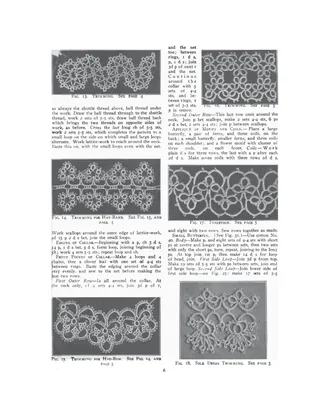
A pattern book of shuttle tatting edited by Julia E. Sanders, with abbreviated written directions for several dozen numbered figures. It opens with an explanation of stitches and a section on modern tatting, then gives patterns for edgings, insertions, beadings, hat trimmings, collars, doilies, a centrepiece, a table scarf, pillows, a jabot, an alphabet, a library scarf, bags, an infant's cap and a baby bonnet. Many photographs show the finished pieces, and the back page advertises other Priscilla needlework books.
Priscilla Tatting Book No.3
Monograph · 36 pages
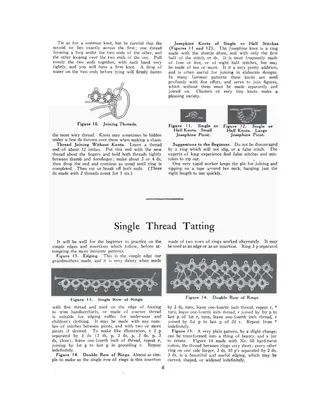
A 1924 instruction booklet of tatting patterns published by the Needlecraft Publishing Company of Augusta, Maine. It opens with general directions on the shuttle, hand positions, picots, joining and thread joining. It then gives written directions and photographs for single-thread and two-thread edgings, beadings, medallions, knot-stitch, needle-and-shuttle, Cluny, lattice-stitch, twisted and roll tatting. Finished projects include centrepieces, doilies, a between-meal cloth, a table runner, a boudoir cap and camisole top, and a baby cap, along with a centrepiece that combines tatting and weaving. Advertisements for other Priscilla needlework books and Needlecraft Magazine appear at the front and back.
The Rose Motif Is Never Lovelier Than When Tatted
Article · 2 pages
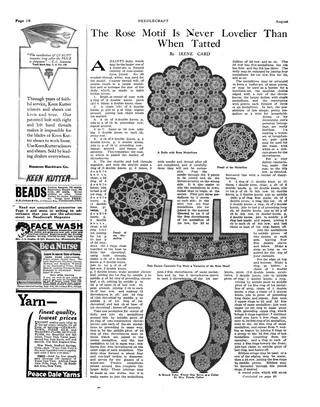
A 1922 Needlecraft Magazine article by Irene Card giving written instructions for tatting a rose medallion with a cloverleaf border. Uses include a water-set doily, buffet and luncheon sets, a camisole top with a daisy-tatting border, and a round yoke or collar made from a second medallion. It also gives a reader's tip on washing tatting. The scan also includes the magazine's advertisements and continuations of filet-crochet and tea-cosy patterns.
Tatting Shuttle
Article · 1 page
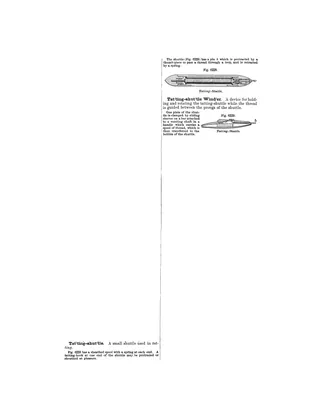
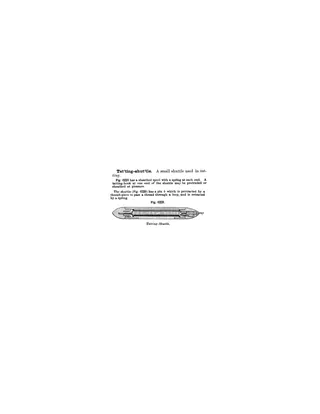
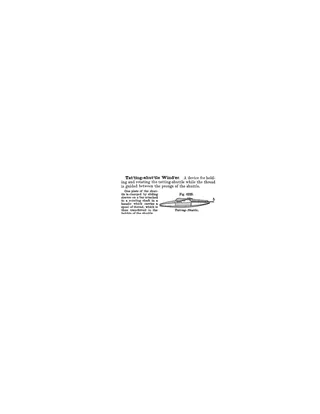
A one-page excerpt from Knight's American Mechanical Dictionary (1876) with entries for the tatting shuttle and the tatting-shuttle winder. It describes two shuttle designs, one with a sheathed spool and retractable tatting hook and one with a spring-retracted protracting pin, and a device that transfers thread from a spool to the shuttle bobbin. Two cross-section figures (Figs. 6228 and 6229) illustrate the shuttles.
Tatting Shuttle
Article · 1 page
A short dictionary entry on the tatting shuttle from Knight's American Mechanical Dictionary. It defines the tool as a small shuttle used in tatting and describes two designs: one with a sheathed spool, springs at each end and a retractable tatting hook, and another with a spring-retracted pin worked by a thumb-piece to pass thread through a loop. It includes a cross-section drawing of one shuttle.
Tatting-Shuttle Winder
Article · 1 page
A short dictionary entry from Knight's American Mechanical Dictionary describing a tatting-shuttle winder, a device that holds and rotates a tatting shuttle so thread from a spool in a handle is transferred to the shuttle's bobbin. One plate of the shuttle is clamped by sliding sleeves on a bar attached to a rotating shaft. It includes a single figure (Fig. 6229) showing a cross-section of the tatting shuttle.
Forty Original Designs in Tatting
Nellie Hall Youngburg · 1921
Book · 24 pages
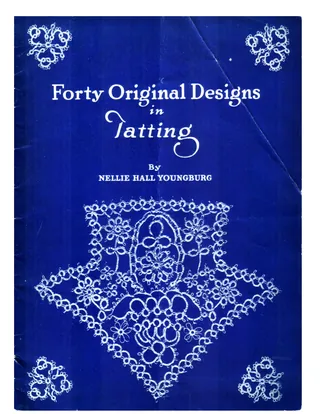
A 1921 pattern booklet of forty original tatting designs by Nellie Hall Youngburg of Brookings, South Dakota, each shown in a photograph with complete written instructions. It begins with a list of tatting abbreviations, then gives narrow edgings and insertions, medallions, a coin purse, a blue bird motif, corners for piano and buffet scarves, a jardiniere stand cover, tab collars, a baby's bonnet, infant's and camisole yokes, and a butterfly corner. Instructions specify thread sizes and colors (mostly crochet cotton in white with blue, pink or lavender) and use double stitches, picots, rings and chains.
Käpyily-ja solmeilutyöt [Tatting and Knotting]
Book · 62 pages · Finnish
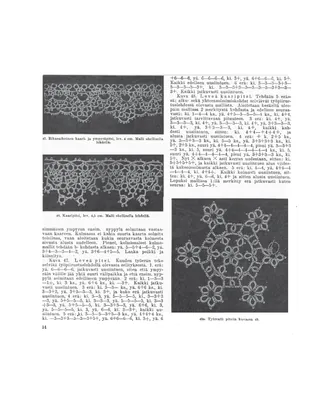
Finnish-language instruction book (Otava's handicraft series no. 6), translated from German by Ilona Jalava, on shuttle tatting (käpyily, frivolité) and knotting/macramé-style work (solmeilu). The first part explains the shuttle, hand positions, rings, arches, picots and joining, followed by many numbered lace edgings, handkerchief borders, collars, doilies and stars with written stitch counts. The second part covers knotting bases, knots (double half-hitch, Josephine knot, leaf knot, picots) and finished pieces such as borders, a belt and reins, a vest, a bag, a cap and free-form lace. It has 147 figures; the last pages reproduce reduced pattern sheets with pattern diagrams and instructions and a list of abbreviations.
Raised Tatting Book
Monograph · 33 pages
A Victorian pattern book of raised tatting by Mlle. Riego de la Branchardiere, published in London in 1868. It gives written instructions for tatting with two shuttles and pearl loops made over a pin or flat mesh: a shell antimacassar, raised scallop border, etoile insertion, mignardise edging, Maltese square, shell edging, daisy insertion, a child's dress and a sash or lappet. The Pearl Beading instructions on page 28 are the base technique for most patterns. Engraved or photographic plates illustrate each design. The back pages carry advertisements for Walter Evans thread, Rowlands' toilet products and the author's other needlework books.
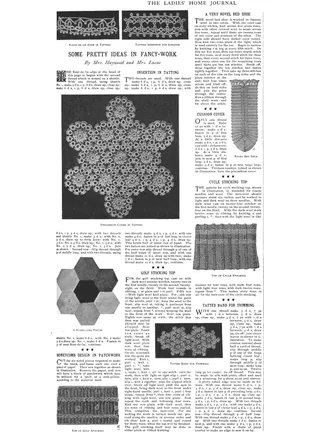
Some Pretty Ideas in Fancy-Work
Article · 1 page
A one-page 1898 Ladies' Home Journal feature giving written instructions for several small fancy-work projects. It includes tatting patterns (a fleur-de-lis edge, a lingerie insertion, a pincushion cover of rosettes, a clover-leaf band and edge), knitted items (a two-color bed shoe, cycle and golf stocking tops), and a honeycomb patchwork block. Patterns are given in abbreviated tatting and knitting notation and illustrated with photographs.
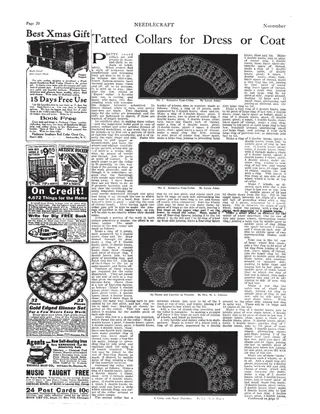
Tatted Collars for Dress or Coat
Article · 3 pages
Three pages from Needlecraft Magazine, November 1912, led by a tatting article giving written instructions for round and shell-pattern tatted collars (wheels, four-ring figures, double-ring insertion, clover-leaves, cuffs and a matching jabot), with advice on basting a cloth pattern to guide assembly. The pages also include instructions for a bonbon doily in novelty braid and crochet, an insertion and medallion in coronation-braid and crochet, and a knitted Francesca Lace edging. A short household hint on mending, a table-cover pattern note and many advertisements are also present.
The Tatting Book
Monograph · 34 pages
An 1850 instruction book on tatting by Mlle. Riego de la Branchardiere, in which she substitutes a netting needle for the traditional shuttle. It covers the single, double and pearl (pin) stitches, joining methods and general rules, then gives written patterns with line illustrations. The patterns include edgings, an insertion, Oriel and Maltese pattern collars with cuffs, a fruit d'oyley (doily), a bunch of grapes, an appliqued grape waistcoat worked with gold twist, and a mourning collar.
The Art of Tatting
Book · 127 pages
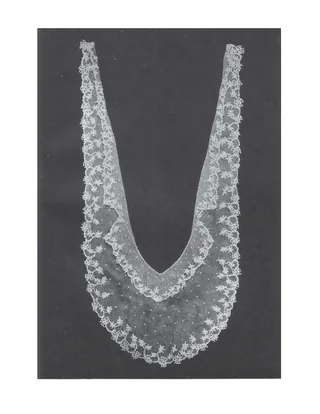
A 1910 book on tatting by Katharin L. Hoare, with an introduction by Carmen Sylva (H.M. the Queen of Roumania). The text covers the history of tatting, the shuttle, and basic single- and two-shuttle technique, with diagrams of the stitch and hand positions. Most of the book is a series of collotype plates of tatted work, chiefly by the Queen of Roumania, with her own descriptions. Items include altar veils, a coverlet, an iconostasis curtain, dress trimmings, collars, bags, handkerchiefs and church work. A final section shows miscellaneous examples, including historic shuttles in the Wallace Collection.
Centerpieces and Other New Designs
Comfort, February 1925
Article · 1 page
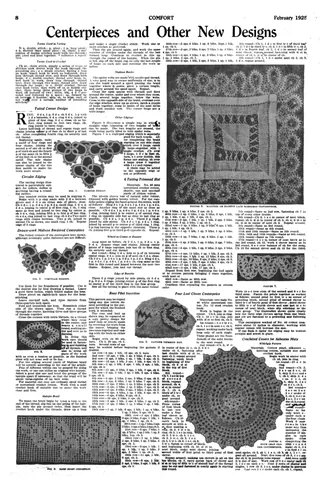
A one-page article from Comfort magazine, February 1925, giving written instructions for tatted and crocheted household trimmings. It covers a tatted corner design, a circular tatted edging, a drawn-work linen centerpiece with hairpin-lace (Maltese braid) edging, a tatted hat trimming, a rose filet crochet insertion charted row by row, a four-leaf clover crocheted centerpiece, and crocheted covers for asbestos mats. Lists of tatting and crochet abbreviations open the page.
Golden Stars in Tatting and Crochet
Monograph · 10 pages
An 1861 English pattern booklet by Mlle. Riego de la Branchardière for making star and diamond motifs in gold-thread tatting, finished with crochet chain loops. It gives terms and rules, tatting instructions for octagon and hexagon stars and diamonds, and materials and directions for a Zephyr sleeve, Zephyr collar, square sleeve, and an antimacassar, cushion or doyley design. Motifs are applied to tulle or Brussels net, and suggested uses include dress trimming and church needlework.
Collingbournes Tatting and Maltese Art
Monograph · 32 pages
A 1917 promotional pattern booklet (Book No. 11) from the Virginia Snow Studios for Collingbourne Mills of Elgin, Illinois, with instructions for tatting, Maltese (hairpin) crochet, Venetian cutwork and netting. It opens with a letter from Virginia Snow about Italian lace, then gives a beginner's tatting lesson and patterns for collars, lingerie yokes, doilies, luncheon linens, bags, caps and edgings. Most pages are photographs of finished pieces with thread recommendations and abbreviated directions. The closing pages advertise other booklets and Collingbourne threads.
Webside, Number 5 (March 2005)
Periodical · 11 pages · weaving drafts
Issue 5 (March 2005) of Ralph Griswold's newsletter about his weaving, lace and textile website, later hosted by Handweaving.net. It reports March additions (134 documents, including Posselt's Textile Journal volumes 2-3 and Beaumont's Carpets and Rugs), planned additions such as Collingwood's rug weaving books, and a series installment on the Illustrations section. Other items cover PDFs, digital photography, Tess Parrish's history of tatting, lace websites, searching weaving in the Library of Congress American Memory, and book reviews. A Handweaving.net section describes the new draft collection from Kastanek's A Manual of Weave Construction, with sample drafts, and a new online weaving gallery showing Oelsner triple weave drafts. It ends with a CD list and web links.
Home Needlework Magazine (February 1914)
Home Needlework Magazine, February 1914
Periodical · 51 pages
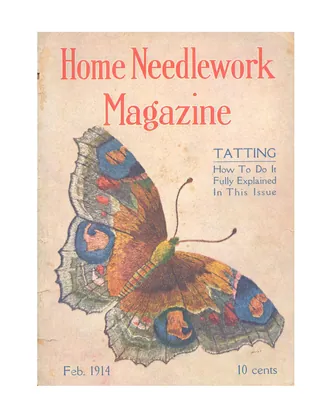
February 1914 issue of Home Needlework Magazine (Vol. XVI, No. 2), featuring a lead illustrated lesson on tatting with shuttle hand positions, picots and patterns for a doily, insertion, edging and centrepiece border. Other projects include French and eyelet embroidery for bed room linens and table pieces, a Venetian crochet collar and cuff set, crocheted and embroidered sofa pillows, a knitted coat sweater, embroidered neckwear, Valentine place cards, a butterfly-embroidered serving tray with reed basketry, china painting, and dressmaking patterns. The issue includes pattern prices and many advertisements for thread, soap, needles and yarn.
Answered by the Editor
Article · 1 page
A single page from the September 1919 issue of Needlecraft magazine with the reader-question column 'Answered by the Editor'. It gives instructions for afghan stitch and pineapple stitch in crochet, a method of needle-tatting with a darning needle, and replies on selling contributed designs and on reproducing patterns from other publications. A reference list, 'Directions for Stitches in Crochet', defines chain, slip, single, double, treble and longer treble stitches. The page is surrounded by period advertisements.
Directions for Stitches in Crochet
Article · 1 page
A one-page item from the Needlecraft magazine of September 1919 combining a reader question-and-answer column with a glossary of basic crochet stitches. The column gives directions for afghan and pineapple stitch in crochet, explains how Needlecraft helps contributors sell their work, and describes making needle-tatting with a darning needle. The closing section defines the chain, slip stitch, single, double, treble, half treble, long treble, double treble and triple treble crochet stitches.
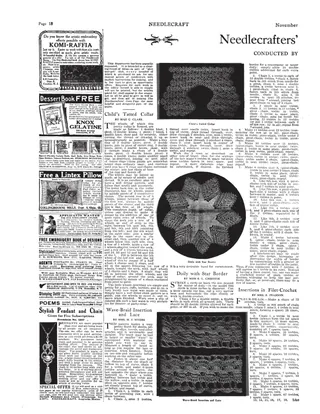
Needlecrafters Own Page [tatted and crocheted lace patterns]
Needlecraft Magazine, November 1912
Article · 2 pages
Two pages from the "Needlecrafters' Own Page" department of Needlecraft Magazine, November 1912, with reader-contributed lace patterns in written instructions. They include a tatted wheel collar for a child, a crocheted doily with a star border, wave-braid insertion and lace, filet-crochet insertions (Fleur-de-lis and Walls of Troy), and an Irish-point Triple-Leaf Lace. Each pattern is illustrated with a photograph, and the pages also carry period advertisements.
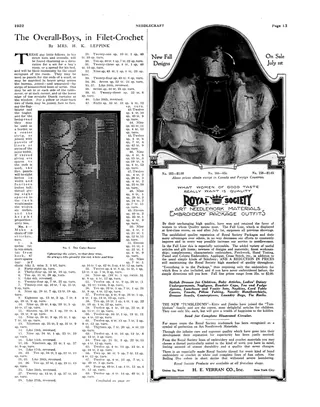
The Over-All Boys, In Filet Crochet
Article · 2 pages
Row-by-row filet crochet instructions for a set of 'Overall-Boys' panels, beginning with the Color-Bearer figure (No. 1), from Needlecraft Magazine, August 1922. The text suggests uses such as bedspread borders, scarf ends, pillow panels and curtain edgings, and gives sizes for different thread gauges. The scan also includes the conclusions of a filet crochet Wild-Rose tea-cosy (with a shell border) and a tatted rose-motif medallion collar, plus period advertisements.
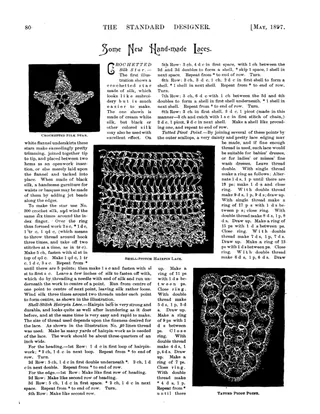
Some New Hand-Made Laces
The Designer, May 1897
Article · 2 pages
A two-page article from The Standard Designer, May 1897, giving written instructions for five hand-made laces and trimmings: a crocheted silk star, shell-stitch hairpin lace, tatted picot point edging, crocheted picot and loop point, and crazy-stitch hairpin lace. Each pattern is given row by row or round by round in period abbreviations, with notes on suggested uses such as trimming for flannel underskirts, waists, children's collars and cuffs, and babies' dresses. Photographs show each finished piece.
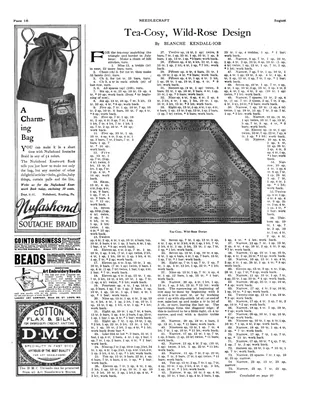
Tea-Cosy, Wild-Rose Design
Article · 2 pages
Filet-crochet instructions by Blanche Kendall-Job for a tea-cosy with a wild-rose design, matching a triangle and border from the previous month's issue. It gives a foundation chain of 326 stitches and row-by-row directions of spaces, treble stitches, lacets and bars through row 80, followed by a shell border with picots, padded lining and ribbon finish. The scan also includes the conclusion of a filet-crochet pattern, the end of a tatted rose-motif collar article, and period advertisements.
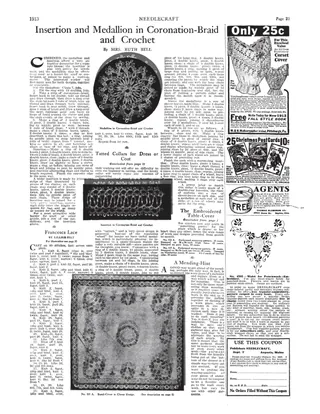
Insertion and Medallion in Coronation-Braid and Crochet
Article · 1 page
A single page from Needlecraft Magazine with instructions by Mrs. Ruth Bell for a round medallion and a strip of insertion worked in coronation braid combined with tatting-style double knots, rings, chains and picots. Suggested uses include blouse trimming, towel ends, scarf borders, cushion covers and hand-bags. The page also includes a knitting pattern for Francesca Lace (Lillian Hilt), the end of a tatted collar pattern, a mending hint, and a transfer-pattern coupon.
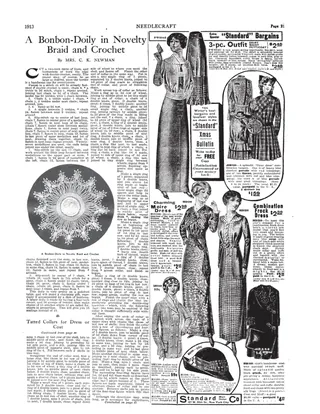
A Bonbon-Doily in Novelty Braid and Crochet
Article · 2 pages
Two pages from Needlecraft magazine with instructions for a bonbon doily and a medallion and insertion in novelty or coronation braid and crochet. The pages also hold directions for a tatted collar (continued from and concluded on other pages) and a knitted Francesca lace pattern with row-by-row instructions. Short notes on a stand-cover pattern, mending, and a transfer-pattern coupon appear as well.
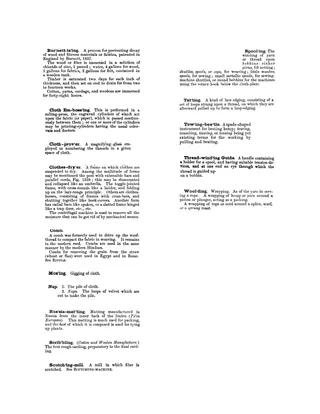
[Textile-related entries from Knight's American Mechanical Dictionary]
Article · 1 page
A single page of short dictionary entries on textile terms and processes from Knight's American Mechanical Dictionary. Entries cover Burnettizing (preserving wood and fabrics with zinc chloride), cloth embossing, cloth-prover, clothes-dryer, comb (weaving and flax), nap, Russia matting, scribbling, scutching, spooling, tatting, tewing-beetle, thread-winding guide, and woolding.
Treatise on Lace Making, Embroidery and Needle Work
Barbour Brothers, 1891
Monograph · 93 pages
Book No. 1 of Barbour's Prize Needle-Work Series, a trade booklet from the Barbour Brothers Company promoting Irish flax threads. It gives instructions for crochet, knotted and macramé work, knitting, netting and darned net, tatting, and embroidery, including lace edgings, insertions, table-mats, and wheels. Row-by-row patterns are illustrated with photographs and line drawings. It also has a glossary of knitting and crochet abbreviations, a prize competition notice, and thread advertisements.
Box for Tatting
Godey's Lady's Book and Magazine, September 1875
Article · 1 page
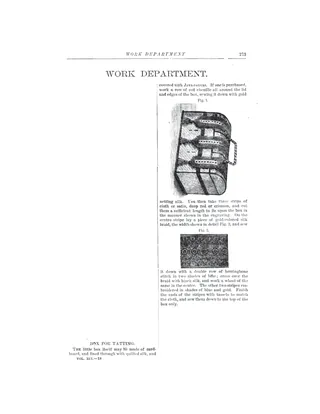
A short Work Department item from Godey's Lady's Book describing how to make a box for holding tatting. The box is made of cardboard, lined with quilted silk and covered with Java canvas, then decorated with three strips of red cloth or satin. The strips carry gold silk braid, herringbone stitch in blue, and embroidery, and are finished with tassels. Two engravings show the finished box and a detail of the braid.
Old Lace
New Republic, March 3, 1920
Article · 3 pages
A short personal essay from The New Republic in which the narrator describes her elderly, illiterate immigrant grandmother in a New York flat, who weaves lace on a small shuttle. The grandmother tells how two foreign strangers sheltered in her Russian village one winter taught her mother the lace pattern. The narrator concludes the men were stragglers from Napoleon's army in 1812, while the grandmother has never heard of Napoleon and cares only that the lace is unique to her region.
107 documents found