Textile Documents › Topic: Power looms and weaving machinery
698 documents found
Sort: 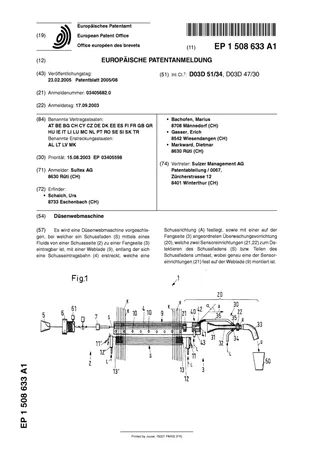
Düsenwebmaschine [Jet Weaving Machine], EU Patent No. EP1508633A1
Patent · 15 pages · German
Front page of European patent application EP 1 508 633 A1, filed by Sultex AG of Rüti, Switzerland, for a nozzle (jet) weaving machine. The abstract describes a machine in which weft is inserted by fluid from the weft side to the catch side along a path on the sley. A monitoring device on the catch side has two sensors for detecting the weft yarn, and exactly one of them is fixed on the sley. Fig. 1 is a side-view diagram of the machine showing the weft insertion path, reed and sensors.
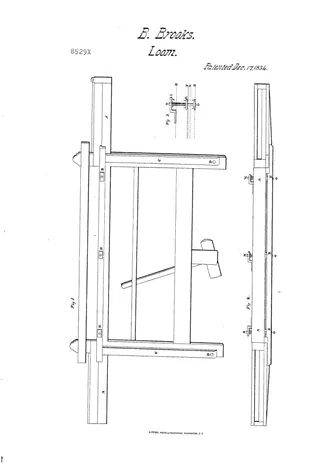
Loom
Brooks E. · December 17, 1834
Patent · 2 pages
Scan of U.S. patent X8529 for a loom, granted to B. Brooks on December 17, 1834. It consists of the patent drawing sheet with Figs. 1 to 3 showing the loom frame, uprights, crossbeams, bearing blocks and a hand lever. The written description is absent; the second page is a Patent Office notice saying the description page was not scanned.
Spiral-Shaped Textile Structure, US Patent No. 5242745
Patent · 8 pages
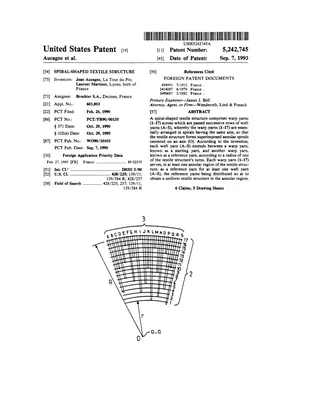
US Patent 5,242,745 (granted 7 September 1993) to Jean Aucagne and Laurent Martinet, assigned to Brochier S.A. of France, describes a spiral-shaped woven textile structure. Warp yarns are arranged in spirals around a common axis, and each weft yarn runs along a radius between a starting yarn and a reference yarn, so the fabric stays uniform in each annular region. The text covers the claims, the background on conventional tapered-roller spiral weaving, and the weaving process and loom. It also gives comparisons of the thickness and surface mass of spiral fabrics made by different methods. The scan is a printout from the USPTO database, with the patent's front page and a figure of warp yarns 1-17 and weft yarns A-S.
Weaving Machine, US Patent No. X0008936
Patent · 2 pages
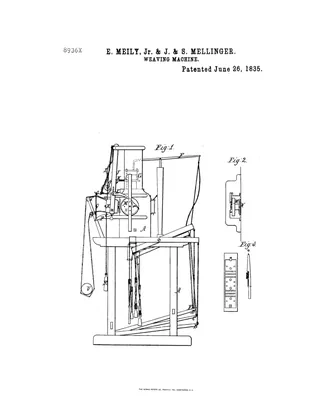
US Patent No. X0008936, granted June 26, 1835, for a weaving machine invented by E. Meily Jr. and J. & S. Mellinger. The scan holds only the drawing sheet, with three figures including a side elevation of the full loom frame with lettered parts. The text pages of the patent were not scanned; a Patent Office notice says they were missing at the time of scanning.
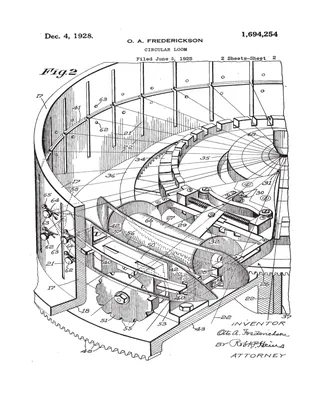
Circular Loom, US Patent No. 1694254
Patent · 6 pages
US Patent No. 1,694,254, granted 4 December 1928 to Otto A. Frederickson of Wethersfield, Connecticut, and assigned to the Wire-Mold Company. It describes a circular loom in which a tilting nose on the shuttle replaces heddles for opening the shed, directing warp threads over or under the shuttle. Fixed pins on the drum wall tilt the nose, and the pins can be repositioned to change the order of thread shifting. The patent has two sheets of drawings (side section, perspective detail, and diagrammatic view of the drum), a specification, and ten claims.
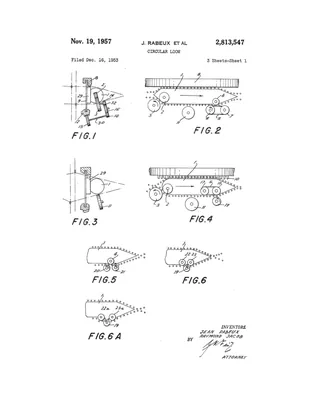
Circular Loom, US Patent No. 2813547
Patent · 6 pages
US Patent 2,813,547, granted 19 November 1957 to Jean Rabeux and Raymond Jacob of France, for a circular loom. It covers a way of supporting and guiding the shuttles of circular looms with a horizontal shed, using driven and idler wheels, belts and a toothed crown in place of rails that hold the shuttle against the warp threads. The inventors say this reduces strain and breakage of the warp, allows fine, fragile threads and tightly woven cloth, and lets the shuttle be removed easily. The document has three sheets of drawings (Figs. 1-12), a specification and 24 claims.
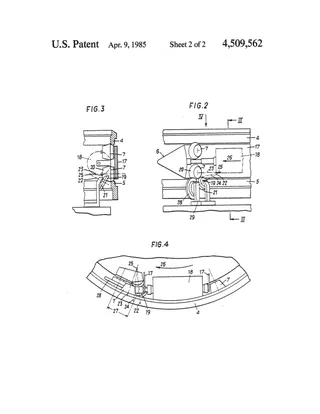
Circular Loom, US Patent No. 4509562
Patent · 8 pages
US Patent 4,509,562, granted April 9, 1985 to Johann Schönberger and co-inventors, assigned to Chemiefaser Lenzing AG (Austria). It describes a circular loom with an improved shuttle drive in which the catch roller on the rotor contacts a running roller at the shuttle's front end, so the shuttle is pulled rather than pushed and is not forced out of the running races. The scan includes a USPTO database printout (abstract, claims, description) and the original patent pages with two sheets of drawings (Figs. 1-4), a description of the harness and shed formation, and two claims.
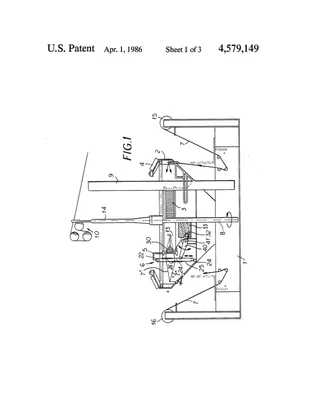
Circular Loom, US Patent No. 4579149
Patent · 7 pages
US Patent 4,579,149, granted 1 April 1986 to Franz X. Huemer of Vienna, for a circular loom whose shaft-driving mechanism uses two-armed control levers. The levers connect a revolving plate cam to belt-type partial healds, which move the inner and outer yarn guiding eyes up and down to form a travelling shed for tubular fabric. The patent gives the abstract, background, description of the drawings (Figs. 1-5), alternative lever-to-belt anchorages and five claims. It has three sheets of mechanical drawings.
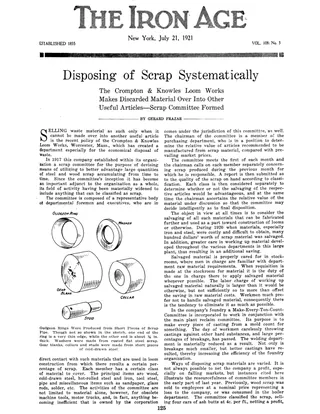
Disposing of Scrap Systematically
Iron Age, July 21, 1921
Article · 2 pages
A 1921 Iron Age trade article describing how the Crompton & Knowles Loom Works of Worcester, Mass., handled scrap through a committee formed in 1917. It explains how steel, pipe, wood and tool scrap was reworked into washers, gudgeon rings, gear blanks, collars, studs and shafts for loom construction, and how the remainder was sold. It includes cost savings figures and a sketch of the reclaimed parts. The focus is on factory management of a loom manufacturer, not on weaving.
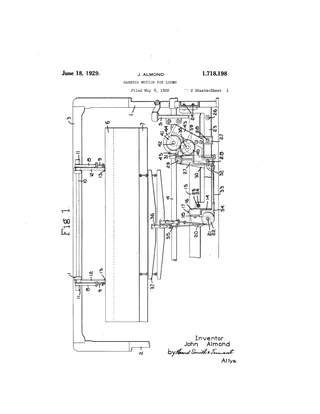
Harness Motion for Looms, US Patent No. 1718198
Patent · 6 pages
US Patent No. 1,718,198, granted June 18, 1929 to John Almond of Methuen, Massachusetts, assignor to the Draper Corporation, for a harness motion (shed-forming mechanism) for looms. The mechanism is a compact set of bell-crank levers and cams placed beneath the harness frames and inside the loom frame. The levers connect to the frames by flexible straps running around idler pulleys, so the frames always move vertically. The document includes two sheets of drawings (side and plan views), the description, and eight claims.
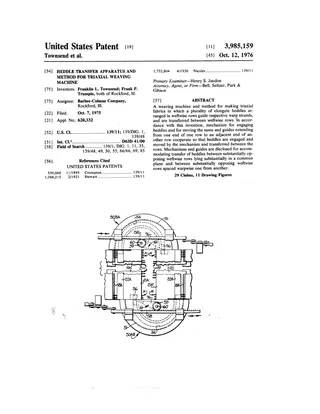
Heddle Transfer Apparatus and Method for Triaxial Weaving Machine, US Patent No. 3985159
Patent · 25 pages
US Patent 3,985,159 (12 Oct 1976), assigned to Barber-Colman Company, describes an improved heddle transfer mechanism for a triaxial weaving machine. Elongate heddles in weftwise rows are moved from the end of one row to the adjacent end of another by stationary guides (cam surfaces, arcuate ribs, plates) and oscillating heddle receptacles driven by rack-and-pinion and lever linkages. The scan includes a USPTO web printout of the full text with abstract and claims, the printed patent with seven sheets of mechanical drawings, the specification, and a certificate of correction.
Improvement in the Power Loom
Scientific American, 1848
Article · 1 page
Short 1848 notice from Scientific American's 'New Inventions' column about R. P. Cunningham of Abington, Connecticut, and his improvement to the power loom. It reports that the improvement lets a loom run over a wider range of speeds, up to about 200 picks per minute against a usual 100, with a claimed 15 to 30 percent speed increase and no added yarn breakage or wear. An editorial note asks that loom improvement reports state the weft quality and picks per inch. The page includes an engraving of a power loom with a seated operator.
Improvements in or Relating to Looms
S. Somet · June 11, 1979
Patent · 9 pages
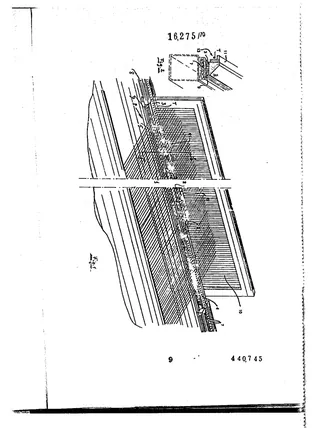
Australian patent specification no. 440745 for an improved shuttleless loom with two weft carriers driven by flexible tapes. Guides for the tapes sit wholly outside the shed, while a low-friction track along the reed supports the carriers and tapes. This avoids guide hooks inside the shed that snag warp yarns, reducing warp breakage and allowing higher loom speed. It includes the description, five claims and a drawing sheet showing a perspective view and a section.
Let-Off Mechanism, US Patent No. 1463966
Patent · 6 pages
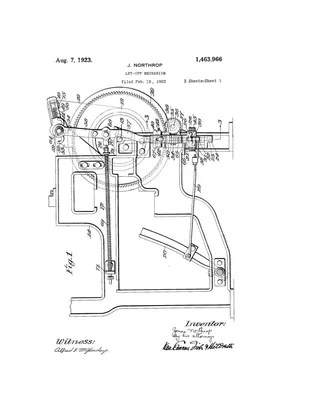
US Patent No. 1,463,966, granted Aug. 7, 1923 to Jonas Northrop of Hopedale, Massachusetts, assigned to the Hopedale Manufacturing Company. It describes a let-off and take-back mechanism for looms that keeps warp tension uniform. A whip roll senses changes in tension and moves a shield, which lets either a let-off pawl or a take-back pawl engage ratchet wheels that turn the warp beam through worm gearing. The document has three sheets of drawings (Figs. 1-6) followed by the specification and two claims.
Loom
Oliver C. Burr · July 17, 1835
Patent · 4 pages
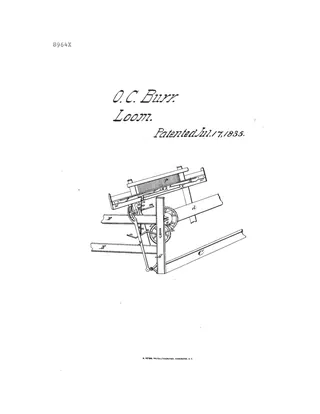
US patent specification, granted July 17, 1835, to Oliver C. Burr, a machinist of Millbury, Worcester County, Massachusetts, for an improvement to looms. The device regulates the cloth beam so that it winds up a small amount of cloth with each pick of filling, keeping the cloth a uniform thickness. The scan has a photolithographed drawing page and handwritten specification text that lists the lettered parts (levers, springs, catch wheel, cog wheel) and explains how the mechanism operates.
Loom Reversing Means, US Patent No. 3318341
Patent · 7 pages
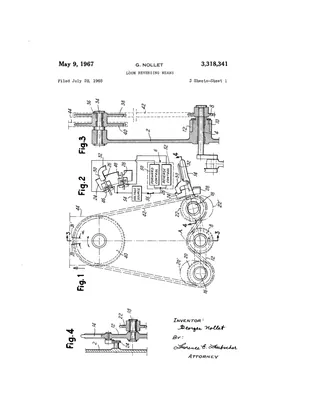
US Patent 3,318,341 granted to Georges Nollet of Mouveaux, France, for a loom reversing means. It describes a way to shift the timing of the heald-driving sprocket relative to the loom sprocket, so a loom with a stationary weft supply outside the shed can run in reverse to unweave without the weft inserters entering a closed shed. Two embodiments are given, a pivoting lever with auxiliary sprockets and latch, and a differential bevel gear with an auxiliary motor, both with safety switches. The scan has three drawing sheets, the specification, 12 claims and the references cited.
Loom, US Patent No. 1752804
Patent · 9 pages · weaving drafts
US Patent 1,752,804, granted to Walter Nicolet of Leipzig, Germany, for a loom that forms two sheds, one behind the other, using two groups of warp threads guided by knitting-type needle bars. The invention shifts the needle bars of one comb longitudinally and transversely before the warp groups cross, so threads enter the correct spaces between needles. The patent has six sheets of drawings (Figs. 1-10) showing thread positions and the cam and lever mechanism, followed by the specification and four claims.
Loom, US Patent No. X0001391
Patent · 5 pages
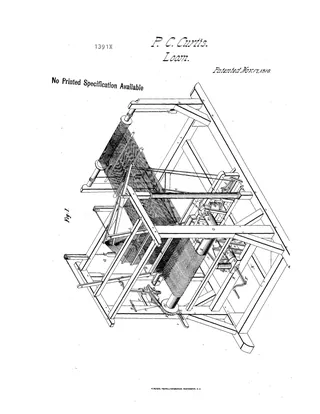
A US patent for a power-style loom by P. C. Curtis, consisting of a patent drawing (Fig. 1) and a handwritten specification. The claims cover an automatic cloth take-up on the cloth beam using two ratchet wheels and pawls worked from the batten, and a revolving grooved cylinder turned by a crank that drives the shuttle-throwing levers. The text says other loom parts are of usual construction and that the loom could be powered by hand, horse, water, wind or steam.
Loom, US Patent No. X0001693
Patent · 7 pages
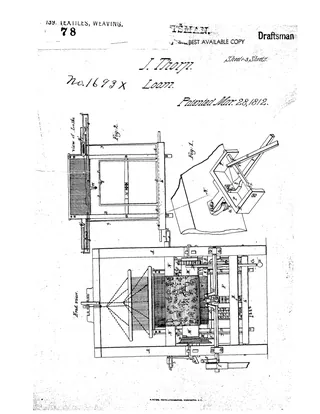
US patent X1693 for a power or treadle-driven loom, with three sheets of patent drawings (perspective, side, end and top views, lathe and reed) followed by the handwritten specification. The text describes a four-post frame, a swinging lathe, a treadle wheel with adjustable chains and pins that operate the treadles so various figures can be woven, and shuttle-box pieces that stop the loom if the shuttle misses the box. Part of the specification pages are illegible in the scan.
Loop Picker and Method of Making Same, US Patent No. 4279276
Patent · 12 pages
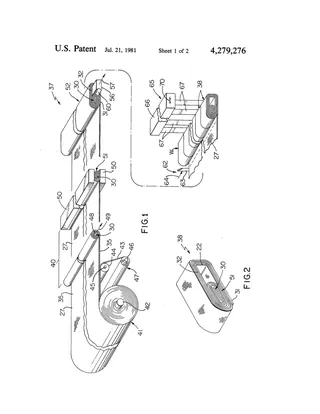
US Patent 4,279,276 (issued July 21, 1981) to G. Brian Hetz, assigned to Dayco Corporation, describes a loop picker for shuttle looms and a method of making it. The picker's forward block and body are made from a single strip of polymer-coated laminated fabric, pleated at the front and wound at the rear to form the picker stick passage. The document includes a USPTO web printout (abstract, claims, description) and the original patent with two sheets of drawings showing the picker and the manufacturing steps of winding, cutting, molding, curing and trimming.
Low Profile Circular Loom, US Patent No. 4479517
Patent · 12 pages
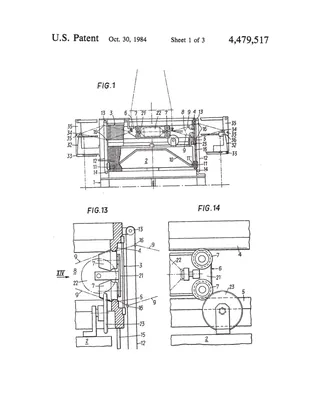
US Patent 4,479,517 (granted 30 October 1984) describes a low profile circular loom for industrial weaving, assigned to Chemiefaser Lenzing AG of Austria. A wave-grooved rotor moves catch elements that raise and lower flexible bands or cords carrying thread-guiding eyes over deflection pulleys. This replaces rigid heddles, lowers the machine height, and opens the shed wide enough for the shuttle to pass without touching the warp threads. The document includes the abstract, claims, description, and three sheets of patent drawings. It is a USPTO database printout plus the patent's printed pages.
Means for Weaving Fabrics, US Patent No. 1764577
Patent · 4 pages
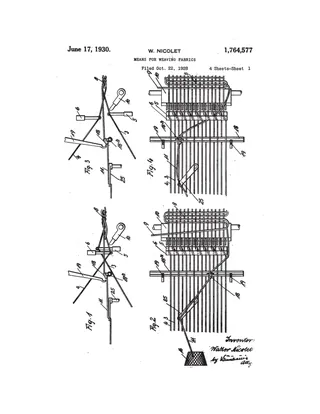
Four sheets of patent drawings for US Patent 1,764,577, "Means for Weaving Fabrics," by Walter Nicolet, filed October 22, 1928 and issued June 17, 1930. The figures (Figs. 1-13) show a weaving mechanism with warp and weft threads, heddles/healds, shed-forming parts, and bars, with numbered reference parts. Only the drawing sheets are present; the specification and claims text are not included.
Rapier Looms, US Patent No. 4100941
Patent · 10 pages
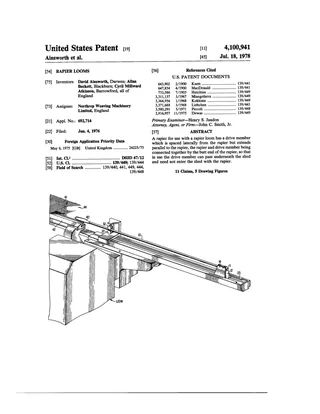
US Patent 4,100,941, granted 18 July 1978 to David Ainsworth, Allan Beckett and Cyril Millward Atkinson, assigned to Northrop Weaving Machinery Limited. It describes a rapier loom in which a carbon-fibre-reinforced rapier is joined at its butt end to a parallel toothed drive rack. The rack runs in a slideway below the shed, so it can be lubricated without contaminating the fabric. The scan has a 2001 USPTO web printout of the abstract, claims and description, followed by the original patent pages with the front page, four sheets of drawings, and the two-column text with 11 claims.
Shuttle Arrangements in Circular Looms for Hoses or the Like, US Patent No. 3076482
Patent · 4 pages
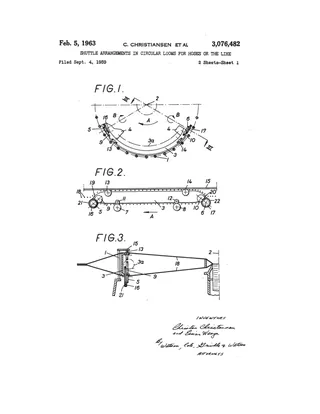
US Patent 3,076,482, granted 5 February 1963 to Christian Christiansen and Einar Håøya of Norway, assigned to Mandals Reberbane Christiansen & Co. It describes an improved shuttle arrangement for circular looms that weave hoses and other tubular textiles. Rollers on the shuttle carrier have notched flanges that take up the radial (centrifugal and centripetal) forces on a fast-moving shuttle and keep the warp threads evenly spaced as the shed opens and closes. The patent has two sheets of drawings (Figs. 1-4), a specification, and two claims.
Shuttle Motion, US Patent No. X0004863
Patent · 2 pages
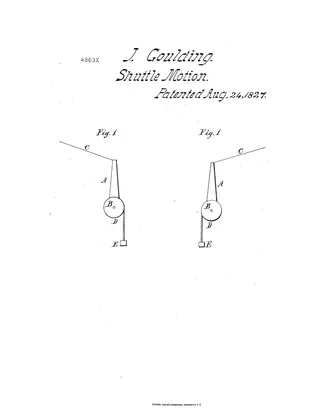
US patent X4863 granted to J. Goulding on August 24, 1827, for a shuttle motion, a mechanism for driving the shuttle in a loom. The scan holds the patent drawing, which shows two views (Fig. 1) of a lever arm, a descending arm, a pulley or wheel and a cord or band. The second page is a Patent Office notice saying the text pages were not available when the patent was scanned, so no specification text is included.
Shuttle Utilized for a Circular Loom, US Patent No. 4365651
Patent · 18 pages
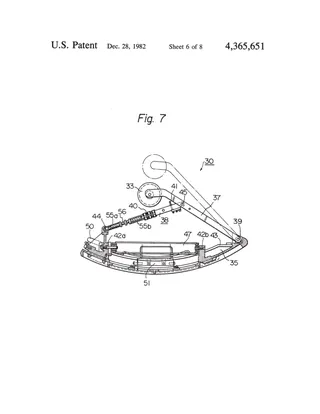
US Patent 4,365,651 (granted 28 December 1982 to Soichi Torii, Torii Winding Machine Co., Kyoto) describes a shuttle for a circular loom that weaves tubular fabric. The shuttle has a main body, brackets that hold a bobbin, and a pivoting lever with an inside guide wheel. Inclined outside wheels carry the gravity and centrifugal loads while the shuttle runs along annular guides, and an adjustable connecting lever makes mounting and removal easy. The document contains the abstract, claims, description and eight sheets of patent drawings of the loom and shuttle.
Take-Up Motion, US Patent No. 30
Patent · 2 pages
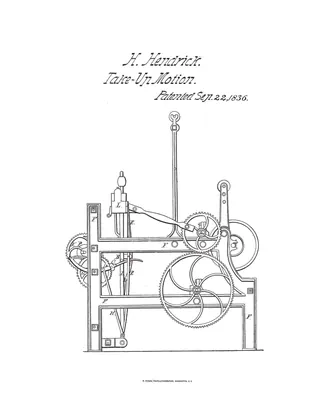
US Patent No. 30, granted September 22, 1836, to Horace Hendrick of Killingly, Connecticut, for a graduating take-up motion for power looms. The invention adds a rod and a sickle that carry motion from the reed (lathe) to the cloth beam, so cloth is taken up evenly and has uniform thickness. The document has a patent drawing (side elevation) on page 1 and the specification and claim on page 2.
Triaxial Weaving Machine with Heddle Shedding Means, US Patent No. 4046173
Patent · 16 pages
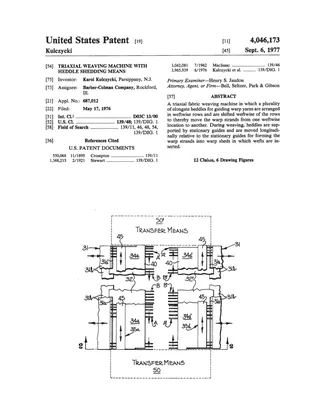
US Patent 4,046,173 (6 September 1977), granted to Karol Kulczycki and assigned to Barber-Colman Company, describes a triaxial weaving machine in which elongate strip heddles are arranged in weftwise rows and shifted weftwise to move warp strands from one weftwise location to another. Stationary guide plates support the heddles while shedding bars engage cutouts in them and move them longitudinally to form warp sheds for weft insertion. The document includes the abstract, 12 claims, a description of the drawings and mechanisms (cams, cranks, drive links, heddle shifting bars), and three sheets of patent drawings. It appears twice: as a USPTO web printout and as the original patent layout.
Triaxial Weaving Machine with Heddle Shifting Means and Method, US Patent No. 3999578
Patent · 17 pages
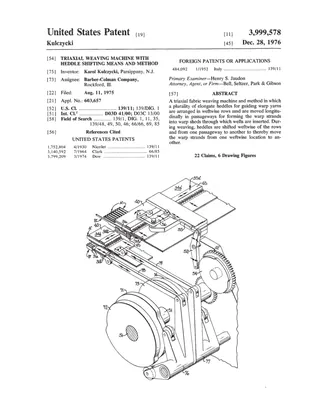
US Patent 3,999,578 (granted 28 December 1976 to Karol Kulczycki, assigned to Barber-Colman Company) describes a triaxial fabric weaving machine. Elongate heddles guide the warp strands and move longitudinally in passageways to form sheds. Between sheds, movable heddle-shifting bars move the heddles weftwise from one passageway to another, so the warp strands run obliquely to the wefts. The document has the USPTO web database printout (abstract, claims, description) and the original patent print with three sheets of drawings showing racks, cams, linkages and drive shafts.
Triaxial Weaving Machine with Heddle Transfer and Method, US Patent No. 4013013
Patent · 32 pages
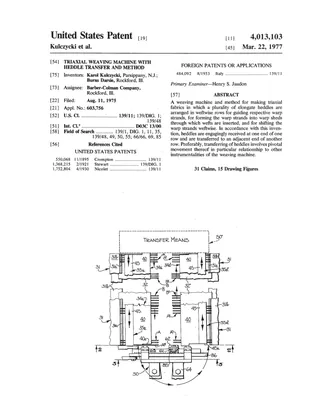
US Patent 4,013,103 (granted March 22, 1977) to Karol Kulczycki and Burns Darsie, assigned to Barber-Colman Company, describes a weaving machine and method for making triaxial fabrics. Elongate heddles arranged in weftwise rows guide the warp strands and form sheds. A transfer mechanism receives a heddle at the end of one row and moves it pivotally to the adjacent end of another row, so the warp strands can be shifted weftwise without undue stress. The scan includes a web printout with abstract and claims, the printed patent with five sheets of mechanical drawings (Figs. 1-15), the full specification and claims, and a certificate of correction.
Warp Length Compensator for a Triaxial Weaving Machine, US Patent No. 4170249
Patent · 12 pages
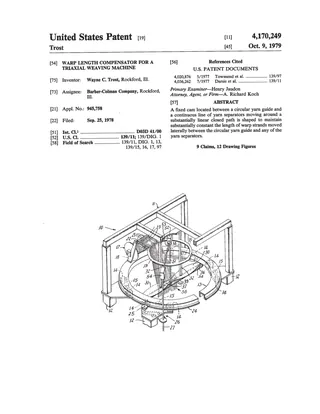
US Patent 4,170,249 (granted Oct. 9, 1979) to Wayne C. Trost of Barber-Colman Company describes a warp length compensator for a triaxial weaving machine. A fixed cam shaped like an elongated figure 8 sits between a circular yarn ring and a moving chain of yarn separators, keeping each warp strand at constant length so tension stays even as the creel rotates. The scan includes a USPTO database printout of the text and claims, followed by the original patent with its cover page, three sheets of drawings (Figs. 1-12), and the two-column specification with nine claims.
Warp Stop Motion for Looms, US Patent No. 637234
Patent · 7 pages
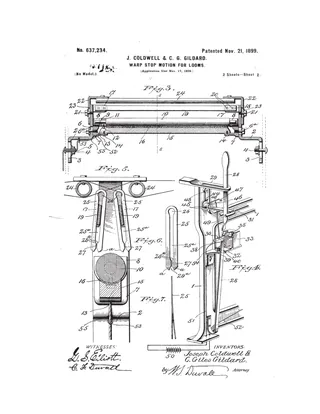
US Patent No. 637,234, granted November 21, 1899 to Joseph Coldwell and Christopher Giles Gildard of Fall River, Massachusetts, for an electrically operated warp stop-motion for looms. When a warp thread breaks, a thin sheet-metal drop-bar falls onto a rotating contact roller and completes a circuit. The circuit energizes an electromagnet that trips a latch and knock-off, which pushes the shipper out of its notch and stops the loom. The patent has two drawing sheets (Figs. 1-7), the specification, and 18 claims covering the drop-bar, circuit-rods, contact-roller with wiping-bar, and shipper-linked cut-out.
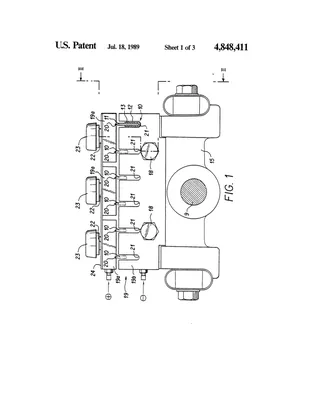
Warp Stop Motion Mechanism for Looms, US Patent No. 4848411
Patent · 9 pages
US Patent 4,848,411 (granted July 18, 1989) to Narachiyo Nishiguchi of Osaka describes an electrical warp stop motion for looms. Droppers fall when a warp yarn breaks and close a circuit between upper and lower contact bar supports that slide on the loom side frames, stopping the loom and helping locate the broken thread. The document includes the abstract, a single claim, background on the prior art with a separate grip, a description of the preferred embodiment, and patent drawings (Figs. 1-6). It is supplied both as a USPTO web printout and as the printed patent.
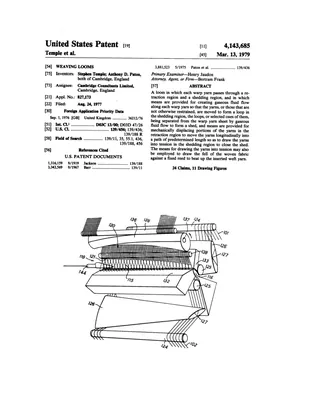
Weaving Looms, US Patent No. 4143685
Patent · 15 pages
US Patent 4,143,685, granted 13 March 1979 to Cambridge Consultants Limited, describes a loom in which warp yarns pass through a retraction region and a shedding region. Gaseous fluid flow along grooved channels forms loops in the warp yarns to open the shed, and mechanical detent devices (rotors, belts or reciprocating elements) draw the yarns into tension to close the shed and to beat up the weft against a fixed reed. The scan includes a USPTO database printout with abstract, claims and description, the patent's printed first page, and eight sheets of patent drawings (Figs. 1-9) showing the loom mechanism, yarn feeding and weft carrier elements.
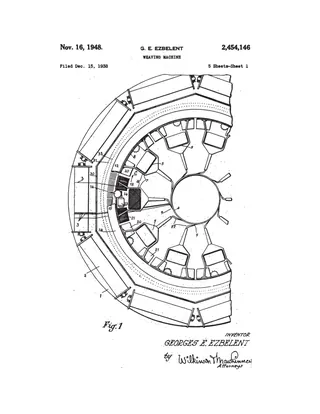
Weaving Machine, US Patent No. 2454146
Patent · 10 pages
US Patent 2,454,146 (granted 16 Nov 1948) to Georges Eugène Ezbelent of Paris for a circular weaving machine that weaves tubular fabric. Self-propelled shuttles, each with its own electric motor, run on a circular track of plates and are kept evenly spaced by magnets or electromagnets. Warp threads are alternated above and below the shuttle path by permutation sliders. The patent describes warp and weft stop motions, variants for spacing control and for an oscillating ring that produces zigzag warps, and an alternative lay. It includes five sheets of drawings, the specification, seven claims and cited references.
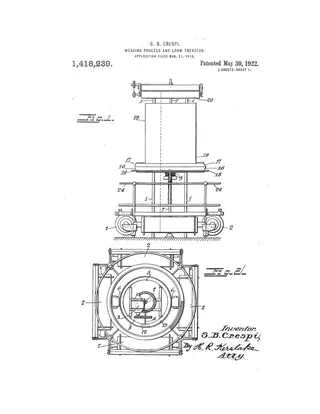
Weaving Process and Loom Therefor, US Patent No. 1418239
Patent · 6 pages
US Patent 1,418,239, granted 30 May 1922 to Silvio Benigno Crespi of Milan, for a circular loom and weaving process. The shuttle runs continuously in one direction around a circular race, drawn by electromagnets, and the reed beat is replaced by a guide on the shuttle that presses the weft into place. The loom weaves tubular fabric that is cut into several pieces. The document has two sheets of drawings, a description of the construction and operation, and two claims.
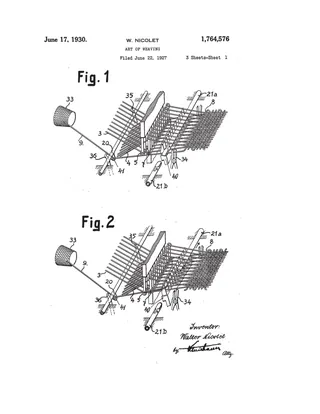
Art of Weaving, US Patent No. 1764576
Patent · 7 pages
US Patent 1,764,576, granted 17 June 1930 to Walter Nicolet of Leipzig, Germany, for a loom that weaves two fabrics' worth of shedding at once using two sets of warp threads and guide combs. A single rigid weft bobbin supplies weft that is entered into a closed front shed and an open rear shed as a hairpin loop, then cut off, which produces a proper selvedge. The scan has three sheets of drawings (Figs. 1-6 showing consecutive loom positions), the specification, and 17 claims covering the method and the loom.
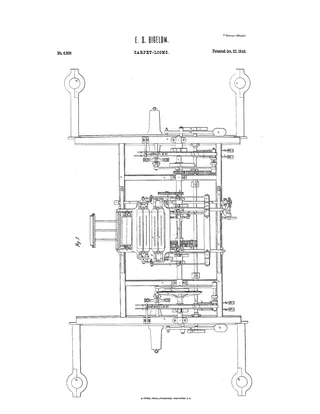
Carpet-Looms, US Patent No. 6806
Patent · 14 pages
US Patent No. 6,806, granted October 23, 1849 to Erastus B. Bigelow of Clintonville, Massachusetts, for improvements in the power loom for weaving carpets and other figured fabrics with a Jacquard. It has seven sheets of drawings and a specification describing a Jacquard frame with its own shafts, driven from the loom and adjustable in height to suit the harness cords. It also covers overhead drive of the picker staffs and shuttle-box shifting for pendulous shuttle-box frames, and a reversing motion for the power loom. Four claims are listed, followed by a disclaimer dated Boston, September 11, 1863, that narrows the reversing-motion claim.
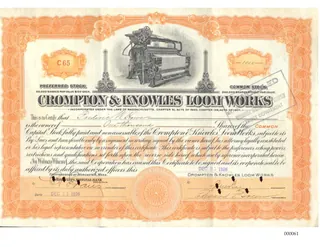
Certificate for common stock
Crompton & Knowles Loom Works, December 21, 1926
Ephemera · 2 pages
A cancelled stock certificate of the Crompton & Knowles Loom Works, a Massachusetts loom manufacturer, certifying ownership of 1,000 shares of common stock. The front carries an engraving of a power loom, countersignature by the Massachusetts National Bank at Worcester, and is dated December 31, 1926. The back has the preferences and voting-rights text and a 1936 assignment of the shares by the Industrial Trust Company, administrator of an estate, to a Providence woman, with revenue stamps and a cancellation stamp.
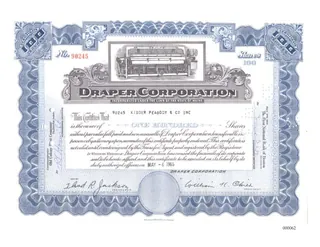
Certificate for stock
Draper Corporation, May 6, 1965
Ephemera · 2 pages
A stock certificate (No. 90245) for 100 shares of Draper Corporation, a Maine-incorporated company known for power looms, issued May 6, 1965 to Kidder Peabody & Co. Inc. Page 1 is the engraved certificate featuring a power loom vignette; page 2 is the assignment form on the back, stamped by Kidder, Peabody & Co. with a June 1, 1965 date. It documents the corporation's officers and transfer agents rather than textile technique.
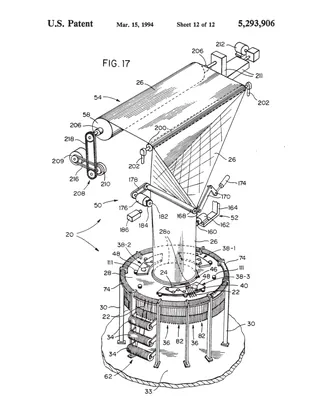
Circular Loom for and Method of Weaving Ribbon-Shaped Weft, US Patent No. 5293906
Patent · 52 pages · weaving drafts
US Patent 5,293,906 (Suresh K. Amin, assigned to Quadrax Corporation, granted 15 March 1994) describes a circular loom and method for weaving fabric with ribbon-shaped weft, intended for fiber-reinforced plastic tapes. Warp sheds are formed by pneumatic air cylinders that a control system presets ahead of the rotating shuttles. Electrical brakes control warp and weft tension, a ring-shaped fabric-forming member produces tubular fabric, and the fabric is slit, pulled and wound on a take-up reel. The scan includes the USPTO web printout, the full specification, the claims and 12 sheets of drawings. These show mechanical assemblies, 5-harness and basket-weave pattern grids, control tables, a flowchart and a block diagram.
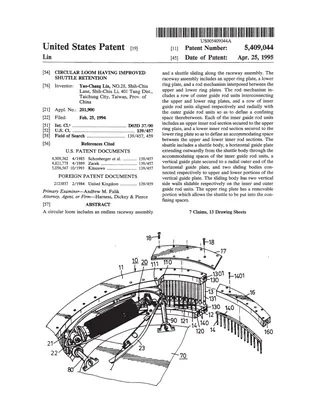
Circular Loom having Improved Shuttle Retention, US Patent No. 5409044
Patent · 23 pages
US Patent 5,409,044, granted to Yao-Chang Lin of Taichung, Taiwan, on April 25, 1995, for a circular loom with improved shuttle retention. The invention adds inner and outer guide rod units between the upper and lower ring plates of the endless raceway, so the shuttle cannot be pulled out of the raceway by centrifugal force and weft tension. The scan has a USPTO database printout (text and claims) plus the patent itself, with 13 sheets of drawings (Figs. 1-6 prior art, Figs. 7-13 five embodiments), background, summary, detailed description and claims.
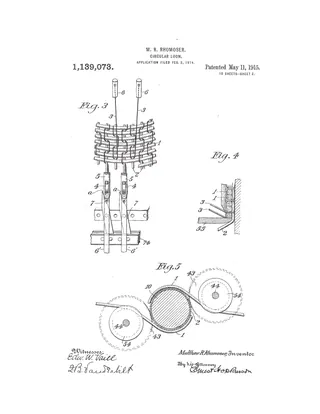
Circular Loom, US Patent No. 1139073
Patent · 18 pages
US Patent No. 1,139,073, granted May 11, 1915 to Matthew R. Rhomoser of Sandy Hook, Connecticut, assignor to Fabric Fire Hose Company, for a circular loom. The machine weaves tubular fabric for fire-hose jackets, with stationary warp strands, helically laid weft from rotating shuttles, and binder strands looped by groups of heddles and switches. The scan has ten sheets of patent drawings (Figs. 1-16) showing the fabric structure, shuttle drive, heddles and cam tracks, followed by the specification and numbered claims.
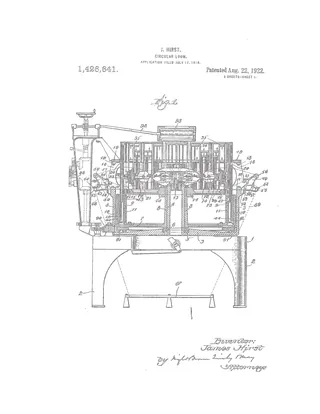
Circular Loom, US Patent No. 1426641
Patent · 12 pages
US Patent No. 1,426,641, granted 22 August 1922 to James Hirst of Melrose, Massachusetts, for a circular loom that weaves seamless tubular fabric. The loom uses gear-driven shuttles that travel in a circle around a mandrel, with heddles driven directly by rotating inner and outer cylindrical cams. The specification covers removable heddle frames, warp tension fingers, an adjustable weft packer and spreader on the shuttle, and a modified form with separate heddle bars. It has six sheets of mechanical drawings, the written specification, and ten claims.
Circular Loom, US Patent No. 1495311
Patent · 7 pages
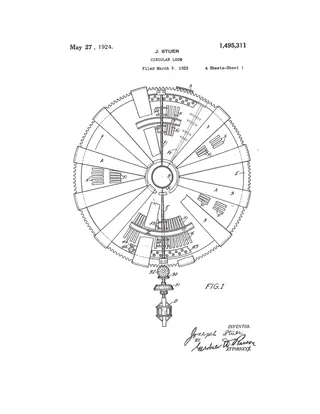
US Patent No. 1,495,311, granted May 27, 1924 to Joseph Stuer of Lawrence, Massachusetts, for a circular loom that weaves a seamless tube of cloth with no selvages. Warp carriers sit in concentric rings and are raised and lowered by cams on rotating filling arms, which carry the weft bobbins and lay the filling into the shed. The document has four sheets of drawings (Figs. 1-16) followed by the specification and two claims.
Circular Loom, US Patent No. 1872168
Patent · 11 pages
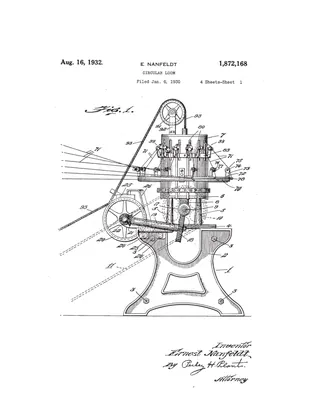
US Patent No. 1,872,168, granted August 16, 1932 to Ernest Nanfeldt of New Haven, Connecticut, assignor to Respro, Inc., for a circular loom that weaves tubular fabric. Weft thread carriers travel around a circular path while cam-driven pivoting guide arms place warp threads above or below each carrier in a set pattern. The loom can weave the tube around a central pin or as a covering on a wire or tube drawn through the hollow shaft. The document has four sheets of patent drawings (side elevation, top plan, vertical section, cam-groove diagram, gear detail, guide-arm detail), then the specification and 14 claims.
Circular Loom, US Patent No. 4846229
Patent · 12 pages
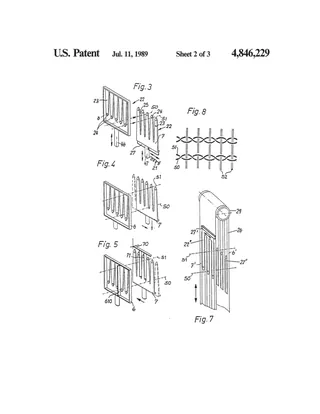
US Patent 4,846,229 (Franz X. Starlinger-Huemer, granted 11 July 1989) describes a circular loom adapted to weave leno fabric, mainly tubular fabric from narrow plastic strands for sacks. Pairs of inner and outer partial healds carry comb-like guides with thread eyes. After each shedding motion, displacement means shift the healds laterally so that warp threads jump across their neighbors to form the leno crossing. The scan includes an abstract, claims, description and three sheets of patent drawings, in both a USPTO web printout and the printed patent.
Circular Loom, US Patent No. 951449
Patent · 11 pages
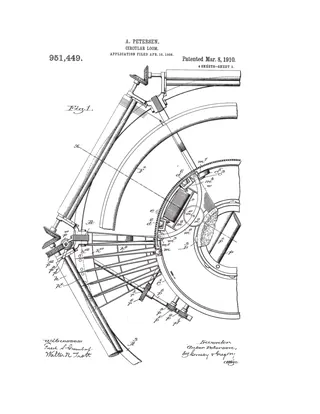
US Patent No. 951,449, granted to Anker Petersen of Chelsea, Massachusetts, on March 8, 1910, for a circular loom that weaves tubular fabric at high speed using several shuttles. The document has four sheets of patent drawings (Figs. 1-9) followed by the specification and 23 claims. The specification describes a circular shuttle raceway made of two rings joined by vertical reed dents, a cam ring that drives both the shed-forming heddle levers and the shuttles, a weft-packing wheel on each shuttle that replaces the reed, spring warp take-ups, and the let-off and take-up mechanisms. It notes that one cam groove gives plain weave and that extra grooves and levers could produce a twill surface.
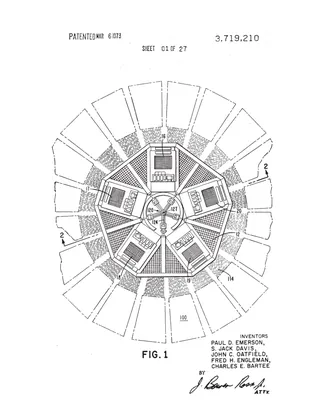
Circular Weaving Apparatus Product and Process, US Patent No. 3719210
Patent · 53 pages
US Patent 3,719,210 (granted March 6, 1973; Emerson et al., assigned to Monsanto) describes a circular weaving machine and the process for making thick-walled, integrally woven, three-dimensionally shaped fabrics on a mandrel. Several Jacquard heads form warp sheds around a vertical axis while filling yarn inserters travel around the mandrel and the mandrel is raised at the rate of weaving. The fabric can be a cylinder, a cone, or an irregular shape such as an airplane wing or boat hull. The patent has 27 sheets of drawings (77 figures) covering mechanical assemblies, mandrel shapes, hydraulic and electrical control circuits, and diagrams of warp and filling yarn arrangements, followed by the specification and 69 claims.
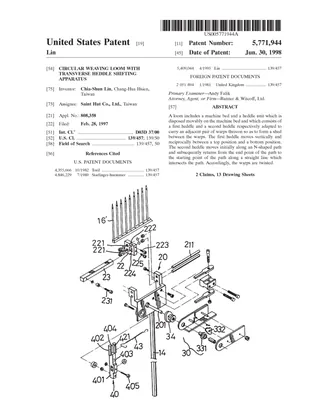
Circular Weaving Loom with Transverse Heddle Shifting Apparatus, US Patent No. 5771944
Patent · 9 pages
US Patent 5,771,944 (Lin, granted 30 June 1998) describes a circular weaving loom in which one heddle moves vertically while a second heddle follows an N-shaped path driven by a cam, ratchet, pawl and swing-arm assembly. The movement twists the warps around the wefts to give a thicker, stronger leno-type cloth. The scan holds the USPTO database printout (abstract, claims, description) and the patent drawing sheets, including prior-art figures and an exploded view of the driving assembly.
698 documents found