Textile Documents › Authors › Author: Faber Birren
3 documents found
Sort: 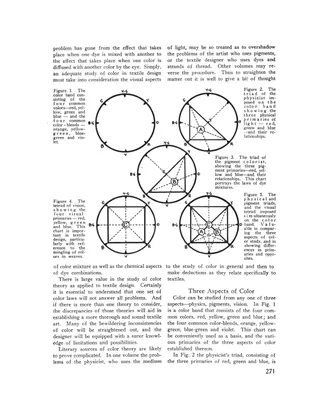
Practical Side of Color Theory Applied to Textile Design
Article · 4 pages
First of three articles by Faber Birren on color theory for textile designers. It argues that woven threads of different colors blend visually in the eye rather than chemically as dyes do, so yellow and blue threads give gray, not green. It compares three color systems (the physicist's light triad, the pigment triad and the visual tetrad) with five diagrams, and uses a black-and-white figure to show how diffusion reduces contrast. It ends with a summary: isolated large areas can use opposing colors for force, while closely woven threads work best in analogous colors.
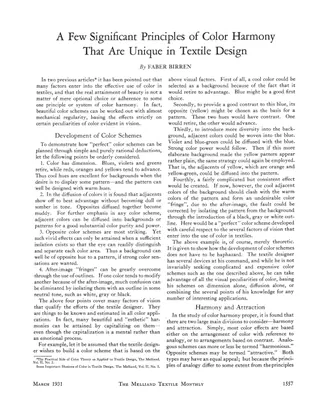
Significant Principles of Color Harmony That Are Unique in Textile Design
Article · 4 pages
Faber Birren's article for The Melliand Textile Monthly sets out principles of color harmony for textile designers. It describes how color dimension, diffusion, opposites and after-image outlines can be used to plan color schemes. It then divides harmony into analogies (of tone, of colors, of a dominant color) and attraction (contrast of brightness, purity and colors), illustrated with a circular color chart showing eight hues of equal gray tone. The scan also includes a page from an unrelated technical article describing the eriometer, a diffraction instrument for measuring wool fiber diameter.
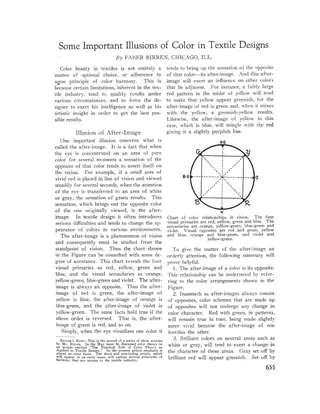
Some Important Illusions of Color in Textile Design
Article · 3 pages
An article by Faber Birren, the second of three on color in textile design, explaining optical illusions that affect how colors look in woven and printed fabrics. It covers the after-image (the opposite color the eye generates), how it shifts adjacent colors, and fixes such as adjusting dye tones or outlining color areas. It also discusses advancing and retreating colors, the effect of dull backgrounds on pure colors, and the diffusion of analogous colors in woven threads, including changeable silks, to gain brilliance or achieve harmony.