Peasant Art of Central Europe
Sample pages
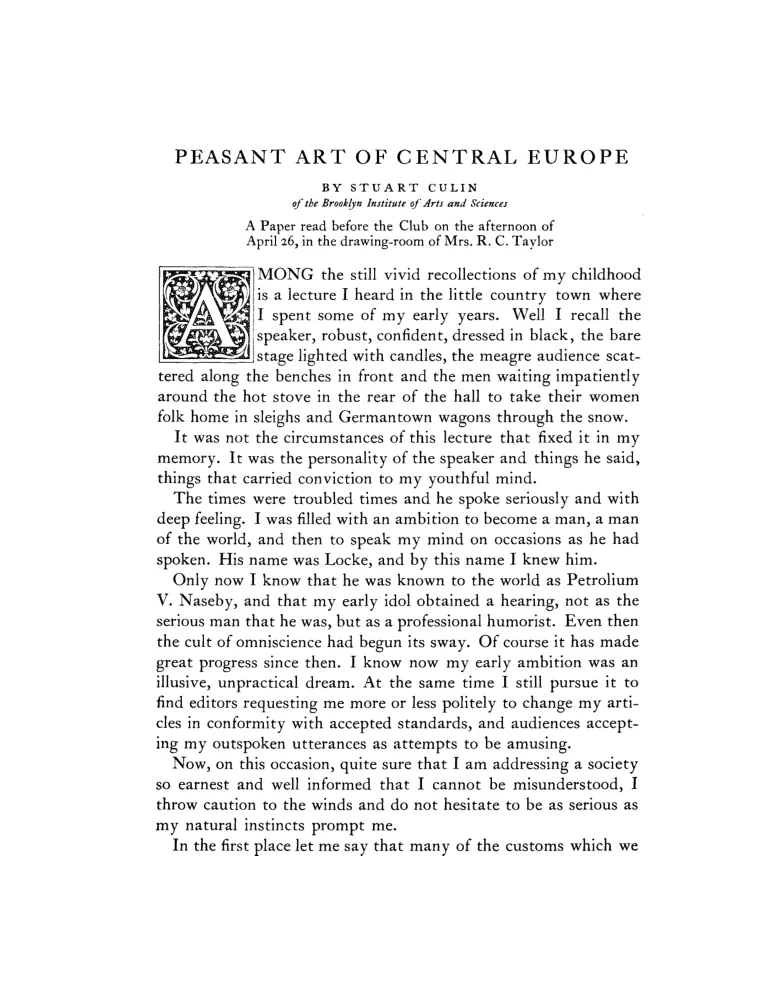
Page 1, at reduced quality. Open the document to read every page in full.
A paper by Stuart Culin of the Brooklyn Institute of Arts and Sciences, read before the Needle and Bobbin Club in April, on peasant embroidery and lace making in Czechoslovakia, Hungary, Austria, Serbia and Romania. He describes how government bureaus and private societies (the Zadruha in Prague, the Isabella in Pressburg, the Albina in Bucharest) tried to sustain these home industries after modernization and the First World War. He also discusses pattern books, the old women who draw designs freehand onto linen, a market fair at Tyrnau in Slovakia, and his view that many patterns derive from Turkish, Persian and Indian sources and from the upper classes.
- Type
- Article
- Date
- 1921
- Language
- English
- Pages
- 7
(A free account is all you need)
From Ralph Griswold's Digital Archive, delivered by the University of Arizona.
Have missing pages or a better copy of this document, or another document to share? Contributing documents »