Textile Documents › Publications › Publication: Meyers Konversations-Lexikon
12 documents found
Sort: 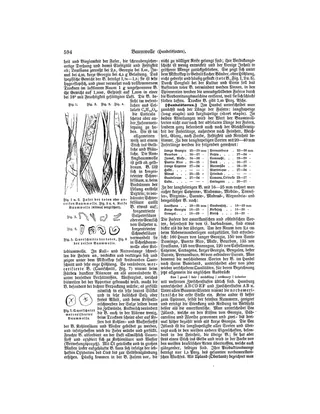
Baumwolle [Cotton]
Article · 6 pages · German
A German encyclopedia article on cotton from Meyers Konversations-Lexikon (5th edition). It covers the botany of the genus Gossypium, cultivation regions and methods, harvesting and ginning, fiber structure and chemistry, and commercial grades by staple length and origin. It also gives a history of the cotton industry from antiquity to the 1890s, with statistical tables on production, consumption, spindles and looms by country, and a bibliography.
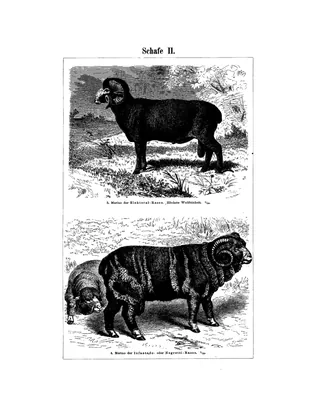
Schaf [Sheep]
Article · 9 pages · German
Encyclopedia article on the sheep from Meyers Konversations-Lexikon (5th edition). It covers wild sheep species, the domestic sheep's anatomy, teeth and breeding data, and a survey of breeds: non-European, European, merino and English breeds. It also covers sheep husbandry, feeding tables, fattening, washing and shearing of wool, diseases, and the decline of German sheep breeding, with a bibliography. Two plates show a heath sheep, a Leicester, and Electoral and Negretti merinos.
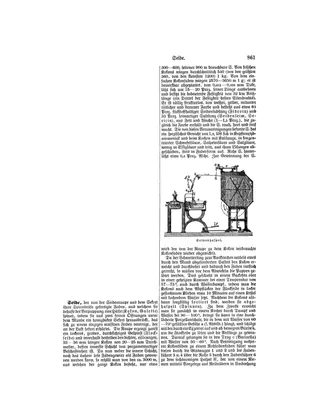
Seide [Silk]
Article · 4 pages · German
A four-page German encyclopedia article on silk from Meyers Konversations-Lexikon (pp. 861-864). It covers the properties of the cocoon thread, killing the pupae, reeling raw silk on the Seidenhaspel, throwing (twisting) into organsine, tram, and other thread types, degumming, bleaching, and titering by denier. It also treats spun silk from waste (floret, bourrette) and wild silks (tussah and others), and gives a history of sericulture from China to Europe, 1890s production and trade statistics by country, and a bibliography.
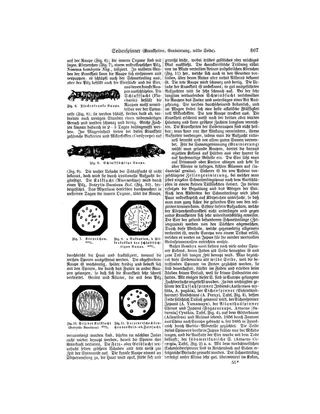
Seidenspinner [Silk Moths]
Article · 4 pages · German
Encyclopedia article on silk moths (Seidenspinner) from Meyers Konversations-Lexikon, covering the mulberry silkworm Bombyx mori: its appearance, life cycle, spinning glands and cocoon formation. It describes silkworm rearing (egg incubation, feeding, bed changing, spinning huts, cocoon collection), the main diseases (pébrine, flacherie, muscardine, jaundice, wasting), and egg production including Pasteur's cell grainage. It ends with wild silk moths (tussah, oak, ailanthus silk moths) and a bibliography of German, French and Austrian sericulture literature.
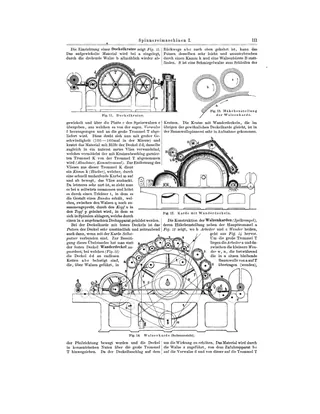
Spinnen [Spinning]
Article · 12 pages · German
Encyclopedia article "Spinnen" from Meyers Konversations-Lexikon (1897), with two accompanying plates on spinning-mill machinery. It covers hand spinning with the distaff and drop spindle, the hand wheel and treadle wheel, and then mechanical spinning. The machine section follows the fiber through each stage: openers and wolves, scutchers and batteurs, carding, combing, drawing frames, roving frames and fine spinning on the water frame, ring frame and mule or selfactor. It also covers spinning of flax, tow, jute, wool and silk waste. Many engraved figures illustrate the machines.
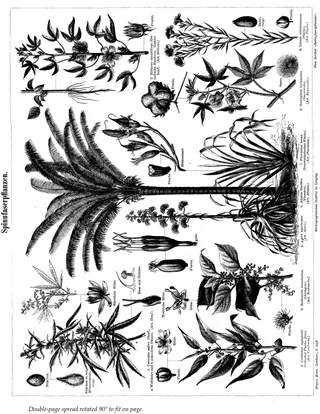
Spinnfaser [Textile Fibers]
Article · 3 pages · German
A German encyclopedia article on spinning fibers (Spinnfasern) from Meyers Konversations-Lexikon, 8th edition. It defines plant and animal fibers suitable for yarn and cloth, compares their properties (hygroscopy, strength, cellulose content, burning behavior, chemical tests), and lists the major fiber-yielding plant families and species. A full-page plate illustrates nine fiber plants including hemp, jute, ramie, agave, piassava, New Zealand flax, cotton and flax, and the article ends with references to Royle, Wiesner and Richard.
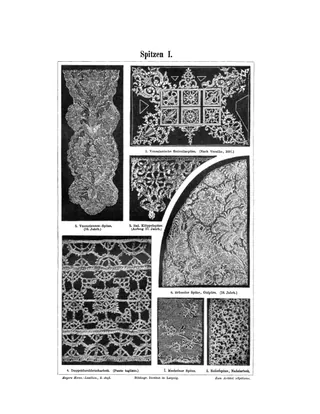
Spitzen [Lace]
Article · 4 pages · German
Encyclopedia article on lace from Meyers Konversations-Lexikon (5th ed.), with two plates of lace samples. It defines lace and distinguishes guipure from ground (réseau) lace, and needle lace from bobbin lace. It describes the bobbin lace pillow, pricked pattern and bobbins, machine lace and Jacquard-equipped bobbin machines, and gives a history by region (Italy, France, Belgium, the Erzgebirge, England). It closes with a bibliography of lace histories and pattern books.
Stickerei [Embroidery]
Article · 2 pages · German
A two-page German encyclopedia entry on embroidery (Stickerei) from Meyers Konversations-Lexikon. It outlines the history of the art from China, the ancient Jews and Egyptians, Assyrians, Greeks and Romans through medieval convent work and the decline after the 14th century. It describes techniques and stitches (cross stitch, petit point, satin stitch, chain stitch, white embroidery, gold embroidery, bead embroidery, tambour work) and the centers of machine embroidery in Plauen. It ends with a bibliography of pattern books and literature from 1604 to 1896.
Stickmaschine [Embroidery Machine]
Article · 3 pages · German
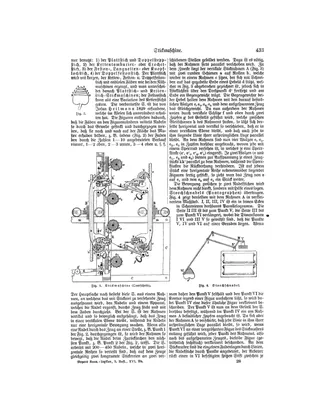
Encyclopedia article from Meyers Konversations-Lexikon describing the embroidery machine (Stickmaschine), used to sew patterns into fabric. It covers the stitches used in machine embroidery, the Heilmann machine of 1829 with its vertical frame, double-pointed needles and gripper carriages, and the pantograph (Storchschnabel) that transfers reduced pattern movements to the frame. It also explains the Voigt festoon apparatus of 1864 and the single-needle chain-stitch machines such as Bonnaz's, used for tulle and curtain embroidery.
Weben [Weaving]
Article · 6 pages · German
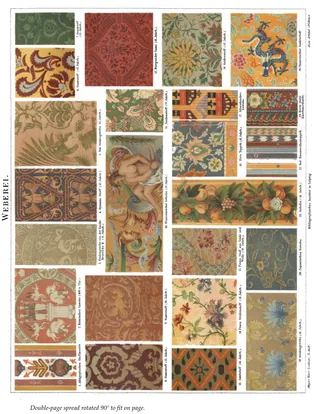
Encyclopedia article on weaving from the 5th edition of Meyers Konversations-Lexikon. It explains the principles of the loom: warp and weft, shed formation, shafts and treadles, reed, take-up and warp beam. It covers the means of pattern weaving (shaft machine, Jacquard harness, brocade, double cloth, gauze, pile fabrics, hollow weaves), power looms versus hand looms, and warp preparation (winding, warping, beaming, sizing, drawing-in). A historical section traces weaving from prehistoric finds through Egypt, Greece, Rome, Byzantium and the Orient to European medieval and later production and the invention of the power loom, with a bibliography of German textbooks. A plate shows 24 historical fabrics.
Webstühle [Looms]
Article · 6 pages · German
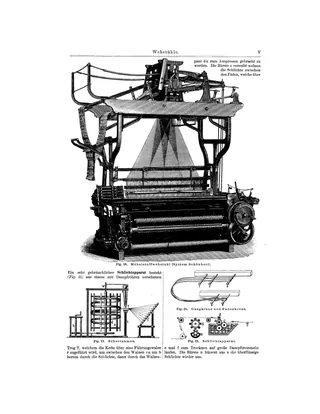
A German encyclopedia supplement article on looms from Meyers Konversations-Lexikon (5th ed.), with numbered figures. It describes the simple hand loom and its parts (warp and cloth beams, heddle shafts, treadles, shuttles, reed, batten, temple), a modern hand loom, the dobby (Schaftmaschine), and the Jacquard machine. It also covers gauze and pile weaving, the power loom with an elaborate upholstery-fabric example from Schönherr of Chemnitz, warping frames, sizing and drying machines, and Jacquard card cutting and punching machines.
Wolle [Wool]
Article · 4 pages · German
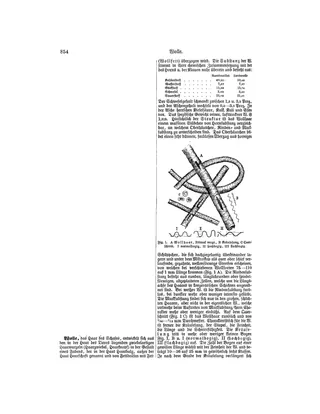
Encyclopedia article on wool from Meyers Konversations-Lexikon (1897), in German. It covers the chemical composition and microscopic structure of the wool fibre, crimp, fineness, length, strength, elasticity, colour and moisture, and the differences between breeds such as Merino, Electoral, Negretti and German landrace. It then distinguishes carding (Streichwolle) from combing (Kammwolle) wool, and describes shearing, washing on the sheep and factory scouring, including Mehl's wool washing machine. It closes with a short history of the wool trade, production and import statistics, by-products such as lanolin, and a bibliography.
12 documents found